



Abstract
In the current manuscript, the aim of the study is to analyze the Eyring-Powell nanofluid flow under the influence of chemical reaction and radiation effects in a slender cylinder in the presence of a non-linear heat source/sink. The flow of Eyring-Powell nanofluid through a slender cylinder along with chemical reaction and MHD effect is not studied yet. Which is the novelty of current research work. Flow analysis is taken near the stagnation point. MHD effect is considered for controlling turbulence. Rosseland model is applied for the estimation of heat flux. The governing system of PDE’S is converted into highly nonlinear ODE’S by utilizing suitable similarity transformations along with the boundary conditions. The resulting coupled systems of nonlinear ordinary differential equations (ODE), accompanied by boundary conditions, are solved using the powerful bvp4c method in MATLAB software. The physical significance of evolved parameters is investigated by graphs and tables. Nusselt number and skin friction are analyzed for several parameters. It is observed that the increase in the MHD effect rises the velocity but lessens the temperature profile and the concentration of the fluid declines when the chemical reaction parameter is incremented. The specific application of the study is that the Eyring-Powell is used in a variety of industrial applications, including lubrication, plastics processing, and oil drilling.
Keywords
Introduction
Magneto hydrodynamic (MHD) contains a fluid, a magnet, and a field that collectively analyze the development of gadgets. MHD flow has several practical and hypothetical investigations due to their industrial applications. Because of several manufacturing applications like electric propulsion, aircraft formation, and cooling of nuclear reactors. MHD is a vigorous area of interest in biological engineering. Malik et al. 1 investigate that the blood behaves like an electric conductor containing hemoglobin in the iron molecules. In comparison to plate geometry, the magnitude of skin friction and the rate of heat transmission are much higher for cylindrical surfaces. Sheikholeslami, 2 examined the MHD two-phase nanofluid flow in a permeable medium, and numerical results were presented using a computer technique. Using CVFEM, a macroscopical simulation of the effects of magnetic forces on alumina convective flow in a permeable cavity is performed. Rehman et al. 3 discussed the MHD stopping point flow of Nano-particles over a stretching surface. Many researchers have worked on MHD second-grade nanofluid flow via several geometries with boundary layer flows.4–9
The colloidal suspension of particles with a size less than 100 nm is classified as nanofluids. In industries, nanofluids play an imperative role to enhance heat transfer rates. Thermal conductivity and heat transfer are widely used in the development of energy-saving devices. Regular fluids like oil and water with lower thermal conductivity are not more efficient. Fluids with higher heat transfer rates are needed to meet the requirement of the world. Sus 10 analyzed nanoparticles magnifying the heat conduction rate. In manufacturing industries, the formation of microchips and in nuclear reactors nanofluids and chemical reactions in Casson fluid are extensively used to magnify the heat flux.4,5,11,12 Nadeem et al. 13 examined an innovative class of nanofluids and deduced that their structure may be tabular or rod-like. Parmar and Jain 14 studied that cancer treatment can be done by the nanoparticles of gold rather than conventional drugs. Many researchers have worked on nanofluids.15,16 Patil et al. 17 studied the slipperation of thermal and flow speed impacts on the natural convective two-phase nanofluid model. The influence of Darcy law over nanofluids with Lorentz forces in a porous medium was evaluated by Sheikholeslami et al. 18 Rashidi et al. 16 studied the combined effects of nanoparticles with base fluids to enhance heat conduction. The combined thermal system’s thermal efficiency is significantly impacted by the geometrical characteristics of coil wires.
Heat transfer and chemical reaction collectively play a significant role in many processes. Such kinds of problems have extensive applications like as the destruction of crops because of freezing, hot rolling, polymer industries, and swirling of fibers. Kumar et al. 19 analyzed the micropolar fluid flow over a surface with a chemical reaction in a porous medium. The chemical reaction attribute has a proclivity to manage the concentration profile was investigated by Reddy et al. 20 MHD (second order) incompressible fluid flow on a sheet with chemical reaction was analyzed by Khan et al. 21
The flows near the stagnation point are referred to as stagnation point flows. In the present era, stopping point flows have attained the interest of researchers due to significant rules in industrial areas. Mehmood et al. 22 investigated the Casson fluid’s stopping point flow across a stretching body. Rehman et al. 23 analyzed the stopping point flow of a second-grade fluid across an exponentially stretching surface. Rehman et al. 24 studied the stopping point flow of nanofluids suspended in a porous medium. Nadeem et al. 25 analyzed the oscillating stopping flow of nanofluids for different geometries. Specific practical applications of this study are that it is commonly used to model the behavior of certain materials, such as polymers, molten plastics, and lubricants. It is a viscoplastic fluid, which means that it exhibits both solid-like and liquid-like behavior depending on the applied stress or strain rate. The Eyring-Powell fluid exhibits a yield stress, which means that it behaves like a solid until the applied stress exceeds the yield stress. Once the yield stress is exceeded, the material begins to flow, and its viscosity decreases with increasing shear rate. The plastic viscosity of the Eyring-Powell fluid is related to the activation energy required to initiate flow, and it can be used to predict the flow behavior of the material under different conditions. The Eyring-Powell fluid is used in a variety of industrial applications, including lubrication, plastics processing, and oil drilling. Its ability to model the behavior of complex fluids has made it a valuable tool in materials science and engineering.
It is a known fact that non-Newtonian fluids conferred a distinctive task to scientists and engineers. Blood, jelly, ketchup, etc. are non-Newtonian fluids. Abdelsalam et al. 26 analyzed that non-Newtonian fluids are more complex in various stages than physical fluids. Blood comprises many suspensions including, proteins, nutrients, leukocytes, gases, etc. Non-Newtonian fluids can’t be studied by linear relations due to their nonlinear behavior. Various models have been proposed to analyze these fluids, like the Eyring-Powell fluid model, Casson, and Jeffery fluid model. Various scientists examined these fluid models.27–29 Khan et al.30–32 examined how a second-grade fluid flowed in a thin film across a stretching sheet. Powel and Eyring first proposed the Powel-Eyring fluid model in 1944. Powel-Eyring fluids have a significant role in controlling environmental pollution, formulation of Anti-fog devices, etc. Nadeem and Rehman 33 considered the Powel-Eyring nanofluid flow in a moving cylinder. Sher Akbar et al. 34 examined MHD Powel-Eyring fluid and concluded for higher intensity resistance to flow increases. Salawu et al. 35 examined the nonlinear solar thermal radiation optimization for hybrid Prandtl–Eyring nano liquid in aircraft. Humane et al. 36 examined the magneto-micropolar fluid’s thermal convection using a porous stretching apparatus. Shamshuddin and Prakash Sharma 37 studied the thermal elaboration of ethylene glycol-based nanostructures via a heated vertical surface. In this particular study, the rheological aspects of magneto Nano liquid movement in a uniformly vertically porous sheet are investigated.
Literature shows that MHD non-Newtonian flow with chemical reaction and the nonlinear source is not studied yet. The purpose of this analysis is to investigate the MHD and chemical effects on Powell-Eyring fluid in the presence of a non-linear source\sink.
Mathematical problem formulation
We analyze the stagnation point flow of Eyring-Powell flow in a slender cylinder. The velocity is assumed to be independent of the circumferential component but depends upon


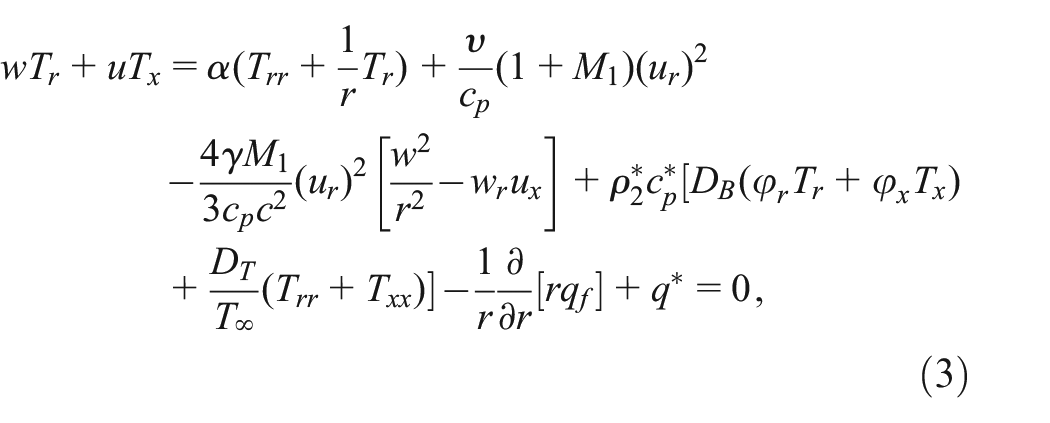

Where the Rosseland model radiative heat flux


So

Here

The boundary conditions are,


Geometry of the problem
Two-dimension, incompressible, and steady-state Eyring-Powell flow in the presence of a boundary layer approximation theory is studied (Figure 1).

Flow geometry.
Similarity transformation
Utilizing appropriate similarity transformations 39 :


The PDE’s (1)–(4) are transformed into an ODE’s using transformations (9) and (10) as 3 :

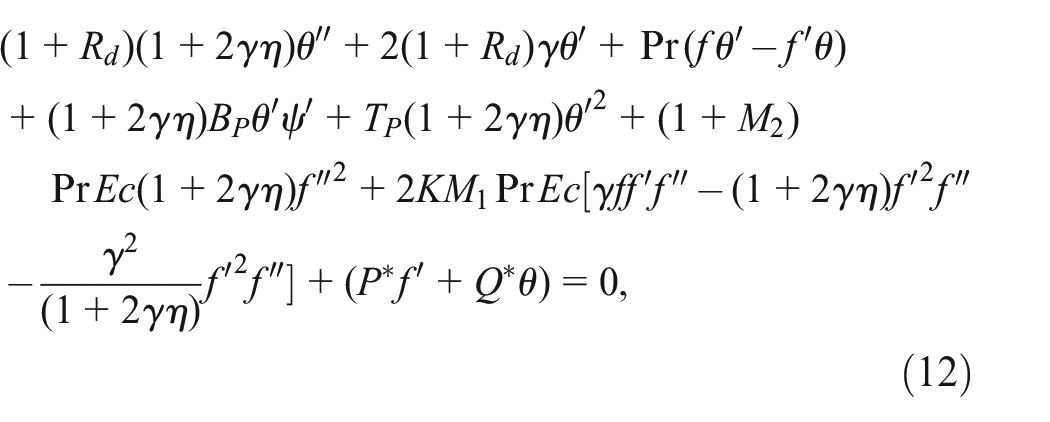

Where curvature parameter is
Dimensionless boundary conditions are as




In
Numerical procedure
Equations (11)–(13) with conditions (14–16) are highly nonlinear and be numerically solved by the faithful technique bvp4c of MATLAB. Regardless, we convert the administering issue into an arrangement in the governing system is substituted as follows:


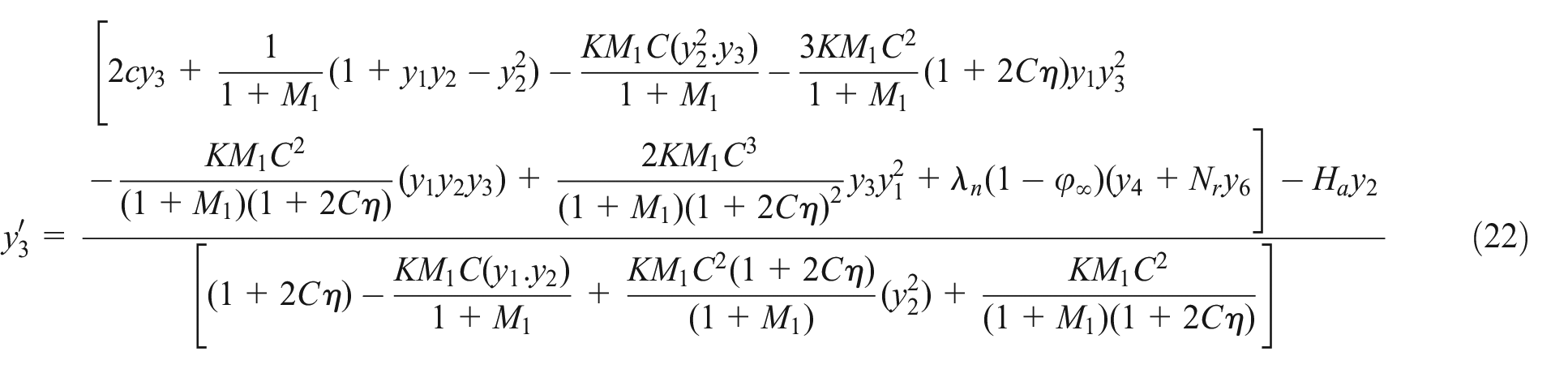
Hence the equivalent first-order system is given below:


The following section presents the solution’s numerical results.
Numerical results and discussion
The major goal is to examine the effects of various parameters on the profiles of fluid velocity, temperature, and concentration. Graphs and tables show how these parameters effects on fluid flow.
Velocity profile
The impact of several parameters on the flow is shown in Figures 2 to 5. The influence of

Fluid parameter effects on velocity.

Curvature’s effect on velocity.

Buoyancy parameter effects on velocity.

Prandtl number effects on velocity.
Temperature profile
Figures 6 to 9 shows how several parameters affect temperature. The thickness of the thermal boundary layer and temperature profile both decrease as the Prandtl number increases, as seen in Figure 6. This demonstrates the concept that as thermal diffusivity increases, less energy can be transferred, which results in a decrease in the thermal boundary layer and temperature. In Figure 7, which is a sketched analysis of the consequence of curvature on temperature profile, it is shown that as curvature increases, heat conduction rate decreases, which increases temperature behavior. As the buoyancy parameter increases, the temperature rises as shown in Figure 8. Temperature increases with the increase in

Temperature profile for several values of

Temperature profile for several values of

Temperature profile for several value of

Temperature profile for several values of
Concentration profile
Figures 10 to 13 are sketched to examine the influence of several parameters over the concentration. Figure 10 shows by enhancing the thermophoresis parameter concentration increase because the particles of nanofluid travels far away from the hotter surface to the cold. A thermophoretic force causes the nanoparticles to move toward areas of greater or lower temperature when there is a temperature disparity in the nanofluid. Prandtl number increment raises the concentration of the nanofluid is depicted in Figure 11.
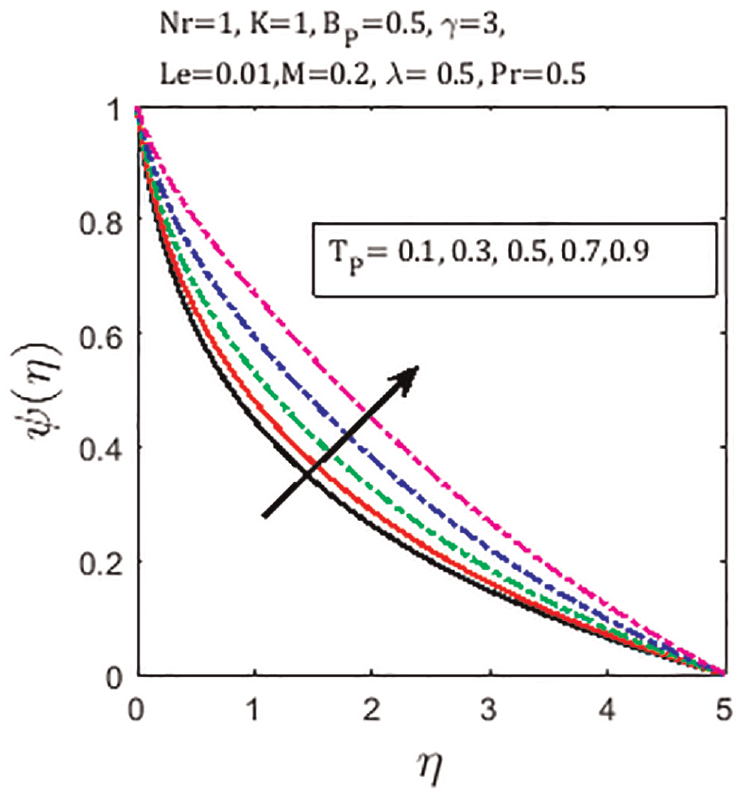
Concentration profile for several value of

Concentration profile for several value of Pr.

Concentration profile for several value of

Concentration profile for several value of
Figure 12 is a piece of good evidence that increase
Impact of MHD
Figure 14 analyzes the influence of magnetic parameter over the velocity profile and numerical results shows the increase in velocity with the rise in magnetic parameter. MHD increases the movements of nanoparticles which causes in rise of Lorentz forces and resulting the enhancement of velocity. Figure 15 shows the impact of MHD over temperature profile and depicts that with increase in magnetic parameter temperature decreases.

MHD’s influence over velocity profile.

MHD’s influence over temperature profile.
Table 1 is formulated to compare the results of previous researches for several values of
Comparison of numerical approximations

Numerical values for Nusselt number against several parameters.

Concluding remarks
We analyzed the numerical results by considering MHD, non-linear heat source/sink, and chemical reaction. Flow analysis is made through a vertical cylinder. The following results are worth citing:
Increase in MHD effect rises the velocity but lessens the temperature profile because when the MHD effect is increased, it accelerates the fluid motion, leading to higher velocities. At the same time, the dissipation of kinetic energy caused by the Lorentz forces reduces the fluid temperature, resulting in a lower temperature profile.
Temperature profile increases or decreases with the positive or negative values
Concentration of the fluid declines when the chemical reaction parameter is incremented because as the reaction rate increases, the consumption of reactants becomes more efficient, causing their concentrations to decrease.
Skin friction should be lowered when the unsteady parameter is incremented. The magnitude of skin friction is influenced by various factors, including the flow velocity, viscosity of the fluid, and the characteristics of the boundary layer.
Nusselt number quickly mounted by enlarging the unsteady parameter which results in maximum heat transfer rate.
Footnotes
Appendix
Handling Editor: Chenhui Liang
Declaration of conflicting interests
The author(s) declared no potential conflicts of interest with respect to the research, authorship, and/or publication of this article.
Funding
The author(s) received no financial support for the research, authorship, and/or publication of this article.
