




Abstract
Accidents and fires in tunnels hinder traffic and threaten the safety of personal and material resources, moreover, impact and temperature effects often cause damage to structures, affect structural performance, and shorten the service life of structures. In this article, the response behavior of the tunnel lining under the action of vehicle impact and fire load is simulated and analyzed. As the failure criterion of the lining dome settlement and the sidewall convergence displacement, the system compares the two interaction effect of the load, namely, the influence of the fire load on the impact resistance of the lining and the influence of the impact load on its fire resistance. The results show that the fire load reduces the impact resistance of the lining. Compared with the initial static load, the impact of temperature on the impact resistance is more significant; the impact load has an adverse effect on the fire resistance of the lining, when the tunnel lining is subject to explosion first. After the impact load working on the fire, the fire resistance of the lining will be significantly reduced with the increase of the static load ratio and the dynamic load ratio. The research can provide the reference for the design of fire protection and explosion protection parameters of tunnel support structures.
With the continuous development of underground space, more and more tunnels and underground projects have been put into operation and construction. China has become the country with the largest and longest road tunnel in the world. Concomitant tunnel vehicles and fire accidents occur from time to time, causing serious social and economic losses. Tunnel fire accidents are often accompanied by car accidents. Fire, which can last a long time in the tunnel, causes temperature rising rapidly and unevenly distributed in tunnel sections. This result is considered to be related with the closure property of the tunnel. The expansion of lining concrete at high temperatures and redistribution of internal forces often lead to different degrees of damage in each section. In addition, the impact on the lining when the vehicle is hitting can easily damage or even collapse the overall structure of the tunnel, which will seriously threaten people’s lives and property. Therefore, it is necessary to study the fire resistance and impact resistance of the tunnel.
The predecessors have done more research on the behavior of structural responses under impact loads and fire loads alone. Sehrefler et al. 1 analyzed the thermal and mechanical coupling reaction of concrete structures at high temperatures, and established a nonlinear relationship to predict the behavior and burst probability of concrete structures under fire conditions. Z Yan and Z Hehua 2 carried out experimental research on the high temperature mechanical behavior and fire resistance of tunnel lining structure fire, and presented the temperature–time curve and spatial distribution of temperature distribution of the tunnel lining under fire. Z Chaojiao 3 discussed the steady-state and transient response problems of cylindrical tunnels in elastic soil under axial impact loads based on wave propagation theory. Z Yuetang et al. 4 proposed numerical methods to construct a weak layer in the joint area of the implosion face frame wall and the lining to reduce the excessive tensile stress caused by the impact load.
In recent years, scholars at home and abroad have begun to pay more and more attention to the performance and response analysis of structures under the joint action of explosion and fire loads. Izzuddin et al. 5 proposed a self-adaptive numerical analysis method for the nonlinear analysis of the frame subjected to explosion and fire loads and analyzed the effect of blast loading on the fire resistance of the structure; Liew and Yu6,7 analyzed the frame structure of local impact by explosion load and caused fire by using the hybrid element method, and explained the influence of explosion load on the fire resistance of multi-layer frame structure; Fang et al. 8 analyzed the influence of blast loading on the fire resistance of steel beams. In this article, the dynamic response of lining concrete structures under impact and fire loads is studied to determine the failure criterion of tunnel lining in two cases where the order of fire and impact loads is different. The effects of static load, temperature, and impact load on its impact resistance and fire resistance were analyzed when the tunnel lining was subjected to fire and impact loads. The conclusions can provide the reference for tunnel fire protection design.
Constitutive model of lining concrete material
For lining concrete structures, it is necessary to determine the failure criterion by combining the requirements of the tunnel and considering the factors such as the cumulative failure of the material. Concrete is a strain rate and temperature sensitive material, so the constitutive parameters related to temperature and strain rate must be used in the simulation analysis.
Lining concrete constitutive model considering temperature effect
Temperature has a significant effect on the constitutive relationship of concrete. With high temperature, the yield strength and elastic modulus of the material will decrease while the temperature increases. In this article, the modulus of elasticity and yield strength of concrete are determined by the reduction coefficient of concrete material properties at different temperatures. The European Concrete Association summarizes the experimental results of various countries and recommends the following formula to calculate the reduction coefficient of concrete compressive strength 9

where T is the temperature and Kc is the compressive strength reduction factor.
As with the strength of concrete, the ratio of the modulus of elasticity of a concrete in the hot state to the modulus of elasticity at normal temperature is defined as the elastic modulus reduction factor, expressed as KCE, and the change in value with temperature is shown in Table 1.
Coefficient of elastic modulus reduction at high temperature of concrete. 9

It is assumed that the elastic modulus and yield stress of concrete at room temperature (T = 20°C) are E and
Constitutive model of lining concrete subjected to blast loading
For the dynamic behavior of lining concrete subjected to impact and explosion, the strain rate effect cannot be ignored. Many scholars have studied the strain rate effect of concrete. The most commonly used expression method is the use of dynamic increasing coefficient DIF 10 (Dynamic Increase Factor)

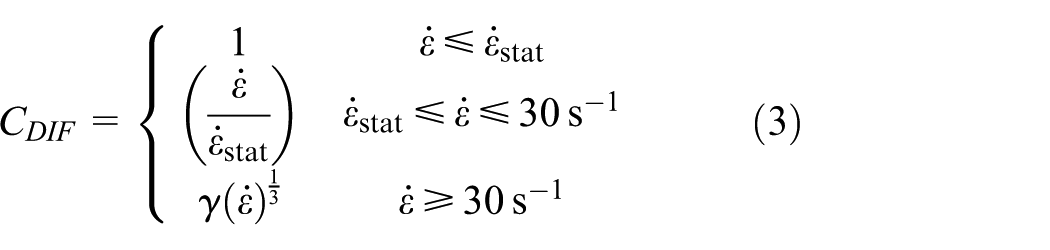
where
Finite element model of lining under explosion and fire
When calculating the response of the tunnel lining to the effect of fire and impact loads, the whole process has been divided into three load steps, as we take the sequence of fire and impact loads into consideration. The first load step applies the gravity balance, and then the second and third load steps apply the impact load and the fire load successively according to the order of the lining fire and the impact load. Impact loads are pulsed (Figure 1):

The pulse load.
The finite element (FE) calculation makes the following assumptions:
The heat conductivity of concrete in all directions is the same, and it is isotropic material.
There is no heat source in concrete.
Considering that the temperature does not change in a certain range along the tunnel axis, the tunnel structure is simplified to two-dimensional heat conduction.
Because the volume of reinforcement in lining concrete is very small, the influence of reinforcement is neglected in calculation.
At the beginning of the heat conduction process, the temperature of the object participating in the heat conduction in the calculation domain is uniform, which is set at 20°C.
The explosion of concrete at high temperature during fire is not considered.
The finite element software ABAQUS was used to simulate the dynamic response and mutual influence of the tunnel lining under the combined action of fire and impact loads. A plane strain model was established to simulate the on-site conditions. The ideal elastic–plastic constitutive model was used in the FE calculation (shown in Figure 2), and elastic support was chosen as the boundary condition to simulate the interaction between lining and surrounding rock. Meanwhile mesh convergence study was carried out for the convergence of the mesh is closely related to the size of the element. The number of units was set to 90, which has better calculation accuracy, efficiency, and better convergence.

Ideal elastic–plastic constitutive model.
The cross section of the tunnel is four-center circle, with the net width 14 m, the net height 7.4 m, and the thickness of the lining is 50 cm. The FE analysis was performed using a beam 31 unit and the lining cross section is rectangular, with a = 1 m, and b = 0.5 m( shown in Figure 3). The fire load and impact load were uniformly applied to the entire lining structure, which means on all elements.

FE model and lining section size.
The temperature rise process of the surrounding environment under fire uses the ISO834 standard temperature rise curve recommended by the International Organization for Standardization (ISO) (shown in Figure 4).

ISO834 standard temperature–time curve.
Its expression is as follows

where Tt is the time-dependent temperature and t is the time of the fire load.
When the lining structure is subjected to the explosion load after being fired first, and the lining structure is subjected to the fire temperature Tt, then the aging time of the lining structure is the time t when the standard heating curve is heated to Tt; when the lining structure is first subjected to an explosion load and after the impact, the fire load was applied according to the standard temperature–time heating curve for a total of 120 min. According to the failure criterion of the lining structure, the temperature at which the load limit state is reached is defined as the critical temperature Tcr.
The applied blast load is an ideal rectangular pulsed load, and the impulse load amplitude is P, and the duration is t0 and the impulse
Criterion of failure of tunnel lining under explosion and fire loads
It is generally believed that when the structure loses its stability or reaches a deformation that is not suitable for continued loading, the structure is considered to have reached its ultimate load bearing state. The tunnel lining will have different degrees of damage under the action of fire load and explosion impact load. With the effect of external loads, the material starts to accumulate, and the original defects continue to develop, as well as new internal defects occur. During this process, some local shear bands are formed, and the damage accumulates to a certain extent, which means the material fails. This article considers the impact of concrete’s cumulative damage on its carrying capacity. When the damage accumulates to a certain extent, sudden component failure or sudden collapse of the structure will occur. When the numerical analysis considers the concrete cumulative damage energy, the real situation can be accurately reflected. According to Shen,
11
the plastic ultimate compressive strain at failure of concrete is defined as
Taking into account the above factors, under the joint action of explosion and fire load, one of the following situations is considered that the tunnel lining structure has reached the limit state of its bearing and used as its failure criterion. (1) The displacement of the dome exceeds ±h/60; (2) the convergence of the side wall reaches ± L/30; (3) when the damage is accumulated seriously, the lining concrete cracks in a large area or the entire lining structure suddenly collapses.
Calculation result analysis
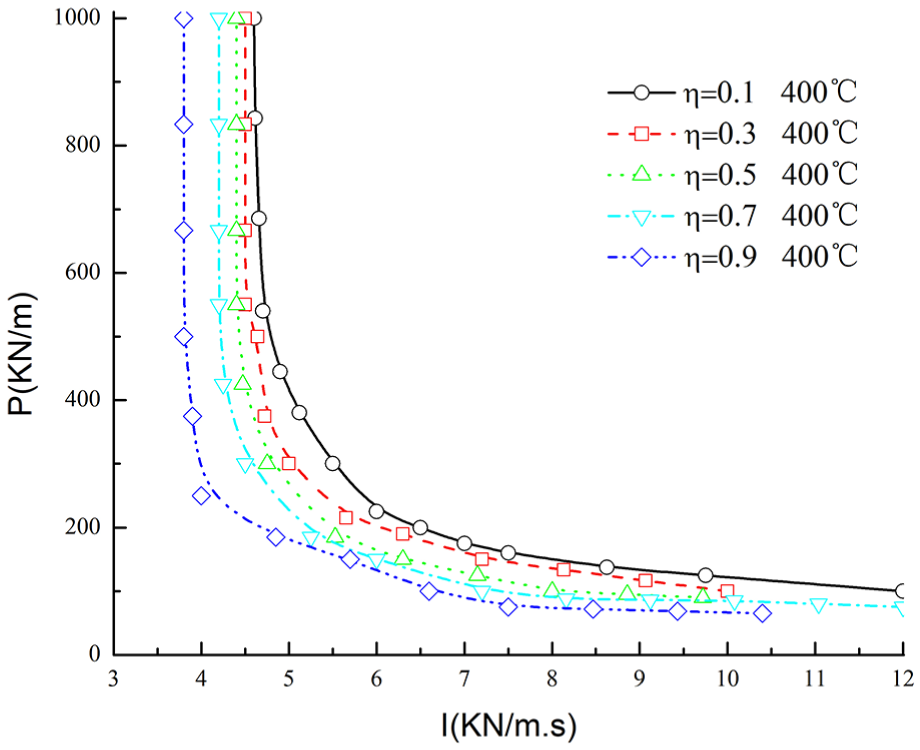
It is well known that the lower left area of the figure
Tunnel lining diagram P—I when fire and explosion loads act successively
From Figures 5 and 6, as the static load ratio increases, the area of the safety zone in the lower left part of the figure gradually decreases. As the temperature increases, the impact resistance of the tunnel lining is significantly reduced, and the effect of temperature on the impact resistance of the tunnel lining is much greater than the initial static load.
The

The
According to the failure criterion in the “Criterion of failure of tunnel lining under explosion and fire loads” section, the explosion situation in the cave is determined. As shown in Figures 7 and 8, after the explosion load in the cave, the critical temperature can be reduced by more than 220°C under the premise that the tunnel lining does not reach its bearing limit. Therefore, the impact of the explosion load on its fire resistance cannot be ignored. If the tunnel lining has reached its bearing limit after the blast load alone acts, it is meaningless to consider the impact of the blast load on its fire resistance. Therefore, on the basis of determining the impact resistance of the tunnel lining under the action of the blast load alone, the impact of the blast load on its fire resistance performance is discussed.

The Tcr–I diagram of tunnel for various dynamic load ratios.

The Tcr–I diagram of tunnel structural for various static load ratios.
Figure 6 shows the static load ratio; the dynamic load ratio is different. Figure 7 is the same dynamic load ratio. The static load ratio is different from the figure. The lower left area of the picture is the tunnel lining fire resistance performance design of the safety area. The figure shows that with the increase of the dynamic load ratio and the static load ratio, the area in the lower left area of the figure gradually decreases, that is, the fire resistance of the tunnel lining gradually decreases while the dynamic load ratio and the static load ratio increases.
Conclusion
Based on the stability problem of tunnel lining under extreme accidents such as explosion and fire, this article analyzes the structural response characteristics of tunnel lining under impact and fire load, and draws the following conclusions:
Under the combined effect of explosion and fire loads, considering the impact of concrete damage accumulation on the bearing capacity of the tunnel lining structure, one of the following conditions is considered to have reached the limit state of its load, and this is taken as its failure criterion: The top displacement exceeds ± h/60; the side wall convergence reaches ± L/30; when the damage is severely accumulated, the lining concrete cracks over a large area or the entire lining structure suddenly collapses.
The P–I diagram is used to characterize the impact resistance of the tunnel lining when it is subjected to an impact load. The higher temperature of the fire and initial static load, the lower impact resistance of the tunnel lining structure, and effect of the fire temperature on the impact resistance of the tunnel lining are significant.
When the tunnel lining is subjected to a fire after being impacted by a blast load, the Tcr–I diagram is used to characterize the fire resistance of the tunnel lining. With the increase of the static load ratio and the dynamic load ratio, the fire resistance of the tunnel lining will be significantly reduced if there is explosion in the tunnel. Therefore, in the design of tunnel explosion-proof and fire protection, the coupling effect of impact load and fire load must be considered to ensure the maximum safety of tunnel operation.
Footnotes
Acknowledgements
Great appreciation goes to the editorial board and the reviewers of this article.
Handling Editor: Nuno Maia
Declaration of conflicting interests
The author(s) declared no potential conflicts of interest with respect to the research, authorship, and/or publication of this article.
Funding
The author(s) disclosed receipt of the following financial support for the research, authorship, and/or publication of this article: This work was supported by the National Key R&D Program of China (2018YFB1600202), the National Natural Science Foundation of China (51609138), and the natural science foundation of Hebei Province (E2017210147) and Collaborative Innovation Center for Disaster Prevention & Mitigation of large basic infrastructure in Hebei Provence.
