




Abstract
The nominal values of structural design parameters are usually calculated using a traditional deterministic optimization design method. However, owing to the failure of this type of method to consider potential variations in design parameters, the theoretical design results can be far from reality. To address this problem, the specular reflection algorithm, a recent advancement in intelligence optimization, is used in conjunction with a robust design method based on sensitivity. This method not only is able to fully consider the influence of parameter uncertainty on the design results but also has strong applicability. The effectiveness of the proposed method is verified by numerical examples, and the results show that the robust design method can significantly improve the reliability of the structure.
Introduction
With the development of the consumer economy, the manufacturing demand for products has significantly increased. As the “skeleton” of most mechanical equipment, the performance of the metal structure in a product directly affects all aspects of the product. Accordingly, in the design of this metal structure, it is necessary to consider the influence of the manufacturing conditions. Only by doing so is it possible to provide a product that performs correctly in real applications. There are many potential uncertainties that can influence the practical application of mechanical products, including manufacturing process errors, measurement errors, material property variability, and environmental variability. These uncertainties have a significant impact on the performance of a mechanical product, such as its capacity, safety, or reliability. Therefore, the control of these parameters is critical in order to maintain the performance of the product within the desired range and to improve the anti-inference ability of the product by ensuring that its design requirements are not sensitive to these various uncertainties. An advanced modern design methods used to study and improve the performance of metal structures and products that contain them are currently a research topic of significant interest. To improve the quality of engineering products, the robust design, reliability-based design, structure uncertainty propagation method and surrogate model method1–3 have been developed.
Parkinson et al. 4 observed that the optimization problem is the core of robust design, and a key concept of robust design is the transfer of changes in variables and parameters to the design function. The reason for this is that corresponding variations of design parameters will lead to change in the design objective and constraints. Optimization design is a general method that relies upon the optimal design theory, which typically yields the most effective design scheme. Usually, the optimal design result will appear on the boundary of whatever constraints have been identified. In practice, however, owing to the potential variation in parameters, such a design result has a significant likelihood of falling into the infeasible design region; in some cases, the solution obtained by a traditional deterministic optimization design method is neither robust nor reliable. Robust optimal design or reliability optimization design is an effective method of addressing the problem of design parameter uncertainty. 5 As a result, applications of robust optimal design and reliability optimization design are presently of great interest. Salomon et al. 6 proposed the concept of dynamic robust optimization and used an evolutionary algorithm to solve the design problem, yielding numerical results that demonstrated that the proposed method offers significant values in practical applications. Y Wu et al. 7 proposed a robust optimization method based on double substitution model and multi-objective particle clearance optimization algorithm, which reduced the dispersion of fatigue life of welded structures and improved the robustness of the fatigue life. LK Song et al. 8 use artificial neural network to fit multi-response surface function, then the ANN-MRSM mathematical model is established, and the theory is applied to analyze the interaction between deformation and stress of turbine blade and fluid–thermal–structure, which provides a theoretical basis for high-reliability and high-performance design of turbine blades, and enriches the theory of mechanical reliability design. S Xiao et al. 9 used the 6σ design criterion to study the robustness of electromagnetic problems and analyzed a variety of robust design method results. Taking beam structure as a research object, the hierarchical genetic algorithm (GA) is used to conduct lightweight design under specified reliability and buckling constraints, then the influence of uncertainties of random parameters and design variables on critical load coefficient and critical displacement are also studied in António and Hoffbauer. 10 In order to improve the fatigue life and robustness of truck cabs, J Fang et al. 11 proposed a multi-objective optimization method which reduced the sensitivity uncertainty of design. E Shindin et al. 12 summarized the robust optimal method for solving general linear optimization problems with uncertainty parameters. Fang et al. 13 adopt multi-objective robust design optimization method to study the design of foam-filled structure, which can improve the robustness of the product in the range of the minimum reliability requirement. Z Chen et al. 14 proposed an optimization and reliability evaluation method for improving the efficiency of reliability evaluation of mechanical products. Sarkheyli et al. 15 proposed using the improved GA to solve the robustness of an adaptive network-based fuzzy inference system. P Hao et al. 16 proposed a non-probabilistic reliability optimization design method for axial-compression-stiffened shell of launch vehicle, and the validity of the method is proved by numerical calculation. Telen et al. 17 used a dynamic optimization technique to solve the stability problem of a complex nonlinear system. F Meng et al. 18 used a robust optimization technique to address the problem of bed allocation in a hospital during an emergency. G Sun et al. 19 have developed a design optimization method based on multi-objective and multi-case reliability to improve the lightweight level and crashworthiness of automobiles.
The problem of design when uncertainty parameters are included is often approached through probability theory, but the distribution of uncertainty parameters is required when using a probability-based method. It is often difficult to conduct large-scale statistical tests in practical engineering applications 20 because of the lack of corresponding statistical data; thus, it is frequently impossible to address uncertainty in design using probability theory. In this article, a robust optimization design method based on design parameter tolerance is adopted, and a specular reflection algorithm (SRA) is used to provide robust optimization. The results of numerical and engineering examples demonstrate that the robust design method presented in this article is reliable and thus is suitable for the structural design of manufactured products.
SRA
The SRA21,22 is an evolutionary optimization method proposed by the author representing a recent research achievement in the field of intelligent optimization. This method uses a non-population search strategy that is different from the general swarm-type intelligence optimization algorithms, such as the GA,23–26 particle swarm optimization algorithm,27–29 and simulated annealing algorithm.30,31 This search strategy significantly simplifies the search process and improves the computational efficiency of the design process. In addition, the SRA adopts a unique new acceptance criterion: whether or not the new solution is superior to the current optimal solution, the new solution is always accepted by this algorithm, thus the acceptance criterion can increase differences among individuals, which can improve the global convergence of the algorithm.
Introduction of SRA
The SRA is the latest of many intelligent optimization theories. The physical phenomena simulated by the SRA are shown in Figure 1, in which an obstruction on the observation route prevents the observer from directly observing the target. If a mirror is placed in a suitable position, it can aid the observer in viewing the target


Physical meaning of the SRA.
Taking the minimization constrained optimization problem shown in formula (1) as an example, the calculation steps of the SRA are as follows:
The first step is to search three sets of random feasible solutions
According to the relative sizes of the three solutions,
Two methods, given in equations (2) and (3) below, are then used to search the location of the target object as follows


where

The objective function

The result of the present computation is then judged to determine if it satisfies the termination condition of the algorithm. If so, the result can be used; otherwise, the process returns to Step 2.
The entire SRA procedure is depicted in Figure 2.
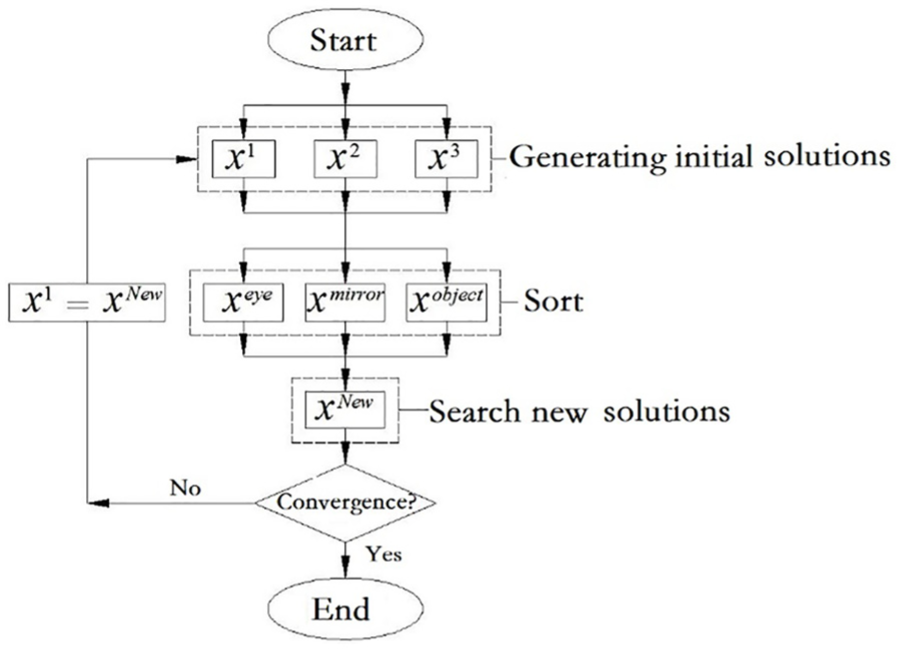
Process of the SRA.
Compared with traditional swarm-type intelligence algorithms, the SRA has the following characteristics:
The function of the SRA is limited to searching and calculating a single solution during each iteration, reducing computational costs compared with a swarm algorithm;
The step size in the search can be changed between iterations, so the precision and rate of convergence can be improved during the process. Indeed, the SRA has been proven to converge to the global extremum with a probability of 1; 22
The SRA accepts all of the solutions produced during optimization, guaranteeing global convergence of the algorithm.
Analysis of optimization performance
A typical multimodal function called the restrain function, the nature of which, including the convergence domain and the theoretical optimal solution, is described in Table 1, is used for comparison in order to verify the computational accuracy and efficiency of the proposed SRA. The SRA was used to optimize the restrain function 20 times, and the results of this calculation, defined by the best optimization, the worst optimization, and the average optimization, are listed in Table 2. For comparison, the simulation results of the plain restrain function as calculated in Lu et al.
32
are also summarized in Table 2. The simulation parameters were set as follows: the maximum iteration number
Restrain test function.

Restrain function test results.
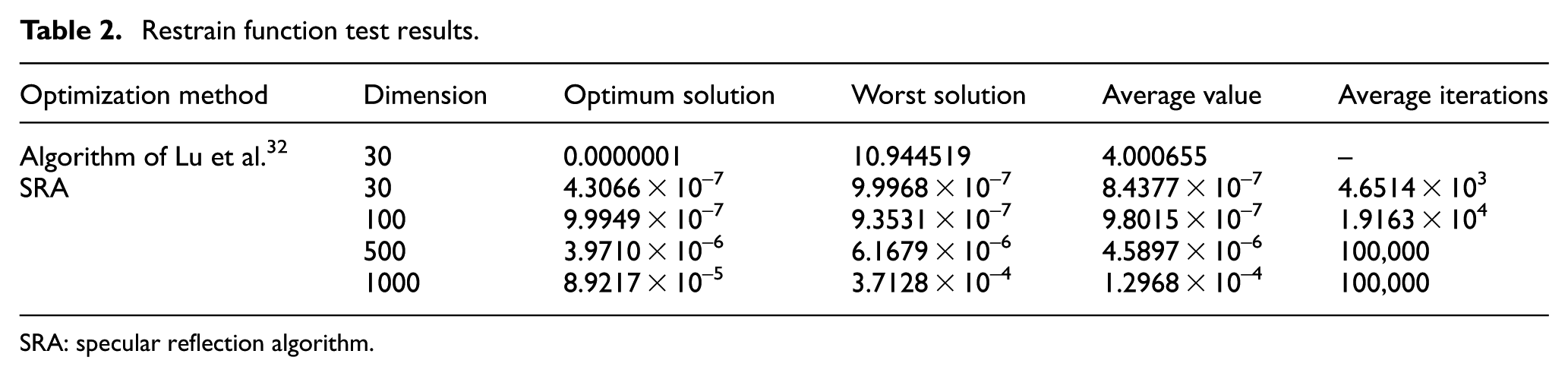
SRA: specular reflection algorithm.

Iterative curve of objective function.
After analyzing the data in Table 2, it is clear that the SRA provides better convergence and accuracy than the restrain function algorithm from Lu et al. 32 When increasing the number of dimensions of the test function from 30 to 1000, the optimized results of the test function can achieve a difference at convergence as small as 8.9217 × 10⁻⁵. This comparison demonstrates that the SRA possesses a remarkable advantage over the plain restrain function algorithm from Lu et al. 32 when dealing with optimization problems. Experimental results show that the SRA has strong robustness and high stability; therefore, when solving practical problems, the SRA can be used to obtain an optimized result, improving the overall economic efficiency of both the optimization and manufacturing processes.
Robust optimization model
In the real world, random or uncertain factors are inevitable, but these factors are not typically taken into account when solving practical engineering problems. However, even a minor fluctuation in product parameters can have a significant effect on the performance of a product, making such products far too unreliable for widespread usage. The traditional structural optimization method makes weight reduction the design goal, and although this method can provide design parameters with lightweight attributes, it fails to satisfy performance requirements related to structural reliability. Therefore, it is important to also consider the uncertainty of design parameters in the process of structural optimization. In this way, not only can the performance of a product be improved but the sensitivity of some parameters to variability can be reduced as well, resulting in product designs that maintain their long-term performance under various conditions.
Robust design based on sensitivity
Robust design is a type of engineering design method for high-quality products. Because of the influence of the environment and the restrictions of manufacturing conditions, some degree of parameter uncertainty is unavoidable. Under these circumstances, the reduction of the sensitivity of product performance to changing parameters becomes the key function of robust design. At present, there are many methods for the robust design of engineering problems, including the sensitive design method, 33 the stochastic model method, 34 and the inverse reliability method. 35 The sensitive design method is widely considered to be an effective design approach; thus, in this study, the sensitive design method was used for the design of a mechanical structure. The sensitivity of the objective function can be expressed as follows

where

where

where
Robust optimization design of a cantilever structure
A cantilever structure with a uniform load
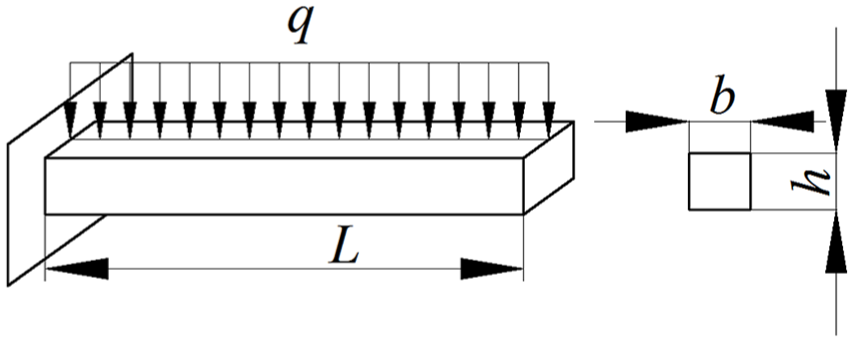
Cantilever structure.
Distribution parameters of basic random variables.

The tolerances of the design parameters must be considered by the proposed robust optimization model. As long as the tolerances of the parameters are known, the robust optimization design method for mechanical products can be used by equation (7). As a result, the distribution and values of the random variables in Table 3 are not necessary for robust optimization design; these values are used only as reference data when calculating the reliability of the subject structure. The reliability index is assumed to quantify reasonable product design, so the distribution and values of the random variables were used to evaluate the rationality of the proposed robust optimization model.
The optimization design of the subject cantilever structure consists of the two components:
Objective function: the mathematical model of the optimization design for the subject cantilever structure is based on the minimum mass of the structure

Constraint conditions: the three main constraints of the subject cantilever structure are its stiffness, dimensions, and stability. The stiffness constraint can be expressed as
Therefore, the optimization model of a cantilever structure can be defined as

Because of the universal optimal mathematics model given by equation (7), on the basis of the uncertainty of design parameters, the robust optimization design model of the subject cantilever structure can be defined as
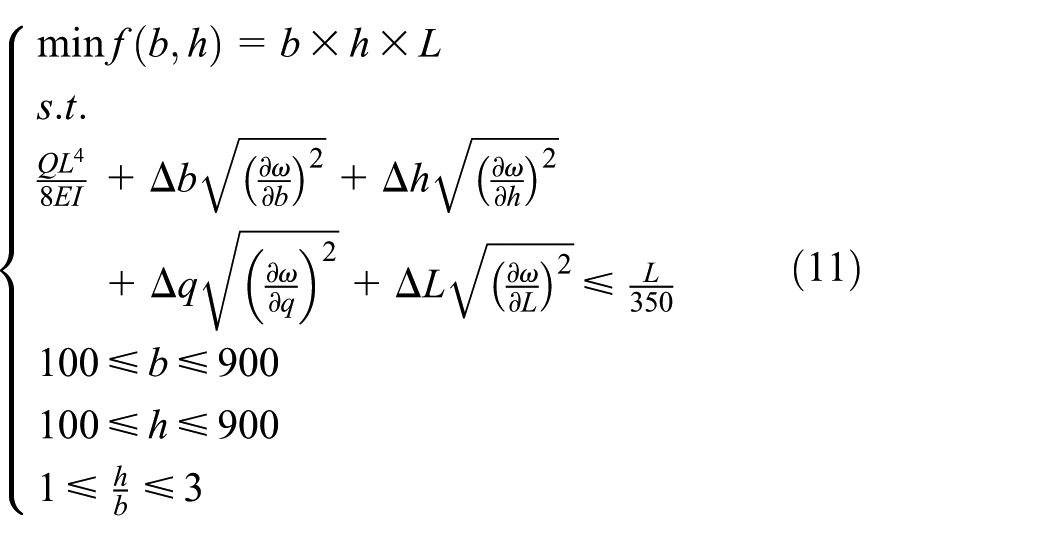
The SRA is then used to analyze the two optimization models demonstrated by equations (10) and (11), with the optimized results as summarized in Table 4. In order to verify the analysis results, the reliability index, calculated by the Monte Carlo method, was used as follows; in this article, the sampling times of Monte Carlo method are set as 1,000,000 times.
Numerical results.

Once analyzed, the calculation results demonstrated that the SRA was able to solve the constraint optimization problems successfully, proving that the mathematical model established in this article is valid. The objective function provides a minimum value for the static moment of area of
Engineering application
A model of a typical bridge crane is shown in Figure 5, with its mechanical models in the horizontal and vertical directions as shown in Figures 6 and 7, respectively. The side beam flanges between the main beam and the side beam are used to ensure the horizontal stiffness of the crane. Not all factors of crane operation can be adequately addressed by the initial crane design method, so some obvious problems can appear such as bolt fracture and track deviation, causing the type of accident shown in Figure 8.

Model of bridge crane.

Horizontal mechanical model of crane.
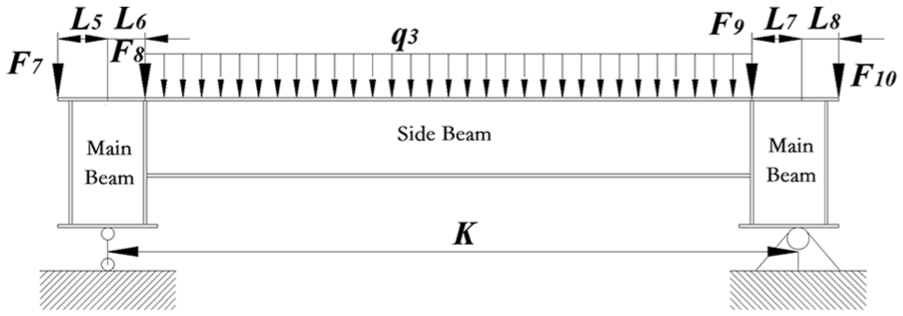
Vertical mechanical model of crane.

Accident scene of bridge crane.
The fatigue and ultimate strength analysis of the crane were investigated, but it was discovered that the crane included fatal defects in its design. Not only were the load-carrying capacities of the bolts unable to meet the design requirements but also the strength of the entire connection area was determined to be quite low as well; in essence, the structure as detailed in Figures 5–7 is not very reliable. In order to reduce the potential losses due to an unreliable design, the side beam of the crane was designed using the proposed SRA and robust optimization design method while all other components of the crane structure were maintained as originally detailed. The calculation procedure was as follows:
1. Parameter definition.
According to the mechanics model presented in Figures 6 and 7, all horizontal and vertical loads possible during the operation of the crane are summarized in Tables 5 and 6, respectively. Using,

where
2. Design variables.
The robust optimization design of the side beam was then performed using the proposed SRA and parameter optimization scheme to improve the performance of the side beam so that it meets the requirements of a robust design. From Figure 9, it can be seen that, the design variables of the side beam that must be accounted for in the robust optimization design are given by

3. Objective.
The objective function of the side beam for robust optimization design is given by equation (14)

4. Constraints.
The robust optimization design model of the crane must satisfy many constraints in addition to the dimensional constraint shown in equation (13), as the side beam also possesses a set of requirements that must be satisfied. Because the side beam of a crane is generally shorter in length than the main beam and its stiffness is very large, the major factor leading to the failure of the side beam is strength rather than stiffness. Therefore, the constraints of the structure design are as shown in equation (15)

where


where
5. Optimization and robust optimization model of side beam.
Horizontal load and position of side beam.

Vertical load and position of side beam.


Section of side beam.
Based on the above analysis, the optimization model and robust optimization model were obtained using equations (20) and (21), respectively, as follows

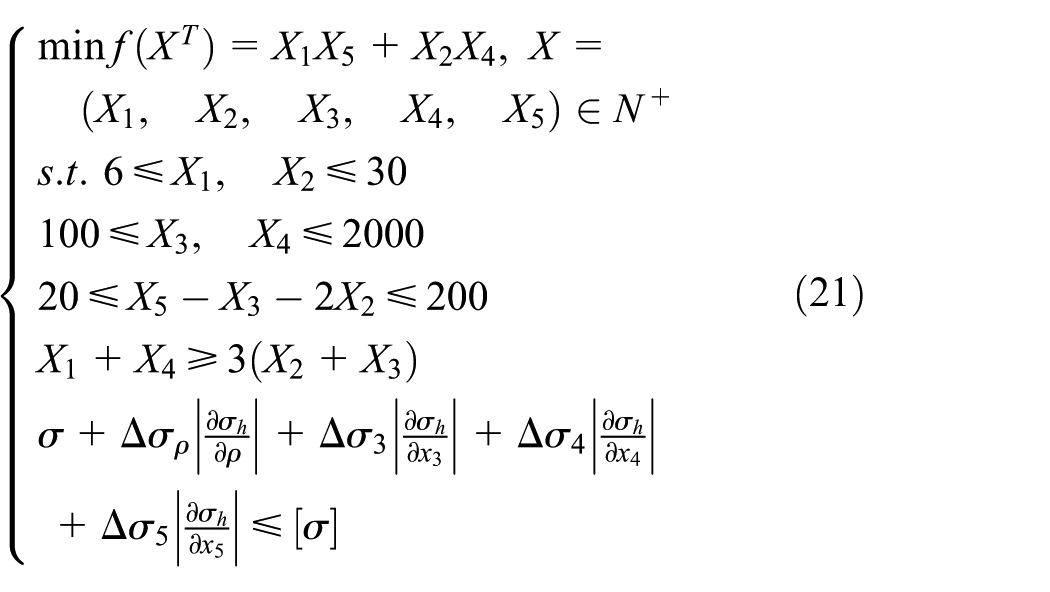
where
6. Calculation results.
Distribution parameters of basic random variables related to side beam.

Robust optimization results of side beam structures.
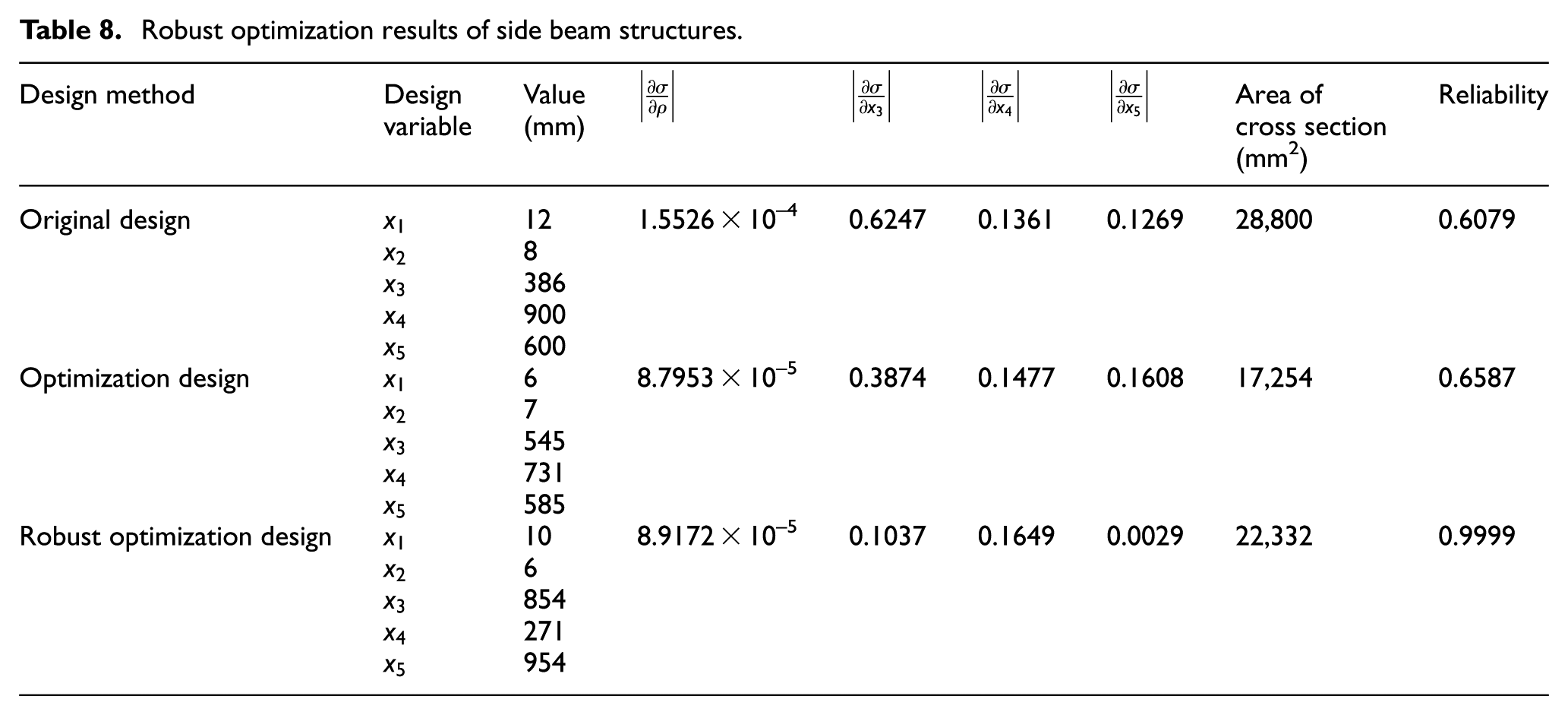
According to the calculation results shown in Table 8, the conventional design of the side beam was quite unreasonable and failed to make full use of the material. Because the horizontal load on the side beam is far greater than the vertical load, the original design enabled the side beam to reach its ultimate capacity in the horizontal direction. However, the vertical capacity was not fully utilized, inevitably leading to material waste. At the same time, the reliability of the structure was the lowest at 0.6079. The optimal design method significantly reduced the dead weight of the side beam by up to 40.1%. However, the reliability of the optimized structure was still very low at 0.6587. Using the proposed method for robust optimization design, not only was the dead weight of the side beam reduced by 22.46%, but the reliability of the structure was also increased to 0.9999. This proves that the proposed robust optimization design model can significantly improve structural reliability. The calculation results demonstrate that the SRA can be successfully applied to optimize structural performance by applying appropriate constraints.
Conclusion and prospect
In order to account for the influence of uncertain factors on quality characteristics in mechanical product design and manufacture, this article introduced an advanced method for robust optimization design combining the sensitivity method with the SRA that is able to improve the all-around reliability of products. On the basis of providing a lightweight design, a robust optimization model was established by adding a sensitivity-based design index to the constraints and objective design functions. The established model does not require detailed statistical information describing design parameters, only their desired tolerances, considerably simplifying the design requirements. The robust optimization model was then applied to the design of a cantilever beam structure. The results show that the proposed robust optimization model is able to effectively produce a more robust design than conventional design methods. The application of the proposed robust optimization method to a practical crane design then demonstrated that the robust optimization model proposed in this article is able to effectively address practical structural problems, improving design reliability and offering broad prospects as a new design method.
For some more complex engineering problems, it is difficult to quantify objectives and constraints as explicit expressions of design variables. In this case, agent modeling can be used to fit objectives and constraints. The next step of the author’s work is to simplify the objective and constraint functions using response surface method, which can greatly reduce the computational load and improve the computational efficiency.
Footnotes
Handling Editor: Raffaella Sesana
Declaration of conflicting interests
The author(s) declared no potential conflicts of interest with respect to the research, authorship, and/or publication of this article.
Funding
The author(s) disclosed receipt of the following financial support for the research, authorship, and/or publication of this article: This paper was supported by the National Nature Science Foundation of China (grant no. 51805348), Doctor Research Project of Taiyuan University of Science and Technology (grant no. 20162028), and Shanxi Province Special Fund to Promote the Implementation of Patent Promotion (grant no. 20171006).
