




Abstract
With the development of optimization theory and the application of computer technology, some new intellective optimization algorithms are developed quickly and applied widely, which is becoming the most important method for optimization problems. In this article, a new intellective optimization algorithm—Specular Reflection Algorithm—is proposed by authors who are inspired by the physical function of mirror. The traditional mathematical theory is used to prove the global convergence of this new algorithm. In order to validate the performance of this algorithm, three classical testing functions are adopted; then the algorithm is used to solve discrete engineering optimization problems and the results indicate that the Specular Reflection Algorithm has higher computation efficiency and extensive prospect for engineering application.
Keywords
Preface
Intelligence Optimization Algorithm (such as Genetic Algorithm1–3 (GA), Particle Swarm Optimization4–7 (PSO), and Simulated Annealing8,9 (SA)), which stems from the simulation of biological behavior, physical process, or chemical properties, is an effective method for solving complex optimization problems because it not only solves objective function regardless of continuity conditions but also has simple calculation principle and high-efficiency computing power.
Previous researches indicated that each method has its own advantages and disadvantages, for example, the SA can get a global convergence with probability of 100%, but the slow physical process of solid annealing directly affects its efficiency. The GA has excellence in rapid convergence and global search capacity, and it can adjust the search direction adaptively, but the existed premature convergence is the bottleneck which limits its development. Therefore, researchers have been working on researching and developing a new and ideal optimum method. In 2011, a new heuristic global optimization algorithm, Fruit Fly Optimization Algorithm (FOA), 10 is proposed by Wen-Tsao Pan who is inspired by foraging behavior of drosophila; 11 the FOA is easy to understand and implement and can be applied in many fields,12–14 while the shortcomings of FOA is that it traps into local optimal easily and has slow convergence speed. 15 The Cuckoo Search (CS) optimization method 16 is proposed by Amir Hossein Gandomi and Xin-She Yang in 2013, who are inspired by the brood parasitism behavior of cuckoo. The CS is a simple and effective global optimization method 17 and it has been successfully applied to solve a large amount of real-world optimization problems, while the performance of CS can be further improved. 18 In 2014, a biologically inspired optimization algorithm which is used to solving fuzzy shortest path problems is proposed by Zhang Xiaoge. 19 In addition, there are large amounts of improvement schemes about the original algorithm, which are widely used in engineering and science. B. Yang and L. Cheng 20 develop a new global optimization algorithm which is named Particle Swarm Optimization combined with Particle Generator (PSO-PG); the calculation accuracy of the proposed algorithm and its optimization efficiency are greatly improved. A. Hosseini and S.M. Hosseini 21 introduced a differential inclusion steepest decent neural network optimization method which is used to solving the general nonsmooth convex problems; the computed results show that nothing penalty parameter is needed by this method and it can easily deal with infeasible starting points.
The mirror can reflect lights; the object which cannot be observed directly can be seen by people with the help of mirror. Inspired by this phenomenon, this article develops a simple and efficient optimization method—Specular Reflection Algorithm (SRA). SRA is a new kind of artificial intelligent algorithm which is functionally similar to GA, SA, PSO, and FOA. Any optimization model can be calculated by SRA which can be used in machinery, materials, electronics, construction, tourism, military, economic, management, and other fields; it can also be used in combination with other algorithms.
SRA
Introduction of SRA
As an important tool, the mirror is not only closely related with people’s work and life but also widely used in most areas of society. Reflecting light is the basic function of mirror, the object which lurks around the corner or shaded by another object can be observed with the help of mirror, such as periscope—if there is no periscope in service, people inside submarine will be unable to know the condition above the water. The physical model which is simulated by SRA is built (as shown in Figure 1), light rays which are sheltered by something cannot travel alone the direction of Route 1, however, they can be accepted by eyes alone in Route 2, when the object can be observed, the goal of finding the object is easy to achieve. The proposed algorithm, SRA, is an optimal algorithm with the goal of optimization that simulates the process of this phenomenon.

Optimization way of SRA.
In this section, we will focus on the problem of object function minimization. According to the characteristics of SRA in searching the target object, the process of optimization can be summarized as the following steps:
Initialize the position of “eye,”“mirror,” and “image” randomly, the relationship among the three elements is
Close to

where
Adjust the position of the three elements (
Evaluate whether the iteration meets the terminal condition, if it does, stop iteration and the optimization results can be output; otherwise, return to step 2.
Values of

The way to adjust the position of elements.

Global convergence analysis of SRA
As a novel intelligence optimization algorithm, formula (1) is adopted by SRA to generate the new solution. Irrespective of whether it is good or not, the strategy for the new solution is accepted. And the SRA is a strictly decreased algorithm, that is

where
In view of SRA is different from other intelligence algorithm in the way of generating and accepting new solutions, it is necessary to verify the global convergence of the algorithm using traditional mathematical theory:
Theorem 1
The constraint overall optimization problem presented by formula (2) can converge to the global extreme with 100% probability by SRA

Testify
Provided that

Hypothesis that
During the process of iteration, the probability that the initial feasible solution just drops into

At the second time, the probability of the generated feasible solution that still does not drop into

So

And by this analogy, after

Calculate the extreme value of formula (6)

Since
Numerical analysis
First, SRA is used to deal with a three-dimensional unconstrained optimization problem; in the process of iteration, each coordinate of solutions is output, so that the features of this algorithm can be illustrated by pictures and text. Next, three classical optimization functions are used to test the efficiency of the algorithm.
Numerical example 1
The three-dimensional test function is known as

Space curve of test function

Flat view of X–Y plane.

Flat View of X–Z plane.
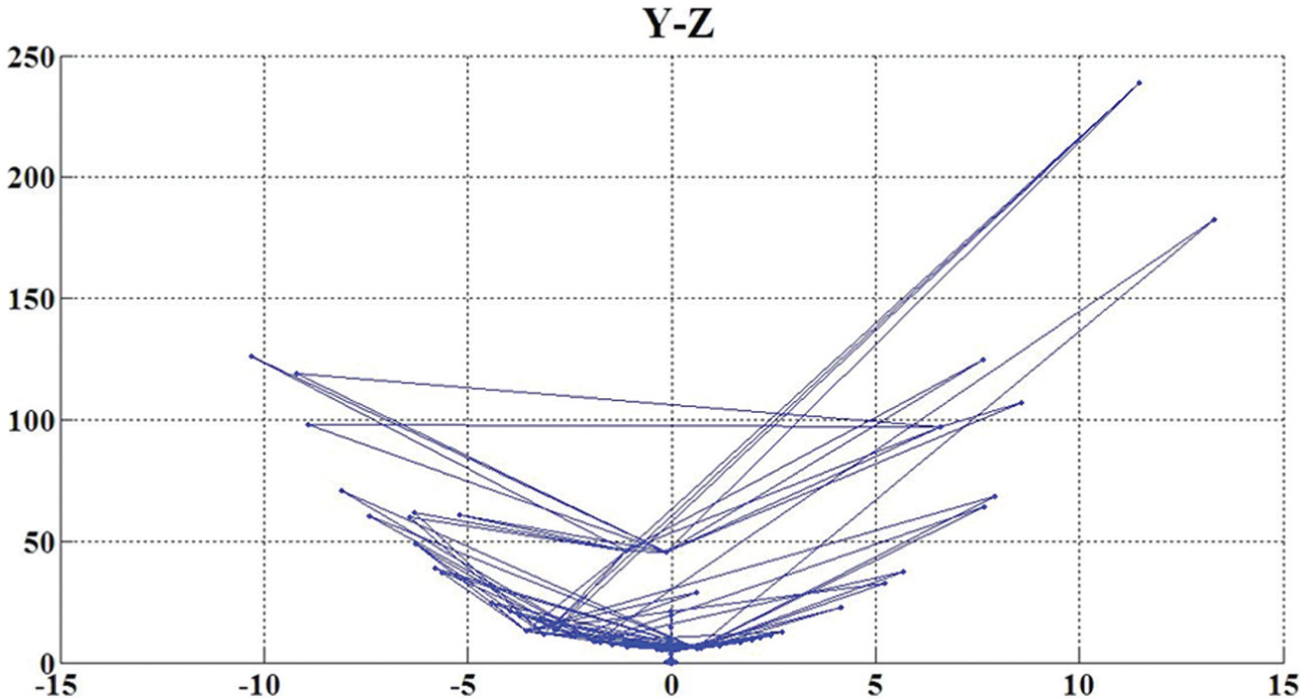
Flat view of Y–Z plane.
Numerical example 2
Three classical test functions f 1, f 2, and f 3 which come from the work of Qingbo et al. 22 are used to test the performance of the new algorithm, and the ability of SRA is evaluated by comparing with the relevant statistical data which are obtained from reference. 22 The names, mathematical expressions, feasible regions, dimensions, and theoretically optimum values of the three test functions are summarized in Table 3. The functions f 1 and f 2 have the property of multi-peak and easily go in local optimal value caused by adding cosine modulation; f 3 is a pathological function whose global extreme is difficult to be searched.
Three test functions for detecting the performance of SRA.

SRA: Specular Reflection Algorithm.
The three test functions are optimized with 30 and 100 design variables, respectively; the maximum iterations MAX_I and the convergence accuracy
Optimization results calculated by SRA and compared with other algorithms.
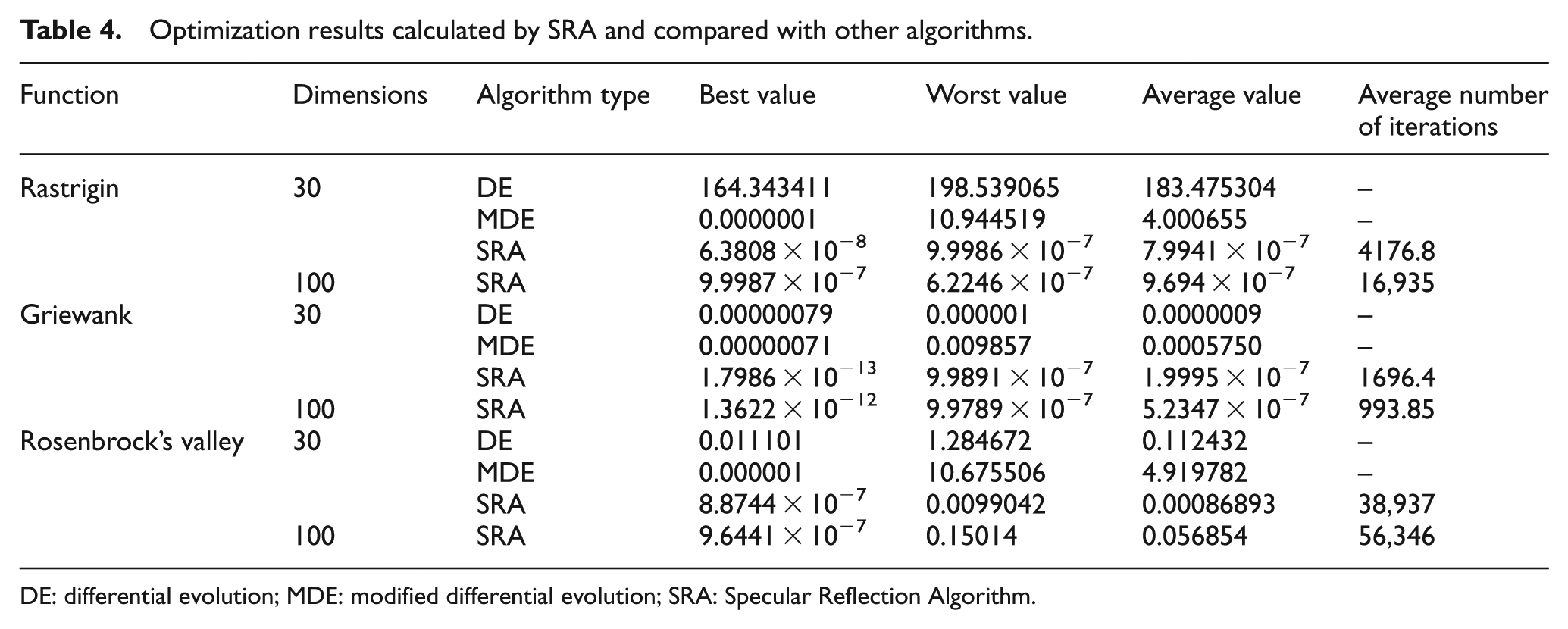
DE: differential evolution; MDE: modified differential evolution; SRA: Specular Reflection Algorithm.

Iterative curve of Rastrigin.

Iterative curve of Griewank.

Iterative curve of Rosenbrock’s valley.
Discrete optimization design for engineering structure
In order to verify the SRA can be applied to engineering design and analyze its ability in solving the discrete combinatory problems, box girder of general-purpose overhead crane is used, whose structure diagram is shown in Figure 9. The research results show that the SRA is an efficient and reliable method for engineering optimization, and it is able to handle discrete optimization problems efficiently.
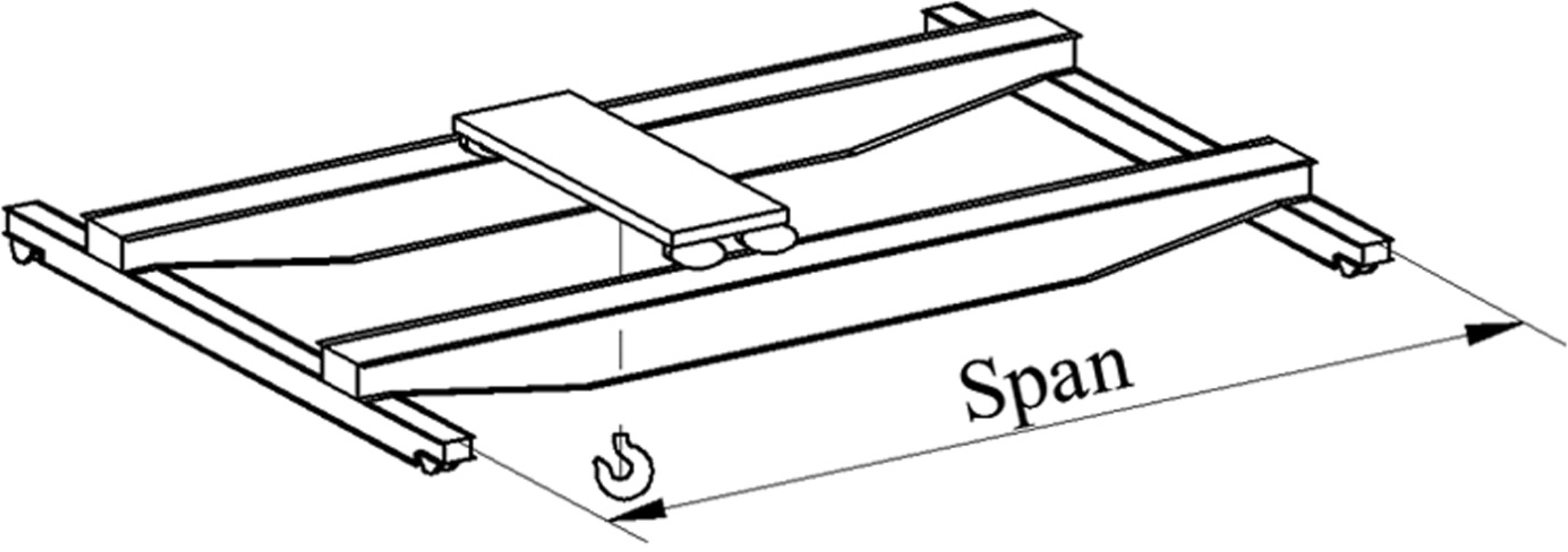
Structure diagram of general-purpose overhead crane.
Design variable
The simplified cross-section of box structure shown in Figure 10 is mostly used as girder of bridge crane. The goal of lightweight design is that to ensure the mass of structure minimized under the premise of design requirements. The six design variables used in this article are thickness of top flange plate X 1(4 ≤ X 1 ≤ 40), thickness of lower flange plate X 2(4 ≤ X 2 ≤ 40), thickness of principal web plate X 3(4 ≤ X 3 ≤ 40), thickness of deputy web plate X 4(4 ≤ X 4 ≤ 40), height of web plate X 5(100 ≤ X 5 ≤ 4000), and internal interval of web plate X 6(100 ≤ X 6 ≤ 4000). Influenced by the condition of manufacture, all the design variables are discretized into integral multiple of 1 mm.

Sectional view of box girder.
Objective function
The span of crane is defined as an invariant parameter, so the objective function can be simplified to design the minimum area of cross-section. Therefore, the objective function can be calculated according to the following formula

Constraint
According to the operation characteristics of general bridge crane which is under working condition, the mechanical model of general bridge crane can be simplified as a simply supported beam. And the loads exerted on the crane will be decomposed as shown in Figure 11.

Simplified mechanical model of crane main box beam.
Strength requirement
Calculated value of stress must be smaller than the allowable stress

where
Rigidity requirement
Vertical static deflection of main box beam cannot be larger than the value of allowable deflection

where
Stability requirement
Box beam has high stiffness; if the height–width ratio of main box beam is smaller than 3, then the global stability of the beam is not needed to check 23

Optimization of general bridge crane
The selected general bridge crane can lift 38 ton; its hoisting height and span are 10 and 25.5 m, respectively; and the design variables are defined as
Comparison computation results before and after optimization.


Iterative curve of objective function.
By analyzing the data in Table 5 and the iterative curve in Figure 12, the conclusions can be reached: under the condition of the structure constraint, the most reasonable combinations of design variables can be acquired by SRA, and the lightweight design of the metal structure of the crane can be achieved. From 49,904 to 29,111 mm2, the weight of the entire structure is decreased to 41.66%, which reduces not only the dead weight of crane nearly 4 ton but also the cost which is used for building construction and equipment transportation. The successful application of SRA in the field of optimization design for crane’s metal structure indicates that the SRA can be widely used in mechanical design and create the considerable economic and social benefits.
Conclusion
The major contribution of this article is to propose an optimization algorithm (SRA) which is a new developed algorithm for global optimization and simulates the phenomenon of light reflection. A new way is designed and adopted to accept the new solution by this algorithm, whether the new solution is the better one or not; by this means, the capacity of global convergence of the algorithm will be improved. Meanwhile, the traditional mathematical theory is used to prove the global convergence of this new algorithm.
Three classical test functions are used to detect the performance of SRA. This article presents some results of numerical experiments which show the new algorithm is more universal, effective, and robust than other common algorithms. The proposed algorithm is used to find the optimized solution of engineering project, which proves that the SRA can solve the practical problems well and have a vast application prospect in engineering.
Footnotes
Academic Editor: Michal Kuciej
Declaration of conflicting interests
The author(s) declared no potential conflicts of interest with respect to the research, authorship, and/or publication of this article.
Funding
This article is supported by National Nature Science Foundation of China (No. 51275329).