




Abstract
A novel technique to identify bridge damage using genetic algorithms and simulated annealing is proposed in this article. In the proposed method, the cross-sectional area of the damaged member is set as a variable that can be updated. An objective function was investigated to estimate the current condition of the damaged members. This function is the relationship between the measured strain and the analytical strain at the damage location. To obtain better agreement, the parameters were then identified using a genetic algorithm and simulated annealing to minimize the objective function. The proposed method was verified by a truss bridge and can directly estimate the damage based on strain measurements.
Keywords
Introduction
The start of the fourth industrial revolution is being built upon the third, the digital revolution. This revolution is driven by advances in artificial intelligence, big data, and so on, with the increasing and ultimate digitalization and integration of both industrial and everyday entities.1–3 Artificial intelligence mimics human cognitive functions such as learning, prediction, and decision-making using a computer. It is developed based on computer science, cybernetics, information theory, and so on. Traditional problem-solving methods may simplify the problem or require making several assumptions. Consequently, these methods cannot solve complicated problems, and their predictions may not converge. Artificial intelligence, including genetic algorithms, simulated annealing, neural networks, and swarm intelligent, has become a new method of solving hard-combinatorial complex problems; in addition, the use of artificial intelligence and automated statistical analysis packages will become increasingly prevalent, and significant opportunity exists to improve statistical practices for engineering. 4
Identifying bridge damage includes many unknowns or uncertainties, problems that need to be mathematically solved. The optimal solution of the combinatorial optimization problem cannot be reached in a reasonable computational time, and it also experiences problems that occur with large dimensionality, making it a very difficult problem to solve using traditional approaches. Artificial intelligence is a method based on input and output data, and it can continue updating the input data to obtain a better result. The bridge health monitoring system provides a large amount of real-time monitoring data, which raises the problem of choosing a computational technique to conduct the data analysis. Artificial intelligence can provide the tools for conducting data analysis. For example, Zhong et al. 5 proposed a damage prognosis framework for bridge structures based on the combination of the wavelet neural network method with an updating finite element model. Liu et al. 6 presented an approach to identify damage to a bridge utilizing modal flexibility and a neural network optimized by particle swarm optimization. Sgambi et al. 7 proposed and applied a method based on the combined application of genetic algorithms and a finite element method to assess the serviceability of a long-span suspension bridge. Avci and Abdeljaber 8 used a self-organizing map for global structural damage detection using dynamic measurements. Arangio and Beck 9 used Bayesian neural networks to assess the integrity of a long suspension bridge under ambient vibrations. Li and Au 10 identified the damage locations of a continuous bridge from the response of a vehicle moving on the rough road surface of the bridge using a genetic algorithm.
The current study focusses on identifying damage based on strain measurements. A change in the stiffness of a structure can be detected using strain measurements.11–13 The concept of damage identification is to establish an objective function that includes the damaged member and to solve the objective function to obtain the optimal value of the damage. In previous research, the optimization algorithm has been used to minimize the difference between the analytical and the measured data for damage identification. For example, Newton’s method was used by others to identify the change in the structural cross-sectional area for a numerically simple structure 12 and simple structure laboratory tests. 13 A Nelder–Mead simplex algorithm has been used to update the static and dynamic measurements for a bridge when the gradient-based optimization algorithms have convergence problems. 14
Using artificial intelligent as a tool, dynamical damage identification (parameter identification) has employed the particle swarm algorithm,15–17 neural networks,18,19 genetic algorithms,20–22 bee colony algorithm,23,24 simulated annealing, 25 and so on. For damage identification using the static test data, Chou and Ghaboussi 26 used a genetic algorithm to identify damage of a numerical model based the measured deflection. Wang et al. 27 identified damage to a roof truss under static load using a genetic algorithm. The damage identification of beams 28 and the laboratory truss model 29 has also been studied using static measurements. In addition, for the numerical optimization method, the truss structure and small-scale frame’s model parameters have been identified based on the strain measurement.30,31 However, intelligent approaches for damage identification based on strain measurements for a bridge are lacking. Unlike existing research, this study applied artificial intelligence methods, including a genetic algorithm and simulated annealing, to bridge damage detection to solve the identification problem using strain measurements. This study applied the proposed method to a truss bridge and identified the damaged truss member.
Methodology for damage identification using strain measurements
In the case of a bridge structure, identifying the properties of damaged members can be regarded as an optimization problem. The objective function is the error between the measured and the estimated strain. The parameters of the damaged member are determined to minimize the objective function. The following section establishes the objective function, which is used to identify the damaged cross-sectional area using the strain measurement. The objective function included the strain measurement, analytical strain, and the analytical cross-sectional area of the damaged member. Minimizing this function allows the analytical cross-sectional area to be as close to the “as-is” condition as possible. Other variables can also affect the axial deformation of truss structure such as boundary conditions in supports and connections and elastic modulus. Since this study specifies for solving the truss member crack problem, it only considers the variation in the cross-sectional area of the member.
Assume that the cross-sectional area of the damaged member is variable A. Based on the stiffness method, 32 we have

where

where

subtracting

Once the nodal displacements are obtained,

where

where E is the elastic modulus and L is the length of the member. Based on the strain–internal force relationship, the analytical strain

where

In identifying problems that rely on the strain measurements of the response, the objective function to be minimized through the optimization process can be formulated as the error between the measured and the predicted responses. The optimal value of A is

In conclusion, the first step in equation (1) is to use the structural stiffness equation to include the unknown damaged section A. Second, equations (2)–(7) try to use the analytical strain
Klehini River Bridge health monitoring
The Klehini River Bridge (Figure 1(a)) is located on the Porcupine Crossing Road accessed at mile point 26.3 of Haines Highway in the state of Alaska. The Klehini River Bridge structure is made of two-span riveted steel Parker Trusses. The bridge spans originally crossed the Mendenhall River Bridge in Juneau. In 1969, the trusses were partially disassembled, shipped to Haines, and installed at their current location.
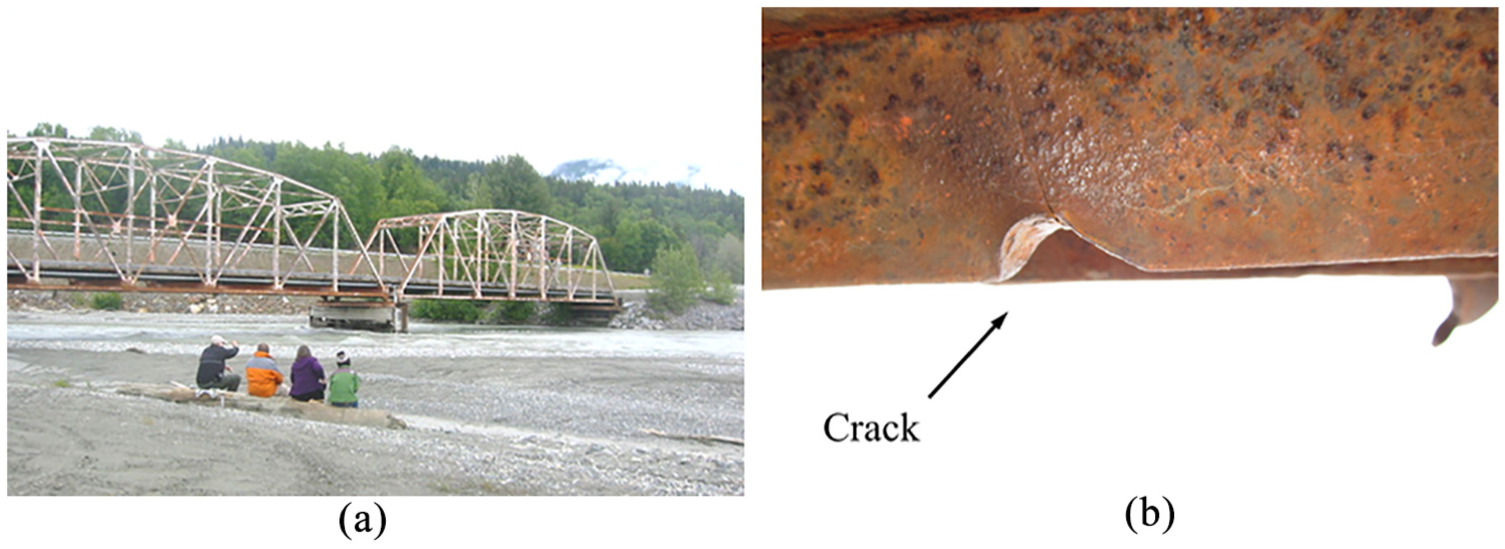
Photographs of (a) Klehini River Bridge and (b) crack on truss member.
Based on field inspection, this bridge showed evidence that there is significant damage in a variety of the structural members. Figure 1(b) shows one damaged member. To evaluate this damaged member, the sensor layout is shown in Figure 2. The strain sensor on the damaged member can provide strain measurements.

Sensor layout of the Klehini River Bridge.
The stiffness matrix for the entire bridge has a large number of degrees of freedom. To control the calculation time and solve the convergence problem, this study used displacement sensor 1, displacement sensor 2, and the boundary condition of abutment 1 to separate the structure (Figure 2). With those additional boundary conditions, the degree of freedom for the stiffness matrix
Genetic algorithm and simulated annealing
The success of damage identification depends on the mathematical capabilities of the optimization algorithm. Conventional gradient-based numerical optimization methods have a satisfactory convergence rate, but they may get stuck in a local minimum, depending on the starting point.33–35 The basic numerical optimization is Newton’s method, which makes use of the local curvature of the original function to build an approximate quadratic model function. This model function is calculated at each point of the iterative process and minimized to obtain the consecutive point. The process ends when the minimum is reached. 35 The global search methods, which is used in genetic algorithms 36 and simulated annealing, 37 are in general more robust. For example, the choice of the starting position has little influence on the final results, and they present a better global behavior. 38
The genetic algorithm is a method used to resolve optimization problems based on the mechanics of natural selection, whose initial theory was proposed by Holland 36 and Goldberg. 39 The algorithm begins with a population of individuals generated at random and continues into subsequent generations. In every generation, the fitness for every individual is evaluated and a portion of them selected according to their fitness. Then, the selected individuals generate a new population and are used for the next iteration. The optimization will stop when either a maximum number of generations or a satisfactory level of fitness has been reached.
Figure 3 shows the fitness value derived using a genetic algorithm. In this analysis, the population size begins at 10. The constraints on A are set between 0 and 8, since the “as-built” cross-sectional area of the damaged member is 8 in 2 . The final optimal value of A is 6.02 after 51 iterations. The best fitness is 4.81131e−16.

Genetic algorithm.
Simulated annealing is based on the analogy of crystal formation from masses melted at high temperature and allowed to cool slowly. 37 With a given start point, the method searches the optimal solutions from nearby solutions, and the range of the search is determined by the solution’s temperature. The temperature decreases as the iteration proceeds, and the algorithm reduces the extent of its search to converge to a minimum. At the beginning, the search points tend to have a relatively large distance between them, corresponding to high temperature. As the temperature cools down, it searches over a smaller range.
Figure 4 shows the function value that resulted from using simulated annealing. The start point of cross-sectional variable A is 8, which was the “as-built” condition of the part. Similar to the genetic algorithm, the constraints of lower bound is 0 and the upper bound is 8. The optimal value was 6.08 after 51 iterations. The best function value is 9.84959e−10.

Simulated annealing.
To verify the results, the analytical strain was calculated based on the global stiffness matrix of the bridge, and the cross-sectional area of the damaged member was selected for three different cases: using the construction drawings (“as-built” condition), using the genetic algorithm optimal value, and using the simulated annealing optimal value. Table 1 shows the analytical strain compared with the measured strain. The error decreased from 21.4% to 0.2% and 1.0%.
Comparison between analytical and measured strain.

Conclusion
This study proposed a damage identification approach to identify the change in the cross-sectional area using a genetic algorithm and simulated annealing. The method represents the damaged member by determining the change in cross-sectional area and using displacement sensors to simplify the stiffness matrix of the bridge. The objective function between the measured strain and the analytical strain was investigated, and artificial intelligence methods were used to estimate the damaged cross-sectional area based on the measured strain. This study used local measurement sensors (strain and displacement sensor) to quantify the local damage in a large-scale structure.
The Klehini River Bridge was carried out to verify the proposed method. Using this method, the damaged members of the bridge were identified. It can be concluded that the proposed method can estimate the cross-sectional area of the damaged member using the strain measurement, and it provided the required information for bridge safety evaluation. The damage detection in bridge deck and other flexural members require further investigation because they were not concluded in this study.
Footnotes
Acknowledgements
The authors would like to thank the editor and reviewers for their valuable suggestions and constructive comments to improve the quality of the article.
Handling Editor: Nuno Maia
Declaration of conflicting interests
The author(s) declared no potential conflicts of interest with respect to the research, authorship, and/or publication of this article.
Funding
The author(s) disclosed receipt of the following financial support for the research, authorship, and/or publication of this article: This work was supported by Nanjing University of Science and Technology, Start–up, Grant/Award Number: AE89991.
