




Abstract
Anxiety is a common emotion of driver, which always affects the safety of driving. Eye movement characteristics can be used to understand the true emotion state of human beings. It is of great significance to study the law of eye movement for realizing active vehicle safety warning and human–machine cooperation. In this article, anxiety-induction experiment, real-vehicle driving experiments, and virtual driving experiments were designed and used to obtain the eye movement data of female novice extroversion driver under calm and anxiety, and mathematical statistics analysis was made on the fixation count, fixation duration, and visit duration in the area of interest within the driver horizon. The results showed that there are significant differences in fixation count and fixation duration of drivers (
Introduction
With the rapid development of global automobile industry and the popularization of private cars, casualties and property losses caused by traffic congestion 1 and traffic accidents have been increasing year after year. The analysis results from relevant experts on traffic accidents show that more than 90% of the occurred traffic accidents are caused by human, 2 in which more than 70% are caused by driver. During driving, the proportion of driver using vision to perceive various traffic information is as high as 80%. 3 The eye movement law in the driver’s visual perception process must be studied in order to prevent the occurrence of traffic accidents.
Due to the great progress in the field of artificial intelligence and computer technology, the visual search mode of driver was studied by traffic scholars of relevant field in different road environments such as sharp turn section of mountain road, 4 road construction section, 5 tunnel entrance section, 6 tunnel lighting environment, 7 traffic sign and billboard,8–10 roundabout, 11 curved road,12,13 grassland road, 14 and urban road. 15 In terms of the relationship between emotion and visual search pattern, Dickins et al.16–18 found that eye gaze time was lengthened when learning under the negative emotion. The effect of anxiety on attention bias was studied using eye tracking technology by Byrow and Holas,19,20 and the results showed that eye movement was more focused on sad and happy faces than neutral faces. Individuals with high trait anxiety searched angry faces faster significantly than smiling faces. The effects of anxiety on attention and gaze behavior in the field of aviation were studied by Allsop and Gray, 21 which found that anxiety increased the randomness of external stay time and visual scanning. Pasupa et al. 22 found that a more accurate prediction was provided using binocular motion information and image features together to determine user emotion than using image features alone based on the improved prediction method. During driving, the relationship between emotion and attention was studied through risk perception by Zimasa and El Haj,23,24 and it was found that negative emotion was harmful to driving safety than positive or neutral emotion, but emotion was not be materialized. Schmidt-Daffy and Yao25,26 found that lowering the vehicle speed can reduce the driver’s feeling of impulses associated with danger in many dynamic models of driving behavior and emotion symptoms were attributed to fear and anxiety. Taylor et al. 27 found through questionnaire survey that drivers with high anxiety were more likely to make mistakes. From previous studies, there was a common finding that anxiety can narrow attention, which led to neurasthenia under stringent state, important information was ignored at the periphery and driving risk increased. 28 In total, 168 drivers were tested by Pourabdian and Azmoon 29 by utilizing the Manchester Driving Behavior Questionnaire and the Spielberg State-Trait Anxiety Scale to analyze the relationship between trait anxiety level and incorrect driving behavior, and it was found that trait anxiety levels were prone to lead to distraction and forgetfulness for driver. Wester et al. 30 found that driver’s fixation frequency increased in the central area and the fixation frequency on both sides decreased under high anxiety situation and attention was narrowed. However, only the index of horizontal fixation was chosen and other eye movement indexes were not introduced in this study. In addition, using a racing game in the experiment was a certain difference from the real scene.
The previous study on driver’s eye movement characteristics mainly focused on different road environments and rarely combined emotion with road environment from the relevant scholars at home and abroad. The emotion was not embodied, which affected the accuracy of result to some extent. In view of this, anxiety-induction experiment, real-vehicle driving experiment, and virtual driving experiment were designed and used to pre-collect the eye movement indexes of female novice extroversion driver. The eye movement law of driver under calm and anxiety was obtained through the analysis of the collected data, which provided the theoretical basis for the realization of active vehicle safety driving warning system and ensures the safety of driving.
Methods
Index selection of eye movement
During driving, there are three basic eye movement patterns, namely, fixation, saccade, and blink. Common characteristic indexes are shown in Table 1.
Common characteristic indexes of three eye movement patterns under calm and anxiety.

Referring to research results from predecessors in the visual direction of driver, 31 based on the specific function of Tobii head-mounted eye tracker, the fixation count, fixation duration, and visit duration were selected (shown as in Table 2 for details); driver visual characteristics under calm and anxiety was comparatively studied.
Common eye movement indexes under calm and anxiety.
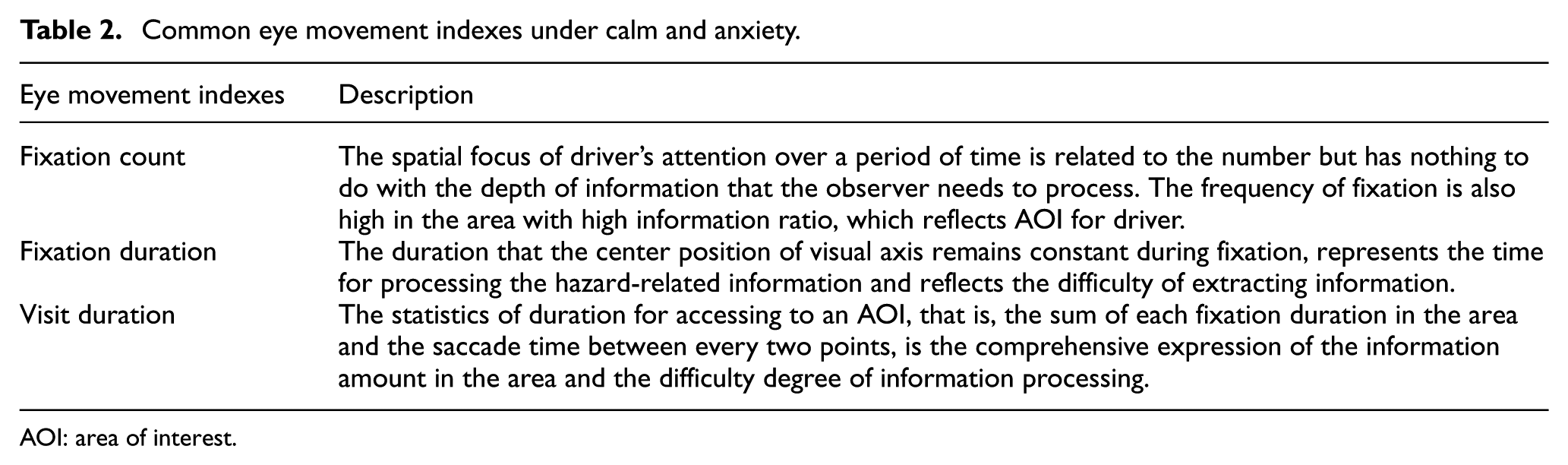
AOI: area of interest.
Participants
Related research on driver characteristics showed that women were more prone to anxiety than men.32,33 Novice drivers had lower performance in risk-perception tasks and were more likely to be involved in road traffic accidents.34–36 In view of this, a total of 40 female novice extroversion drivers were selected for eye movement data acquisition under calm and anxiety. The driving propensity of subjects is determined by Driving Propensity Questionnaire, 37 and the specific performance is shown in Table 3. The biological age ranges from 21 to 45 years and driving age ranges from 1 to 23 years. Driving experience is divided with the standard on driving mileage of 10,000 km. 38 All subjects have normal hearing, vision or corrected vision, and normal color vision.
Driving propensity type and its performance.

Experiment conditions
Emotion-induction materials
Anxiety-induction materials are the fundamental components of ensuring anxiety to be stimulated and are the basis to ensuring validity of subsequent eye movement parameters. Anxiety-induction materials used in this experiment mainly include International Affective Picture System (IAPS) and Chinese Affective Picture System (CAPS). IAPS are the authoritative materials of emotion induction internationally. CAPS are the emotion-induction materials that adapt to Chinese unique social and cultural backgrounds. According to the different sensory channels of materials, emotion-induction materials used in this experiment include visual materials (words and pictures with anxiety, changes in driving environment brightness, etc.), auditory materials (noisy and irregular audio, etc.), olfactory materials (cigarettes, durian, licorice, etc.), gustation materials (dark chocolate, etc.), and multi-channel stimulus materials (video with anxiety, etc.). A part of the emotion materials is shown in Figure 1.

Partial materials of anxiety induction: (a) partial visual stimulus of anxiety and (b) anxiety face pictures.
Instruments
Experiment instruments include comprehensive experiment vehicle for road traffic (equipped with 32-line laser radar, laser ranging sensor, SG299GPS non-contact multi-function speedometer, CTM-8A non-contact multi-function speedometer, vehicle recorder, Tobii eye tracker, WTC-1 pedal power manipulator, high-definition camera, laptop, etc.), high simulation platform of virtual vehicle driving, camera Tobii Studio software for data analysis, recorder, IR-Marker, wedge foam, and so on. A part of the experiment instruments is shown in Figure 2.

Experiment instruments.
Driving route
The road sections of Beijing Road–Renmin West Road–Nanjing Road–Xincun West Road in Zibo city (shown as in Figure 3) were selected as the driving route under good weather and road conditions. The whole length of the line is about 5.6 km. The subjects of this article are the novice drivers. The stability of driver’s calm state will be affected by the large or complex traffic flow. Therefore, the driving experiment under driver’s calm state was carried out during the off-peak time on Saturday and Sunday morning, driving experiment under drivers’ anxiety was was carried out at the early peak and late peak time from Monday to Friday. A virtual driving road of one-way dual lane was set according to the research requirement, and different virtual driving scenes were set in the experiment section (shown as in Figure 4), including unimpeded road, road maintenance, traffic accident, curve, and queuing waiting of intersection, and so on. There were both common environments (no artificial barriers) and special circumstances (pre-set obstacles at specific locations in the driving environment), which can stimulate or enhance anxiety, to ensure research is of universal significance.

Driving route applied in real vehicle.

Part of virtual driving scenes.
Procedure
The experiments are divided into real-vehicle driving and virtual driving. The data obtained from real-vehicle experiment are more similar to natural driving data, but the experiment organization is more difficult and the cycle is longer. So, it is difficult to obtain large amounts of eye movement data. Relatively, virtual driving experiment is simple, the cycle is short, the experiment organization and data collection process are easy, and experiment data can be supplied effectively.
Preparation
Before experiment, the organizers fixed the IR-Marker of Tobii eye tracker on the front windshield according to the 4 × 6 matrix first. The rearview mirror, steering wheel, dashboard, and so on were also placed in accordance with the IR-Marker placement requirements. The distribution diagram of IR-Marker is shown in Figure 5. Since the driver sat on the left side of vehicle while driving, the IR-Marker was integral to the left. The wedge foam was used to offset the tilt angle of the front windshield in order to ensure that each IR-Marker can face the driver directly, so the driver’s eyeball could be better captured with the eye tracker in the experiment. The eye tracker was corrected to ensure that higher quality eye movement data can be obtained during the experiment.
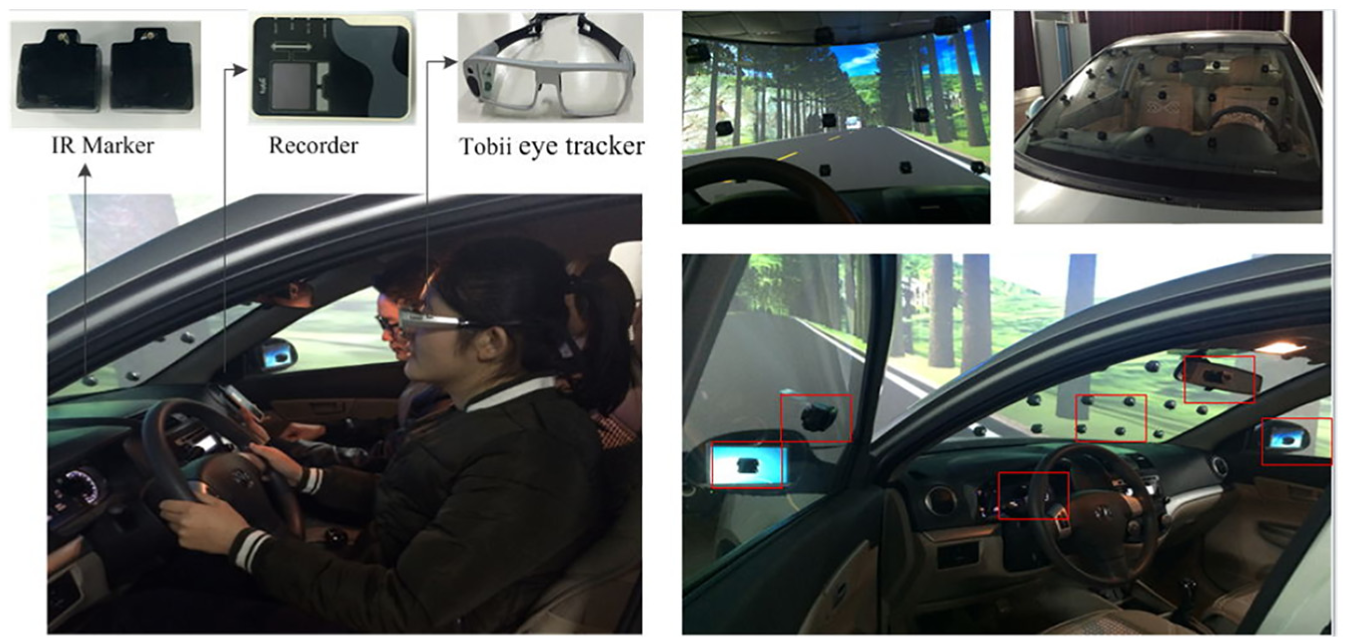
Distribution diagram of IR-Markers.
Emotion-induction and driving experiments
Anxiety is divided into two forms: state anxiety and trait anxiety. Anxiety in this study includes state anxiety, generated by driver under the stimulation of experiment conditions during driving, and their own unique trait anxiety. The driving experiment process under calm and anxiety is shown in Figure 6.

Driving experiments design.
Evaluation of anxiety-induction effect
The anxiety-induction effect affects the accuracy and reliability of the results directly. During driving, the behaviors of subjects such as facial expressions, driving condition, driving speed, and pedaling force were recorded using instruments such as camera, speedometer, and pedal power manipulator. After driving, the subjects watched the video playback during their driving process and reported the experience of emotion intensity at different moments to the experiment organizers. Fragments of eye tracker shooting were extracted, respectively, under calm and anxiety. The Beck Anxiety Scale, the Self-Rating Anxiety Scale, and the subjects’ physiological characteristics such as facial expression, speech signal, and behaviors during driving were comprehensive used to evaluate the anxiety-induction effect. The anxiety selected in this study was moderate and severe anxiety of drivers who scored more than 25 (Beck Anxiety Scale) and greater than 59 (Self-Rating Anxiety Scale) under the stimulation of experiment conditions (shown as in Table 4), respectively.
Basis of anxiety degree on Baker Anxiety Scale and Self-Rating Anxiety Scale.

In accordance with the above experiment steps, 40 female novice extroversion drivers were organized to carry out real-vehicle and virtual driving experiments, and the data were collected by eye tracker. After calm and anxiety were stimulated, respectively, subjects drove on specific road section at each experiment. In the real-vehicle and virtual driving experiments, 160 groups of experiment data were obtained, which were all divided into 100-s fragments for analysis, and 1920 valid time segments were obtained.
Data analysis
After the experiments, the data of recorder was imported into Tobii Studio software, and the scene in the driver’s field of vision was divided into nine non-overlapping fixation areas 42 by trisecting in the horizontal and vertical directions, which were represented with area of interest (AOI). The location and coverage of each AOI are shown in Figure 7 and Table 5. Due to the limited space, the process of regional division is no longer detailed.

Division of drivers fixation area.
Coverage of drivers fixation area.
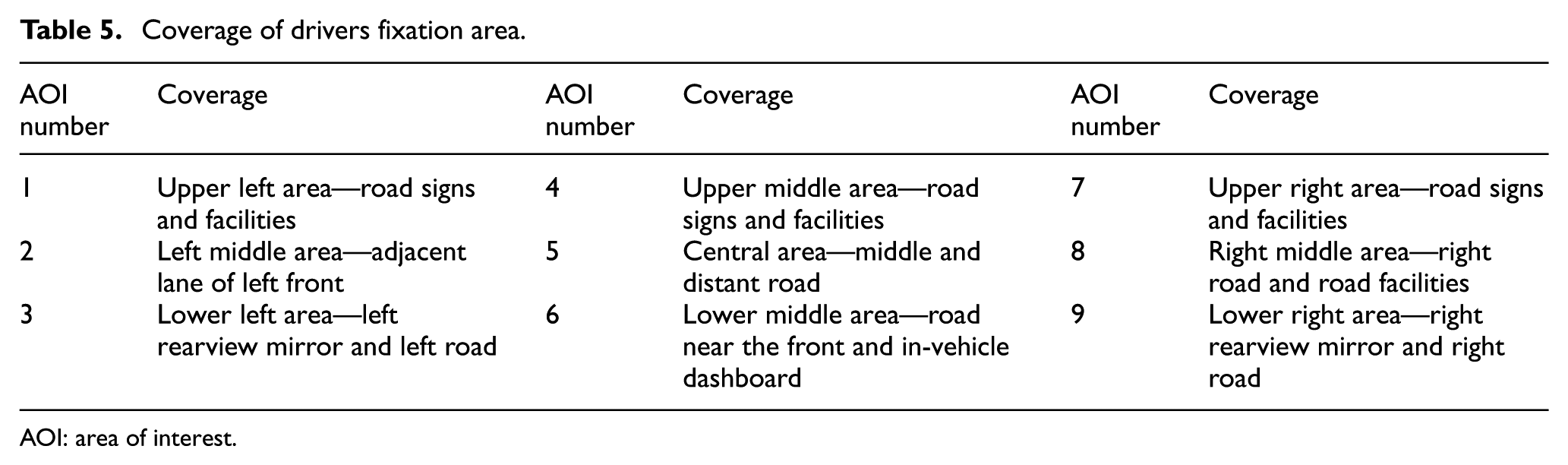
AOI: area of interest.
The variables and symbols of experiment acquisition and partial experiment data are shown in Tables 6 and 7, respectively.
Variables and symbols of experiment acquisition.

Part of experiment data.

The analysis of drivers eye movement data such as fixation count, fixation duration, and visit duration in AOI is to obtain the difference of eye movement characteristics of female novice extroversion drivers under calm and anxiety by utilizing Tobii Studio and SPSS software.
Results
Fixation count
The spatial focus of driver’s attention is reflected over a period of time by fixation. The fixation count reflects the number of information that the observer needs to deal with in the process of visual search. To some extent, the interest degree of observer to the area was embodied by comparing the driver’s fixation count of a certain time under calm and anxiety. Larger fixation count and greater amount of information the brain processes indicate that the drivers pay more attention to AOI than others. In this article, the difference of drivers extraction information was obtained to evaluate the safety of driving through studying the fixation count distribution of female novice extroversion drivers in AOI under calm and anxiety. The distribution of fixation count is shown in Figure 8.

Distribution of driver’s fixation count under calm and anxiety.
Paired sample t-test and analysis of variance are made on the above data using SPSS. The results are shown in Table 8. The difference in fixation count under the calm and anxiety of female novice extroversion drivers is significant (
Paired sample t-test and analysis of variance on drivers’ fixation count.

According to the AOI group function of Tobii Studio software, a subject’s attention area to an image is showed by different colors combined with heat map, the times of vision dwell for a subject in a certain area is showed in Figure 9. In this article, heat map is created according to fixation count. Red represents the area with the most fixation points, followed by green, and there are many excessive levels among them.
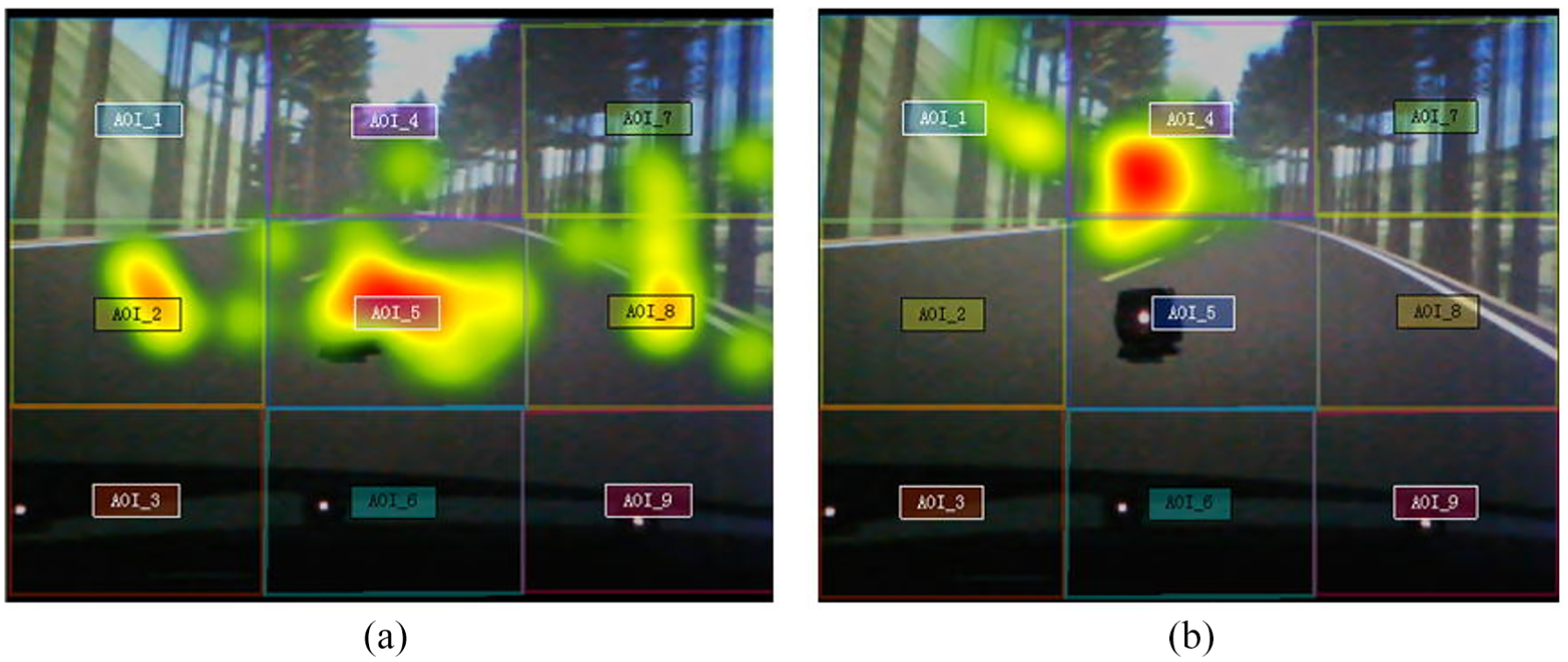
Heat map of driver’s fixation count under (a) calm and (b) anxiety.
The results showed that the distribution law of drivers’ fixation count in AOI was consistent under calm and anxiety as a whole. The fixation count in the middle AOI was higher than both sides. The drivers paid more attention to the left rearview mirror and dashboard than the other areas. Compared with the situation of anxiety, the search width of drivers in the horizontal direction was significantly higher and the fixation count was larger under calm. The drivers’ visual angle was narrowed under anxiety, which significantly affected the number of right fixation points. The attention bias toward the middle and left areas affected drivers’ comprehensive extraction of information.
Fixation duration
The fixation duration is the constant time of the visual axis center position, which is used to represent the time taken by the driver to extract valid information from the target being viewed. The difficulty degree of information being extracted and the driver’s interestingness in the target are reflected by the fixation duration. The variable can distinguish whether the driver has an attention bias in different road conditions. The distribution of fixation duration for female novice extroversion drivers on each AOI under calm and anxiety in this article is shown in Figure 10.

Distribution of driver’s fixation duration under calm and anxiety.
Paired sample t-test and analysis of variance are made on the above data using SPSS. The results are shown in Table 9. The difference in fixation duration under the calm and anxiety of female novice extroversion drivers is significant
Paired sample t-test and analysis of variance on drivers’ fixation duration.

Using the AOI group function of the Tobii Studio software, the driver’s attention area is observed more intuitively combined with trajectory map. As shown in Figure 11, the difference of driver extraction information is obtained in order to evaluate the driving safety under two states. The visual interface of trajectory map can show the position of fixation point and the length of fixation duration (the size of dot) on static stimulus materials (such as a picture or scene).

Trajectory map of driver’s fixation duration under (a) calm and (b) anxiety.
The results showed that the difference of drivers’ fixation duration was not significant in each AOI under calm, more concentrated on the middle area, tending to concentrate attention. Compared with the situation of calm, the fixation duration of drivers increased relatively under anxiety, and there was a significant difference in fixation duration for each AOI. For drivers, the fixation time of the middle and right areas became longer and the attention bias to the fixation target had occurred.
Visit duration
The visit duration is not the fixation duration. It is the time from the first fixation point appearing in AOI to the next fixation point moving out of AOI, that represents the total length which is the sum of each fixation duration and the saccade time between every two points of driver’s fixation time in a certain AOI. The visit duration is a comprehensive expression of the amount of information in an AOI and the difficulty degree of information processing, which is used to measure the driver’s comprehensive interest degree in different areas. The distribution of visit duration for female novice extroversion drivers in each AOI under calm and anxiety in this article is shown in Figure 12.

Distribution of driver’s visit duration under calm and anxiety.
Paired sample t-test and analysis of variance are made on the above data using SPSS. The results are shown in Table 10. There is no significant difference in visit duration of female novice extroversion drivers under the calm and anxiety
Paired sample t-test and analysis of variance on drivers’ visit duration.

The results showed that the distribution law of drivers’ visit duration in AOI was consistent under calm and anxiety as a whole. Most of the drivers concentrated on the middle area, followed by the left area, but the visit duration for each AOI was different. It indicated that anxiety could cause drivers’ attention bias to traffic information, and there was no significant difference in overall visit duration. Under the situation of anxiety, the drivers got more traffic information through visit duration to middle area, which was less concerned about the left and right sides, and the attention bias appeared. Traffic accidents were more likely to occur due to ignoring important traffic information.
Discussion
Through the real-vehicle and virtual driving experiments in this article, the eye movement data of drivers under calm and anxiety was obtained, and the eye movement characteristics of female novice extroversion drivers in two emotion states were explored. The main conclusions were as follows:
Under calm and anxiety, the drivers fixation count in the middle AOI is higher than both sides, and the difference in fixation count is significant
The difference in fixation duration of drivers under calm and anxiety is significant
There is no significant difference in visit duration of drivers under anxiety
There are differences in drivers’ fixation of each AOI under anxiety. For drivers, more attention is focused on the middle area, the fixation count and visit duration on the left area are relatively more, and the fixation duration of right area is relatively long.
Eye movement characteristics of female novice extroversion drivers under calm and anxiety are explored in this article, which makes up for the lack of micro-study in the field of traffic safety and provides a basis for the study of driver emotions and intentions. However, there are still some deficiencies in this study: (1) due to human emotions are complex and diverse, only calm and anxiety during driving were studied in this article, and the analysis of eye movement characteristics under other emotions are the focus of follow-up research. (2) Anxiety is a dynamic, changeable, and complex psychological process, and the study of eye movement characteristics considering the dynamic evolution of driver emotions is needed to proceed. (3) Only representative eye movement characteristics of female novice extroversion drivers were analyzed in this article. More detailed drivers classification need to be further explored. (4) Some external factors such as driving environments and driver proficiency will bring a certain amount of error for the experiment results. The influence of external factors on the experiment results should be controlled in subsequent studies.
Conclusion
Anxiety is an important factor affecting driver’s behavior. It is not only a significant premise to determine the changing law of eye movement of female novice extroversion drivers under anxiety for identifying drivers’ intentions accurately and realizing active vehicle safety driving but also the important content for preventing accident. By analyzing a large number of experiment data of eye movement, we, respectively, contrasted the differences of fixation count, fixation duration, and visit duration of driver in AOI under calm and anxiety, which provided the theoretical basis for the study of driver’s visual behavior law and driving safety. From the perspective of “humanism,” the study of drivers’ eye movement characteristics under anxiety will contribute to the rational planning of transportation infrastructure and help to build and develop a traffic system with more social benefit. Taking into account the universal applicability, further research on driver’s eye movements and anxiety can focus on the differences in eye movements of drivers with different characteristics under anxiety or in different road scenes, in order to improve the driver’s risk-perception ability in traffic accidents. The theoretical basis of the auxiliary driving system of active vehicle safety is offered by the results.
Footnotes
Handling Editor: Tao Feng
Declaration of conflicting interests
The author(s) declared no potential conflicts of interest with respect to the research, authorship, and/or publication of this article.
Funding
The author(s) disclosed receipt of the following financial support for the research, authorship, and/or publication of this article: This study was supported by the Joint Laboratory for Internet of Vehicles, Ministry of Education-China Mobile Communications Corporation under the project No. ICV-KF2018-03, the State Key Laboratory of Automotive Safety and Energy (grant number KF16232), the National Natural Science Foundation of China (grant numbers 61074140, 61573009, 51508315, and 51608313), the Natural Science Foundation of Shandong Province (grant numbers ZR2014FM027 and ZR2016EL19), and the Project of Shandong Province Higher Educational Science and Technology Program (grant number J15LB07).
