




Abstract
This article aims to investigate the fluctuation of the static rigidity for preloaded ball screws. Based on the correlation between preload and friction torque, a new model to calculate the contact rigidity by friction torque is proposed. Meanwhile, a novel test bench is constructed to measure the static stiffness at different positions. The experimental results agree well with the theoretical values, which proves the validity of the model. Furthermore, it is found that the screw shaft rigidity has the greatest influence on the system stiffness fluctuation, compared to the bearing rigidity, and the torsional rigidity. For the feed system, increasing the bearing rigidity, which is the lowest stiffness of the whole system, is an effective method to increase the system stiffness. The study provides an accurate method to obtain the stiffness fluctuation in the effective travel of ball screws, which is significant for improving the positioning accuracy of ball screws and computer numerical control machine tools.
Keywords
Introduction
Ball screws, which are widely used in computer numerical control (CNC) machine tools, have a great influence on the dynamic stability and vibration of the feed systems.1,2 With the continuous increase in the requirement of the speed and load capacity of ball screws, 3 the vibration and other problems caused by poor stiffness are becoming more and more prominent, which seriously affect the positioning accuracy of CNC machine tools.4,5 According to ISO 3408-3-2006, 6 the fluctuation of the friction torque of preloaded ball screws can be achieved as high as 50% of the initial dynamic preloaded drag torque, which will lead to a great fluctuation in the static rigidity over the whole effective travel.7,8 Therefore, it is necessary to study the correlation between friction torque and contact rigidity.
So far, lots of theoretical studies about ball screws have been carried out on the static rigidity modeling through numerical calculation and finite element simulation. 9 Considering the preload and axial load, Wei and Lin 10 built a static axial rigidity model of single-nut ball screws. Considering the elastic deflection between screw shaft and ball nut body and the contact deflection between ball and groove, Takafuji and Nakashima 11 developed a static rigidity model of double-nut ball screws. According to the variation of preload and working conditions, Chung and Park 12 studied the axial deformation of nut caused by contact deflection and then proposed a method to estimate the position accuracy. As we can see, none of the above studies have considered the stiffness fluctuation caused by the preload, screw shaft, ball bearing, and so on.
Current experimental studies of ball screw rigidity mainly focused on the axial deformation measurement at specific positions. In order to study the effect of ball screw rigidity on the machine tools, Funaru and Stan 13 measured the stiffness variation under different axial loads. Chen and Tang 14 measured the axial deformation of the nut through an inductance displacement micrometer, which includes the elastic deflection between screw shaft and ball nut body and the contact deflection between ball and groove. However, none of the above studies have considered the effect of the torsional deformation of screw shaft when measuring ball screw rigidity.
Therefore, in the present work, to calculate the contact rigidity of double-nut preloaded ball screws, a new model considering the friction torque at different positions is proposed. And then, a novel test bench is constructed to measure the static rigidity, which proves the new model is valid. Accordingly, the influence of torsional rigidity, screw shaft rigidity, and supporting bearing rigidity on the system stiffness fluctuation are calculated and analyzed. The research provides a method to accurately measure the stiffness fluctuation over the effective travel, which is significant for improving the position accuracy of ball screws and CNC machine tools.
Theoretical analysis
Correlation between contact rigidity and friction torque
According to ISO 3408-4-2006, 8 the static axial rigidity in ball/balltrack area can be expressed as

where

where z is the effective number of balls in one circle, and the number of unloaded balls in the re-circulating mechanism


where


According to Zhou et al., 7 the correlation between preload and no-load friction torque is given as

where
Combining equations (1) and (10), the relationship between the contact rigidity and the friction torque for double-nut preloaded ball screws can be written as

where λ can be written as
Torsional rigidity of the screw shaft
Apart from axial deformation, the torsional deflection generated by axial load should be considered. Due to the fact that the distance between the force-bearing point and the supporting end of screw shaft will directly affect the twist deflection, the variation of torsional rigidity at different positions needs to be considered. The force analysis of a double-nut preloaded ball screw is presented in Figure 1.

Force analysis of a double-nut ball screw.
Initially, nut A and nut B are affected by the preload
The relationship among

According to Wei and Lai, 15 the normal forces between the groove and the ball in two nuts are calculated by

Based on the equilibrium condition of forces, the following equation can be written as

Then, the following relation holds

Equation (15) cannot determine the forces, thus the deformation needs to be analyzed as shown in Figure 2. Under the axial loading, subscript p is the axial contact deformation generated by preload, subscript a is the elastic contact deformation of nut A under axial load F, subscript b is the elastic recovery deformation of nut B under axial load F, and subscripts A and B are the axial contact deformations of nut A and nut B, respectively, under the combination of preload and axial load.

Deformation analysis of a double-nut ball screw.
As the contact deformation is proportional to 2/3 square of axial load, 8 axial contact deformation under the preload and axial force can be obtained as

The deformation caused by axial force can be written as

Combining equations (15)–(17), the following equations can be written as

Since subscript a is equal to subscript b,

where
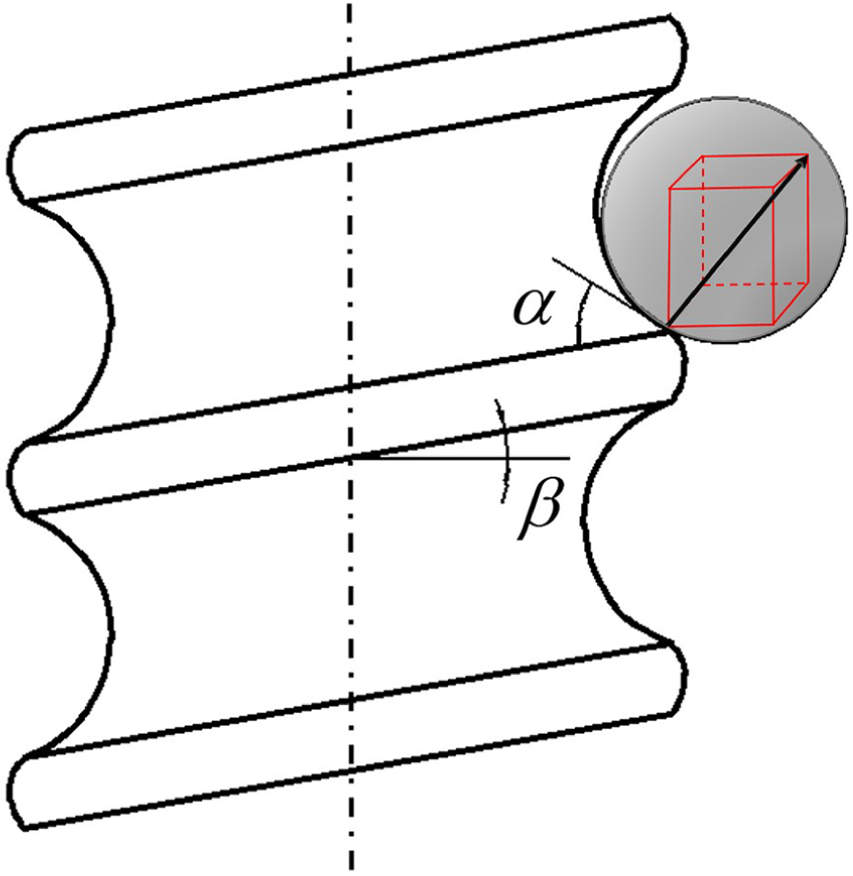
Force analysis of a ball.
The distance from the ball screw contact to the screw axis can be written as

The torque generated by one nut when the axial load is applied can be written as

Using this relation, the twist angle of the screw shaft can be obtained as

where T is the comprehensive torque produced by two nuts, L is the distance between the center of nut and the shaft support, G is the shear elastic modulus of the material, and

where
Thus, the torsional rigidity of the screw can be expressed by

Rigidity of ball screws
As the main transmission part in feed system, the static rigidity of the ball screw is related to the distance between the nut and the support, which can be expressed by

where
Rigidity of feed system with bearing rigidity
In the feeding process of machine tools, the rigidity of transmission is affected by many factors. Two of the most important factors are ball screws and fixed types, which can be expressed by

where
Experimental verification
Friction torque measurement
In the experiment, the no-load friction torque of a ball screw is measured on the friction torque test bench. As shown in Figure 4, one end of the ball screw is connected with a servo motor and the other end is fixed on the tailstock. The adjustable support unit in the worktable is in contact with the screw during the measurement. The rotation of the nut is constrained by the connecting rod ① and the cantilever ②. So the worktable feeds with the nut along the screw axial direction when shaft rotates. And the friction of circumferential movement measured by the pressure sensor ③ is multiplied by the force arm to get the real-time friction torque. Before the experiment, the ball screw ran for 5 min to make it fully lubricated using No.100 lubricating oil. Then, the friction torque was measured at the speed of 100 r/min. 6 The specifications of the ball screw is shown in Table 1.

Acquisition system of friction torque: 1, connecting rod; 2, cantilever; and 3, pressure sensor.
Specifications of the measured ball screw.

Axial static rigidity measurement
In the experiment, the axial static rigidity of the ball screw is measured on the static rigidity test bench. As shown in Figure 5, the ball screw nut is connected on the support unit ③ by threaded connection. To prevent the rotation of the nut and screw, the connecting rod is installed between the upper and lower pressure plates, and the flat bond connection is assembled between the lower pressure plate and the shaft end. To ensure the equal measure length in every test, three equal high blocks are placed between the screw measurement datum ⑤ and the nut measuring device ⑥. The axial load is applied on the screw shaft when the mobile beam moves downward.

Acquisition system of static rigidity: 1, pressure sensor; 2, upper pressure plate; 3, nut support unit; 4, anti-rotation device; 5, displacement sensor; 6, screw measuring datum; 7, nut measuring device.
Before the experiment, the ball screw was pressed with an axial load of 3734 N (10%
Results and discussions
Experimental results and discussions
Figure 6 shows the measured friction torque, theoretical, and measured axial static rigidity. The test results show that the variation trend of static rigidity is consistent with the friction torque and the measurement curve of static rigidity agrees well with that of the new model. Table 2 shows the comparison between the experimental and the theoretical results at different positions. The relative error of the traditional model is within 8.09%, while the error of new model is within 6.75%. More importantly, only a constant rigidity of 740.6 N/µm can be obtained by the traditional model, which cannot reflect the fluctuation. While in the new model, the calculated fluctuation of the static rigidity is 6.67%, which is very close to the experimental result (7.71%) and indicates that the new model built in this article is valid. It has to be mentioned that, the measured rigidity in 50 mm is lower than that in 100 mm. This may be related to the travel error and material defect near the position of 50 mm, which generates a larger axial deformation and then reduces the contact rigidity.

Friction torque, theoretical, and experimental static rigidity.
Comparison between experimental and theoretical results at different positions.
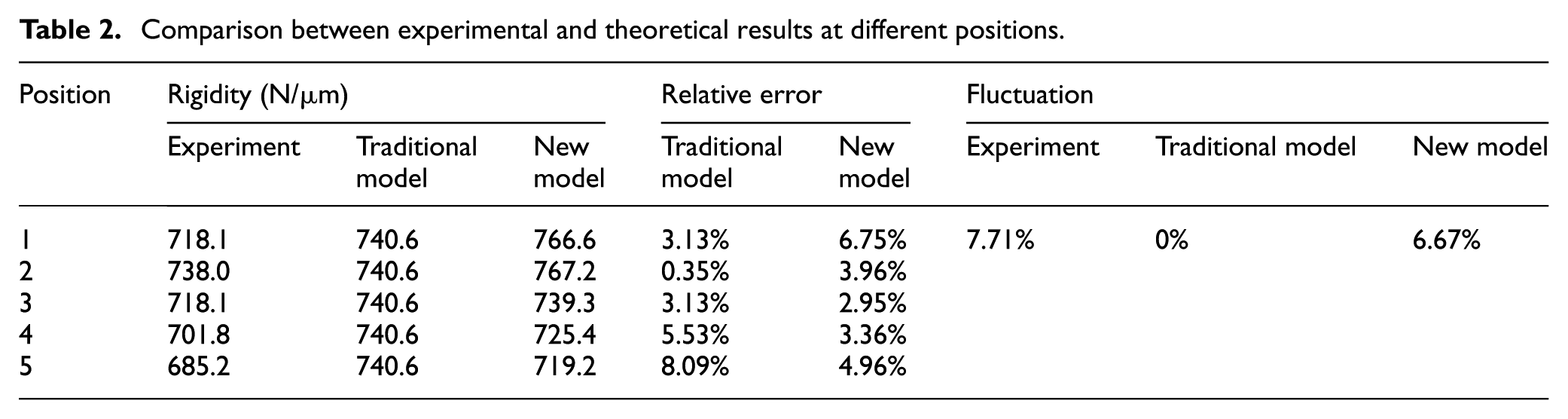
Table 3 shows the simulation results of the static rigidity under different levels of friction torque (3, 2, and 1 Nm) and friction torque fluctuation (50%, 30%, and 10%). According to Table 3, under a certain level of the friction torque fluctuation, higher friction torque level leads to lower static rigidity fluctuation. And under a certain level of the friction torque, higher friction torque fluctuation level leads to higher static rigidity fluctuation. More specifically, under different friction torque levels (1–3 Nm), a friction torque fluctuation of 10%, 30%, and 50% brings about a static rigidity fluctuation of 2.7%, 7.6%, and 12.1%, respectively. This means the effect of friction torque on the contact stiffness must be considered when the friction torque fluctuation reaches to a certain level, which also indicates that our new model can reflect the static rigidity fluctuation of preloaded ball screws well.
Simulation results of the rigidity under different levels of friction torque fluctuation.

Effect of stiffness on the feed system
Besides the contact rigidity, the torsional rigidity, screw shaft rigidity, and bearing rigidity also have a great influence on the feed system. In order to analyze the effect of each stiffness, four kinds of stiffness are calculated separately, as shown in Figure 7. It is worth mentioning that, the fixed type of the preloaded ball screw used here is fixed-free, and the screw shaft ends are supported by the angular contact thrust ball bearing with the 7602030TUP type (back-to-back 60 DEG), whose rigidity is a constant of 964 N/µm. As we can see in Figure 7, the contact rigidity shows a clear fluctuation over the whole effective travel, which is mainly due to the fluctuation of the friction torque at different positions. Due to the fixed type of the preloaded ball screw (fixed-free), both the screw shaft rigidity and the torsional rigidity reach to their highest values at the position of 0 mm, which is the closest position to the fixed end of the screw shaft. With the increase in the position, the distance between the position and the fixed end increased, leading to a larger axial deformation and a larger twist deflection of the screw shaft, and then a decrease in both the screw shaft rigidity and the torsional rigidity.

Comparison of different stiffness.
According to Figure 7, the torsional rigidity ranges from 10,664 to 28,494 N/µm; the rigidity fluctuation is 167.1%. The screw shaft rigidity ranges from 552 to 1793 N/µm; the rigidity fluctuation is 224.8%. The contact rigidity ranges from 1486 to 1707 N/µm; the rigidity fluctuation is 14.8%. In summary, the stiffness is sequenced by the descending order: torsional rigidity, screw shaft rigidity, contact rigidity, and bearing rigidity. And the rigidity fluctuation follows the descending order: screw shaft rigidity, torsional rigidity, contact rigidity, and bearing rigidity. The screw shaft rigidity and torsional rigidity are affected distinctly by position, that is, the longer the distance between the positions to the shaft end support, the lower the rigidity.
As aforementioned, the system rigidity is superimposed by each rigidity; therefore, the effect of different rigidities on the feed system is analyzed as below.
Effect of torsional deflection
The calculated static rigidity (

Static rigidity (
Effect of screw shaft
The calculated static rigidity (

Static rigidity (
Effect of shaft end bearing
Usually, the system rigidity is not only related to the bearing rigidity but also the fixed types. Two of the most commonly fixed types of preloaded ball screws are fixed-free and fixed-fixed, respectively. Considering the ball screw rigidity (

Static rigidity of feed system under different rigid mountings.
Comparison of stiffness fluctuation
To have a better understanding of the influence of different rigidities and fixed types, the stiffness fluctuation under different conditions is calculated, which is shown in Figure 11. The gray rectangles in Figure 11 indicate the rigidity fluctuation. As we can see in Figure 11, the torsional rigidity, screw shaft rigidity, and bearing rigidity will decrease the overall system rigidity. The torsional rigidity decreases the system stiffness by 4.98%, while increases the stiffness fluctuation by 3.77%. For the fixed types of the fixed-free, the screw shaft rigidity decreases the system stiffness by 46.69%, while increases the stiffness fluctuation by 63.19%. For the fixed types of the fixed-fixed, the screw shaft rigidity decreases the system stiffness by 30.25%, while increases the stiffness fluctuation by 10.59%. In different fixed types, the bearing rigidity under one end fixed type (fixed-free) decreases the system stiffness and the stiffness fluctuation by 30.78% and 30.31%, respectively; bearing rigidity under both ends fixed type (fixed-fixed) reduces the system stiffness and the stiffness fluctuation by 25.24% and 6.88%, respectively.

Rigidity fluctuation under different circumstances.
According to Figure 11, the influence of each rigidity on the system stiffness and stiffness fluctuation is sequenced by descending order: screw shaft rigidity, bearing rigidity, and torsional rigidity. For different fixed types, the fixed type of fixed-fixed could greatly reduce the fluctuation of system stiffness without decreasing the system stiffness obviously. The fixed type of fixed-free will worsen both stiffness and stiffness fluctuation of the system. And it also shows that, the screw shaft rigidity increases system stiffness fluctuation, and the torsional rigidity has little effect on the stiffness fluctuation of the system, which can be ignored.
Conclusion
In the present work, the relationship between friction torque and contact rigidity of a double-nut preloaded ball screw is built based on the correlation between preload and friction torque. The experimental results show that, the variation trend of measured stiffness is consistent with the theoretical values with the relative error within 6.75%, which verified the correlation derived in this article.
Furthermore, the value and fluctuation of four kinds of stiffness are discussed. Compared to the contact rigidity and bearing rigidity, the screw shaft rigidity and torsional rigidity are greatly influenced by the position. The screw shaft rigidity has the greatest influence on the system stiffness and stiffness fluctuation, followed by the bearing rigidity, and the torsional rigidity. For the feed system, it is of great significance to increase the bearing rigidity, which determines the lowest stiffness of the whole system. The fixed type at both ends (fixed-fixed) is an ideal installation way, which can reduce the system stiffness fluctuation without losing the system stiffness substantially.
Footnotes
Acknowledgements
The authors greatly thank the Key Laboratory of Performance Test and Reliability Technology for CNC Machine Tool Components of Chinese Machinery Industry for providing the experiment materials.
Handling Editor: Xichun Luo
Declaration of conflicting interests
The author(s) declared no potential conflicts of interest with respect to the research, authorship, and/or publication of this article.
Funding
The author(s) disclosed receipt of the following financial support for the research, authorship, and/or publication of this article: This study has been supported by the National Science and Technology Major Projects of China (2016ZX04004007).
