



Abstract
Based on the theory of thermal transmission, this article provides a new method to acquire the friction coefficient in ball screw mechanism. While the screw is in thermal equilibrium, the heat absorption is equal to the heat dissipation. The heat absorption is able to be achieved by calculating the heat energy due to the friction at the contact area and the heat dissipation can be calculated by the law of thermodynamics. When the temperature rise is determined, the heat dissipation can be obtained and the friction coefficient in ball screw mechanism can be calculated further. In order to confirm the validity of this method, a measuring system is constructed to obtain the temperature rise of ball screws. The experimental results show that the temperature rise has the same tendency with the theoretical values depending on this model. Therefore, it can be exploited to predict the temperature rise of ball screws in the rated life cycle when the ball screw is under the condition of thermal equilibrium. Furthermore, this model can be used to evaluate the mechanical efficiency, which is an important parameter for the performance of the ball screw.
Introduction
The ball screw mechanism is widely used in computer numerical control (CNC) machining equipment to transmit force and movement due to its excellent performance in positioning accuracy and loading capacity. 1 In recent years, with the demand for high-speed CNC machine tools growing, the development of ball screws has been promoted. As the friction exists in the ball screw, the temperature rise happens when it is operating, especially at a high speed. This phenomenon will lead to thermal deformation and decrease the precision of ball screws. It is reported that in precision error, the thermal error takes 40%–70% overall. 2 Therefore, it is important to predict and control the temperature rise of ball screws.
The friction coefficient of ball screws is relevant to the rotational speed, axial load, coefficient of friction. 3 Due to the complex structures of ball screws, it is difficult to determine the coefficient of friction directly, but it is easier to obtain the friction torque of the ball screw. Therefore, many studies have been conducted for the calculation of the friction torque and the coefficient of friction is usually considered as a fixed value in these studies. Lin et al. 4 developed a theory to design the ball screw mechanism and evaluate the efficiency of the mechanism. A peak efficiency can be obtained when the coefficient of friction is equal to 0.075 based on their study. Wei and Lin 5 proposed a theoretical model to obtain the friction torque of ball screws. However, the coefficient of friction is quite small based on their model when the rotational speed is 100 r/min. Xu et al. 6 developed a new analysis model to acquire the friction torque of ball screws based on the systematic creep theory on the assumption that the coefficient of friction was 0.03. Zhou et al. 7 analyzed the correlation between no-load drag torque and the preload of ball screws with the coefficient of friction as 0.05. CC Wei and colleagues8,9 analyzed the kinematics of the ball screw mechanism and the friction at the contact area at high rotational speed, and found the increasing rotational speed increased the driving torque. Olaru et al. 10 developed a new model to investigate the friction loss at the contact area of the balls and the circular in the ball screw system, and the effect of the speed and load on total friction torque. As aforementioned, the coefficient of friction was chosen empirically; there are no direct calculations for the coefficient of friction. Besides, all the coefficients of friction used in the above studies are different from each other, which will lead to different theoretical results of the friction torque for a certain ball screw even under the same working condition.
Due to the existence of friction coefficient, the temperature rise will happen when it is under operation. In terms of the temperature characteristics of ball screws, many researches have been conducted about the distribution, cooling, and the thermal deformation. Kim and Cho 3 built a system to obtain the temperature distributions of the ball screw with a preload in the axial direction at different velocities with the finite element method (FEM). Min and Jiang 11 provided an integrated thermal model based on the FEM to acquire the temperature distribution of the ball screw system. Xu et al. 12 created the thermal behavior models based on the FEM and modified lumped capacitance method (MLCM) to analyze the thermal error in the ball screw system. For better accuracy, Koda et al. 13 produced an automatic error compensation system to reduce the thermal error of ball screw. Nevertheless, the mentioned studies on thermodynamics of ball screws pay more attention on the effect of the temperature rise. The method to calculate the temperature rise of ball screws is fewer.
As the friction coefficient influences the efficiency and temperature rise of the ball screw directly, it is necessary to obtain the value of the friction coefficient. Therefore, in this study, a model is built to calculate the friction coefficient. When the friction coefficient is determined, the studies on ball screws will achieve better results.
Theoretical analysis
When the rotational speed of the ball screw is stable, there are two heat sources: the friction between the balls and nut, balls and screw and the friction of the bears. In order to simplify the analysis, two assumptions are made in this article: (1) the heat

Calculation of
As

where z is the total number of the balls, F is the friction at the contact area of the ball and screw, and S is the relative displacement at contact point in unit time between the ball and screw. According to the formula for force and friction, F is written as

where f is the friction coefficient between the ball and screw raceway and P is the axial force at the contact point of the ball and screw.
As shown in Figure 1, when taking the preload as the external load, we can get

where


The stress characteristics of the balls.
Both rolling and slipping exist at the contact points in ball screws. However, the heat caused by rolling is much smaller than that by slipping. Therefore, it is assumed that

where

where
Calculation of

where n is the rotational speed of the bear and M is the friction torque of bear.
Calculation of

where h is the coefficient of heat convection, A is the surface area of the screw, and

where
By substituting equations (2), (3), (4), (8), and (9) into equation (1), the friction coefficient f at the contact area of the ball and screw can be written as

Mechanical efficiency
based on the thermal equilibrium
When a ball screw operates at a certain rotational speed and in the condition of thermal equilibrium, the input work is divided in two parts: the out work and the heat loss. Therefore, the mechanical efficiency

where
Temperature rise of a ball screw
From equation (11), we can get the equation for

Experiment details
In order to obtain an obvious temperature rise phenomenon, the test bench needs to provide a high rotation speed. The schematic diagram of the temperature rise test bench for ball screws is shown in Figures 2 and 3. The test bench is placed in the environment with a steady temperature of 20°C. Four temperature sensors are used to acquire the temperature of the bears, screw, and nut. The ball screw is assembled with the servo motor in order to rotate with a certain speed. For

The schematic diagram of the temperature rise test bench for ball screws.

The temperature rise test bench for ball screws.
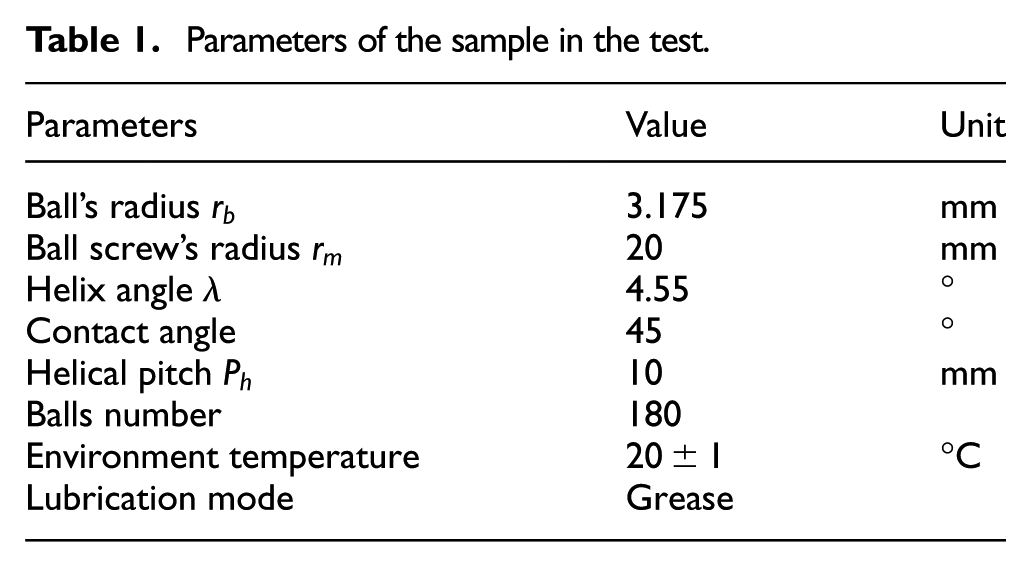
In the running experiment, the details of the sample in the operation test are shown in Table 1. Before the experiment starts, the sample is placed on the test bench until the temperature of the sample is the same with the air. Through the whole process, the revolution of the sample is 10 million cycles at a speed of 1000 r/min. The
Parameters of the sample in the test.
Results and discussion
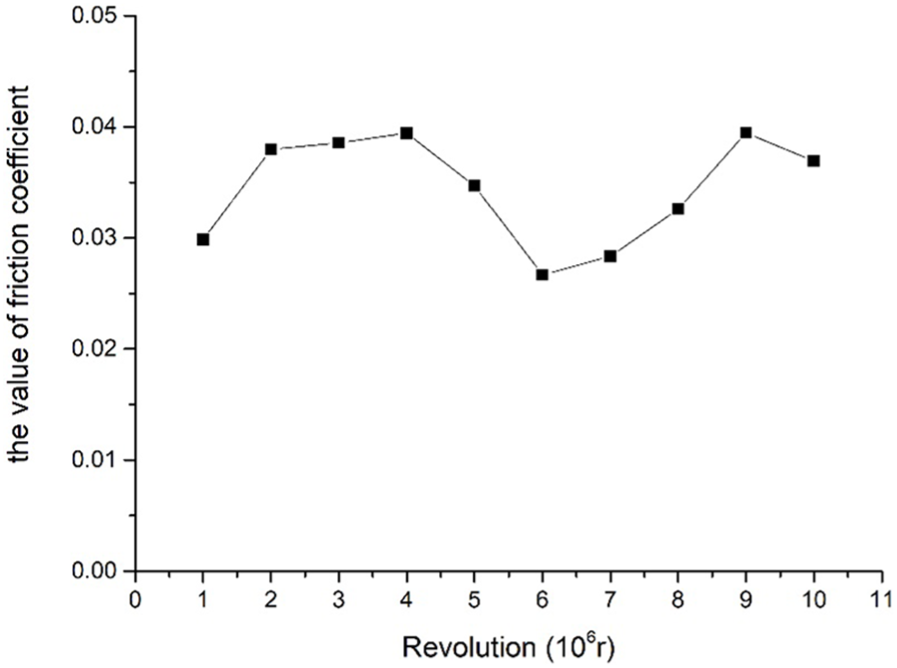
The calculated values of the friction coefficient according to the experimental results are shown in Figure 4. From the figure, it is obvious that the coefficient of friction is changing in the rated life of the ball screw, within 0.025–0.04, as the preload keeps changing during the running process.
The experimental and theoretical values of the temperature rise.
Therefore, when the coefficient of friction is considered as the average value, it is capable to obtain the temperature rise of ball screws. In Figure 5, the experimental and theoretical values of the temperature rise are shown. The experimental values of the temperature rise show a similar tendency as that of the theoretical results, which proves the validity of the present model. Before the 2 million cycles, the ΔT decreases quickly because of the preload loss. After 2 million cycles, the temperature rise because the preload is stable. The theoretical values are usually a little higher than the experimental values. This is because that the friction torque increases when the rotational speed increases, and the rotational speed of measuring is lower than the speed of running.
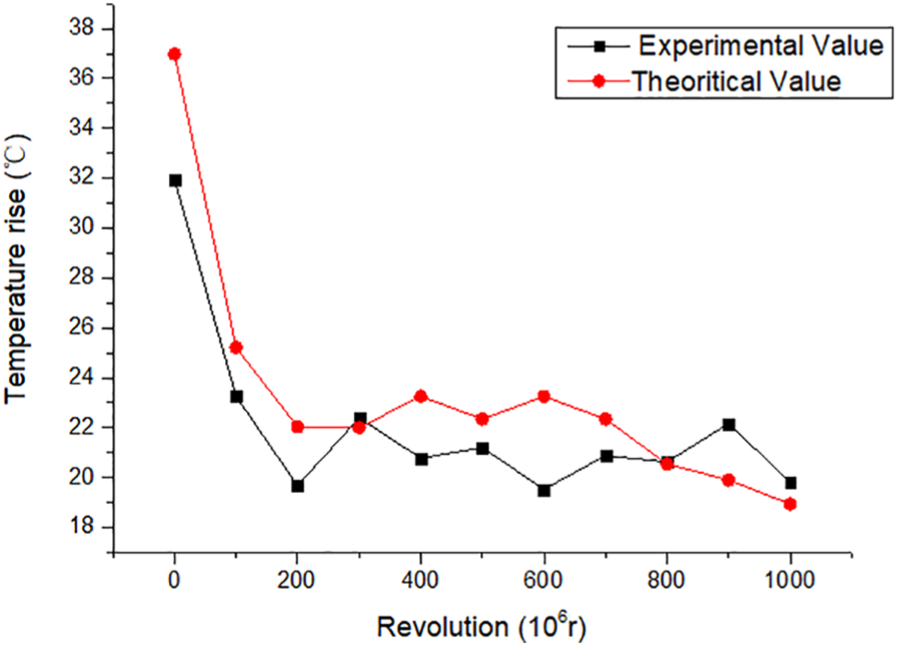
The experimental and theoretical results of the temperature rise.
Conclusion
In this article, a new method to acquire the friction coefficient in ball screw mechanism is proposed based on the theory of thermal transmission. According to the calculation based on this method, the friction coefficient of the sample in this study is within 0.025–0.04, and the coefficient of friction is changing a little in the rated life of the ball screw. As the preload is different every time, the friction coefficient of ball screw has no obvious change, so the preload has little effect on the friction coefficient of the sample. Based on this method, the experiment is conducted to predict the temperature rise of the ball screw. The experimental results of the temperature rise show a similar tendency as that of the theoretical results, which proves the validity of the present model. More importantly, the discrepancy between the experimental and theoretical results is relatively small, which indicates the friction coefficient of the ball screws is relatively stable during the whole progress.
Footnotes
Acknowledgements
The authors greatly appreciate the Key Laboratory of Performance Test and Reliability Technology for CNC Machine Tool Components of China Machinery Industry for providing the test benches and experiment materials.
Handling Editor: Zengtao Chen
Declaration of conflicting interests
The author(s) declared no potential conflicts of interest with respect to the research, authorship, and/or publication of this article.
Funding
The author(s) disclosed receipt of the following financial support for the research, authorship, and/or publication of this article: The authors greatly appreciate National Science and Technology Major Projects of China (2016ZX04004007) for support.
