




Abstract
For curve indeterminate box girder, updated Bayes identification model of displacement constants was derived and studied with the variable-scale optimization theory. First, the updated Bayes objective function of displacement constants of the structure was founded. The gradient matrix of the objective function to displacement constants and the calculative covariance matrix were both deduced. Then, with finite curve strip element method, mechanical analysis of curve indeterminate box girder was completed. With automatic search scheme of quadratic parabola interpolation for optimal step length, the variable scale theory was utilized to optimize the updated Bayes objective function. Then, the identification steps were expounded, and the identification procedure was developed. Through typical examples, it is achieved that the updated Bayes identification model of displacement constants has numerical stability and perfect convergence. The stochastic performances of systematic parameters and systematic responses are simultaneously deliberated in updated Bayes objective function, which can synchronously take the actual measured information at different times into account. The variable-scale optimization method continually changes the spatial matrix scale to generate renewed search directions during the iterations, which certainly accelerates the identification of the displacement constants.
Keywords
Introduction
The curve indeterminate box girder is commonly used in civil engineering, and especially, the curve indeterminate box girder often appears in bridge engineering. The perfect mechanical performances such as larger torsion stiffness and lighter weight naturally exist in this kind of thin-walled structures.1–3 The research results of mechanical analysis of the curve indeterminate box girder have ceaselessly emerged because of the importance in civil engineering.4,5 In Ye et al., 6 the layered shell element based on the supposition of the ignorance of the transversal shearing stress is deduced. Then, in Zhang, 7 the degraded solid element is applied for the curve indeterminate box girder, and with failure criteria of concrete material, the mechanical behaviors after cracking are studied in detail. Compared with the layered shell element, the finite strip element has fewer nodes and elements in structural analysis, and the mechanical responses of the curve indeterminate box girder are completed in Zhang et al. 8 In practical engineering, before the analysis of the curve indeterminate box girder, the displacement constants including elastic modulus and Poisson’s ratio must be mastered; otherwise, the prearrangement cannot be put into practice,9,10 and this problem is quite worth researching. During the available achievements, the Kalman filtering theory which has the advantages of auto-revision and auto-optimization has been applied in the identification of the displacement constants, which shows that if the initial constants are given improper, then the Kalman correction matrix might be divergent. 11 The Powell direct optimization method has been successfully used in the constant identification of the curve indeterminate box girder. 12 In Powell iterative processes, the improvement of the displacement constants only depends on the revision of the objective function without any search direction, which consequentially leads to lower computational efficiency. 13 In Zhang et al., 14 one-dimensional optimization method called Fibonacci series search method is employed to improve the computational efficiency, but it cannot conquer the inherent disadvantage of the Powell direct optimization method. The gradient optimization methods such as the variable-scale optimization method can smooth over the defect just disserted to a certain extent.15–19 The motivation of this article is how to derive the mechanical identification model of displacement constants of curve indeterminate box girder with updated Bayes theory.
Thus, the updated Bayes objective function expression of displacement constants of the curve indeterminate box girder is derived and the finite curve-strip-shaped element for the specific structure is attained. The major contributions of this article also lie in that the variable-scale optimization method is combined to establish the identification model of displacement constants of the curve indeterminate box girder. And, through analysis of some classic examples, several important conclusions of identification of displacement constants of the box structure are achieved. And, the updated Bayes objective function can tackle the measured systematic responses of different times and different spots simultaneously, which can also consider the randomness of the displacement constants and systematic responses accurately. The updated Bayes identification model and the variable-scale optimization method can also be used in other kinds of structures.
Updated Bayes theory for displacement constants of curve indeterminate box girder
In the identification model of displacement constants of the curve indeterminate box girder, the displacement constants are generally considered as stochastic variables which are usually recorded as the stochastic vector to complete the identification of poly constants. In identification of research achievements such as identification of models performance of fracture toughness of polymeric particle nanocomposites, identification of material interfaces in piezoelectric structures, and identification of typical flaws in piezoelectric structures using extended finite element method (FEM),20–22 Bayes theory is widely applied because one of the superiorities lies in its taking the stochastic property of systematic parameters and systematic responses into account efficiently; however, a much more efficient Bayes objective function in this article is derived below. From Bayes theorem, 13 it can be attained as

where

where
In structural engineering, the systematic responses at the testing points must be measured several times and the collected displacement data

where

Evidently,
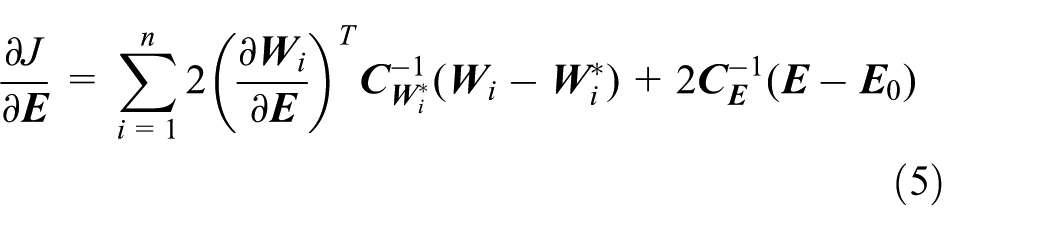

where the sensitivity matrix of systematic response to displacement constants

where

Presuming

where

where

Considering

Finite curve-strip-shaped element method for curve indeterminate box girder
Governing equation of finite curve-strip-shaped element for simply supported box girder
In equation (4), the updated objective function of displacement constants of curve indeterminate box girder,


Finite curve-strip-shaped element of box girder: (a) geometrical description of curve box, (b) element of top plate or bottom plate, and (c) element of web plate.
Aimed to simply supported box girder, displacement field function of finite curve-strip-shaped element through shape function interposition is achieved as

where

where

Due to the orthogonal property of the harmonic sinusoids

The mth item of the governing equation of pinned curve box is

where

where
Force agglomeration theory for curve indeterminate box girder
As for curve indeterminate box girder, it is impossible to resolve the curve indeterminate problem only depending on the derived finite curve element method. Therefore, the requisite joint algorithm is deduced with force agglomeration theory. Removing the external restrictions of middle supporters and the internal restrictions of diaphragms shown in Figure 2, the indeterminate box girder structure is converted into statically determinate system noted as simply supported box girder. Compatibility equations of structural deformation of the points at the external and internal restrictions can be presented as

where

Inner redundant forces of diaphragm.
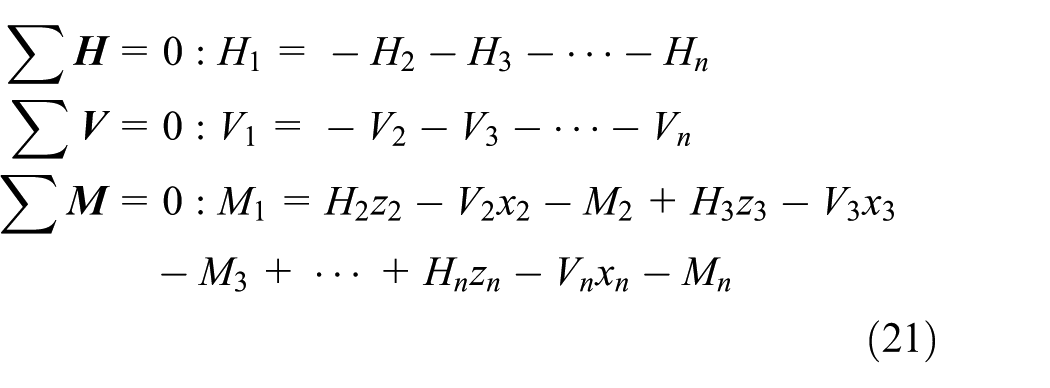
Then, in the section where each diaphragm lies, the internal redundant forces just constitute the self-equilibrium mechanical system. Select the ith diaphragm section and, for instance, take the No. 1 point into consideration shown in Figure 2, then from equilibrium relationship, it is achieved as
where

where

where

where


Substituting the agglomerating redundant force vector
The identification model of displacement constants with updated Bayes theory
The current optimal methods may be mainly divided into two categories called direct search strategy (simplex method, complex method, etc.) and gradient search strategy (variable scale method, Newton gradient method, etc.). 12 Generally, the direct search methods are comparatively inferior to the gradient search methods for the lower computational efficiency because of its only simply depending on the revision of the objective function.13,14 Variable-scale optimal method ceaselessly alters the spatial matrix scale to produce new search directions during the iterative processes and optimizes the objective function efficiently. During the variable scale steps of displacement constants of curve indeterminate box girder, determination of the optimal step size is involved, which belongs to a fairly complicated question in constant identification analysis. In the achieved references, the one-dimensional search algorism is probably directed to golden section algorism and Fibonacci series search algorism because they can guarantee the accuracy of the calculation and the simplicity of the program. But the iterative times are always larger, which inevitably leads to a lower efficiency because the two methods belong to linear interpolation search.26–28 The quadratic parabola interpolation method is adopted, which can make certain the interval of the optimal step size and implement the assignment automatically.
Combined with finite strip element method, the flowchart for the identification model of displacement constants of curve indeterminate box girder with updated Bayes theory is shown in Figure 3, and the corresponding steps in the mechanical identification model are achieved as follows:
1. Choose the initial values
2. From equation (4), compute the updated Bayes objective function
3. Determine the search direction vector by

4. From equation (4), confirm the optimal step length


The flowchart for the mechanical identification model of the displacement constants.
The one-dimensional quadratic parabola interpolation search method is involved in equation (28), which can be decomposed into the next three steps.
5. Decision of the domain in which the optimal step size
6. If
7. Interpolating of the optimal step size



where
8. When the optimal step length
9. For the following convergence judgment equations, if either of the next two criteria is satisfied, it is that


In equation (32), the mathematical symbol |·| means absolute value. In equation (33), the mathematical symbol
The iterative computation is convergent, which means that the identification results of displacement constants
10. If
11. Compute the variable vector difference


12. Determine the iterative variable scale matrix


Then, let
13. The covariance
Analysis of the examples
The variable scale of displacement constants

Numbers of curve-strip-shaped elements and nodal lines (cm).

Vertical view of continuous box girder.

Connection points between box and diaphragm.
Actual values of displacement constants and other parameters of the curve indeterminate box girder.

Expectations and standard deviations of the systematic responses (10−2 cm).

Case 1
The identification of displacement constants of the curve indeterminate box girder when the priori information is accurate, which indicates that the priori information of the continuous box girder is
Identification results of displacement constants of continuous box girder in Case 1 (104 N/cm2).


Variable scale results of displacement constants in Case 1 (104 N/cm2): (a) iterative results when the first group is set and (b) iterative results when the second group is set.
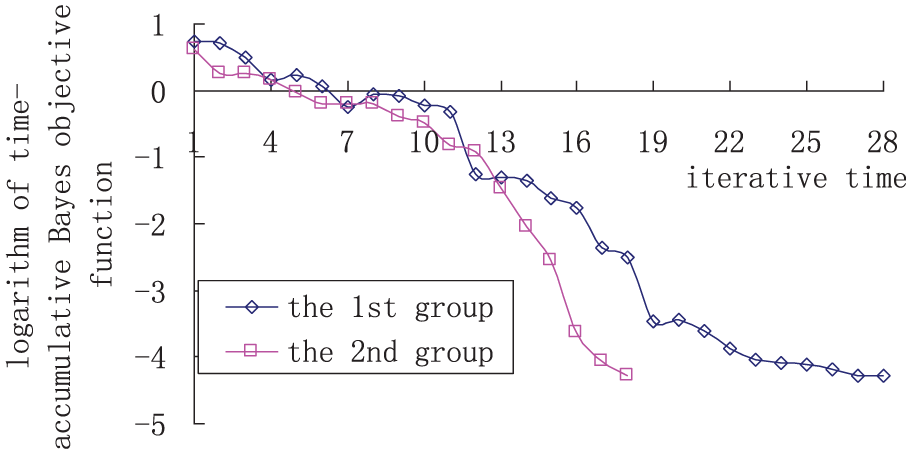
Iterative results of logarithm of updated Bayes objective function in Case 1.
From the results in Table 3 and Figure 7, it is indicated that when the priori information is accurate, the optimization process of the mechanical identification model of displacement constants of the curve indeterminate box girder converges to the actual parameter values stably. Iterative results of logarithm of updated Bayes objective function in Figure 8 are steadily decreased. The results indicate that whether the initial constant values are close to the actual parameter values or not, the convergence of the mechanical identification model is unassociated with the initial constant values. The advantage of the proposed method lies in that compared with the Powell direct optimal results,13,14 the mechanical identification model is more efficient because the computational times of the derived Bayes objective function mainly resulting from the finite strip element model are fewer. The final coefficient of variation of constant is about 0.08, which is ameliorated in comparison with the given value. In this case, the optimization process can converge according to the two convergence criteria if different initial constant values are assigned.
Case 2
In order to achieve some other regularities of the mechanical identification model of displacement constants of curve indeterminate box girder while the priori information is accurate, the initial values of the third group
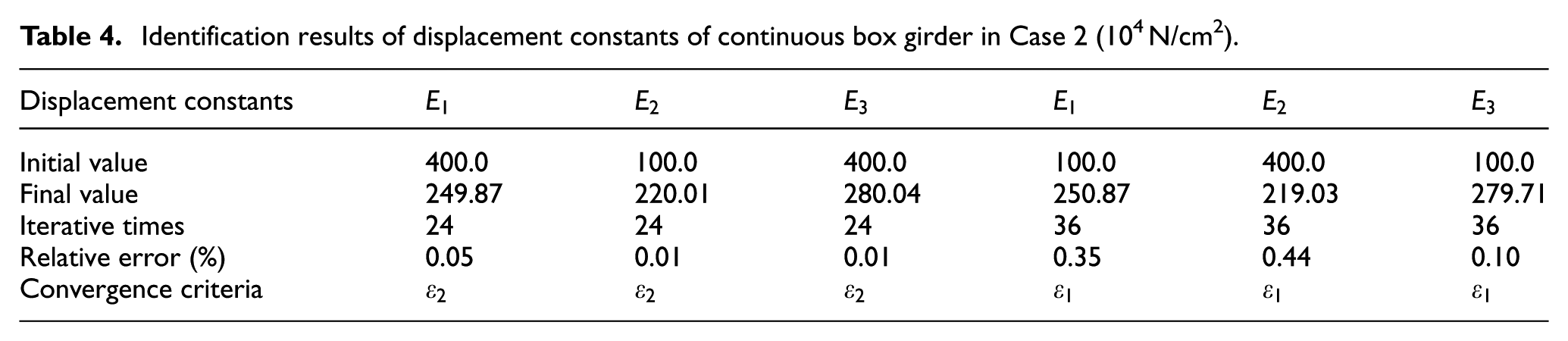
Identification results of displacement constants of continuous box girder in Case 2 (104 N/cm2).
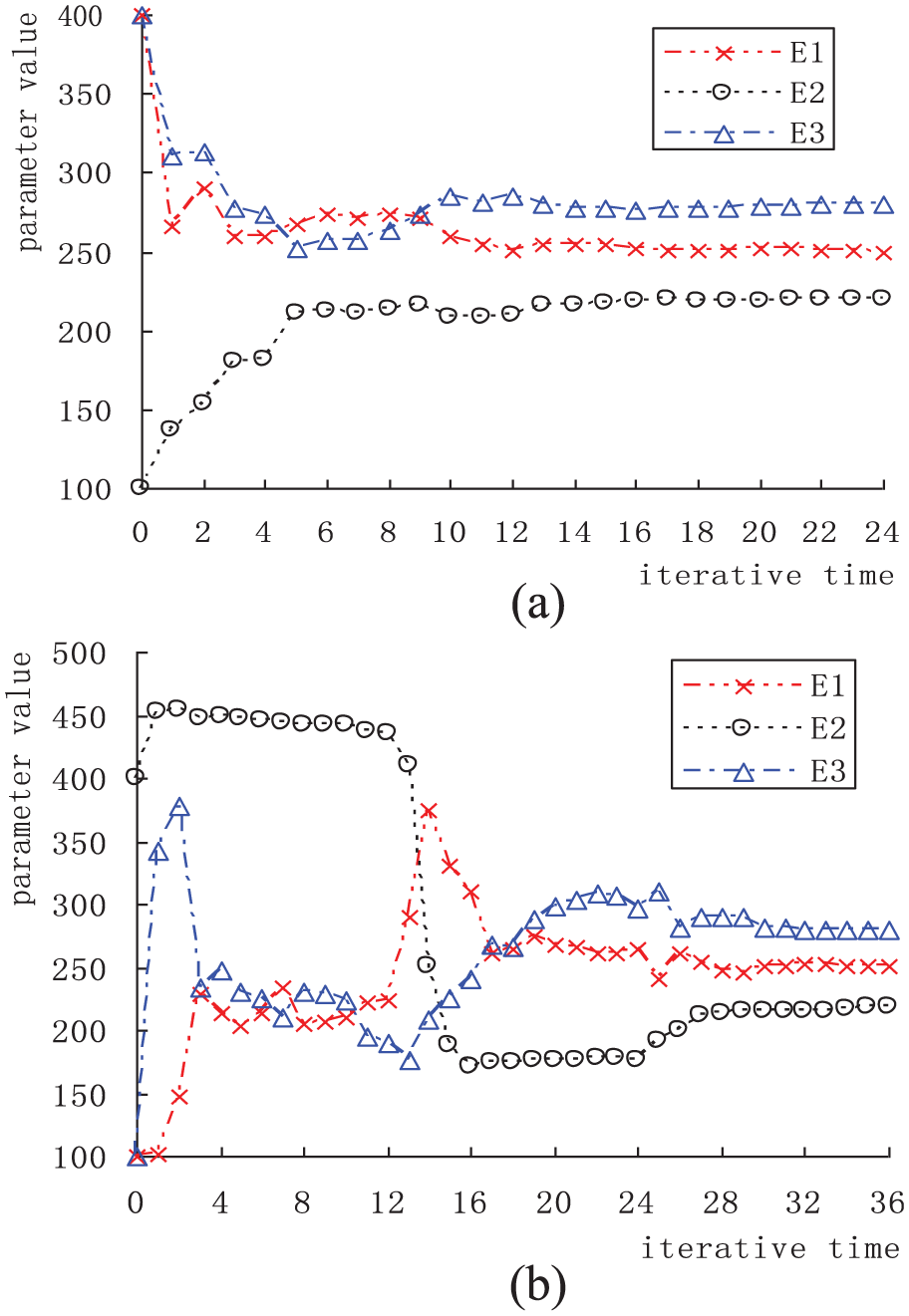
Variable scale results of displacement constants in Case 2 (104 N/cm2): (a) iterative results when the third group is set and (b) iterative results when the fourth group is set.

Iterative results of logarithm of updated Bayes objective function in Case 2.
From the results in Table 4 and Figure 9, it is shown that the optimization processes still converge to the actual values steadily. Iterative results of logarithm of updated Bayes objective function in Figure 10 are also steadily decreased. Some other conclusions can be drawn as follows. First, supposed that the initial constant values are closer to the actual values, the iteration times are not necessarily reduced when either of the convergence criteria is satisfied. For example, compared with the second group, the third group is evidently closer to the actual value
Case 3
The identification analysis of displacement constants of curve indeterminate box girder when the priori information is inaccurate. This case is consistent with the practical engineering because the presupposed priori information only dependent on engineering experience is hardly possible to agree with the actual value. Let priori information
Identification results of displacement constants of continuous box girder in Case 3 (104 N/cm2).

It can be found from Table 5 that if the iteration processes of systematic constant converge, then it only conforms to the second convergence criterion. The iterative results indicate that all of the relative errors are more than 10%, which means that the iterative processes are divergent. The reason is that combined with equation (4), when the priori information is inaccurate, it is improbable to make both of the items in the right of equation (4) converge to zero synchronously. Thus, although the iterative processes may converge, they cannot satisfy the first convergence criterion. Lacking the evaluating criterion of the accuracy of the actual values, how to judge whether the priori information is assigned appropriate is of great significance. Otherwise, the inappropriate assignment will lead the displacement constants to converge to wrong values, which would influence the engineering design by error. Through much research work, the regularity may be summarized and achieved that if the priori information satisfies the accurate condition, then the iteration processes can converge by both of the convergence criteria with different iterative times. If the priori information is inaccurate, then the iteration processes may diverge or converge only by the second convergence criterion.
Conclusion
The mechanical identification model of displacement constants of curve indeterminate box girder is completed with updated Bayes theory, and the main conclusions are drawn:
The identification processes of displacement constants of curve indeterminate box girder are steadily convergent to the actual values when the priori information is precise, which proves the accuracy of the derived mechanical identification model and the reliability of the compiled procedure;
During the iterative process, the mechanical identification model with variable-scale optimization theory incessantly engenders new search directions. It optimizes the derived objective function more efficiently than the Powell method, which depends simply on the revision of the objective function.
Compared with the routine Bayes objective function, it is an improvement that the updated Bayes objective function in the mechanical identification model can tackle the measured systematic responses of different times and different spots simultaneously, which can also consider the randomness of the displacement constants and systematic responses accurately.
Footnotes
Handling Editor: Shun-Peng Zhu
Declaration of conflicting interests
The author(s) declared no potential conflicts of interest with respect to the research, authorship, and/or publication of this article.
Funding
The author(s) disclosed receipt of the following financial support for the research, authorship, and/or publication of this article: This paper was financially supported by the National Natural Science Foundation of China (No. 11232007), Natural Science Foundation of Jiangsu Province (No. BK20130787), the Fundamental Research Funds for the Central Universities (No. NS2014003), Research Fund of Graduate Education and Teaching Reform of NUAA (No. 2017-2), and Research Fund of Education and Teaching Reform of College of Aerospace Engineering, NUAA (No. 2017-5).
