



Abstract
With general Bayesian theory, the accumulative Bayesian objective function of displacement constants of a hybrid indeterminate box girder was found. The gradient matrix of accumulative Bayesian objective function to displacement constants and the calculative covariance matrix were both derived. The finite curvilinear strip controlling equation of a pinned box girder was derived and the hybrid indeterminate problem of a continuous curvilinear box girder with diaphragm was solved based on agglomeration theory. Combined with one-dimensional (1D) Fibonacci automatic search scheme of optimal step length, the variable scale gradient theory was utilized to research the stochastic detection of displacement constants of the hybrid indeterminate curvilinear box girder. Then the detection steps of displacement constants of the hybrid indeterminate curvilinear box girder were presented in detail and the detection procedure was developed. Through some classic examples, it is achieved that the accumulative Bayesian detection of displacement constants of the hybrid indeterminate curvilinear box girder has perfect numerical stability and convergence, which demonstrates that the derived detection model is correct and reliable. The stochastic performances of displacement constants and structural responses are simultaneously deliberated in an accumulative Bayesian objective function, which proves to have high computational efficiency. The variable scale gradient method incessantly changes the spatial matrix scale to engender new search directions during the iterative processes, which makes the derived accumulative Bayesian detection of the displacement constants more efficient.
Keywords
The box girder is generally applied in civil engineering and especially the curvilinear box girder often appears in structural engineering.1,2 The superior mechanical characteristics including larger torsion stiffness and lighter weight naturally exist in this kind of structure.3,4 The research results of mechanical analysis of the box girder have usually emerged with the improvement of the construction technology.5,6 The layered shell element based on the supposition of the ignorance of the transversal shearing stress is deduced in Ye et al. 7 and the analysis of ultimate loads of a prestressed concrete multi-T girder is accomplished. Then in the study of Zhang, 8 the degraded solid element is applied for the box girder, and with the failure criteria of concrete material, the mechanical performances after cracking are studied in detail. Compared with the layered shell element, the finite strip element has fewer nodes and elements in structural analysis, the mechanical responses of the box girder are completed in Zhang et al., 9 and, with agglomeration theory, the hybrid indeterminate curvilinear box girder is resolved. 10 Before the analysis of the box girder, the systematic constants including elastic modulus and Poisson’s ratio must be mastered, otherwise the prearrangement cannot be put into practice.11,12 However, it is sometimes quite difficult to grasp displacement constants exactly. The displacement constants are often presupposed by engineering experiments and even sometimes subjectively given by engineering experiences, which cannot take the influence of stochastic factors into consideration or cannot accurately reflect the complex practical circumstance.13–15 How to determine the displacement constants efficiently is worth researching. During the available achievements, the Kalman filtering theory which has the advantages of self-revision and auto-optimization has been applied in the detection of displacement constants, which shows that if the initial constants are improper, the Kalman adaptation matrix might be divergent. 16 The Powell direct optimization method has been successfully used in the constant detection of the box girder. 17 In the Powell iterative processes, the improvement of the systematic constants only depends on the revision of the objective function without any search direction, which consequentially leads to lower computational efficiency. 18 In Zhang et al., 19 a new search method for optimal step length is employed to improve the computational efficiency, but it cannot alter the inherent disadvantage of the Powell direct optimization method. And fortunately the gradient search methods can conquer the defect just disserted to a certain extent.
Thus, the accumulative Bayesian objective function of displacement constants of the hybrid indeterminate curvilinear box girder is derived and the finite curvilinear strip element for the box structure is obtained. In order to find the detection analytical model of displacement constants of the hybrid indeterminate curvilinear box girder, the variable scale gradient theory is combined with. And through analysis of some classic examples, several laws about accumulative Bayesian detection of displacement constants are recognized and achieved.
Accumulative Bayesian objective function of displacement constants of a hybrid indeterminate box girder
Although the Bayesian statistical method is quite different from the classical statistical methods, the parameters estimated by the referred methods are identical under the condition of large samples. In the case of small samples, the Bayesian statistical method can make full use of all kinds of information and the results are more reliable. The characteristic of the Bayesian statistical method is that it can make full use of existing information, such as general information, empirical information, and sample information, and base statistical inference on posterior distribution. This not only reduces the statistical error caused by the small sample size, but can also be inferred without data samples.20–23 During the process of the variable scale gradient detection of displacement constants of the hybrid indeterminate curvilinear box girder, the displacement constants are totally considered as stochastic variables, which are recorded as the stochastic vector

where
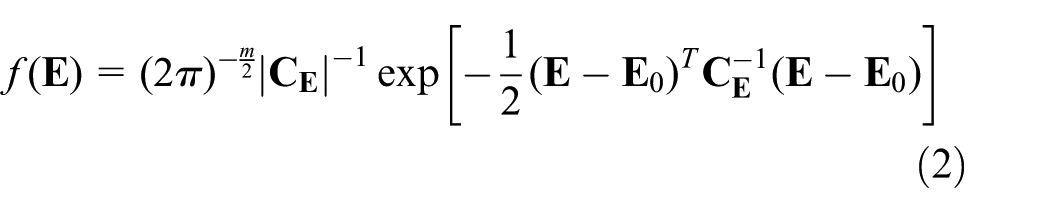
where
In practical engineering, the displacements at the measuring nodes must be measured many times and the measured displacement data

where

To obtain the detection result of displacement constants with variable scale gradient theory, from equation (4) the gradient matrix of accumulative objective function J to displacement constants

Expanding

where

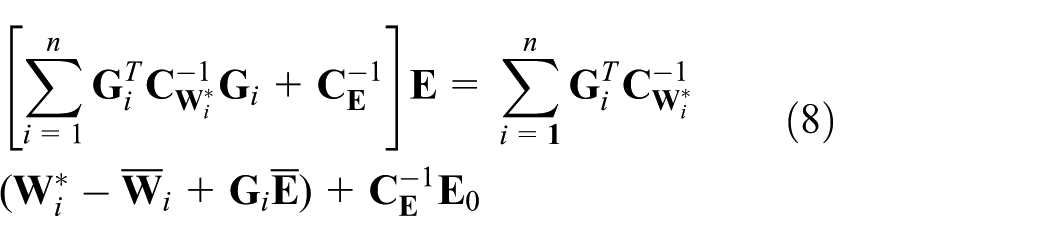
where
Assuming

where

where

Equation (11) can be derived as

The mechanical solution of the hybrid indeterminate curvilinear box girder
Finite curvilinear strip element theory
A finite curvilinear strip element is suitable for mechanical research in the determinate girder shown in Figure 1. The different kinds of

where the x-axis is the longitudinal direction in the initial section, the y-axis is the tangential direction in the initial section, and the z-axis is vertical to the plane which includes the x-axis and the y-axis; r is the radius variable;

The determinate pinned curvilinear box.
As for the pinned curvilinear box structure, the displacement interposition function of the finite curvilinear strip element shown in Figure 2 is

where

where


The finite curvilinear strip element.
For the orthogonality of

The mth controlling equation of the pinned curvilinear box girder is

where

where
Agglomeration theory for the hybrid indeterminate curvilinear box girder
As for the hybrid indeterminate curvilinear box girder, it is impossible to resolve the hybrid indeterminate issue only depending on the above finite curvilinear element method. Therefore, the fairly complicated arithmetic is solved with agglomeration theory. Releasing the interior restrictions of diaphragms and the exterior restrictions of middle supporters in Figure 3, the hybrid indeterminate box girder is converted into a determinate analytical system noted as a pinned curvilinear box girder. The equation of compatibility for structural deformation of the joints at the redundant restrictions can be expressed as

where

where

where

where

where

Interior redundant forces of the diaphragm.
Variable scale gradient theory for accumulative Bayesian detectionof displacement constants
Variable scale gradient theory
The main optimization methods may be assorted into two kinds: direct optimization method (simplex method, complex method, etc.) and gradient optimization method (variable scale method, Newton gradient method, etc.). 12 Generally, the direct search methods are always inferior to the gradient search methods for the lower computational efficiency because of simply depending on the correction of the objective function.16–18 The variable scale gradient method incessantly changes the spatial matrix scale to produce new search directions during the iterative processes and optimizes the derived objective function efficiently.
Combined with the finite curvilinear strip element method and variable scale gradient theory, accumulative Bayesian detection steps of displacement constants of the curvilinear box girder are achieved as follows:
1. Set the initial values
2. From equation (4), compute the accumulative Bayesian objective function
3. Determine the search direction vector by
4. From equation (4) and using the next 1D Fibonacci search method, confirm the optimal step length

Then compute the accumulative Bayesian objective function
5. For the following convergence judgment equations, if one of them is satisfied, it is that

The variable scale gradient iteration is convergent and the detection results of displacement constants
6. If
7. Compute the variable vector difference

8. Compute the gradient vector difference

9. Determine the next iterative variable scale matrix


where
The Fibonacci series method
The 1D search of step length



where
The detection analysis of the examples
Accumulative Bayesian detection of displacement constants

Number of curvilinear strip element and the typical line/cm.

Restrictions of the hybrid indeterminate curvilinear box.

Joint points between the box and the diaphragm.
True values of displacement constants and the widths of the curvilinear box girder.

Expectations and standard variances of the measured displacements/cm.

Case 1
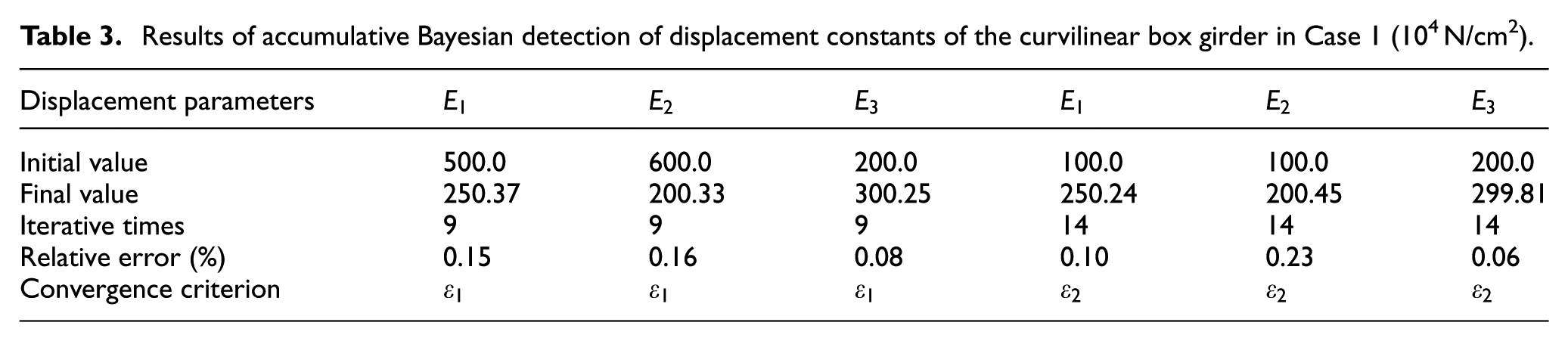
Accumulative Bayesian detection of displacement constants of the hybrid indeterminate curvilinear box girder when the priori information is precise, which means that the priori information of the curvilinear box structure is
Results of accumulative Bayesian detection of displacement constants of the curvilinear box girder in Case 1 (104 N/cm2).

Accumulative Bayesian detection results of displacement constants in Case 1 (104 N/cm2): (a) iterative results with
From Table 3 and Figure 7, it is proved that, when the priori information is precise, the iterative process of accumulative Bayesian detection of displacement constants of the hybrid indeterminate curvilinear box girder is steadily convergent to the true constant values. Whether the initial constant values are far from the true or not, the convergence is independent of the initial constant values. The results also indicate that, compared with the Powell direct optimal results,18,19 the variable scale theory is more efficient because the computational times of the accumulative Bayesian objective function mainly resulting from the finite curvilinear strip element model are fewer. The result of the constant variation coefficient is about 0.078, which is ameliorated in comparison with the given coefficient. In this case, the iterative process can be convergent in conformity to the two convergence criteria when different initial constant values are selected and set.
Case 2
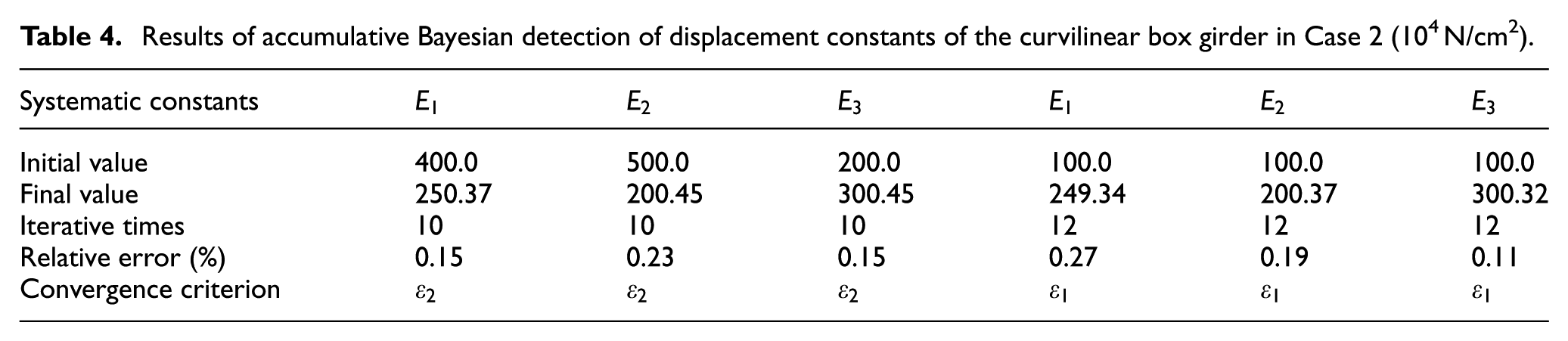
In order to achieve some other regularities of accumulative Bayesian detection of displacement constants of the hybrid indeterminate curvilinear box girder when the priori information is precise, the initial values of displacement constants
Results of accumulative Bayesian detection of displacement constants of the curvilinear box girder in Case 2 (104 N/cm2).
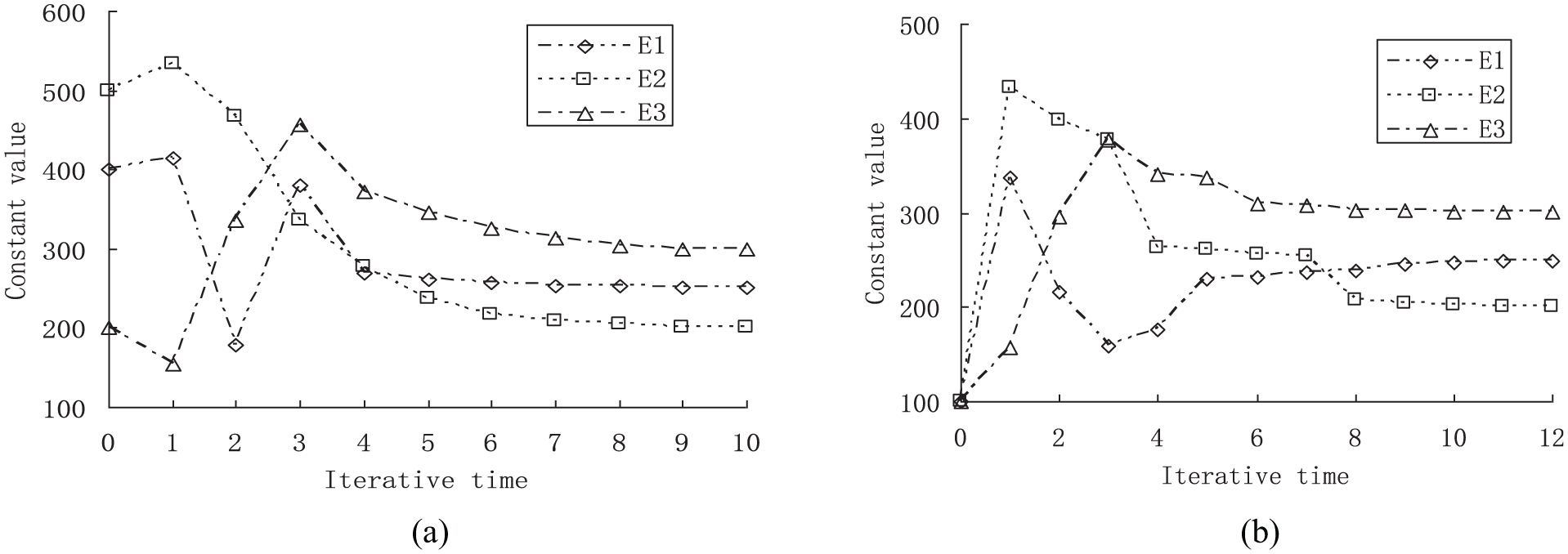
Accumulative Bayesian detection results of displacement constants in Case 2 (104 N/cm2): (a) iterative results with
It is indicated from the results in Table 4 and Figure 8 that the iterative processes are still steadily convergent to the true values. Some other conclusions can be drawn as follows. First, supposing that the initial constant values become closer to the true values, the iterative times cannot always get fewer when the convergence criterion is satisfied. For example, compared with
Case 3
The third case is when the accumulative Bayesian detection of displacement constants of the hybrid indeterminate curvilinear box girder when the priori information is imprecise. This case is in accordance with practical engineering because the supposed priori information only dependent on engineering experience is hardly possible to coincide with the true value. Let priori information
Results of accumulative Bayesian detection of displacement constants of the curvilinear box girder in Case 3 (104 N/cm2).

It can be found from Table 5 that if the iterative process of displacement constant is convergent, it only conforms to the second convergence criterion. The iterative results indicate that the whole relative errors are larger than 10% and the iterative processes are disconvergent to the true values. Without the judgment criterion of the true values, how to judge whether the priori information is applied properly is significant. Otherwise, it will make the displacement constants become convergent to false values, which will inevitably guide the practical engineering wrongly. Through considerable research, the regularity can be grasped and it is obtained that if the priori information satisfies the precise condition, the iterative process can be convergent by the two convergence criteria, which may produce different iterative times. If the priori information is imprecise, the iterative processes may be convergent only satisfying the second convergence criterion or divergent.
Conclusion
Accumulative Bayesian detection of displacement constants of the hybrid indeterminate curvilinear box girder is completed and the main conclusions are drawn as follows:
The accumulative Bayesian detection processes of displacement constants of the hybrid indeterminate curvilinear box girder are steadily convergent to the true values when the priori information is precise, which proves the accuracy of the derived detection analytical model and the reliability of the compiled procedure.
In accumulative Bayesian detection, the variable scale gradient method incessantly engenders new search directions during the iterative processes and optimizes the derived objective function efficiently, while the Powell optimal method is comparatively inferior for the lower computational efficiency because of its simple dependence on the revision of the objective function.
Compared with the routine Bayesian objective function, it is an improvement that the accumulative Bayesian objective function of displacement constants of the hybrid indeterminate curvilinear box girder can tackle the measured systematic responses of different times and different spots simultaneously, which can also consider the stochasticity of the displacement constants and systematic responses accurately.
With finite curvilinear strip element theory and agglomeration theory, a numerical mechanical method is put into practice without more elements in partition for the spatial mechanical analysis of the hybrid indeterminate curvilinear box girder.
Footnotes
Handling Editor: Daxu Zhang
Declaration of conflicting interests
The author(s) declared no potential conflicts of interest with respect to the research, authorship, and/or publication of this article.
Funding
The author(s) disclosed receipt of the following financial support for the research, authorship, and/or publication of this article: This study was financially supported by the National Natural Science Foundation of China (No. 41272325), the Natural Science Foundation of Jiangsu Province (No. BK20130787), the Fundamental Research Funds for the Central Universities (No. NS2014003), Research Fund of Graduate Education and Teaching Reform of NUAA (No. 2017-2) and Research Fund of Education and Teaching Reform of College of Aerospace Engineering, NUAA (No. 2017-5).
