




Abstract
An improved quality function deployment model based on integration of design failure mode and effects analysis and 2-tuple linguistic is proposed to guide the design scheme selection in the product redesign process. By adopting the entropy weight approach, the risk priority number of the risk assessment index is improved. Meanwhile, the improved results are fed back in quality function deployment to reassess the target values. In addition, the accuracy of the model on the basis of 2-tuple linguistic is improved in the process of information evaluation and data processing. Finally, the model is applied in the case of gear reducer to demonstrate its applicability. This model can not only improve the product’s reliability, but also enhance the quality of product by taking the customers’ needs and product’s risk priority number into consideration simultaneously and therefore improve the market competitiveness of the products.
Keywords
Introduction
Failure mode and effects analysis (FMEA) is a process of identifying potential failures to minimize the risk associated with them. 1 FMEA has been widely applied to product design decision-making. For example, Wang and Wei 2 proposed a dependent linguistic ordered weighted geometric (DLOWG) operator–based FMEA risk evaluation method, in which each factor of risk priority number (RPN) is regarded as a linguistic variable. Rhee and Ishii 3 addressed traditional RPN’s drawbacks and introduced life cost–based FMEA, which measures risk based on cost. It is useful for selecting design alternatives and reducing the overall life cycle cost. For reducing medical errors, Su et al. 4 developed a healthcare failure mode and effects analysis (HFMEA). To improve the low application efficiency of traditional FMEA in the analysis of multi-failure and multi-function products, Zhuo et al. 5 proposed a reliability design method based on the combination of axiomatic design and FMEA. By completely decomposing the design parameters of system or products adopting independent axiom, they eliminated the influence of design parameters and conducted complete and accurate FMEA analysis for subsystems and components. Mariajayaprakash and Senthilvelan 6 integrated FMEA with Taguchi method to detect failure and optimize sugar mill boiler. Chang et al. 7 integrated gray relational analysis with the decision-making trial and evaluation laboratory (DEMATEL) method to rank the risk of failure in FMEA assessment. Recently, there are an increasing number of FMEA models developed based on multiple criteria decision-making (MCDM) methods, for example, based on the MCDM method, Tian et al. 8 proposed an integrated fuzzy FMEA for risk factor analysis.
To be sustainable, manufacturing companies should consider how to fulfill consumer demand for products. 9 Sullivan 10 defined quality function deployment (QFD) as “a systematic and structured approach which ensures that customer needs drive the product design and production processes.” Li and Gao 11 introduced gray correlation degree in QFD. Ju and Sohn 12 proposed a hierarchical QFD framework that enables one to set R&D priorities and develop the corresponding business models to meet future societal needs. Moldovan 13 integrated the QFD approach and knowledge management to understand the customer needs. Not only the theory of QFD has been developed continuously, but also the application of QFD has been extended from the motor industry to the whole manufacturing industry and finally even to industries such as software development, health care, and education.14–16 Since QFD in its ability to identify the most suitable product design alternative and FMEA in its ability to identify the associated risk with that option, they remedy their respective limitations for each other, merged both application together to form a decision tool which not only can effectively guide the quality control in the product design and implementation phases, but also enhance customers’ satisfaction and competitiveness of the product in marketing phase. So recently a lot of models which combine QFD and FMEA have been constructed, for example, Almannai et al. 17 combined QFD and FMEA to develop a decision support tool for the selection of manufacturing automation technologies; based on the advantages of the QFD, FMEA, and activity-based costing (ABC) methods, Hassan et al. 18 developed a cost-based FMEA decision technique for improving the product quality/cost ratio; Guo et al. 19 combined QFD and FMEA to evaluate the element importance of shafting installation, that is why we combined both methods to analyze the quality and failure effects in product redesign.
Owing to the complexity of the product redesign process, the abundance of data, limited knowledge of designers, and the difficulty in quantitative presentation, it is natural for decision-makers to express their preferences by means of incomplete two-tuple linguistic preference relations. Herrera and Martinez 20 initiated the 2-tuple linguistic representation model in the IEEE academic journal. Now it becomes a hot research topic and widely used in decision-making problems. There are some new results in 2-tuple linguistic modeling. Li et al. 21 proposed a personalized individual semantics model by means of an interval numerical scale and the 2-tuple linguistic model, and defined a new computing with words (CW) framework. Dong and Herrera-Viedma 22 proposed a consistency-driven automatic methodology to set the interval numerical scales of 2-tuple linguistic term sets with linguistic preference relations. Dong et al. 23 proposed a novel CW methodology where the hesitant fuzzy linguistic term sets can be constructed based on unbalanced linguistic term sets using a numerical scale. Due to differences in knowledge backgrounds and experiences, FMEA team members prefer to utilize multi-granular linguistic term sets to express their assessments of system risk. Ko 24 adopted the two-tuple linguistic computational approach to overcome the drawbacks of the conventional RPN calculation method and proposed an improved FMEA model based on QFD. A hybrid risk evaluation model by FMEA was exploited with multi-granular linguistic term sets to express their assessments of system distribution assessments and is used in supercritical water gasification systems.24,25 Zhang 26 developed a novel approach to address multi-criteria group decision-making (MCGDM) problems with multi-granular incomplete 2-tuple fuzzy linguistic preference relations (FLPRs) and unknown weight information.
In this article, a new model is proposed. The product FMEA analysis was conducted first based on the 2-tuple linguistic evaluation method, through which each key failure mode’s risk index RPN can be obtained based on entropy weight. The fault correlation index, namely, F value, is derived from the RPN value. The F value can then be used in QFD analysis to modify the absolute important weight of various technical characteristics of the products obtained in House of Quality (HOQ). This new model, which integrates the FMEA into QFD in the product redesign process, does not only take into account the customer requirements, but also handle the hidden quality problem in the product manufacturing and circulation process.
The rest of this article is organized as follows. In the second part, the 2-tuple linguistic evaluation method is introduced. Then, the feasibility of integrated FMEA and QFD is analyzed. The improved RPN based on entropy weight and index of fault restoration is proposed. The integrated model of FMEA and QFD in the context of 2-tuple linguistic is constructed and the processing flow of this integrated model is also given. In the fourth part, the integrated model proposed is applied in a gear reducer design quality improvement case. Finally, the conclusion summarizes the contribution of this study.
Two-tuple linguistic information processing
2-tuple linguistic evaluation method was first proposed by the Spanish scholar Herrera et al. 27 To solve the multi-index clustering analysis problems with linguistic assessment information, Yu and Fan 28 introduced the 2-tuple linguistic–based maximal tree clustering method. Mi et al. 29 investigated the evaluation of uncertain systems with qualitative and quantitative information by integrating 2-tuple linguistic evaluation with gray clustering. At present, the evaluation based on the 2-tuple linguistic operator and/or fuzzy logic has been widely used in many research fields.23,30–32
When redesigning the gear reducer, the engineer needs to evaluate the possibility of gear reducer box cracking. One way is to use data from previous products for quantitative analysis; however, after redesign, there are no data to support quantitative analysis of the severity of post-design cracking, which can only be judged by experts or designers. In this case, it is difficult to give quantitative evaluation, for example, the probability is 0.3. They may give qualitative judgments, such as very likely, possible and impossible. In order to reduce the failure possibility, many experts or designers often need to make group decision and often need to consider the multi-dimensional evaluation and balance. This is a typical multi-criteria linguistic decision-making problem.
Linguistic assessment information can be used in FMEA and QFD.
24
For FMEA, its most commonly used tool is RPN. In traditional ways, RPN =
Typical rankings of failure factors.

However, due to the complexity of objective things and the fuzziness of human thought, the experts fail to estimate risks precisely using the numerical values. In the core tool of QFD, namely, HOQ, serial numbers (such as 1, 2, and 3) are also utilized to reflect the complex relationships between customers’ needs and engineering characteristics, or even the relationships among all engineering characteristics. Therefore, information loss and distortion are likely to occur due to the deployment step by step. In contrast, the 2-tuple linguistic model uses the 2-tuple
The 2-tuple linguistic model uses

In this article, three risk factors of FMEA are treated as 2-tuple linguistic
The evaluation of the importance of customers’ demand in QFD, the relationship matrix between customers’ requirements and engineering characteristics, the complex relationship matrix of each engineering characteristic, and the customer’s competition are all expressed using these two factors: linguistic evaluation set and the differences between linguistic and linguistic evaluation of language, namely, the 2-tuple
The proposed methodology
Improved RPN based on entropy weight
Entropy is the function of the system’s chaos, which describes the state of the system. The greater the entropy, the greater the uncertainty of the system. Shannon
33
first proposed the concept of information entropy and statistical mechanics entropy, and emphasized the concept of “information quantity,” that is, the more the information is, the more regular the system structure is, the more perfect the function is, and the smaller the entropy is. Supposing that there are n possible results:

In equation (2),
In this article, FMEA was given three risk index weights. According to the thought of entropy, the amount and quality of information that people obtained in decision-making has an impact on the accuracy and reliability of the decision. The entropy is a measurement when applying to the evaluation of different decision-making processes or case effectiveness evaluation.
Suppose that there are M evaluation objects and N evaluation indexes and
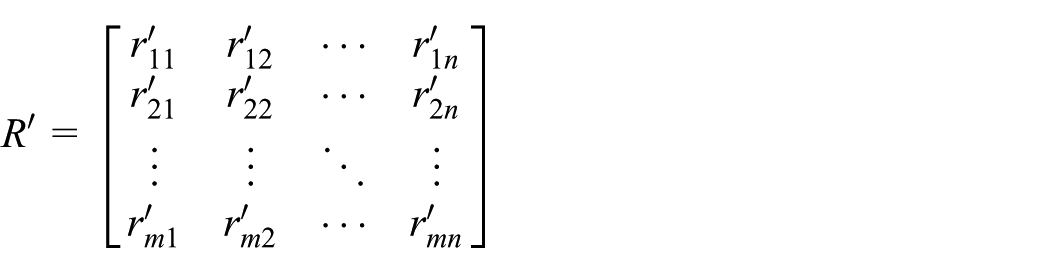
Normalized

So

when
The greater the degree of variation of the index, the smaller the information entropy, which means the greater role played by the index value in the evaluation process, and vice versa.
Then, the entropy weight of the

The value of the entropy weight is directly influenced by the object of evaluation. After the object for evaluation is determined, the adjustment can be made to the evaluation index according to entropy weight, which can improve the accuracy and reliability of the evaluation. Meanwhile, the precision of the evaluation index can also be adjusted according to the entropy weight. If necessary, the evaluation value and precision can be reset.
The weights of the three indicators (

The overall accuracy of the FMEA model is improved after the addition of the weight factor of each risk index. The RPN ranging between 1 and 10 is obtained using the method of 2-tuple linguistic information processing. The higher RPN means the greater risk. Thus, it settings the ordering of the priority rank.
Failure correction coefficient
In order to reduce the deviation caused by the isolated analysis of each functional element in QFD and defect that QFD cannot steadily reflect the engineering characteristics of components due to its comprehensive consideration of the customers’ need variation, the FMEA is required to be fed back into QFD to correct objective values. Therefore, the failure correction coefficient F (as shown in equation (6)), which is calculated by the RPN in the design failure mode and effects analysis (DFMEA) analysis, is used to correct the absolute weights of each technique in QFD by transforming the customers’ needs into engineering requirements on the component level

Here Q is the threshold value. If the RPN value is less than Q, then its corresponding failure cause does not need to be corrected. P represents the degree of the correction. The new significant order of each engineering characteristic is obtained by multiplying F with the absolute weights of the original engineering characteristics of components, which provides new reference data for improvement in the development and design of the product remanufacturing process.
The integrated model of FMEA and QFD based on 2-tuple linguistic
In this article, the integrated model of FMEA and QFD based on 2-tuple linguistic is used to help the design of the product. The model is based on the FMEA analysis RPN results. The risk indexes of the critical failure modes are obtained by FMEA analysis, and on the basis of RPN, the fault correction index F is proposed, which will be fed back to the QFD analysis to form the integrated QFD model. The integrated QFD matrix increases the fault correction index F, which can be used to modify the absolute weight of the product’s technical characteristics obtained in QFD, so that a real QFD and FMEA integration model can be obtained. The concrete steps are as follows:
FMEA analysis process
1. First, we analyze the FMEA of the remanufacturing products. According to the analysis of similar products in the database and the experience of the experts, we can list the critical failure modes of the products 2. Experts analyze the impact of each failure mode. From the expert analysis, the risk 3. Experts analyze the causes of each failure mode. From the expert analysis, the risk frequency degree 4. Experts analyze the detection method of each failure mode. Using the 2-tuple linguistic information processing method, the corresponding risk detectability 5. Experts calculate the improved RPN value. The elements
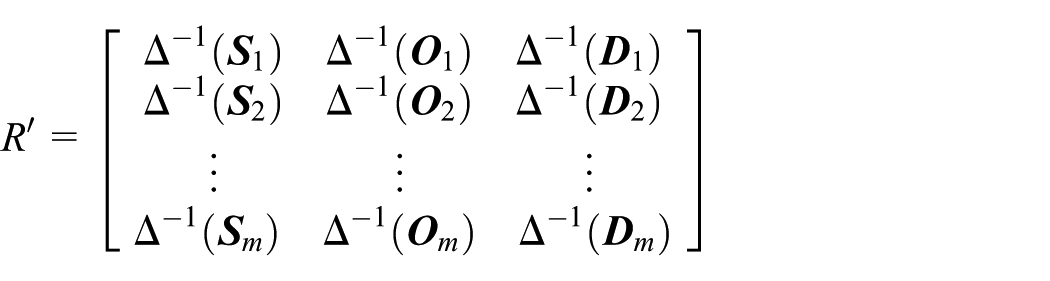
According to equations (2) and (3), the weights

According to the equation
6. On the basis of the improved
QFD analysis process
7. According to the market survey, the customers’ demand for the product is listed as
Using the 2-tuple linguistic computing method, we can extract the important degree of the customers’ requirement as
8. Calculate the absolute weight of the technical characteristics as

The absolute weight of the technical characteristics can be obtained by equation (7)

Combined QFD with FMEA
9. Finally, the results of the FMEA analysis are integrated into the QFD analysis. The fault correction index F was used to modify the absolute weight of the technical characteristics obtained by QFD. After modification, new weights

Based on
Numerical example of the model
For example, a gear reducer company wants to improve and redesign their product gear reducer. For improving the quality of the product by taking the customers’ needs and product’s reliability into consideration, and therefore improve the market competitiveness of the products. Thus, the product redesign evaluation was conducted before the product’s real redesign. Limited by the length of the article, only the first stage of QFD, transforming customers’ needs to technical schemes, is considered in this research.
Three experts are invited to participate in the product redesign evaluation process. First, FMEA analysis is performed for existing similar products to obtain the major failure modes, the influences of each failure mode, and the corresponding causes of the failure modes. Then, according to the experience of the existing similar products and the FMEA experts’ experience, the main failure modes of the gear reducer are listed as cracking of box
FMEA of gear reducer.

FMEA: failure mode and effects analysis; RPN: risk priority number.
When different experts evaluate the severity, frequency, and detectability of risks under varied conditions, the 2-tuple linguistic method is adopted to transform experts’ linguistic information into

After standardized matrix
Afterwards, the QFD table is established to continue analyzing the reliability of the gear reducers. According to the market survey, customers’ needs include high bearing capacity (
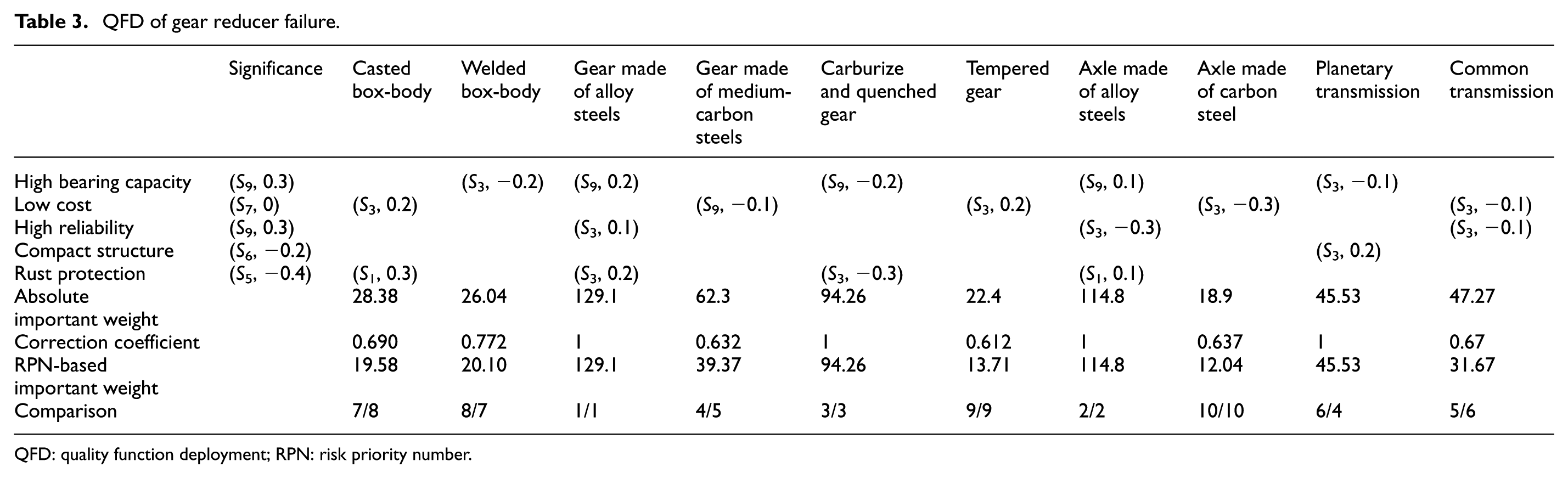
For each functional part, two alternatives are displayed in Table 3. Then the significance of the above needs and the relationship between customers’ needs and functional alternatives are all transformed into a 2-tuple. Then the 2-tuple inverse function in equation (1) is used to obtain the matrix
QFD of gear reducer failure.
QFD: quality function deployment; RPN: risk priority number.
Furthermore, according to equation (7), we can obtain the absolute weight of every technical characteristic
Table 3 indicates that the priority of absolute important weights and RPN-based important weight of each functional part have been changed, except three functional parts which do not correlate with customers’ needs. The results also modify the selection of the materials of each functional part. For instance, the material of box-body was changed from casting to weldment and the common transmission was replaced by a planetary one. All the above modifications indeed improve the products’ design quality and enhance the customers’ satisfaction

Conclusion
In this article, we proposed an integrated model of QFD and FMEA for the product redesign evaluation by using the 2-tuple linguistic information processing method to deal with the large amount of linguistic information in QFD and FMEA, and using the entropy weight method to improve the RPN of the risk assessment index. Furthermore, we apply the proposed model in the case of gear reducer redesign.
The results of the case study in this article show that, compared with traditional FMEA and QFD, the proposed integrated model can not only improve the product’s reliability, but also enhance the quality of product by taking the customers’ needs and product’s RPN into consideration simultaneously. From the engineering viewpoint, this method can prevent the isolated analysis of the failure modes and translate customers’ needs into engineering characteristics. From the management viewpoint, compared with numerical evaluation, the improved QFD model based on FMEA and two-tuple linguistic can deal with the problem of evaluation in real situations with uncertain linguistic information. This is suitable for the case of lack of numerical data in the process of product redesign, which requires expert language evaluation.
Although the case study has demonstrated the usefulness of the model in product redesign evaluation, we believe that there are areas for future validation and improvement. Furthermore, there are still certain limitations in our method, namely, the computation of the methodology is complicated and not easily appreciated by managers. It is necessary to develop an integrated information system to effectively support this method and provide a user interface to combine all the methodologies used in it. Moreover, the decision-makers must be at a senior level in the company in order to realize the importance and trends of all aspects, such as marketing, technology, and manufacturing.
Regarding the future research work, first, FMEA can be introduced into three stages of QFD deployment to further improve the product design quality. Second, several new 2-tuple linguistic models have recently been developed to deal with term sets that are not uniformly and symmetrically distributed.21–23,32 How to use these new models is worth studying.
Footnotes
Handling Editor: Stephen D Prior
Declaration of conflicting interests
The author(s) declared no potential conflicts of interest with respect to the research, authorship, and/or publication of this article.
Funding
The author(s) disclosed receipt of the following financial support for the research, authorship, and/or publication of this article: The authors would like to thank the National Social Science Fund of China for financially supporting this research under Grant No. 17BGL055.