




Abstract
Ferguson’s curves are widely used in airfoil design. We present a kind of Ferguson’s curves with a shape parameter by integrating the classical Ferguson’s curves with the q-derivatives, called q-Ferguson curves. This kind of curves not only preserves the interpolation properties of classical Ferguson’s curves but also has a shape parameter which provides a freedom variable to construct the desired curves satisfying the interpolation or length constraint.
Introduction
The problem of defining a curve through an array of points in space is a fundamental problem in mechanical design and computer-aided geometric design (CAGD), and several methods have been proposed. Generally, a set of functions
In CAGD, many scholars have addressed this problem and applied for curves and surfaces reconstructions. Zhu and Wang
4
provided a new method for fitting
The q-derivative, or Jackson derivative,
10
is a q-analog of the ordinary derivative. It is the inverse of Jackson’s q-integration. There are many scholars who studied on q-derivative.11–13 Simeonov and Goldman
14
integrated the q-derivatives with B-splines and proposed a kind of Quantum splines whose q-derivatives, up to some order, agree at the joins. Koekoek and Koekoek
15
proved the existence of the n-th q-derivative at the origin for every n and every function in both complex and real variable case. Zhang
16
presented a linearly parametrized set of curves, named C-curves with basis
The structure of the article is organized as follows. In section “Ferguson curves,” we briefly summarize the relevant definitions and results about Ferguson’s curves. Some results on q-derivatives are recalled in section “q-derivative.” In section “q-Ferguson curves,” we construct a q-Ferguson curve
Ferguson’s curves
In 1963, Ferguson developed a polynomial representation of space curves

We can express
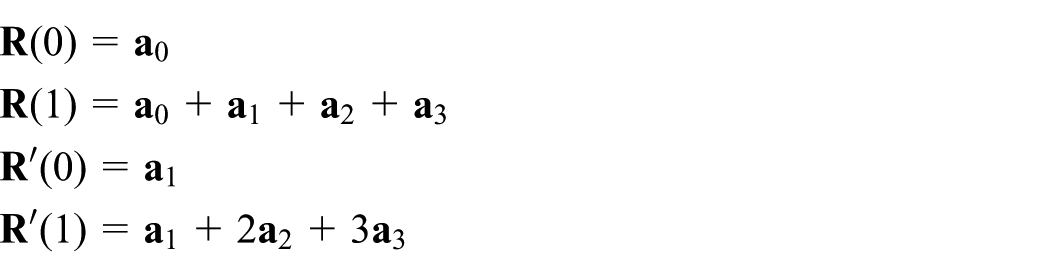
Solving the above equations yields expression for the coefficients, in terms of the geometric end conditions of the curve

Substituting back into equation (1), we obtain

Where

As Figure 1 shows, these basis functions,
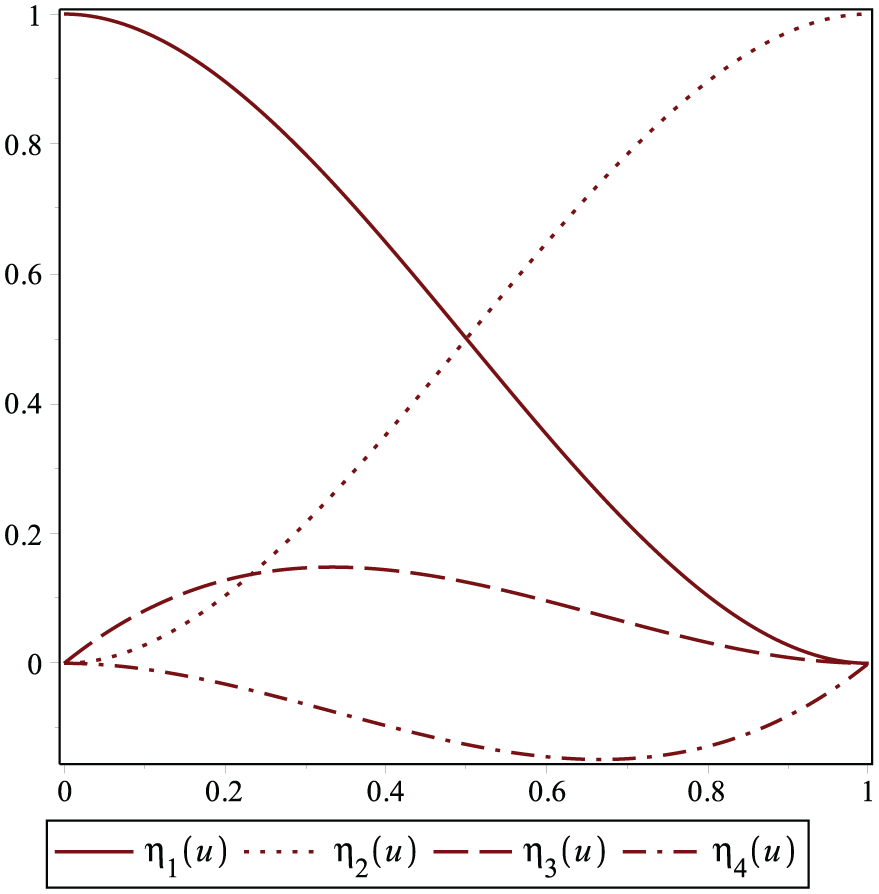
The blending functions of cubic Ferguson curves.
q-derivative
The quantum calculus deals with discrete derivatives, and the theory of splines investigates piecewise polynomials whose derivatives, up to some order, match at the joins. Quantum splines are piecewise polynomials whose quantum derivatives, up to some order, agree at the joins. Quantum derivatives are just classical derivatives without limits. There are two common notions of quantum derivative: the h-derivative and the q-derivative.
The h-derivative of a function

The q-derivative of a function

It is also often written as

The h-derivative is more familiar, but the q-derivative is more powerful. Many h-formulas are simply limits of q-formulas, 18 where we observe that the h-Bernstein basis functions are limits of the q-Bernstein basis functions. Similarly, the h-B-splines are limits of the q-B-splines.14,20 The q-derivative is also known as the Jackson derivative. It has the analogous linear and product rules to the ordinary derivative.
The linear rule:
The product rule:
Similarly, it satisfies the quotient rule

Example 1
For example, the q-derivatives of the monomials are given by

where

q-Ferguson curves
We integrate the Ferguson’s curves with the q-derivatives and get a new kind of curves with one parameter, called q-Ferguson curves, which not only interpolates the endpoints
Definition 1
For the given

where

or in the matrix form

In fact, without loss of generality, we assume the representation of the expect cubic polynomial curve is

where

Solving the above equations, we can get the following coefficients

By substituting the coefficients into the above representation, we can rewrite equation (5), as shown in equation (3) of Definition 1. The blending functions

The blending functions of q-Ferguson curves.
Remark 4.1
While
Example 4.1
Let

The left picture of Figure 3 depicts the q-Ferguson curves for

q-Ferguson curves.
The applications of q-Ferguson curves
The Ferguson’s curves are widely used in CAGD, such as airplane wing design, car body design, and ship hull design. In this section, we present two simple applications of q-Ferguson curves: q-Ferguson curves interpolation and q-Ferguson curves with constrained length.
q-Ferguson curves interpolation
Given the endpoints
Example 5.1
Let

If imposing the additional interpolation constraint: q-Ferguson curves interpolates

The corresponding q-Ferguson curve is shown in Figure 4.

q-Ferguson curves interpolation.
q-Ferguson curves with constrained length
For given two points
There are many literatures addressed to constructing curves with length constraint.9,21,22 We use q-Ferguson curves to deal with this problem. By the above first two conditions, we get the generic representation of q-Ferguson curves as

where

Since
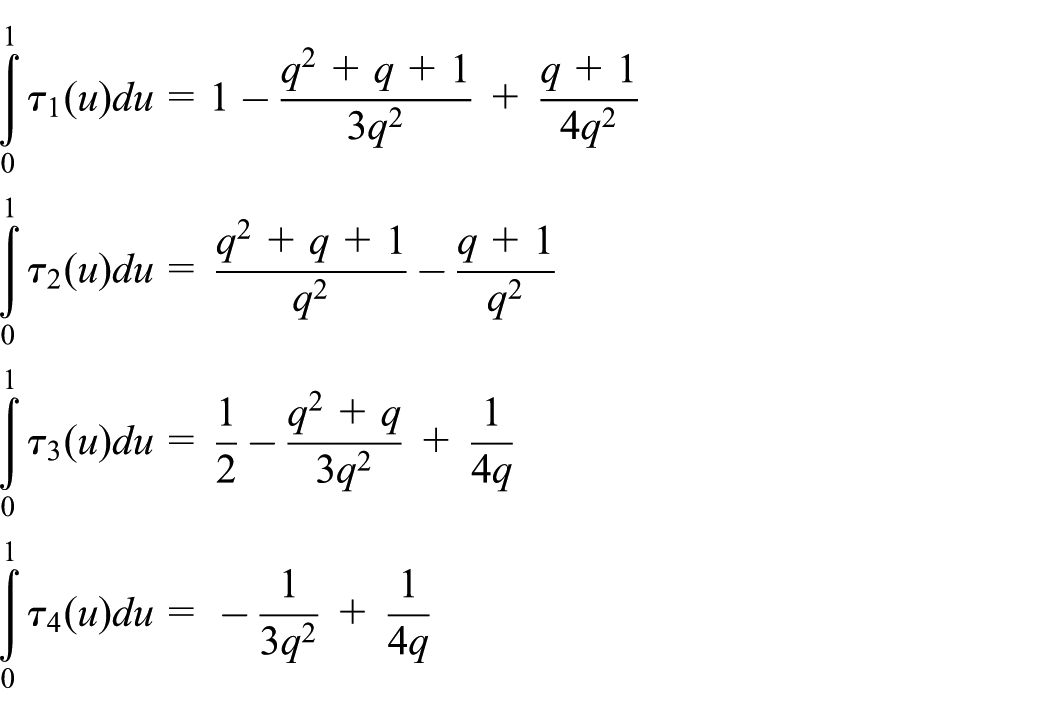
Substituting these four equations into equation (7), we can obtain the exact value of q by the following result.
Theorem 1
The length of q-Ferguson curves is L, namely

Example 5.2
Let the length L of q-Ferguson curve equal 2, and

q-Ferguson’s curves with length 2.
Conclusion
The classical Ferguson’s curves deals with generalized polynomial derivatives whose derivatives, up to some order, match at the joins. In this article, we present a kind of Ferguson’s curves with q-derivative, namely q-Ferguson curves. q-Ferguson curves are parametric polynomials curves whose q-derivatives, up to some order, agree at the endpoints. This kind of curves not only preserves the interpolation properties of classical Ferguson’s curves but also has a shape parameter which provides a freedom variant to construct the desired Ferguson’s curves satisfying the interpolation or length constraint.
As well known, the Ferguson’s curves can be applied in airfoil design, materials science, civil engineering, ship manufacture, and so on. Therefore, to study the influence rule of the shape parameter and the potential applications of the q-Ferguson curves in these fields is a very interesting topic. We will focus on applications of the q-Ferguson curves in airfoil design, numerical control milling, and so on. Moreover, we will also study the q-Ferguson surfaces and the applications of q-Ferguson curves in engineering design and CAGD.
Footnotes
Acknowledgements
The authors appreciate the comments and valuable suggestions from the anonymous reviewers. Their advice helped to improve the presentation of this paper.
Handling Editor: Francesca Russo
Declaration of conflicting interests
The author(s) declared no potential conflicts of interest with respect to the research, authorship, and/or publication of this article.
Funding
The author(s) disclosed receipt of the following financial support for the research, authorship, and/or publication of this article: This work was partly supported by the National Natural Science Foundation of China (grant nos. 11671068, 11271060, and 11801490).
