




Abstract
This article is made to discuss the effect of magnetohydrodynamic on squeezing flow of the nanoparticles between two confined boundaries. Constitutive expressions are utilized for convectively heated Maxwell nano-fluid using Buongiorno’s model in the mathematical development of considered flow problem. Here system of transport equations incorporates the combined impacts of thermophoresis diffusion, Brownian diffusion, and double stratification. Non-linear coupled ordinary differential equations are transformed by employing suitable similar transformations. The formulated non-linear system is evaluated successfully via convergent approach, that is, Homotopy analysis method. The graphical analysis is carried out for different active physical flow parameters. Nusselt and Sherwood numbers are also treated graphically. The results portray that the velocity profile shows cross flow behavior for increasing values of material parameter. Moreover, for dominant values of Biot number, convective effects dominant on plate surface and help the temperature and nanoparticles concentration to increase rapidly near the surface.
Keywords
Introduction
Many fluids correspond to industrial and engineering applications cannot be treated through Navier–Stokes equations. Such fluids include polymer solutions, paints, certain lubricants and oils, suspension and colloidal solutions, coating of clay, and many others. Among such fluids that can be described in various physical structures, there is no single model that discloses all the salient features of non-Newtonian fluids. In general, non-Newtonian fluids are categorized into differential, integral, and rate type fluids. Thus, Maxwell fluid includes in a simple class of fluids termed as rate type fluids. Properties of relaxation time are described conveniently through this model. Such effects may not be predicted via differential type non-Newtonian fluids. Flow of electrically conducting non-Newtonian fluid has achieved great importance over the years. Practically, we are dealing with a flow of conducting fluid which reveals dissimilar behavior under the effect of magnetic forces. For such cases, magnetohydrodynamic (MHD) feature is also needed in considered flow. It is expected that MHD analysis of nano-fluids has significant role in switches and optical gratings, separation of ink’s float, magnet is utilized to move up the particles in bloodstream to tumor in cancer therapy. Characteristics of magnetic field effects on stagnant flow of convectively heated Maxwell nano-fluid induced by stretchable sheet are explored by Ibrahim. 1 Sui et al. 2 exhibited the properties of heat and mass transport processes via non-Fourier and non-Fick fluxes in Maxwell nano-fluid flow through stretchable sheet with velocity slip. Saleem et al. 3 inspected the properties of modified law of Fourier on flow and heat transfer of MHD Maxwell liquid through stretchable surface. Reddy et al. 4 exhibited slip analysis on convectively heated Maxwell nanomaterial flow deformed by exponentially stretched sheet with magnetic effects. Liu and Liu 5 discussed the features of Maxwell fluid flow deformed by stretched sheet having variable thickness under boundary layer assumption. Imran et al. 6 described the variation of Newtonian heating and velocity slip on MHD Maxwell fluid flow through vertical sheet which is accelerated exponentially. Jafarimoghaddam 7 explored the magnetic effects on the porous flow of Maxwell nano-fluid caused by bi-directional stretchable plan surface. Exact perturbed solutions were computed for basic equations.
In recent past, the studies via Brownian motion and thermophoresis diffusion correspond to convectively heated nano-fluids are relatively not much attended. Due to this reason, researchers show great interest in nano-fluids with these effects. Thus, nanoparticles and the base fluid are mixed together to form a new variety of energy transport fluid termed as nano-fluid. The nano-fluids have been very helpful in number of engineering and industrial processes because of its remarkable enhancement in thermal conductivity. Unconventional characteristics of nano-fluids make such fluids potentially pertinent in different processes involving heat transport analysis such as hybrid-powered engines, fuel cells, and micro-electronics. Hussain et al. 8 exposed the combined impacts of thermal radiation and mixed convection in MHD stratified flow of Maxwell nano-fluid. Sheikholeslami et al. 9 described the characteristics of heat transfer in MHD flow of nano-fluid using Buongiorno model. Madhu et al. 10 explained the radiative flow of a Maxwell MHD nano-liquid through stretchable surface. Sreedevi et al. 11 explored the radiative analysis of chemically reactive nano-fluid flow over non-linear and linear stretchable surface. Khan et al. 12 exposed the variation of mass flux condition on flow of radiative Maxwell nano-fluid over stretchable cylinder with heat source or sink. Irfan et al. 13 disclosed the features of convective heating in Maxwell magneto nano-liquid flow over a shrinking cylinder with heat sink/source. Jaimala et al. 14 exposed the influence of zero mass flux condition (at both surfaces) on Darcy Maxwell nanomaterial flow utilizing law of macroscopic filtration. Shen et al. 15 exhibited the behavior of different particle shapes on fractional Maxwell magneto nano-fluid flow with non-Fourier heat flux.
Recently, convective heat and mass transfer analysis is acquired much importance among researchers and engineers because of its impact on heat and mass transport properties on the surfaces and as a consequence the quality of final manufacturing industrial products. This analysis under convective boundary condition in magnetic field effects is important in many processes include gas turbine, material drying, nuclear plants, transpiration cooling process, thermal energy storage. Therefore, it seems pertinent to have convective boundary condition in considered flow problem rather taking isothermal or isoflux wall conditions. Ibrahim 16 investigated the convective effect on stagnant flow of hydro-magnetic Maxwell nano-fluid over stretchable surface with assumption of induced magnetic effects. Stretching effects on convectively heated and concentrated Carreau nano-fluid flow through cylinder is communicated by Khan et al. 17 Responses of convective surface conditions on radiative Powell–Eyring nano-fluid flow under boundary layer settled on stretching surface are portrayed by Hayat et al. 18 Magnetic effects on porous flow of convectively heated nano-fluid deformed by exponentially stretched sheet with entropy generation are depicted by Shit et al. 19 Heat source (or sink) effects on Oldroyd-B nano-fluid flow through stretchable plate subjected to convective surface conditions is illustrated by Gireesha et al. 20 Jyothi et al. 21 described the features of convective boundary conditions on radiative CNT-water (single and multi-wall) nano-fluid flow saturated in rotating stretchable disks with magnetic field. Hayat et al. 22 have presented the entropy generation analysis for convectively heated CNT-water nano-liquid flow over a bi-directional stretched plane surface saturated in non-Darcian medium. Srinivasacharya and Bindu 23 studied the slip effect on micro-polar fluid flow, convective heating and mass transfer analysis over cylinder with entropy generation.
The aim of concern exploration is to examine the MHD squeezed Maxwell nano-fluid flow through parallel two plates. The lower plate is fixed while upper plate squeezes toward lower plate with particularize unsteady velocity distribution. Mathematical illustration of consider flow problem involves domination of Brownian motion, thermophoresis diffusion, and convective boundary condition with heat and mass transfer parameters in stratified heat and mass transport phenomenon. Non-linear differential system is constructed to acquire convergent series solutions via homotopic technique Homotopy analysis method (HAM).24–29 Graphical results are investigated for embedded physical parameters as well as for Nusselt and Sherwood numbers.
Mathematical modeling
Let us assume that electrically conducting Maxwell fluid with nanoparticles is being squeezed between two parallel plates. The flow is assumed laminar, incompressible, unsteady and two dimensional. The stretching velocity of fixed lower plate (at




Here u and v represent velocity components in x and y directions, respectively.

Flow geometry.
The boundary conditions are as follows

where

Here
We introduce the similarity solutions

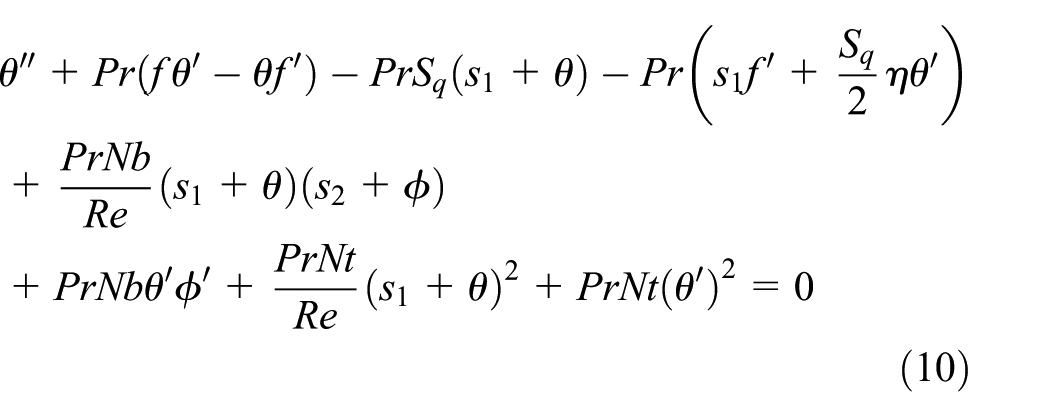
Pressure is eliminating from equations (2) and (3) and governing equations (2)–(6) yield


with boundary conditions
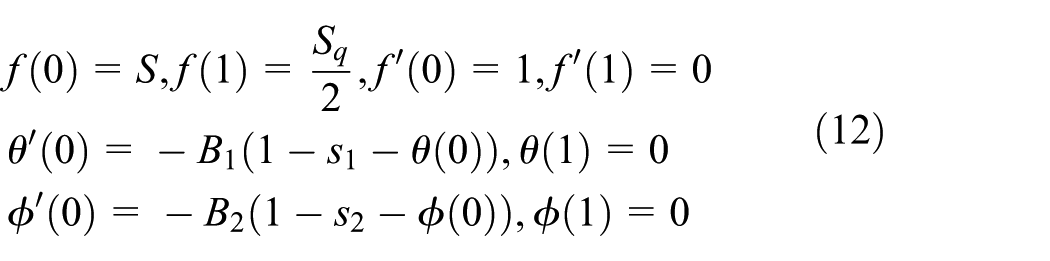
where squeezing parameter

It is witnessed that
The expressions of the Nusselt and Sherwood number are

In dimensionless scale, equation (14) takes the form

here,
Solutions by HAM
For homotopic series solutions, it is required to choose the suitable initial guesses and corresponding linear operators for present flow problem as


with

where
Zeroth order problems
Here


Defining non-linear operators as


where
mth order problems
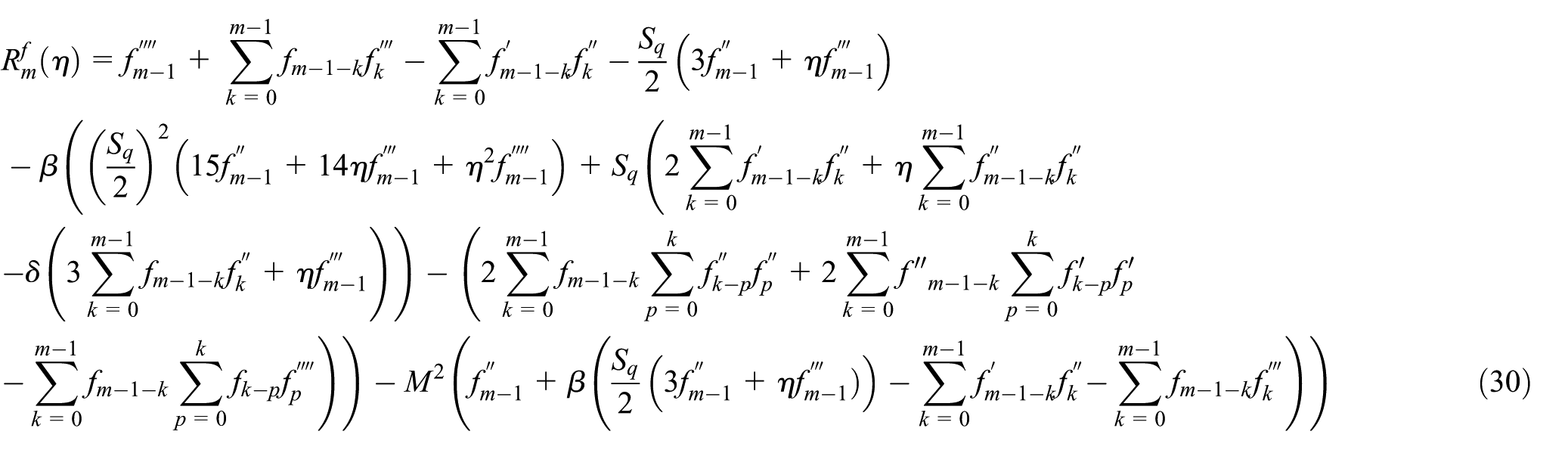
Here



Defining non-linear operators as


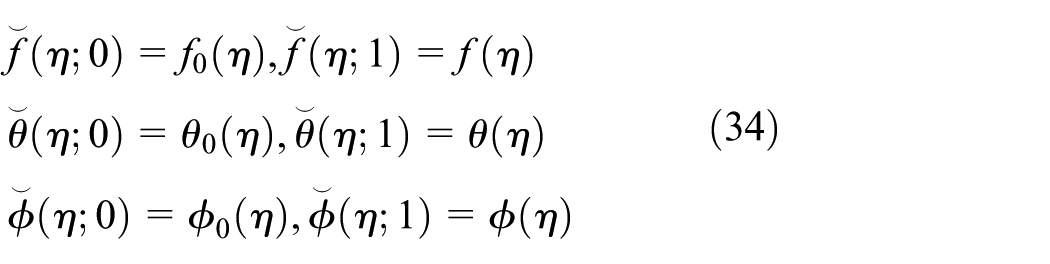
For
and with the variation of

choose suitable value for auxiliary parameter that the series equation (35) converges at


Convergence of problem
It is noted that


for the considered constitutive equations, respectively. Where N is an integer and the total error at the kth order of approximation is expressed as

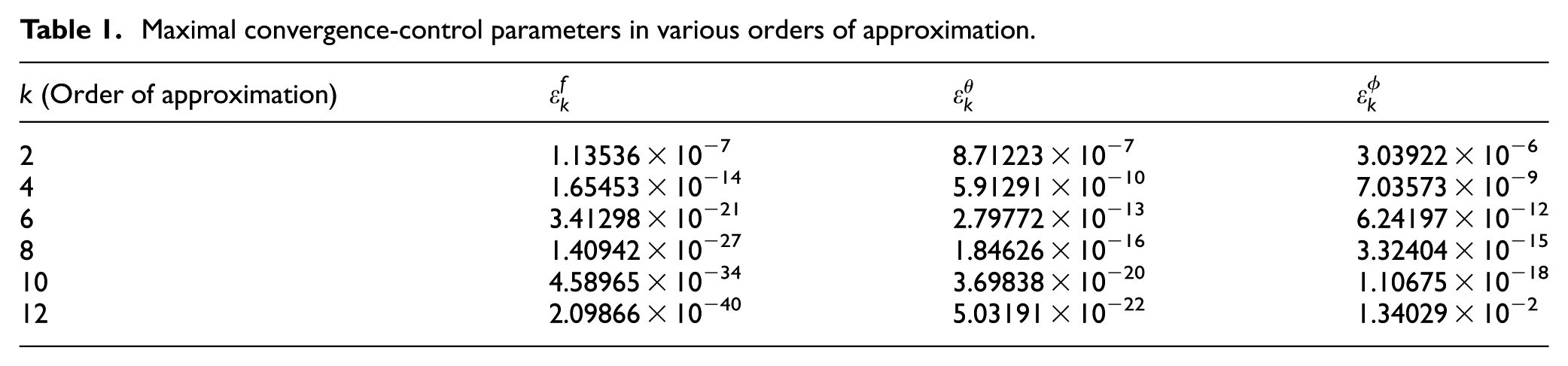
The analogous maximal parameters that control the convergence are tabulated up to 12th order of approximations (Table 1).
Maximal convergence-control parameters in various orders of approximation.
Note that total error
Graphical representation for 12th order of approximation is disclosed in Figure 2. Here

Here, the

Graph for 12th order of approximation.
Results and discussion
This segment discloses how the flow parameters affect various quantities of interest such as velocity, temperature, and nanoparticle concentration. To this end, Figures 3–22 are plotted. The graphical results are constructed using the representative parameters involved in the squeezing heat and mass flow phenomenon. Deviation of squeezing parameter

Effect of
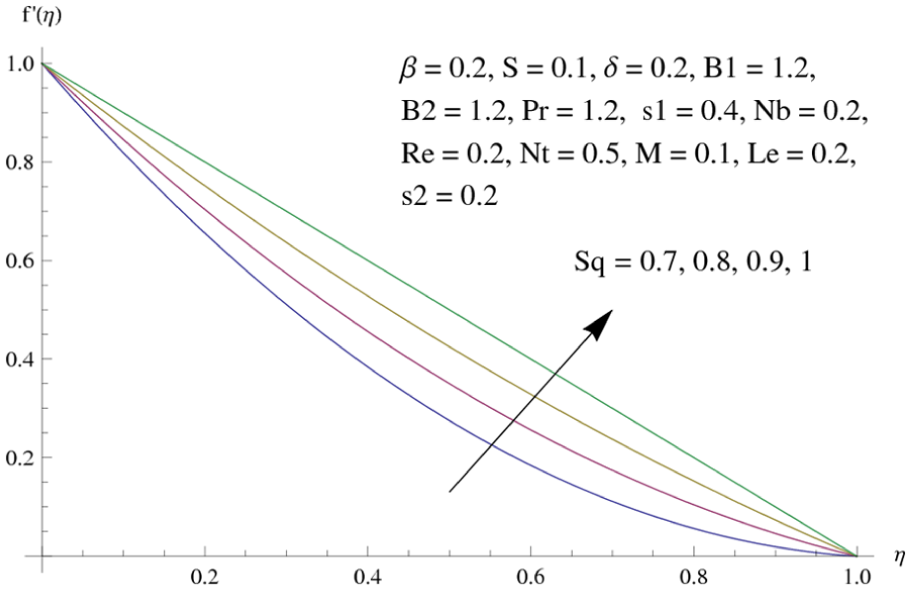
Effect of
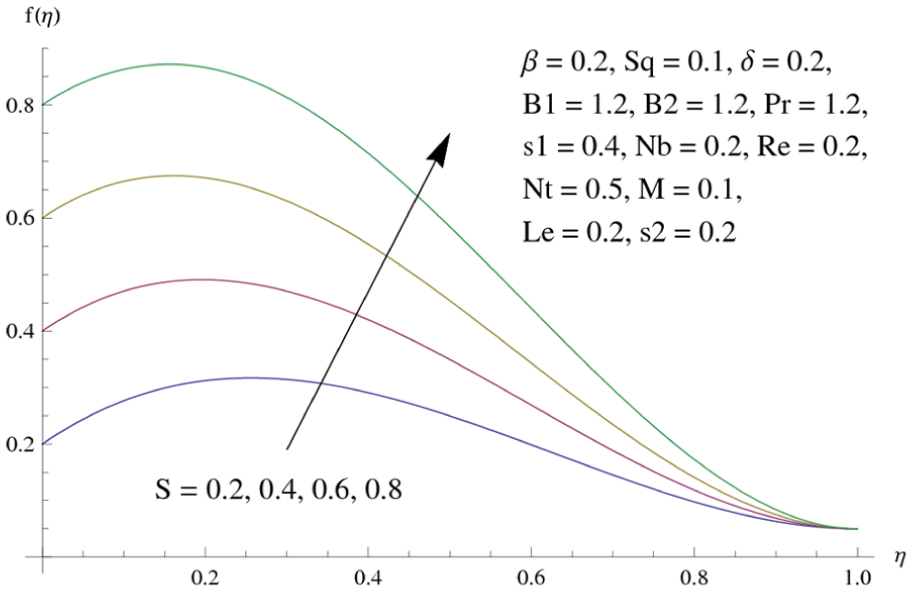
Effect of S on

Effect of S on
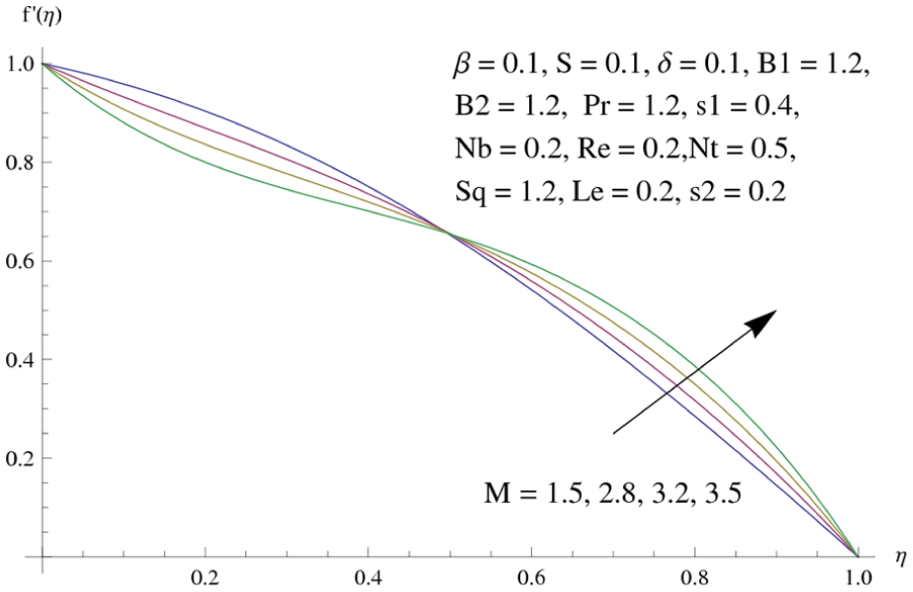
Effect of M on
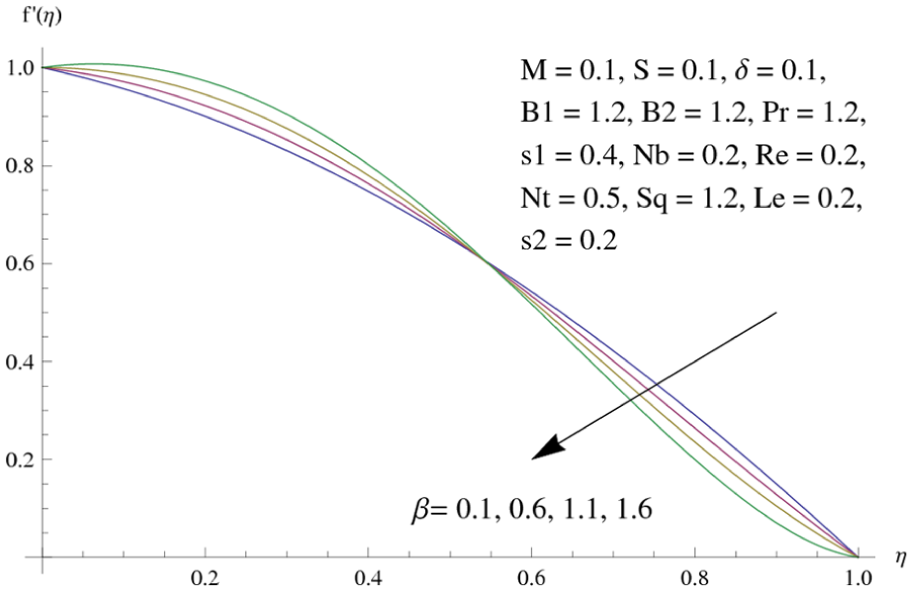
Effect of

Effect of

Effect of

Effect of Nb on

Effect of Nt on
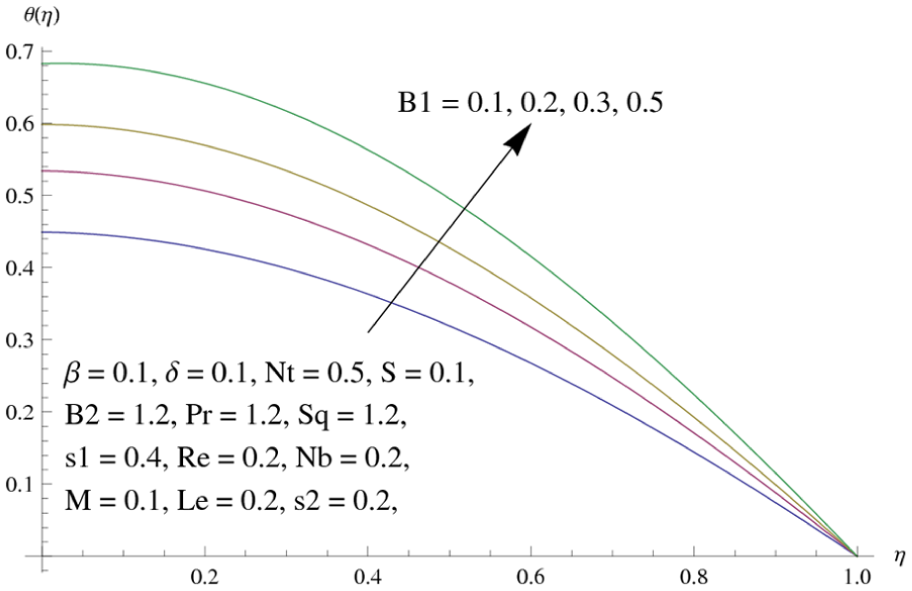
Effect of
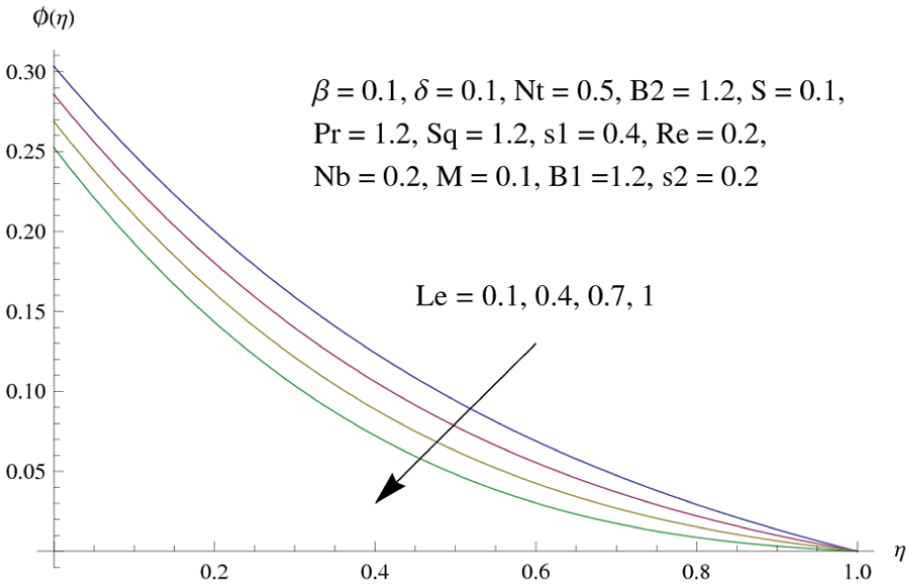
Effect of Le on

Effect of Nb on

Effect of Nt on

Effect of
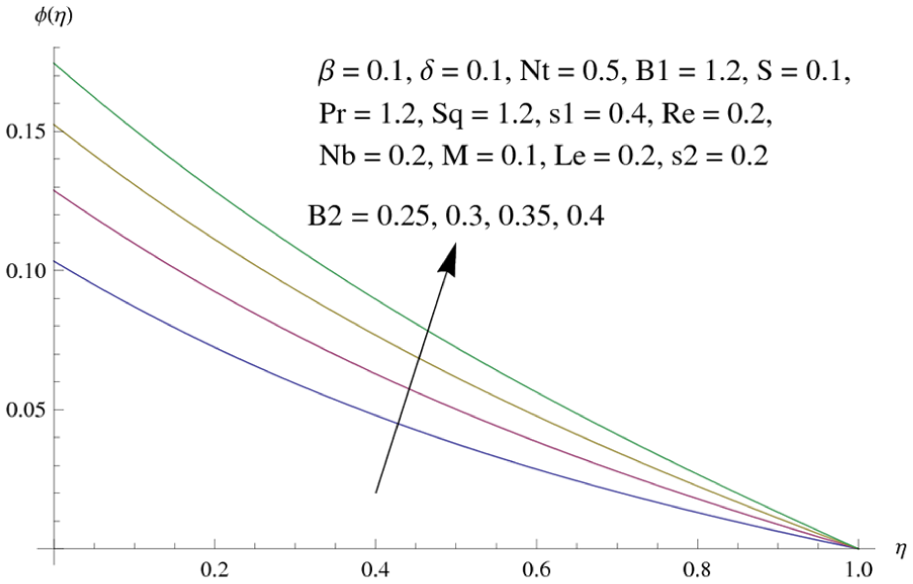
Effect of
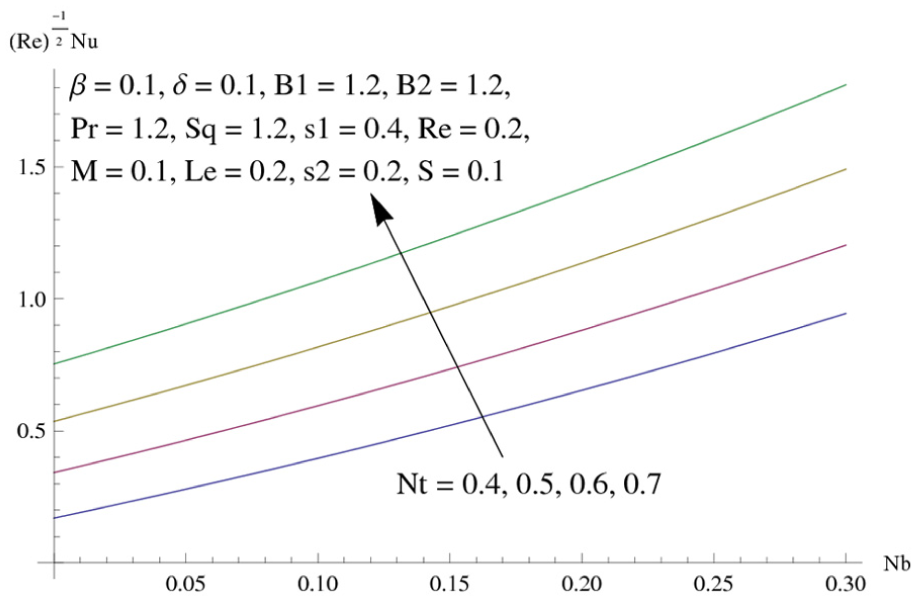
Effect of

Effect of

Effect of

Effect of
Closing remarks
A theoretical investigation for Maxwell fluid based on MHD squeezing flow of nanoparticles is accounted in the presence of convective heating.
Key points of our inspection are noted as follows:
Cross flow variation of velocity distribution is noted for greater material parameter
The fluid temperature increases for enhanced thermophoresis and Brownian motion parameters.
Concentration profile follows an opposite trend for themophoresis and Brownian motion parameters.
The temperature field enhances with an enlargement in the values of thermal stratified parameter and thermal Biot number.
Decline in concentration field is noted for larger solutal stratified parameter whereas solutal Biot number raises the concentration profile.
Footnotes
Appendix 1
Handling Editor: Oronzio Manca
Declaration of conflicting interests
The author(s) declared no potential conflicts of interest with respect to the research, authorship, and/or publication of this article.
Funding
The author(s) received no financial support for the research, authorship, and/or publication of this article.
