In this communication, attention is paid to analyze theoretically the influence of the temperature-dependent binary chemical reaction for hydro-magnetic viscous fluid flow, flowing through the porous medium due to the squeezing phenomenon. For better understanding of variations in the processes of convective heat and mass transport, Arrhenius activation energy is also accounted. The equations governing the flow, heat, and mass are altered into non-linear differential system (ordinary differential equation) by means of suitable conversion methods. Efficient convergent technique is employed to compute resulting non-linear system. The solutions thus acquired are utilized to interrogate the behavior of the physical operating variables on flow velocity, fluid temperature, and fluid concentration. Coefficient of skin friction and rate of heat and mass transport are graphically elaborated. From the graphs, it is concluded that the temperature of fluid dominates against activation energy parameter and reaction parameter . However, an opposite trend is noted for concentration field. Moreover, temperature field and fluid concentration are incremented for dominant thermal and solutal Biot numbers, respectively. This analysis has the industrial processes which include engine cooling system, polymer industry, lubrication mechanisms, design of cooling and heating systems, molding of plastic sheets, designing porous surfaces to decrease drag, optimizing oil/gas production, in the domain of engineering (i.e. chemical, biomedical, geothermal etc.), chemical or nuclear system, cooling process in nuclear reaction, biochemical process, bimolecular reaction, and polymeric flows which is electrically conducted can be restrained and managed by exploiting the magnetic field. Encouraged by such physical situations, the proposed analysis is accomplished.
Recent advancement in the Darcy Law originates the fluid flows through porous medium and has gained the attention of research community in the practical perspective. Thus, the flows over and through porous layers have emerged in industrial and natural problems. These incorporate natural ground water flows, nutrients into plants, oil via porous bedrock, and blood flows into animal tissues. Furthermore, flow through permeable layers or plates (surfaces) is also encountered in various industrial processes including engine cooling system, lubrication mechanisms, design of cooling and heating systems, designing porous surfaces to decrease drag (i.e. aircraft wings with porous cavities), and production of gas and oil, where estimating and optimizing production were in focus. Zaytoon et al.1 disclosed the flow over a porous surface with variable permeability. Jain and Bohra2 explored the radiative flow through the rotating disk emerged in permeable medium considering variable fluid characteristics. Khan et al.3 addressed the magneto-hydrodynamic (MHD) squeezed Casson liquid flow via porous medium. Javed et al.4 disclosed the natural convection in MHD flow of ferrofluid through porous channels. Ullah et al.5 elaborated the magnetic Casson liquid flow past a non-linear shrinkable/stretchable plate saturated in Darcian medium with Newtonian heating and velocity slip. Farooq et al.6 described the generalized double-diffusive analysis in reactive Darcian flow of a squeezed fluid. Haq et al.7 disclosed the magneto fluid flow past a permeable medium. Dogonchi et al.8 reported the convective flow of hydro-magneto nanoliquid filled in a porous media. Javed et al.9 explained the melting phenomenon in chemically reactive magnetic flow through a Darcian medium considering activation energy. Ullah et al.10 discussed the squeezed MHD fluid flow in a Darcian medium.
The development in the dynamics of heat and mass transport by means of convective-type conditions is important in understanding a variety of industrial and engineering phenomenon. Such transport processes appear in material drying, transpiration cooling process, thermal energy storage and so on. Therefore, the choice of convective boundary conditions seems pertinent instead of taking isothermal/isoflux wall condition. Mixed convection impacts on slip flow of convectively concentrated and heated Casson fluid through a plate with non-linear stretching, Dufour and Soret phenomena is depicted by Ullah et al.11 Hydro-magnetic stagnant Jeffrey fluid flow deformed by exponentially stretchable sheet with convective-type condition at boundary is exposed by Hayat et al.12 The magnetic field effect on nanofluid flow with the introduction of convective conditions at surface is examined by Shehzad et al.13 Hayat et al.14 disclosed the Jeffrey nanofluid flow past a convectively heated non-linear stretchable surface assuming heat source (or sink). Hayat et al.15 illustrated the radiation effects on squeezed second-grade liquid flow with convective surface condition.
Mass transfer process involving chemically reactive system with activation energy is used in various applications including recovery of thermal oil, food processing, chemical engineering, geothermal reservoirs, and cooling of nuclear reactions. However, few theoretical estimations of activation energy in the flow are found in existing literature. In most of the situations, chemical reaction interacts with mass transfer in a complex manner, and it can be noticed in the manipulation of reactant species at various rates both inside the mass transport and the fluid. In this regard, the analysis of binary chemically reactive system was initiated by Bestman.16 Subsequently, Bestman17 presented the radiative flow of mixture having combustible characteristic through vertical channel with Arrhenius activation energy. Makinde et al.18 elaborated the chemically reactive binary mixture flow through porous sheet with radiative and convective effects. Chemical reaction features in binary mixture of convective fluid flow over a permeable sheet with Soret and Dufour impacts is determined by Makinde and Olanrewaju.19 Several contributions into the area of binary-type reactive flows along with the features of activation energy were discussed by Maleque.20–22 Awad et al.23 reported the rotating flow of chemically reactive fluid with generalized Arrhenius theory. Their contributions motivated many other recent researchers to develop the theoretical analysis capable of predicting characteristics of binary mixture of chemically reactive fluid along with Arrhenius activation energy.24–29
Many engineering, biomedical, and industrial process are highly influenced by MHD fluid flows. It has applications in the field of magnetosphere, aeronautical plasma flows and so on. Furthermore, these processes comprise of designing of cooling/heating systems, nuclear reactors, measurement of blood flow, and MHD generators. Due to such wide-spread practical applications, MHD flows have enraptured the curiosity of researchers and scientists. Sheikholeslami30 described the irreversibility analysis in magnetic nanofluid flow in a porous media. Sheikholeslami31 discussed the magnetic flow of water-based Al2O3 nanomaterial saturated in a permeable medium. Sheikholeslami and Mahian32 disclosed the magnetic features in nanomaterial of inorganic nature. Sheikholeslami et al.33 explored the Lorentz force effect in Darcy flow of water-based Fe3O4-ferrofluid with entropy phenomenon. Sheikholeslami et al.34 reported the exergy analysis in magneto nanoparticles through Darcy media. Furthermore, noticeable works35–42 on MHD are also accounted in various physical situations.
Aforementioned attempts provide motivation to disclose the features of chemical reaction of binary type in addition with generalized Arrhenius assumption in heat and mass transport processes. These transport analysis are also characterized by novel aspects of convective transportation of heat and mass. The flow analysis is based on MHD squeezing phenomenon through a porous medium. Similarity approach is adapted to transmute non-linear ordinary differential equations (ODEs) which are computed by convergent procedure (homotopy analysis method (HAM)).43–49 Obtained outcomes are demonstrated through graphs for velocity components, temperature, and fluid concentration corresponding to various involved parameter. Nusselt and Sherwood numbers in addition to drag force (skin friction) are also graphically described.
Description of the problem
Consider a fluid inside parallel sheets separated by the width . The fluid is set into motion due to squeezing of the top plate and expansion of the bottom plate in its own plane with shrinking velocity . It is assumed that the top plate approaches the bottom plate with vertical velocity . The flow inside the plate is assumed unsteady and incompressible saturated in permeable medium. The governing flow equations of considered fluid model are developed in Cartesian coordinate system . Taking -axis in the direction of lower sheet, while -axis is considered in normal direction as displayed in Figure 1. Magnetic field strength of constant intensity acts perpendicular to the lower plate. Extra heating factor like temperature-dependent binary chemical reaction is accounted. Modified Arrhenius law is utilized to investigate the activation energy analysis in flow, heat, and mass transport of fluid.
Flow geometry.
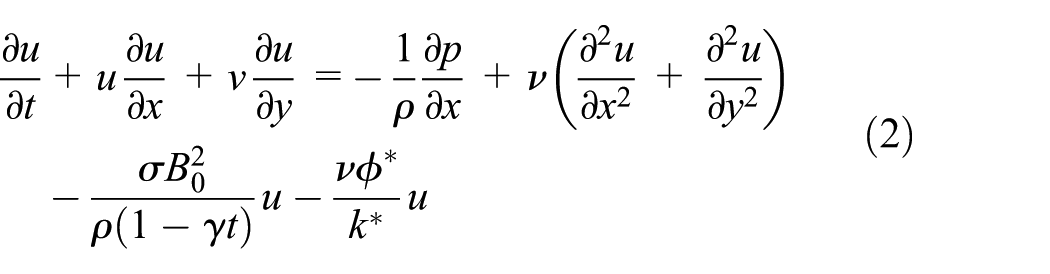
Rheological flow equations for the problem under all these assumptions can be expressed as follows22,45
Here, velocity components are along axes , respectively. Kinematics viscosity is denoted by , electrical conductivity is denoted by , fluid density is denoted by , porosity of porous medium is denoted by , pressure is denoted by , chemical reaction rate constant is denoted by , permeability of porous medium is denoted by , magnetic field strength is denoted by , specific heat capacity is denoted by , fluid temperature is denoted by , thermal conductivity is denoted by , exothermic/endothermic coefficient is denoted by , fluid concentration is denoted by , diffusion coefficient is denoted by , represents modified time-dependent Arrhenius function in which the temperature is linearized using Taylor’s series, represents Boltzman constant, activation energy is denoted by , and exponent fitted rate constant is denoted by .
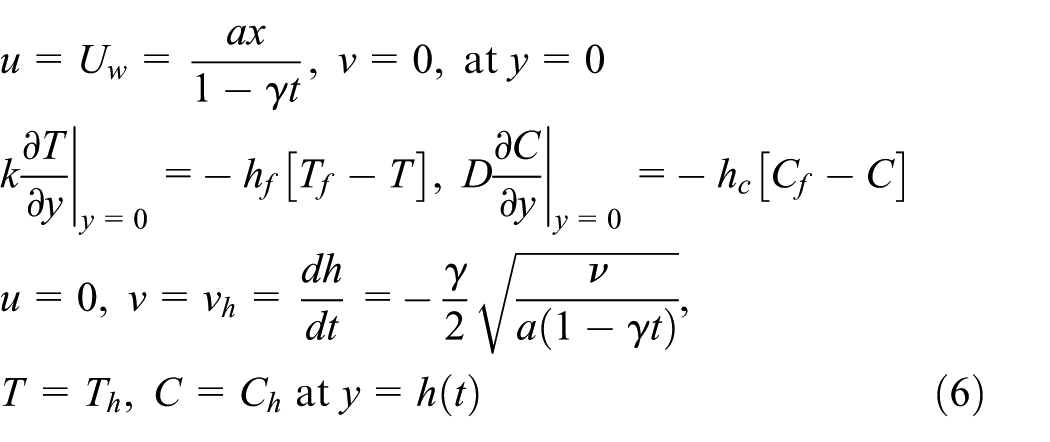
The appropriate boundary conditions are as follows
where denotes stretching velocity, and represent temperature of fluid and of upper plate, respectively, represent particle concentration of fluid and at upper plate, respectively, and represent dimensional constant, respectively, and represent the mass and heat transport rate, respectively.
Condition for incompressibility is satisfied automatically, and the constitutive equations (2)–(5) after eliminating pressure term from equations (2)–(3) along with boundary condition (6) can be exhibited as
subject to the suitable boundary conditions
where Hartman number is , squeezing parameter is , inverse Darcy number is , Prandtl number is , exothermic/endothermic parameter is , reaction parameter is , temperature ratio parameter is , activation energy parameter is , thermal Biot number is , Schmidt number is , solutal Biot number is are presented by
It is observed that the values of leads to away movement of the plates, indicates that the plates moves toward each other while corresponds to stationary plate or steady case.
Mathematical expression for skin friction, rate of heat and mass transfer are as follows
In dimensionless variables, one has
where represents Reynolds number.
Method of solutions
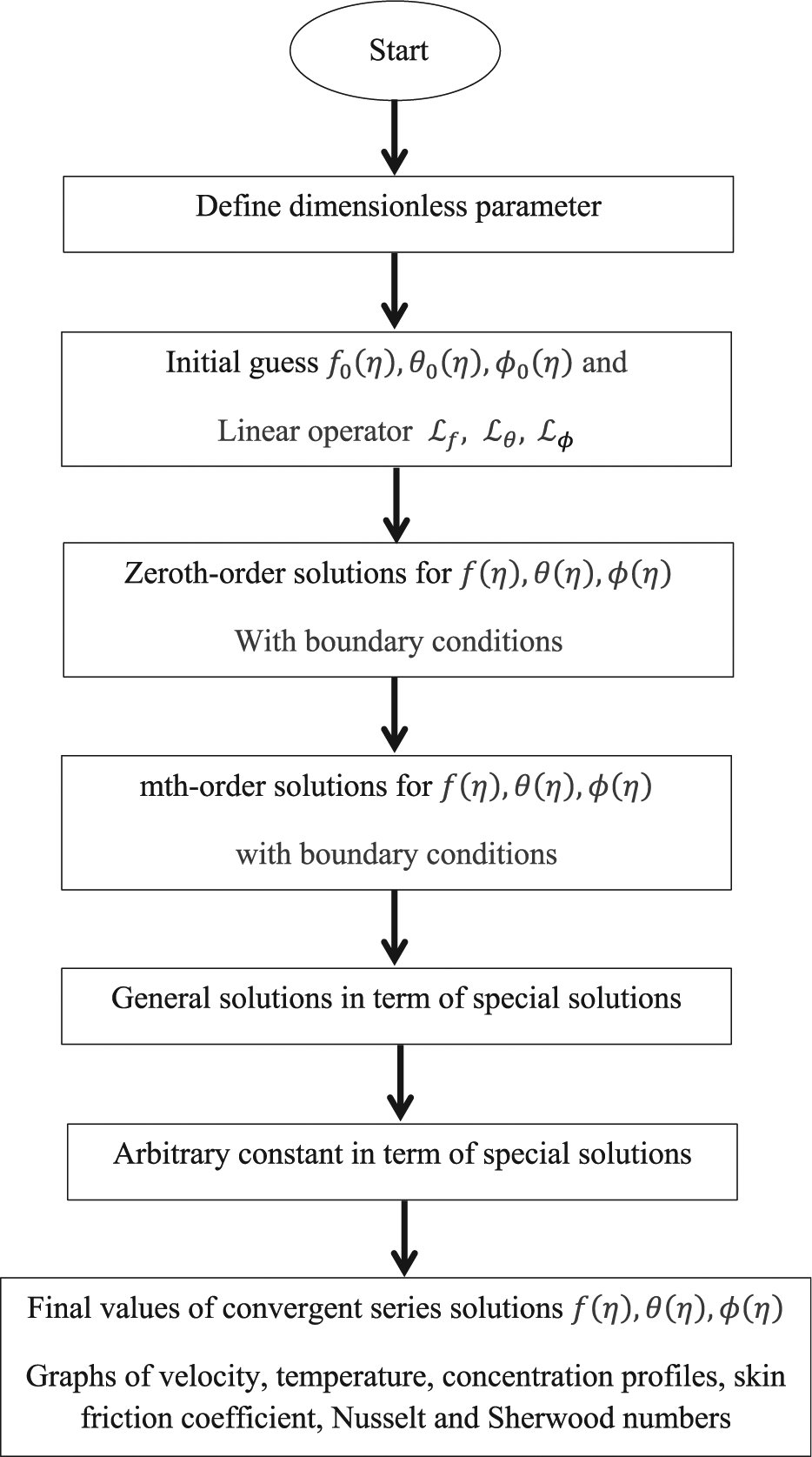
Due to non-linear nature of equations (8)–(10), it is inconvenient to tackle exact solutions. Therefore, we opted to go for series solutions. To this end, we employed a convergent technique termed as homotopic procedure (HAM) to solve considered non-linear system of equations (8)–(10). This method has dependence on initial guesses and linear operators which can be expressed for the present flow analysis as below
with
where are arbitrary constants.
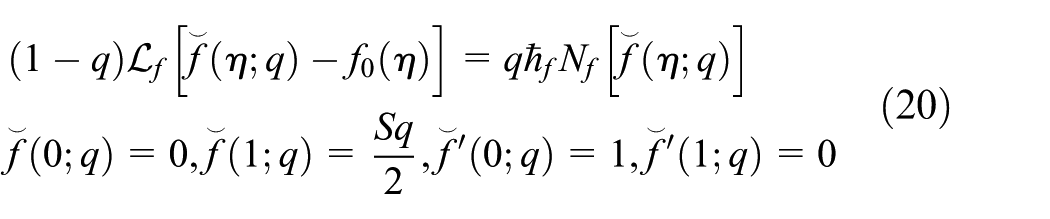
Zeroth-order problems
Here
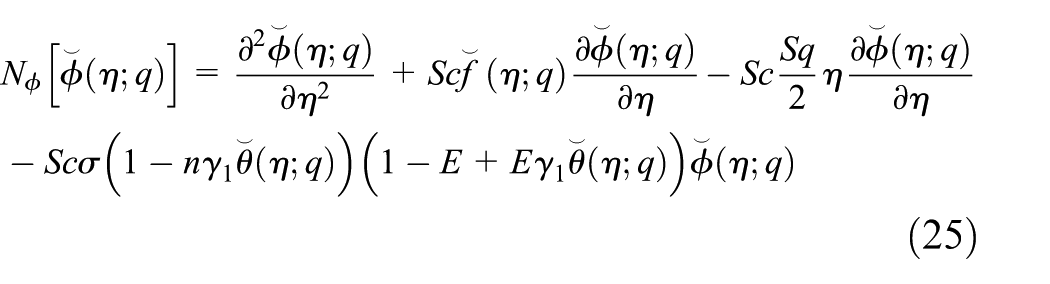
Non-linear operators are expressed as
where embedding parameter is , and are auxiliary parameters, which are non-zero in character.
mth-order problems
Here
Non-linear operators are expressed as
for , we can write
and with the variation of vary from the initial solutions to the final solutions , respectively. By Taylor series, we have
We have selected parameter (auxiliary) in a way that series (34) converge at . Thus, we have
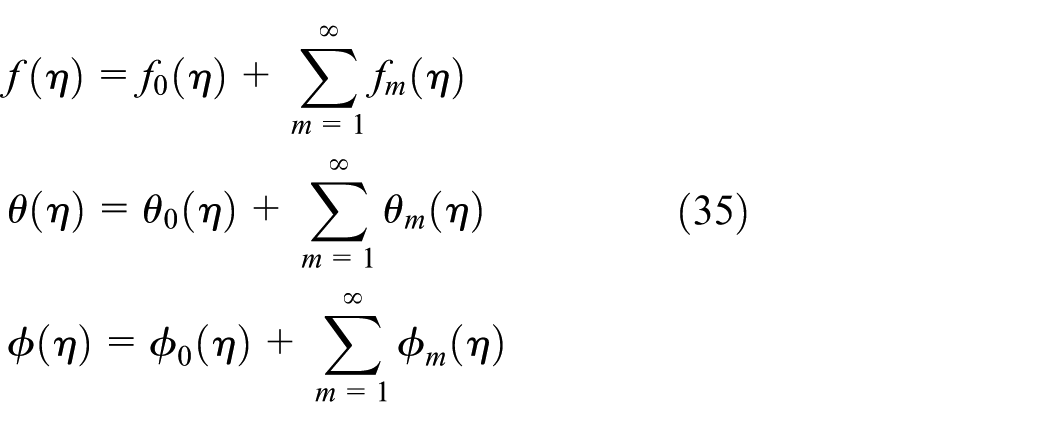
here represent the general solutions in term of special solutions given by
where the constant are computed through boundary condition equations (26)–(28).
The following is the flowchart of this analytical approximate procedure:
Convergence analysis
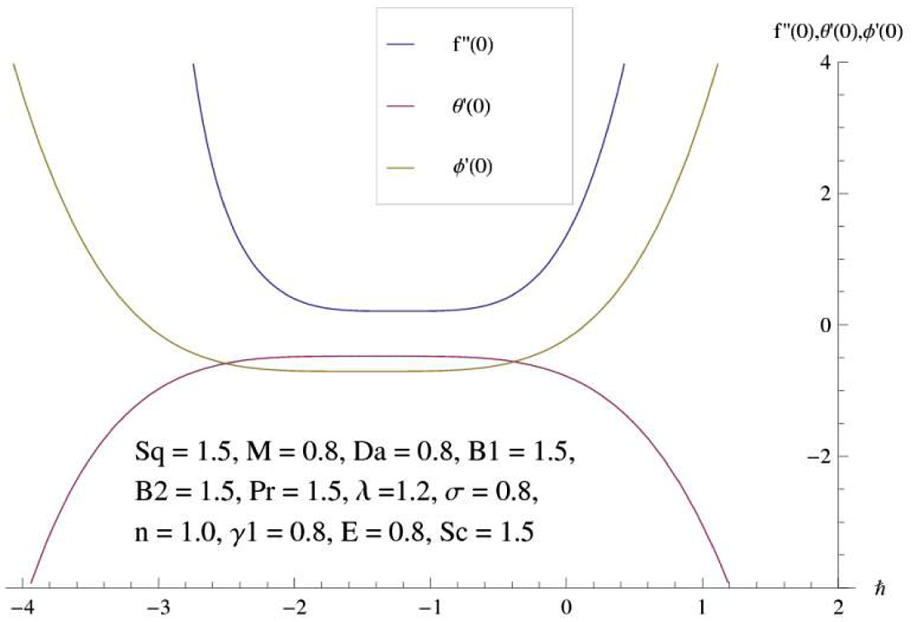
It is a well-established argument that homotopic procedure provides us flexibility and ensures the convergent series solutions of non-linear flow problem. For this purpose, the -curves are sketched in Figure 2 to determine the region of convergence which is parallel to -axis. Hence, Figure 1 depicts the allowable values of auxiliary parameters and as , respectively.
Regions of convergence for .
Result and discussion
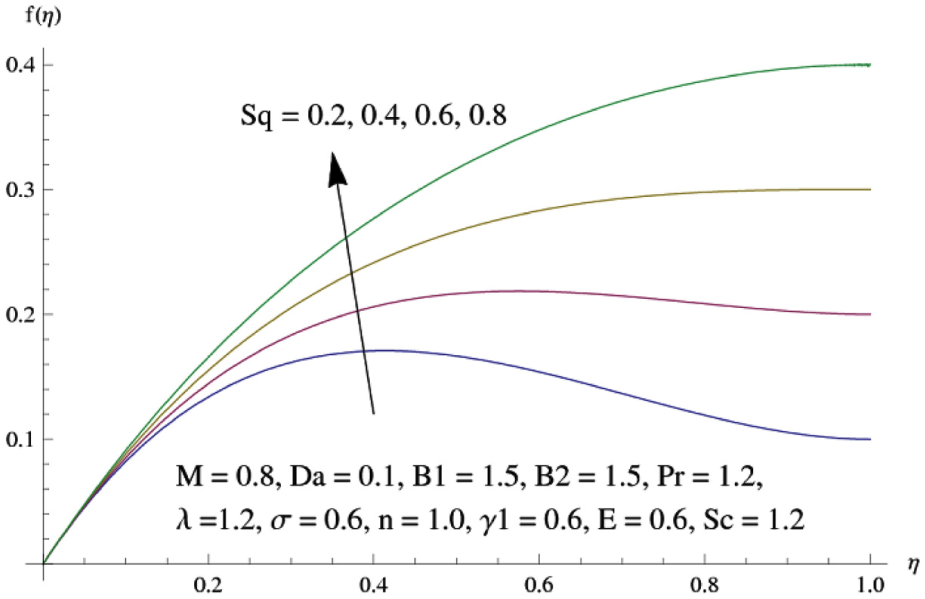
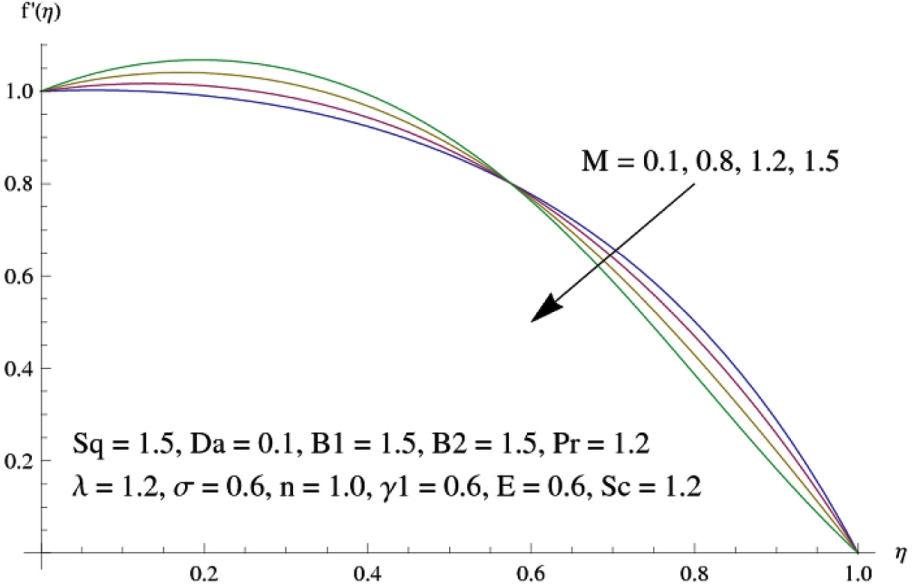
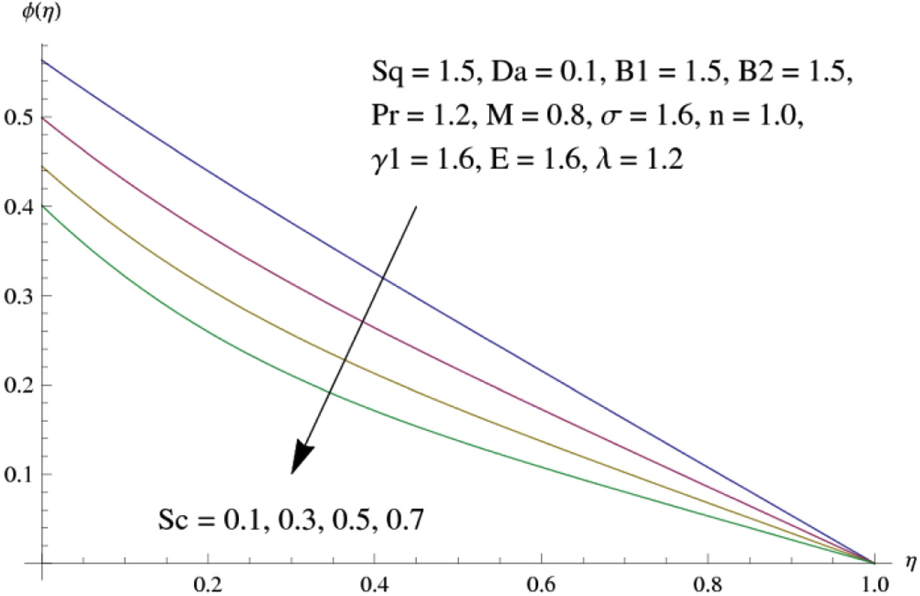
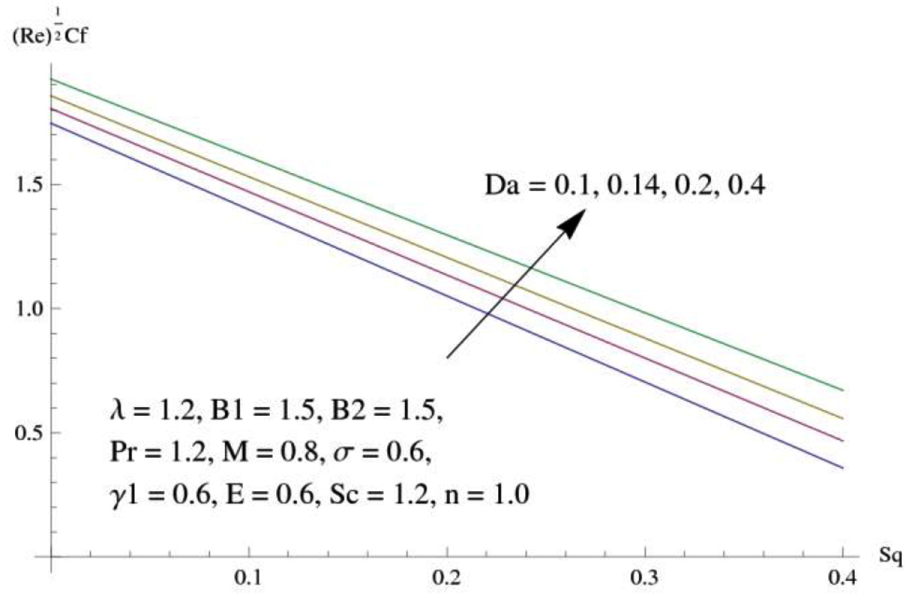
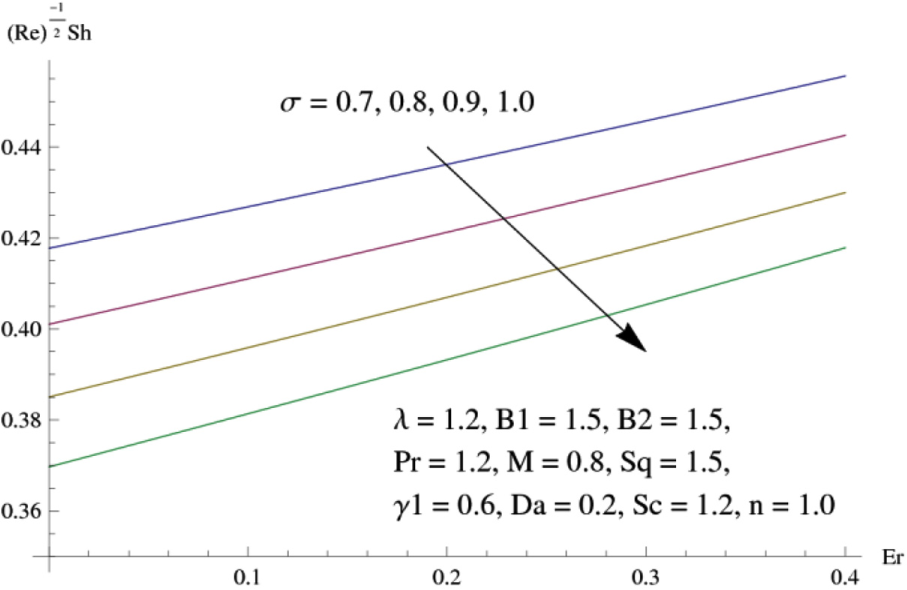
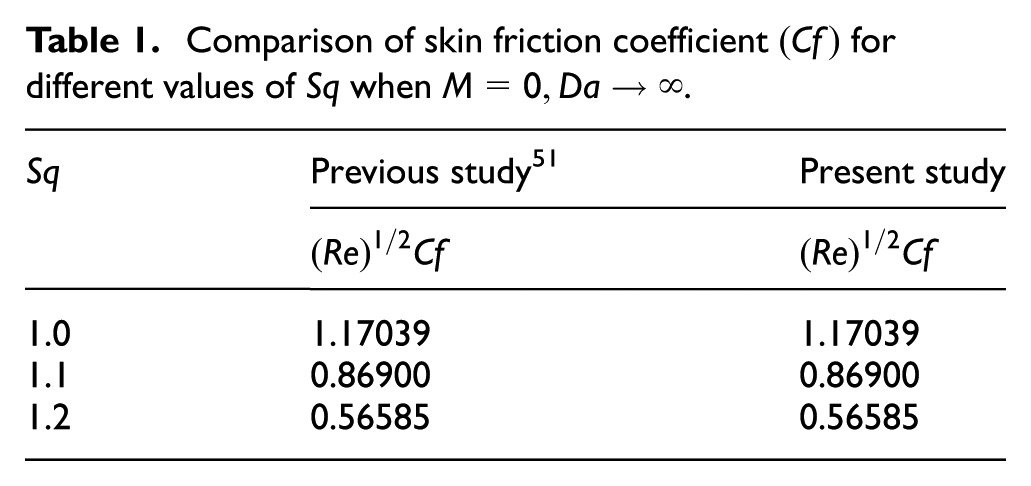
In this segment, results are graphed in order to demonstrate the flow characteristics, heat and mass transport phenomena associated with squeezing mechanism. Figures 3 and 4 illustrate the vertical and horizontal velocity components for diverse values of squeezing parameter . For higher , both the components achieve maximum values. Physically, by escalating , the squeezing force increases, which in turn increases the fluid motion. Thus, the velocity components also increase. Furthermore, the velocity field increases for the diverse values of . The velocity profile is lower at the lower surface while higher at the upper plate. Figure 5 indicates how the Hartman number affects the fluid velocity in two regions. As expected, fluid velocity increases with in the interval due to a decrease in Lorentz forces. Moreover, horizontal velocity decays when increases correspond to from . Physically, the Lorentz force is stronger near the plates as compared to away from the plates. So that decrease in the flow velocity near the plates (0.5, 1] will balance the increase in velocity field within the central region [0, 0.5) which leads to an alternative flow behavior. Figure 6 demonstrates the fluid velocity plots for different Darcy numbers . One observed that effects are quite similar to the effects. In the region , velocity dominates with increasing while increment of results in the domain and thus greater represents resistance to flow so it decays fluid velocity. Figure 7 describes that fluid temperature curves corresponding to different values decay due to decline in kinematic viscosity and its dependence on velocity and width that separates the walls. Effects of non-dimensional exothermic/endothermic parameter on temperature field are exhibited through Figure 8. A striking observation is made from this figure, that is, the temperature field becomes stronger for larger values of . Physically, with an increment in , the transfer of heat due to exothermic reaction is more in the working fluid, which enhances the temperature field. Figure 9 is developed to address the variations in fluid temperature versus thermal Biot number . It clearly depicts that temperature field rises for higher . Because of dominant thermal Biot number, thermal convection enhances, consequently temperature distribution will dominate. Figure 10 captures the variations of reaction parameter on temperature field. It is seen that with increment of , fluid temperature increases throughout the porous medium. In fact, dimensionless reaction rate greatly increases the reactant’s kinetic energy, which allows more collisions between particles and consequently, temperature field increases. Figure 11 plots the temperature distribution for dominant temperature difference parameter . From figure, one observes that for strong temperature significantly rises. The increment is more pronounced near the lower plate which becomes heated due to cooling of upper plate. Figure 12 shows dimensionless temperature distribution for activation energy parameter . This figure depicts that dimensionless temperature intensifies with increasing . In fact, the number of energetic particles increases, that is, having energies equal (or greater) to activation energy corresponding to greater which results in increased temperature distribution. The concentration curves for different variations in Schmidt number are disclosed in Figure 13. It is found that for small values of , the effects of species diffusion rate are dominant and the resultant concentration field decays. Figure 14 is plotted to observe the impact of dimensionless reaction rate on fluid concentration. It is noticed that when the values are greater, then the concentration curves are smaller as the concentration gradient and its flux are higher, so that it will increase the fluid concentration. Figure 15 depicts the dimensionless concentration field versus temperature difference parameter . The smaller location of the concentration curves corresponds to larger . This is because, there would be an increase in lower and upper wall temperature difference with increasing . Variation of non-dimensional activation energy parameter on fluid concentration is addressed in Figure 16. Decline is declared in the concentration field with increasing . On the physical aspect, destructive chemical reaction rate constant is stronger for high temperature and activation energy. Such strong reaction rate ensures decay in fluid concentration. Figure 17 exhibits the behavior of solutal Biot number on fluid concentration. Concentration field is noted to be an increasing function of . The reason behind this phenomenon is that Biot number is directly related to mass transfer coefficient. The coefficient of mass transfer increases for an increasing and the fluid becomes more concentrated which results in the domination of concentration field. The behavior of dimensionless drag force through increasing values of Darcy number and squeezing parameter are exposed in Figure 18. It is noted that drag force is greater for high , while it is a decreasing function of . Graphical estimations of Nusselt and Sherwood numbers are illustrated in Figures 19 and 20 corresponding to diverse values of reaction parameter and activation energy . Figure 19 depicts that the estimations of Nusselt number are increased when is increased. However, it reduces for larger , and Figure 20 discloses that the Sherwood number decreases with an increase in , whereas reverse trend is noticed for incrementing values of . The drag force (or co-efficient of skin friction) is computed for diverse values of squeezing parameter with and . To validate the results, a comparison of different values of surface drag is made with a previous study by Muhammad et al.51 and is displayed in Table 1. It is reflected that the computed outcomes are in good agreement which depicts the accuracy of the results.
Plots of for .
Plots of for .
Plots of for .
Plots of for .
Plots of for .
Plots of for .
Plots of for .
Plots of for .
Plots of for .
Plots of for .
Plots of for .
Plots of for .
Plots of for .
Plots of for .
Plots of for .
Plots of for .
Plots of for .
Plots of for .
Comparison of skin friction coefficient for different values of when .
A mathematical estimation is exhibited to disclose the aspect of binary chemical reaction incorporates activation energy on squeezed MHD flow in porous medium under the influence of convective-type conditions at boundary. The flow problem is governed by fourth- and second-order non-linear ODEs which are evaluated using homotopic technique. The eminent parameter impacts on velocity, fluid temperature, and fluid concentration are reported. The main outcomes regarding this study are as follows:
An increment in squeezing parameter results in an increase in horizontal velocity, whereas it decreases fluid temperature.
The velocity field in the region near the plate decays with dominant Darcy number , and it becomes stronger in the central region and consequently cross-flow behavior is observed.
Dimensionless exothermic/endothermic parameter improves the temperature field.
Fluid temperature enhances when values of reaction parameter , temperature ratio parameter , and dimensionless activation energy parameter are incremented.
The estimation of thermal Biot number on temperature field is more pronounced.
Concentration field is less influenced with larger , , and .
Larger solutal Biot number increases the concentration distribution.
Footnotes
Handling Editor: James Baldwin
Declaration of conflicting interests
The author(s) declared no potential conflicts of interest with respect to the research, authorship, and/or publication of this article.
Funding
The author(s) received no financial support for the research, authorship, and/or publication of this article.
ORCID iD
Shakeel Ahmad
References
1.
ZaytoonMAAldersonTLHamdanMH. Flow over a Darcy porous layer of variable permeability. J Appl Math Phys2016; 4: 86–99.
2.
JainSBohraS. Radiation effects in flow through porous medium over a rotating disk with variable fluid properties. Adv Math Phys2016; 2016: 9671513.
3.
KhanHQayyumMKhanO, et al. Unsteady squeezing flow of Casson fluid with magnetohydrodynamic effect and passing through porous medium. Math Probl Eng2016; 2016: 4293721.
4.
JavedTMehmoodZAbbasZ. Natural convection in square cavity filled with ferrofluid saturated porous medium in the presence of uniform magnetic field. Physica B2017; 506: 122–132.
5.
UllahIShafieSKhanI. Effects of slip condition and Newtonian heating on MHD flow of Casson fluid over a nonlinearly stretching sheet saturated in a porous medium. J King Saud Univ Sci2017; 29: 250–259.
6.
FarooqMAhmadSJavedM, et al. Chemically reactive species in squeezed flow through modified Fourier’s and Fick’s laws. Eur Phys J Plus2018; 133: 63.
7.
HaqSUKhanMAShahNA. Analysis of magnetohydrodynamic flow of a fractional viscous fluid through a porous medium. Chinese J Phys2018; 56: 261–269.
8.
DogonchiASSeyyediSMHashemi-TilehnoeeM, et al. Investigation of natural convection of magnetic nanofluid in an enclosure with a porous medium considering Brownian motion. Case Stud Therm Eng2019; 14: 100502.
9.
JavedMAlderremyAAFarooqM, et al. Analysis of activation energy and melting heat transfer in MHD flow with chemical reaction. Eur Phys J Plus2019; 134: 256.
10.
UllahIRahimMTKhanH, et al. Analysis of various semi-numerical schemes for magnetohydrodynamic (MHD) squeezing fluid flow in porous medium. Propuls Power Res2019; 8: 69–78.
11.
UllahIKhanIShafieS. Soret and Dufour effects on unsteady mixed convection slip flow of Casson fluid over a nonlinearly stretching sheet with convective boundary condition. Sci Rep2017; 7: 1113.
12.
HayatTAsadSMustafaM, et al. MHD stagnation-point flow of Jeffrey fluid over a convectively heated stretching sheet. Comput Fluids2015; 108: 179–185.
13.
ShehzadSAHayatTAlsaediA. Influence of convective heat and mass conditions in MHD flow of nanofluid. B Pol Acad Sci-Tech2015; 63: 465–474.
14.
HayatTAzizAMuhammadT, et al. A revised model for Jeffrey nanofluid subject to convective condition and heat generation/absorption. PLoS ONE2017; 12: e0172518.
15.
HayatTJabeenSShafiqA, et al. Radiative squeezing flow of second grade fluid with convective boundary conditions. PLoS ONE2016; 11: e0152555.
16.
BestmanAR. Natural convection boundary layer with suction and mass transfer in a porous medium. Int J Energ Res1990; 14: 389–396.
17.
BestmanAR. Radiative heat transfer to flow of a combustible mixture in a vertical pipe. Int J Energ Res1991; 15: 179–184.
18.
MakindeODOlanrewajuPOCharlesWM. Unsteady convection with chemical reaction and radiative heat transfer past a flat porous plate moving through a binary mixture. Afr Mat2011; 22: 65–78.
19.
MakindeODOlanrewajuPO. Unsteady mixed convection with Soret and Dufour effects past a porous plate moving through a binary mixture of chemically reacting fluid. Chem Eng Commun2011; 198: 920–938.
20.
MalequeKA. Effects of binary chemical reaction and activation energy on MHD boundary layer heat and mass transfer flow with viscous dissipation and heat generation/absorption. ISRN Thermodyn2013; 2013: 284637.
21.
MalequeKA. Unsteady natural convection boundary layer flow with mass transfer and a binary chemical reaction. Brit J Appl Sci Technol2013; 3: 131–149.
22.
MalequeKA. Effects of exothermic/endothermic chemical reactions with Arrhenius activation energy on MHD free convection and mass transfer flow in presence of thermal radiation. J Thermodyn2013; 2013: 692516.
23.
AwadFGMotsaSKhumaloM. Heat and mass transfer in unsteady rotating fluid flow with binary chemical reaction and activation energy. PLoS ONE2014; 9: e107622.
24.
ShafiqueZMustafaMMushtaqA. Boundary layer flow of Maxwell fluid in rotating frame with binary chemical reaction and activation energy. Results Phys2016; 6: 627–633.
25.
AbbasZSheikhMMotsaSS. Numerical solution of binary chemical reaction on stagnation point flow of Casson fluid over a stretching/shrinking sheet with thermal radiation. Energy2016; 95: 12–20.
26.
MustafaMMushtaqAHayatT, et al. Numerical study of MHD viscoelastic fluid flow with binary chemical reaction and Arrhenius activation energy. Int J Chem React Eng2017; 15: 1–9.
27.
MustafaMKhanJAHayatT, et al. Buoyancy effects on the MHD nanofluid flow past a vertical surface with chemical reaction and activation energy. Int J Heat Mass Tran2017; 108: 1340–1346.
28.
ZaibARashidiMMChamkhaAJ, et al. Impact of nonlinear thermal radiation on stagnation-point flow of a Carreau nanofluid past a nonlinear stretching sheet with binary chemical reaction and activation energy. Proc IMechE Part C: J Mechanical Engineering Science2018; 232: 962–972.
29.
HsiaoKL. To promote radiation electrical MHD activation energy thermal extrusion manufacturing system efficiency by using Carreau-nanofluid with parameters control method. Energy2017; 130: 486–499.
30.
SheikholeslamiM. New computational approach for exergy and entropy analysis of nanofluid under the impact of Lorentz force through a porous media. Comput Method Appl M2019; 344: 319–333.
31.
SheikholeslamiM. Numerical approach for MHD Al2O3-water nanofluid transportation inside a permeable medium using innovative computer method. Comput Method Appl M2019; 344: 306–318.
32.
SheikholeslamiMMahianO. Enhancement of PCM solidification using inorganic nanoparticles and an external magnetic field with application in energy storage systems. J Clean Prod2019; 215: 963–977.
33.
SheikholeslamiMArabkoohsarAKhanI, et al. Impact of Lorentz forces on Fe3O4-water ferrofluid entropy and exergy treatment within a permeable semi annulus. J Clean Prod2019; 221: 885–898.
34.
SheikholeslamiMShafeeAZareeiA, et al. Heat transfer of magnetic nanoparticles through porous media including exergy analysis. J Mol Liq2019; 279: 719–732.
35.
SheikholeslamiMRezaeianjouybariBDarziM, et al. Application of nano-refrigerant for boiling heat transfer enhancement employing an experimental study. Int J Heat Mass Tran2019; 141: 974–980.
36.
SheikholeslamiMJafaryarMAliJA, et al. Simulation of turbulent flow of nanofluid due to existence of new effective turbulator involving entropy generation. J Mol Liq2019; 291: 111283.
37.
SheikholeslamiMJafaryarMHedayatM, et al. Heat transfer and turbulent simulation of nanomaterial due to compound turbulator including irreversibility analysis. Int J Heat Mass Tran2019; 137: 1290–1300.
38.
SheikholeslamiMJafaryarMShafeeA, et al. Heat transfer of nanoparticles employing innovative turbulator considering entropy generation. Int J Heat Mass Tran2019; 136: 1233–1240.
39.
SheikholeslamiMHaqRUShafeeA, et al. Heat transfer simulation of heat storage unit with nanoparticles and fins through a heat exchanger. Int J Heat Mass Tran2019; 135: 470–478.
40.
SheikholeslamiMHaqRUShafeeA, et al. Heat transfer behavior of nanoparticle enhanced PCM solidification through an enclosure with V shaped fins. Int J Heat Mass Tran2019; 130: 1322–1342.
41.
SheikholeslamiMGerdroodbaryMBMoradiR, et al. Application of neural network for estimation of heat transfer treatment of Al2O3-H2O nanofluid through a channel. Comput Method Appl M2019; 344: 1–12.
42.
SheikholeslamiMJafaryarMShafeeA, et al. Simulation of nanoparticles application for expediting melting of PCM inside a finned enclosure. Physica A2019; 523: 544–556.
43.
LiaoS. Beyond perturbation: introduction to homotopy analysis method. Boca Raton, FL: Chapman and Hall, CRC Press, 2003.
MustafaMHayatTObaidatS. On heat and mass transfer in the unsteady squeezing flow between parallel plates. Meccanica2012; 47: 1581–1589.
46.
HayatTAliSAwaisM, et al. Stagnation point flow of Burgers’ fluid over a stretching surface. Prog Comput Fluid Dy2013; 13: 48–53.
47.
HayatTAliSFarooqMA, et al. On comparison of series and numerical solutions for flow of Eyring-Powell fluid with Newtonian heating and internal heat generation/absorption. PLoS ONE2015; 10: e0129613.
48.
FarooqMKhanMIWaqasM, et al. MHD stagnation point flow of viscoelastic nanofluid with non-linear radiation effects. J Mol Liq2016; 221: 1097–1103.
49.
HayatTKhanMWAlsaediA, et al. Squeezing flow of second grade liquid subject to non-Fourier heat flux and heat generation/absorption. Colloid Polym Sci2017; 295: 967–975.
50.
ZhaoQXuHTaoL. Unsteady bioconvection squeezing flow in a horizontal channel with chemical reaction and magnetic field effects. Math Probl Eng2017; 2017: 2541413.
51.
MuhammadNNadeemSMustafaT. Squeezed flow of a nanofluid with Cattaneo–Christov heat and mass fluxes. Results Phys2017; 7: 862–869.