The current study investigates incompressible, MHD flow of Cross nanofluid containing of gyrotactic microorganisms and thermophoretic particle deposition over a sheet with activation energy and variable thermal conductivity. The variable characteristic of thermal conductivity is considered as a linear function of temperature. The present study’s insights can optimize the design of nanofluid-based systems, enhance drug delivery methods, improve environmental monitoring, refine materials engineering, advance microfluidics for diagnostics, boost renewable energy technologies, and upgrade electronics cooling solutions. Moreover, this study contribution to scientific understanding will catalyze further research across disciplines, fostering innovation and progress. Cross nanofluid containing iron oxide nanoparticles, and based fluid ethylene glycol ( is used. In the current study, distributions of concentration, temperature, mass, microorganisms, and flow are examined in the presence of nanofluid while also accounting for thermophoretic particle deposition and a heat source. The proposed flow equations are transmuted into ODEs by employing the suitable similarity variables. RKF-45th approach is used to evaluate the reduced equations. Graphs are used to determine the effects of important factors on thermal, microorganism, concentration, and flow profiles. With a rise in the Marangoni ratio parameter, the velocity distribution is enhanced, whereas the temperature distribution exhibit inverse behavior.
The typical upward movement of microbes that are denser than the base fluid starts the process of bioconvection. The movement of a moving, gyrotactic microbe is known as bioconvection, and it depicts macroscopic motion. Microorganisms are divided into two types including and oxytocic organisms and reduced organisms. Microorganisms have unquestionably made important advancements in human life, notably in the field of medicine. A life without microorganisms is challenging to lead. Even with a powerful microscope, some species are too rare to be seen, but they are perfect for the environment. Biofuel production, enzymatic biomaterial synthesis, mass transportation, biotechnology, and biological engineering all involve microorganisms in their processing, production, and environmental mechanisms. Chu et al.1 explored the study of nanofluid model for flow due to disks in existence of gyrotactic microorganisms. Using a chemically reactive flow Casson nanofluid over an inclined porous sheet under convective boundary conditions, Humane et al.2 inspected the outcome of bioconvection on the dynamics. This study shows that boost in the bioconvection Schmidt number declines the boundary layer thickness of microorganisms. Through the use of a stretchable plate and porous media with heat source, Shamshuddin et al.3 inspected the MHD bioconvection microorganism nanofluid. This study shows that the Schmidt number dominates the Reynolds number for the chemical species reacting in the nanofluid, the microorganisms profile decreases. Alsaedi et al.4 investigated the magneto bioconvective flow of nanofluid in the presence of gyrotactic microorganisms. The modeling of Von Kármán whirling bioconvection nanofluid flow using the domain decomposition method were examined by Shamshuddin et al.5 Some of the studies indicating the importance of microorganisms are given in the Refs.6–8
Marangoni effect is used to describe the mass transfer caused by the gradient of surface tension at the interface of two fluids. James Thomson, a scientist, first introduced this mechanism in under the name “tears of wine.” Because a region of high surface tension drags the surrounding fluid particles more strongly than a region of low surface tension, this gradient in surface tension is what causes liquid to migrate from low interfacial tension to high tension. Surface tension gradients result from temperature or concentration gradients. The Marangoni effect has several meaningful applications including the stability of soap films, convection cells, and manufacturing of integrated circuits, where it is used to dry silicon wafers in wet processing to prevent components from being damaged by oxidation. The Marangoni effect is also used in welding, metal melting with an electron beam, and crystal growth. The computational analysis of thermo-solutal Marangoni convective flow of hybrid nanofluid with thermophoresis and activation energy were investigated by Abbas et al.9 This study asserts that temperature and layer thickness are dropping by employing a larger Marangoni convection parameter. The velocity profile, however, exhibits an entirely different behavior. A modified model was study by Lin et al.10 to examine the Marangoni convective flow of a pseudo-plastic nanofluid over a porous material. This study shows that velocity rises with increasing Marangoni convection. Physically, a higher Marangoni convection parameter is linked to less viscosity. A force with low viscosity has a tendency to accelerate the fluid velocity. The precise investigation of the influence of heat generation on Marangoni convective flow nanofluid of across a surface with porous medium has been examined at by Aly and Ebaid.11 The examination of Marangoni convection’s heat transfer is discussed in several recent articles.12–14 Various fluid models are frequently proposed to describe the fluid properties due to the discrepancy in flow behavior. The Cross model15 is one of them and is a unique subclass of the generalized non-Newtonian fluids. When modeling non-Newtonian flows with the WC-MPS approach, Xie and Jin16 investigated the parameter determination for the Cross rheology equation. The Cross fluid17–19 is used to develop different polymeric solutions and because the time constant is involved, it is frequently used in engineering simulations.
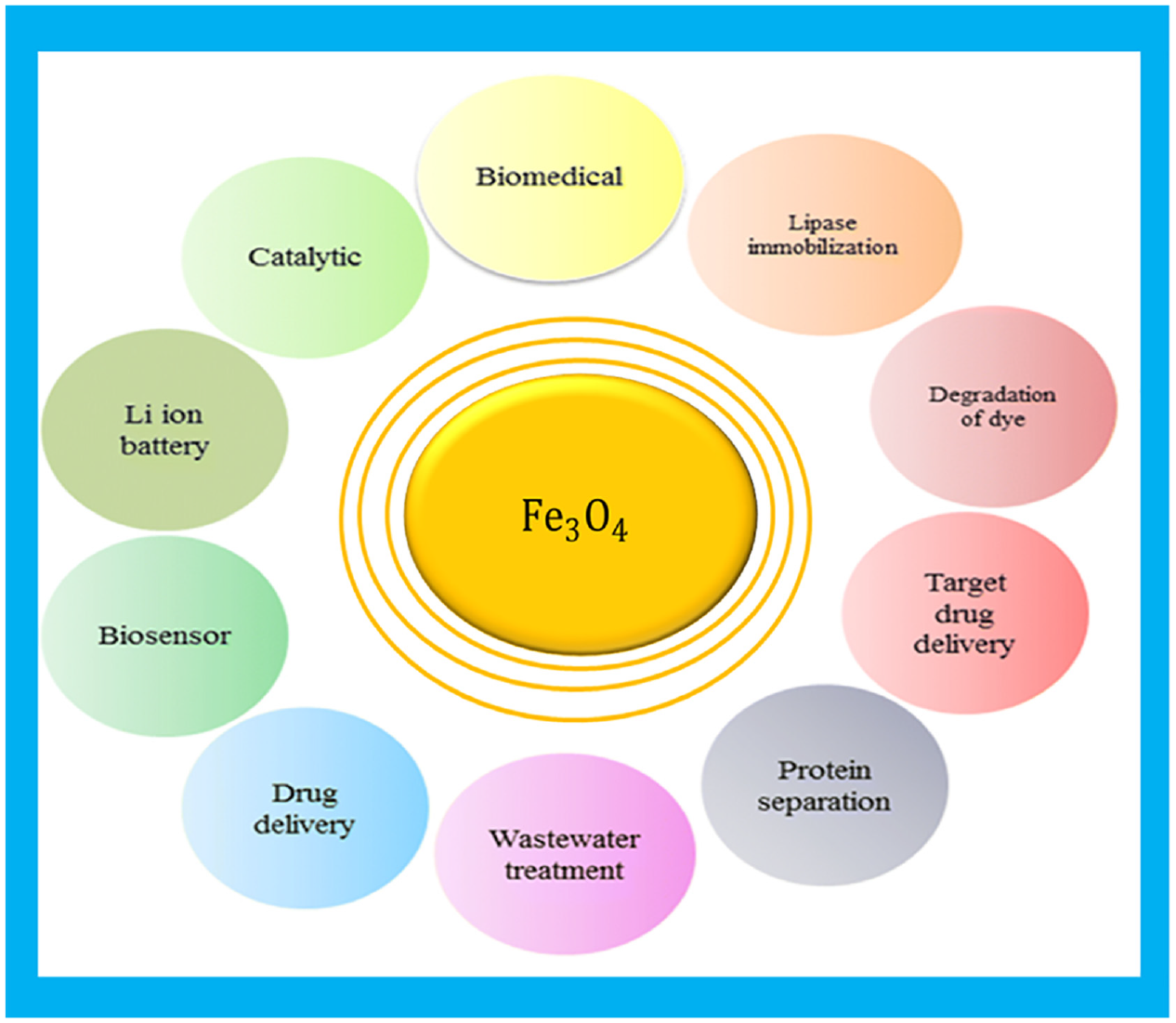
Nano liquid is the term used to describe a nanoscale particle immersed in a liquid. When nanoparticles are combined with base liquids, their physical properties, such as viscosity, density, electrical conductivity, and thermal conductivity change. In many industrial and technological applications, the thermal conductivity is one of these characteristics that cannot be ignored. Enhancing heat transfer efficiency to achieve higher thermal performance is the main objective of using nanomaterials in such procedures. The application of nanofluids in various manufacturing procedures, optics, solar panels, electronics, catalysis, renewable energy sources, and smart computers makes them a crucial component of nanomaterials. Nuclear reactors, solid state lighting, paper and plastic production, food and beverage processing, biomedicine, transformers, cancer therapy, and other fields all profit from their utilization. Uddin et al.20 examined the effect of heat radiation on nanofluid flow past a sheet with slip effects. Adnan et al.21 inspected the impacts of thermal conductivity on the heat transfer gradient in nanofluid. Williamson fluid containing radiated nanomaterials with activation energy were studied by Chu et al.22 in terms of modeling and theoretical study of gyrotactic microorganisms. The analysis of heat transfer using nanomaterials has been carried out in several recent publications.23–26Figure 1 shows the applications of nanoparticles.
Applications of nanoparticles.
Thermophoresis is the procedure by which small particles are suspended in a non-isothermal gas as they rapidly approach a dropping temperature. Although the thermophoresis does not have an effect on large particles, it considerably increases the deposition momentum of tiny particles. Numerous manufacturing and micro-engineering applications, such as safeguarding nuclear reactors, contamination, cleaning gas, avoiding micro- and avoiding heat exchanger corrosion, all benefit from the thermophoresis phenomena. In a Carreau-Yasuda fluid over a chemically reactive Riga plate, Abbas et al.27 investigation concentrated on the thermophoretic particle deposition. A thin moving needle was the subject of an investigation by Kumar et al.28 into the effects of thermophoresis on mass and heat transport of Casson fluid flow. The outcome of thermophoresis on liquid flow have been extensively studied by researchers, and some of the most notable studies are presented in the Refs.29–31
The uniqueness of present investigation is to explore the importance of Marangoni convection on mixed convective flow of Cross nanofluid across sheet in the presence of gyrotactic microorganism, thermophoretic particle deposition with convective boundary conditions and variable thermal conductivity. One of the main goals of this study is to determine the mass and heat transfer properties of thermo-solutal Marangoni driven boundary layer flow of a Cross nanofluid. According to the aforementioned literature, these effects are extremely important, have several applications, and have not yet been studied. The Marangoni convection is used in a varied range of industrial, biological, and daily contexts including film drainage in emulsions, coating flow technology, foams, and microfluidics. Combining particle with an ethylene glycol base fluid is claimed to develop the characteristics of the nanofluid. The governing PDEs are properly converted to ODEs before using RKF-45th order approach to numerically solve the equations. The goal of this study is to determine theoretically.
➢ To determine how the thermal conductivity, affect the flow phenomenon.
➢ Inspect the outcome of the magnetic field have on the desired flow.
➢ The objective of this study is to regulate how Marangoni convection influences the thermal, microorganism, velocity, and concentration profiles of Cross nanofluid.
➢ Analyze how the concentration profile is affected by the thermophoretic and reaction parameters.
➢ Examining the impacts of Joule heating and heat radiation on the thermal boundary layer flow of Cross nanofluid is the objective of this investigation.
➢ To ascertain how the heat source affects the thermal transport of a specific nanofluid.
The following is the arrangement of the article under discussion. Step 2 identifies mathematical description of the problem. The numerical approach is used in Step 4 to describe the problem’s solutions (RKF-45th). Step 5 includes discussion and numerical results. The conclusions are summarized in Step
In terms of shear rate, the Cross fluid rheology viscosity equation is given as19
or
where second invariant strain rate tensor, (zero shear rate viscosity Cross time constant, infinite shear rate viscosity), power-law index, and (shear rate). For the fluid with four parameters, the Cauchy stress tensor is defined as:
such that pressure, first Rivlin-Ericksen tensor, and identity tensor and.
It is generally accepted to set the infinite shear rate viscosity to zero.19
The important characteristic of the Cross model is that the fluid shear-thins when and thickens when . Additionally, when it reduces to the usual Newtonian fluid.
Mathematical formulation
Consider a Cartesian coordinate system where flow is restricted at and and are measured perpendicular to the sheet and parallel to the sheet (Figure 2), respectively. The gradient in surface tension is also influenced by the concentration of solutes and the temperature. The nanofluid is composed of iron oxide nanoparticles and a base liquid ethylene glycol (. Figure 3 shows the applications of iron oxide nanoparticles.
Flow description.
Application of Iron oxide nanoparticles.
The analysis of the current study is based on the below mentioned assumptions.
Thermal radiative flow is addressed.
Tiwari-Das nanofluid scheme is adopted.
Activation energy and mixed convection are presented in the formulation.
Variable thermal conductivity is considered.
Nonlinear Joule heating and heat generation are taken into account.
In this model, convective boundary conditions are taken into account.
Nanoparticles are consistent in size and spherical in shape.
Gyrotactic microorganisms and thermophoretic particle deposition are considered.
Model equations
These assumptions lead to the following form of the model.32–34.
The relative boundary conditions are described as follows27,33:
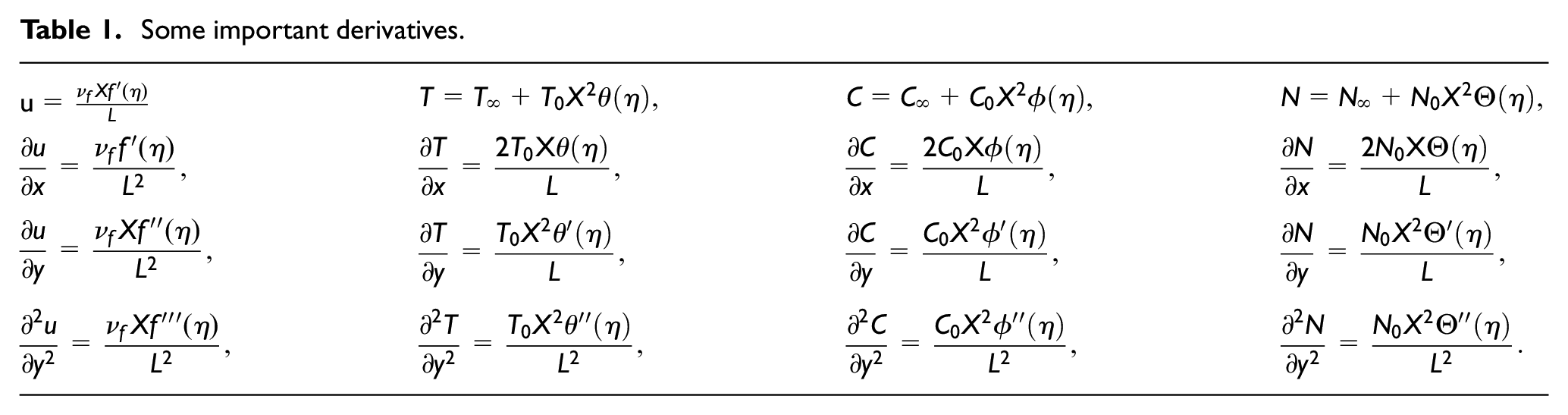
Marangoni convection is the term used to describe the boundary condition in equation (12). This condition has been used because it has so many uses in engineering and technology, including film drainage in emulsions, microfluidics, drying of semiconductor vapors in microelectronics, coating flow technology and surfactant replacement therapy for neonatal infants. The surface tension is presumed to be dependent linearly on solutal (concentration) and thermal (temperature), where temperature surface tension coefficient is and concentration is Table 1 displays the important derivatives.
Some important derivatives.
The following similarity transformations are used33:
The thermal conductivity that varies with temperature is given as35:
where is Boltzmann constant. For nonlinear thermal radiation, the heat flux in terms of the Roseland approximation is:
As we observed from equation (20) the highly nonlinearity of the term can be simplified by using Taylor expansion about the constant value
Where, (temperature ratio parameter). First term of right hand side of equation (9) can also be expressed as , where
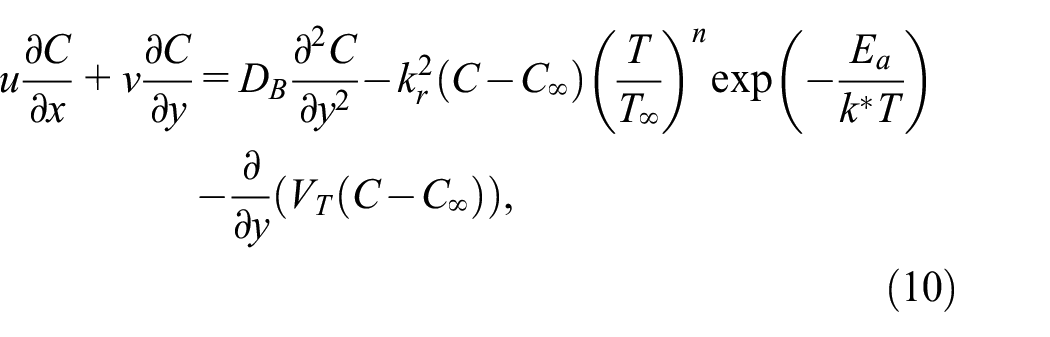
After applying similarity transformations, the equations (8)–(11) reduced to the following form:
The following are the transformed boundary conditions:
Where, Weissenberg number, porosity parameter, Schmidt number, heat source parameter (exponential dependent), activation energy parameter, magnetic parameter, heat source parameter (temperature dependent) temperature difference, Prandtl number, Marangoni number radiation parameter. thermal Biot number, Marangoni number, thermal Grashof number, chemical reaction parameter, concentration mixed convection parameter, microorganism Biot number, bioconvection mixed convection parameter, Eckert number, thermpopherotic parameter, and concentration Biot number. Some important derivatives are given in Table 1. The thermo-physical features of nanofluid are shown in Table 2. The thermo-physical characteristics of base fluid and nanoparticle are shown in Table 3. Table 4 shows the shape factor of nanoparticles.
The most significant physical quantities in terms of practical applications are ,, and , which stand for the local density of mobile microorganisms, local skin friction, local mass transfer, and local heat transfer coefficients respectively. The surface drag coefficient , thermal gradient , solute gradient , and microorganism’s gradient are mathematically expressed as:
Where heat flux, motile microorganism’s flux, shear stress, and mass flux.
Numerical method
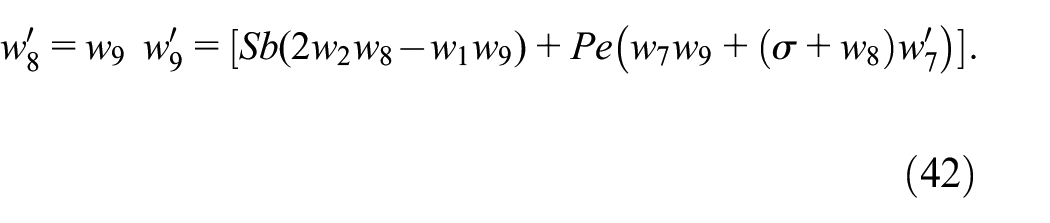
The well-known shooting strategy using the RKF-45th method is used in MATLAB to numerically solve equations equations (23)–(26) with boundary conditions The shooting technique is the most efficient method for calculating the numerical approximation of this type of highly nonlinear problem. In contrast to other numerical techniques, this method provides excellent solution accuracy and avoids the need for a complex discretization.9.
Boundary conditions
The calculations are performed systematically for a set of values of previously determined parameters, using randomly chosen initial conditions. Figure 4 shows the flow chart of numerical solution. Whereas, unknown conditions (initial) , and are acquired by iterative scheme (shooting method) until the agreed boundary values , and as are attained. The distribution of mesh is adjusted as:
Iterations of the method will continue until the desired conveence threshold of is reached.
Furthermore, step size is chosen throughout the calculation.
The integration length is selected in such a way that all the stated boundary values agreed the results.
Flow chart.
Result and discussion
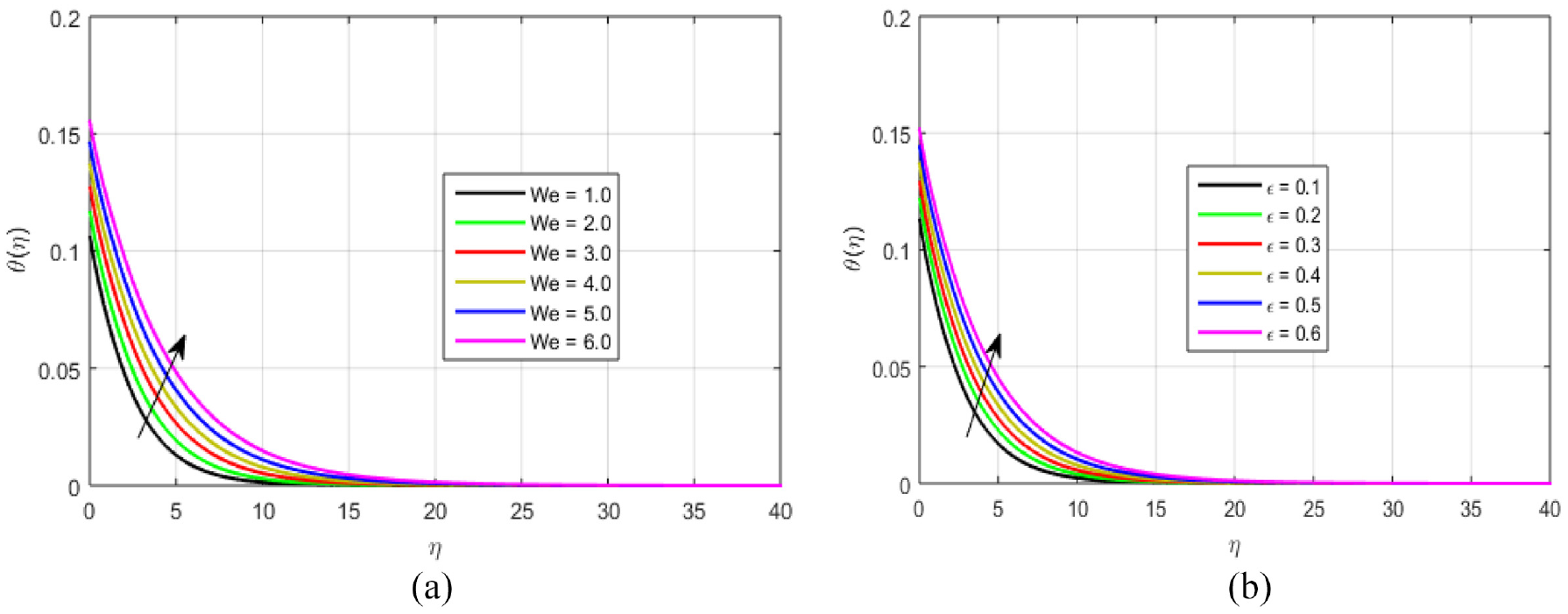
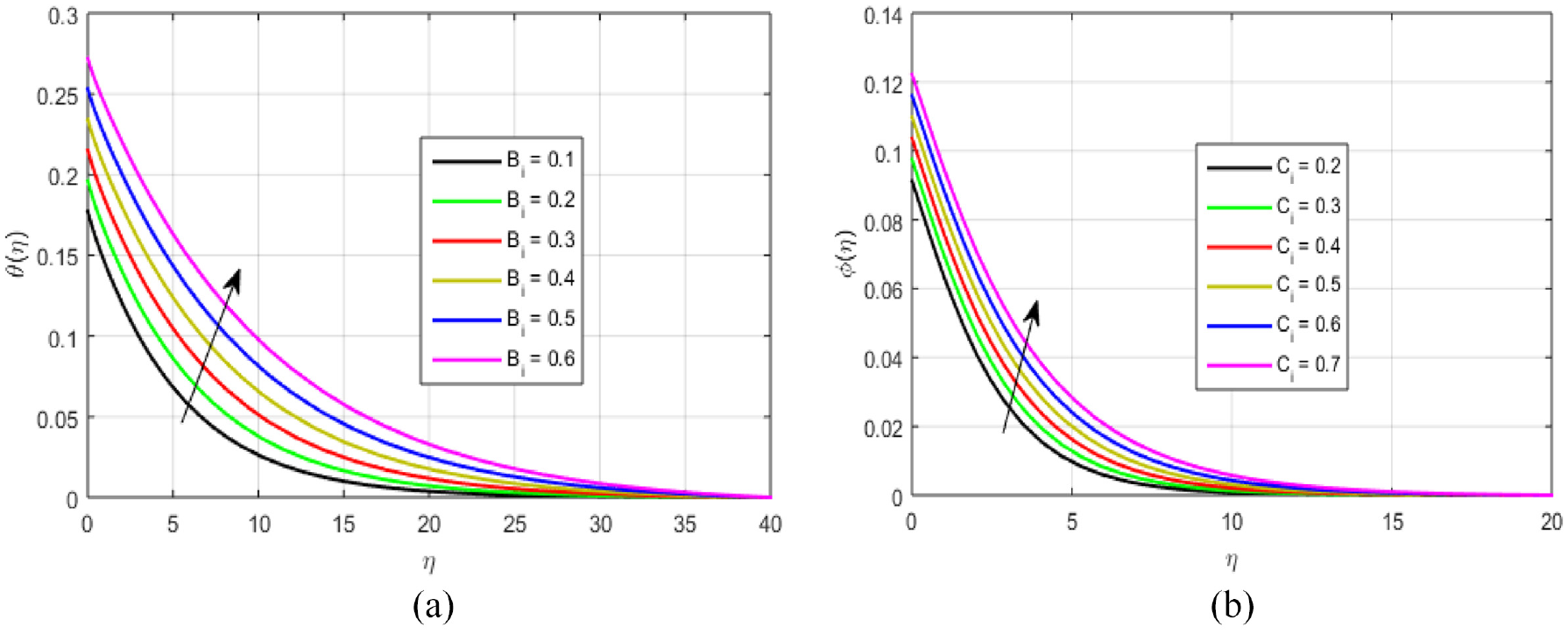
The thermo-solutal Marangoni convective flow of Cross nanofluid over a sheet with porous medium, microorganism, variable thermal conductivity, heat generation, thermophoretic particle deposition, and convective condition is considered in this study. Non-linear coupled system is simulated in two dimensions using RKF-45th technique. The solutions are offered to show how various important parameters distress the profiles of temperature, velocity, concentration, and microbes. The range of values for the parameters has been chosen by following Khan et al.,32 Rasool et al.,33 Mamatha et al.38 and that is, Figure 5(a) shows how the is affected by enhancing . The analysis of Figure 5(a) reveals that the fluid velocity is increased by the power law index’s progressive values. Figures 5(b) and 6(a) show graphically how and change for growing values of . The temperature profile is shown graphically to be an growing function of . The physical reason of this graphical pattern is that the relaxation time is prolonged for rising values of , which results in a decrease in and an rise in . The encouragement of on is portrayed in Figure 6(b). It is determined that as values of increase, and thermal boundary layer both improve. The consequence of on and is seen in Figure 7(a) and (b). The graphs show clearly that increasing reduces profile. This is due to the fact that increased porosity causes pores in a porous material to open wider, which makes resistive forces work against flow, lowering and enhancing . The influence of and on is shown in Figure 8(a) and (b). It’s stimulating to note that the velocity of the Cross nanofluid increases as and values rise. The influence of on and is seen in Figure 9(a) and (b). It is obvious that a higher reduces and profiles. This is due to the fact that when increases, the velocity decrease and thermal profile enhance. Physically, the concentration of nanoparticles in a fluid surpasses the density of the nanofluid, slowing down fluid motion, and enhancing the thermal profile. The outcome of on and is seen in Figure 10(a) and (b).. The graphs clearly show that when the increases, deteriorates and grows. This is caused by the Lorentz force, which occurs when is increased and acts as the flow opposing force. This force tends to thin the temperature boundary layer and thick . We observed enhance in as a result. The outcome of and on is shown in Figure 11(a) and (b). It is noticeable that the temperature profile upsurges when the heat production parameters are increased. The heat source factor depicts how much heat is produced and distributed throughout the environment when is positive. It can be shown that the boundary thermal layer generates energy, which raises the fluid temperature for the raising values of rises. The outcome of on concentration is portrayed in Figure 12(a). As increases, the solutal profile decreases. The mass and momentum diffusivity in a fluid flow is represented by the Schmidt number . The higher correlates with smaller . Mass diffusion, which happens when is enriched, is what leads to decrease the solutal profile. Figure 12(b) illustrates the outcome of on concentration profile. The concentration profile in this case is enhanced with an upsurge in . The Arrhenius equation demonstrates mathematically that the concentration profile is more significantly affected if a chemical reaction slows down as a result of a reduction in heat. In response to an increase in activation energy, the modified Arrhenius mechanism exhibits rising behavior. Activation energy is recognized in any system by the Arrhenius equation. In Figure 13(a) the impact of is shown on . From Figure 13(a), it can be seen that falls as the values of rise. Due to a growth in particle mobility, a weaker concentration is observed as the temperature gradient increases. The impact of on the microorganism profile is depicted in Figure 13(b). As value increases, the microorganism’s field gets weaker. The ratio of momentum diffusivity (kinematic viscosity) to microorganism diffusivity in a fluid flow is known as the bio-convection Schmidt number. The outcome of on is portrayed in Figure 14(a). It is determined that by increasing the estimation of , the field of microorganisms is slowed. The Peclet number and cell swimming speed ) are directly related to one another, but (microorganisms diffusivity) is inversely proportional to both. The speed of advection and diffusion depends on the Peclet number A higher is produced as a result of a faster rate of advective transport, which swiftly boosts the flux of microorganisms. Increased values consequently result in a reduction in and an increase in the flux of wall motile bacteria. The outcome of on is revealed in Figure 14(b). Here, growing the amount of increases the microorganism distribution . The influence of on is seen in Figure 15(a). It is obvious that a higher enhances . A higher Biot number suggests less heat transfer from the system since it measures the ratio of confrontation to heat transmission from the inside to the exterior surfaces of the body. As a outcome, the system’s overall energy rises and it multiplies as the thermal boundary layer thickness gradually upsurges. The determination Figure 15(b) is to investigate the impact of on . For , it is shown that the grows. The impacts of on and are shown in Figure 16(a) and (b). The graph illustrates how raising value enhances Cross nanofluid velocity profile. The cause of this phenomena is surface variation. Since the Marangoni effect acts as a driving force for liquid streams, a better Marangoni effect will almost always result in a higher velocity profile. These plots demonstrate that as values increase, the temperature profile decrease dramatically. Surface tension has a direct physical relationship with the Marangoni number. Surface tension develops on the surface of a liquid as a result of the liquid’s bulk attraction to the elements in the surface layer. As a result, surface molecule attraction is increased as surface tension and temperature decrease. The streamline pattern is seen in Figure 17(a) and (b). by a changing Marangoni convection parameter The streamlines are less curved near the surface for a stronger and more curved near the surface for a smaller . The isotherm pattern for is further explained in Figure 18(a) and (b). The isotherms increased with increasing radiative Cross nanofluid, and vice versa. Tables 5 and 6 address the skin friction and Nusselt numbers against multiple values of emerging constraints. Table 7. Display compare the heat transfer rates between the published research and current study, utilizing the integer case and only common parameters. Both results are in conspicuous accord with one another. This bolsters the accuracy of the current study.
(a and b) Influence of and on .
(a and b) Outcome of and on .
(a and b) Outcome of on and .
(a and b) Outcome of and on .
(a and b) Impact of on and .
(a and b) Influence of on and .
(a and b) Outcome of and on .
(a and b) Outcome of and on and .
(a and b) Outcome of and on .
(a and b) Outcome of and on .
(a and b) Encouragement of and on and , respectively.
(a and b) Influence of on and .
Streamlines for (a) and (b) .
Isotherm for (a) and (b) .
Encouragement of many parameters on skin friction).
Outcome of several parameters on Nusselt number.
A comparison of the Nusselt number with outcomes that have been published for various values of
In this paper investigated the effects of thermos-solutal Marangoni convection and heat radiation on Cross nanofluid flow over a sheet in the existence of, microbe and thermophoretic particles. These are the investigation’s main outcomes:
❖ The velocity profile is improved when the Marangoni ratio parameter rise, but the temperature exhibits the reverse behavior.
❖ The flow profile is declined and the thermal profile is improved when the magnetic parameter rises. The growing values of thermal radiation, temperature, and exponential dependent heat generation parameters advance the heat transfer;
❖ The microorganism profile decreases as the bioconvection Schmidt and Peclet number increase.
❖ The growing values of Marangoni number, Weissenberg number, and Marangoni ratio parameter decrease the skin friction coefficient; however, it exhibits opposite trend for nanoparticle volume friction. The Nusselt number rises by uplifting values of nanoparticle volume friction, heat source, and thermal radiation while reverse behavior is seen for Marangoni number, Marangoni ratio parameter, variable thermal conductivity parameter, and Weissenberg number.
Future work
Future research should expand on this work by taking into account thermophoresis particle deposition, convective conditions, variable conditions, and trihybrid nanoparticles. These models will be highly helpful in the construction of furnaces, atomic power plants, gas-cooled nuclear reactors, SAS turbines, and unique driving mechanisms for aircraft, rockets, satellites, and spacecraft.
Numerical code
Footnotes
Appendix
Handling Editor: Chenhui Liang
Declaration of conflicting interests
The author(s) declared no potential conflicts of interest with respect to the research, authorship, and/or publication of this article.
Funding
The author(s) received no financial support for the research, authorship, and/or publication of this article.
ORCID iD
Nargis Khan
References
1.
ChuYMAl-KhaledKKhanN, et al. Study of Buongiorno’s nanofluid model for flow due to stretching disks in presence of gyrotactic microorganisms. Ain Shams Eng J2021; 12: 3975–3985.
2.
HumanePPPatilVSShamshuddinMD, et al. Role of bioconvection on the dynamics of chemically active Casson nanofluid flowing via an inclined porous stretching sheet with convective conditions. Int J Model Simul. Epub ahead of print 8January2023. DOI: 10.1080/02286203.2022.2164156.
3.
ShamshuddinMDRajputGRJamshedW, et al. MHD bioconvection microorganism nanofluid driven by a stretchable plate through porous media with an induced heat source. Waves Random Complex Media. Epub ahead of print 26September2022. DOI: 10.1080/17455030.2022.2126024.
4.
AlsaediAKhanMIFarooqM, et al. Magnetohydrodynamic (MHD) stratified bioconvective flow of nanofluid due to gyrotactic microorganisms. Adv Powder Technol2017; 28: 288–298.
5.
ShamshuddinMMishraSRBegOA, et al. Adomian decomposition method simulation of Von Kármán swirling bioconvection nanofluid flow. J Cent South Univ2019; 26: 2797–2813.
6.
HillesdonAJPedleyTJKesslerJO. The development of concentration gradients in a suspension of chemotactic bacteria. Bull Math Biol1995; 57: 299–344.
7.
HillNABeesMA. Taylor dispersion of gyrotactic swimming micro-organisms in a linear flow. Phys Fluids2002; 14: 2598–2605.
8.
KhanNRiazIHashmiMS, et al. Aspects of chemical entropy generation in flow of Casson nanofluid between radiative stretching disks. Entropy2020; 22: 495.
9.
AbbasMKhanNHashmiMS, et al. Numerically analysis of Marangoni convective flow of hybrid nanofluid over an infinite disk with thermophoresis particle deposition. Sci Rep2023; 13: 5036.
10.
LinYZhengLZhangX. MHD Marangoni boundary layer flow and heat transfer of pseudo-plastic nanofluids over a porous medium with a modified model. Mech Time Depend Mater2015; 19: 519–536.
11.
AlyEHEbaidA. Exact analysis for the effect of heat transfer on MHD and radiation Marangoni boundary layer nanofluid flow past a surface embedded in a porous medium. J Mol Liq2016; 215: 625–639.
12.
MatNAAArifinNMNazarR, et al. Radiation effect on Marangoni convection boundary layer flow of a nanofluid. Math Sci2012; 6: 1–6.
13.
GuedriKHashmiMSAl-KhaledK, et al. Numerical simulation for two-phase dusty thermally developed Marangoni forced convective flow of Williamson material: a finite difference scheme. Z Angew Math Mech2023; 103: e202100206.
14.
GevorgyanGSPetrosyanKAHakobyanRS, et al. Experimental investigation of Marangoni convection in nanofluids. J Contemp Phys2017; 52: 362–365.
15.
CrossMM. Rheology of non-Newtonian fluids: a new flow equation for pseudoplastic systems. J Colloid Sci1965; 20: 417–437.
16.
XieJJinYC. Parameter determination for the Cross rheology equation and its application to modeling non-Newtonian flows using the WC-MPS method. Eng Appl Comput Fluid Mech2016; 10: 111–129.
17.
EscudierMPGouldsonIWPereiraAS, et al. On the reproducibility of the rheology of shear-thinning liquids. J Nonnewton Fluid Mech2001; 97: 99–124.
18.
SteffeJF. Rheological methods in food process engineering. East Lansing, MI: Freeman Press, 1996.
19.
KhanMManzurM. Boundary layer flow and heat transfer of Cross fluid over a stretching sheet. arXiv preprint arXiv:1609.01855, 2016.
20.
UddinMJBégOAIsmailAI. Radiative convective nanofluid flow past a stretching/shrinking sheet with slip effects. J Thermophys Heat Trans2015; 29: 513–523.
21.
Adnan ZaidiSZAKhanU, et al. Impacts of freezing temperature based thermal conductivity on the heat transfer gradient in nanofluids: applications for a curved Riga surface. Molecules2020; 25: 2152.
22.
ChuYMAzizSKhanMI, et al. Nonlinear radiative bioconvection flow of Maxwell nanofluid configured by bidirectional oscillatory moving surface with heat generation phenomenon. Phys Scr2020; 95: 105007.
23.
MahantheshBGireeshaBJGorlaRR, et al. Numerical solutions for magnetohydrodynamic flow of nanofluid over a bidirectional non-linear stretching surface with prescribed surface heat flux boundary. J Magn Magn Mater2016; 417: 189–196.
24.
PrasannakumaraBCGireeshaBJGorlaRS, et al. Effects of chemical reaction and nonlinear thermal radiation on Williamson nanofluid slip flow over a stretching sheet embedded in a porous medium. J Aerosp Eng2016; 29: 04016019.
25.
AldabeshAHussainMKhanN, et al. Thermal variable conductivity features in Buongiorno nanofluid model between parallel stretching disks: improving energy system efficiency. Case Stud Therm Eng2021; 23: 100820.
26.
IbrahimMAlgehyneEASaeedT, et al. Study of capabilities of the ANN and RSM models to predict the thermal conductivity of nanofluids containing SiO2 nanoparticles. J Therm Anal Calorim2021; 145: 1993–2003.
27.
AbbasMKhanNShehzadSA. Thermophoretic particle deposition in Carreau-Yasuda fluid over chemical reactive Riga plate. Adv Mech Eng2023; 15: 16878132221135096.
28.
KumarRNGowdaRPMadhukeshJK, et al. Impact of thermophoretic particle deposition on heat and mass transfer across the dynamics of Casson fluid flow over a moving thin needle. Phys Scr2021; 96: 075210.
29.
ChuYMHashmiMSKhanN, et al. Thermophoretic particles deposition features in thermally developed flow of Maxwell fluid between two infinite stretched disks. J Mater Res Technol2020; 9: 12889–12898.
30.
KhanNMahmoodT. Thermophoresis particle deposition and internal heat generation on MHD flow of an Oldroyd-B nanofluid between radiative stretching disks. J Mol Liq2016; 216: 571–582.
31.
ChuYMKhanNKhanMI, et al. Thermophoresis particle deposition analysis for nonlinear thermally developed flow of Magneto-Walter’s B nanofluid with buoyancy forces. Alex Eng J2021; 60: 1851–1860.
32.
KhanMManzurMur RahmanM. On axisymmetric flow and heat transfer of Cross fluid over a radially stretching sheet. Results Phys2017; 7: 3767–3772.
33.
RasoolGZhangTShafiqA. Marangoni effect in second grade forced convective flow of water based nanofluid. J Adv Nanotechnol2019; 1: 50.
34.
KhanSAHayatTAlsaediA, et al. Irreversibility analysis in Marangoni forced convection flow of second grade fluid. J Phys Commun2020; 4: 085013.
35.
ObalaluAMAjalaOAAbdulraheemA, et al. The influence of variable electrical conductivity on non-Darcian Casson nanofluid flow with first and second-order slip conditions. Partial Differ Equ Appl Math2021; 4: 100084.
36.
UnyongBVadivelRGovindarajuM, et al. Entropy analysis for ethylene glycol hybrid nanofluid flow with elastic deformation, radiation, non-uniform heat generation/absorption, and inclined Lorentz force effects. Case Stud Therm Eng2022; 30: 101639.
37.
AbbasMKhanNAlshomraniAS, et al. Performance-based comparison of Xue and Yamada–Ota models of ternary hybrid nanofluid flow over a slendering stretching sheet with activation energy and melting phenomena. Case Stud Therm Eng2023; 50: 103427.
38.
MamathaSURamesh BabuKDurga PrasadP, et al. Mass transfer analysis of two-phase flow in a suspension of microorganisms. Arch Thermodynamics2020; 41: 175–192.
39.
Punith GowdaRJNaveen KumarRJyothiAM, et al. Impact of binary chemical reaction and activation energy on heat and mass transfer of Marangoni driven boundary layer flow of a non-Newtonian nanofluid. Processes2021; 9: 702.