




Abstract
Serious vibrations can occur in the coke pushing ram in the coke pushing process and may directly affect the regular production of coke oven, in order to avoid vibration, it is necessary to study the vibration characteristics of coke pushing ram. In this article, the coke pushing resistance is derived via the coke pushing current and a mathematical model of coke pushing ram in the coke pushing process is established to study the vibration mechanism of coke pushing ram. The results indicate that in the low-velocity and heavy-load coke pushing process after the slipper enters the carbonization chamber, the coke pushing velocity is less than the critical velocity, which indicates that the stick-slip vibration occurs in the coke pushing ram, and the factors affecting the coke pushing ram stability mainly include the difference between the static and dynamic friction coefficients, stiffness, and damping. The results are validated by numerical simulation and experiment test.
Introduction
Coke oven production is beneficial for the comprehensive utilization of coal and plays an important role within the metallurgical industry. The coke pushing ram is the core component of coke oven production; it is a box structure with the length of 27 m, width of 0.40 m, height of 5.65 m, and weight of 40 tons, which mainly consists of a coke pushing head, ram, and slipper. A three-dimensional model of coke pushing ram is shown in Figure 1.

Three-dimensional model of coke pushing ram.
Figure 2 presents a three-dimensional model of coke pushing process. It can be observed that the coke pushing ram is driven by a gear, and the coke is pushed out from the carbonization chamber via a coke pushing head.

Three-dimensional model of coke pushing process.
However, in the coke pushing process after slipper enters the carbonization chamber, serious vibrations can occur in the coke pushing ram so that the coke cannot be completely pushed out from the carbonization chamber and may directly affect the regular production of coke oven. 1 In order to avoid serious vibration, it is necessary to study the vibration characteristics of coke pushing ram.
Zhang and Hao 2 analyzed the force characteristics of coke pushing ram in the coke pushing process and suggested that the structure of coke pushing ram was not solid enough to cause it to vibrate. Chu and Song 3 suggested that the force would cause deformation of the structure, which would cause the gear rack not to mesh normally and induce vibration of the coke pushing ram. The above studies are limited to analyzing the vibration phenomenon of coke pushing ram, lacking a theoretical basis. By comparing the vibration frequency and natural frequency of coke pushing ram, it was found that the vibration frequency was close to the natural frequency, leading Gao 4 to propose that the vibration of coke pushing ram belonged to self-excited vibration. Using ANSYS, Zhao 5 analyzed the vibration amplitude of coke pushing ram in horizontal and longitudinal directions, without further analyzing the vibration characteristics of coke pushing ram.
To date, studies on the vibration characteristics of coke pushing ram in the coke pushing process have been very limited, lacking theoretical analysis, numerical simulation, and experimental test. In order to study the vibration characteristics of coke pushing ram, in this article, the coke pushing resistance is derived via the coke pushing current, the coke pushing process is simplified as a physical model and a mathematical model is developed from the physical model to analyze the vibration mechanism of coke pushing ram. In addition, the results are validated by numerical simulation and experiment test.
Coke pushing resistance
In order to study the vibration characteristics of coke pushing ram, the force conditions of coke pushing ram in coke pushing process are first analyzed.
Figure 3 shows the force conditions of coke pushing ram in the coke pushing process. M is the force of the gear drive, F is the coke pushing resistance caused by the coke pushing ram pushing the coke, f is the friction between the coke pushing ram and ground of the carbonization chamber generated by the bottom of the slipper contacting with the ground of the carbonization chamber, and N1, N2, N3, N4, and N5 are the support force.

Force analysis of coke pushing ram.
Coke pushing resistance has a great influence on the coke pushing process and can be characterized by the coke pushing current. Based on the coke pushing current–displacement data recorded by the instrument panel of the coke pushing operating room, such as in Figure 4, the coke pushing current–displacement function is fitted, and coke pushing resistance of different displacements segment is derived based on the current variations, which provides basis for deriving the mathematical model of coke pushing ram in the coke pushing process.

Coke pushing current–displacement data.
From Figure 4, it can be seen that the coke pushing current varied significantly between 3.6 and 8 m, and the analysis is as follows:
0–2.95 m: The coke pushing ram is in the startup phase, so the coke pushing current is stable at 230 A.
2.95–3.6 m: Coke pushing phase 1, the slipper has not entered the carbonization chamber. The coke pushing current reaches to the peak at 3.6 m, after a slow downward trend. During the initial phase of coke pushing process 1, the coke pushing ram does not only push the coke, so there still is a need to compact the loose coke. The coke pushing resistance goes from zero to a maximum, such that the current instantly increases. As the coke is compacted and pushed out, the current slowly decreases.
3.6–18 m: Coke pushing phase 2. The coke pushing ram runs to 8 m, and the slipper enters the carbonization chamber.
According to data 1 and 2, it is possible to fit the coke pushing current–displacement function as follows
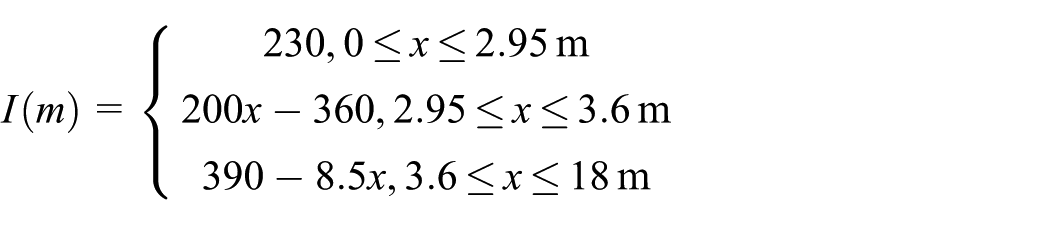
Coke pushing current is stable at 230 A in the startup phase, so in the coke pushing phase, the current changed is caused by the coke pushing resistance, and the current variations
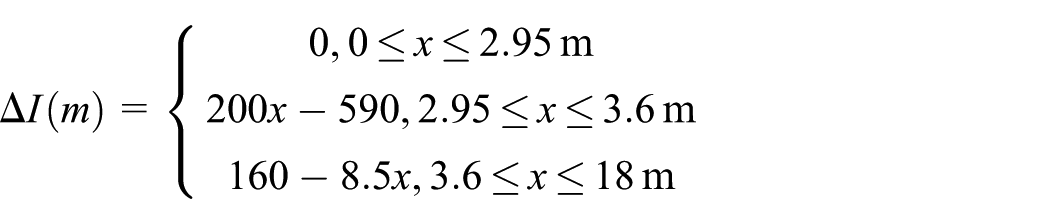
Based on

where
Therefore, the formula for the coke pushing resistance can be given as
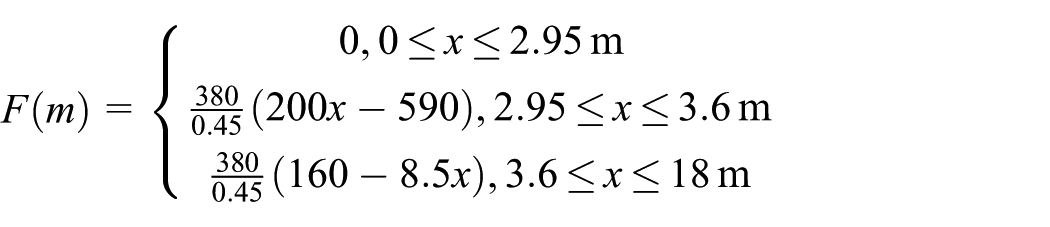
The curve of the coke pushing resistance is shown in Figure 5.

Curve of coke pushing resistance.
Vibration mechanism
Mathematical model
In view of the importance and complexity of coke pushing process, the vibration mechanism of coke pushing ram is analyzed by establishing a mathematical model. For convenience, based on the results obtained in the section above, the coke pushing process is simplified as a physical model presented in Figure 6. A mathematical model is developed from the physical model to analyze the main factors affecting the stability of the coke pushing ram. 6

Physical model in the coke pushing process.
The drive actuates the coke pushing ram move to the left with the velocity

where
Dynamic friction

Substituting equation (2) into equation (1), the kinetic equation of coke pushing ram can be written as

Ordering

Equation (4) is a second-order system, damping ratio
When
When
When
From the results above, it can be concluded that the primary cause of vibration is
Critical velocity
As the stiffness k is larger,

where
The coke pushing ram pushes the coke instantaneously,

where
Substituting equation (6) into equation (5), the displacement equation of coke pushing ram can be written as

Equation (7) is to take a derivation with respect to time

Equation (8) shows that velocity
If

Considering a cycle, that is,

when equation (10) is in the critical state of

Based on the equivalent infinitesimal, when


The critical value of D can be expressed as
Based on

where N is the positive pressure,
The parameters of the coke pushing ram are shown in Table 1, and the analysis is as follows:
Parameters of the coke pushing ram.

In the low-velocity and heavy-load coke pushing process, after the slipper enters the carbonization chamber, the coke pushing velocity is less than the critical velocity, it can be concluded that stick-slip vibration occurs in the coke pushing ram. In addition, the parameters affecting the coke pushing ram stability mainly include the difference between the static and dynamic friction coefficients
Numerical simulation
In order to validate the results of theoretical analysis, a simulation model is established by ADAMS to simulate the effects of the difference between the static and dynamic friction coefficients, stiffness and damping on the stability of coke pushing ram. The simulation model is shown in Figure 7, and the simulation parameters are shown in Table 2.

Simulation model.
Simulation parameters.

Figures 8–10 present the simulation results. It can be observed that before the slipper enters the carbonization chamber, the coke pushing velocity is stable and the displacement in the Y and Z directions are smaller, with no obvious vibration occurring in the coke pushing ram. After the slipper enters the carbonization chamber, different degrees of vibration occur in the coke pushing ram, and the analysis is as follows:

Effect of the difference between the static and dynamic friction coefficients on the stability of coke pushing ram: (a) coke pushing velocity in X direction, (b) displacement in Y direction, and (c) displacement in Z direction.

Effect of stiffness on the stability of coke pushing ram: (a) coke pushing velocity in X direction, (b) displacement in Y direction, and (c) displacement in Z direction.

Effect of damping on the stability of coke pushing ram: (a) coke pushing velocity in X direction, (b) displacement in Y direction, and (c) displacement in Z direction.
Figure 8 presents the effect of the difference between the static and dynamic friction coefficients on the stability of coke pushing ram. The main parameters such as drive velocity, stiffness, and damping remain unchanged, with a decrease of the difference between the static and dynamic friction coefficients, fluctuation of the coke pushing velocity is less obvious, the displacement in the Y and Z directions decrease noticeably, and stick-slip vibration decreases noticeably. 11
Figure 9 presents the effect of stiffness on the stability of coke pushing ram. The main parameters such as drive velocity, difference between the static and dynamic friction coefficients and damping remain unchanged, with the increase of stiffness, fluctuation of the coke pushing velocity is less obvious, the displacement in the Y and Z directions decrease gradually, and stick-slip vibration decreases gradually. 12
Figure 10 presents the effect of damping on the stability of coke pushing ram. The main parameters such as drive velocity, difference between the static and dynamic friction coefficients and stiffness remain unchanged, with the increase of damping, there is a slight decrease for fluctuation of the coke pushing velocity and the displacement in the Y and Z directions, indicating that stick-slip vibration has decreased slightly.
From the simulation results above, it can be concluded that after the slipper enters the carbonization chamber, the stick-slip vibration occurs in the coke pushing ram, moreover, decreasing the difference between the static and dynamic friction coefficients and increasing stiffness and damping can decrease vibration of the coke pushing ram, which validates the results of theoretical analysis.
Modal analysis
In order to study the vibration characteristics of coke pushing ram, the natural frequencies of the coke pushing ram are obtained via modal analysis. Material parameters of the coke pushing ram are shown in Table 3.
Material parameters of coke pushing ram.

A finite element model of the coke pushing ram is shown in Figure 11 13 and the grid number is 594753.
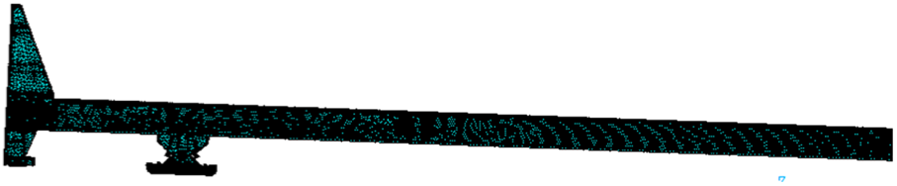
Finite element analysis model of coke pushing ram.
For modal analysis, the modal extraction method used is PCG Lanczos, with the frequency range of 0.01–1000 Hz. As the vibration frequencies of the coke pushing ram is mainly concentrated in the low frequency range of 0–100 Hz (as shown in Figure 14), the first 30 orders natural frequencies are selected for analysis, as shown in Table 4.
First 30 orders natural frequencies of coke pushing ram.

Experimental test
Experimental method
Vibration signals of the coke pushing ram in the coke pushing process are acquired via an experiment, and the vibration frequencies and vibration time of coke pushing ram are obtained by time–frequency analysis; furthermore, the vibration characteristics of coke pushing ram are analyzed by comparing the vibration frequencies, natural frequencies, and excitation frequency.
Table 5 lists the test instruments, and Table 6 lists the test backgrounds. To push out the coke, it is necessary for the coke pushing ram to enter the carbonization chamber, and due to the complicated production site, vibration sensors are placed on the front roller to acquire the vibration signals of coke pushing ram. Vibration sensors arrangement is shown in Figure 12.
Test instruments.

Test background.


Vibration sensors arrangement.
Experimental analysis
In view of non-stationary and non-linear characteristics of vibration signals of the coke pushing ram, the Hamming window is selected for short-time Fourier transform of the vibration signals.14,15 Sampling frequency Fs is 2048 Hz, Nfft is 20480, frequency resolution Δf is 0.1, and window length is 2048 × 1.5. 16
Based on the coke pushing characteristics of coke pushing rod, the coke pushing process can be divided into three phases: startup phase, coke pushing phase 1 (before the slipper enters the carbonization chamber), and coke pushing phase 2 (after the slipper enters the carbonization chamber).
Figure 13 shows the vibration signals in the X, Y, and Z directions. When the vibration signals in the X, Y, and Z directions are transformed by short-time Fourier transform, it is found that serious vibration occurs in the X, Y, and Z directions, and mainly occurs in the low frequency range of 0–100 Hz. Since the vibration frequencies in the three directions are extremely close, the vibration signal in the Y direction is selected for further analysis. 17
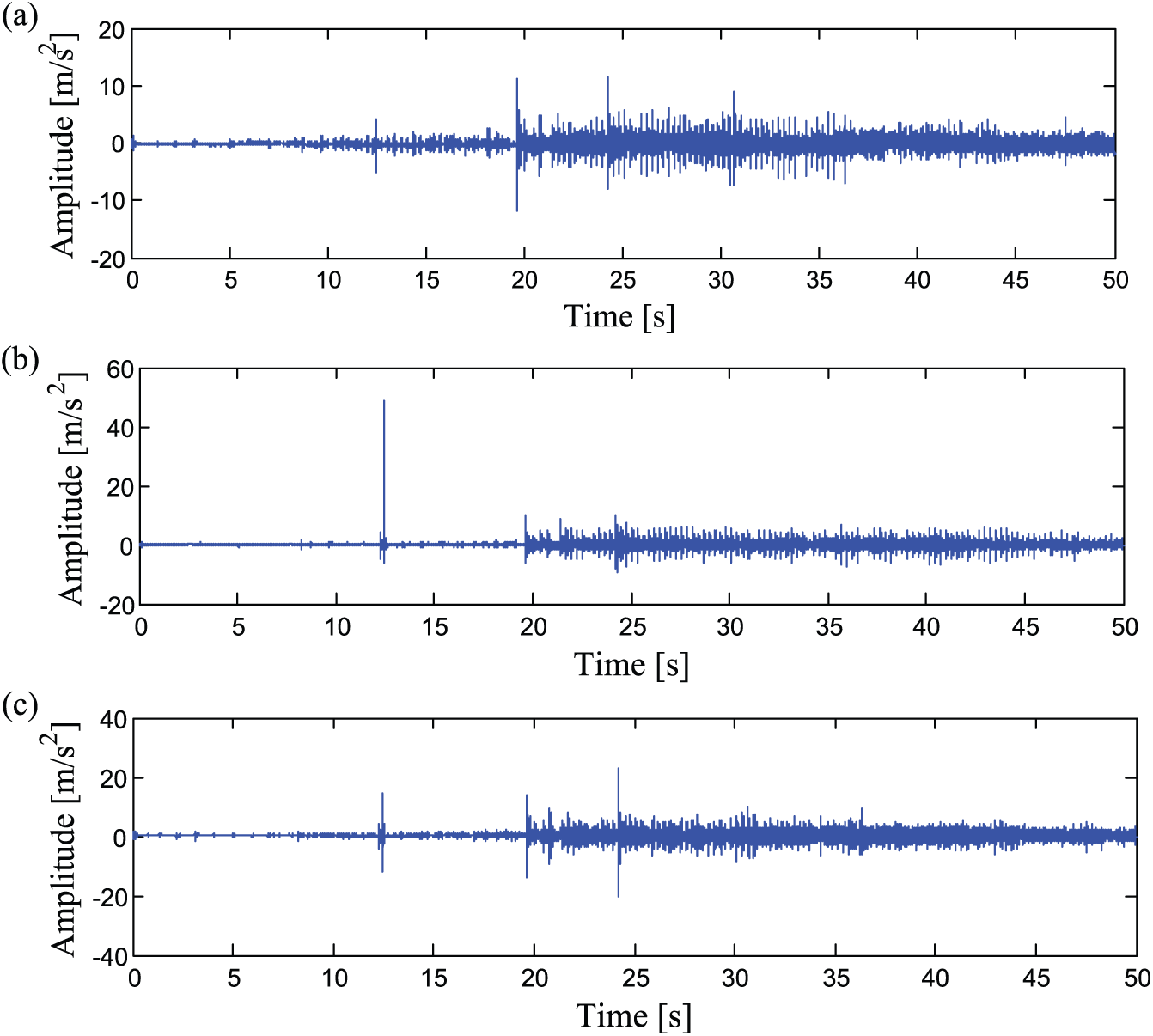
Vibration signals of coke pushing ram: (a) X direction, (b) Y direction, and (c) Z direction.
Figure 14 presents the time–frequency in the Y direction, and the analysis is as follows:

Time–frequency in Y direction.
Figures 13 and 14 indicate that vibration of the coke pushing ram is serious during the coke pushing process between 20 and 50 s, that is, vibration of the coke pushing ram occurs mainly after the slipper enters into the carbonization chamber, with the maximum amplitude of vibration in the Y direction reaching to 0.8 m/s2. Therefore, the serious vibration in area A is selected to analyze the characteristics of vibration in the coke pushing ram.
Figure 15 shows the time–frequency of area A, it can be observed that the vibration frequencies mainly include 32.4, 35.7, 37.6, 39.7, 46.7, and 50.5 Hz, Which are close to the natural frequencies of 30.889, 36.499, 48.006, and 50.256 Hz, and different from exciting frequency of 2.8 Hz; moreover, the first order natural frequency is 1.846 Hz, which is also different from exciting frequency of 2.8 Hz, this indicates that self-excited vibration occurs in the coke pushing ram. 18

Time–frequency of area A.
Experiment results indicate that after the slipper enters the carbonization chamber, the vibration occurs in the coke pushing ram and the form of vibration is self-excited vibration, which proves the results of theoretical analysis.
Conclusion
To avoid vibration and its effect on the regular production of coke oven, the vibration characteristics of coke pushing ram are studied based on the theoretical analysis, numerical simulation, and experimental test. The results show that in the low-velocity and heavy-load coke pushing process, after the slipper enters the carbonization chamber, the coke pushing velocity is less than the critical velocity, which indicates that the stick-slip vibration occurs in the coke pushing ram. In addition, the main factors that affect the coke pushing ram stability include the difference between the static and dynamic friction coefficients, stiffness, and damping. Furthermore, decreasing the difference between the static and dynamic friction coefficients, increasing stiffness and damping can decrease the critical velocity, and thus decrease vibration of the coke pushing ram.
Footnotes
Handling Editor: Sang-Wook Kang
Declaration of conflicting interests
The author(s) declared no potential conflicts of interest with respect to the research, authorship, and/or publication of this article.
Funding
The author(s) disclosed receipt of the following financial support for the research, authorship, and/or publication of this article: This study is supported by Key Technology Breakthrough Project of Coal Machine in Shanxi Province, China (grant number MJH2014-08).
