




Abstract
As a key component of the machine tool spindle, bearing has critical influences on the spindle thermal error. In particular, the installation errors of bearing have considerable effects upon the spindle thermal error by altering the bearings’ internal contact angles, contact loads, and friction torques for different ball positions, but have yet to be fully elucidated. In this article, the influence of installation errors on the resulting spindle thermal error was evaluated using both empirical methods and simulation method, with the ultimate aim of reducing installation error. Deviations within the bearing support were used to simulate bearing parallel misalignment; bearing parallel misalignment running model was built, and an analysis and comparison of various conditions were used to determine the influence, showing that the parallel misalignment has significant influence on the spindle Z direction thermal error.
Introduction
As the key component of the machine tool, the spindle thermal error influences the working accuracy of a machine tool positively. 1 Due to high operating speeds, bearing characteristics are significantly affected by the assembly tolerances, generating detrimental effects on the spindle thermal characteristics and leading to thermal deformation of the shaft. Moreover, the lifespan of a bearing is greatly affected by the distribution and variation of the dynamic loads and contact pressures experienced during the running process. 2
The bearing installation misalignment is a critical factor that causes concentrated contact loads between the balls and rings, resulting in only a few balls against the cutting force. Under the condition of bearing existing installation misalignment, the radial clearance has a non-uniform distribution, as shown in Figure 1. In addition, when a load is applied to the bearing, the contact angles and loads at different ball positions will also have a non-uniform distribution. At present, it has been paid extensive attention in determining the influence of installation misalignment on bearing performance. Teutsch and Sauer 3 proposed an improved slicing technology to present a more accurate pressure distribution for tilted bearings using the Lundberg logarithmic profile. TJ Park 4 discussed the effect of deflection on contact pressure under elastohydrodynamic lubrication (EHL) and reported very high values due to the tilted misalignment. Zamponi et al. 5 presented a mixed methodology employing both a finite element analysis (FEA) method and Hertz contact theory to analyze the contact pressure in bearings and considered the effects of tilted misalignment on the load distribution for bearings with both rigid and flexible rings. Z Ye et al. 6 analyzed the distribution of loads and contact stress in high-speed roller bearings with quasi-dynamic method and FEA method considering effects of tilted misalignment between inner and outer rings for the roller cylindrical bearings. Interestingly, the influence of installation misalignment has rarely been studied for angular contact ball bearings, which are widely used in machine tool spindles driven by computer numerical control (CNC).

The radial clearance distribution under parallel misalignment.
Heat generated by the bearing is the main heat source within spindle systems. Moreover, transfer of heat from the bearing to the shaft has a considerable influence on thermal deformation of the shaft; therefore, the bearing temperature field is the intermediate bond between the bearing generated heat and the shaft thermal deformation. Y Li et al. 7 discussed the relationship between the temperature field and thermal deformation of the spindle system by FEA. Xiang et al. 8 built preliminary theoretical models of the temperature field and the thermal deformation based on the size of the spindle and the parameters of the bearing. The centrifugal force and thermal expansion occurring on the bearings and motor rotor change the thermal characteristics of the built-in motor, bearings, and assembly joints. 9 And also many researchers have done the spindle thermal error analysis on the basis of bearing statuses calculated accurately.10–12 The bearing temperature field is the internal factor for the shaft thermal deformation.
Hence, as an influencing factor of the bearing temperature field, parallel misalignment plays an important role in spindle thermal error analysis. In this article, the influence law of parallel installment misalignment on the internal physical relationships of the bearing and spindle thermal error was analyzed in detail. And an action mechanism was proposed for bearing installation parallel misalignment.
Bearing running model with parallel misalignment
A simplified schematic diagram of the angular contact ball bearing is shown in Figure 2.
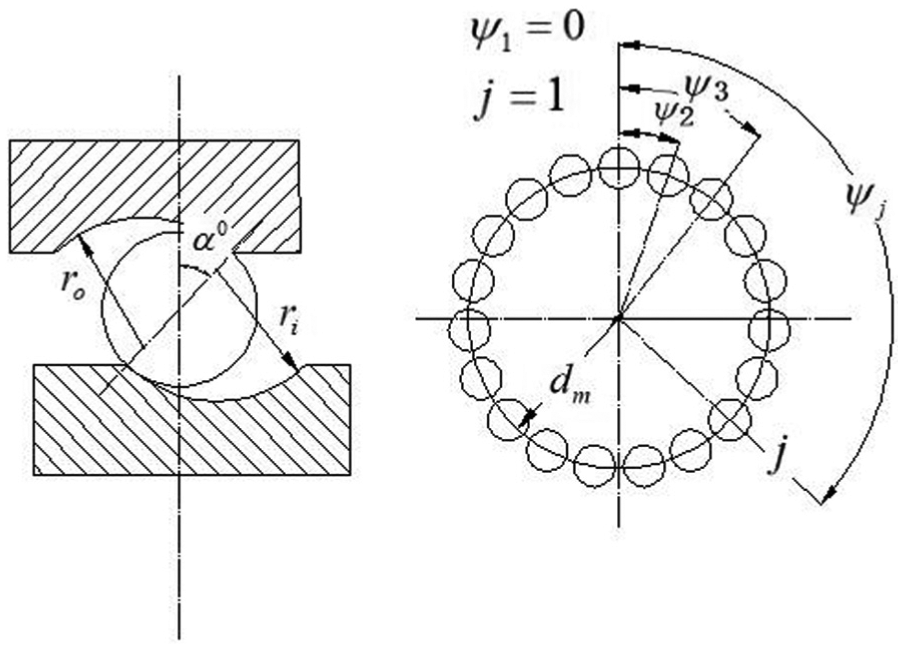
Simplified schematic diagram of angular contact ball bearing.
The radial clearance between the rings was assumed to move the shaft along the radial direction without shaft tilt; therefore, parallel misalignment of the bearing induced an additional radial displacement for each ball δrcosψj with respect to the initial position. When the cutting force was applied to the bearing, the ball gained an additional radial displacement

The relative position for the bearing rings’ curvature centers.
The auxiliary parameters A1j, A2j, X1j, and X2j and the equilibrium equations for the entire bearing were defined as


where f is the ring groove curvature radius coefficient, D is the bearing outer diameter, and ψj is the ball bearing position angle. BD= (fo+fi− 1)D, which is the distance between the outer ring curvature center and the inner ring curvature center. The force applied to every ball is depicted in Figure 4.
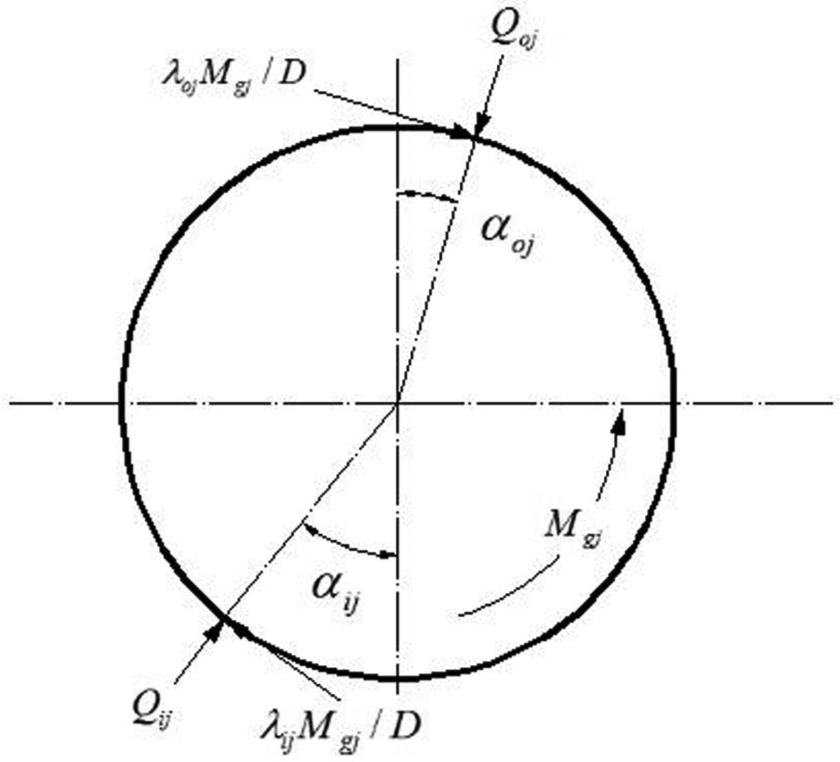
Ball loads at angle ψj.
The force balance equations for each ball are presented as follows


where
Combining the entire bearing balance equations (5) and (6) and the calculated equation for both centrifugal force and gyroscopic moment equations (7) and (8), the bearing internal contact angles and loads are determined by using the Newton–Raphson method


where Fa and Fr are the applied loads on the bearing

The specific parameters of a 7012AC bearing are shown in Table 1. Contact angles and loads were calculated relative to different positions using Fa= 400 N and Fr= 0 N and shown as Figures 5 and 6, respectively.
Parameter values of the bearing 7012AC.


Contact angles between the ball and ring.

Contact loads between the ball and ring.
In Figure 5, a huge difference among the contact angles at different ball positions can be observed and Figure 5 suggests that a larger misalignment may lead to a greater difference. From Figure 6, it can be observed that only a few balls support the applied load. This suggests that there were even fewer balls supporting the load and huge differences among the contact loads at different ball positions in the condition of larger misalignments.
Bearing heat generation distribution
In machining process of machine tool operations, major heat sources include the heat generated by the cutting process and the heat produced by the bearings. It is assumed that the majority of cutting heat is taken away by coolant, and therefore, the heat generated by the bearings is the dominant factor of thermal deformation. The frictional torque M is the sum of three torques: (1) torque due to applied load, M1; (2) torque due to viscous friction, M0; and (3) torque due to spinning motion at the contact area, Msi(o). The torque due to the applied load M1 and the torque due to viscous friction M0 have previously been determined in the literature.13,14,16
The spinning friction torque Msi(o) is generated by ball spinning motion and has previously been defined 13

From equation (9), it can be concluded that the spinning friction torque is proportional to the contact loads and contact ellipse semi-major axis, which is closely connected to the bearing installation offset. Based on the calculated results of the contact loads and angles, the specific heat generated at different contact areas by the spinning friction torque under different axial force is calculated; axial force Fa = 400 N is shown in Figure 7. The generated heat shows the same trend with the contact angles and loads.

Specific heat generated at different contact areas.
Simulation, experiment, and discussion
The experimental spindle system proposed in this study is shown in Figure 8.

Experimental spindle system.
The fine tooth thread alters the space within the oil-filled chamber and moves the rear bearing support backwards to apply a uniform axial load on the bearings. A pressure sensor was used to measure the pressure of oil, which can be used for calculating the axial load indirectly. By changing the front bearing support to create different central axis deviations, various bearing parallel misalignments were simulated, as shown in Figure 9.
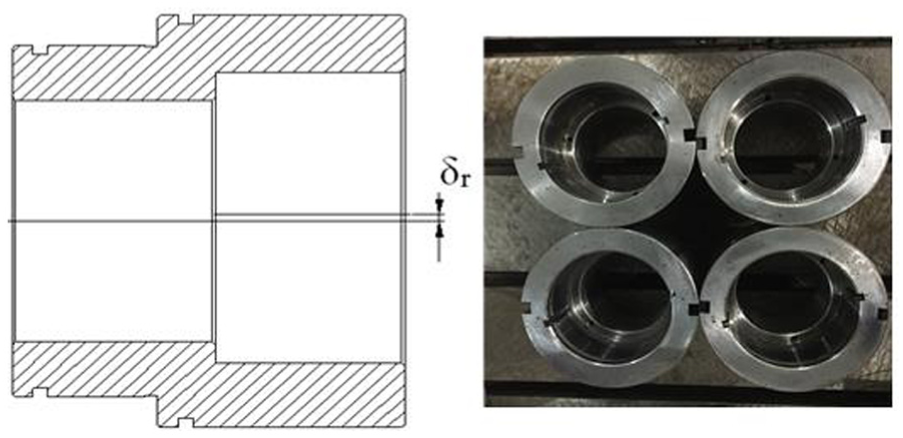
Bearing support with different central axis deviations.
The spindle thermal error measurement system is shown in Figure 10. The system is symmetrical in the Z direction, such that the thermal error is smallest in the Z direction; therefore, the misaligned bearing supports can be installed parallel to the Z direction to verify the influence of bearing outer ring misalignment on the spindle thermal error.
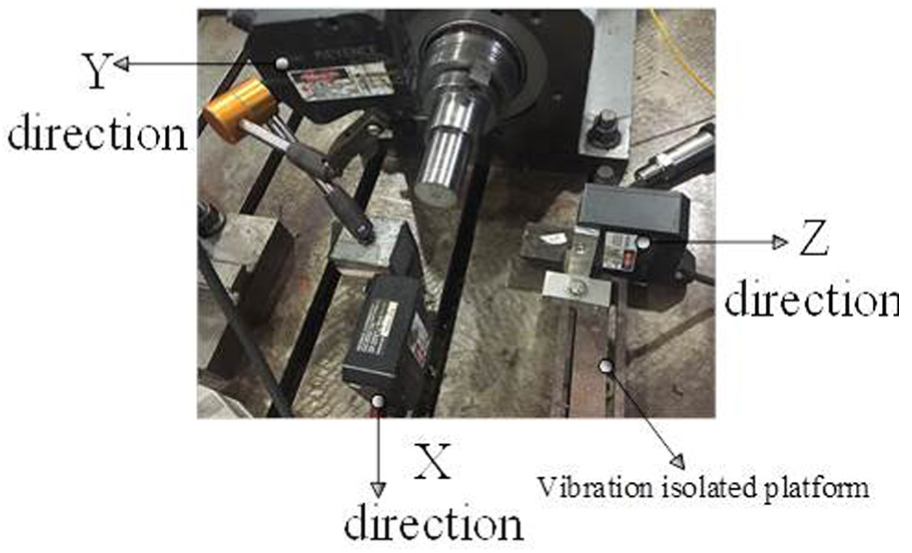
Spindle thermal error measurement system.
The spindle system thermal error, with deviations, was generated by an FEA model, based on a model previously described in our laboratory 15 and Jiang and Mao. 16 The comparative results for the simulation versus empirically derived measurements in condition of spindle speed of 3000 r/min and an axial load of 800 N are presented in Figure 11, and the axial load 800 N is selected for limiting the ball skidding which is clarified in Dong et al. 17

Comparison of results for the simulation versus empirical measurements.
Normally, the Z direction thermal error should have the smallest slope, because the spindle system has absolute symmetry structure. However, it was observed that the parallel bearing installation misalignment has a greater influence on the spindle thermal error in the Z direction than in the X and Y directions. It is indicated that the misalignment has changed the uniform temperature field on the peripheral direction, giving rise to the Z-direction thermal error, which corresponded with the previous analysis.
Conclusion
In this article, the effect of bearing installation misalignment on the bearing characteristics and thermal error was analyzed for the first time. The condition for a parallel bearing installation misalignment was simulated through changing the bearing support center axis position, and the contact angles and loads were calculated based on a quasi-static analysis with reasonable assumptions. From the analysis results, the bearing misalignment was shown to have a considerable influence on the spindle thermal error as determined using both the FEA model and empirical measurements from the representative system. In conclusion, it is shown that if the bearing misalignment is properly optimized, spindle thermal error can be significantly reduced, and this work needs to be carried out later.
Footnotes
Acknowledgements
The authors would like to acknowledge the contributions from all collaborators within the projects mentioned.
Handling Editor: Xichun Luo
Declaration of conflicting interests
The author(s) declared no potential conflicts of interest with respect to the research, authorship, and/or publication of this article.
Funding
The author(s) disclosed receipt of the following financial support for the research, authorship, and/or publication of this article: This study was supported by the National Natural Science Foundation Committee (NSFC) of China (grant no. 51475343) and International Science & Technology Cooperation Program of China (grant no. 2015DFA70340).
