




Abstract
An analytical method for free vibration analysis of arbitrarily shaped plates with simply supported edges is presented using the non-dimensional dynamic influence function (NDIF) method, which was introduced by the author. A major difficulty in the theoretical formulation of the proposed method is to analytically measure the values of diagonal elements of the system matrix that gives the eigenvalues and mode shapes of the plate of interest. In addition, particular attentions are given to remove the spurious eigenvalues of the plate. Various case studies show that the proposed method yields very accurate eigenvalues and mode shapes compared with other analytical and numerical methods in spite of its theoretical simplicity.
Introduction
For vibration problems of arbitrarily shaped membranes and plates, numerical approximate methods such as the finite element and boundary element methods are usually applied.1,2 However, these methods cannot be expected to give very accurate results because a large amount of numerical calculation is required as the number of nodes increases.3–5 For highly accurate results, the author introduced the non-dimensional dynamic influence function (NDIF) method for the free vibration analysis of arbitrarily shaped membranes.6,7
The NDIF method is an alternative superposition method based on the general collocation method that utilizes two-dimensional basis functions of two independent variables for the approximate solution of a plate. In order to simplify a large amount of numerical calculation that may be caused by the two-dimensional basis functions, a special one-dimensional basis function called NDIF is employed in the NDIF method. 6 The function is a wave-type function having one independent variable and exactly satisfies the governing differential equation of a plate. For more detailed explanation on the function, refer to the author’s previous papers. 6
Later, the author improved the NDIF method to effectively extract the eigenvalues of membranes8,9 In addition, the author extended the NDIF method to arbitrarily shaped acoustic cavities10,11 and plates with the clamped boundary condition,12,13 a mixed boundary condition, 14 and the free boundary condition. 15 As known in the author’s previous researches,12–15 the author developed the NDIF method for arbitrarily shaped plates with various boundary conditions except the simply supported boundary condition.
Although many researches for plates with arbitrary shapes have been performed up to recently, several papers that have recently been published are introduced for lack of space. Fantuzzi et al. 16 dealt with the free vibration problem of arbitrarily shaped plates with FG-CNT material. Also, they solved the free vibration problems of arbitrarily shaped plates using three different numerical approaches in terms of accuracy and reliability. 17 In addition, they considered arbitrarily shaped plates with arbitrary boundaries generated with NURBS using an analogy between fixed membranes and simply supported thin plates. 18 Liu et al. 19 developed a numerical technique for studying arbitrarily shaped plates with extremely accurate methodology which is able to employ a different number of points on the edges and in the domain.
On the other hand, the NDIF method for arbitrarily shaped plates with simply supported edges was formulated by Shi et al. 20 However, he failed to obtain the closed-form expressions for the diagonal elements of the system matrix, of which the determinant gives the eigenvalues of a plate. Instead, he employed the approximation of reducing the Bessel functions as serious expansions and omitting higher order terms. It should be noted that in the NDIF method that the diagonal elements of the system matrix for a simply supported plate become singular when the source and collocation points coincide with each other. 20
In the study, an improved theoretical formulation of the NDIF method is performed for a simply supported plate and particular care is given in obtaining the closed-form expressions for the diagonal elements of the system matrix to complete Shi’s work. 20 Finally, the proposed method is validated by comparing its results with those of the exact method, FEM (NASTRAN), and other analytical methods.
Theoretical formulation
Equation of motion and boundary conditions
It is known that the governing differential equation for small amplitude free transverse vibration of a thin plate with no in-plane force may be written as 21

where


in which
The two boundary conditions for a simply supported edge are given by 21


in which
General solution and discrete boundary conditions
In Figure 1, the plate under consideration is depicted by the dotted line and the boundary of the plate is discretized by

where

Arbitrarily shaped plate depicted by the dotted contour along which
In order to consider the simply supported boundary conditions (equations (4) and (5)) at


where
Substituting the general solution (equation (6)) into the discrete boundary conditions (equations (7) and (8)) gives

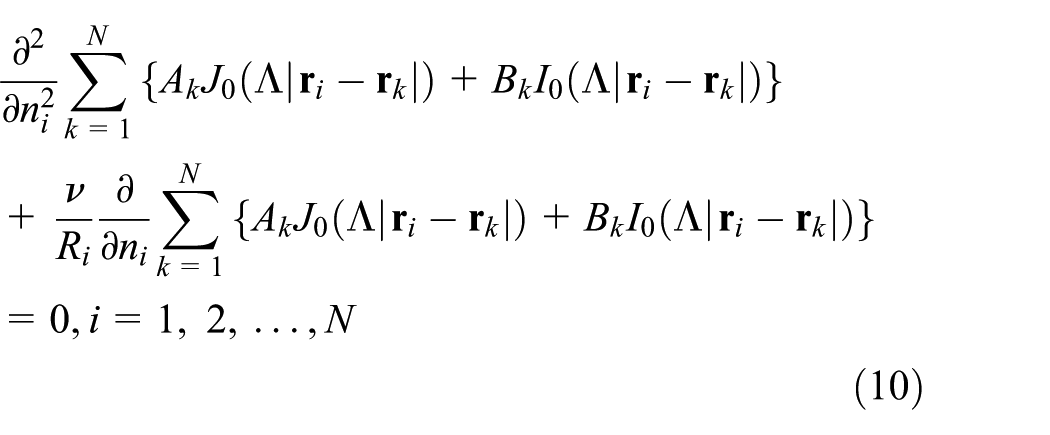
For simplicity, equations (9) and (10) are rewritten in matrix equations


where the elements of matrices


where
On the other hand, it should be pointed out that
Minute examination of
and
for
First, equations (15) and (16) are intentionally expressed using the Cartesian coordinate system

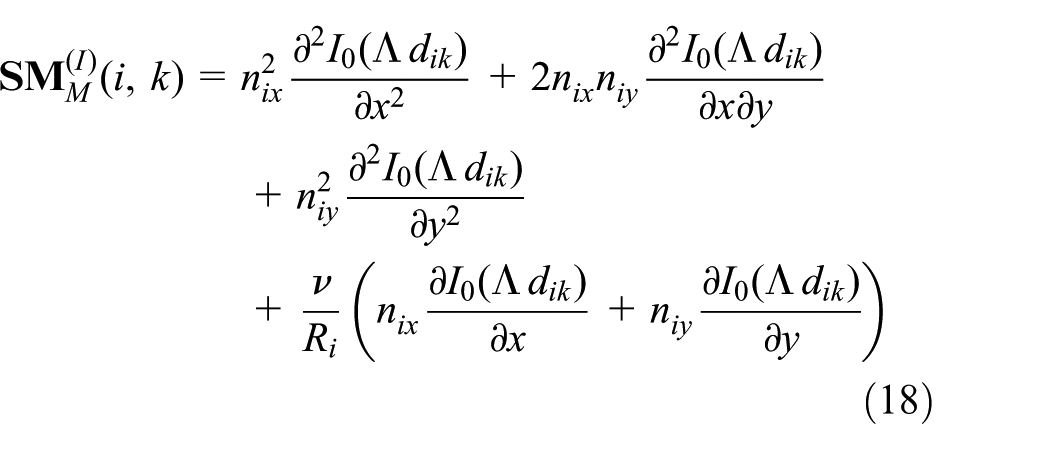
where

where

which, using equation (19), leads to

where

Especially, in the case of


where


In a similar way,


Next,

Especially, for

where

Using both

Similarly,





Finally, by substituting equations (25)–(28), (32)–(37) into equations (17) and (18), closed-form expressions for the diagonal elements of the system matrices can be obtained as follows


due to


System matrix and eigenvalues
To extract the system matrix that gives the eigenvalues and mode shapes, equations (11) and (12) given in section “General solution and discrete boundary conditions” are considered. Equation (11) is rewritten as

where

where the system matrix

which is a function of the frequency parameter (
The condition for which equation (43) has a non-trivial solution is that the determinant of the system matrix becomes zero, that is

The eigenvalues may correspond to the values of the frequency parameter (
Elimination of spurious eigenvalues
As in the authors’ previous papers,12–15 equation (45) may yield not only the eigenvalues of the plate of interest but also the eigenvalues of a similarly shaped membrane, which are called the spurious eigenvalues. To confirm these spurious eigenvalues, the proposed method is applied to a simply supported circular plate of unit radius and Poisson’s ratio of 0.3.
First, the boundary of the circular plate is discretized using 16 equally spaced points, as shown in Figure 2. Logarithmic values of

Circular plate discretized by 16 boundary points.
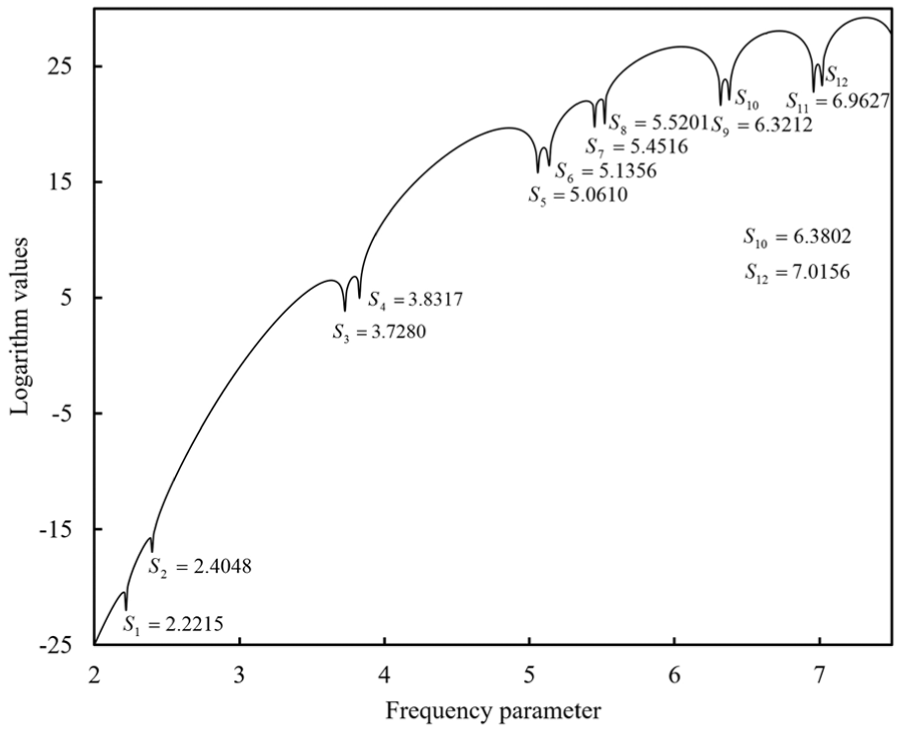
Logarithm curve for

From the fact that the singular values of

where

from which

By the rearrangement of equation (48),

where

Since

Finally, the eigenvalues of the plate may be obtained from the roots of the determinant of

where note that
Case studies
Numerical tests are presented to show the validity and accuracy of the proposed method for various shapes of plates with simply supported edges.
Circular plate
The present method is applied to a simply supported circular plate of unit radius with Poisson’s ratio of 0.3. The boundary of the plate is discretized with 16, 18, and 20 boundary points. For

Logarithm curves for
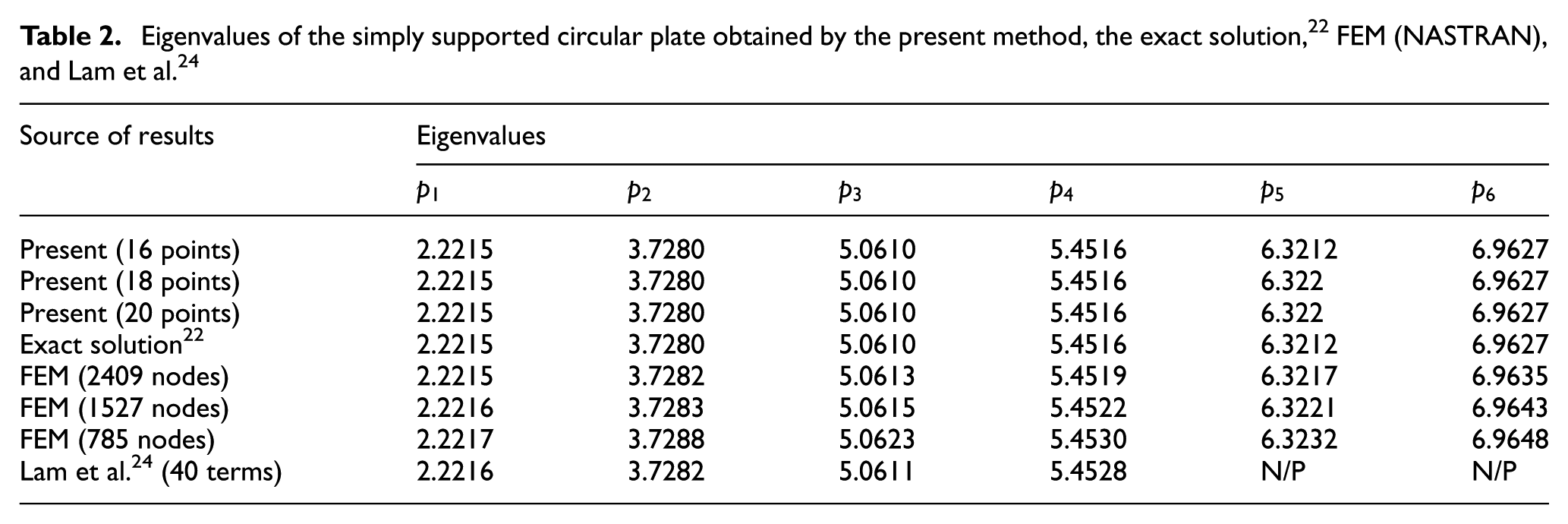
The eigenvalues of the circular plate obtained from Figure 4 are summarized in Table 2 where they are compared with those obtained by the exact solution, 22 FEM (NASTRAN), and Lam’s method. 24 The comparison shows that the eigenvalues by the present method using 16, 18, and 20 boundary points are identical to the exact solution. On the other hand, it is found in Table 2 that except for the first eigenvalue, the eigenvalues by FEM do not fully converge to the exact solution, even though 2409 nodes are used, and that the eigenvalues by Lam et al. 24 are slightly higher than the exact solution. From the above comparisons, it may be said that the present method yields very accurate eigenvalues compared with other methods, although it needs a small amount of numerical computation. This high accuracy results from the fact that the present method employs the radius of curvature in its theoretical formulation as in equation (8) unlike FEM. Note that computational efficiency between the NDIF method and FEM can be clearly compared by considering the max matrix dimension (rank) of each method.
Figures 5 and 6 show the mode shapes produced by the present method and FEM, respectively. It may be said from the comparison of the mode shapes that although only 16 boundary points are employed, the mode shapes by the present method agree well with those by FEM using 1527 nodes.
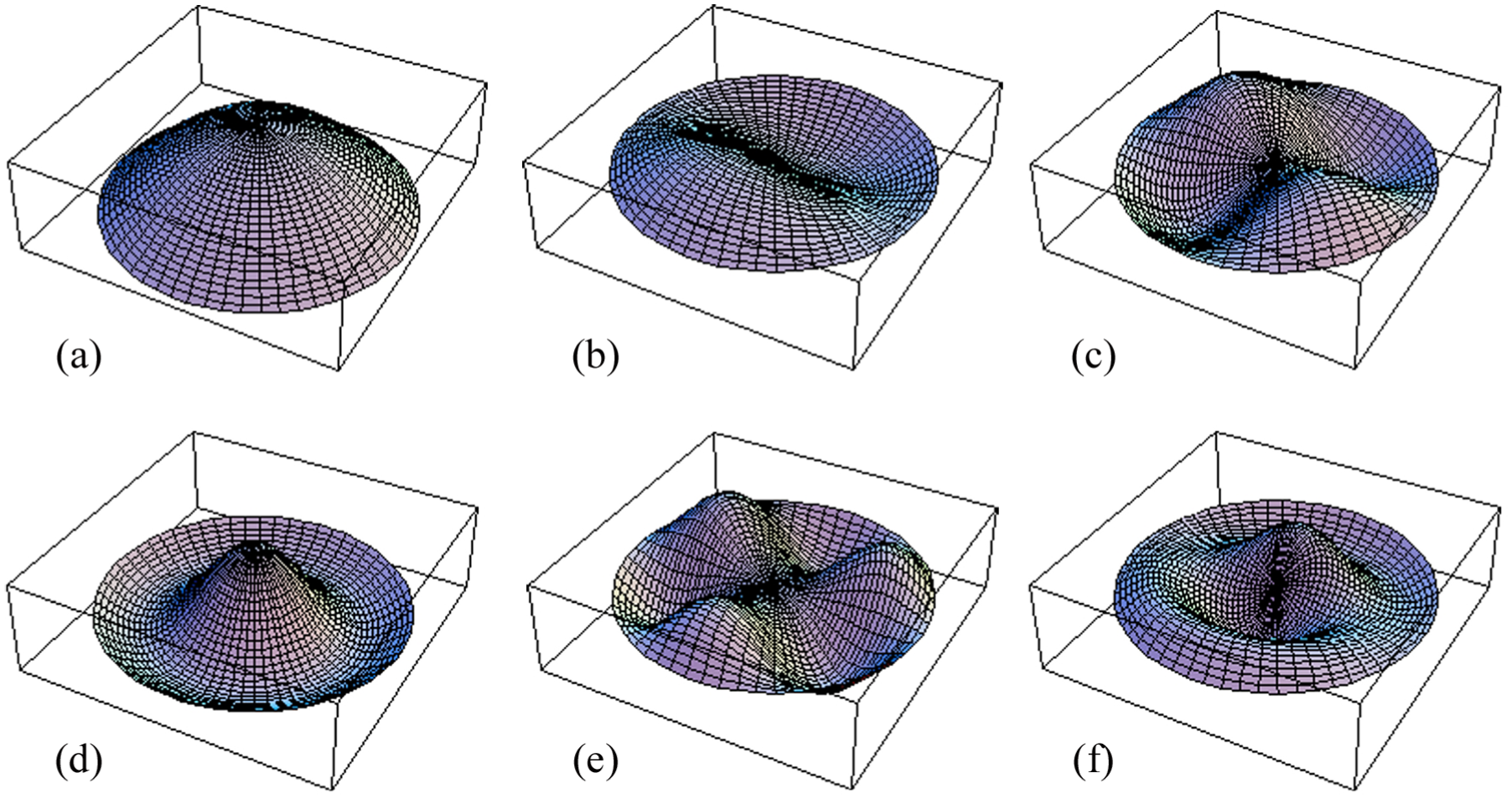
First six mode shapes of the circular plate obtained by the present method using 16 boundary points: (a) first mode, (b) second mode, (c) third mode, (d) fourth mode, (e) fifth mode, and (f) sixth mode.

First six mode shapes of the circular plate obtained by FEM (NASTRAN) using 1527 nodes: (a) first mode, (b) second mode, (c) third mode, (d) fourth mode, (e) fifth mode, and (f) sixth mode.
Elliptical plate
A simply supported elliptical plate of which the lengths of the major and minor axes are given by 1.2 and 1.0 m (Poisson’s ratio

Elliptical plate discretized by 16 boundary points.

Logarithm curve for

It may be said in Table 3 that the eigenvalues obtained by the present method using only 16 boundary points agree well with those calculated by FEM using 2871 nodes. In addition, it may be seen that the fundamental eigenvalue obtained by the present method is identical to the value presented by FEM and Singh and Chakraverty 25 but is slightly higher than the value presented by Leissa. 26 The difference is 0.054% in value. As shown in Figure 9, the present method successfully gives the first six mode shapes for only 16 boundary points. It is revealed that these mode shapes are good agreement with those produced from FEM, which are given in Figure 10.

First six mode shapes of the elliptical plate obtained by the present method using 16 boundary points (its major and minor axes are given by 1.2 and 1.0 m; Poisson’s ratio

First six mode shapes of the elliptic plate obtained by FEM (NASTRAN) using 2871 nodes (its major and minor axes are given by 1.2 and 1.0 m; Poisson’s ratio
An elliptical plate with different dimensions and Poisson’s ratio is again considered to confirm the accuracy of the proposed method. The lengths of the major and minor axes are 1.0 and 0.5 m (Poisson’s ratio

Logarithm curve for

Arbitrarily shaped plate
In this section, an arbitrarily shaped plate is considered and its geometry is shown in Figure 12 where the plate is discretized with 20 boundary points. The normal directions at the corners having the 1st, 6th, and 16th boundary points are approximately determined by the sum of the two normal vectors for the edges adjacent to each corner.

Arbitrarily shaped plate discretized by 20 boundary points at which
The eigenvalues obtained from the logarithm curve of

Logarithm curve for
Eigenvalues of the simply supported, arbitrarily shaped plate obtained by the present method and FEM (NASTRAN) (Poisson’s ratio

Figures 14 and 15 show the first six mode shapes given by the present method and those obtained by FEM, respectively. From the comparison between the figures, it may be said that mode shapes by the two methods are in good agreement.

First six mode shapes of the arbitrarily shaped plate obtained by the present method using 20 boundary points: (a) first mode, (b) second mode, (c) third mode, (d) fourth mode, (e) fifth mode, and (f) sixth mode.
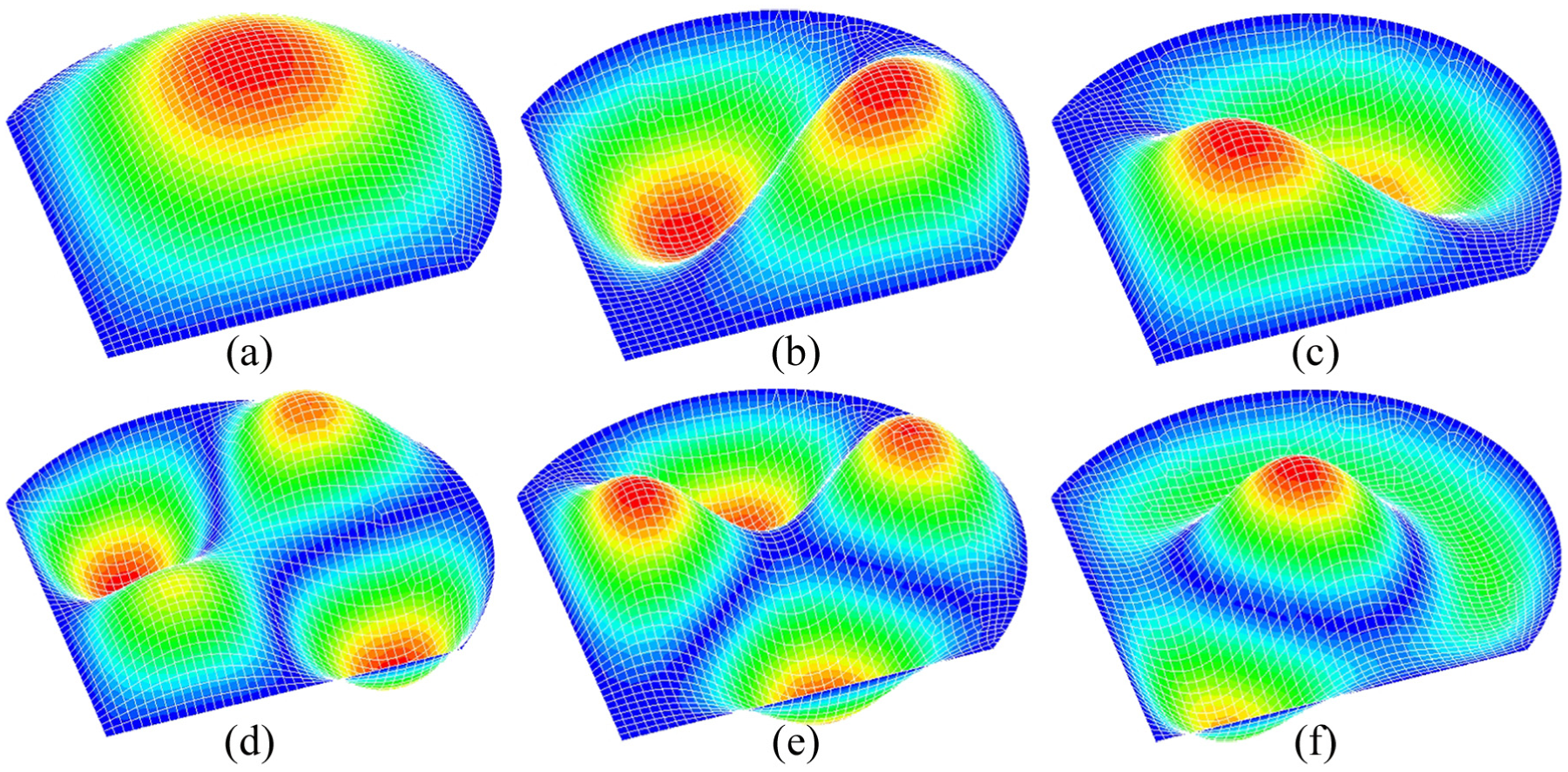
First six mode shapes of the arbitrarily shaped plate obtained by FEM (NASTRAN) using 2212 nodes: (a) first mode, (b) second mode, (c) third mode, (d) fourth mode, (e) fifth mode, and (f) sixth mode.
Conclusion
The NDIF method has been extended to the free vibration of arbitrarily shaped plates with simply supported edges. Deep consideration has been given to measure the diagonal elements of the system matrix and thus, the closed-form expressions for the diagonal elements have been achieved. It was revealed from case studies that the eigenvalues and mode shapes obtained by the proposed method are very accurate in spite of the small number of boundary points compared with other analytical or numerical methods. Although the proposed method gives very accurate eigenvalues compared with other methods, it cannot be applicable directly to laminated composite plates at this stage. Thus, an improved NDIF method effective for laminated composite plate will be developed in the another paper following this article. In addition, it will be investigated the possibility that the NDIF method can be extended to other theories such as the first-order shear deformation theory.
Footnotes
Handling Editor: Daxu Zhang
Declaration of conflicting interests
The author(s) declared no potential conflicts of interest with respect to the research, authorship, and/or publication of this article.
Funding
The author(s) disclosed receipt of the following financial support for the research, authorship, and/or publication of this article: This research was financially supported by Hansung University.
