




Abstract
A new formulation for the non-dimensional dynamic influence function method, which was developed by the authors, is proposed to efficiently extract eigenvalues and mode shapes of clamped plates with arbitrary shapes. Compared with the finite element and boundary element methods, the non-dimensional dynamic influence function method yields highly accurate solutions in eigenvalue analysis problems of plates and membranes including acoustic cavities. However, the non-dimensional dynamic influence function method requires the uneconomic procedure of calculating the singularity of a system matrix in the frequency range of interest for extracting eigenvalues because it produces a non-algebraic eigenvalue problem. This article describes a new approach that reduces the problem of free vibrations of clamped plates to an algebraic eigenvalue problem, the solution of which is straightforward. The validity and efficiency of the proposed method are illustrated through several numerical examples.
Keywords
Introduction
For vibration problems of plates with arbitrary shapes, numerical approximate methods such as the finite element method (FEM) and boundary element method (BEM) are usually applied.1–5 However, these methods cannot be expected to give very accurate results because a large number of numerical calculations are required as the number of nodes increases. To obtain highly accurate results, the non-dimensional dynamic influence function (NDIF) method for free vibration analysis of arbitrarily shaped membranes has been introduced6,7 by the authors and extended to arbitrarily shaped acoustic cavities 8 and clamped plates. 9 It has then been applied to arbitrarily shaped plates with a mixed boundary composed of simply supported and clamped edges 10 and to arbitrarily shaped plates with free edges. 11
Recently, many researchers have studied various meshless methods, which discretize the entire region of a plate unlike the NDIF method. For instance, Bert and Malik 12 developed a methodology for the extension of the differential quadrature method to irregularly shaped plates using the mapping concept of a square region to a general curvilinear region. Misra 13 proposed the radial basis function (RBF) method using multiple linear regression analysis to obtain eigenvalues of simply supported and clamped plates, which were compared with the eigenvalues presented by the authors’ previous research. 9 Krowiak 14 applied the RBF-pseudospectral method to the free vibration analysis of two-dimensional structures, which combines the meshless feature of the RBF method and the simplicity of the pseudospectral method. He also used eigenvalues 6 presented by the authors to show the accuracy of his method. Bui and Nguyen 15 developed a moving Kriging-interpolation-based meshfree method having Kronecker’s delta property. Finally, Rodrigues et al. 16 presented a meshless technique based on the RBF-QR algorithm for the static and vibration analyses of plates. The above methods12–16 still have a limitation in accuracy owing to the large number of numerical calculations compared with the NDIF method. 9
Although the NDIF method yields highly accurate results compared with FEM, BEM, and other numerical methods, 9 its final system matrix equation does not have a form of an algebraic eigenvalue problem. As a result, the NDIF method needs the inefficient procedure of searching frequency values that make the system matrix singular in the frequency range of interest. To overcome this limitation, we have recently developed an improved NDIF method for membranes17,18 and acoustic cavities 19 with arbitrary shapes. In this article, the basic concept of the improved NDIF method17–19 is extended to arbitrarily shaped plates with clamped edges. The proposed method is validated by comparing its results with those of other methods such as the NDIF method, FEM (ANSYS), and the exact method. It is revealed that the proposed method gives as accurate results as the NDIF method and needs much shorter calculation time than the NDIF method. Note that the computational speed of the improved NDIF method was reported in detail in the authors’ previous paper. 17
NDIF method review
The equation of motion for free flexural vibration of a uniform thin plate is written as 20

where

where the frequency parameter

Considering an infinite plate with a point source located at point

where

Infinite plate including an arbitrarily shaped plate (dashed line).
For free vibration analysis of an arbitrarily shaped plate whose boundary is illustrated by the dotted line in Figure. 1, N nodes are first distributed at points

Equation (5) is employed as an approximate solution for the free vibration of the finite-sized plate depicted by the dotted line in Figure 1. Note that the approximate solution also satisfies the governing equation (equation (2)) because the NDIF satisfies the governing equation.
If a clamped plate is considered, the boundary condition defined continuously along the dotted line in Figure 1 is discretized so as to be satisfied only at the N nodes as follows 20


where
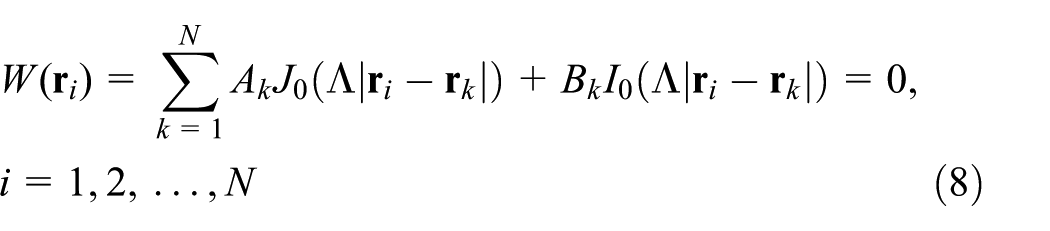

Equation (9) may be rewritten as

Equations (8) and (10) can be rewritten as matrix forms


where system matrices
Furthermore, equations (11) and (12) can be combined into a single equation

where the final system matrix


The condition that the system matrix equation (equation (13)) has a non-trivial solution gives that the determinant of the system matrix

Eigenvalues of the plate can be obtained from the values of the frequency parameter (
It may be seen in equation (13) that elements of the system matrix
Improved theoretical formulation
The four Bessel functions




where M denotes the number of terms of the series and




where


Substituting equations (21) and (22) into equation (8) yields
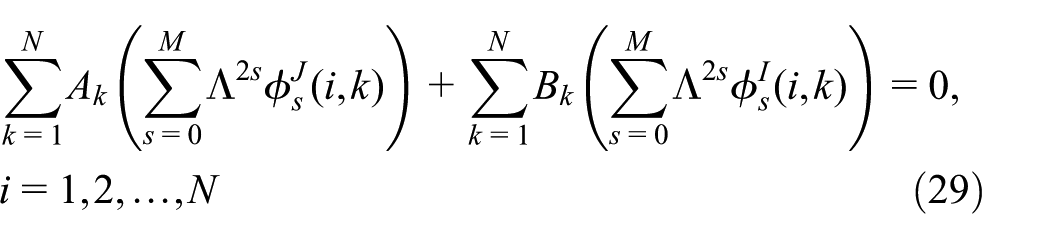
Similarly, substituting equations (23) and (24) into equation (10) yields

Equation (30) is simplified further as

where


Changing the order of


After defining


Next, equations (36) and (37) may be expressed in matrix equations as follows


where the elements of matrices


and unknown vectors


Furthermore, equations (38) and (39) may lead to a single matrix equation

which is expressed as a simple form as follows

where

Finally, equation (45) may be changed into the algebraic eigenvalue problem 22 as follows

where the system matrices


and the vector

Note that unlike

The ith mode shape can be obtained by plotting equation (5), where the unknown coefficients
Verification examples
We performed numerical tests for a clamped circular plate having an exact solution and an arbitrarily shaped plate with clamped edges to examine the validity and accuracy of the proposed method. The eigenvalues and mode shapes of the plates are obtained through the numerical testes. Since the eigenvalues have the same dimension as the frequency parameter in equation (2), the natural frequencies of the plates can be calculated from equation (3).
Clamped circular plate
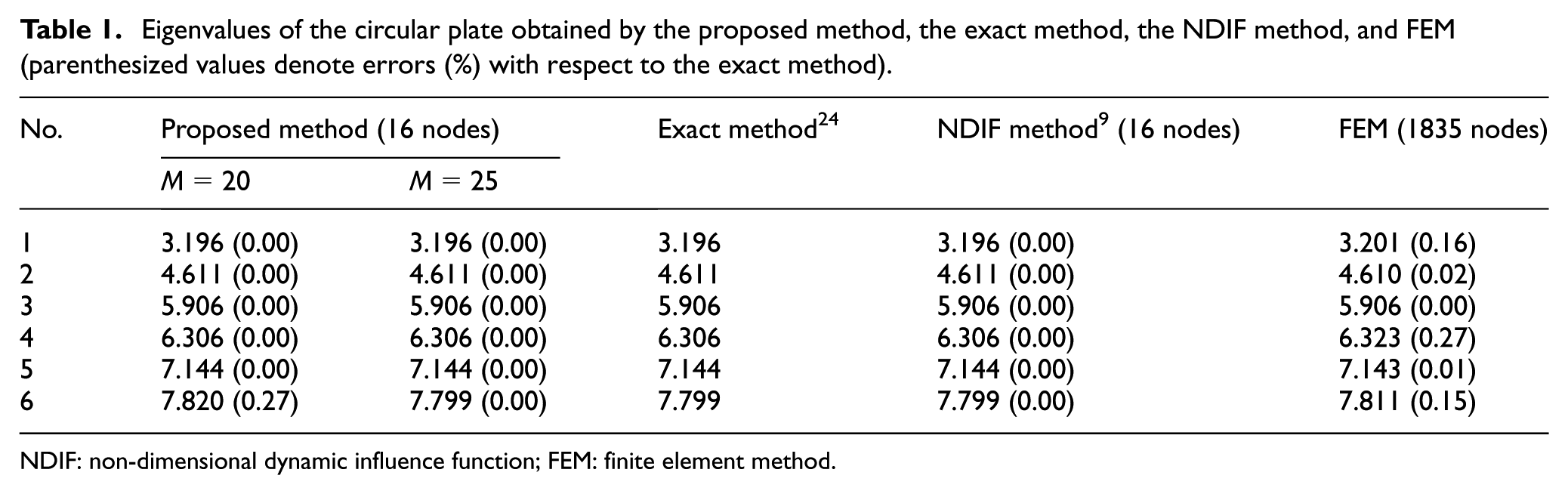
The proposed method is first applied to a clamped circular plate of unit radius (Figure 2). The boundary of the plate is discretized with 16 nodes for the proposed method. The eigenvalues obtained by the proposed method using


Clamped circular plate discretized with 16 nodes.
Eigenvalues of the circular plate obtained by the proposed method, the exact method, the NDIF method, and FEM (parenthesized values denote errors (%) with respect to the exact method).
NDIF: non-dimensional dynamic influence function; FEM: finite element method.
Furthermore, note that the proposed method using only 16 nodes yields more accurate eigenvalues than FEM (ANSYS) using 1835 nodes. Although the computational speed (CPU time) of the proposed method is not presented here, it has improved vastly compared with that of the NDIF method.
In addition, mode shapes produced by the proposed method using 16 nodes for

Mode shapes of the circular plate produced by the proposed method using 16 nodes for
The accuracy of an eigenvalue obtained by the proposed method can be verified by plotting its mode shape. If the plotted mode shape does not exactly satisfy the given boundary condition (the clamped boundary condition), it may be said that the eigenvalue is not accurate, and increasing the number of nodes or series functions is required to improve its accuracy.
Arbitrarily shaped plate with clamped edges
An arbitrarily shaped plate whose boundary is composed of a semicircle of unit radius and two equilateral edges of

Arbitrarily shaped plate discretized by 20 boundary nodes (the arrows denote the normal directions of the corresponding nodes).
Eigenvalues of the arbitrarily shaped plate obtained by the proposed method, the NDIF method, and FEM (parenthesized values denote errors (%) with respect to FEM using 961 nodes).

NDIF: non-dimensional dynamic influence function; FEM: finite element method.
Figure 5 shows the mode shapes obtained by the proposed method, which are in good agreement with those obtained by FEM (ANSYS), which are shown in Figure 6.

Mode shapes of the arbitrarily shaped plate obtained by the proposed method using 20 nodes for

Mode shapes of the arbitrarily shaped plate obtained by FEM (ANSYS): (a) 1st mode, (b) 2nd mode, (c) 3rd mode, (d) 4th mode, (e) 5th mode, and (f) 6th mode.
Conclusion
An improved NDIF method is proposed to more efficiently extract eigenvalues and mode shapes of arbitrarily shaped plates with clamped edges. It is revealed that the proposed method yields highly accurate eigenvalues, which converge to the exact solution. Owing to its concise formulation, the proposed method gives eigenvalues that are much more accurate than those obtained by FEM, which uses a large number of nodes. The proposed method should be extended to accurately analyze concave plates because it gives accurate results for only convex plates. To overcome this limitation, a sub-domain method of dividing the concave region of interest into several convex regions will be developed in future research.
Footnotes
Academic Editor: Farzad Ebrahimi
Declaration of conflicting interests
The author(s) declared no potential conflicts of interest with respect to the research, authorship, and/or publication of this article.
Funding
The author(s) disclosed receipt of the following financial support for the research, authorship, and/or publication of this article: This research was supported by the Basic Science Research Program through the National Research Foundation of Korea (NRF) funded by the Ministry of Education (2014R1A1A2057076).