




Abstract
This article introduces an improved non-dimensional dynamic influence function method using a sub-domain method for efficiently extracting the eigenvalues and mode shapes of concave membranes with arbitrary shapes. The non-dimensional dynamic influence function method (non-dimensional dynamic influence function method), which was developed by the authors in 1999, gives highly accurate eigenvalues for membranes, plates, and acoustic cavities, compared with the finite element method. However, it needs the inefficient procedure of calculating the singularity of a system matrix in the frequency range of interest for extracting eigenvalues and mode shapes. To overcome the inefficient procedure, this article proposes a practical approach to make the system matrix equation of the concave membrane of interest into a form of algebraic eigenvalue problem. It is shown by several case studies that the proposed method has a good convergence characteristics and yields very accurate eigenvalues, compared with an exact method and finite element method (ANSYS).
Introduction
The authors developed the non-dimensional dynamic influence function (NDIF) method for free vibration analysis of arbitrarily shaped membranes.1,2 Although the NDIF method has the feature that it yields highly accurate solutions compared with the finite element method (FEM) 3 and the boundary element method,4,5 the final system matrix equation of the NDIF method does not have a form of the algebraic eigenvalue problem 6 unlike the FEM and the boundary element method. As a result, the NDIF method needs the inefficient procedure of searching values of the frequency parameter that make the system matrix singular by sweeping the frequency parameter in the range of interest.
The authors introduced an improved NDIF method to eliminate the above inefficient procedure by changing the final system matrix equation in the NDIF method into a form of the algebraic eigenvalue problem.7,8 However, the improved NDIF method has the weak point that it does not give good solutions for concave membranes with high concavity and multi-connected membranes with holes. This article employs the sub-domain method of dividing the entire domain of a membrane into two convex sub-domains. Although the proposed method is similar to the authors’ previous method 2 in employing the sub-domain approach, the two methods differ in whether the final system matrix equation has a form of the algebraic eigenvalue problem.
A vast literature exists for obtaining analytical solutions of free vibration of membranes and plates having no exact solution as surveyed in the authors’ previous articles.1,2,7 However, a survey of the literature performed by the authors reveals that only a very few articles of them dealt with concavely shaped membranes and plates.
Recently, many researchers have studied new numerical methods for more accurate solutions of concave membranes and plates than the FEM. For instance, Wu et al. 9 developed the local radial basis function–based quadrature method for the vibration analysis of arbitrarily shaped membranes and solved highly concave-shaped membranes without the use of any domain decomposition. Shu et al. 10 applied the two-dimensional least-square-based finite difference method for solving free vibration problems of arbitrarily shaped plates with simply supported and clamped edges. It should be noted that the above methods9,10 still have a limitation in accuracy owing to a large amount of numerical calculation. In this article, a simple and practical approach, which is applicable to arbitrary shapes and offers a highly accurate solution, is proposed by extending the authors’ previous research.2,7 Note that the proposed method is occasionally ill-posed when too many nodes are used. On the other hand, the proposed method does not consider the problem of spurious eigenvalues, which have been studied in many articles related to plate vibrations,11–16 because the spurious eigenvalues do not appear in the NDIF method for fixed membranes.
NDIF method reviewed
NDIF
The NDIF primarily satisfies the governing equation of the eigen-field of interest and physically describes the displacement response of a point in an infinite domain due to a unit displacement excited at another point.1,7 In the case of an infinite membrane (see Figure 1), the NDIF between the excitation point

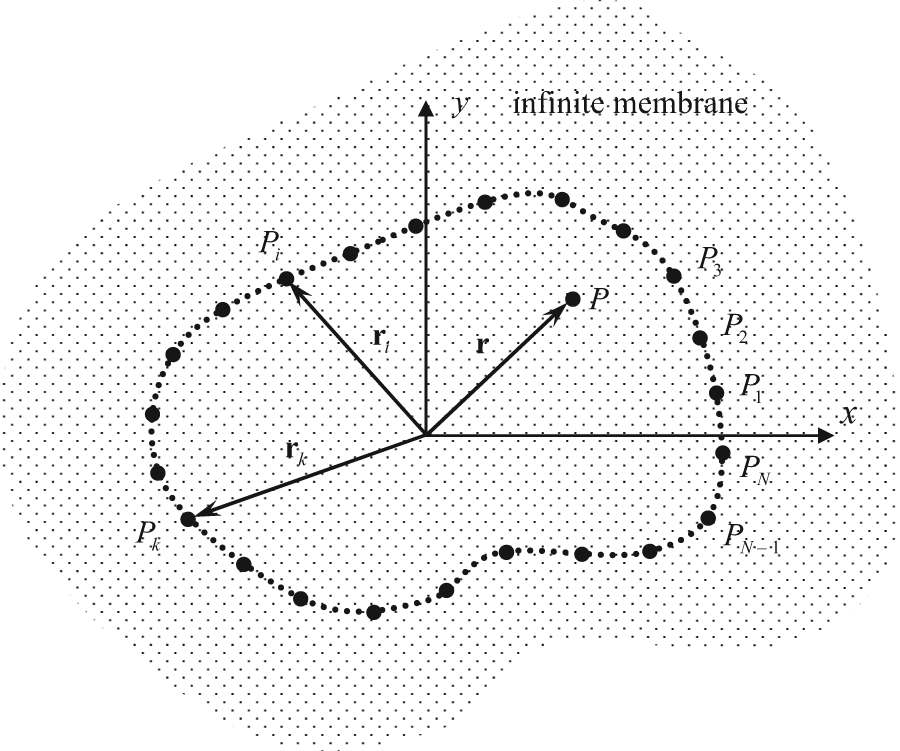
Infinite membrane with harmonic excitation points that are distributed along the fictitious contour (dotted line) with the same shape as the finite-sized membrane of interest.
in which

where
NDIF method
For free vibration analysis of an arbitrarily shaped membrane, of which the boundary is illustrated by the dotted line in Figure 1, N boundary points are first distributed at points

where
Next, the boundary condition given for the membrane is discretized at boundary points

where

Finally, equation (5) may be written in a simple matrix form

where elements of the

which is the system matrix equation of the membrane.
Since the system matrix
Improved formulation
Assumed solution and boundary conditions
A concave membrane, illustrated as the solid line in Figure 2, is divided into the two domains,


Concavely shaped membrane subdivided into two domains,
where

where

where
In order to decouple

where function

Substituting equation (11) into equation (10) yields

which is rearranged as follows

In the same manner as equation (8), an approximate solution in

where

is applied to equation (15), one can obtain

where

where function

Next, continuity conditions in displacement and slope are considered on the common boundary

Displacements at boundary points

Since displacements at

Expanding the two Bessel functions in equation (22) in a Taylor series and rearranging yield
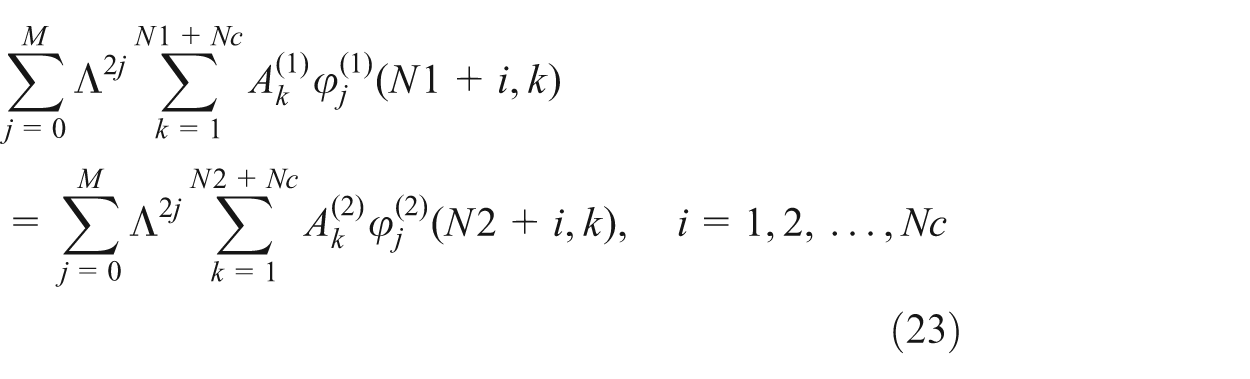
Since slopes at boundary points
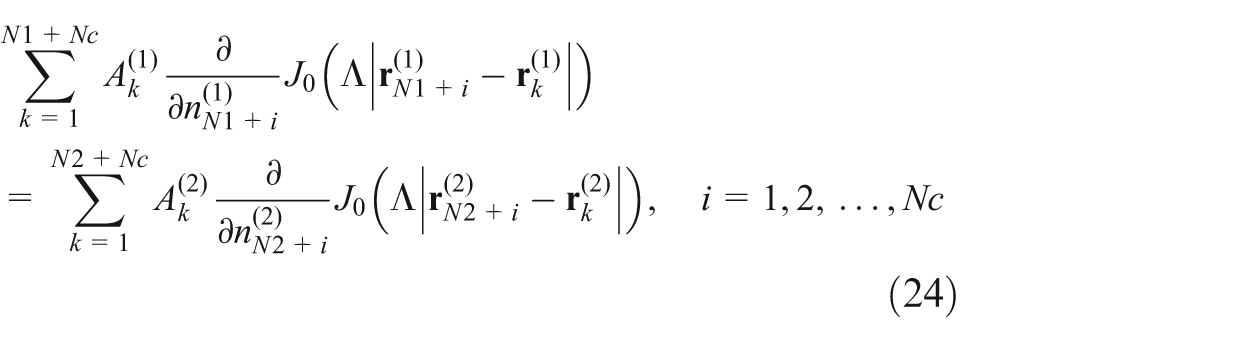
where

The Bessel functions in equation (25) are expanded in a Taylor series as follows

where

where

System matrix equation and eigenvalues
Equations (14), (18), (23), and (27) may be expressed in simple matrix equations, respectively


In equations (29)–(32), the ith row and kth column element of matrices

where matrix

Note that equation (33) is called the higher order polynomial eigenvalue problem. 18 Equation (33) may be changed into a linear matrix equation as follows

where the system matrices


and the vector

where
Finally, multiplying equation (35) by the inverse matrix of

which may be expressed as the algebraic eigenvalue problem

where the system matrix is given by

Note that the system matrix
Case studies
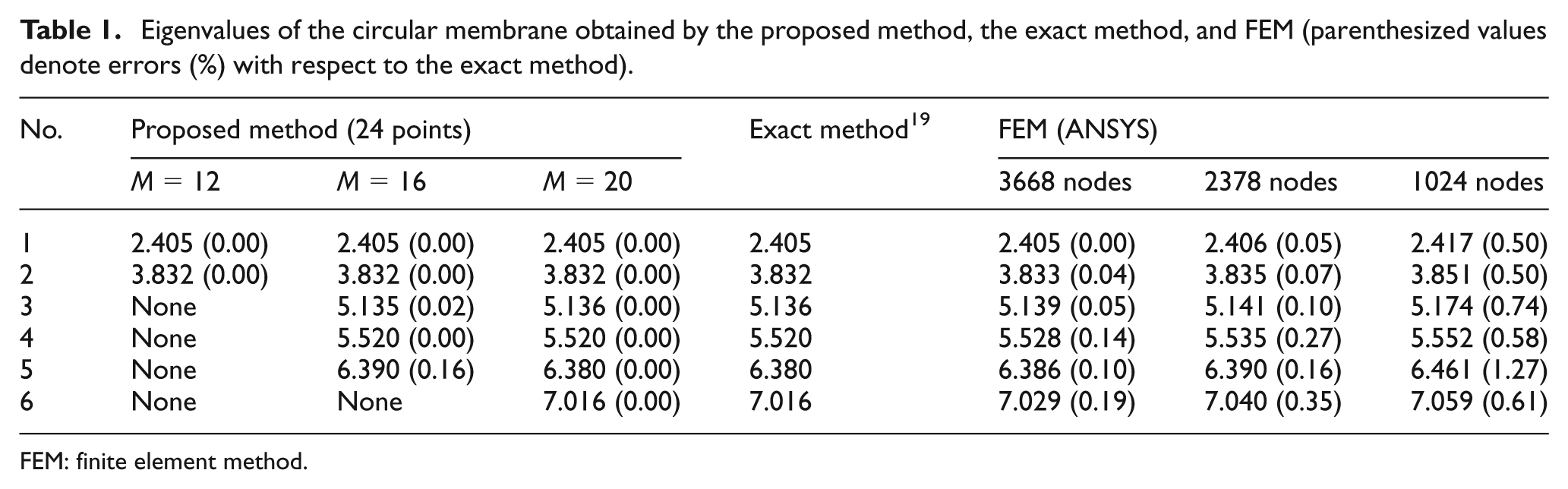
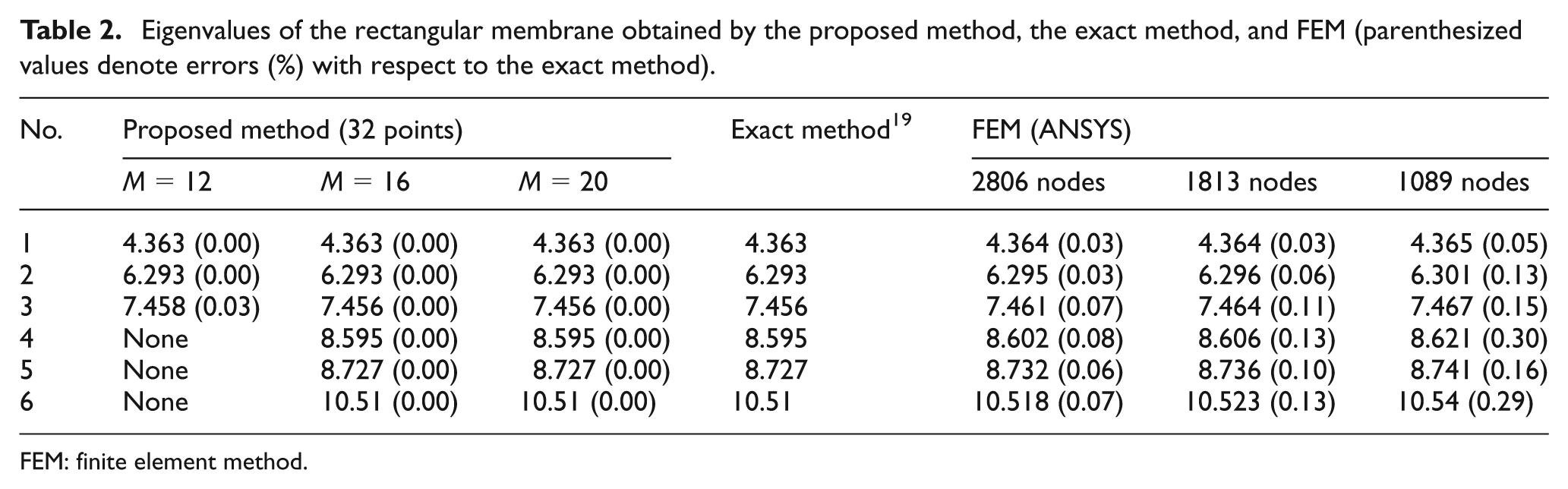
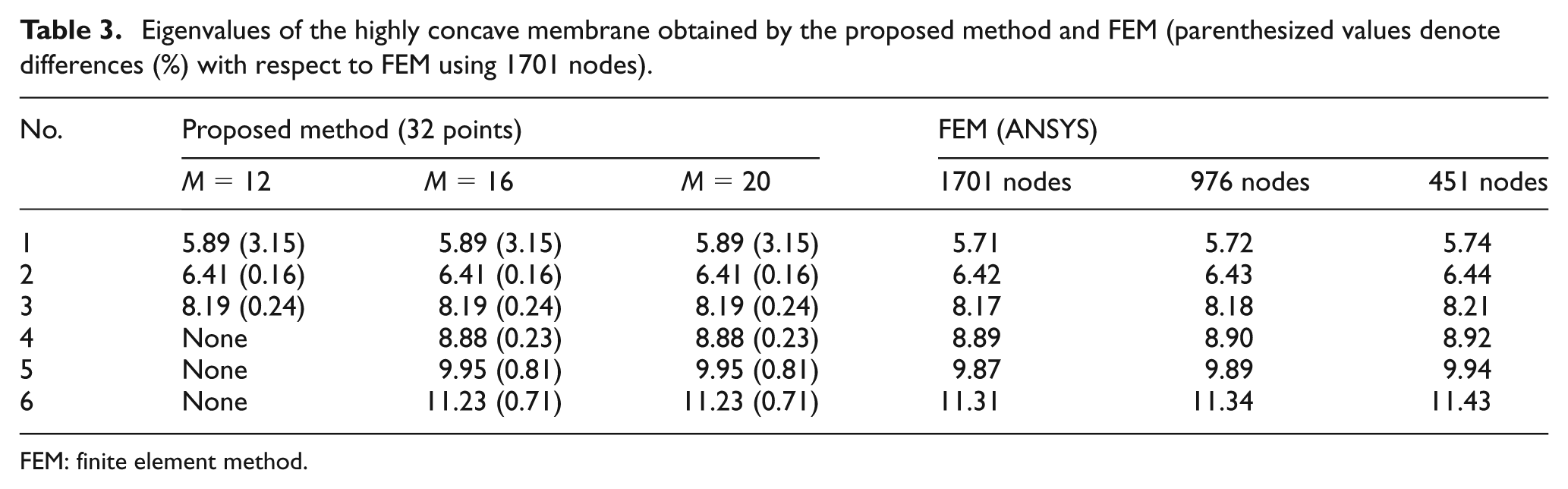
The validity of the proposed method is shown through numerical tests of circular, rectangular, and highly concave membranes. For each case, the eigenvalues obtained by the proposed method are compared with those computed by the exact solution and FEM (ANSYS).
Circular membrane
The proposed method is first applied to a circular membrane of unit radius where the exact solution
19
is known. As shown in Figure 3, the membrane is intentionally divided into two domains
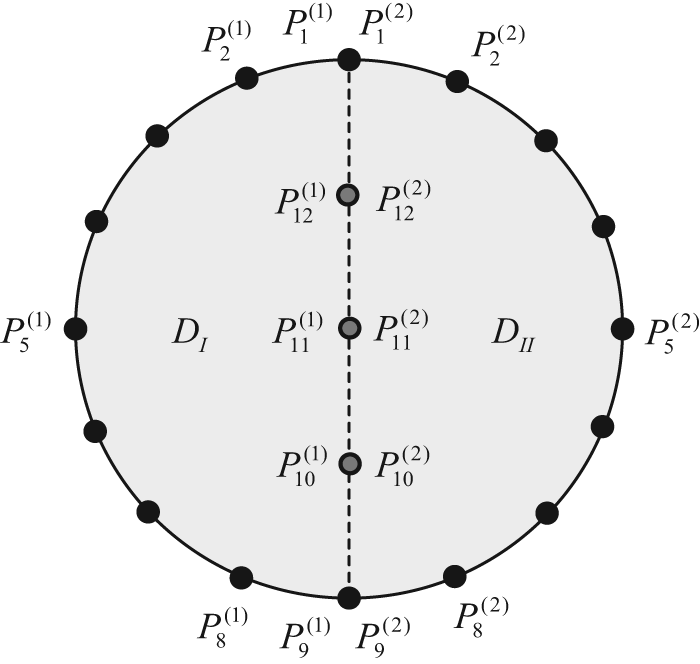
Circular membrane divided into two domains using 24 boundary points.
Eigenvalues obtained by the proposed method using
Eigenvalues of the circular membrane obtained by the proposed method, the exact method, and FEM (parenthesized values denote errors (%) with respect to the exact method).
FEM: finite element method.
On the other hand, the accuracy of an eigenvalue obtained by the proposed method can be verified by plotting its mode shape, which is omitted in the article. If the plotted mode shape does not satisfy exactly the given boundary condition (the fixed boundary condition), it may be said that the eigenvalue is not accurate and larger number of nodes and series functions are required to improve its accuracy.
Rectangular membrane
As shown in Figure 4, a rectangular membrane with dimensions
Eigenvalues of the rectangular membrane obtained by the proposed method, the exact method, and FEM (parenthesized values denote errors (%) with respect to the exact method).
FEM: finite element method.
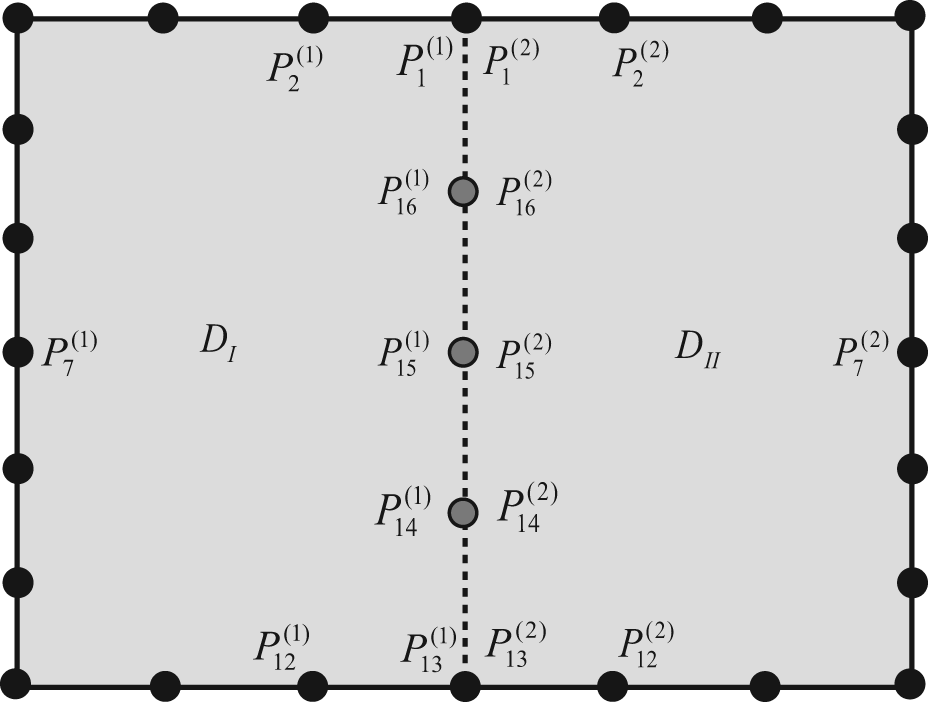
Rectangular membrane divided two domains using 32 boundary points.
Highly concave membrane
Figure 5 shows a
Eigenvalues of the highly concave membrane obtained by the proposed method and FEM (parenthesized values denote differences (%) with respect to FEM using 1701 nodes).
FEM: finite element method.

Highly concave membrane divided two domains using 32 boundary points.
Conclusion
A practical, improved NDIF method for the free vibration analysis of concave membranes with arbitrary shapes was proposed in the article. It was revealed that the proposed method yields much more accurate eigenvalues, which converge to exact values for membranes having exact solutions, than FEM using a large number of nodes. On the other hand, the proposed method cannot be directly applied to a multiply connected membrane because it divides the region of the membrane of interest into only two regions. In order to overcome this weak point, an extended way of dividing the region of the membrane into more than two regions will be developed in future research.
Footnotes
Academic Editor: Gongnan Xie
Declaration of conflicting interests
The authors declare that there is no conflict of interest.
Funding
This research was financially supported by Hansung University.