




Abstract
In a pallet pool, pallets would be delivered through a supply chain. The operation procedure that consists of at least five operation processes as distribution, reposition, recycling, purchase (or rent), and maintenance is quite complex. These pallets are likely to be damaged, lost, destroyed, and so on. So, it is necessary to monitor the pallets using radio-frequency identification technology. However, there is no literature on the management of a pallet pool with both radio-frequency identification–tagged pallets and non-tagged pallets being put into consideration. In our research, an optimization model is presented to manage such a pallet pool. The objective of the optimization model is to minimize the total operation cost of a pallet pool including distribution cost, reposition cost, recycling cost, purchase or rent cost, loss cost, maintenance cost, loading and unloading cost, storage cost, and punishment cost. A particle swarm optimization algorithm is developed in Microsoft Visual Basic. Our numerical example shows that the optimization model and particle swarm optimization algorithm are effective. It is proved that the model and algorithm also can be used to measure whether the investment of a radio-frequency identification system is valuable or not. We proposed some suggestions for the pallet pools management.
Introduction
Pallets are the most popular equipments in the logistics industry. There are about 2 billion pallets in circulation in the United States, 280 million pallets in the European Union, and 1.2 billion pallets in China.1–3 The most common pallet materials are wood and plastic.4–6 About 80% of pallets are wooden pallets. Flat pallets are the most common structure of pallets. The dimensions of flat pallets are various. For example, 1016 mm × 1219 mm (famous as 40 in × 48 in) is the most commonly used in the North America, 1000 mm × 1200 mm in Europe, and 1100 mm × 1100 mm in Asia. As important assets, pallets always are managed very carefully. There are three industry strategies for managing pallets as follows: open-loop system with no salvage value (single-use expendable pallet system), open-loop system with salvage value (buy and sell system), and closed-loop rental system (pallet pool system).2,7 The closed-loop system is the most popular.8,9
There is one issue which ever plagues the pallet industry—proprietary pallets that have leaked out of a closed-loop system. 10 Ilic et al. 11 reported that the annual loss rate of pallets was about 10%. Moreover, LeBlanc 12 and Brindley 13 found that a lot of pallets in CPC (Canadian Pallet Association) and PECO (PECO Pallet Pooling Co., Ltd) were damaged. In order to reduce the loss rate and damage rate, radio-frequency identification (RFID) technology is always used. 14 Intelligent Global Pooling Systems (iGPS, a leading provider of pallet and pooling services) is the first pallet pool operator in the world to build an advanced tracking and management system that take the advantage of RFID. After about 2 months, in October 2006, Commonwealth Handling Equipment Pool (CHEP, an iGPS competitor) announced that it would also deploy an RFID solution which allowed CHEP to offer track-and-trace asset visibility solutions to its customers. Now, iGPS is the operator of the world’s first 100% RFID-tagged all-plastic pallet pool, while CHEP is the leading pool providing both RFID-tagged plastic and wooden pallets. Moreover, almost all of the pallet pools could provide RFID-tagged pallets.
In fact, RFID could not only reduce the loss and damage rate but also help the managers to make scientific decisions. For example, using RFID, the managers of a pallet pool could get more information about their pallets so as to make a reasonable and scientific pallet allocation planning against the uncertainty of some parameters (such as the position and condition of the pallets).
RFID have been deployed in many fields. In the manufacturing management field, Barenji et al. 15 discussed a multi-agent architecture devised to deploy RFID-enabled distributed control and monitoring system for a manufacturing shop in 2013. Then, a multi-agent-based architecture for scheduling and control in the manufacturing industry was designed and developed based on RFID. 16 This scheduling and control system was tested, and the results highlighted the potential of employing both the multi-agent system and RFID technology as new paradigms for retrofitting the current manufacturing system. 17 A simulation test platform also had been developed, and it was proved that the RFID-enabled multi-agent scheduling and control system could increase the uptime productivity and production rate of a flexible assembly line.18,19 Recently, an RFID-enabled multi-agent-based manufacturing control system integrated with indirect coordination mechanism had been presented, and it performed better in comparison with the RFID-enabled multi-agent-based manufacturing control system integrated with direct coordination mechanism. 20 In the warehouse management field, Choy et al. 21 proposed an RFID-based storage assignment system which could enhance the efficiency of order picking in a warehouse. Zhou et al. 22 presented a novel RFID localization approach for pallets checking-in in a warehouse. In the supply chain management field, although Veronneau and Roy 23 stated that RFID could not achieve direct gains significant enough on a pallet-level-tagging deployment to justify the expenditure, a lot of researchers proved that the implementation of RFID practices significantly positively affect the supply chain performance in the areas as supplier, inventory, distribution, and so on.24,25 It not only enables the supply chain partners to improve their utilities but also promotes the efficiency of supply chain management as a whole. 26
There are several literatures on the operations of a pallet pool. Ren and Zhang27,28 proposed an integer programming model and a stochastic programming model for the pallet recycling over a pallet pool. Then, they studied on the pallet allocation model with the method of stochastic chance constrained programming. 29 In this model, they considered distribution, reposition, and recycling. Ren et al. 8 pointed out a multi-scenario model for multi-type pallet allocation over a pallet pool considering the uncertain future without adequate historical data. In this model, the processes of pallet allocation include purchase (or rent), distribution, reposition, and recycling. A pallet allocation model over a railway pallet pool was presented by Zhou et al. 30 They also established a pallet allocation model for a normal pallet pool in which allocation time was considered. 31 Wen and Qing 32 proposed a reverse logistics network model for rental pallet recycling considering transport capacity. Based on the lifecycle analysis of pallets in a pallet pool, Ni et al. 33 modeled the pallet allocation considering production, distribution, reposition, recycling, and maintenance. Doungpattra et al. 34 studied on how to minimize the cost of pallet allocation over a pallet pool in the pet food industry. However, there is no literature on the management of a pallet pool with both RFID-tagged pallets and non-tagged pallets. This article will focus on the topic.
In section “Problem description,” the problem addressed is described. In section “Model development,” an optimization model for the problem is proposed. A case study is introduced in section “Numerical example and analysis.” Some suggestions for the managers are given in section “Assessing the value of an RFID system.”
Problem description
In a pallet pool, pallets would be moved through a supply chain. As shown in Figure 1, the operation processes are quite complex. There are at least five procedures including distribution, reposition, recycling, purchase (or rent), and maintenance.29,35,36 The pallets may be damaged, lost, destroyed, and so on:
A customer requires the number of
The customer loads cargos on these pallets and moves these loaded pallets to the destination. After unloading cargos from these pallets, the customer requires the supplier to take these pallets away.
The supplier (or a recycler who is the partner of the supplier) checks the quantity and
quality of these pallets. The number of
The supplier moves the number of
If there are not enough pallets to meet the demand
The customer moves the loaded pallets with cargos to the destination. Then, the customer requires the supplier to take these pallets away after cargos unloaded.
The following steps are as steps 3–5.
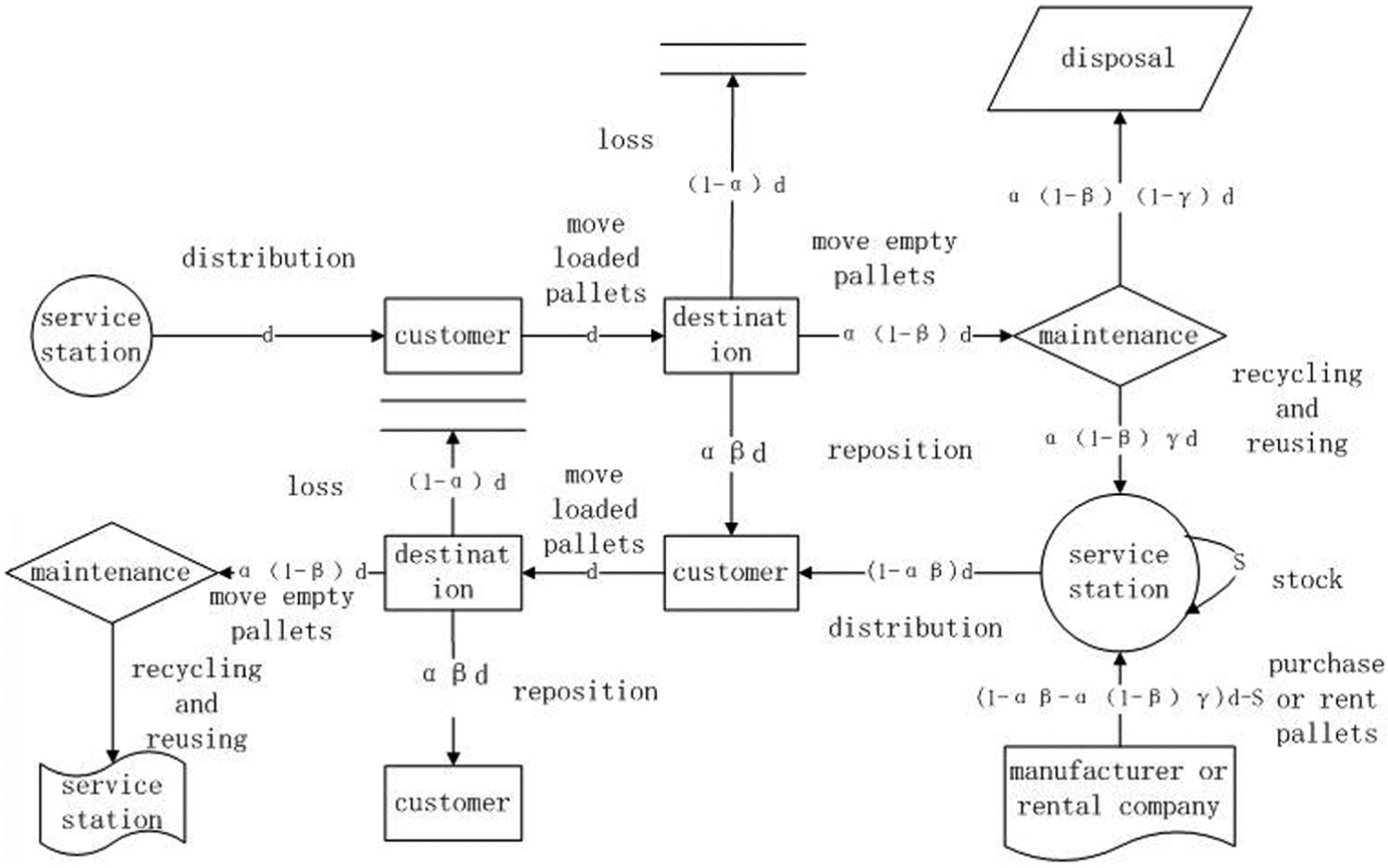
The operation processes of a pallet pool.
As mentioned above, the loss rate and damage rate of pallets in a pallet pool are quite
high. In fact, the loss rate is about 15%–20%, according to Deloitte. And, the damage rate
of wooden pallets is more than 22%, according to a Chinese report. Consequently, it is hard
to estimate how many pallets will be returned and whether they are in good condition. The
application of RFID technology can significantly improve the visibility of the supply chain.
Specifically, it is helpful to improve the accuracy of the value of
Model development
Objective function
The objective of the optimization model is to minimize the total operation cost of a pallet pool. The managers of 10 pallet pools in China were visited. The cost list suggested by them is as follows:
The transportation cost of pallets from supplier’s service stations to demand
customers (this kind of customers require pallets for freights carriage).
It also could be named as distribution cost.
The transportation cost of pallets from supply customers (this kind of
customers have many pallets which need to be taken away; in Figure 1, the customer at destination is a
supply customer) to demand customers. It also could be named as reposition
cost.
The transportation cost of pallets from supply customers to supplier’s
service stations. This kind of cost also could be named as recycling cost.
The total purchase or rent cost.
The total loss cost.
The total maintenance cost.
The loading and unloading cost at all supplier’s service stations.
The unitary loading and unloading cost at
The loading and unloading cost at all supply customers. The unitary
loading and unloading cost at
The loading and unloading cost at all demand customers. The unitary
loading and unloading cost at
The total storage cost at all supplier’s service stations. The
number of non-tagged and RFID-tagged pallets stored at
The total punishment cost of failing to take away all pallets from all supply
customers. We assumed the supplier could fail to take away all pallets if
the requests are uncertain. The number of non-tagged and RFID-tagged pallets stored at
The total punishment cost of exceeding the demands for all pallets of all
demand customers. We assumed the supplier could exceed the demands if the
demands were uncertain. The number of non-tagged and RFID-tagged pallets stored at
Therefore, the objective function could be described as equation (1)

Constraints
As the survey results shown, the constraints should include distribution, reposition, demand, recycling, storage, transportation capacity, loading and unloading capacity, and so on.
Distribution
The number of non-tagged (or RFID-tagged) pallets moved from a pallet service supplier station to all demand customers cannot exceed the non-tagged (or RFID-tagged) pallets supply capacity. The supply capacity is the sum of the number of storage pallets, purchased (or rent) pallets, recycled pallets, and recovered pallets. The constraint sets equations (2) and (3) show the distribution constraints of non-tagged and RFID-tagged, respectively


Reposition
The constraint set equation (4) guarantees that the number of non-tagged pallets moved from a supply customer to all demand customers does not exceed the available non-tagged pallets that are in good condition at this supply customer. The constraint set equation (5) guarantees that the number of RFID-tagged pallets moved from a supply customer to all demand customers does not exceed the available RFID-tagged pallets that are in good condition at this supply customer


Demand
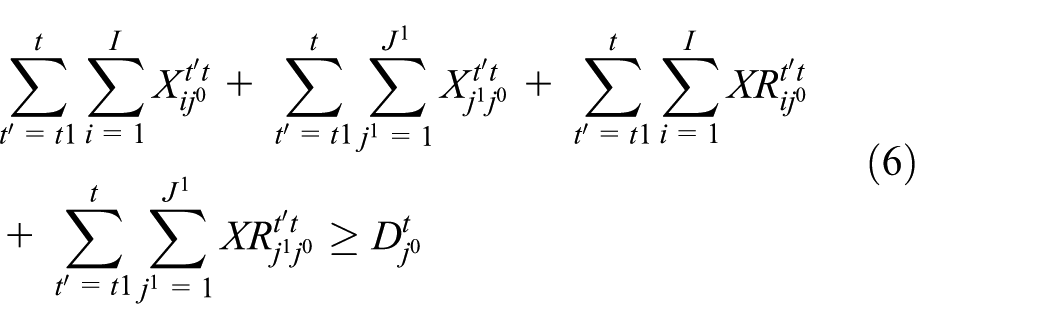
The constraint set equation (6) ensures that the requests of a demand customer have to be met using of non-tagged and RFID-tagged pallets
Recycling
The number of pallets moved from a supply customer could not exceed the available pallets at this supply customer. The constraint sets equations (7) and (8) show the recycling constraints of non-tagged and RFID-tagged pallets, respectively


Storage
The constraint sets equations (9) and (10) show the number of storage of non-tagged and RFID-tagged pallets at a supplier’s service station, respectively
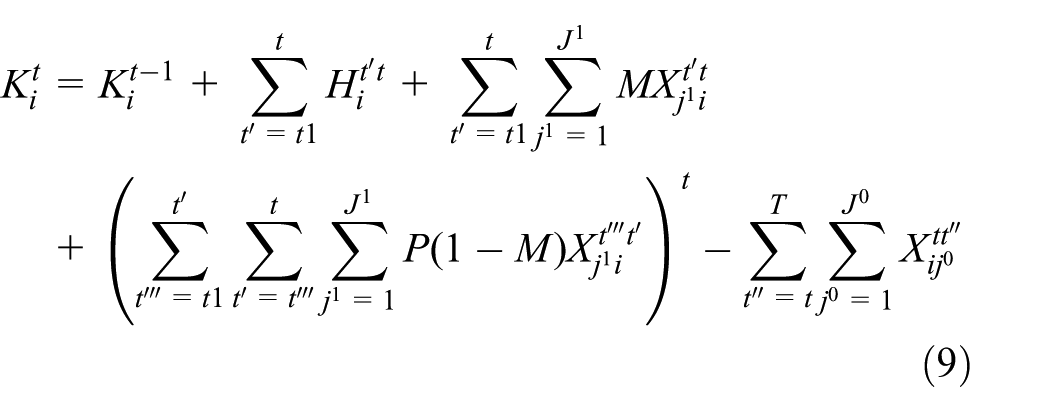

According to constraint equation (11), pallets (including non-tagged and RFID-tagged pallets) stored at a supplier’s service station are not supposed to beyond its storage capacity

The constraint sets equations (12) and (13) show the number of storage of non-tagged and RFID-tagged pallets at a supply customer, respectively


The constraint sets equations (14) and (15) ensure the number of non-tagged and RFID-tagged pallets which have not been taken away is non-negative


The constraint set equation (16) shows the number of pallets exceeding the requests of a demand customer

Transportation capacity
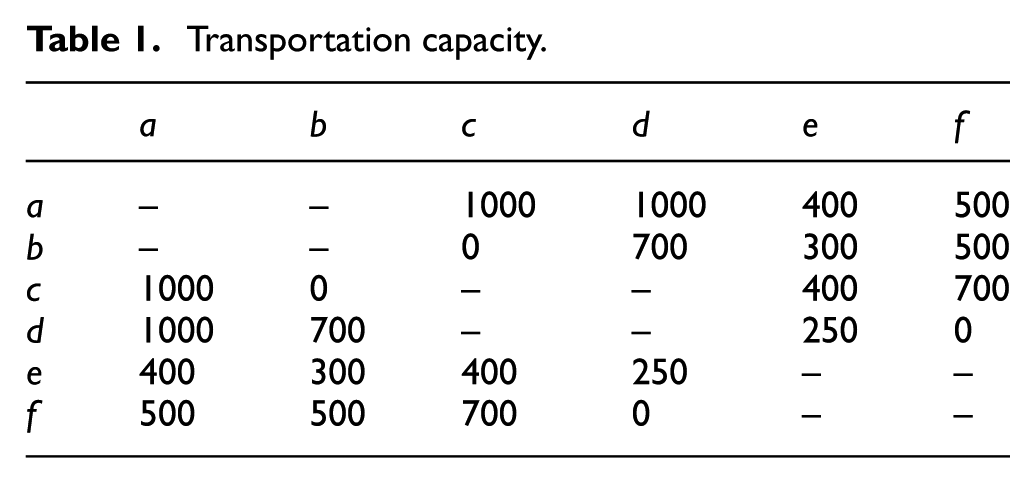
The constraint sets equations (17)–(19) impose an upper transportation capacity on the number of the pallets that can be moved between two locations


Loading and unloading capacity
The constraint sets equations (20)–(22) impose an upper loading and unloading capacity on the number of pallets that can be loaded or unloaded at a supplier’s service station, a supply customer, and a demand customer, respectively


The value of decision variables
The constraint set equation (23) indicates that all decision variables are non-negative integer values

Numerical example and analysis
Numerical examples
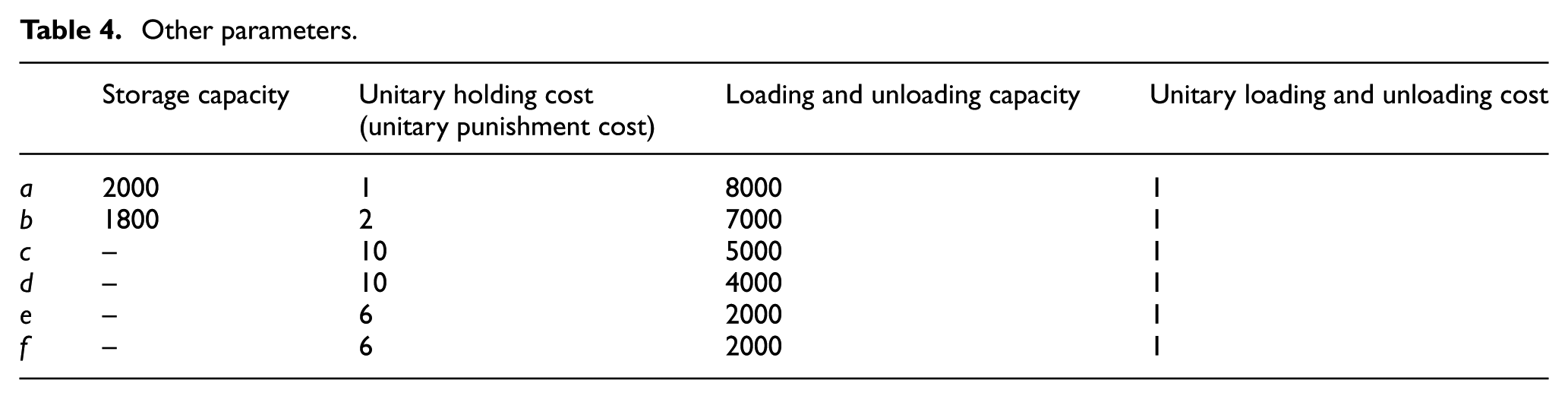
There are two supplier’s service stations
Transportation capacity.
Unitary transportation cost.

Demand and supply.

RFID: radio-frequency identification.
Other parameters.
Particle swarm optimization algorithm and experimental results
Particle swarm optimization (PSO) is a novel swarm intelligence algorithm presented by Kennedy and colleagues.37,38 It has been applied in a wide range of problems: vehicle routing, berth allocation, machine scheduling, order allocation, and empty container allocation.39–42 PSO was inspired on the behavior of birds in flocks where solutions to a given optimization problem, called particles, “fly” (like birds) through a multidimensional search space.43,44
The pallet pool operation problem is a non-deterministic polynomial-time (NP) problem. Due to the computational complexity, researchers have developed heuristics to solve the pallet pool operation model in the literature. Zhou et al. 9 developed an immune clone algorithm (ICA) for a pallet allocation model, and it was proved more effective than the traditional genetic algorithm (GA). However, compared with some other evolutionary algorithms (EAs) as ICA and GA, PSO is easier to implement and fewer control parameters are needed. 45 To our best knowledge, none of research we found has used PSO to solve the pallet pool optimization problem. In that case, we developed a PSO algorithm for pallet pool operation. The procedures of the PSO algorithm are as follows.
Step 1. Randomly generate a population of particles with velocity.
The population size is 40.
46
The initial position of each particle is given with
Step 2. Calculate constraints and fitness function. Calculate
constraint sets equations (2)–(23) as showed in section
“Constraints.” If one of the constraints is not met, then set the fitness function
with
Step 3. Update velocity and positions. The velocity is updated with
Step 4. Stop the algorithm when the maximum number of iterations
Initial position of the 40th particle.

N: Non-tagged pallet; R: RFID-tagged pallet; P: purchase.
For example,
The PSO algorithm was developed in Microsoft Visual Basic 6.0 and ran on a PC with a 2.50-GHz Intel CPU and 4.00 GB RAM, under the Windows 7 operating system. The result shows the minimization operation cost is 66,577. And, the optimization scheme is shown in Table 6.
Optimization scheme of the example.

As shown in Table 6, both the recycling fulfillment and demand fulfillment are 100%. So, the model and PSO algorithm are useful to manage a pallet pool with both RFID-tagged pallets and non-tagged pallets.
Assessing the value of an RFID system
The model and PSO algorithm could also be used to measure whether the investment of an RFID system is valuable or not. There are four steps to do so. The first step is to use the model and calculate the operation cost of a pallet pool without RFID-tagged pallets. The second step is to use the model and calculate the operation cost of a pallet pool with RFID-tagged pallets. The third step is to calculate how much operation cost could be reduced using RFID-tagged pallets. The fourth step is to calculate whether the investment of an RFID system could be covered with the operation cost saving. Certainly, the decision period should be reasonable and the data should be accurate. For example:
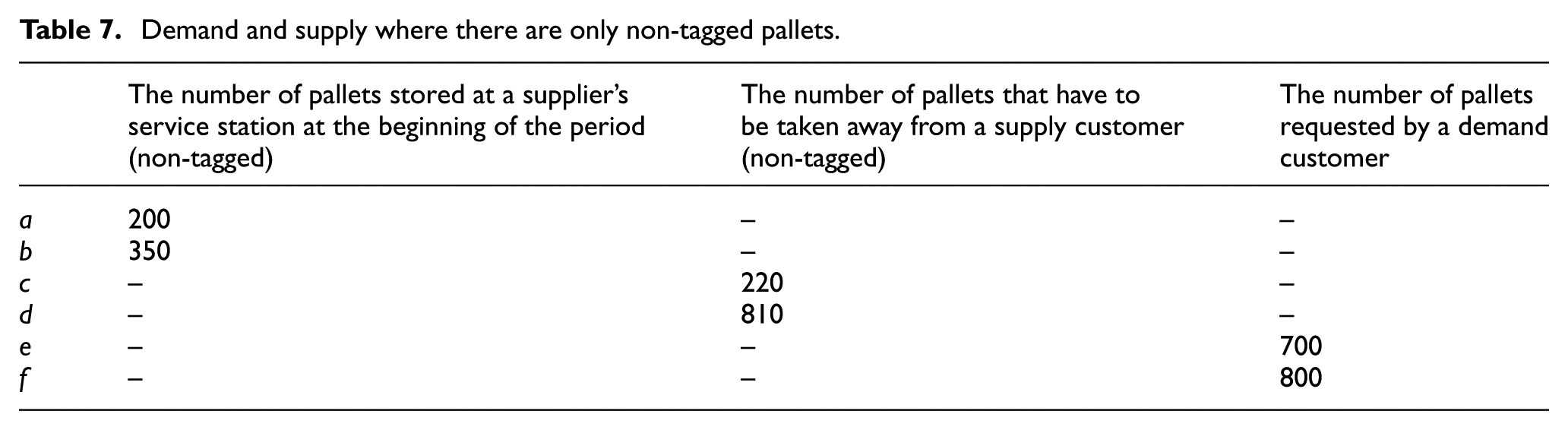
Step 1. Assumed there are only non-tagged pallets in a pallet pool. The demand and supply are shown in Table 7. We set the purchase cost of an RFID-tagged pallet as 1020, because it is hoped that supplier’s service stations will never purchase an RFID-tagged pallet. The other parameters values are the same as the section “Numerical example.” As shown in Table 8, the result shows the minimization operation cost is 74,007.
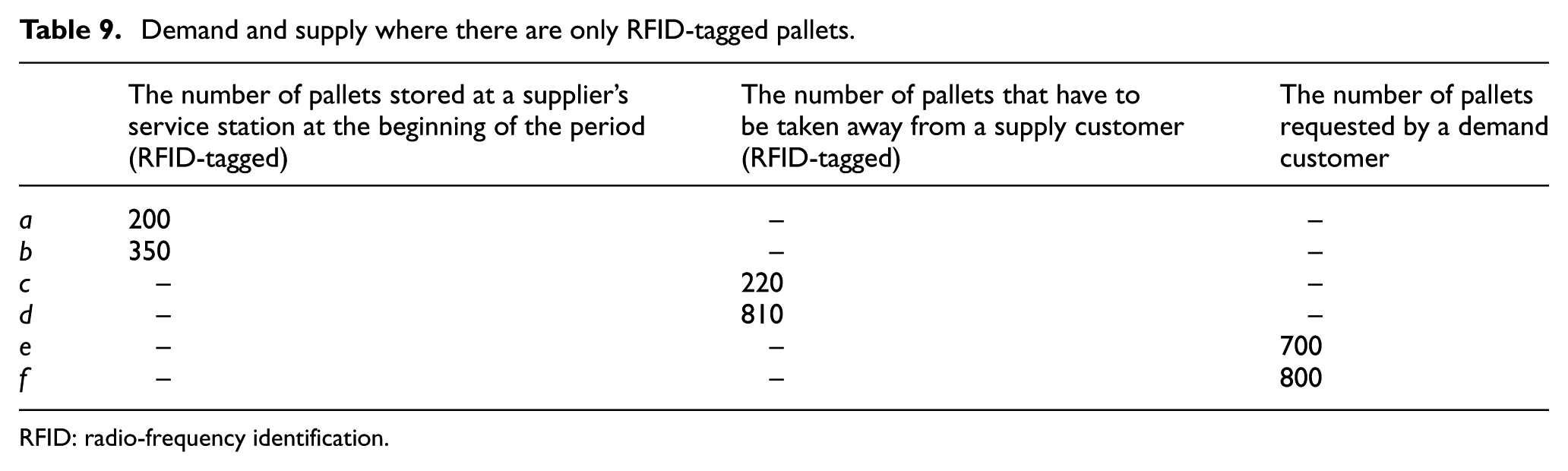
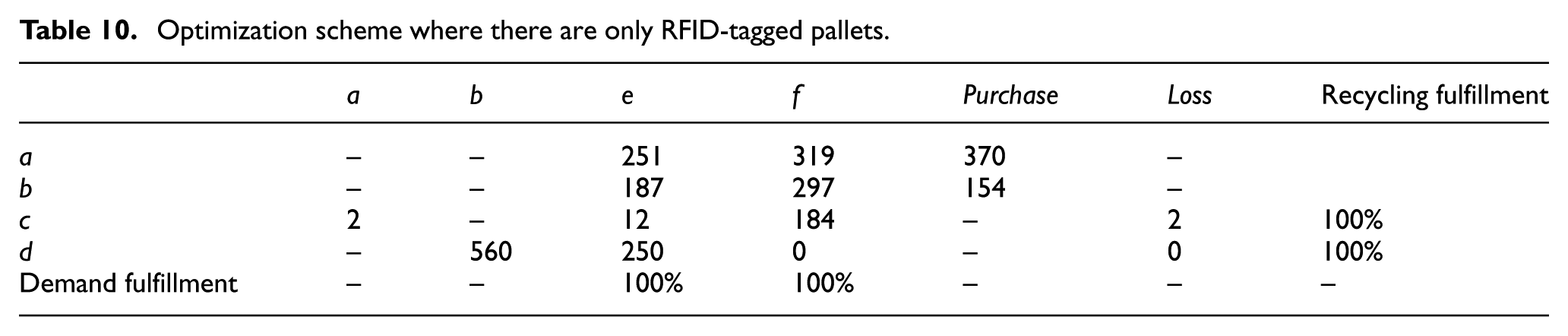
Step 2. Assumed there are only RFID-tagged pallets in a pallet pool. The demand and supply are shown in Table 9. We set the purchase cost of a non-tagged pallet as 1000, because it is hoped that supplier’s service stations will never purchase a non-tagged pallet. The other parameters values are the same as the section “Numerical example.” As shown in Table 10, the result shows the minimization operation cost is 68,587.
Step 3. Obviously, the operation cost could be reduced 5420 using RFID-tagged pallets in a period.
Step 4. If the cost of an RFID system is 50,000 and the maintenance cost of the system is 50 per year, the cost of the RFID system could be covered with the operation cost saving as long as the decision period is longer than 18 periods (with the method of net present value (NPV)). The relationship between the cost of an RFID system and save of operation cost (income) is shown in Figure 2. Figure 3 shows the accumulated revenue (total income minus total maintenance cost). Figure 4 shows the NPV.
Demand and supply where there are only non-tagged pallets.
Optimization scheme where there are only non-tagged pallets.

Demand and supply where there are only RFID-tagged pallets.
RFID: radio-frequency identification.
Optimization scheme where there are only RFID-tagged pallets.

Income (save of operation cost) and cost (maintenance cost) of each period.

Accumulated revenue.

Net present value.
Conclusion
There is one issue which ever plagues the pallet industry—proprietary pallets that have leaked out of a closed-loop system. Moreover, a lot of pallets in a closed-loop system are damaged that contributes to manage pallets difficultly. The implementation of RFID technology plays an important role in not only reducing the loss rate and damage rate but also offering support for the managers to make scientific decisions.
An optimization model was proposed to manage a pallet pool with both RFID-tagged pallets and non-tagged pallets. The objective of the model is to minimize the total operation cost including the transportation cost, purchase or rent cost, loss cost, maintenance cost, loading and unloading, storage cost, and punishment cost. Several constraints are considered in the model, such as distribution, reposition, demand, recycling, storage, transportation capacity, and loading and unloading capacity. This is the first article to study the five processes (including distribution, reposition, recycling, purchase (or rent), and maintenance) of pallet pool operation in an optimization model. A PSO algorithm was proposed to solve the optimization model. Compared with other EAs as ICA and GA, PSO is easier to implement and there are fewer control parameters to adjust. A numerical example was used to prove the useful of the model and PSO algorithm. To the best of our knowledge, this is the first study to provide an optimization model and PSO algorithm for the operations of a pallet pool with both RFID-tagged pallets and non-tagged pallets.
Although the investment of an RFID system is expensive, it will help us to reduce operation cost. The managers of a pallet pool can measure whether it is worthwhile to invest in an RFID system based on the methodology proposed and combined empirical experience. The four steps presented can be used to do the job. Obviously, with promising foreground of the pallet pool industry, the managers who apply RFID will take advantages in the competitive market.
The objective of the optimization model is to minimize the total operation cost of a pallet pool, but the average operation cost per unit time may be better than that. Future work will involve research on a more scientific optimization model and empirical study.
Footnotes
Acknowledgements
The authors thank Dr Bo Liu at University of Science and Technology Beijing for his help on the research. The authors are grateful to the anonymous referee for a careful checking of the details and for helpful comments that improved this article.
Handling Editor: Chenguang Yang
Declaration of conflicting interests
The author(s) declared no potential conflicts of interest with respect to the research, authorship, and/or publication of this article.
Funding
The author(s) disclosed receipt of the following financial support for the research, authorship, and/or publication of this article: This work was supported by the National Natural Science Foundation of China (71502087), China Postdoctoral Science Foundation (2017M611204), the Research foundation of China Society of Logistics (2016CSLKT3-015), and the Postdoctoral Research Foundation of Inner Mongolia University.