




Abstract
To realize higher coverage rate, lower reading interference, and cost efficiency of radio-frequency identification network in logistics under uncertainties, a novel robust radio-frequency identification network planning model is built and a robust particle swarm optimization is proposed. In radio-frequency identification network planning model, coverage is established by referring the probabilistic sensing model of sensor with uncertain sensing range; reading interference is calculated by concentric map–based Monte Carlo method; cost efficiency is described with the quantity of readers. In robust particle swarm optimization, a sampling method, the sampling size of which varies with iterations, is put forward to improve the robustness of robust particle swarm optimization within limited sampling size. In particular, the exploitation speed in the prophase of robust particle swarm optimization is quickened by smaller expected sampling size; the exploitation precision in the anaphase of robust particle swarm optimization is ensured by larger expected sampling size. Simulation results show that, compared with the other three methods, the planning solution obtained by this work is more conducive to enhance the coverage rate and reduce interference and cost.
Keywords
Introduction
With the development of information technology, there is an increasing usage of radio-frequency identification (RFID) network in logistics.1,2 How to deploy the minimum number of readers for covering all tags in the entire space is known as the radio-frequency identification network planning (RNP) problem, 3 which is one of the fundamental problems in large-scale RFID networks. 4 Coverage, inference, and cost, which are key elements of the RNP problem, are largely influenced by the number and positions of the RFID devices.5,6 However, uncertainties, such as radio channel, antenna read range and the influence on readers’ identification ability by different materials and objects around tags, may exist in the actual RFID network system. These uncertainties bring great influence to coverage, interference, and cost of the RFID network. Therefore, how to adopt the intensive way of deploying the readers to obtain higher coverage rate and less interference within low budget becomes a key issue for the popularization and application of RFID networks in logistics.
In the past decades, extensive efforts have been made to model and plan RFID network under certain environment,5–10 and coverage problem is one of the fundamental issues in RNP. Gong et al. 5 formulated a model of RNP, in which tag coverage, number of readers, interference, and the sum of transmitted power were considered. Liu and Ji 6 proposed an optimization model of RFID network system to solve the problem of how to place readers, taking the coverage rate and load balance into consideration. Di Giampaolo et al. 8 developed a simple and effective model, in which the performance indicators consisted of coverage efficiency, overall overlapping, total power, and cost of the network. Tao et al. 10 conducted the reader deployment in large-scale RFID systems as a problem of multi-objective combination optimization by taking the coverage, signal interference, and load balance as the optimization objectives and deducing the objective ranges.
The RFID network planning problem has been proved to be NP-hard for its nonlinearity and complexity. In recent years, evolutionary computation (EC) and swarm intelligence (SI) have become an effective tool for solving the planning of RFID network problem under certain environment, such as genetic algorithm (GA),3,7 plant growth simulation algorithm (PGSA), 4 particle swarm optimization (PSO),8–10 and artificial colony algorithm. 11 Yang et al. 7 proposed a GA-based RNP method, which included mapping the RFID network, presenting the problem states using gene and chromosome, and implementing the mechanisms of individual selection and genetic operation. Simple and effective models of electromagnetic elements involved in RNP are developed and included in the frame of PSO algorithm. 8 An improved PSO algorithm based on genetic algorithm (GA-PSO) was proposed to solve the problem of how to place readers so that the readers can effectively get the information of multiple tags. 9 Tao et al. 10 proposed an improved particle swarm algorithm, which can restrict the position change of original and new particles in the iteration process and accelerate the convergence speed of the algorithm, to solve the reader deployment in large-scale RFID systems. A k-coverage model, which is formulated as a multi-dimensional optimization problem with constraint conditions is developed to evaluate the network performance. And the PGSA is used to optimize the RFID networks by determining the optimal adjustable parameters in the model. 4 Ma et al. 11 proposed a cooperative multi-objective artificial colony algorithm to find all the pareto optimal solutions and to achieve the optimal planning solutions by simultaneously optimizing four conflicting objectives (tag coverage, reader interference, economic efficiency and load balance) in multi-objective RNP. Lin and Tsai 3 proposed a micro-genetic algorithm (mGA) with novel spatial crossover and correction schemes to cope with this constrained three-dimensional reader network planning problem. The mGA was computationally efficient, which allowed a frequent replacement of RFID readers in the network to account for the short turnaround time of cargo storage and guaranteed 100% tag coverage rate to avoid missing the cargo records.
Although the modeling and planning of RFID network has drawn extensive attention, few studies have considered several objectives under uncertainties about decision-making for the RNP problem. Meanwhile, there have been some studies on the sensor deployment of wireless sensor networks (WSNs) under uncertainties. Li et al. 12 and Ozturk et al. 13 proposed a probability sensing model when the detection region of sensor was uncertain. Vu and Zheng 14 presented a systematic study of the impact of location uncertainty on the coverage properties of WSNs and devised an efficient polynomial algorithm. Vu and Zheng 15 carried out a rigorous study of the impacts of location uncertainty on the accuracy of target localization and tracking, and proposed an effective algorithm based on order-k max and min Voronoi diagrams. However, different properties of WSNs and RFID network make these approaches useful in WSNs inapplicable to RFID networks. 4
The robust optimization method is very important in complicated RFID network planning under uncertainties. To deal with complex uncertainty problem, it is simple and effective to combine intelligent optimization algorithms and robust optimization.16–19 However, robust optimization is generally based on Monte Carlo integral, while cyclic iteration is usually used in intelligent optimization algorithms. This straightforward method needs more number of fitness evaluations, which brings about a large calculation. Therefore, how to keep the search performance while reducing the computational complexity, in other words, how to improve the search performance in the case of limited sampling size, is a problem deserving study.
Uncertainties, such as radio channel, antenna read range, and the influence on readers’ identification ability by different materials and objects around tags, can be converted to uncertain positions of tags with respect to readers’ identification. Therefore, to enhance the reliability and stability in logistics, this work focuses on tags’ uncertain positions and studies robust modeling and planning of RFID networks under uncertainties. First, a robust planning model of an RFID network in logistics is built, in which the coverage rate is analyzed on the basis of the probability sensing model of WSN under uncertainty. Second, the concentric map–based Monte Carlo method is applied to calculate the interference. Third, to enhance the searching capability, robust particle swarm optimization (RPSO), which can trade off the exploitation speed and precision, is put forward to solve the RFID planning problem under uncertainties. Finally, the simulation results indicate that the proposed method possesses a better robust optimization capability.
RFID network planning problem under uncertainties
The key to the RFID network planning problem is the deployment of readers to satisfy multi-objective requirements due to the limited range of reader–tag communication. First, it is hoped that the tags can be identified as much as possible. Second, reading interference is closely related to the reader collision problem, 20 which may occur when the tags are located in the overlapping area of any two readers’ interrogation zones, and both readers read tags simultaneously. 3 Consequently, the number of tags located in the overlapping area of interrogation zones should be as small as possible. Third, the smaller the number of placed readers is, the lower the cost is. Therefore, the proposed planning model of RFID network aims to optimize a set of objectives (such as tag coverage, reading interference, and economic efficiency) simultaneously by adjusting the control variables (the coordinates of readers, the number of readers, etc.) of the system. In view of uncertainties which can be converted to uncertain positions of tags with respect to readers’ identification, a novel study related to the coverage and interference analysis is considered in this work.
The deployment region of the RFID network system is supposed as a two-dimensional (2D) square domain which consists of several tags. Assume that uncertainties are arbitrary and then the uncertain area of tags’ positions to readers’ identification is circles with radius RT. A conceptual view of tags’ uncertainty positions is shown in Figure 1, where coarse dots indicate tags and small circles are the ranges of tags’ uncertainty positions.

Tags and their uncertainty positions.
Coverage rate
Coverage is the main task of an RFID network. By referring the probability sensing model for WSNs,12,15

where RR is the sensing radius of each reader; Rb is the radius of each tag’s uncertainty position;

In order to make the coverage rate comparable in different numbers of tags,

Interference
Interference mainly occurs in an environment with dense readers, where several readers try to interrogate tags simultaneously. Interference will result in unacceptable misreading 21 and failure of information collection. 10 Due to uncertainty of tags’ positions, it is complicated to use geometric analysis method to deal with the interference problem. And it is hard to build an approximate mathematical coverage model. Here the Monte Carlo sampling method is employed.
If the ith reader can identify the sampling site

When





where
Precision of random sampling is low, because
If


Cost
The quantity of readers is a key impact factor of the RFID network cost.

RFID network planning model under uncertainties
The robust planning model of RFID network is built, in which the coverage rate, interference, and cost are considered. Equation (13) is taken as the objective function, where

Any deployed reader must be in the region of the RFID network. Let A be the region of the RFID network. Then the feasible region is shown in equation (14)

Constraints of the RFID network planning model are equations (1)–(3), (10)–(12), and (14).
Robust particle swarm optimization algorithm
From section “RFID network planning model under uncertainties,” it can be known that the RFID network planning problem under uncertainties is mainly a continuous problem. In this work, PSO is applied to the RFID network planning problem, because PSO possesses ease of implementation, high quality of solutions, computational efficiency, and speed of convergence 6 and also exhibits good ability to solve continuous optimization problem. 5
From section “Interference,” it can be shown that there is a trade-off between accuracy and speed in interference calculation. Larger number of sampling sites can improve the calculation accuracy and lead to lower speed, or vice versa. In order to balance the calculation of accuracy and speed, a novel robust particle swarm optimization algorithm is proposed.
Particle swarm optimization (PSO) algorithm
PSO is a population-based heuristic search technique, in which a group of particles search the best solution by iterations. The iteration formulations 24 are as follows


where
Besides, the velocity Vld is limited by the maximum velocity Vmax,d.
Basic idea of RPSO
In the prophase of iterations, PSO algorithm should explore the search space to find the optimum region with faster speed. In the anaphase of iterations, PSO is supposed to develop the optimum region to search the optimal solution with higher precision. The sampling size is closely related to the exploring speed and exploitation precision. The smaller the sampling size is, the faster the exploring velocity is. The larger the sampling size is, the higher the exploitation precision is.
According to this line of thinking, a robust particle swarm optimization is proposed. To be specific, some sampling sizes formed a set
In this work, the sampling sizes in
Method of sampling size selection
Here, an asymmetric 2D sigmoid function is designed to set the selection probability of each sampling size in



where
The changes of
It can be known that if

Expected sampling size
The expected sampling size,
Calculation of expected sampling size

The sampling sizes in

From equation (21), it can be seen that the change of
Change of expected sampling size

because

Therefore, when

Therefore,
Average expected sampling size
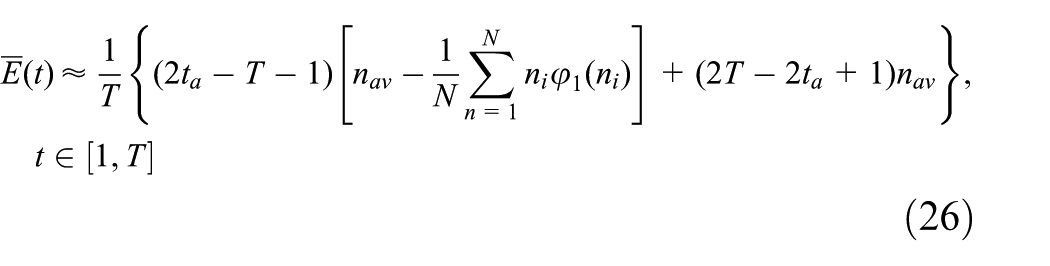
When
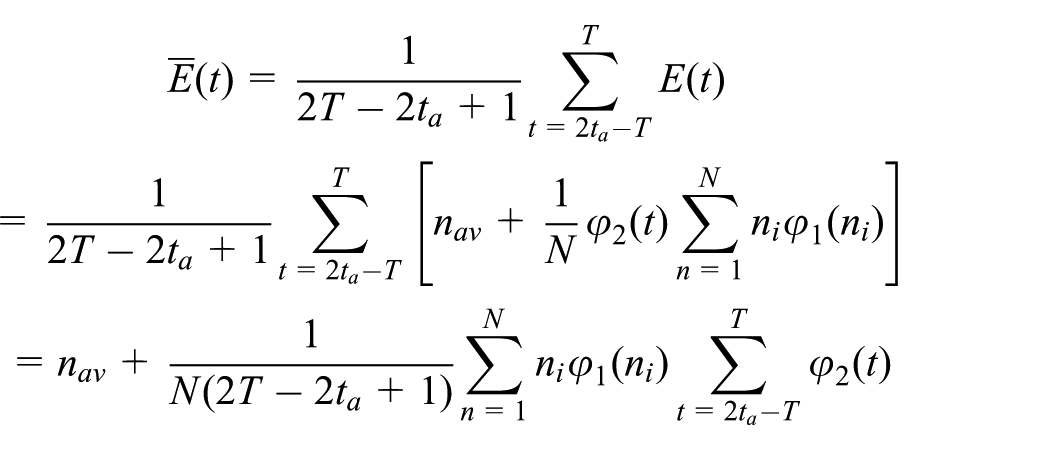
Because

From equation (23), it can be known that equation (25) is true if

Therefore, if

Case of parameter setting
Here, a case of parameter setting is illustrated to visualize the changes of

Change of

Change of
From Figure 2, it can be known that
From Figure 3, it is seen that
RPSO for the RFID network planning problem
Here, the proposed RPSO is applied for the RFID network planning problem. The objective function, equation (13), acts directly as the fitness function of RPSO. In the objective function, the coverage of RFID network is calculated by referring to section “Coverage rate”; interference is determined by Monte Carlo sampling method introduced in section “Interference”; cost is counted by equation (12) in section “Cost.” The pseudo-code of RPSO is as follows

Simulations
In an ultra-high-frequency (UHF) RFID network area of 30 m × 30 m, 100 RFID tags (JY-T9662) are randomly distributed. Tag (JY-T9662), which is made of copperplate paper, is an UHF passive tag characterized by 860–960 MHz. Parameters are set according to Table 1, where RR is set in accordance with Gong et al.; 5 λ1, λ2, β1, and β2 are set in accordance with Ozturk et al.; 13 M and T are the population size and the number of iterations of optimization algorithms detailed in the following paragraphs, respectively.
Parameter setting.

To verify the performance of the proposed method, four algorithms are implemented and compared, among which RGA_MC is real-coded GA based on traditional Monte Carlo method, RPSO_MC is PSO based on traditional Monte Carlo method, RGA_SC is real-coded GA based on the sampling method introduced in this work, and RPSO_SC is RPSO described in section “Robust particle swarm optimization algorithm.” In all these four algorithms, coverage of the RFID network is calculated by referring to section “Coverage rate”; cost is calculated using equation (12); interference in RGA_MC and RPSO_MC is determined by traditional Monte Carlo method, while interference in RGA_SC and RPSO_SC is calculated by Monte Carlo method based on the sampling method presented in this work. M and T of all algorithms are set according to Table 1. In RGA_MC and RGA_SC, the uniform crossover and uniform mutation are implemented, where the crossover and mutation rates are 0.7 and 0.01, respectively.
To compare these four algorithms, let the calculation quantity of the sampling method introduced in this work be the same as that in the traditional Monte Carlo method. In view of additional selection probability calculation for sampling size in RGA_SC and RPSO_SC, the sampling sizes of RGA_MC and RPSO_MC are both set at 18, which is slightly higher than
These four algorithms are continuously executed for 50 times. The best and average results are shown in Tables 2 and 3, respectively, where
The best results’

The average results’

Average

The average fitness value comparisons among these four methods are shown in Figure 4(a). The average fitness error comparisons among these four methods are shown in Figure 4(b). The best results acquired by RPSO_AS are shown in Figure 5, where * represents the reader, coarse dots indicate the tags, large circles represent the identification ranges of readers, and small circles are uncertain positions of tags.

Average fitness value (a) and average fitness error
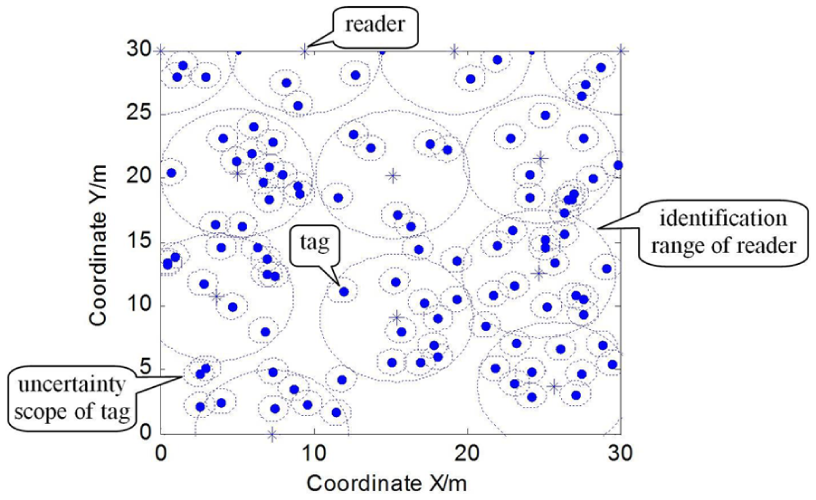
Diagram of the best RFID network obtained by RPSO_SC.
From Tables 2 and 3, the best and average results displayed by RGA_SC and RPSO_SC are better than those by RGA_MC and RPSO_MC. RPSO_SC shows more excellent interference and fitness than RGA_SC. CPU time spent by RPSO_SC is obviously less than those spent by the other three methods.
From Table 4, individual evaluation errors in the best and average results obtained by RGA_SC and RPSO_SC are significantly smaller than those obtained by RGA_MC and RPSO_MC. It can be reflected from the expected sampling sizes in the last few iterations. For example, in the 77th–100th iterations, the expected sampling size of RGA_SC and RPSO_SC is between 30 and 31, which are drastically larger than those of RGA_MC and RPSO_MC, which is 18. In addition, it can be seen that the average fitness error obtained by RPSO_SC is smaller than that obtained by RGA_SC.
From Figure 4(a), the convergence rate of RPSO_SC is faster than those of the other three methods. From Figure 4(b), the fitness errors are clearly influenced by the sampling size. The average fitness error of RPSO_SC is obviously larger than those of RGA_MC and RPSO_MC in the 1st–65th iterations, but it is gradually smaller than those of the other three methods after the 70th iteration. From Figure 5, most tags have been identified by readers and lower reading interferences occur among readers.
To verify the model and method proposed in this work comprehensively, RFID network planning is done using different numbers of tags. In areas of 50 m×50 m, 50 m × 100 m, and 100 m × 100 m, the values of
Average planning results of the three examples.


Average fitness value (a) and average fitness error

Average fitness value (a) and average fitness error

Average fitness value and average fitness error
From Table 5, it can be seen that in different tag quantities RPSO_SC which spent the shortest CPU time is the best among the four algorithms referring to the interference and fitness. From Figures 6–8, in robust planning of the RFID network with different numbers of tags, the convergence rate of RPSO_SC is faster than those of the other three methods and the average fitness error of RPSO_SC is gradually smaller than those of the other three methods. The average fitness value obtained by RPSO_SC is obviously larger than those obtained by the other three methods from the 44th, 25th, and 119th iterations in Figures 6(a), 7(a), and 8(a), respectively. The average fitness error in fitness values obtained by RPSO_SC is obviously larger than those obtained by RGA_MC and RPSO_MC in the 1st–150th iterations, 1st–300th iterations, and 1st–600th iterations shown in Figures 6(b), 7(b), and 8(b), respectively. However, it is gradually smaller than those obtained by the other three methods from the 206th, 351st, and 690th iterations shown in Figures 6(b), 7(b), and 8(b), respectively.
These results suggest that RPSO_SC possesses better optimization performance in solving the RFID network planning problem under uncertainties.
Conclusion
To sum up, this work builds a RFID network planning model in logistics under uncertainties which can be converted to uncertain positions of tags with respect to readers’ identification. The probability sensing model is employed to analyze the coverage rate, and the Monte Carlo method is applied to calculate the interference among readers. To enhance the planning efficiency of an RFID network under uncertainties, a robust particle swarm optimization algorithm is proposed. To reduce the computational complexity and improve the search performance simultaneously, the sample sizes are smaller and larger in the prophase and anaphase of iterations, respectively. The expected sampling size is analyzed for the convenience of performance comparisons between RPSO_SC and the other algorithms based on traditional sampling method. Several simulations are executed in different network scales. With respect to coverage, interference, network cost, fitness, CPU time, convergence rate, and fitness error, the proposed approach can provide a better planning scheme for an RFID network system in logistics under uncertainties.
Footnotes
Handling Editor: Luca Catarinucci
Declaration of conflicting interests
The author(s) declared no potential conflicts of interest with respect to the research, authorship, and/or publication of this article.
Funding
The author(s) disclosed receipt of the following financial support for the research, authorship, and/or publication of this article: This work was supported by the National Natural Science Foundation of China (No. 51579143), The Ministry of education of Humanities and Social Science project (Nos 15YJC630145 and 15YJC630059), and the Natural Science Foundation supported by Shanghai Science and Technology Committee (No. 15ZR1420200), which is gratefully acknowledged.