




Abstract
When using the finite element method for structural–acoustic coupled analysis, the mass and stiffness matrices are not symmetric because the acoustic space is described by sound pressure and the structure is described by displacement. Therefore, eigenvalue analysis requires a long computational time. In this article, we proposed concentrated mass models for performing structural–acoustic coupled analysis. The advantage of this model is that the mass and stiffness matrices become symmetric because both the acoustic space and the membrane are described by the displacement of the mass points. Furthermore, our models do not generate spurious modes and zero eigenvalues that arise in finite element method whose variable is displacement in acoustic space. To validate the proposed models, the natural frequency obtained using the concentrated mass models is compared with the natural frequency found using finite element method. These results are in good agreement, and spurious modes and zero eigenvalues are not generated in the proposed model whose variables are sound pressure. Furthermore, we compare the proposed model with finite element method in terms of the calculation time required for the eigenvalue analysis. Because the matrices of the proposed models are symmetric, these eigenvalue analyses are faster than that of finite element method, whose matrices are asymmetric. Therefore, we conclude that the proposed model is valid for coupled analysis of a two-dimensional acoustic space and membrane vibration and that it is superior to finite element method in terms of calculation time.
Introduction
To reduce interior noise in transportation vehicles, structural–acoustic coupled analyses have been performed using the finite element method (FEM).1–3 Craggs 4 and Everstine et al. 5 gave equations of motion in FEM for the structural–acoustic coupled problem. However, the derivation of these equations is complicated because of the different variables in the structural and acoustic fields. In the structural field, displacement at the nodal point is used as the variable, whereas in the acoustic field, sound pressure or velocity potential is used. Therefore, the mass and stiffness matrices of the equation of motion are asymmetric. This asymmetry increases the computational time required for eigenvalue analysis of the coupled problem and complicates modal analysis because orthogonality is not satisfied. 6
To overcome the problem of eigenvalue analysis, Craggs and Stead 7 arranged frequency domain equations into a symmetric form. However, this method cannot be applied to damped systems.
To overcome the problems of eigenvalue and modal analysis, many researchers have transformed asymmetric equations of motion into symmetric equations. Everstine 8 substituted the coupled term into the damping matrix to symmetrize the mass and stiffness matrices. Olson and Bathe 9 introduced air velocity potential in addition to sound pressure and derived a symmetric equation with a damping matrix. However, such approaches require solving complex eigenvalue problems, even in the case of an undamped system or proportional viscous damping. Ohayon10,11 and Sandberg and Goransson 12 introduced air displacement potential as a replacement for velocity potential and derived a symmetric equation that does not have a damping matrix. However, the degree of freedom is redundant, and the mass and stiffness matrices are dense, thus requiring a long computational time. MacNeal et al.13,14 and Sandberg 15 transformed sound pressure in the acoustic field and displacement in the structure into modal coordinates and arranged the equation of motion as a symmetric equation using coordinate transformation. Flanigan and Borders 16 analyzed acoustic and panel vibration problems using MacNeal’s method. However, these approaches require that eigenvalue analysis of the acoustic field and structure be done in advance. Moreover, as a result of the coordinate transformation, the physical meaning of the original coordinates is lost, despite its importance in system-parameter identification problems. 6
To overcome the problem of modal analysis when an asymmetric equation is used, Hagiwara and Ma 17 introduced the concept of left and right eigenvectors to perform modal analysis using asymmetric equations of motion. However, the eigenvalue problem is asymmetric in the first modal analysis step, and so considerable computational time is required for eigenvalue analysis.
The other methods to overcome these problems are FEMs whose variable is displacement in the acoustic space.18–20 These methods have the advantage that the compatibility and equilibrium condition along the boundary between the acoustic space and the structure is satisfied easily, 20 and the mass and stiffness matrices are symmetric. However, zero eigenvalues whose natural frequencies are 0 Hz and spurious modes that are physically meaningless are generated in these methods.18,20 Hori et al. 21 and Kim and Yun 20 proposed the methods to transform the spurious modes into zero eigenvalues. However, the degree of freedom is larger than that of FEM with sound pressure or velocity potential as the variable.
In our previous study, we proposed a concentrated mass model for coupled analysis of two-dimensional acoustic and membrane vibration. 22 This model consists of masses and connecting springs. The mass points are placed at the intersection points of elements, and the displacement of the mass point is used as the variable in this model. For the structural–acoustic coupled problem, the treatment of the coupling involves only placing the mass points of the structure and of the acoustic field at the nodal points in each area. Therefore, the equations of motion of the mass points can be derived simply. Furthermore, the mass and stiffness matrices in the equations are symmetric. Thus, the modal analysis can be applied easily, and the computational cost of the eigenvalue analysis becomes lower when using the concentrated mass model. However, zero eigenvalues and spurious modes are also generated in this model. 22
Here, we propose a new concentrated mass model to eliminate the zero eigenvalues and spurious modes. The sound space and membrane are modeled as masses and connecting springs. The mass points are placed at the center of sides of elements to eliminate the spurious modes. Furthermore, the variable displacements of the mass points are transformed into the sound pressure to eliminate zero eigenvalues. To validate the proposed model, the natural frequency obtained by the concentrated mass model is compared with that obtained by FEM.
Concentrated mass model
We deal with a coupled problem of a two-dimensional acoustic in a rectangular plate-shaped space and one-dimensional membrane vibration, as shown in Figure 1. One face of the rectangular plate-shaped space is the membrane and the other faces are rigid. The thickness of the acoustic space is h. The lengths of the acoustic space are

Analytical space.
Model of acoustic space
The air in the acoustic space is modeled as a concentrated mass that consists of masses and connecting springs, as shown in Figure 2. The space is divided into uniform rectangular elements with sides of

A connecting spring describes the relationship between pressure

where

Substituting equation (3) into equation (2) and linearizing, we obtain

Considering the force acting on the shaded area in Figure 4, the equations of motion in the x and y directions are given by

Substituting equation (4) into equation (5), the equations of motion can be written as follows using the displacements


Concentrated mass model.
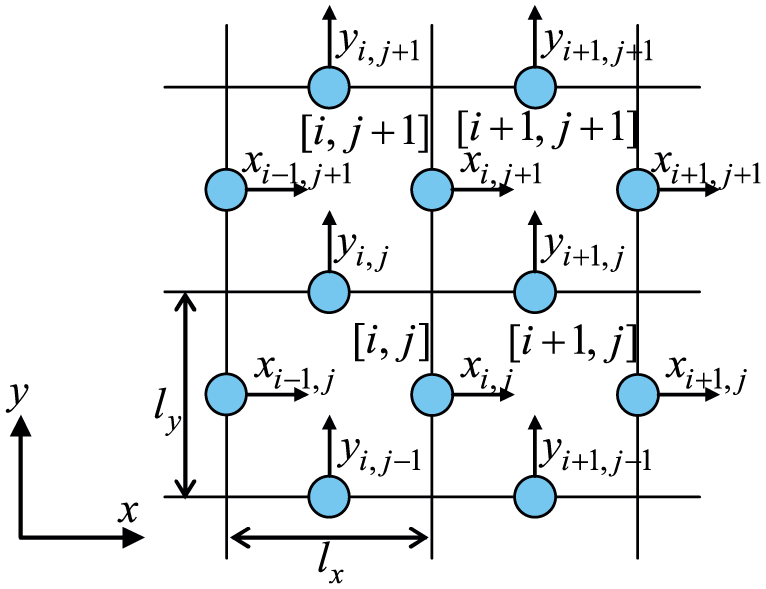
Square lattice and mass point.
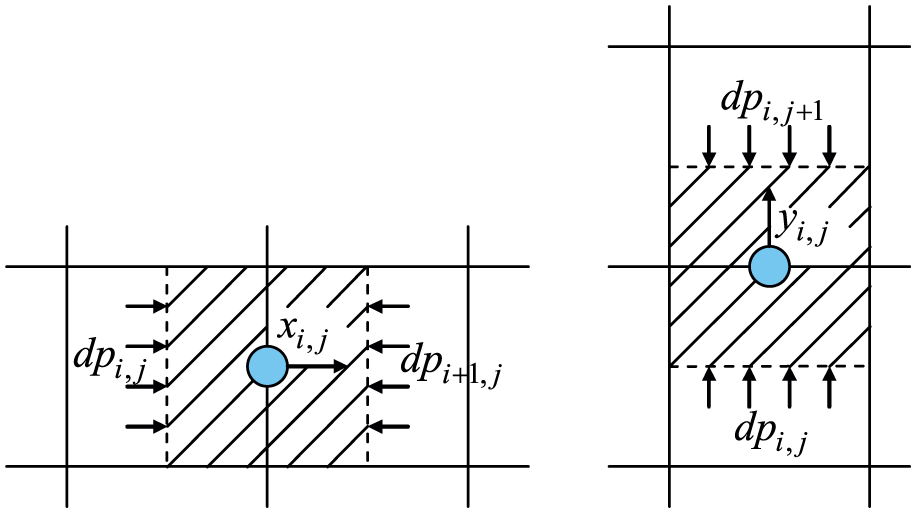
Definition of mass and sound pressure force.

Volume variation in element
Membrane model
The membrane face in Figure 1 is modeled as a concentrated mass model that consists of masses and connecting springs, as shown in Figure 6. We consider a one-dimensional membrane. The membrane is divided into uniform elements such that the length is
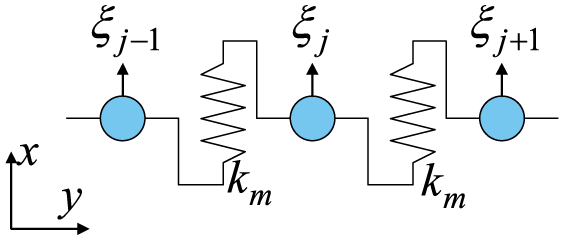
Membrane model.

Membrane element.
Considering the mass of the membrane in the shaded area in Figure 7, the mass of each mass point is

The restoring force of the membrane is modeled as a spring. The forces shown in Figure 8 act on the shaded area shown in Figure 7. The displacement of the membrane at coordinate y in the x-direction is

If we relate

From this equation, the constant of the spring shown in Figure 6 is

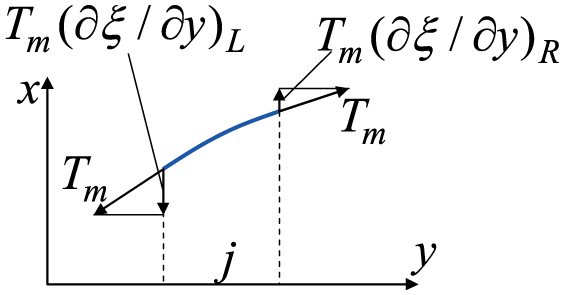
Tension of membrane.
Treatment of coupled region
Next, we treat the coupled region of the acoustic space and the membrane. Figure 9 shows the mass arrangement in the

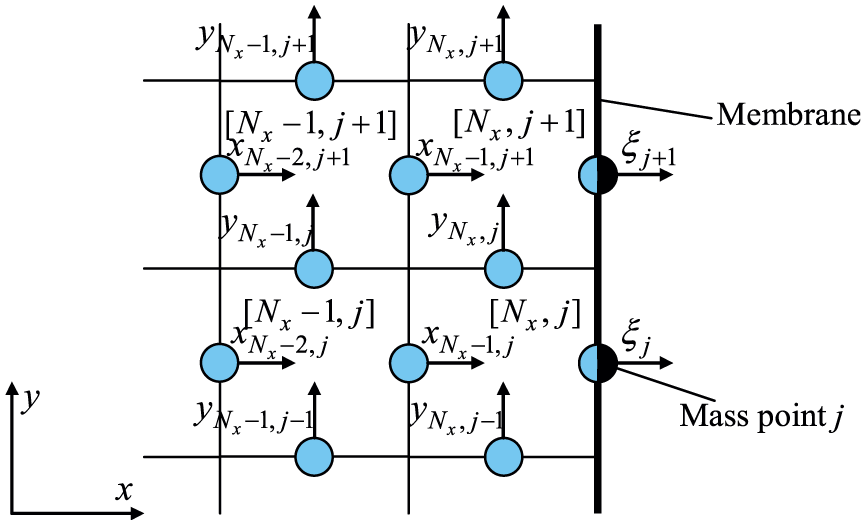
Placement of mass point near membrane.
Assuming that the mass of the mass point on the membrane is the sum of the membrane mass and the air mass in half of the element and that the sound pressure,

Substituting equation (11) into equation (12), the equation of motion is given as follows using the displacement of the mass points of air

Equation of motion
Arranging equations (6) and (13) in a matrix gives equations in the form

where
Sound pressure model
The degree of freedom of equation (14) is redundant because the variables in the acoustic space are
Arranging equations (4) and (11) in a matrix gives equations in the form

where

where

where

Here,

Transforming this equation using equation (15), the equation of motion becomes

The displacements
This model whose variables of the acoustic space are sound pressure is called the “sound pressure model,” and the model whose variables are displacements is called the “displacement model.”
Solution of eigenvalue analysis
To validate the proposed model, we perform eigenvalue analysis of a rectangular plate-shaped space comprising five rigid walls and one membrane wall (Figure 1). The natural frequencies and natural mode shapes obtained by the proposed model are compared with FEM results.
Analysis with displacement model
The natural frequencies and natural mode shapes are obtained by the displacement model proposed in section “Concentrated mass model.” The boundary conditions at the rigid walls are


These equations show that the displacements of air on the rigid wall in directions perpendicular to the walls are zero. Displacements in directions parallel to the walls are unrestricted.
Assuming

Assuming that the solution of equation (23) is

To transform equation (24) into a standard eigenvalue problem, the mass matrix

where

where

Here,
Analysis with sound pressure model
In this section, we explain how to obtain the natural frequencies and natural mode shapes by the sound pressure model as proposed in section “Sound pressure model.” Assuming

Assuming that the solution of equation (28) is

To transform equation (29) into a standard eigenvalue problem, Cholesky decomposition is applied to matrix

Substituting equation (30) into equation (29) and multiplying

Assuming

Here,
FEM
In this section, we derive the FEM formulation of a coupled problem of a two-dimensional acoustic and a one-dimensional membrane vibration. The wave equation about the sound pressure

where

where

Multiplying equation (33) by

where

If we assume that

Substituting equation (38) into equation (37) and integrating in each element, the equation of motion in the acoustic space becomes

Multiplying equation (34) by

Substituting equation (38) into equation (40) and integrating in each element, the equation of motion of the membrane becomes

Combining equations (39) and (41), the equation of motion of the coupled system becomes

where

Assuming that the solution of equation (43) is

Multiplying equation (44) by

The eigenvalues and eigenvectors of the coupled problem are obtained using this equation.
Numerical results
Eigenvalue analysis of a rectangular plate-shaped space comprising five rigid walls and one membrane wall (Figure 1) is performed. Table 1 lists the parameter values used in the simulation.
Parameter values.

Table 2 shows a comparison of the natural frequencies. The natural frequencies obtained by the displacement model and by the sound pressure model are in perfect agreement. The displacement model has 7821 zero eigenvalues whose natural frequencies are 0 Hz because the degree of freedom of this model is redundant. On the other hand, the sound pressure model has only one zero eigenvalue. Therefore, the lowering of the degrees of freedom by the transformation of the variable is valid.
Natural frequency of the coupled problem.

FEM: finite element method.
The natural frequencies obtained by the concentrated mass model (displacement model and sound pressure model) agree well with those obtained by FEM. Figure 10 shows a comparison of the natural mode shapes obtained by the concentrated mass model and the mode shape obtained by FEM. In Figure 10(a) and (b), the order of the natural mode is first; in Figure 10(c) and (d), the order is second; and in Figure 10(e) and (f), the order is third. The left-hand figure shows the mode shapes of the sound pressure and the right-hand figure shows those of the membrane displacement. The values are normalized so that the membrane amplitude is 1. The natural modes of the concentrated mass model are the results obtained by the displacement model and sound pressure model. The natural modes obtained by the concentrated mass model agree well with those obtained by FEM. Furthermore, no spurious mode is generated in the concentrated mass model, unlike in our previous model. 22 Therefore, the model proposed in this article is valid for the coupled analysis of acoustic and membrane vibration.

Mode shapes of sound pressure and membrane: (a) concentrated mass model (first mode), (b) FEM (first mode), (c) concentrated mass model (second mode), (d) FEM (second mode), (e) concentrated mass model (third mode), and (f) FEM (third mode).
In Figure 10, the acoustic (1, 0) mode and the first mode of the membrane are dominant in the first mode, the acoustic (0, 1) mode and second mode of the membrane are dominant in the second mode, and the acoustic (1, 1) mode and second mode of the membrane are dominant in the third mode. Table 3 shows the natural frequencies of the acoustic field when all the walls are rigid, given by

Natural frequency of an acoustic space when all walls are rigid.

From Table 3, the natural frequency of the (1, 0) mode of the acoustic space alone is 417.71 Hz, that of the (0, 1) mode of the acoustic space alone is 334.17 Hz, and that of the (1, 1) mode is 534.93 Hz. In contrast, the natural frequency of the first mode of the coupled system, in which the (1, 0) mode of the acoustic space is dominant (Figure 10), is 283.01 Hz (Table 2). The natural frequency of the second mode, in which the (0, 1) mode of the acoustic space is dominant, is 310.32 Hz. The natural frequency of the third mode, in which the (1, 1) mode of the acoustic space is dominant, is 472.00 Hz. Therefore, the natural frequencies of the coupled problem decrease from the natural frequency of the acoustic field in the case where all walls are rigid by the coupled effect.
The numerical results obtained using the displacement model have many zero eigenvalues with a natural frequency of 0 Hz (Table 2). The variables used in the displacement model are displacements

Mode shape of a zero eigenvalue whose natural frequency is 0 Hz: (a) sound pressure and membrane displacement (Nx × Ny = 80 × 100) and (b) displacement in acoustic space (Nx × Ny = 4 × 5).
Figure 12 shows the natural frequency to the variation of

Natural frequency to variation of division number: (a) first order, (b) second order, and (c) third order.
Figure 13 shows the natural frequency by the concentrated mass model for first-, second-, and third-order to the variation of

Natural frequency to variation of length of acoustic space in the x-direction.
Figure 14 shows the natural frequency by the concentrated mass model for first-, second-, and third-order to the variation of the membrane tension

Natural frequency to variation of membrane tension.
Comparison of computational time
To confirm the advantage of the proposed model over FEM, we compared the computational times for eigenvalue analysis. In the case of the displacement model or sound pressure model, the time from the decomposition in equation (25) or (30) to the acquisition of all eigenvalues is measured. In the case of FEM, the time from the calculation of the inverse matrix in equation (45) to the acquisition of all eigenvalues is measured.
Table 4 shows the computational environment. The eigenvalue analyses are performed using the Intel Math Kernel Library. The eigenvalue analysis method for the displacement model is a divide-and-conquer method for a standard symmetric eigenvalue problem; the dsyevd function of the library is used. The method for the sound pressure model is a divide-and-conquer method for a general symmetric eigenvalue problem; the dsygvd function that includes the decomposition in equation (30) is used. The method for FEM is a QR method for a standard asymmetric eigenvalue problem; the dgeev function is used. We used (20, 25), (40, 50), and (80,100) as the number of divisions (
Computational environment.

Table 5 shows a comparison of the computational time in each division number (
Comparison of computational times.

DOF: degree of freedom.
Conclusion
To analyze the coupled problem of a two-dimensional acoustic space in a rectangular plate-shaped space and membrane vibration, we propose a concentrated mass model that consists of masses and connecting springs. The acoustic space and membrane are both modeled as a concentrated mass model. The treatment of the boundary between the acoustic space and the membrane is simply the arrangement of air masses on the membrane, so it is easy to couple the structure and acoustic field by means of the concentrated mass model. Furthermore, a sound pressure model in which sound pressure is used as the variable for the acoustic space is proposed to reduce the degree of freedom. We compared the natural frequencies of the coupled problem as obtained by the concentrated mass model (displacement model and sound pressure model) and FEM and found that they are in good agreement, and spurious modes that are physically meaningless are not generated. Furthermore, the computational times of the displacement model and sound pressure model are faster than FEM in eigenvalue analysis because its matrices are symmetric.
In summary, the proposed concentrated mass model is valid for the coupled analysis of two-dimensional acoustics and membrane vibration. Future tasks include extending this analysis to three-dimensional problems and the comparison between this method and FEM-BEM coupling method. 24
Footnotes
Handling Editor: Pietro Scandura
Author note
Ataru Matsuo is now affiliated to Aero-Engine & Space Operations, IHI Corporation, Tokyo, Japan. Yuta Akayama is also affiliated to Materials Handling Department, Kawasaki Heavy Industries, Kobe, Japan.
Declaration of conflicting interests
The author(s) declared no potential conflicts of interest with respect to the research, authorship, and/or publication of this article.
Funding
The author(s) received no financial support for the research, authorship, and/or publication of this article.