



Abstract
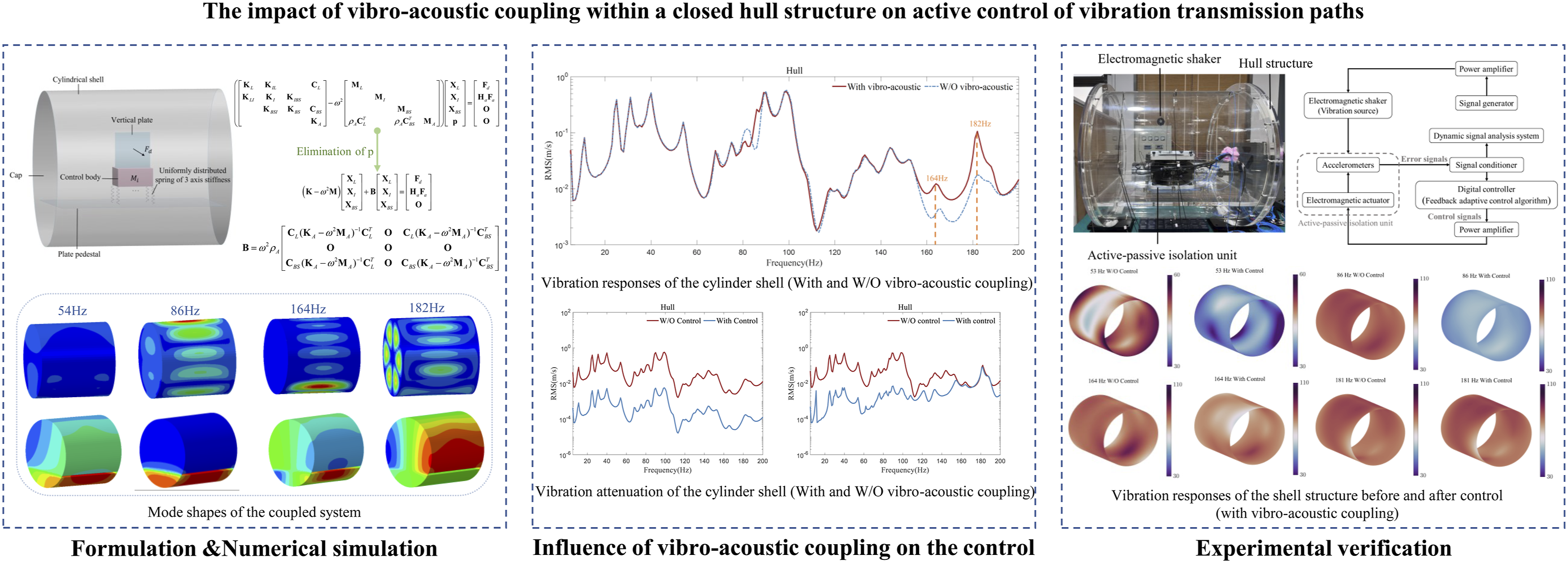
To investigate the influence of vibro-acoustic coupling on active vibration transmission control within a closed hull structure, a numerical model is developed to describe the involved sound-structure interaction. Modal characteristics of the structural system and acoustic cavity as well as the responses of the hull structure subjected to an internal vibration source are analyzed. Comparative analyses between scenarios with/without sound-structure interaction are presented, and the assessment is based on the responses of the error points and the hull structure. The results indicate that controlling the structural transmission path does not always effectively mitigate the transmission of vibrations from the internal vibration source to the hull structure in the presence of strong vibro-acoustic coupling. Uncontrollable frequencies are found to coincide with those of the acoustic cavity of the closed hull structure. Experimental validation has further confirmed the influence of vibro-acoustic coupling and revealed that the acoustic cavity of the closed hull structure acts as a non-negligible transmission path in addition to the structural transmission paths. The vibro-acoustic coupling is of negative impact on the efficacy of vibration transmission path control and its influence generally intensifies at higher frequencies.
Keywords
Get full access to this article
View all access options for this article.