




Abstract
This article explores the backbone of urban street networks to reflect the characteristics of the overall network. The model representing the connection of urban road elements based on traffic properties is constructed and then applied to the traffic network in Xiamen, China. The backbone of urban street networks comprises road elements whose hierarchical measure is greater than 1 and named roads in this context. And the difference between the overall road network and the backbone is compared from the perspective of degree distribution and connection characteristics. The results reveal that the backbone (hierarchical measure > 1) of the urban street network is consistent with the overall road network. The skeleton road network in this article saves the amount of work for road elements by 17.75%, and the intersection elements by 4.21%. Our conclusions will be beneficial to assess the current network performance more efficiently and improve existing road network systems as well as discovering the complicated relationship between network structure and dynamic behaviors.
Introduction
Different structure of the actual road network determines the distinct functions. Studying the topological characteristics of urban road traffic networks is significant. The skeleton of urban road networks should be recognized from the perspectives of urban design or functional applications. Researchers in the field of transportation science should identify the urban road network skeleton from the point views of the characteristics of network structure and corresponding main elements. Scellato et al. 1 obtained spanning trees to describe the city’s great route skeleton based on the centrality measures. The elements of urban street networks proposed in this article comprise road elements and intersection elements, and the urban road network is indicated as a spatial network (embedded in the real space). Nodes in the two-dimensional (2D) Euclidean space occupy the exact locations, and edges are representative of the actual physical connection. 2 Cardillo et al. 3 carried out a method to indicate the local and global properties of the spatial graphs regarding the urban street network. 4 Buhl et al. 5 conducted the topological patterns of 41 self-organizing cities in the primal approach and figured out the degree distributions were consistent with the exponential distribution, and most of the street networks were disassortative. Crucitti et al. 6 explored the centrality measures of the urban street spatial networks whose dimension was 1 mi2 based on the primal approach. Wang et al. 7 introduced lane attributes (count, width, direction, etc.) in the model with the connections among node elements, and validated the improved model using the data of Xiamen urban network. The results showed that the proposed improved degree distribution presented the power-law distribution, and the connections between the nodes indicated the segmentation characteristics.
Extensive research of road elements under the dual approach has been carried out in recent years. The dual approach, opposite of the primal one, regards an edge (the road) as a node, and a node (the intersection) as an edge. Porta et al. 8 found scale-free and small-world properties in the six cities’ street networks (within 1 mi2). Jiang 9 conducted the topological model of 40 urban road networks in the United States and figured out the structure has the small-world effect, both road length and connectivity have the scale-free property, and that the power-law characteristic is widespread in the self-organizing cities. Masucci et al.10–12 examined the structural features in London based on two modeling methods and studied the evolution of urban street networks. Ye 13 used the dual method to abstract the topological structures of 12 urban networks with different scales by continuous road centerline. The researchers analyzed the complex characteristics of urban road network topology in general and verified the small-world and scale-free characteristics. Tian et al. 14 investigated degree correlations of the worldwide wide-scale complex road networks with stroke of the dual form. The research pointed out that the degree correlation of the road network is positively correlated with the robustness.
At present, the distribution of the original degree index and the correlation analysis of the network connection are widely applied, while it lacks description about details of the road network. Therefore, corresponding interpretation of the structural characteristics of the network elements is not convincing. Simultaneously, there exists a process during the development of urban road traffic networks. It is essential to choose mature road networks as research objects so that we could get helpful conclusions for general street network evolution. Moreover, the purpose of urban street network characteristics study is not only to understand the possible regularity of physical network, but also to serve the resident travel and traffic network management. Thus, it is of importance to determine reasonable and appropriate selection of road elements as the object of study. Based on the research of intersection 7 and road characteristics in urban road networks, the author has investigated that in the city road networks there exist many branch roads (only one lane or no name), while these trails have not been incorporated into the entire system. All the roads, however, were taken into consideration in our previous studies. 7 Now the question is whether or not the corresponding dominating network elements can reflect the characteristics of the overall network. What is worse, it is undetermined whether a significant number of trails discussed will have an adverse influence on the degree distribution and connection characteristics of the road network. This study focuses on the degree distribution and connection characteristics of the main road network elements while the effect of the small roads is not considered. It is the time-consuming data collection that inspired us to discover the backbone characteristic of urban street networks. As we all know, network science is linked to data science closely. In big data era, data collection is a big challenge. Similar to other networks, there also exists a large amount of unstructured data in urban street networks. For example, lane properties in this article cannot been attained for researchers of this field. We got all of them by manual statistics. Thus, we began to think about whether we can collect them more efficiently. And we tried to investigate the backbone of urban street networks based on our previous work.
In section “Methodology,” this article proposes the methodology which introduces the determination of network elements and sets up the improved degree model based on lane properties as well as the connectivity measure. In section “Case study,” the application flow based on the methodology aforementioned is analyzed within the actual road network data in Xiamen, China. The results determine the elemental distribution and connection characteristics of the skeleton road network, which match with the overall network. Finally, we give the research conclusions and discussions about future work in the final section.
Methodology
Determination of network elements
The physical meaning of intersections in the primal approach is clear, which mainly includes the T-shaped and cross-shaped intersections and so on. The dual approach in analyzing the road elements here is used to combine the named street approach and stroke-like analysis to determine the “road,” where the definition of “road” elements is in line with the residents’ cognition. Jiang 9 and Jiang and Claramunt 15 defined named streets as a logical flow unit or regarded the named street as the whole business environment. Road segments with the same name in the study area are considered to be the node set, and the intersection between node set is abstracted as an edge, and the dual graph is obtained in this way, as shown in Figure 1. The key point of the method is to acquire the names of roads. The names of urban roads need to be conformed to the residents’ cognition, and the road can be used to analyze its distribution and connectivity. However, in the urban road traffic network, there exist certain numbers of unnamed roads (branch, dead-end segments, etc.). Therefore, the dual topology based on the named streets can only reflect the main structure of urban road network to some extent. Stroke theory is assumed to recognize the road with good continuity based on the centerline or other road characteristics (road width, cross-sectional, etc.). 16 It is convenient to identify the unnamed roads including branch or broken roads by residents’ cognition. Unnamed roads are usually short, while a stretch of the road based on the inhabitants’ cognition should be directly connected with the named arterial road or sub-arterial road. Thus, the road here that cannot be regarded as a road in the original stroke analysis should be treated as a road. Even though a one-lane segment and a two-way two-lane segment are combined in a real continuity, it cannot be treated as a road judged by lane numbers in the traditional stroke analysis. Like road 8 which is not real in Figure 1(a), the two segments have different lane numbers and its continuity is not very good. For urban citizens, the two unnamed parts should be a road, not part 1 and part 2. The determination of the intersection angle is another reason to result in this similar situation. Thus, the method is namely stroke-like analysis. There is a combination between named street approach and stroke-like analysis to determine a road element. The idea derives from the research purpose of transport science which is beneficial to citizen trip and traffic management. So, we should think about this question from the perspective of city citizens. The name of a road is a direct way to find it. Everyone can get a right cognition from its name. Unnamed roads, however, are under uncertainty. Stroke analysis which was utilized to solve this problem by Jiang is a good solution combining with his named street approach. In primal graphs, nodes are the intersections, and links represent the actual streets, while in dual graphs this logic is reversed as shown in Figure 1(b) and (c).

Urban road network modeling: (a) real road network, (b) primal approach modeled network, and (c) dual-approach modeled network.
Improved degree based on lane attributes
As a basic indicator of network science, degree represents the connection between the node elements. 17 It is the standard measurement index of network connectivity and defined as

where
Road elements
The road hierarchy is closely related to the number of motor vehicle lanes. In order to figure out the impact of road hierarchy information on the road connection, hierarchical measure is defined as

where
Edges refer to the connection between nodes in a complex network, 18 while nodes are road elements in dual-approach model. Here, the properties associated with the intersection traffic capacity (lanes, signal timing, etc.) are considered to build the “edge” model. The lane comprises of motor vehicle and non-motor vehicle lanes, and lane attributes include the number of lanes, lane width, road alignment, slope, and so on. A E model of complex traffic networks is defined as

where

In this equation,
From the aspect of distinguishing the roads, a question is proposed: when the two roads with different grades and the same E, how to distinguish their influences on the network? In fact, the traffic incident will rarely cause the paralysis to the whole road, and mostly it will result in a certain lane or few lanes closed. Hence, the traditional thought derived from the node deletion method is not a suitable solution in the field of transportation, while the method to consider both the lane-based degree and the corresponding hierarchical measure is more reasonable. The new indicator K (improved degree) is defined, which refers to the average number of connected lanes for its own each lane. An improved degree of the dual approach based on the analysis is summarized as

The meaning of each parameter is the same as the above. And it represents the ability of loading and unloading traffic pressure for each lane of this road.
Intersection elements
For the improved degree

where k is the number of connecting roads, namely the original degree value of the undirected network;
Connectivity measurement
There are correlations between degrees in the degree distribution of the actual complex networks. And degree correlation is an important statistical feature of the network. It describes the relationship between nodes with different degrees, namely assortativity and disassortativity. If nodes with large degree tend to connect with similar nodes, the network has a positive degree correlation, that is, assortativity; otherwise, the network has a negative degree correlation, that is, disassortativity. Newman found that social networks are mostly assortatively mixed, but that technological and biologic networks tend to be disassortative.
Pastor-Satorras et al.
19
proposed the method of average nearest neighbors’ degree (ANND) to describe the degree correlation using the relationship between k and the mean value

where

where N is the total number of nodes and

If
Case study
The proposed method and indicators are applied to Xiamen, China, and the purpose is to analyze the distribution of the backbone network and the connection characteristics of the network elements. Xiamen is one of the important cities and national central cities in the southeast China. The area is located in the ranges of 118° 07′ 54.41″N–118° 08′ 22.83″N, 24° 29′ 00.36″ E–24° 29′ 53.90″ E. Xiamen had a population of 3.86 million and vehicle inventory of 900,000 in 2015. The main roads of the urban road network were determined by two aspects: (1) The hierarchical measure (the number of motor vehicle lanes) is greater than 1; (2) the road owns names. And the first principle was used to analyze the elements of main intersections. Based on the statistics, the area of Xiamen includes 1076 road elements (551 named roads and 525 unnamed roads) and 1379 intersection elements, as shown in Figure 2.

Roads and intersections in Xiamen, China.
Analysis of roads whose hierarchical measure is greater than 1
Figure 3(a) shows the hierarchical measure distribution of all road elements. It can be found that in the urban road network, roads with even lanes are obviously more than roads with odd lanes. The ratio of these two types is about 4.4:1, and the two-lane roads are included with the highest frequency. In general, both the odd and even values of the hierarchical measure conform to the power-law distribution, that is,
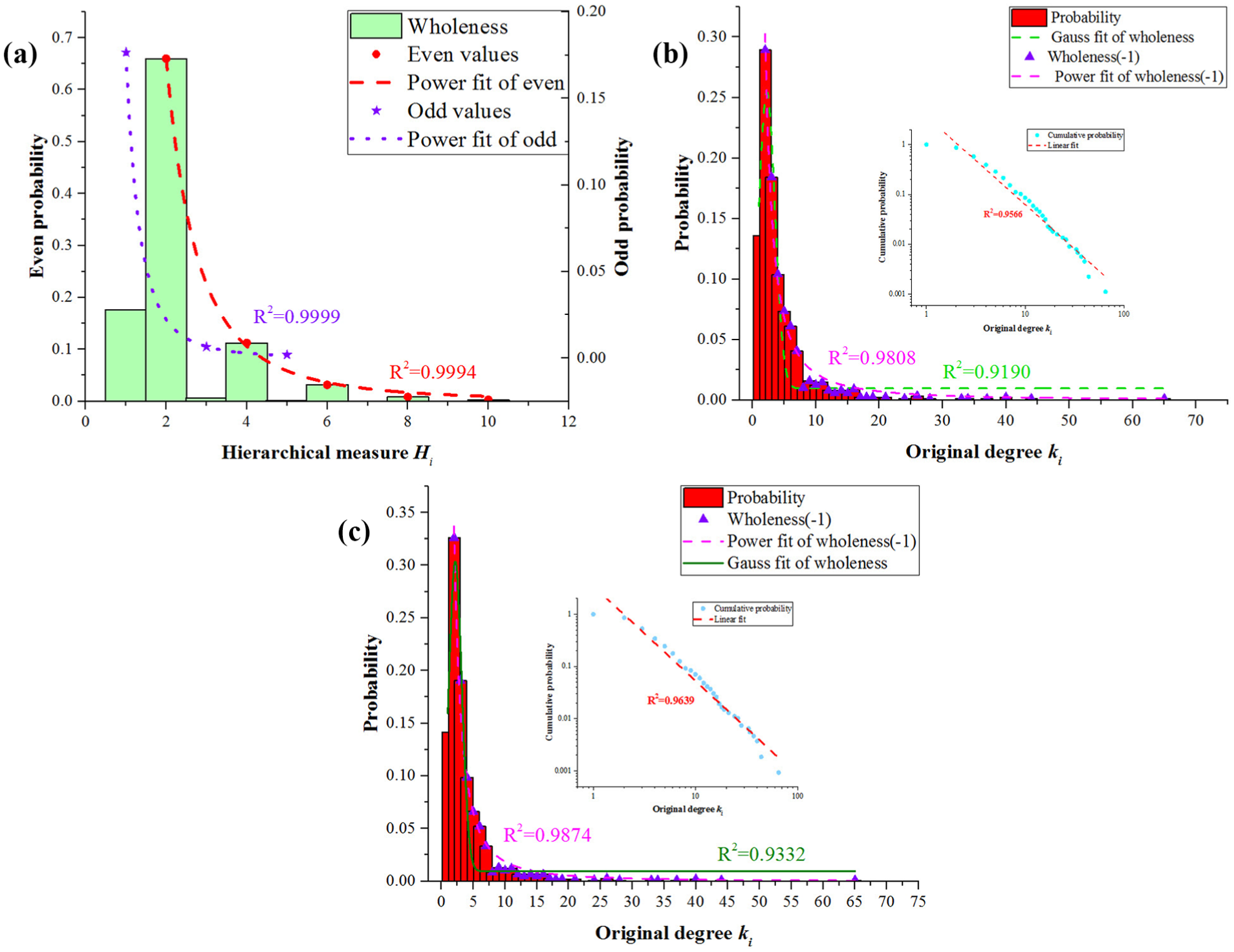
In the road network: (a) hierarchical measure distribution of all road elements, (b) original degree distribution of backbone roads whose hierarchical measure is greater than 1, and (c) original degree distribution of all roads.
Therefore, when examining the original degree distribution of the backbone network, it is consistent with the Gaussian distribution, and the fitting parameters are slightly larger than the corresponding fitting results of the overall network elements. The tail is in conformity with the power-law distribution, and its power exponent is slightly smaller than the fitting exponent of the overall network elements. It should be noted that the linear fitting results in the double logarithmic coordinates in Figure 3(b) and (c) are favorable. It is reasonable to propose the linear relationship in the double logarithmic coordinate system is the necessary factor merely for the power-law distribution of the overall network elements due to the small degree value of the urban transportation network. In the urban traffic network, the linearity distribution under the double logarithmic coordinates cannot be regarded as a proof of the power-law distribution of the overall network elements. This should be noted in the future study of the transportation system.
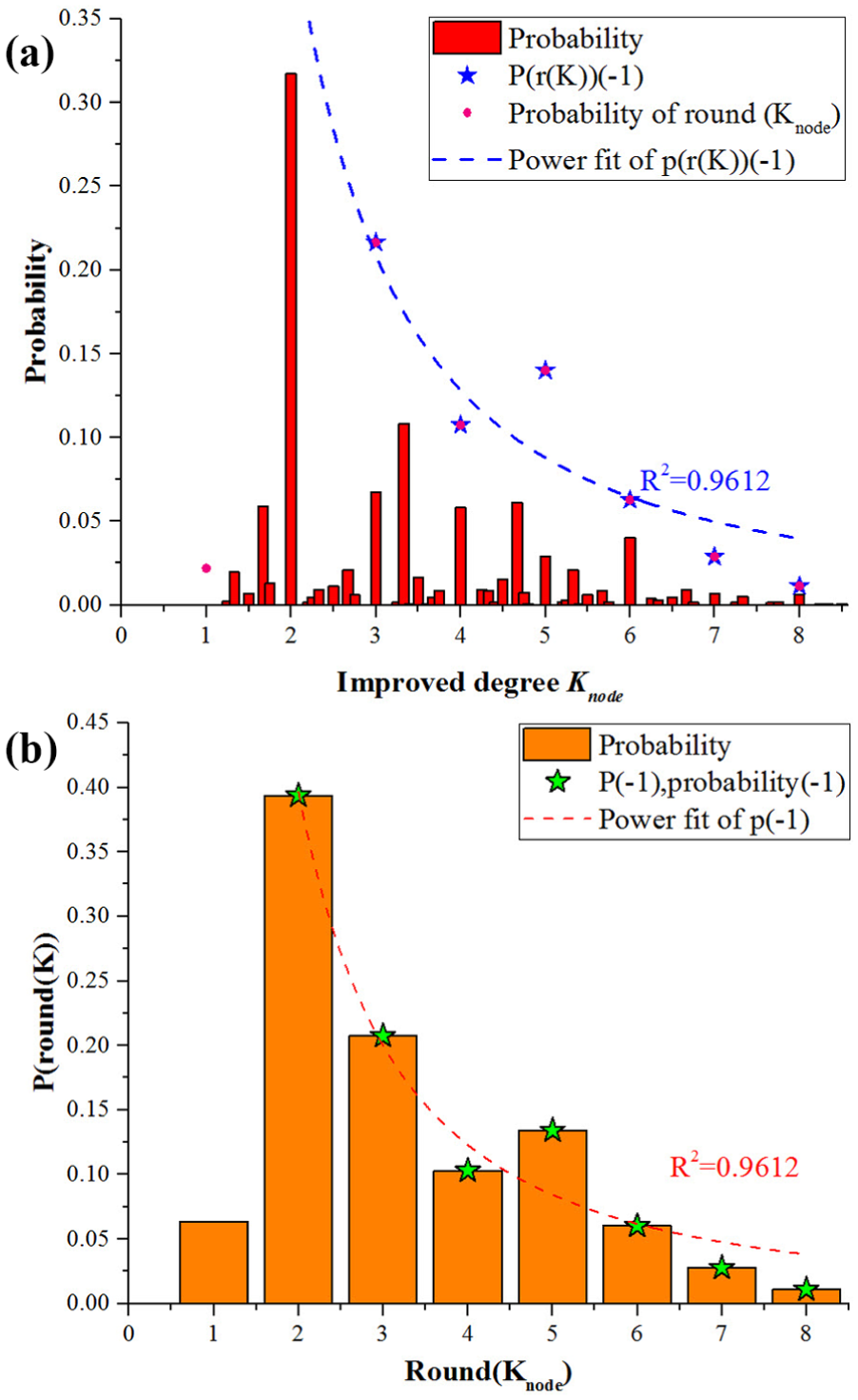
Figure 4 shows that the distribution of the backbone network is similar to the overall road network regarding the improved degree. The difference is the slightly reduced frequencies at several integer values (1, 2, 3, 4, 5, and 6). Its probability distribution peaks at each integer value, and two sides present the hierarchical level at the reference point (0.5). Then, we got the rounding estimated values. It is found that the curve of the estimated distribution of backbone road network looks more smooth, and its overall distribution is approximately by Gaussian model, with

Improved degree distributions: (a) backbone roads distributions and fits and (b) all roads distributions and fits.
The connection characteristics of each index in the urban backbone network were examined then. Since the backbone network form just excluded the roads (hierarchical measure = 1), Figure 5(a) shows the connectivity of the overall road network. When examining the traditional ANND, it is not difficult to figure out that the network is not assortative or disassortative. The hierarchical measure of the urban road element network presents the characteristic of connection segmentation. When

Connectivity characteristics of backbone roads whose hierarchical measure is greater than 1: (a) hierarchical measure; (b) original degree and hierarchical measure; and (c) improved degrees of backbone roads and all roads, where
For the relationship between hierarchical measure and original degree, the overall network elements’ original degree, their hierarchical measure, and the hierarchical measure of the nearest road elements are positively correlated. Namely the more lanes are on the road, the more adjacent roads the road relates to; meanwhile, the larger number of lanes on its adjacent roads to some extent. As for the backbone, Figure 5(b) shows the relationship between the two parameters of the backbone network in the first case. The sub-graph shows the road element network (hierarchical measure > 1), and the main graph shows some other road network (hierarchical measure > 1, frequency > 10). The characteristics of the road network (hierarchical measure > 1) are consistent with the features of the overall network. The backbone network will strengthen the characteristic to enable the positive correlation more significant. The greater the hierarchical measure is, the more roads connected. When investigating the connection features of the improved degree, it is difficult for the traditional average nearest neighborhood method to summarize the regularity. Moreover, the proposed link coefficient is focused on the comparison with the personal attribute. When
Named streets analysis
In the part, degree and connection characteristics of the backbone network within the named streets were investigated. The study included 551 named roads, which were analyzed using the proposed indicators and methods. Figure 6 shows the distributions of the original degree and improved degree of the named road network are roughly the same as the distributions of the whole road network, while the significance is slightly smaller than the latter one. The distributions of two parameters are by the Gaussian model, and the tail of the distribution is of course consistent with power-law. The overall original degree is

Degree distributions of named roads: (a) origin degree distribution and (b) improved degree distribution.
Figure 7(a) shows that the hierarchical measure of the nearest neighbor roads is linearly positive to its own hierarchical measure within the named streets, which contrasts with the overall network characteristics illustrated in Figure 5(a). Figure 7(b) indicates the relationship between two parameters of the backbone network in the second case. The sub-graph shows the road element network (hierarchical measure > 1), and the main graph shows the road network (hierarchical measure > 1, frequency > 10). Similar to the first case, the road network formed by the named roads has the same characteristics with the overall road network. The backbone network will strengthen the characteristic to enable the positive correlation more significant. When examining the connection features of the improved degree, the traditional neighborhood degree method is still difficult to draw a clear conclusion. Moreover, the link coefficient is focused on the comparison with the own attribute. When

Connectivity analysis of named streets: (a) hierarchical measure correlation, (b) correlation between original degree and hierarchical measure, and (c) improved degree correlation, where
Intersections analysis
Given the above conclusions, if excluding intersections with all one-lane connecting roads and taking the rest of intersections as the backbone intersections in the road network, the remaining number of nodes is 1321. The original degrees are still 3, 4, 5, and 6. As shown in Figure 8(a), the number of improved degree values is reduced to 51, and the reduced improved degree is 1. It still conforms to the power-law distribution when the particular intersections were removed (see Wang et al.
7
about particularity), namely
Improved degree distributions of nodes: (a) selected intersections and (b) all intersections.

Connectivity correlations of nodes: (a) selected intersections and (b) all intersections.
Conclusion
This article proposes the road network model with the purpose of facilitating resident travel and traffic management. And both the methods of network science and traffic science are applied in this model. We analyze the degree distribution of the skeletal road element network and the connection characteristics from the perspectives of roads whose hierarchical measure is greater than 1 and named streets. The fitting parameters of the first case are much closer to that of the complete network than named streets in addition to connectivity consistency. And the degree distribution obtained by the named roads in this example has a significant deviation from the whole, and the connection tendency of hierarchical measure is entirely different from the entire distribution. Meanwhile, critical point of the improved degree decreases with a rank value. It is limited to replace the overall network characteristics with results of partial network elements in this sense. Thus, the intersections crossed by the roads whose hierarchical measure is equal to one were excluded in this study. And related results of the node network are consistent with the whole.
It is an important step to study the structural characteristics of urban road networks based on the urban skeleton networks. To select the skeleton network which can reflect the network characteristics is an urgent issue needed to be resolved. The skeleton road network in this article saves the amount of work for road elements by 17.75%, and the intersection elements by 4.21%. The example with actual statistical data from Xiamen in China indicated that the structural features of the skeleton road network in former one are highly consistent with the overall network characteristics, which contributes to obtaining the data for urban road network structure research more conveniently. It is also beneficial to explore the complicated relationship between the structural characteristics of the road network and traffic functions. If we know the backbone can reflect the overall characteristics of the whole, we need merely analyze the traffic demand and traffic flow of the backbone. And then we would discover the relationship between the structure and the function of urban street networks. The conclusions drawn from the analysis of the advanced urban road network structural characteristics contribute to the development and evolution of the road network in small-medium cities. Based on the characteristics of backbone network, it is possible to assess the current network performance more efficiently and will be helpful to improve existing road network systems. More empirical analysis based on the proposed method can be conducted to summarize the universal law for the next step. Since the lane in the traffic network contains functional information and plays a major role in the dynamic behaviors, the method in this study can be used to combine the network structure index with the traffic parameters for the future work.
Footnotes
Handling Editor: Hyung Hee Cho
Declaration of conflicting interests
The author(s) declared no potential conflicts of interest with respect to the research, authorship, and/or publication of this article.
Funding
The author(s) disclosed receipt of the following financial support for the research, authorship, and/or publication of this article: The work is supported by the National Natural Science Foundation of China (grant nos 51408257, 51308249, and 51308248) and the National Key Technology Research and Development Program of the Ministry of Science and Technology of China (grant no. 2014BAG03B03).