




Abstract
Road construction is an important source of occasional urban road network traffic congestion. In this article, a new cellular automaton model is proposed to simulate road construction traffic flow in urban two-way-six-lane network systems with roundabout intersections. In the proposed model, a three-lane traffic rule is adopted to represent vehicle movements on road sections, turning lane changing and overtaking lane changing are allowed, and vehicle movements in intersection areas are determined by priority which relies on vehicle position. Simulation results show that increasing the closed lane number may lead to decline of the network speed. We also found that there is a relatively fixed influence range of road construction in different cases, and a proper proportion of vehicle bypass can improve the operation efficiency of road network when semi-closed construction.
Keywords
Introduction
Road construction is an important factor causing urban road network congestion. Developing simulation models for urban road network traffic and discovering the fundamental laws of traffic flow affected by road construction can provide significant contributions to traffic congestion mitigation and prevention. In the past few decades, various models have been proposed to simulate it. Among them, the cellular automaton (CA) model is an effective tool to simulate road construction due to its characteristics of simplicity, flexibility, and immediacy.
Since the most basic one-dimensional CA traffic model (model no. 184) was proposed by Wolfram in 1983, 1 various factors have been considered into the CA models to enhance the ability of the models in simulating the metropolitan traffic phenomena.2–18 However, most of the existing models are developed for one-way traffic systems. In practice, two-way-multi-lane roads are more commonly found in urban road networks.
In this article, a new CA model for urban two-way-six-lane network systems with roundabout intersections is proposed. In our model, vehicles on roads follow the rules of turning lane changing and overtaking lane changing. To reduce vehicle conflicts and improve traffic efficiency, the vehicles in a lane of the roundabout intersection are assumed to have priority over the vehicles that attempt to enter the lane. Three novel rules are proposed to move the vehicles in intersection areas. Simulations are carried out to investigate the effect of the closed lane number and proportion of vehicle bypass and to search the influence range of road construction.
The rest of the article is organized as follows: in section “Model,” a new CA model is proposed for urban two-way-six-lane networks. In section “Simulation results,” simulation results are presented and discussed. Finally, conclusions are drawn in section “Conclusion.”
Model
As shown in Figure 1, an urban road network with

A two-way-six-lane road network with

Diagram of the section number,
In the beginning, N cars are randomly distributed in the network. Each car is randomly assigned an origin and a destination. Beside the cells in intersections, all other cells can be taken as origins and destinations by cars. All cars are assumed to travel along the shortest path in terms of distance to their destinations. We adopt an additional distance to reflect the different impedance of each movement at intersections: 16, 10, and 4 cells for left-turning, ahead, and right-turning movements, respectively. Then, the Dijkstra algorithm can be used to generate the shortest path tree, and each car randomly selects one shortest path to finish its travel. When a vehicle arrives at its destination, it will randomly select a new destination to continue its travel. 19
The movement behavior of a car traveling through an intersection is quite different from that on a road. Hence, update rules of cars on roads and in intersection areas are separately described as follows.
Update rules of road sections
As shown in Figure 3. Let

The sketch of road section.
1. Turning lane changing
If the above four conditions are coincident, then the nth vehicle will change its lane to the adjacent lane.
2. Overtaking lane changing
If the above three conditions are coincident, then the nth vehicle will change its lane to the adjacent lane with probability
3. The longitudinal location update
Step 1. Acceleration.
Step 2. Deceleration. If
Step 3. Randomization.
Step 4. Vehicle movement.
Update rules of the vehicles in intersection areas
As shown in Figure 4, there are three types of cells related to each intersection: (a) cells in the outer side of the intersection (i.e. cells 1–24), (b) cells in the inner side of the intersection (i.e. cells 25–40), and (c) cells near the intersection (i.e. cells 41–52). Vehicles of different directions travel through an intersection with different trajectories. For example, the left-turning vehicles on
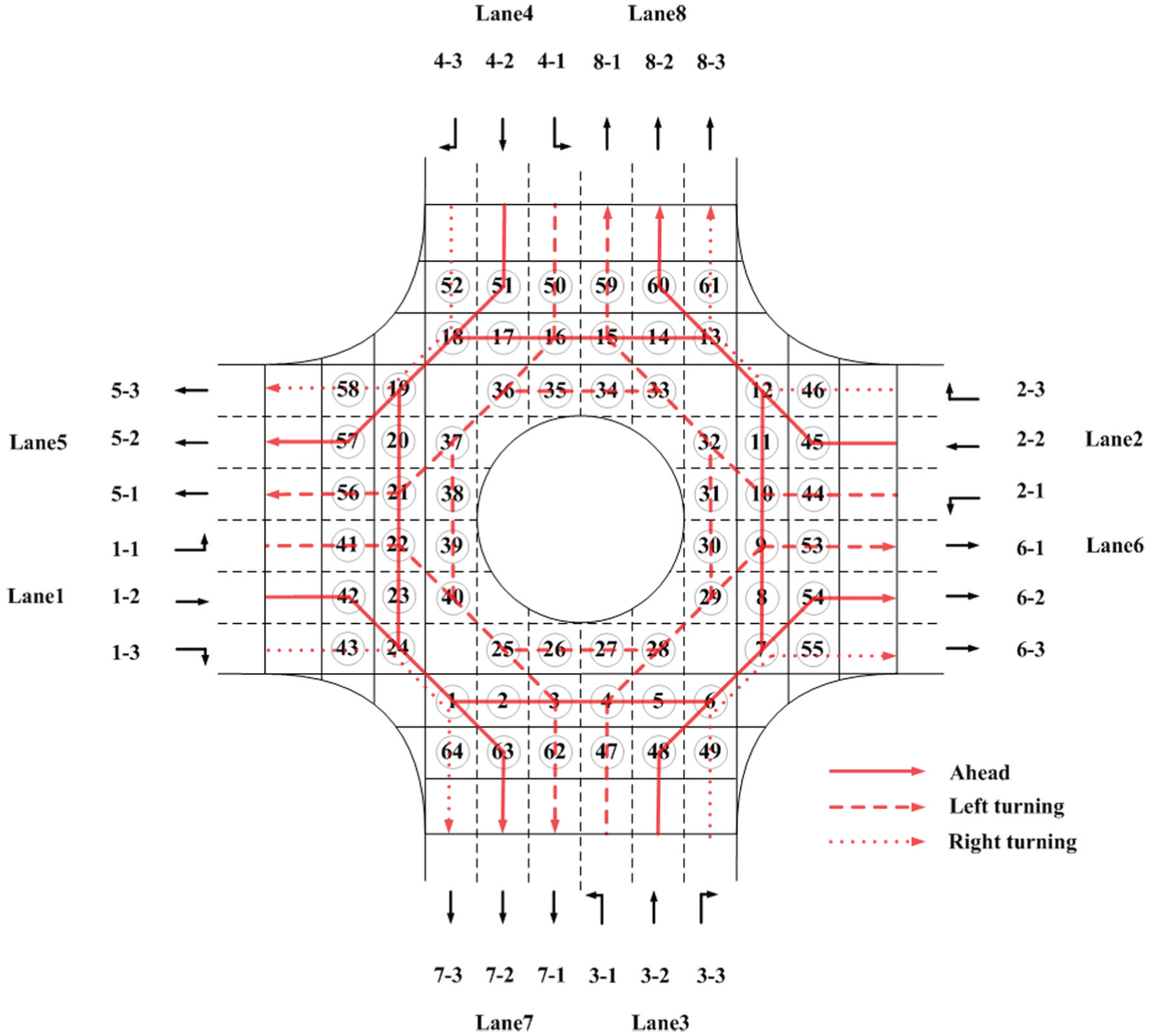
Cell representation of an intersection.
To prevent vehicle collision, we assume that the vehicles in a lane of the roundabout intersection are assumed to have priority over the vehicles that attempt to enter the lane. For example, a vehicle in the cells in the outer side of the intersection has priority over the vehicles in the cells near the intersection, a vehicle in the outer side of the intersection has priority over the vehicles trying to enter the outer side of the intersection from the inner side of the intersection, and a vehicle in the inner side of the intersection has priority over the vehicles trying to enter the inner side of the intersection from the outer side of the intersection. The following three rules will be adopted to update vehicles in intersection areas:
1. Update rules for vehicles in cells in the outer side of the intersection
When the vehicle moves alone the cells in the outer side of the intersection or leaves the intersection, if the front cell is empty, then the vehicle moves forward one cell at the end of the step; otherwise, the vehicle will hold still. When the vehicle tries to enter the cells in the inner side of the intersection, if the front cell is empty and no vehicles in the inner side of the intersection try to occupy or close to it (less than three cells), then the vehicle moves forward one cell at the end of the step; otherwise, the vehicle will hold still. This rule will be adopted for all vehicles in cells 1–24.
2. Update rules for vehicles in cells in the inner side of the intersection
When the vehicle moves alone the cells in the inner side of the intersection, if the front cell is empty, then the vehicle moves forward one cell at the end of the step; otherwise, the vehicle will hold still. When the vehicle tries to enter the cells in the outer side of the intersection, if the front cell is empty and no vehicles in the outer side of the intersection try to occupy or close to it (less than three cells), then the vehicle moves forward one cell at the end of the step; otherwise, the vehicle will hold still. This rule will be adopted for all vehicles in cells 25–40.
3. Update rules for vehicles in cells near the intersection
If the front cell is empty and no vehicles in the outer side of the intersection try to occupy or close to it (less than three cells), then the vehicle moves forward one cell at the end of the step; otherwise, the vehicle will hold still. This rule will be adopted for all vehicles in cells 41–52.
Simulation results
In this section, simulations based on the proposed CA model are carried out to investigate traffic flow affected by road construction in a two-way-six-lane road network. The network size is
The effect of the closed lane number
Let the closed lane numbers be 1, 2, and 3. Among them, 1 and 2 indicate semi-closed construction, and 3 indicates fully closed construction. The influence of the closed lane number on network traffic flow is graphically displayed in Figure 5. One can observe that the influence of the closed lane number is weak when the network density is lower than a critical density. However, the network speed is greatly influenced by the closed lane number when the network density exceeds the critical density. Finally, the influence will be weak again when the network density becomes larger. This is because lane closed causes network capacity drop. The vehicles can move freely when the network density is low, and the decline of traffic capacity is not enough to affect the traffic flow condition. When the network speed density is larger than the critical density, more closed lane number may increase the loss of traffic capacity and bring a lower network speed. When the network density is larger than a certain value, vehicles may frequently be in a state of stop-and-go due to traffic congestion, and the influence of the closed lane number probability disappears.

The effect of the closed lane number.
The influence range of road construction
Three lanes are assumed all closed, and the network density is 0.05. Construction road will be deleted from the shortest path tree when fully closed construction. Therefore, vehicles will search new shortest paths to the destination to bypass the construction road and affect several other roads. The influence range of road construction is graphically displayed in Figure 6. One can observe that the speed of eight roads such as numbers 21, 22, 23, 24, 30, 32, 33, and 41 decrease significantly. Clearly, they are the main influence range of road construction when no. 31 road is under road construction. Some traffic organization measures should be adopted to relieve the pressure of the road diversion and avoid traffic congestion.

The influence range of road construction.
The effect of proportion of vehicle bypass
Two lanes are assumed closed, and the network density is 0.05. Vehicles can choose the construction road or bypass. The effect of proportion of vehicle bypass is graphically displayed in Figure 7. The network speed has a sustainable growth with proportion of vehicle bypass, reaches its maximum value at a certain proportion of vehicle bypass, and then drops gradually. This is because some vehicles choose bypass and improve the speed when the proportion of vehicle bypass is low. However, the effect may be weak when the proportion further increases because more and more vehicles choose bypass and cannot improve speed obviously. When the proportion increases more than a certain value, the reaction will appear, and the network speed decreases along with the increase in proportion of vehicle bypass. This means that when most of the vehicles choose bypass, it may make the vehicles on the road around too concentrated and resulting in a decline of the overall network speed. When the proportion is 100% amount to fully closed construction, the network speed is the lowest. Therefore, a proper proportion of vehicle bypass can improve the operation efficiency of road network when semi-closed construction.

The influence of proportion of vehicle bypass.
Conclusion
In this article, a new CA model for urban two-way-six-lane road networks was proposed. The simulation results showed that the more closed lane number, network speed declines more under certain network density. We also found that there is a relatively fixed influence range of road construction in different cases, and a proper proportion of vehicle bypass can improve the operation efficiency of road network when semi-closed construction. In the future, we will consider congestion control for the road construction in two-way-multi-lane network systems, such as route guidance,19,20 signal control, 21 vehicle movements bans,22–24 driver assistance system, 25 and incident prevention 26 .
Footnotes
Academic Editor: Xiaobei Jiang
Declaration of conflicting interests
The author(s) declared no potential conflicts of interest with respect to the research, authorship, and/or publication of this article.
Funding
The author(s) disclosed receipt of the following financial support for the research, authorship, and/or publication of this article: This work was jointly supported by the Zhejiang Provincial Natural Science Foundation of China (LQ15E080005) and the Project of Science and Technology of the Department of Transportation of Hubei Province, China (2014-721-3-13) and the Project of Science and Technology of Jinhua, China (2015-3-027).