




Abstract
An experimental investigation is performed into the behavior of ethanol droplets impacting on a vibrating stainless steel surface. In characterizing the impact behavior, the dimensionless kinetic energy of the droplet prior to its impact on the surface is represented by the original Weber number (We). Meanwhile, the dimensionless relative impact kinetic energy of the droplet as it impacts the vibrating surface, and thus undergoes a change in its relative impact speed, is represented by the relative Weber number (Wer). Impact experiments are performed for various values of the original Weber number We and vibration frequency f. The impact behavior in each case is classified as either post-spreading deposition or crown splashing. It is shown that for a static (non-vibrating) surface, the critical Weber number for the generation of splashing is Wec = 400. Furthermore, for a given impact speed and vibration frequency, if no splashing occurs without vibration but splashing takes place after vibration, the difference between the original Weber number (We) and the critical Weber number (Wec) is proportional to the additional impact Weber number provided by the vibrating surface, that is, (Wer − Wec). For a given relative impact speed, a higher vibration frequency ƒ results in a greater relative impact distance during splashing and a larger effective impact energy. Overall, the experimental results show that the relation between We and Wer for the generation of splashing is given as
Introduction
The impact of liquid droplets on a solid surface is of practical interest in many engineering and agricultural applications. According to Rein, 1 droplets impacting on a dry solid surface may exhibit three different behaviors, namely spreading, splashing, or bouncing. Lesser and Field 2 reported that the spreading of droplets impinging on a solid surface comprises three stages, namely (1) propagation of an internal shock immediately after impact; (2) generation of spreading lamella, during which the backside drop shape remains unchanged since the spreading speed is higher than the collision speed; and (3) drop deformation into a pancake shape. To explain the observed phenomena, many researchers assumed a velocity profile in the spreading process and derived expressions for the maximal spread diameter based on a force or energy balance.3,4
To determine the effects of surface tension, a few experimental studies, such as Pasandideh-Fard et al., 5 conducted an experimental investigation into the effect of surfactant-induced surface tension on the impact behavior of water droplets on solid surfaces and found that while the surfactant had no effect on the shape of the impacted droplet, it increased the maximum spreading diameter and reduced the bouncing height. Zhang and Basaran 6 showed that an accumulation of surfactants on the impacted solid surface reduced the surface tension and increased the spreading diameter. However, an uneven surfactant distribution increased the Marangoni stress, and hence suppressed the droplet spread.
In addition to the liquid properties and droplet kinematics, the physical characteristics of the target surface, for example, its wettability, roughness, temperature, and inclination, also have a significant effect on the impact outcome. Fukai et al. 7 quantified the effect of the surface wettability on the ability of a liquid to spread in a known gaseous surrounding by means of static contact angle measurements. Ford and Furmidge 8 found that a reduced static contact angle resulted in a greater spreading diameter. Karl et al. 9 examined the spreading of liquid drops from the perspectives of dynamic energy, surface energy, and potential energy conservation, respectively. Mao et al. 10 used the static contact angle and maximum spreading diameter to predict the critical value of bouncing and verified the predicted value by means of extensive experimental data.
In the splashing of droplets on a dry surface, the liquid drops first form a thin corona ring. Fluctuations then develop around the thin film, and finally surface tension effects lead to fragmentation. The literature contains many investigations into the effects of the drop size, drop density, surface tension, drop viscosity, and impact velocity on the splashing phenomenon, such as Thoroddsen and Sakakibara, 11 Bhola and Chandra, 12 Bussmann et al., 13 and Mehdizadeh et al. 14 The authors in Mundo et al., 15 Cossali et al., 16 and Range and Feuillebois 17 investigated the effects of surface roughness on the splashing behavior of impacting droplets and proposed a critical value for splashing/deposition of K′ = WeOh−0.4, where We is the Weber number and Oh is the Ohnesorge number (defined as Oh = We1/2Re, in which Re is the Reynolds number). It was shown that K′ varied as a function of the mean roughness amplitude. Stow and Hadfield 18 investigated the asymmetric spreading of droplet films formed by droplet impact on an oblique smooth surface. Similarly, Šikalo et al. 19 studied the bouncing and deposition phenomena for droplets impinging on a smooth sloping surface. Both studies showed that when droplets impact on an inclined surface, gravitational effects cause splashing to occur around the lower side of the droplet along the inclined plane when the impact kinetic energy exceeds a certain critical value. Kang and Lee 20 investigated the dynamic behavior of water drops impacting on dry surfaces with different inclination angles and temperatures. Bussmann et al. 21 Reznik and Yarin, 22 and Lunkad et al. 23 conducted numerical simulations to investigate the capillarity effect for droplets impacting on a dry horizontal surface and the gravitational effect for droplets impacting on a dry inclined surface. Moreover, the authors in Hanchak et al. 24 Capizzano and Iuliano, 25 and Dyment 26 employed different numerical methodologies to simulate the behavior of water droplets impinging on different surfaces. Xu et al. 27 investigated the corona splash behavior for liquid droplets impacting on a smooth dry substrate. The results showed that splashing can be completely suppressed by decreasing the pressure of the surrounding gas.
In the studies above, the authors considered single liquid droplets impacting a static horizontal or inclined solid surface. To investigate impact of droplet on high-velocity moving surface (stimulation of water drop’s impacting on turbine blade), Povarov et al.28,29 utilized wheel-and-jet technology to investigate the impact behavior of a string of drops impacting vertically on a high-speed rotating disc. It was shown that droplet spreading occurred when the air flow above the disc had the form of a laminar boundary layer. Furthermore, in the event of bouncing, the droplets acquired a rotational speed as a result of the dynamic effect of the surrounding air. However, when the disc rotated at a very high speed, the droplets could not impinge directly on the surface of the disc. Chen and Wang 30 used three parameters to analyze the spreading adhesion/bouncing behavior of water droplets impacting on a solid rotating surface, namely (1) the peripheral velocity (different centrifugal acceleration), (2) a positive Webber number for positive impacts of the droplet on the surface, and (3) a Webber number associated with the relative speed of the droplet in a direction tangential to the circumferential surface. Courbin et al. 31 examined the behavior of milk drops impacting on the center of a rotating disc and found that the Weber number associated with splashing reduced as the centrifugal force increased. Zen et al. 32 investigated the influence of the gravitational effects induced by different inclination angles and surface movement velocities on the impact behavior of ethyl alcohol drops with diameters ranging from 2.32 to 2.58 mm on inclined rotating silicon wafer discs. The results showed that the critical value of the impact Weber number for the occurrence of side-splash or splash-around of the ethyl drops was approximately Wen = 120. Moreover, it was shown that while gravitational effects contributed to an instability of the downward flow of the liquid film, they enhanced the stability of the upward flow. Therefore, as the downward movement speed of the inclined surface was increased, the downward splashing behavior of the droplet changed to deposition behavior, while the upward deposition behavior changed to upward splashing. In addition, it was shown that given a sufficiently large inclination angle, the deposition area could be enlarged through an appropriate control of the surface movement speed.
The deposition/splashing behavior of droplets impacting on a vibrating solid surface is of practical interest in many engineering applications, for example, the wall vibration of engine fuel systems in operation, secondary droplet generation in fuel atomization systems or spray dyers, spray coating and cooling in vibration environments, and so on. However, the literature contains very few investigations into the related phenomena. Brothier et al. 33 investigated the behaviors of three different types of droplets (water, polyvinyl alcohol/water solution, and uranyl nitrate, diameter: 2–5 mm in every case) impacting at velocities of up to 1.7 m/s on a vibrating hot plate with a temperature of 260°C, a vibration frequency of 0–1 kHz, and an amplitude of several μm to 0.5 cm. No corona splashing was observed under the considered impact conditions. However, fingers were formed on the anterior edge of the spreading droplet as a result of the air film between the droplet and the surface and the vibration of the high-temperature plate.
The results presented in Brothier et al. 33 suggest that a positive impact velocity provides momentum for an outward spreading of the film. At the moment of impact, an upward movement of the vibrating surface provides not only a higher positive impact velocity, but also a stress which promotes an upward motion of the anterior edge of the droplet film. By contrast, a downward motion of the plate inhibits the upward movement of the anterior edge of the liquid film, and thus results in a greater thickness of the anterior edge due to inertial forces. A sufficiently large and continuous vibrating disturbance generates fingers on the anterior edge of the droplet film and leads to secondary droplet splashing. Consequently, the vibration frequency (i.e. the action time of the upward–downward motion) and the vibration amplitude (i.e. the speed of the upward–downward movement) both influence the generation of deposition/splashing after impact.
The present study explores the deposition/splashing phenomena for droplets impacting on a vibrating surface with various vibration frequencies. In order to eliminate the effects of surface roughness on the droplet impact behavior, the impact tests were performed using stainless steel reeds polished to a final surface finish of 100 nm. In addition, ethanol was used as the working fluid due to its low surface tension (approximately 0.022 N/m), and hence increased propensity to produce splashing. The experimental results are used to determine a predictive equation for the splashing phenomenon as a function of the vibration frequency. The predictive equation provides a useful practical tool for regulating the vibration frequency in such a way as to control the formation of deposition/splashing and secondary droplets during droplet impacts.
Experimental system
Figure 1 presents a schematic illustration of the experimental setup. As shown, the major items of equipment include a droplet-generating system, a position-adjustment system, an image acquisition system, and a vibrating surface system. The details of each system are described in the following.

Schematic illustration of experimental setup.
Droplet-generating system
The droplet-generating system consisted of a syringe pump designed to provide the working fluid (ethanol) at a constant flow rate of 1 mL/min and a droplet nozzle in the form of a subcutaneous hypodermic needle tube with a diameter of approximately 0.4 mm. The ethanol drop ejected from the syringe pump accumulated at the tip of the nozzle and then fell freely under its own weight until impact on the vibrating surface. Changes in the needle tube diameter and syringe pump flow rate result in droplets of a different diameter. In the present study, the droplets had a mean measured diameter of approximately 1.9 mm. To avoid the possibility of contamination effects (thereby resulting in a change in the droplet surface tension), each impact test was performed using a new bottle of ethanol.
Position-adjustment system
The position-adjustment system comprised two 3D mobile platforms supporting the droplet-generating system and vibrating surface system, respectively. In performing the experiments, the vertical distance between the droplet nozzle and the vibrating surface was adjusted in order to change the droplet impact velocity (i.e. the Weber number, We), while the horizontal position of the droplet-generating system relative to the vibrating surface was adjusted in order to change the droplet impact point.
Image acquisition system
Experimental images were captured using a Phantom V9.1 high-speed camera (1632 × 1200 pixels at 1016 frames/s) with a maximum frame speed of 153,846 frame/s and a photosensitivity of 2400/ Mono (ISO-12232 Standard). The images were captured with a minimum exposure time of 2 μs using a 500 W halogen lamp as the illumination source. The shade of the lamp was attached to a 3D mobile platform along with a vibrating reed so as to facilitate localization. During the experiments, the halogen lamp was turned on only during image shooting in order to prevent overheating of the reed.
Vibrating surface system
The vibrating surface system had the form of a stainless steel reed with dimensions of 6 cm × 2 cm × 0.1 cm (length × width × thickness). As described above, the reed was polished to a final surface finish of 100 nm in order to eliminate surface roughness effects. The ends of the reed were attached to piezoelectric characteristic plates by means of basal copper plates and screw fasteners. In performing the impact tests, the piezoelectric plates were driven by square-wave voltage signals with different amplitudes (0–12 V) and frequencies (0–2500 Hz). The waves were produced by a TG1010A wave generator and then passed through a PZD350 voltage amplifier. Figure 2(a) shows the sketch of vibrating surface positions. Figure 2(b) shows the displacement of the vibrating surface over time given a driving frequency of 2000 Hz. Note that the displacement of the vibrating surface was determined from experimental images captured at a speed of 10,000 frames/s.

(a) Sketch of vibrating surface position and (b) variation of vibrating surface position over time (t).
Measurement method and physical model
Surface vibration velocity (Vs)
The droplet impact tests were performed at vibrating surface frequencies in the range of 0–2500 Hz and a maximum amplitude of 0.08 mm. Each vibration cycle was divided uniformly into eight different time points and the position of the vibrating surface at each point was measured directly from the images captured using the high-speed camera. The measured surface positions were plotted (see the “+” symbols in Figure 2(b)) and a curve-fitting technique was then applied to determine the relation between the surface position and time (t). For the example shown in Figure 2(b), the maximum amplitude is 0.065 mm and the cycle time is 0.5 ms (i.e. the vibrating frequency is 2000 Hz). Furthermore, the time reference t = 0 is assigned to the point at which the surface is located at its highest position. From the number of shoots (n) (between the impacting point and the highest point of the surface) and the photographing frequency of the high-speed camera (f), it can be deduced that t = n/f.
Figure 2(b) shows that the position of the vibrating surface varies as a cosine function. In other words, the displacement of the surface can be written as

where L is the amplitude; f is the vibration frequency; t is the time; and the minus sign indicates that the downward direction is taken as the positive direction.
Differentiating equation (1) with respect to time, the velocity of the vibrating surface is obtained as

As described above, the experimental images were captured using a high-speed camera at a rate of 10,000 images/s. In other words, the time interval between successive images was just
Droplet impact velocity
In the experiments, the droplets fell freely under their own weight through a height h. Since the maximum amplitude of the vibration surface is relatively small compared to the drop height, the droplet velocity immediately prior to impact with the stainless steel surface can be approximated simply as

where g is the gravitational acceleration force and has a value of 9.8 m/s2. The instantaneous relative velocity of the droplet as it impacts the vibrating surface is thus obtained as

In general, three different outcomes exist for droplets impacting on a dry solid surface, namely spreading, splashing, or bouncing. According to Rein 1 and Zen et al., 32 deposition and splashing can be distinguished by the magnitude of the Weber number, which represents the competition process between the kinetic energy and surface energy of the droplet. The kinetic energy tends to deform the shape of the droplet, whereas the surface energy tries to keep the droplet geometry compact. In the present study, the Weber number of the droplet prior to impact on the stainless steel surface was derived in terms of its falling velocity (equation (3)) as follows

where ρ is the droplet density, d is the droplet diameter, and σ is the droplet surface tension.
In order to quantify the threshold for splashing of the ethanol droplets on the vibrating surface, the following relative Weber number (Wer) was also derived

where
Experimental method
Experiments were performed to investigate the effects of the impact Weber number and vibration frequency on the post-spreading deposition and post-spreading splashing of the droplet. The working temperature was set at 25°C. Five vibration frequencies were considered, namely 0, 1250, 1560, 2000, and 2500 Hz. For each vibration frequency, the effect of the relative droplet impact velocity on the impact behavior was investigated by varying the impacting point. Finally, the experimental results were used to determine a predictive equation for the splashing phenomenon as a function of the vibration frequency.
The experimental images were captured at a rate of 10,000 images/s. Consequently, the interval between successive images was equal to just
Experimental results and discussion
Figure 3 presents a sequence of experimental images showing the impact of an ethanol drop on the downward-moving stainless steel surface at a velocity of 2.3 m/s (We = 400, Wer = 286). From Figure 3, it can be seen that the drop hits the surface and spreads a liquid sheet and then deposits on the surface (i.e. t = 0.25–0.5 ms). Note that the surface has a vibration frequency of 2000 Hz and an amplitude of 0.08 mm. Since the surface is moving in the downward direction at the moment of impact, the instantaneous relative velocity of the droplet impacting on the vibrating surface reduces. Deposition happens in low-energy impacts or impacts with a lower relative Weber number. Consequently, no crown splashing occurs. However, fingers are generated after spreading. Figure 4 shows the impact of an ethanol droplet on an upward-moving stainless steel surface at a velocity of 2.3 m/s (We = 400, Wer = 533). Since the surface is moving in the upward direction at the moment of impact, the instantaneous relative velocity of the droplet impacting on the vibrating surface increases. The high relative velocity stretches the drop into a thinner but longer sheet. If the elongation is sufficient, the instability of the disc edge increases to encourage the occurrence of splashing (i.e. t = 0.25–0.5 ms). Consequently, splashing occurs in addition to the fingers generated after spreading. Moreover, it can be seen that the ethanol drop broke into a lot of smaller drops both in Figures 3 and 4 at t = 5 ms. This phenomenon shows the completion of impact and then surface vibration dominates.

Photographic images showing impact of ethyl alcohol droplet on downward-moving stainless steel surface with velocity of 2.3 m/s (post-spreading deposition, f = 2000 Hz, We = 400, Wer = 286).

Photographic images showing impact of ethyl alcohol droplet on upward-moving stainless steel surface with velocity of 2.3 m/s (splashing, f = 2000 Hz, We = 400, Wer = 533).
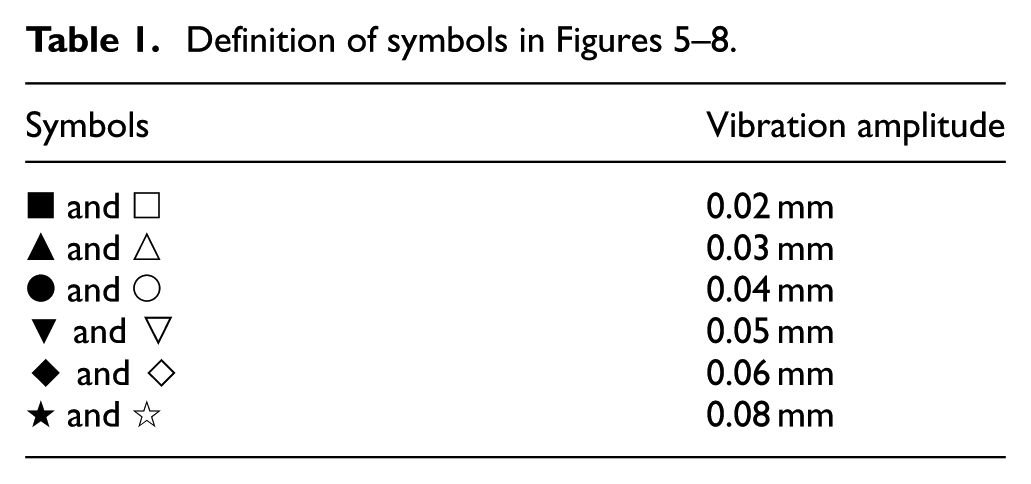
In a series of preliminary experiments using a static surface (i.e. no vibration), the critical Weber number for splashing generation was found to be Wec = 400. This value was subsequently taken as a benchmark in exploring the impact behavior (i.e. post-spreading deposition or crown splashing) of the ethanol droplets given different values of the surface vibration frequency. Figures 5–8 present the experimental results obtained for the ethanol droplet impact behavior given original impact Weber numbers in the range of We = 300–550 and surface vibration frequencies of 1250, 1560, 2000, and 2500 Hz, respectively. Note that the droplet diameter is 1.9 ± 0.1 mm in every case and the vibration amplitude ranges from 0 to 0.08 mm. Note also that the solid symbols (e.g. ■, ●, ▲) represent post-spreading deposition, while the hollow symbols (e.g. □, ◯, △) represent post-spreading splashing. (The exact definitions of each symbol used in the four figures are indicated in Table 1.) Taking the critical splashing Weber number of Wec = 400 for a static surface as a benchmark, it is seen that for a droplet with an original impact Weber number We greater than 400, the value of Wer for splashing generation reduces as We increases. Conversely, for a droplet with an original impact Weber number We less than 400, the value of Wer associated with the generation of splashing increases as We decreases.

Deposition/splashing impact phenomena for original impact Weber number We and corresponding relative impact Weber number Wer given vibration frequency of 1250 Hz.

Deposition/splashing impact phenomena for original impact Weber number We and corresponding relative impact Weber number Wer given vibration frequency of 1560 Hz.

Deposition/splashing impact phenomena for original impact Weber number We and corresponding relative impact Weber number Wer given vibration frequency of 2000 Hz.

Deposition/splashing impact phenomena for original impact Weber number We and corresponding relative impact Weber number Wer given vibration frequency of 2500 Hz.
In Figures 5–8, the boundaries between the solid and hollow symbols (i.e. between the deposition and splashing domains) have a linear characteristic in every case. Thus, the following relation intuitively holds

Equation (6) suggests that in the impact of droplets on a vibrating surface, the original impact Weber number We does not always dominate during the acting time of splashing. For example, in the case of
Regarding the influence of the vibration frequency, the formation of splashing arising from droplet impact on the surface is completed within a single vibration cycle (approximately 0.5 ms, as shown in Figure 2). Therefore, the effective Weber number of the droplet impact is associated with the surface vibration frequency f. For a given relative Weber number, Wer, the relative impact distance and effective impact Weber number both increase as the vibration frequency increases. Figures 5–8 indicate that the slope of the splashing critical line increases with increasing f, that is,
In Figure 5, corresponding to a vibration frequency of ƒ = 1250 Hz, the slope of the splashing critical line is equal to −0.757. In other words, the splashing critical line for ƒ = 1250 Hz can be predicted as

Similarly, in Figure 6, corresponding to a vibration frequency of ƒ = 1560 Hz, the splashing critical line has a slope of −1.15. In other words, the splashing critical line for ƒ = 1560 Hz can be predicted as

In Figure 7, the splashing critical line has a slope of −2.22. Thus, for a vibration frequency of f = 2000 Hz, the splashing critical line can be predicted as

Finally, in Figure 8, corresponding to a vibration frequency of ƒ = 2500 Hz, the slope of the splashing critical line is −6.25. Consequently, the splashing critical line can be predicted as

Based on the four relational expressions given in equations (7)–(10), and the condition that “We = Wec when f = 0,” the relation between We and Wer for predicting the generation of splashing can be obtained via curve-fitting as

for
From equation (4), it is known that the instantaneous relative velocity depends on the impact position and is difficult to control. However, since

The corresponding maximum relative Weber number can also be derived as

Substituting equation (13) into equation (11), a minimum We for inducing splashing can be derived as

Equation (14) represents that if the Weber number of the droplet (i.e. calculate from equations (3) and (5a)) lower than the corresponding Wemin (i.e. calculate from equation (14)), splashing will never occur. In other words, for given the vibration frequency f and amplitude L, engineers may use a Weber which lowers than the corresponding Wemin to ensure that splashing will not occur.
Conclusion
This study has performed an experimental investigation into the formation mechanisms of deposition/splashing during the impact of ethyl alcohol droplets on a vibrating surface. The study has focused particularly on the effects of the Weber number of the droplet impact and the frequency of the vibrating surface on the impact behavior of the droplet. The experimental results support the following main conclusions:
For a static surface, the critical Weber number for the generation of splashing is Wec = 400.
For a vibrating surface, the difference between the original Weber number and the critical Weber number, that is, (Wec − We), is proportional to the additional relative impact Weber number provided by the surface vibration, that is, (Wer − Wec).
For a given relative impact velocity, the relative impact distance and effective impact energy both increase as the vibration frequency f increases.
Under the surface temperatures at 25°C and the surrounding pressure at atmospheric pressure, the generation of splashing can be predicted as a function of the vibration frequency as follows:
For a droplet with a Weber number which lowers than the corresponding Wemin, splashing will never occur.
Footnotes
Appendix 1
Handling Editor: Xiao-Jun Yang
Declaration of conflicting interests
The author(s) declared no potential conflicts of interest with respect to the research, authorship, and/or publication of this article.
Funding
The author(s) disclosed receipt of the following financial support for the research, authorship, and/or publication of this article: This study was financially supported by the Ministry of Science and Technology (MOST) of Taiwan under grant number MOST 103-2221-E-415-007.