




Abstract
Droplet impact on a flexible substrate is a prevalent phenomenon in nature and various advanced technologies such as soft bio-printing, tissue engineering, smart biomaterials and flexible electronics. Recent rapid advancement in new functional surfaces, ultra-high-speed imaging, nanotechnology, deep learning, advanced computational strength and the relation between fluid dynamics and interfacial science have intensified the physical understanding of droplet impact on soft materials. Once a droplets impacts on a solid surface, it deposits, spreads, rebounds or splashes. Given the importance of the droplet impact onto soft substrates in biotechnology, medicine and advanced flexible electronics, a deep physical understanding of such complex phenomenon is vital. This review initially presents the liquid-solid interaction physics and relevant interfacial science. Next, this review discusses the physics of droplet impact on soft materials with different physical and interfacial characteristics. Moreover, this review presents advancements in droplet impact on elastic materials relevant to new technologies such as soft electronics, elastic smart biomaterials, tissue engineering and the fight against COVID-19 pandemic. Finally, this review lays out future research directions related to current problems in such complex physical phenomenon.
Keywords
Introduction
Droplet impact is a ubiquitous physical event in various natural and industrial processes. The examples include rain drops falling on insect wings, splashing of pesticide on plant leaves, coffee stain, food industry and inkjet printing.1–19 Physics of droplet-substrate interaction has been an attractive field of science in various technologies including healthcare, aerospace, electronics, coatings, printings and materials science.20–99
Previous studies about droplet impact on rigid substrates demonstrated following physical events: deposit (adhesion), breakup (fragmentation), prompt splash, corona splash, partial bounce and complete bounce as illustrated in Figure 1.5,16,17,54,100–108 However, the physical process of a droplet impact on an elastic material is much more challenging due to interplay between the material elasticity and the droplet impact mechanism. With respect to the influence of a substrate on the droplet impact onto soft materials, in addition to substrate roughness and substrate chemistry, the mechanical properties of the substrate including material stiffness and elasticity will play important roles in the complex physical process.52,109–132 A soft material exhibits the Young’s modulus of elasticity ranging in the order of magnitude of 1000 Pa–1 MPa. Therefore, soft materials are classified as elastic and flexible materials. 133
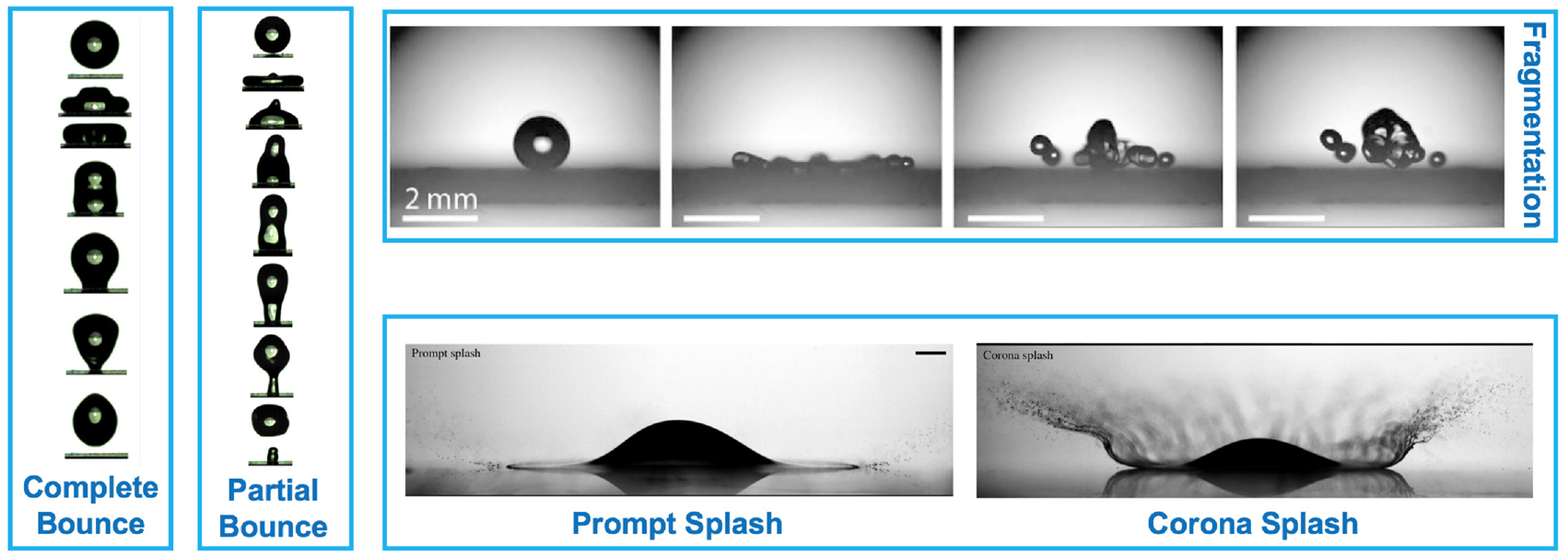
Physical events during droplet impact on a rigid substrate.54,106,107 Reprinted from The Journal of Fluid Mechanics, 892, Burzynski, D. A., Roisman, I. V., and Bansmer, S. E. ‘On the splashing of high-speed drops impacting a dry surface’, A2, Copyright (2020), with permission from Cambridge University Press. Reprinted from Scientific Reports, 6, Weisensee, P. B., Tian, J., Miljkovic, N., King, W. P. ‘Water droplet impact on elastic superhydrophobic surfaces’, 30328, Copyright (2016), with permission of Springer Nature. Reprinted from Langmuir, 33, Malla, L. K., Patil, N. D., Bhardwaj, R., and Neild, A. ‘Droplet bouncing and breakup during impact on a microgrooved surface’, 9620–9631, Copyright (2017), with permission of American Chemical Society.
When a droplet gets into contact with a substrate, a three phase (solid-liquid-air) contact line forms, as demonstrated in Figure 2. This physical event is called droplet spreading. This happens when the contact line advances on the substrate as a result of the competition between adhesion and cohesion forces at the three-phase contact line.19,50–53,55,56,70–72,100,108,132,134–160 The adhesion force leads to the advancement the droplet on the substrate while the cohesion force resists the droplet advancement on the substrate.
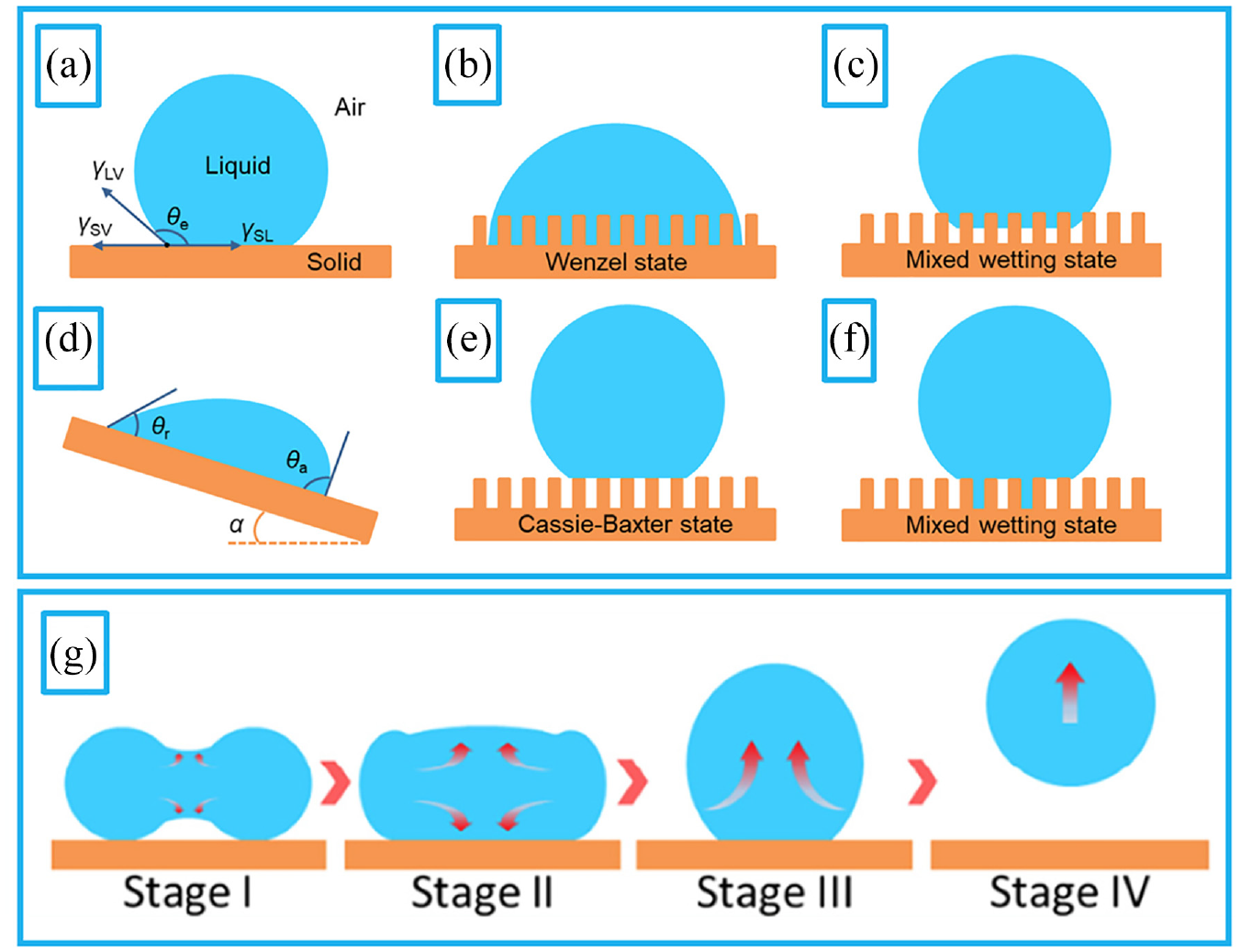
Droplet shape during contact with a substrate. 72 (a) Droplet on a horizontal flat substrate. (b) Droplet on a rough substrate under Wenzel wetting mode. (c) Droplet on a rough substrate under a mixed wetting state. (d) Droplet on a smooth tilted substrate. (e) Droplet on a rough substrate under Cassie-Baxter wetting mode. (f) Droplet on a rough substrate under a mixed wetting state. (g) Mechanism of coalescence-induced droplet jumping process. Reprinted from Advances in Colloid and Interface Science, 305, Wang, X., Xu, B., Chen, Z., Col, D. D., Li, D., Zhang, L., Mou, X., Liu, Q., Yang, Y., and Cao, Q. ‘Review of droplet dynamics and dropwise condensation enhancement: theory, experiments and applications’, 102684, Copyright (2022), with permission from Elsevier.
Once the droplet impact the substrate, a contact angle is at the contact line which determines the wettability of the substrate. The contact angle is the result of the balance between interfacial tensions. The static (equilibrium) contact angle,

in which
The droplet motion on an inclined substrate, with inclination angle (
For droplet impact on rough substrates, three well-known models were proposed to show the droplet conformation on the rough materials, as shown in Figure 2. These models are Wenzel, Cassie-Baxter, and mixed wetting state.72,162–165
Wenzel demonstrated the droplet shape on rough and orderly patterned substrates. 163 He concluded that presence of roughness on a substrate enhances the solid-liquid contact without any air pockets between them, with the apparent contact angle, represented by equation (2):

Cassie and Baxter164,165 showed that air pockets present between a droplet and a substrate. The Cassie-Baxter wetting model is evaluated by equation (3):

A droplet might exhibit a mixture of two wetting conformations: portion of the droplet in contact with the substrate roughness and the rest is placed above the air pockets, as demonstrated in Figure 2(c) and (f).200–202 The contact angle for the mixed wetting mode is expressed by (4):

in which
When two or more droplets become close to each other, they merge (coalesce). This phenomenon is controlled by imbalance of a local pressure in which droplet surface energy converts to viscous dissipation and kinetic energy. As a result of coalescence of the droplets, droplet jumping occurs.68,69,72,154,160,171–175,203–227 Coalescence-induced droplet jumping process is demonstrated in Figure 2(g).
Droplet impact on soft materials presents a significant interest in current technologies including advanced functional materials, flexible printed electronics, generation of smart materials, tissue engineering, smart biomaterials, functional organs, development of biosensors, fabrication of nano-materials, fight against the COVID-19 pandemic, three-dimensional (3D) printing, bio-printing, nano-printing, energy performance, and high resolution additive manufacturing in biomedicine. Therefore, it is vital to focus significantly on the physics of droplet impact on soft materials. This review presents a summary of studies on the physics of droplet impact on flexible materials.
In the following sections, some applications of the droplet impact on soft materials are presented. Next, forces that are responsible in the physics of droplet impact on a substrate are discussed and pertinent non-dimensional parameters are introduced. After that, a summary of previous studies of the droplet impact on flexible materials are discussed in detail. Furthermore, future perspectives for extending the knowledge of this complex physical process are presented.
Applications of droplet impact on soft materials
Droplet impact on soft materials shows a great interest in bioprinting, fabrication of smart biomaterials, production of flexible printed electronics and fight against COVID-19 pandemic.228–233 In this section, the role of droplet impact on soft materials in these leading-edge advanced technologies are presented in detail.
Coating and printing
Among numerous printing techniques, printing droplets on soft viscoelastic materials has gained a tremendous attention in current fast growing technologies including flexible printed electronics, production of advanced functional materials, soft biomaterials and smart materials, as illustrated in Figures 3 and 4.228,234–237 The droplets might contain biological solutions, biopolymers and electronic conducting solutions. Recent study by Modak et al. [2020] has illustrated printing droplets, containing conducting solutions (silver inks) and polymers, on to soft tapes to produce advanced flexible electronic materials. 228 Figure 3 shows the ‘cavity-collapse-driven single-microdroplet ejection’ technique to impact the droplets onto a superhydrophobic groove by the force balance between the dynamic pressure of the impacting droplet and the breakthrough pressure of the groove. 228
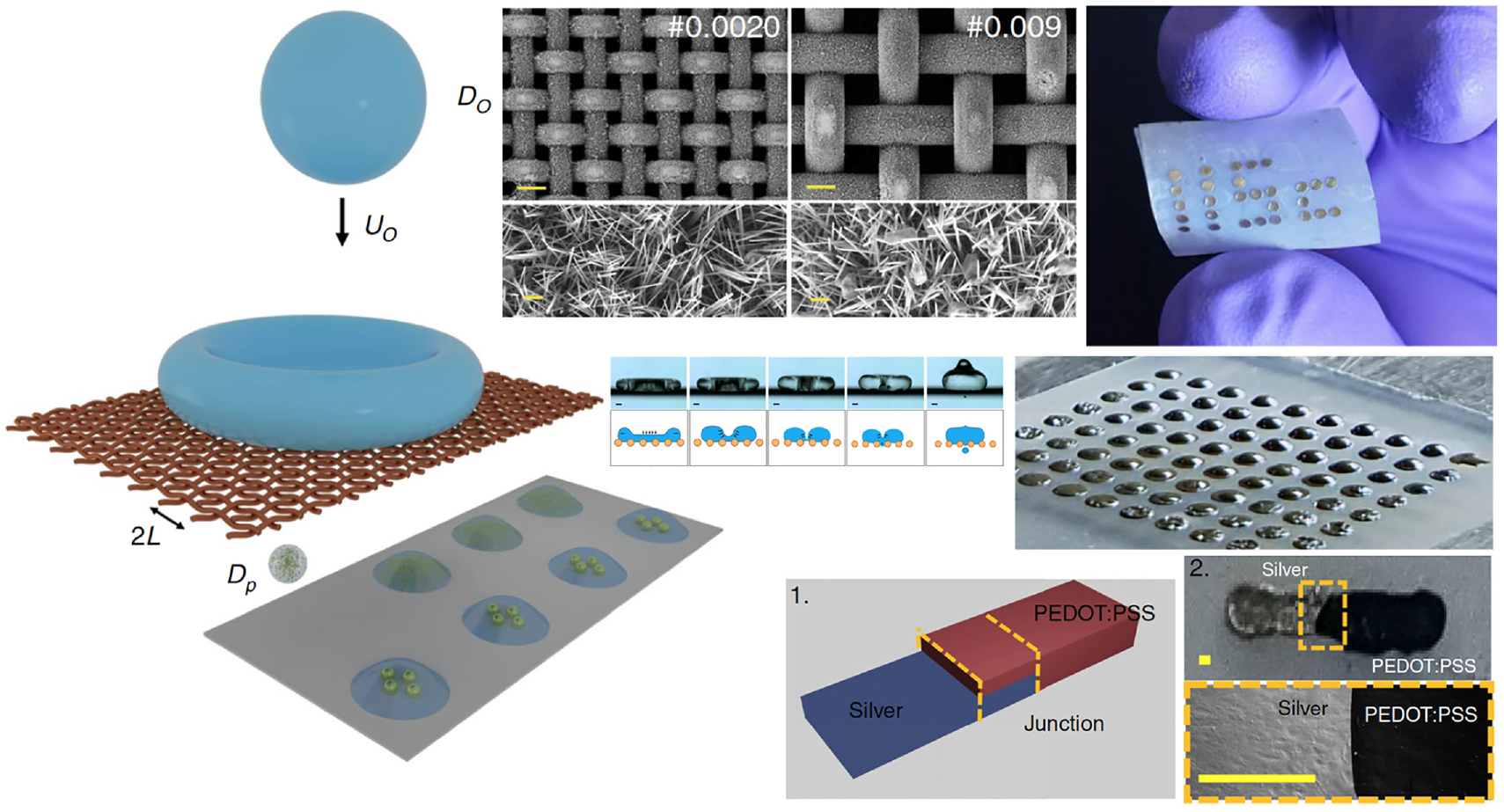
Droplets, containing electrically conducting solutions such as silver ink, impacting onto soft viscoelastic materials for manufacturing flexible printed electronics products. 228 Reprinted from Nature Communications, 11, Modak, C. D., Kumar, A., Tripathy, A., and Sen, P. ‘Drop impact printing’, 4327, Copyright (2020), with permission of Springe Nature.

Bioprinting: printing of droplets containing biological samples including biological cell-based solutions onto hydrophobic Teflon materials for manufacturing three-dimensional biopolymers. 228 Reprinted from Nature Communications, 11, Modak, C. D., Kumar, A., Tripathy, A., and Sen, P. ‘Drop impact printing’, 4327, Copyright (2020), with permission of Springe Nature.
Moreover, droplet impact on flexible materials has shown a great influence in the area of 3D bioprinting for advancement in the field of biomedicine (Figure 4). Figure 4 illustrates the biological droplet, DMEM (Dulbecco’s Modified Eagle Medium), impacting on a Teflon coated surface. After drying stage, the DMEM droplet became hydrophilic and the rest of the Teflon-coated substrate maintained its hydrophobicity. This creates a wettability gradient on the surface with the biological sample for the purpose of cell-culture-based researches. Three-dimensional bioprinting covers various biomedical purposes including printing droplets containing DNA molecules, biological cells and proteins onto soft materials. Three-dimensional bioprinting is a leading-edge technology in the area of tissue engineering, production of 3D smart biomaterials, biosensor manufacturing, stem cell research, fabrication of 3D functional organs and gene expression analyses.
Biotechnology and healthcare
COVID-19 pandemic largely caused loss of millions of lives worldwide by transmission of the droplets containing SARS-CoV-2 in the community. 238 The common mode of contracting the virus was realized to be by spread of the aerosol-based SARS-CoV-2-laden respiratory droplets from infected individuals through sneezing, coughing and exhaling. 239 Face masks were shown to prevent its spread in the society.240,241
Therefore, the physical understanding of droplet impact on soft face masks and the adhesion/deposition of the impacting respiratory SARS-CoV-2-loaded droplets onto the soft superhydrophobic face masks are vital.238–240,242–248 Moreover, fight against the COVID-19 highlighted the lack of comprehensive knowledge pertinent to the interaction of the respiratory droplets with individual skin and various surfaces such as the personal protective equipment including soft superhydrophobic face masks to intensify their efficacy (Figure 5).239,240,248
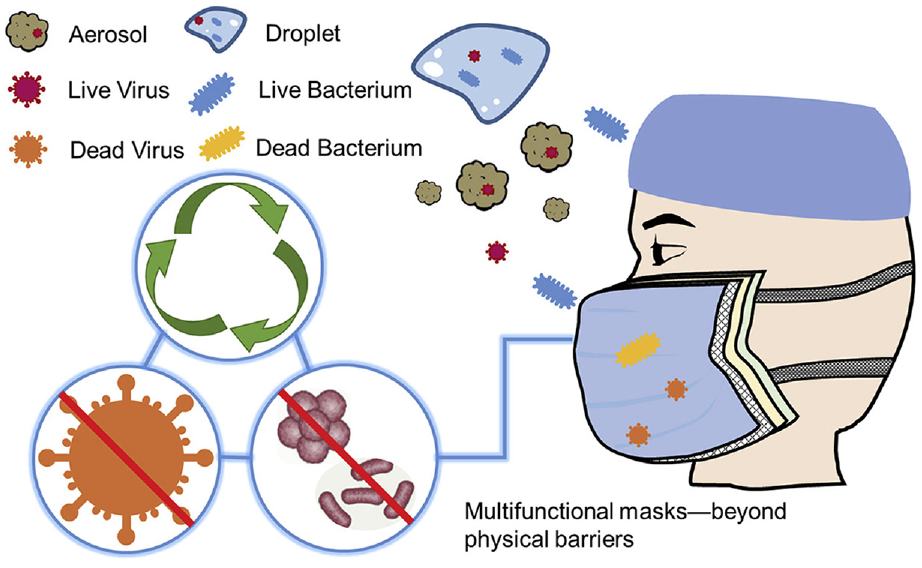
Role of droplet impact onto soft materials in study of aerosol-laden, SARS-CoV-2-containing respiratory droplets impacting onto soft superhydrophobic face masks for fight against COVID-19 pandemic. 249 Reprinted from Current Opinion in Colloid and Interface Science, 52, Liao, M., Liu, H., Wang, X., Hu, X., Huang, Y., Liu, X., Brenan, K., Mecha, J., Nirmalan, M., and Lu, J. R. ‘A technical review of face mask wearing in preventing respiratory COVID-19 transmission’, 101417, Copyright (2021), with permission of Elsevier.
Forces and non-dimensional parameters in physics of droplet impact on a substrate
When a droplet becomes in contact with a substrate, the balance of physical forces and external forces, such as electric and magnetic fields, control the corresponding interfacial physics. The governing physical forces are interfacial tensions, gravity and viscosity.17,55–57,124,148,204,211,221,250–276 Figure 6 illustrates the stationary condition of a droplet on a soft (flexible) substrate with interfacial tensions acting along the interfaces due to deformation of the soft substrate via impact of the droplet.

Schematics of droplet onto a soft solid surface and the interfacial tensions along the interfaces.
Viscosity resists the droplet motion on a substrate which causes the viscous dissipation. Interfacial tensions induce the droplet stiffness during contact with the material. Gravity affects the droplet puddling which might be negligible as the droplet diameter is less than the capillary length (
The physical forces characterize the droplet impact physics by various non-dimensional parameters: the Reynolds number (
Droplet impact physics is generally described by the Reynolds number (ratio of inertia to viscous effects) and the Weber number (ratio of inertia to capillary effects), as shown by equations (5) and (6):


in which

The capillary number defines the relative significance of viscous and capillary forces (equation (8)):

In the case of non-negligible effect of the gas phase, it is common to apply the Stokes number to show the role of the gas phase for the lubrication layer under the droplet before impact. The Stokes number denotes the role of gas viscosity in the droplet impact physics, as formulated by equation (9):

in which


For the case of elastic droplets, three non-dimensional parameters are normally used to show the role of elasticity on the droplet impact physics: the Weissenberg number (
Additional non-dimensional numbers might be introduced in the droplet impact physics due to the external forces (electric filed, magnetic field, vibration, wind and obstacles), substrate roughness, substrate chemistry and mechanical properties of the substrate.17,258,259
Research in droplet impact physics onto soft flexible materials progressed remarkably since last couple of decades when astonishing high-speed imaging capabilities and power of computational fluid dynamics enabled clarifying the rapid physical event.68,69,278–280 Several physical parameters such as force, drag, pressure and shear stress, droplet shape, air cushioning and many more pertinent to the physics of droplet impact on smooth soft materials were investigated through experimental, computational and theoretical efforts.68,69,280
In the physics of droplet impact on flexible substrates, besides roughness and chemistry of a substrate, the mechanical properties of the substrate including elasticity and stiffness are vita.281–284 Material deformation by droplet impact has a key role in numerous parameters in interfacial science and technology including contact angle, contact angle hysteresis, adhesion, condensation, frost growth and evaporation. In following sections droplet impact physics on smooth and rough soft materials are discussed.
Droplet impact on soft smooth substrates
There were various efforts on the droplet impact physics on smooth soft substrates that deform due to the capillary effect. It was reported that surface deformation is reversely related to substrate shear modulus. 281 Chen et al. experimentally studied impact physics of water droplets on soft viscoelastic hydrophobic substrates for a broad range of the Weber numbers by determining the physical interactions between the droplet and the soft substrate. 281
At the small Weber number, the droplet bounces from the soft material while at the larger Weber numbers, the droplet spreads and deposits on the soft material. 281 At the moderate Weber number, air bubbles entrap inside the droplet during deposition on soft material. 281 Similar mechanism was observed for droplet impact on rigid substrates. 281
At the large Weber numbers, droplet does not bounce from the soft viscoelastic materials. In comparison, partial bouncing of the droplet from rigid materials were observed. Similarly, an elastic droplet rebounds from a superhydrophobic rigid material. 281 The elasticity of a soft material does not affect on the dynamics of droplet spreading after its impact on the soft material. 281 However, mechanical vibration of the droplet after impact on a flexible viscoelastic material is governed by wettability of the soft material. 281
Lee et al. studied the physics of water droplet impact on smooth bitumen materials with unique characteristics of being rigid and flexible viscoelastic. They showed the dynamic stick-slip feature of the droplet on the soft deformable material. 285 Spreading and dewetting dynamics of a water droplet after impact on a rigid material and a deformable material were compared for different impact speeds. 285 Different droplet impact mechanisms including spreading/deposition, partial rebound and complete rebound were considered at different impact speeds. 285 The water droplet impact/wetting has a classical quasi-static predictable condition on a rigid material. In comparison, the water droplet impact/wetting behaviour is a dynamic un-predictable condition on a deformable viscoelastic material due to formation of wetting ridges. 285
Langley et al. investigated the role of the elasticity of soft substrates on formation of air layer and air bubbles under the droplet at the onset of impact on the elastic materials by an ultra-fast imaging technique (Figure 7(a) and (b)). 286 Figure 7 demonstrates the images of the air entrapment dynamics after impact of an ethanol droplet on a glass substrate in comparison with the ethanol droplet impact on a soft (flexible) silicone substrate. The elasticity of a soft material delays compressibility of air layer, formed under the droplet after impact. Material elasticity induces generation of thicker air films as compared to the air films formed under the droplet after impact on the rigid materials. 286

(a) Ultra-rapid interferometry bottom view images of a water droplet impacting on a flexible viscoelastic silicone surface: The pictures show gliding stages of water droplet after impact onto soft silicone material and the gliding area in each image is shown by a red solid line. 286 (b) Ultra-fast interferometry imaging to compare air entrapment in terms of its size after impact onto a rigid and a soft material: bottom view images of an ethanol impacting on a glass surface (left) and a soft elastic silicone surface (right) with the air rings entrapped inside the droplet; along with the plots under each image to illustrate the profile of the half of the entrapped air disc ring evaluated along the red line shown in each image. 286 Reprinted from Soft Matter, 16, Langley, K. R., Castrejón-Pita, A. A., and Thoroddsen S. T. ‘Droplet impacts onto soft solids entrap more air’, 5702, Copyright (2020), with permission of Royal Society of Chemistry.
Chen and Bertola studied the physics of a water droplet impact on a curved soft elastic material by a high-speed imaging considering different material elasticity and curvatures. 287 Moreover, their observations were compared with their simulations over a broad range of the impact Weber numbers. It was shown that increase in the elastic material curvature induces more droplet receding from the soft material. 287 When a droplet impacts on an elastic curved material, the dynamic contact angle depends on three parameters: material curvature, material elasticity and the impact Weber number. 287 After a droplet impacts on an elastic curved or flat substrate, viscous energy dissipation happens due to deformation of the soft material after droplet impact.
Poulain and Carlson analytically studied the coupled interactions between the droplet and the substrate coated with a thin soft material containing one of the following: viscous film, elastic compressible film and an elastic sheet protected by a viscous layer. 288 Their results were compared with their simulations. They showed that the droplet impact dynamics and droplet configuration depend on the nature of the soft material.
Recently, there has been a great attention on application of elastohydrodynamic lubrication (soft lubrication) for a broad range of systems such as stereolithography and biological adhesion.171,189,289–292 In this field of technology, experimental efforts showed that droplet impact dynamics on a soft material is governed by the elasticity of the soft material.281,286,293–295 Similarly, it was reported that the droplet impact physics is effected by the mechanical deformation of the soft material via absorbing part of energy or due to the contact line dynamics.296,297 Table 1 lists various studies that have been conducted on physics of droplet impact onto soft flexible solid materials.
Summary of researches on droplet impact onto soft smooth substrates.

Droplet impact on soft rough substrates
Weisensee et al. showed that the material elasticity affects on the physics of droplet impact on a soft rough material. 107 Figure 8 shows the physics of droplet impact dynamics onto a rigid superhydrophobic and an elastic flexible superhydrophobic surface at very large impact velocities, 1.58 and 1.57 m/s, respectively. 107 As shown in Figure 8, droplet impact onto a rigid superhydrophobic surface causes the droplet breakup and splashing while after droplet impact onto an elastic superhydrophobic surface, the substrate vibrates and the droplet lifts-off in a pancake geometry. 107 The time interval over which a water droplet is in contact with an elastic superhydrophobic substrate is half of the time interval a water droplet is in contact with a rigid superhydrophobic substrate (Figure 8).

High-speed visualization of water droplet impact on a rigid (top) and an elastic (bottom) superhydrophobic surface. 107 Reprinted from Scientific Reports, 6, Weisensee, P. B., Tian, J., Miljkovic, N., King, W. P. ‘Water droplet impact on elastic superhydrophobic surfaces’, 30328, Copyright (2016), with permission of Springer Nature.
Alizadeh et al. studied the role of the material elasticity on the mechanism of a water droplet impact on a smooth and a patterned superhydrophobic substrates with various elasticity. 300 The droplet spreading on and retraction from a soft material depends on the material elasticity through viscoelastic energy dissipation event. It was shown that decrease in elasticity of a soft material induces a reduction in the droplet retraction from the soft material. 300 A water droplet spreads less on a soft material with higher elasticity. 300
Few studies were attempted to gain insights on the role of material roughness in the area of droplet impact on soft flexible material. The mechanism of droplet spreading and droplet penetration inside pores of a rough flexible material were investigated by high-speed imaging and results were compared with their simulations. 311 This test was conducted for the impact of blood droplet on flexible rough fabrics. Moreover, recent efforts were attempted on the droplet response to the impact on a flexible soft material. Recently, Banitabaei and Amirfazli studied the collision of the droplets with arrays of spherical particles and reported the role of impact speed and the wettability of the spherical particles on the mechanism of impact. 312
It was shown that as a result of droplet impact on an elastic superhydrophobic surface the contact time between the droplet and the superhydrophobic soft substrate is remarkably reduced as compared with droplet impact on a rigid superhydrophobic substrate. 107 Moreover, it was reported that micro- and nano-patterns on superhydrophobic soft surface can enhance the droplet removal performance by properly controlling the flexibility of the superhydrophobic material. 313
It should be noted that most of studies focused on the dynamics of a droplet motion after impact on a soft material. There were few research attempts on the response dynamics of the elastic soft superhydrophobic surfaces. Recent study by Soto et al. demonstrated the dependency of the deformation dynamics of a thin cantilever plate on the force, due to droplet impact, using momentum conservation law. 314 Similarly, theoretical work by Gart et al. showed the elastic response of a cantilever plate due to water droplet impact. The elastic response dynamics consist of deflection, vibration, damping and bending. 315
Dong et al. applied smoothed particle hydrodynamics approach to numerically model the impact physics of a droplet on a cantilever plate as well as a flexible beam. 316 However, their simulation is limited to small deformation of the elastic beams. Huang et al. followed up previous work for modelling the elastic beam deformation due to droplet impact for much larger deformation. 317 Table 2 lists various studies that have been conducted on physics of droplet impact onto soft flexible solid materials.
Summary of researches on droplet impact onto soft rough substrates.

Future perspectives
Various studies have been attempted on the physics of droplet impact over soft elastic (flexible) materials considering both smooth and rough surfaces with or without curvature. Moreover, numerous physical non-dimensional parameters were considered to explain the physics of droplet impact dynamics onto soft elastic substrates including Weber number and Reynolds number. Majority of investigations on the dynamics of droplet impact onto soft flexible materials involve Newtonian liquids such as water, silicone oil and ethanol. However, considering the complexity of the real-life problems related to the field of droplet impact onto soft elastic materials, these studies need to be significantly enhanced.
Droplet impact on flexible materials show a significant role in current science and technology including fight against COVID-19, energy efficiency, nano-printing, bio-printing, 3D-printing, tissue engineering, smart biomaterials, functional organs, flexible printed electronics and high-resolution additives in medicine. For example, heterogeneous droplet impact on a flexible material presents a key role in pharmaceuticals. Liquid drugs are heterogeneous droplets that contain insoluble solid particles in the aqueous solution. To name a few more are impact of virus-contained droplets onto flexible materials with heterogeneous morphology/chemistry and heterogeneous biological cell-contained droplets for biomaterials.
Given the importance of advancement in healthcare, medicine, energy and smart technology, it is vital to enhance applying emerging advanced technologies such as deep learning, quantum computation and nanoscience in imaging such as transmission electron microscopy and cryogenic electron microscopy to strengthen physical understanding of complex droplet impact on real-life heterogeneous flexible materials. Droplets in real-life can contain complexity in terms of rheology, interfacial properties, and physical properties. Similarly, flexible materials can consist of heterogeneity in morphology, chemistry and mechanical properties in real-life problems.
A comprehensive list is provided for complexity of droplet impact on flexible materials in real-life problems (Figure 9). Future research directions in the area of droplet impact on flexible materials need to consider these complexities.

List of various droplets, flexible materials and environment conditions for complex physic of droplet impact on a flexible substrate. Flexible material might exhibit multiple features mentioned in the list. Environment condition might consist multiple complexity mentioned in the list.
Moreover, environment condition has a key role on the physics of droplet impact on soft materials. For instance, pressure affects on droplet splashing.17,52,323,324 Air enhances air film entrainment under the droplet after impact on a soft material. The droplets need to be in perfect contact with soft materials for high-quality biomaterials, tissue engineering and flexible printed electronics. Furthermore, Marangoni effect controls the droplet behaviour on a soft material via the interfacial tension gradient due to the temperature gradient. Therefore, it is vital to consider such complexities in the future researches in the area of droplet impact on soft viscoelastic materials.
Also, scientific community from various fields are strongly encouraged to collaborate to unravel physical understanding of this complex interfacial phenomenon. The physics of complex droplet impact on real-life heterogeneous flexible materials demands collaboration across various fields including applied physics, applied chemistry, biology, molecular biology, mathematics, materials science, computer science, medicine, aerospace engineering, biochemistry, chemical engineering and mechanical engineering.
Despite the fact that all real-world problems, attributed to the area of droplet impact on soft materials, contain complex droplets and real-life heterogeneous flexible materials, most previous studies in this physical phenomenon were contributed to the Newtonian fluids and homogeneous soft materials. As a result, it is extremely vital to enhance physical understanding in the area of impact of complex droplets on real-life heterogeneous flexible materials under variant environment condition suitable to the real-world situations.
Footnotes
Handling Editor: Chenhui Liang
Declaration of conflicting interests
The author declared no potential conflicts of interest with respect to the research, authorship, and/or publication of this article.
Funding
The author received no financial support for the research, authorship, and/or publication of this article.
