




Abstract
Low drilling rate is one of the key difficulties in shale formation, but the shale fracture mechanism during drilling operation is unclear. The shale dynamic fragmentation and crack from the multiscale perspective need to be studied. A multiscale shale indentation experiment was investigated. Comparative analyses of macroscale and mesoscale experimental results were provided. Macroscale shale fragmentation was established on the accumulation of mesoscale fracture. The accumulation of shale mesoscopic crack and breakage develop into macroscale breakage. The typical four stages of mesoscale shale fragmentation were overserved by the indentation test. With increasing loading rate of indenter, indentation displacement of Longmaxi shale decreases and the critical crack load of Longmaxi shale increases. The probability of two–three times macroscale crack for Longmaxi shale is greater than four times. The indentation displacement and critical load have a strong nonlinear relationship. The macroscale statistics of Longmaxi shale hardness and elastic modulus are close to the mesoscale statistics of Longmaxi shale. The elastic modulus of Longmaxi shale is proportional to the loading rate of indenter. The study results are benefit for the optimization of drill rate and drilling tools design.
Introduction
The elastic parameters and fracture parameters have important effect on the rate of penetration (ROP) and rock fragmentation.1–5 In order to obtain the key mechanical parameters for the ROP and rock fragmentation, the conventional methods of the macroscale tests and measurement include standard rock parameters testing, scrape testing, acoustic logging, wave testing, indentation testing and artificial core sample are used.6–14 However, based on the above measurement and test methods of rock parameters, until now, indentation testing is still a convenient and frequently used method. Because the loading–displacement curve of indentation testing can easily get the critical fracture force, elastic modulus, and hardness from the outcrop rock, downhole core, and drill cuttings, respectively.15,16 Many macroscale and microscale results of rock indentation fragmentation and crack have been carried out. The indenter shape has the effect on the rock stress distribution and fragmentation response mechanism.17–19 The indenter shape of laboratory experiments includes wedge, cylindrical, flat, and spherical indenters. The diameter of flat-end indenter and spherical indenter is 1–20 and 1–2 mm, respectively.20–22 The indenter is widely used in the macroscale indentation test. The range of loading rate is 0.01–0.05 mm/s, the tensile strength and compression parameters of rock were proportional to the loading rate at the macroscale test.11,23 The rock sample size has the scale effect on the indentation testing, and the conventional size of rock indentation specimens is 2–75 mm. Previous researchers observed three typical zones of rock indentation test, which include a crushed zone, a micro-cracking zone that covers the crushed zone, and a zone that covers the crushed and cracked zones.23–27 The previous engineers and researchers mainly force on the stress-deformation distribution, and mechanical parameters of rock macroscale indentation testing are the research priorities. In order to reduce the effects of the heterogeneity and anisotropy of rock samples, the researcher collects three testing points for one test condition at the macroscale and collects two groups and three testing points of each group for one test condition at the microscale. The date credibility is based on the statistic test date result, especially for the microscale experiments.28–32
However, the heterogeneity and anisotropy of rock increase the difficulty and workload of rock mechanics experiments, especially for shale, and many key problems involving the rock-breaking mechanism remain unresolved. This article focuses on the macroscopic and mesoscale indentation fragmentation test of Longmaxi (LMX) shale. In order to reduce the effects of the heterogeneity and anisotropy of shale samples, the 144 indentation points of macroscale and mesoscale tests are divided into 16 groups. Based on statistic date, the contrastive analysis was carried out.
Mesoscale experiment of indentation fragmentation
Mesoscale experiment principle
Indentation test device description
The indentation test device is a mesoscale surface properties tester, which can complete the micron-grade testing. The schematic and main parameters of the testing device are shown in Figure 1 and Table 1, respectively. The test device consists of load frame, sensors, indenter, and holding device. The processing and measuring techniques are very difficult of flat-end indenter in the mesoscale and microscale, so the indenter of mesoscale indentation is triangular pyramid indenter.

The schematic diagram of mesoscale test device.
The limited parameters of mesoscopic test device.

The basic experiment principle
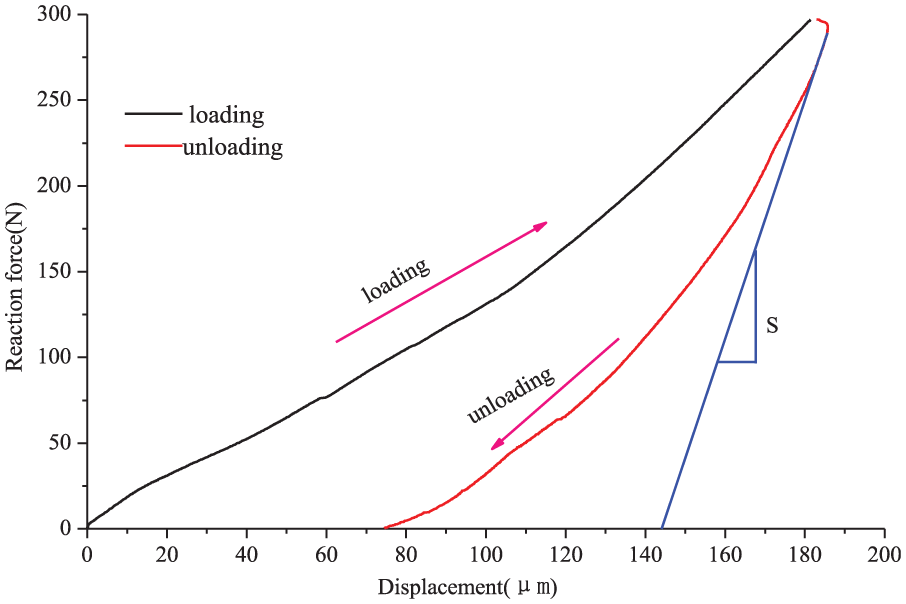
The indenter contacts the rock sample surface (Figure 1). The loading–unloading–displacement curve of rock indentation test is obtained from the force and displacement sensors (Figure 2).
Schematic diagram of mesoscale indentation experiment.
Based on many indentation tests, the Oliver–Pharr method has become one international standard method for the material indentation test. The calculation equations are as follows25,26


The test specimen description
The LMX shale formation is one of the most important shale gas reservoirs in China. The test specimen was taken from outcrop LMX shale in the Sichuan basin. The test size of shale specimen is larger than the indentation displacement, which is considered to be a semi-infinite body. The size of test shale specimen is 6 cm × 1.6 cm × 0.5 cm, and the maximum indentation displacement is 100 μm. The polishing treatment is used to reduce the effect of rough surface of shale specimen. In order to reduce the effects of heterogeneity, every shale specimen has 10 test points, as shown in Figure 3. In order to decrease the effect of stress distribution of test points, the distance of test position is not less than 0.5 cm from the shale specimen edge.

The shale specimen and test points diagram.
Mesoscale experimental results and discussion
The typical characteristics of mesoscopic shale indentation fragmentation
The typical image and loading–unloading–displacement curve of shale mesoscale indentation are shown in Figures 4 and 5, respectively. In order to study the typical characteristics of mesoscopic shale indentation fragmentation, the shale indentation image was captured by a high-precision posture microscope. The typical characteristics of mesoscopic shale indentation fragmentation include the indenter shape, fragmentation edge, and indenter contact face as shown in Figure 4. The bottom shape and indenter contact face of the fragmentation pit are similar to the indenter shape. Because of the heterogeneity and anisotropy of shale specimen, the fragmentation edge shows irregular characteristics and is not beneficial for the ROP and shale fragmentation prediction.3,4,13,19

The typical mesoscopic shale indentation fragmentation image.

The curve of shale indentation fragmentation at mesoscale.
The loading–unloading–displacement curve of shale mesoscale indentation is divided into four zones. The shale elastic deformation occurs in Zone 1. With the indentation load increasing, the shale plastic deformation occurs in Zone 2. The shale hardening occurs in Zone 3. With increasing indentation displacement, the reaction force sharply increases, the slop of reaction force is largest among the Zone 1, Zone 2, and Zone 3. When the reaction force has reached to the shale fracture load, the shale indentation fragmentation occurs in Zone 4. When the indentation load is unloaded to the zero, the fragmentation pit has a residual depth, which cannot restore the original state.
Four zones were observed from the shale indentation fragmentation test at mesoscale test, which can be a new test basis of shale indentation fragmentation and fracture. This research results further explain the rules of shale indentation fragmentation at the mesoscale. The previous research results mainly focus on the strength parameters and elastic deformation stage and did not research the plastic and fragmentation stage.8,13,16,26,29 The study results are beneficial for the research of bit ROP at the mesoscale.3,4
Effect of the loading rate
The dynamic drilling and rock fragmentation can be affected by the loading rate. Rock mechanical properties are the key problem for the dynamic drilling and rock fragmentation. The curve of shale mesoscale indentation fragmentation at different loading rates is shown Figure 6. When the peak load is 200 N, the limited indentation displacements are 127 and 122 μm. When the displacements are 23 and 18 μm at a loading rates of 50 and 100 N/min, respectively, shale indentation fragmentation occurs. When the peak load is 250 N, the limit depths are 163 and 140 μm. When the limited indentation displacements are 80 and 25 μm at a loading rates of 50 and 100 N/min, respectively, shale indentation fragmentation occurs.

The curve of shale mesoscale indentation fragmentation at different loading rates.
Above the indentation test results, with increasing loading rate, the shale fracture load increases. The peak load is a proportional to the increasing rate of shale fracture force. With increasing loading rate, the indentation displacement decreases. The results show that the loading rate has complicated effect on the rock fragmentation.
Effect of repeated indentation
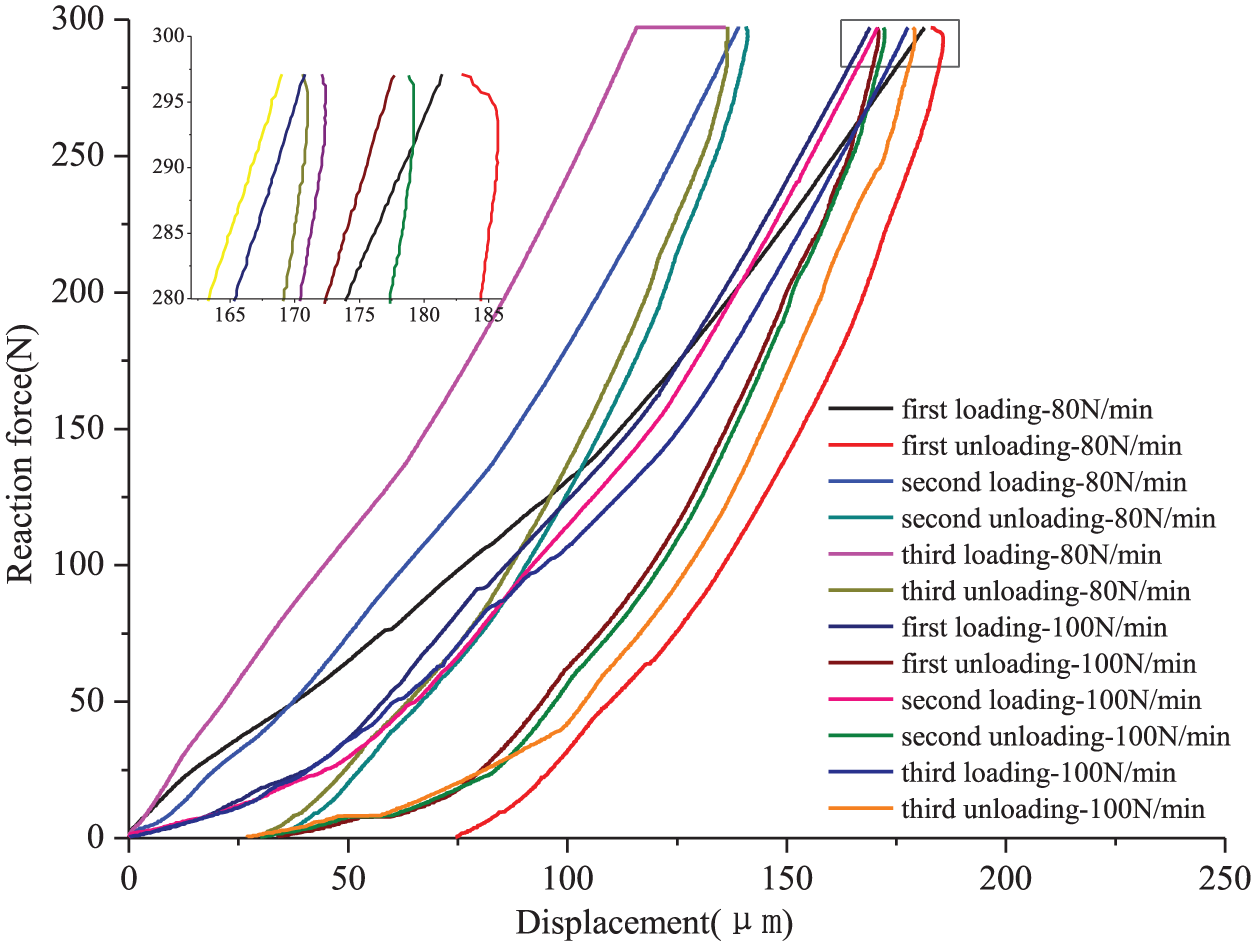
The repeated indentation directly affects the efficiency of rock fragmentation. The typical image and loading–unloading–displacement curve of shale repeated indentation at the mesoscale are shown in Figures 7 and 8, respectively. When the loading rate and peak load are 80 N/min and 300 N, respectively, the limited displacements, indenting three times at the same test point, are 186, 142, and 137 μm. When the third indentation displacement is 113 μm, shale indentation fragmentation occurs with an audible sound. The fragmentation edge also is irregular. When the loading rate and peak load are 100 N/min and 300 N, the limited displacements are 180, 163, and 159 μm. When the third indentation displacement is 81 μm, shale indentation fragmentation occurs, a white point cannot be observed from Figure 7.

The typical mesoscopic shale fragmentation image of repeat indention.
The curve of shale mesoscale indentation fragmentation at different repeat times.
With increasing repeated indentation times at the same position, the limited indentation displacement decreases and the shale indentation fragmentation easily occurs. The energy efficiency of repeated three indentations for 80 N/min is larger than 100 N/min. The results show that the loading rate can increase the repeated indentation energy efficiency.
Macroscale experiment of indentation fragmentation
Macroscale experiment principle
Indentation test device description
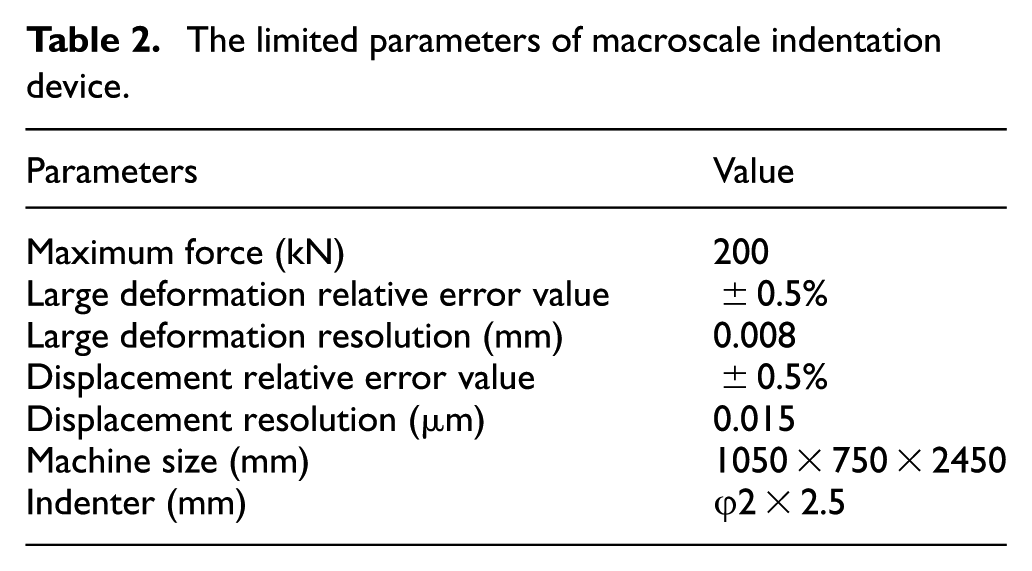
The indentation test device is a macroscale rock properties tester. The schematic and main parameters of the testing device are shown in Figure 9 and Table 2, respectively. The test device consists of load frame, sensors, indenter, and holding device.

The schematic diagram of macroscale indentation device.
The limited parameters of macroscale indentation device.
The basic experimental principle
The indenter contacts the rock sample surface. The loading–unloading–displacement curve of rock indentation test is obtained from the force and displacement sensors (Figure 9). The first shale fragmentation at the macroscale is used to get the shale mechanical parameters (Figure 10).

The schematic diagram of macroscale indentation.
The shale hardness is as follows27,30

The shale elasticity modulus is as follows

Macroscale experimental results and discussion
The typical characteristics of macroscopic shale indentation fragmentation
The typical image and loading–unloading–displacement curve of shale macroscale indentation are shown in Figures 11 and 12, respectively. The typical characteristics of macroscopic shale indentation fragmentation include fragmentation edge, chip, fracture, and pit bottom. The pit bottom shape is similar to the indenter shape. Because of the heterogeneity and anisotropy of shale specimen, the fragmentation edge also shows irregular characteristics and the fragmentation pit is similar to a funnel. When the indentation load is too large, the pit has the fracture and chip. The research results are similar to the previous results.2,21

The macroscopic shale indentation image.

The curve of macroscopic indentation shale fragmentation.
The loading–unloading–displacement curve of shale macroscale indentation is divided into four zones. Zone 1 shows that the indenter contacts shale specimen surface. When the reaction force reaches 1.75 kN (point M), small shale indentation fragmentation occurs, which could be affected by the chip and indenter shape. Mesoscopic shale indentation fragmentation is a result of the mesoscale fracture. When the reaction force reaches 2.58 kN (point A), first macroshale indentation fracture occurs. In this stage, the shale stress releases, then the contact load decreases sharply. When the indentation load continually was increased, based on Zone 1, the second macrofracture process occurs in Zone 2.
The similar shale fragmentation rules also occur in Zone 3 and Zone 4. The mesoscale fracture can be observed in Zone 1, Zone 2, Zone 3, and Zone 4, which also can be a new test basis of shale indentation fragmentation and fracture. This research results further explain the relationship between shale mesoscale and macroscale indentation fragmentation, as shown in Figures 4 and 5. Previous work did not focus on the mesoscale fracture in the macroscale indentation test.2,5,15,19,30 The results show that the design of ROP should consider the macroscales and mesoscales at the same time in the engineering field.
Effect of loading rate
The dynamic drilling and rock fragmentation can be affected by the loading rate. Rock mechanical properties are the key problem for the dynamic drilling and rock fragmentation, as shown in Figure 13. When the loading rate is 0.05 and 1 mm/min, the first shale critical fracture load is 1.58 and 2.77 kN, respectively. The second and third critical crack loads have the same law with first critical load. With increasing loading rate, the shale critical fracture load increases. This result shows that the dynamic indentation load can improve the fragmentation efficiency and slightly increase the shale fragmentation load at the same time. During the drilling, the engineers cannot use too high dynamic load, which is not benefit for drilling tools life and the optimism of ROP.

Macroscale shale indentation curve at different loading rates.
Effect of the indentation depth at the macroscale test
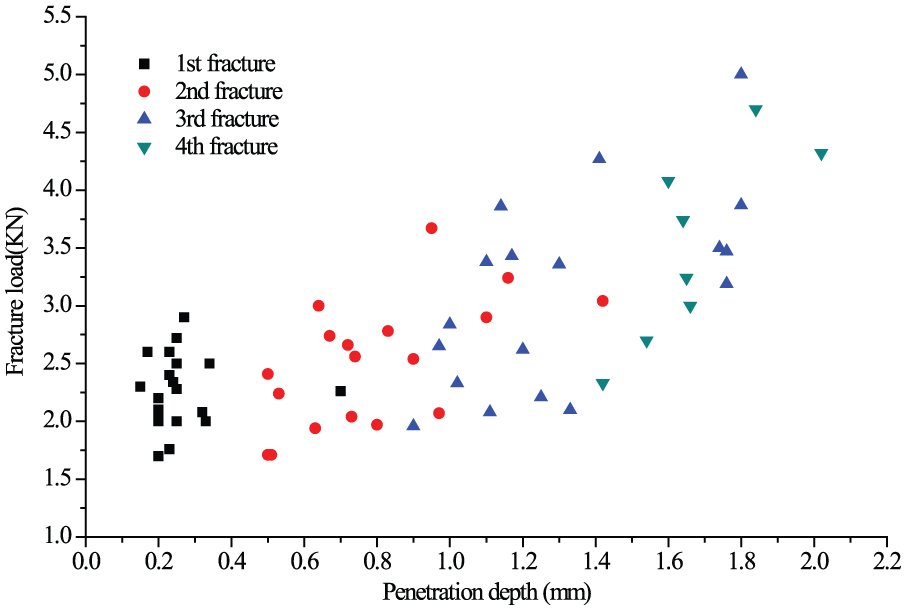
The relationship between the penetration depth and the critical fracture load at the macroscale is determined by many indentation test data, as shown in Figure 14. With increasing penetration depth, the shale critical fracture load increases and the number of shale fragmentation varies. The probability of two–three times macroscale crack for LMX shale is greater than four times. The relationship between the penetration depth and the critical fracture load should be used to the numerical model of LMX shale fragmentation. Because the weight-on-bit (WOB) effect of the indentation depth of bit cutters, the optimization of shale fragmentation must consider the WOB.
The relationship between the penetration depth and the critical fracture load.
Contrastive analysis and discussion of shale indentation fragmentation
Contrast analysis and discussion of LMX shale indentation hardness
The LMX shale hardness is calculated by equations (2) and (4), as shown in Figure 15. In order to reduce the effects of the heterogeneity and anisotropy of shale samples, the 144 indentation points of macroscale and mesoscale tests are divided into 16 groups. Based on statistic date, the contrastive analysis was carried out. Each group has three data, and the average at the macroscale is 1.97 GPa and the average at the mesoscale is 1.78 GPa. The difference in the macroscale and mesoscale shale hardness is 10.6%.

Macroscale and mesoscale LMX shale hardness.
The macroscale statistics of LMX shale hardness are close to the mesoscale statistics. But the heterogeneity and dispersion of mesoscale hardness are greater than the macroscale hardness. The macroscopic and mesoscopic shale breakage are inseparable. Macroshale fragmentation is established on the accumulation of mesoscale fracture. The accumulation of rock mesoscopic damage, fracture, and breakage develop into macroscale fragmentation. In the drilling field, the test sample of shale hardness at the mesoscale indentation test is easily obtained than macroscale indentation, because the test specimen at the mesoscale can be the drilling cutters.30,31
Contrast analysis and discussion of LMX shale elastic modulus
The LMX shale hardness is calculated by equations (1) and (5), as shown in Figure 16. In order to reduce the effects of the heterogeneity and anisotropy of shale samples, the 144 indentation points of macroscale and mesoscale tests are divided into 16 groups. Based on statistic date, the contrastive analysis was carried out. Each group has three data, and the average at the macroscale is 19.5 GPa and the average at the mesoscale is 18 GPa. The difference in the macroscale and mesoscale shale hardness is 8.3%.

Macroscale and mesoscale LMX shale elasticity moduli.
The macroscale statistics of LMX shale elasticity modulus are close to the mesoscale statistics. But the heterogeneity and dispersion of mesoscale hardness is greater than the macroscale hardness. The macroscopic and mesoscopic shale breakage is inseparable. Macroshale fragmentation is established on the evolution of mesoscale fracture. The reason is similar to the LMX hardness at the multiscale. The contrast results show that the elastic modulus value also can be easily obtained from two experimental scales.
Relationship between loading rate and elastic modulus
The relationship between the loading rate and elasticity modulus is obtained by the statistical method and fitting line, as shown in Figure 17. Because the limited loading rate of test device, the relationship between elasticity modulus and loading rate is linear at the lower loading rate. With increasing loading rate, the elastic modulus of the rock increases, which suppresses the energy release of the shale fragmentation. The result is similar to previous research. 16 The research results were observed from the macroscale and mesoscale at the same time. This rule further explains the shale indentation fragmentation rules and the low ROP from the multiscale aspect, which may be an important reason why percussive drilling and percussive-rotary drilling cannot be generally applied in the drilling engineering field.3,4 In order to increase the ROP of the shale formation, the design of ROP should consider the effect of multiscale in the future, especially the macroscale and mesoscale.

The relationship between loading rate and elastic modulus of LMX shale.
Conclusion
Macroshale fragmentation is established on the evolution of mesoscale fracture. The accumulation of shale mesoscopic damage, fracture and breakage develop into macroscale fragmentation. The typical four stages of mesoscale shale fragmentation were overserved by the indentation test. With increasing loading rate of indenter, indentation displacement of LMX shale decreases and the critical crack load of LMX shale increases. The macroscale statistics of LMX shale hardness and elastic modulus are close to the mesoscale statistics of LMX shale. The elastic modulus of LMX shale is proportional to the indenter loading rate. In order to increase the ROP of the shale formation, the design of ROP should consider the effect of multiscale in the future, especially the macroscale and mesoscale. The study results are beneficial for the optimization of ROP and drilling tools.
Footnotes
Acknowledgements
The authors are immensely grateful to the anonymous reviewers and editors for their constructive comments and suggestions to improve this article.
Academic Editor: Xiaotun Qiu
Declaration of conflicting interests
The author(s) declared no potential conflicts of interest with respect to the research, authorship, and/or publication of this article.
Funding
The author(s) disclosed receipt of the following financial support for the research, authorship, and/or publication of this article: This work was supported by the National Science and Technology Major Project (Grant No. 2016ZX05022001), National Science and Technology Major Project (Grant No. 2016ZX05028001), Major National Basic Research Development Program of China (973 Program; Grant No. 2013CB228003), the Science and Technology Support Program of Sichuan Province (Grant No. 2015SZ0003), the Basic Research Subject of the State Key Laboratory of Oil and Gas Reservoir Geology and Exploitation of Southwest Petroleum University (Grant No. G3-1), the Exploratory Subject of the State Key Laboratory of Oil and Gas Reservoir Geology and Exploitation of Southwest Petroleum University (Grant No. G201604), and Open Fund of the State Key Laboratory of Oil and Gas Reservoir Geology and Exploitation of Southwest Petroleum University (Grant No. PNL201611).