In this work, the double Laplace decomposition method is applied to solve singular linear and nonlinear one-dimensional pseudohyperbolic equations. This method is based on double Laplace transform and decomposition methods. In addition, we prove the convergence of our method. This method is described and illustrated by some examples. These results show that the introduced method is highly accurate and easy to apply.
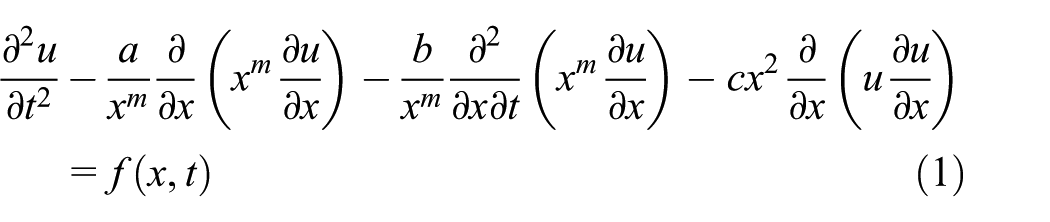
The linear and nonlinear pseudohyperbolic equations are the important classes of evolution equations which have been developed in recent years, and there is an extensive application in chemistry, plasma physics, thermo-elasticity, and engineering. Many powerful methods have been developed to solve linear and nonlinear partial differential equations (PDEs), such as homotopy perturbation method,1,2 combined Laplace transforms and decomposition method,3 the transformed rational function method which presents exact traveling wave solutions to nonlinear integro-differential equations has been studied in Ma and Lee,4 the bi-linear techniques5 which present multiple wave solutions to nonlinear differential equations, and the integral transform method.6–9 An auxiliary parameter method using Adomian polynomials and Laplace transformation have been powerfully combined10 to study the nonlinear differential equation. The one-dimensional nonlinear hyperbolic equation with Bessel operator is one of the fundamental nonlinear wave equations having many applications in science. The energy-integral method is used to handle nonlinear singular one-dimensional hyperbolic equation.11 The convergence of Adomian’s method has been studied by several authors.12–18 In this article, we are concerned with the following problem
subject to the initial conditions
where a, c are constants and is called Bessel’s operator and f is a known function, where . Equation (1) is described by the following cases:
Case 1. At , the equation is called singular nonlinear one-dimensional like-wave equation;
Case 2. At , the equation is called singular one-dimensional pseudohyperbolic equation;
Case 3. At , the equation is called singular nonlinear one-dimensional pseudolike-wave equation;
Case 4. At and , the equation is called nonlinear one-dimensional like-wave equation;
Case 5. At and , the equation is called singular one-dimensional wave equation;
Case 6. At and , the equation is called singular one-dimensional pseudo wave equation.
In the general case when , equation (1) is called singular one-dimensional pseudolike-wave equation.
The aim of this article is to use the double Laplace transform and domain decomposition method to obtain approximate solutions with high accuracy for a singular one-dimensional pseudohyperbolic equation and a singular one-dimensional pseudolike-wave equation. In addition, one of the main aims of this article is to provide a sufficient condition of convergence of the series.
Now, we recall the following definitions which are given by previous studies.19–22 The double Laplace transform is defined as
where and are complex values, and further double Laplace transform of the first-order partial derivative is given by
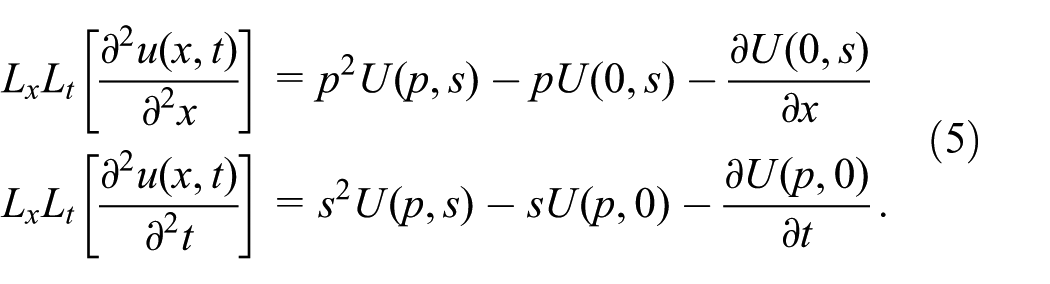
Similarly, the double Laplace transform for second-order partial derivative with respect to x and t are defined as follows
The following Lemma is used in this article.
Lemma 1
Double Laplace transform of the non-constant coefficient second-order partial derivative and the function are given by
and
where .
One can prove this lemma using the definition of double Laplace transform in equations (3)–(5).
To illustrate the basic idea of the modified double Laplace decomposition method, we assume that and in equation (1), we obtain the singular one-dimensional pseudohyperbolic equation
subject to
where the term is Bessel operator. In the following theorem, we apply modified double Laplace decomposition methods.
Theorem 1
We claim that the solution of the singular one-dimensional pseudohyperbolic equation given in equation (8) is denoted by
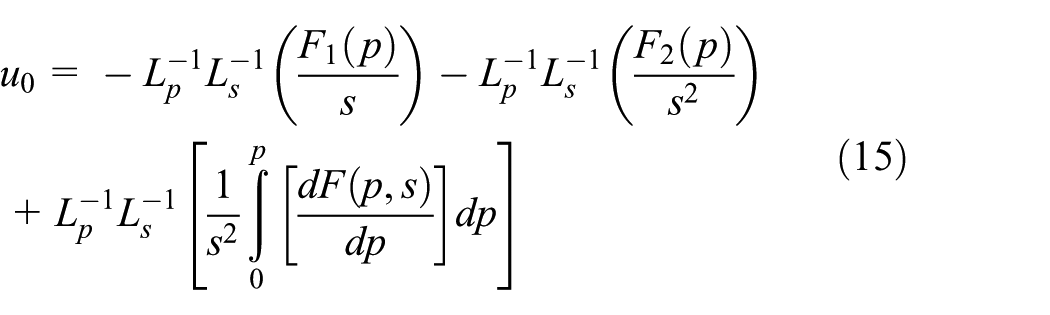
where double Laplace transform with respect to and double inverse Laplace transform with respect to , the function , , and are Laplace transform of the functions , , and , respectively. Here, we provided double inverse Laplace transform with respect to p and s exist for each term in the right-hand side of equation (10).
Proof
By multiplying equation (8) by x and using the definition of partial derivatives of the double Laplace transform, single Laplace transform, and the Lemma 1 for equation (8), respectively, we get
Applying the integral for both sides of equation (11) from 0 to p with respect to p, we have
The next step in double Laplace decomposition method is representing the solution of singular one-dimensional pseudohyperbolic equation as by the infinite series
To illustrate our method for solving the singular one-dimensional pseudohyperbolic equation, in the case in equation (8), we consider the following example.
Example 1
subject to
By taking double and single Laplace transform for equations (21) and (22) and applying theorem 1, we have
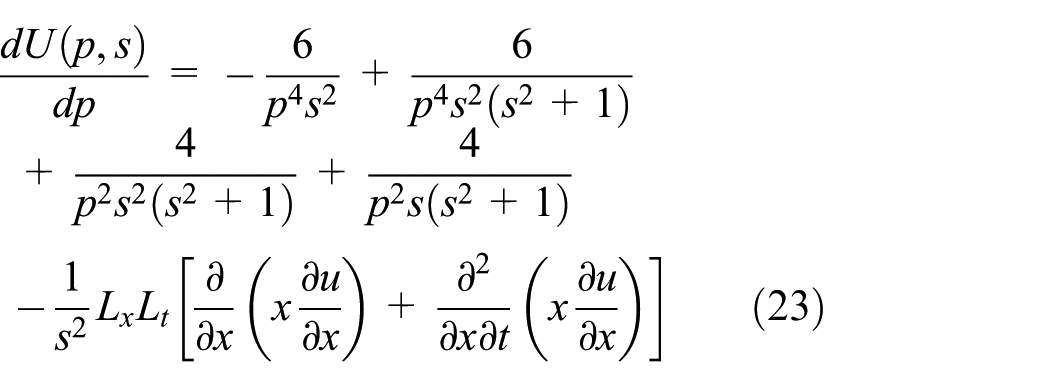
Integrating both sides of equation (23) from 0 to p with respect p, we obtain
On using double inverse Laplace transform, we have
In this section, we discuss the use of modified double Laplace to solve the singular one-dimensional pseudohyperbolic equation
subject to
where is Bessel operator, and and are known functions. To obtain the solution of singular one-dimensional pseudohyperbolic equation (27), we apply our method as follows. Using the definition of partial derivatives of the double Laplace transform, single Laplace transform for equations (27) and (28), respectively and Lemma 1, we have
By integrating both sides of equation (29) from 0 to p with respect to p, we have
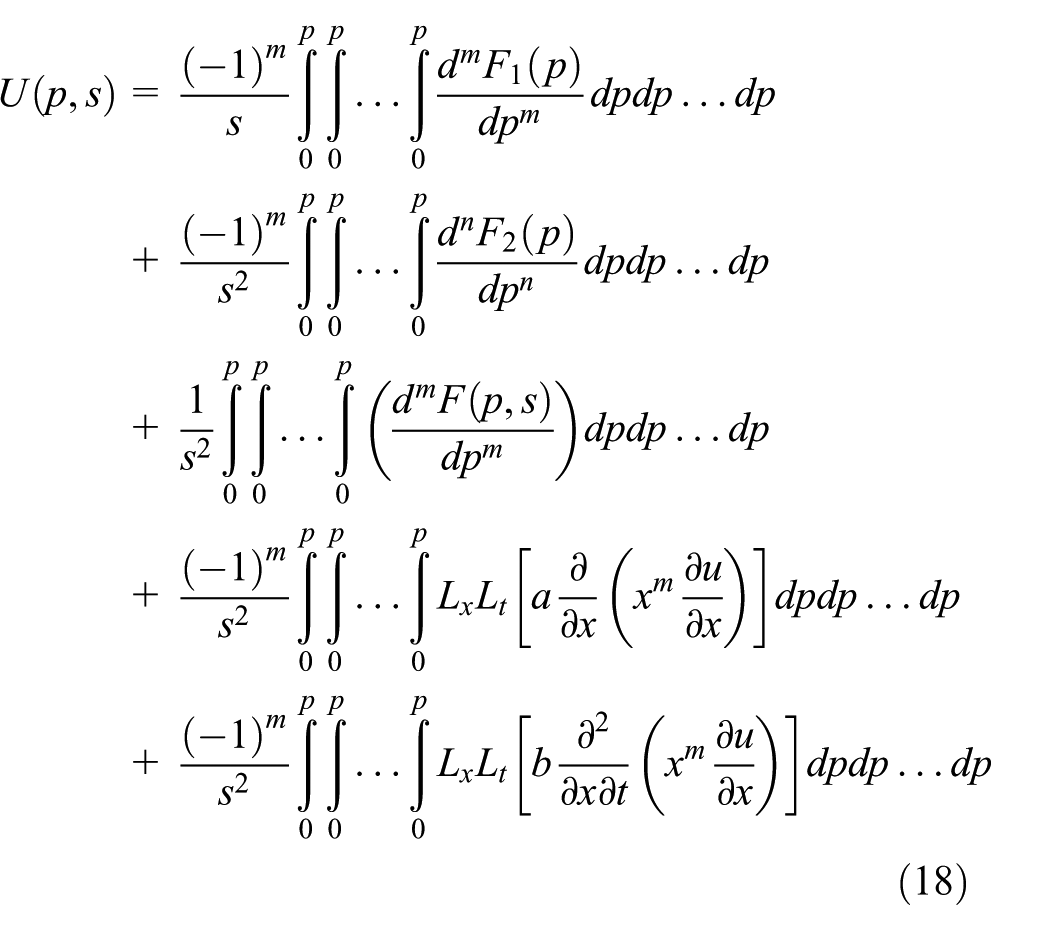
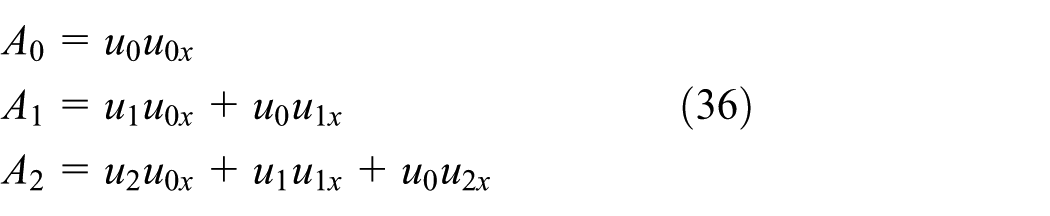
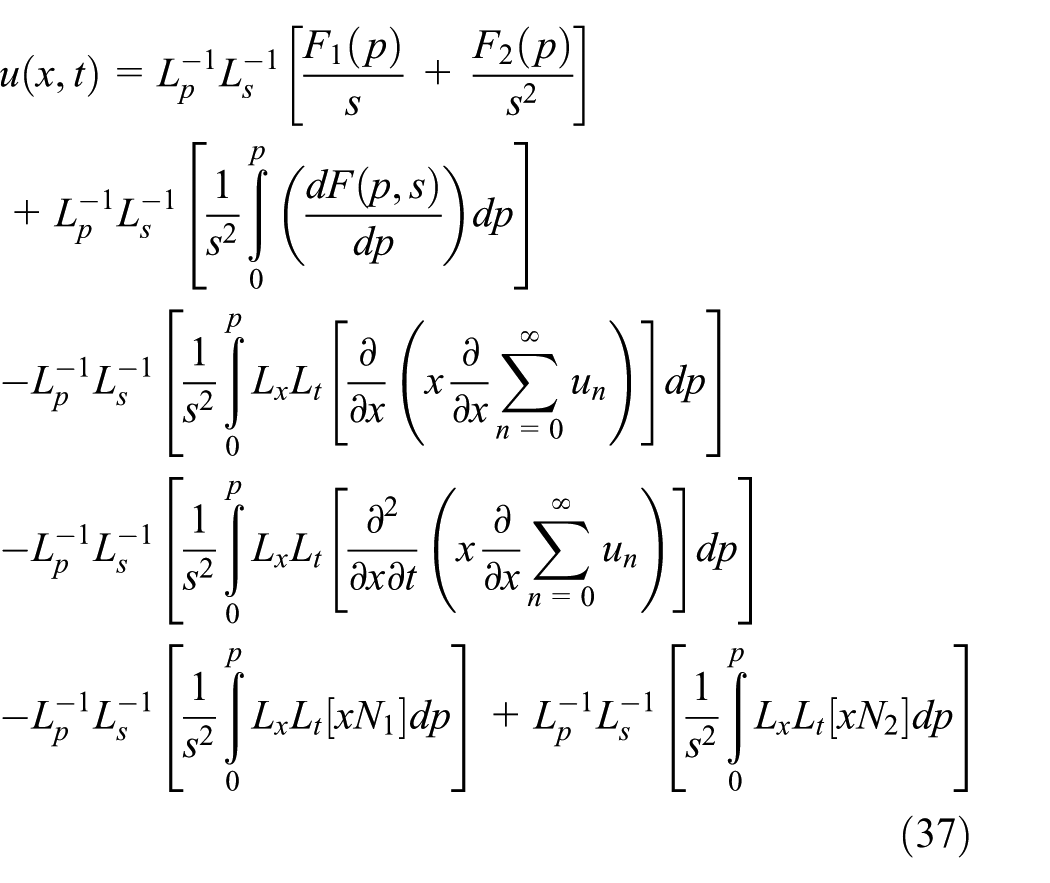
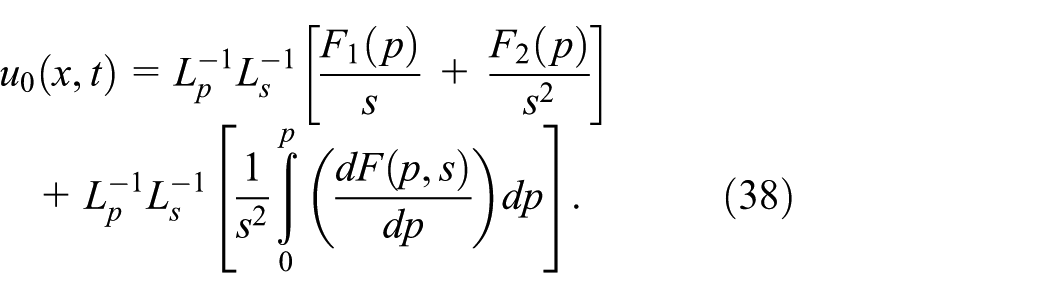
The double Laplace Adomian decomposition method (DLADM) defines the solution of equation (27) as by the infinite series
where and are defined in equation (33). By calculating the terms we obtain the solution as
To illustrate the modified double Laplace decomposition method for solving the singular nonlinear one-dimensional pseudohyperbolic equation, we let , , , and in equation (27), hence we have the following example.
Example 2
Consider the following nonlinear singular one-dimensional pseudohyperbolic equation
In this section, we will discuss the convergence analysis of the modified double Laplace decomposition methods for the singular nonlinear one-dimensional pseudohyperbolic equation which is given by
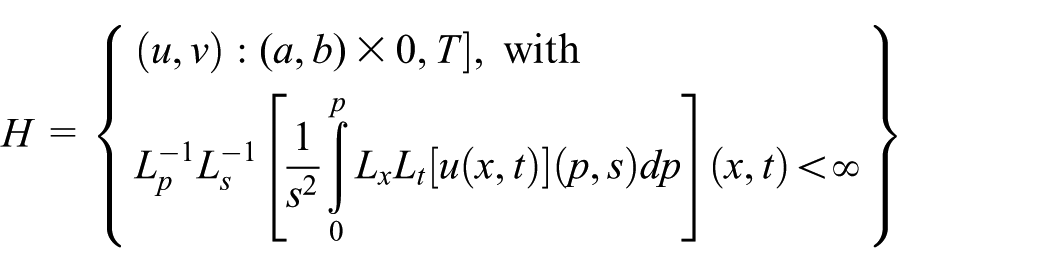
for all . We define H as , where and
where and
Such that the solution satisfies the final condition . Multiplying both sides of equation (43) by x and writing the equation in the operator form
For L hemicontinuous operator, consider the following hypotheses:
(H1) .
(H2) whatever may be , there exist a constant such that for with , we have
for every . In the next Theorem, we follow the literature.15,23–25
Theorem 2 (Sufficient condition of convergence)
The Modified double Laplace decomposition methods applied to the nonlinear singular one-dimensional pseudohyperbolic equation (44) with homogeneous initial condition converges toward a solution.
Proof
To verify the convergence hypotheses (H1) for equation (44), we use the definition of our operator L, and we have the following form
therefore
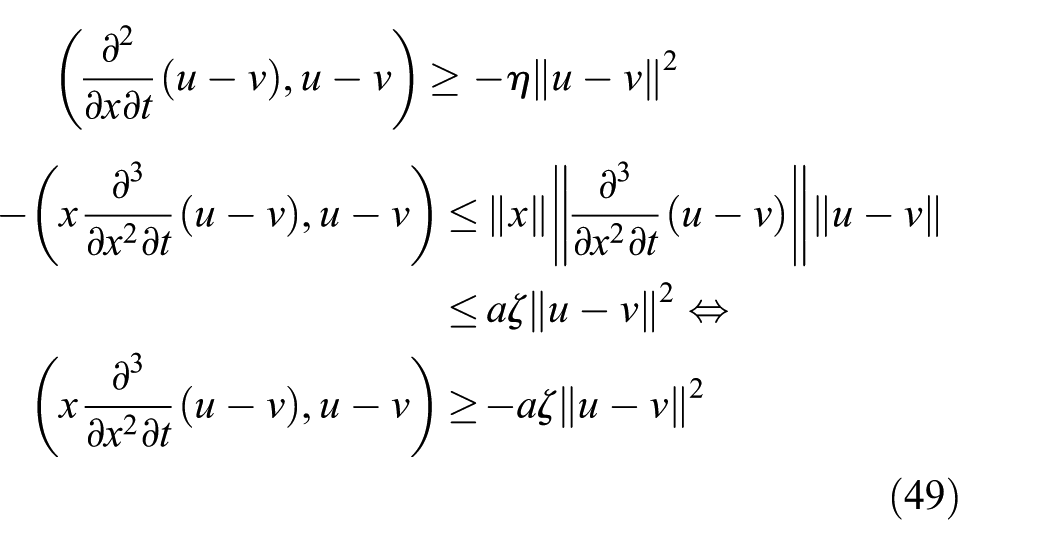
Since and are differential operators in H, there exists numbers such that
where , using Cauchy Schwartz inequality
and
According to Cauchy Schwartz inequality, where as f is Lipschitzian function, we have
Now we verify the convergence hypotheses (H2) for the operator . For every , there exist a constant such that for with ,
for every . For that we have
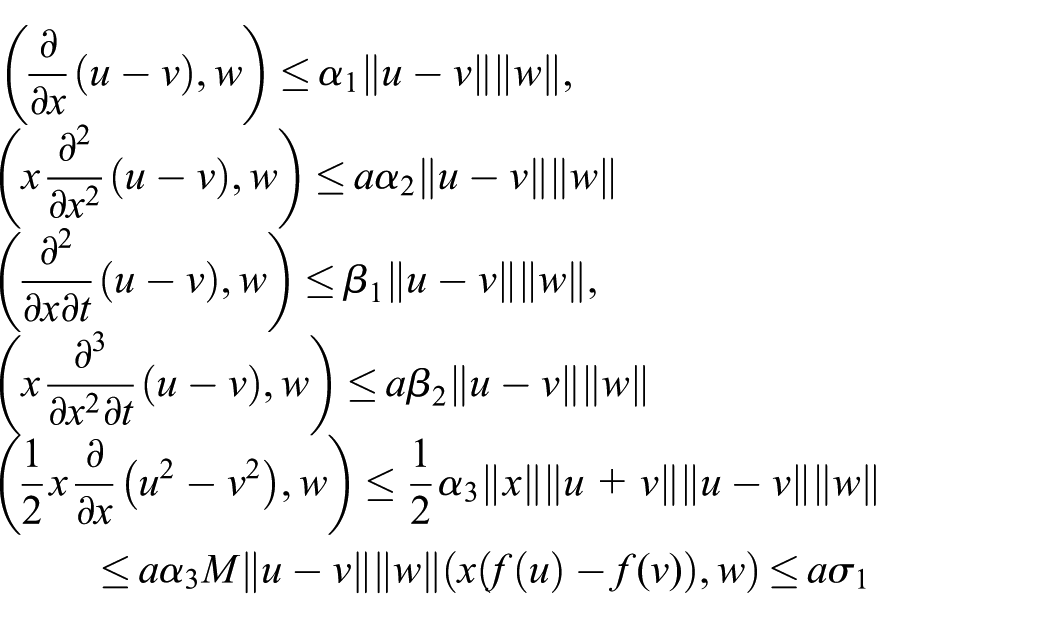
There exist numbers such that, using the Schwartz inequality and the fact that u and v are bounded, we obtain
where . We also have
where
and therefore (H2) holds.
Conclusion
In this article, we proposed modified double Laplace decomposition methods to solve singular one-dimensional linear and nonlinear pseudohyperbolic equations. The efficiency and accuracy of the present scheme are validated through examples. This method can be applied to many complicated linear and nonlinear PDEs and also for system of PDEs and does not require linearization.
Footnotes
Acknowledgements
The authors would like to thank the referees for valuable suggestions and comments, which helped the authors to improve this article substantially. All authors jointly worked on deriving the results and approved the final revised manuscript.
Academic Editor: Xiao-Jun Yang
Declaration of conflicting interests
The author(s) declared no potential conflicts of interest with respect to the research, authorship, and/or publication of this article.
Funding
The author(s) disclosed receipt of the following financial support for the research, authorship, and/or publication of this article: The authors would like to extend their sincere appreciation to the Deanship of Scientific Research at King Saud University for funding of this research through the Research Group Project number RGP-117.
References
1.
AbbasbandyS.Iterated He’s homotopy perturbation method for quadratic Riccati differential equation. Appl Math Comput2006; 175: 581–589.
2.
SadighiAGanjiDD.Solution of the generalized nonlinear Boussinesq equation using homotopy perturbation and variational iteration methods. Int J Nonlin Sci Num2007; 8: 435–443.
3.
BabolianEBiazarJVahidiAR.A new computational method for Laplace transforms by decomposition method. Appl Math Comput2004; 150: 841–846.
4.
MaW-XLeeJ-H.A transformed rational function method and exact solutions to the 3 + 1dimensional Jimbo–Miwa equation. Chaos Soliton Fract2009; 42: 1356–1363.
5.
MaW-X.Bilinear equations, Bell polynomials and linear superposition principle. J Phys Conf Ser2013; 411: 12021.
6.
LiangaXGaoaFGaoYNet al. Applications of a novel integral transform to partial differential equations. J Nonlinear Sci Appl2017; 10: 528–534.
7.
YangX-J.A new integral transform method for solving steady heat-transfer problem. Therm Sci2016; 20: 639–642.
8.
YangX-J.A new integral transform operator for solving the heat-diffusion problem. Appl Math Lett2017; 64: 193–197.
9.
YangX-J.A new integral transform with an application in heat-transfer problem. Therm Sci2016; 20: 677–681.
10.
KhanYVázquez-LealHFarazN.An auxiliary parameter method using Adomian polynomials and Laplace transformation for nonlinear differential equations. Appl Math Model2013; 37: 2702–2708.
11.
BouzianiA.On initial boundary value problem with Dirichlet integral condition for a hyperbolic equation with Bessal operator. J Appl Math2003; 10: 87–502.
12.
AbbaouiKCherruaultY.Convergence of Adomian’s method applied to differential equations. Comput Math Appl1994; 28: 103–109.
13.
AbbaouiKCherruaultY.Convergence of Adomian’s method applied to nonlinear equations. Math Comput Model1994; 20: 69–73.
14.
AbbaouiKCherruaultYSengV.Practical formulae for the calculus of multivariable Adomian polynomials. Math Comput Model1995; 22: 89–93.
15.
AtanganaANoutchieSCO. On multi-Laplace transform for solving nonlinear partial differential equations with mixed derivatives. Math Probl Eng2014; 2014: 267843-1–267843-9.
16.
EltayebHKiliçmanAMesloubS.Application of the double Laplace Adomian decomposition method for solving linear singular one dimensional thermo-elasticity coupled system. J Nonlinear Sci Appl2017; 10: 278–289.
17.
Eltayeb GadainHBacharI. On a nonlinear singular one-dimensional parabolic equation and double Laplace decomposition method. Adv Mech Eng2017; 9: 1–7.
18.
GadainHE.Application of double Laplace decomposition method for solving singular one dimensional system of hyperbolic equations. J Nonlinear Sci Appl2017; 10: 111–121.
19.
MouraCAD. A linear uncoupling numerical scheme for the nonlinear coupled thermodynamics equations. In: PereyraVReinozeA (eds) Lecture notes in mathematics, vol. 1005. Berlin: Springer, 1983, pp.204–211.
20.
KiliçmanAEltayebH.A note on defining singular integral as distribution and partial differential equation with convolution term. Math Comput Model2009; 49: 327–336.
21.
EltayebHKılıçmanA.A note on solutions of wave, Laplace’s and heat equations with convolution terms by using double Laplace transform. Appl Math Lett2008; 21: 324–1329.
22.
KılıçmanAGadainHE.On the applications of Laplace and Sumudu transforms. J Frankl Inst2010; 347: 848–862.
23.
HashimINooraniMSMSaid Al-HadidiMR.Solving the generalized Burgers–Huxley equation using the Adomian decomposition method. Math Comput Model2006; 43: 1404–1411.
24.
KayaDInanIE.A convergence analysis of the ADM and an application. Appl Math Comput2005; 161: 1015–1025.
25.
KayaDInanIE.A numerical application of the decomposition method for the combined KdV–MKdV equation. Appl Math Comput2005; 168: 915–926.