




Abstract
In this article, the double Laplace transform and Adomian decomposition method are used to solve the nonlinear singular one-dimensional parabolic equation. In addition, we studied the convergence analysis of our problem. Using two examples, our proposed method is illustrated and the obtained results are confirmed.
Keywords
Introduction
One-dimensional linear and nonlinear parabolic equations arise in many different fields of Science and Engineering and are frequently modelled through linear and nonlinear partial differential equations. However, it is still difficult to get closed-form solutions for most models of real-life problems. In recent years, several researchers have paid attention to find the solution of these equations using various methods, such as Adomian decomposition method (ADM)1–5 and Laplace decomposition method. 6 The convergence of the decomposition method has been studied by several authors.7–11 The aim of this article is to solve a nonlinear singular one-dimensional parabolic partial differential equation by combining the domain decomposition techniques and the double Laplace transform method. In addition, we investigate the convergence of our method. We first recall the following definitions which can be found in previous studies.12–16 The double Laplace transform is defined as

where x, t are real variables and p, s are complex values and further double Laplace transform of the first-order partial derivatives is given by

It is easy to prove equation (2) as follows

using integral by parts for the right-hand side of equation (3), we get

Similarly, the double Laplace transforms for second partial derivatives with respect to x and t are defined by

where
Lemma 1
The double Laplace transform of the functions

and

respectively. One can prove this lemma using the definition of double Laplace transform in equations (1), (2) and (4) as follows

on using equations (2) and (1)

Similarly, we can prove equation (6).
Nonlinear singular one-dimensional parabolic partial differential equation
The main aim of this study is to know how to solve the nonlinear singular one-dimensional parabolic partial differential equation using modified double Laplace decomposition method (MDLDM).
First problem
Consider the following nonlinear singular one-dimensional parabolic partial differential equation

subject to initial condition

where

The proposed approach includes the following steps.
The double Laplace transform is applied on both sides of equation (9) and single Laplace transform is adopted and applied to equation (8). The differential property is then used and gives

we rewrite equation (10) as follows

where
The MDLDM gives the solution in the following form

where the term

where

Using double inverse Laplace transform for equation (11) and using equations (12) and (13) we have

we define the following recursive formula

and

where the double inverse Laplace transform with respect to p, s is denoted by
Example 1
Consider the following nonlinear singular one-dimensional parabolic partial differential equation

subject to initial conditions

By multiplying equation (18) by

Applying the inverse double Laplace transform in equation (20) yields

using the decomposition series for
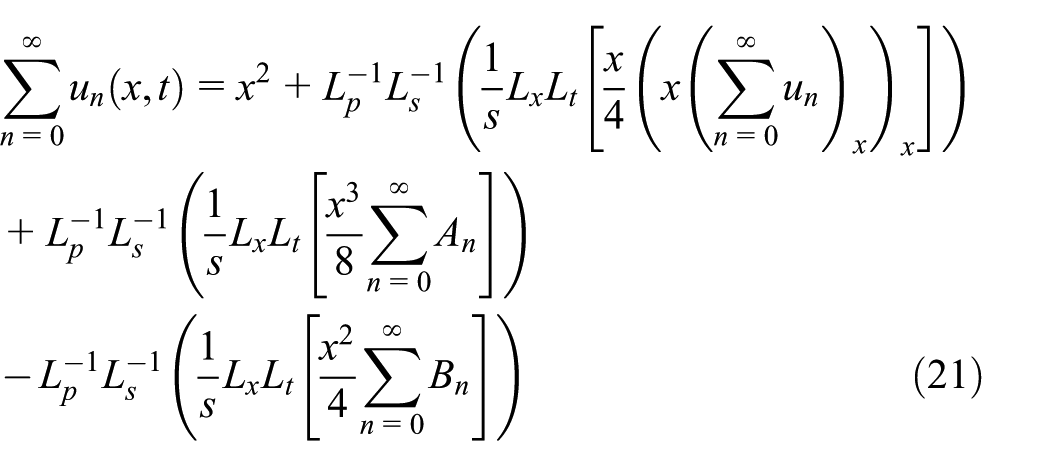
Using equations (16) and (17), we obtain

The other components are given by
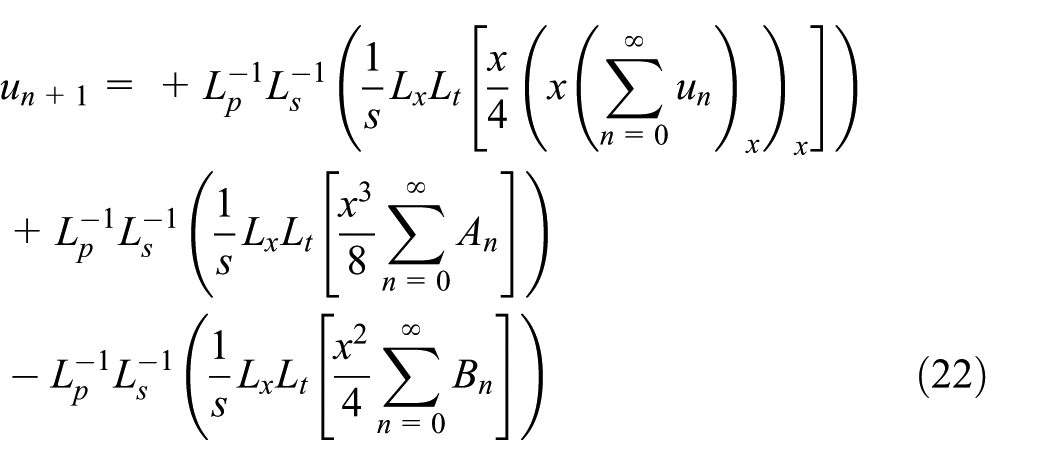
The other components of the solution can be easily found using equation (22) as follows
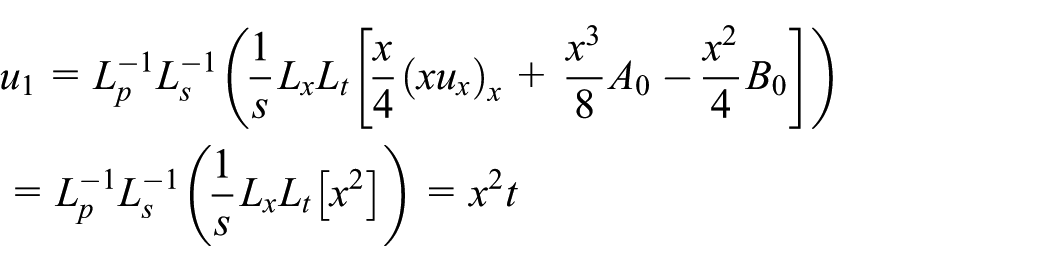
where
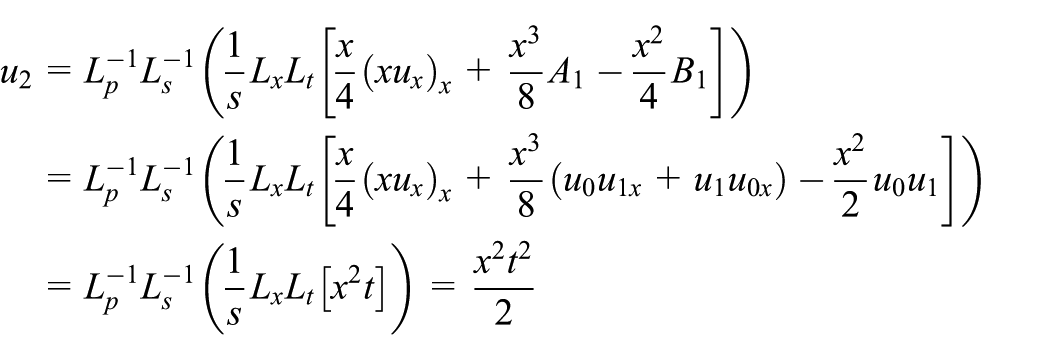
and

and so on. In the same manner, the rest of the components can be obtained by the same method and then the functions

as

Therefore, the exact solution is given by

Second problem
Consider the following nonlinear singular one-dimensional parabolic partial differential equation

subject to

where the term
Step 1. Multiply both sides of equation (7) by x.
Step 2. Using Lemma 1 and definition of the Laplace transform of partial derivatives for equations in step 1 and applying single Laplace transform for initial condition, we have
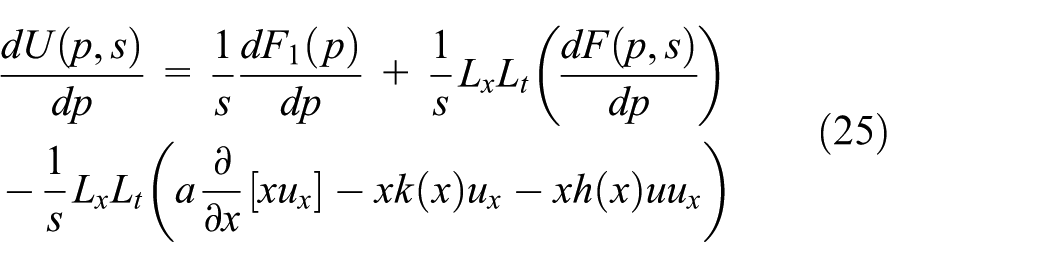
where
Step 3. Applying the integral for both sides of equation (12) from 0 to p with respect to p, we have
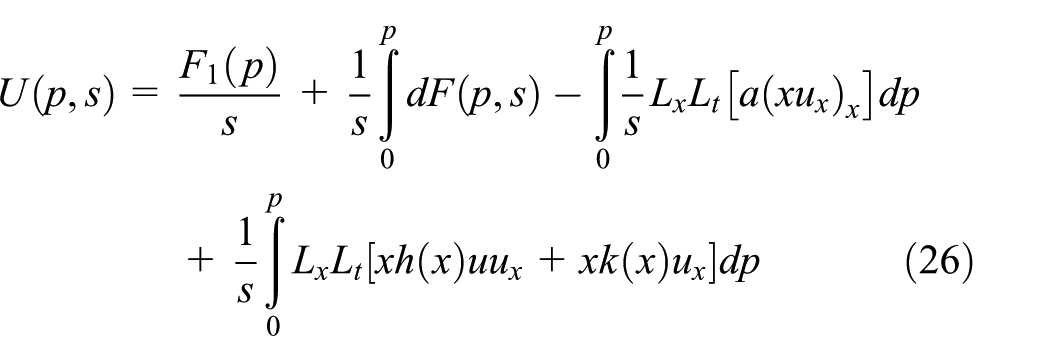
Step 4. The double Laplace decomposition method is representing the solution of nonlinear singular one-dimensional parabolic partial differential equation as
Step 5. By applying double inverse Laplace transform for equation (26) and using equation (14), we obtain
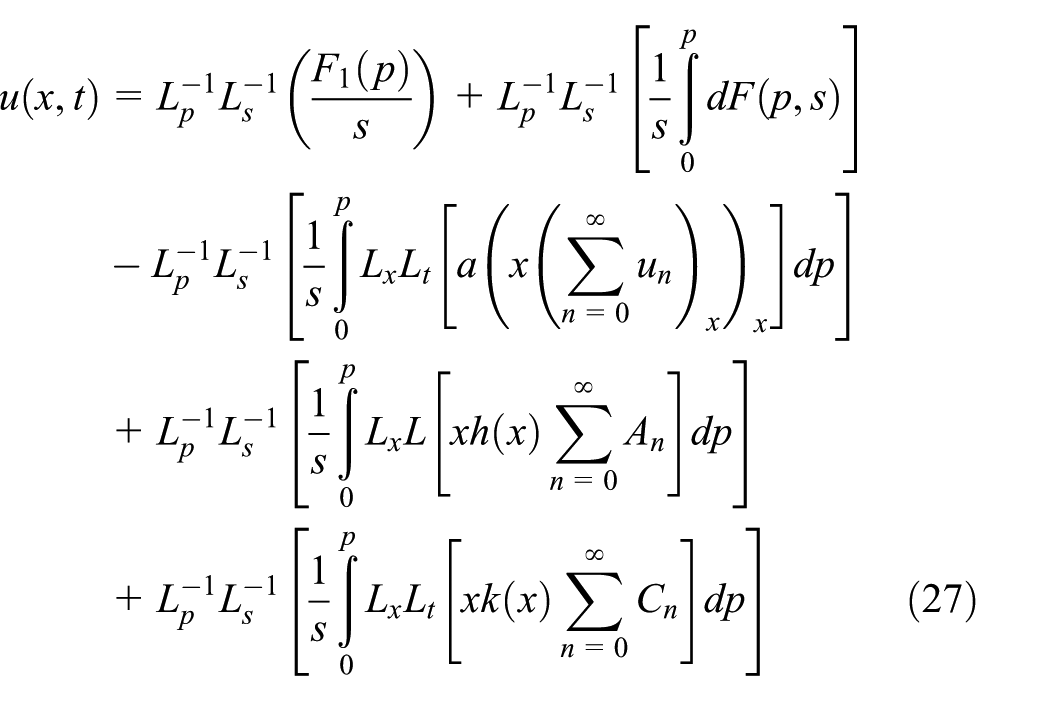
where the definition of

and
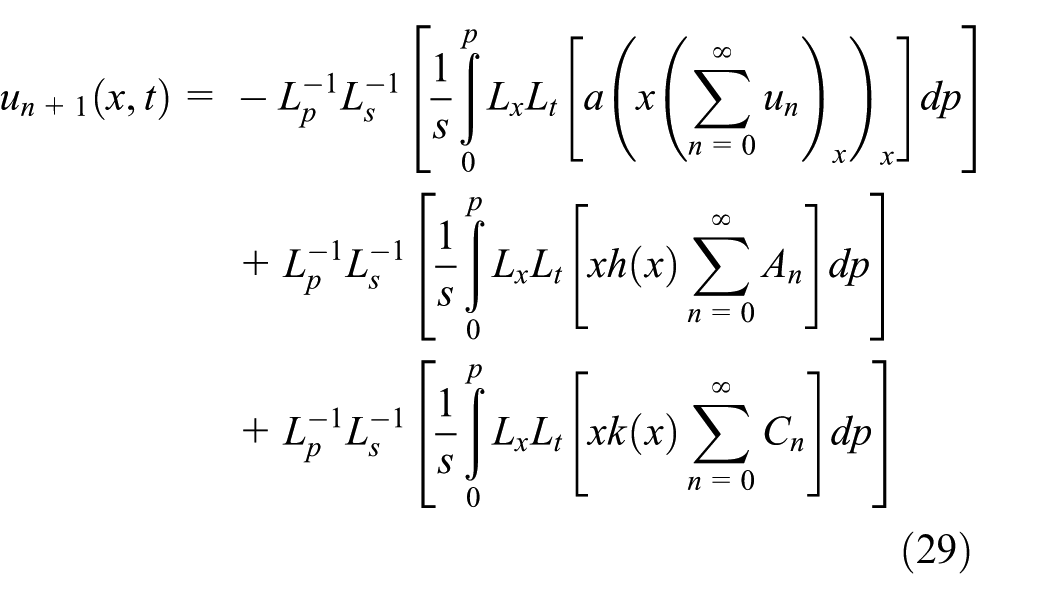
In order to illustrate the accuracy and reliability of the scheme, we assume
Example 2
Consider the following nonlinear singular one-dimensional parabolic partial differential equation

subject to

Using the above steps, we have
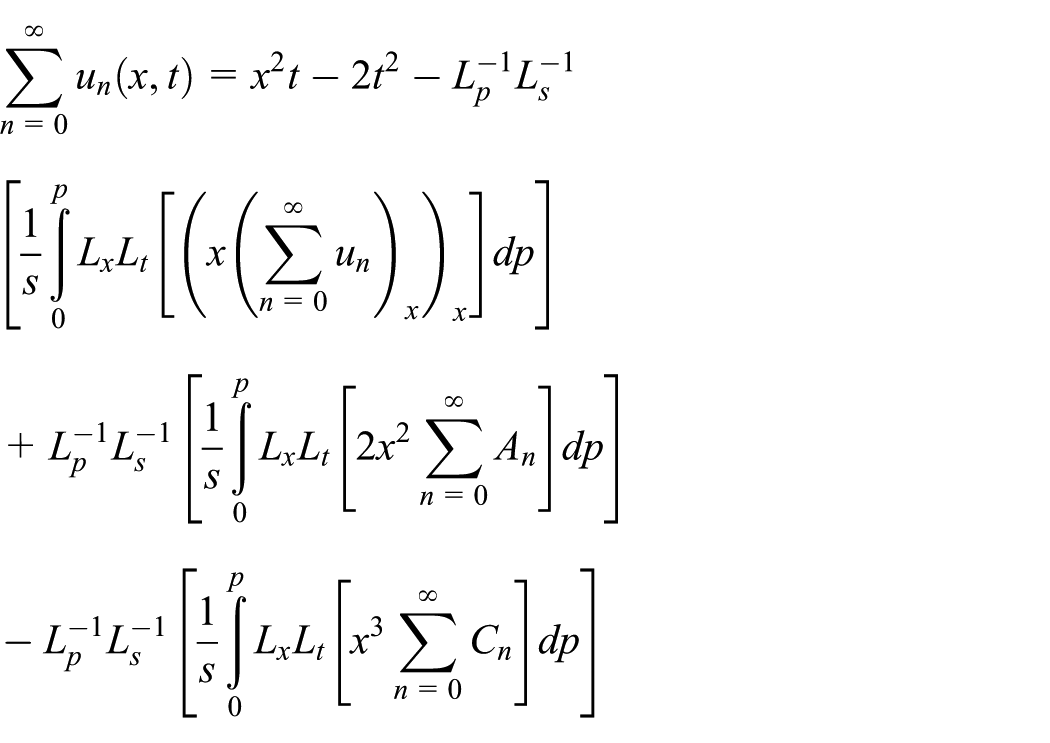
Using equations (28) and (29), we obtain

and

The other components of the solution can be easily found using equation (32) as follows

where

so the solution u(x, t) is given by

therefore, the exact solution is given by

Now, we study the convergence of the used method by considering a more general parabolic partial differential equation, more precisely, we investigate the convergence of the method for the one-dimensional parabolic partial differential equation with Bessel operator.
Convergence analysis
The aim of this section is to discuss our method for the nonlinear singular one-dimensional parabolic partial differential equation given by

for all
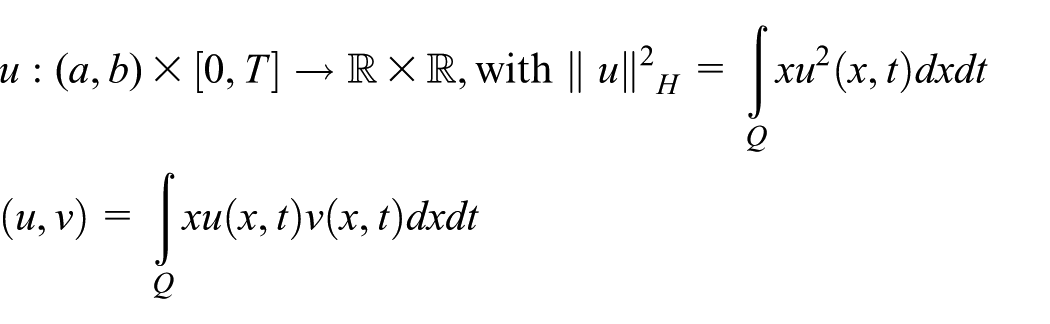
where

For more details, see Atangana and Noutchie. 10 We can rewrite equation (33) in the following form

For L hemicontinuous operator, consider the following hypothesis:
(H1)
(H2) whatever

Theorem 1 (Sufficient condition of convergence)
The MDLDMs applied to the nonlinear singular one-dimensional pseudohyperbolic equation (34) without initial and boundary conditions converge towards a particular solution.
Proof
To verify the convergence of equation (34), we use the definition of our operator L, and we have the following form

therefore

According to the properties of the differential operator

using Cauchy–Schwarz inequality


and

According to Cauchy–Schwarz inequality, where

substituting equations (36)–(41) into equation (35) gives
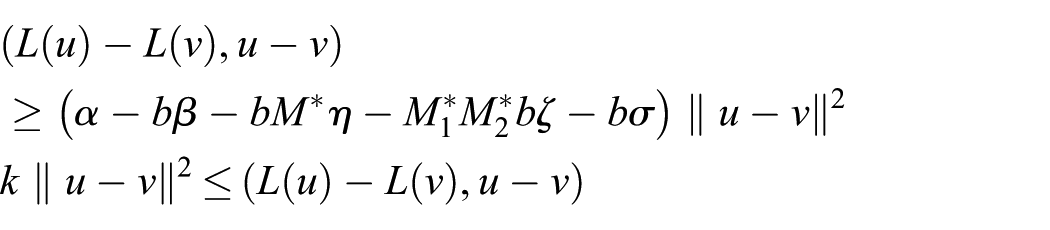
So the hypothesis (H1) holds, where

Now we check the hypotheses (H2) for the operator

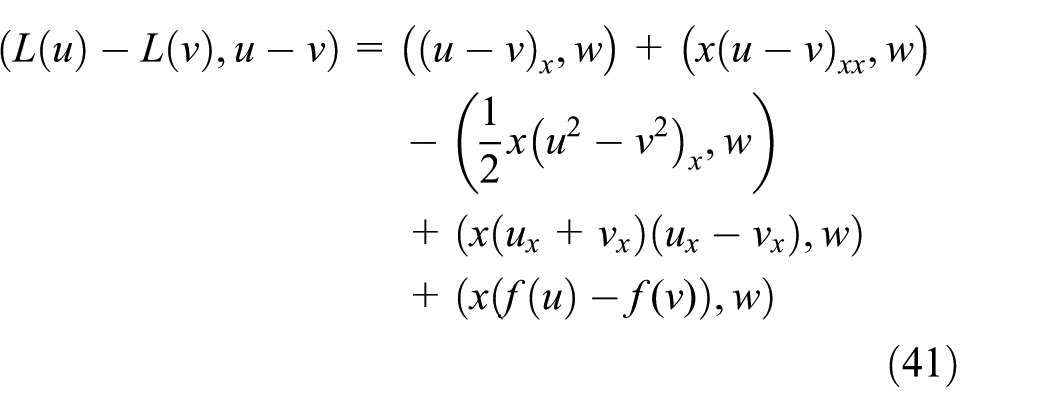
There exist

where

where
Conclusion
Modified double Laplace Adomian decomposition method (MDLADM) has been known to be an efficient and accurate method for solving nonlinear singular one-dimensional parabolic partial differential equation. In this work, we have applied the MDLADM for solving a nonlinear parabolic equation. The method was tested to obtain exact solutions in two examples.
Footnotes
Academic Editor: Ramoshweu Lebelo
Declaration of conflicting interests
The author(s) declared no potential conflicts of interest with respect to the research, authorship, and/or publication of this article.
Funding
The author(s) disclosed receipt of the following financial support for the research, authorship, and/or publication of this article: The authors would like to extend their sincere appreciation to the Deanship of Scientific Research at King Saud University for funding this research (group no. RG-1435-043).