




Abstract
In this article, the residual power series method is used to solve time-fractional Fisher equation. The residual power series method gets Maclaurin expansion of the solution. The solutions of present equation are computed in the shape of quickly convergent series with quickly calculable fundamentals using mathematica software package. Explanation of the method is given by graphical consequences and series solutions are made use of to represent our solution. The found consequences show that technique is a power and efficient method in conviction of solution time-fractional Fisher equation.
Introduction
Important care has been assigned to the work of the fractional calculus during the last few decades and its numerous utilizations in the physics, regular variation in biophysics, thermodynamics, blood flow phenomena, viscoelasticity, electrical circuits, aerodynamics, astrophysics, biology, control theory, and so on.1–4 However, fractional derivatives supply an important implement for the definition of recollection and hereditary characteristics of different necessaries and treatment. This is the fundamental advantage of fractional differential equations in return usual integer order problems.
Recently, there has been a significant analytical improvement in fractional differential equations and its applications. In the work by Yang et al., 5 researchers applied the local fractional derivative operator for obtaining the non-differential solution for diffusion equation in fractal heat transfer; in the work by Gao et al., 6 the exact solution for the local fractional diffusion equation in fractal one-dimensional space is obtained; in the work by Yang et al., 7 the analytical solutions of the sub-diffusion and wave equations are obtained by utilizing the local fractional variational iteration method; in the work by Gao and Yang, 8 the local fractional Euler’s method is applied to obtain numerical solution for the local fractional heat-relaxation equation; in the work by Yang et al., 9 authors analyzed the exact traveling wave solutions for local fractional Korteweg–de Vries (KdV) equation; in the work by Yang et al., 10 the exact traveling wave solutions for the local fractional two-dimensional Burgers-type equations are investigated, and in the work by Zhang et al., 11 researchers utilized the series expansion method within local fractional derivative to obtain the solutions of homogeneous and non-homogeneous transport equations, respectively. For some articles and books on fractional differential and fractional calculus equations, see Baleanu and colleagues12–14 and the references therein.
In this study, we apply residual power series method (RPSM) to find powerful series solution for a nonlinear problem. The new method supplies the solution in the shape of a convergence series. A repeated algorithm is constituted for the designation of the infinite series solution. The RPSM was developed as an efficient method for fuzzy differential equations. 15 It has been successfully put into practice to handle the approximate solution for generalized Lane–Emden equation, 16 the solution of compound and non-compound fractional differential equations, 17 predicting and representing the profusion of results to boundary value issues of fractional order, 18 constructing and forecasting the solitary arrangement solutions for nonlinear time-fractional advance partial differential equations, 19 the comparative solution of the nonlinear fractional KdV–Burgers equation, 20 the comparative solutions of fractional population diffusion model, 21 and the numerical solutions of linear non-homogeneous partial differential equations of fractional order. 22 The introduced method constitutes a comparative solution in the shape of a polynomial. Contrary to Taylor series method, RPSM needs small calculational condition with high certainty and less time at older orders. RPSM is a preference process for getting consistent Maclaurin series solution of problems.
The base purpose of our work is to present practice of RPSM in the touch of the Caputo fractional differential to examine and establish an approximate solution of the space-time-fractional order Fisher equation 23

In above equation,
Time-fractional Fisher equation can be readily solved by many methods. In the work by Rida et al., 24 an accurate algorithm for the solution of special conditions is developed and differential transform method is used. Khan et al. 25 used homotopy perturbation approach in order to find the comparative solutions of time-fractional Fisher equation. Sungu and Demir 23 applied generalized differential transform and finite difference method for numerical solutions of the equation. Baranwal et al. 26 and Merdan 27 used fractional variational iteration method for series solutions of proposed equation.
In section “Some necessary definitions and results from fractional calculus” of this work, some preliminary results related to the Caputo derivative and the fractional power series (PS) are described. In section “Solution of the time-fractional Fisher equation with RPSM algorithm,” base opinion of the RPSM is constituted to construct the solution of the time-fractional Fisher equation (1). In section “Graphical results of the RPSM,” some graphical consequences are included to demonstrate the reliability and efficiency of the method. Moreover, consequences are introduced in section “Final remarks.”
Some necessary definitions and results from fractional calculus
Below, we first illustrate the essential descriptions and various features for the fractional algebra theory. 2
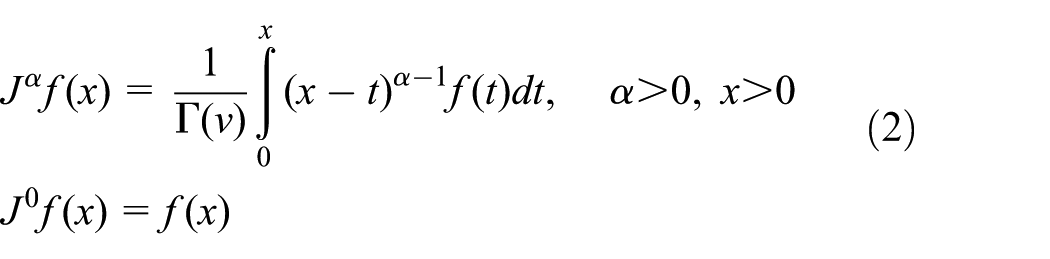
Definition 1
From El-Ajou et al.,17,20 the fractional integral operator Riemann–Liouville with order
Definition 2
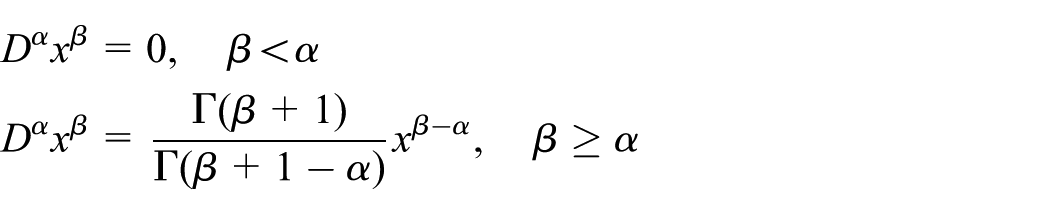
The Caputo fractional derivative with order

where
By the Caputo derivative, we get
Definition 3
For n to be the smallest integer that exceeds
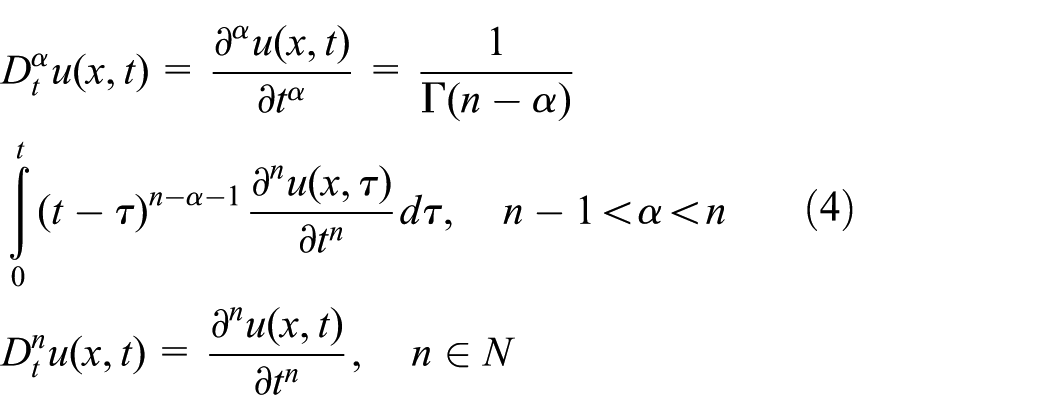
and the space-time-fractional differential with order

Definition 4
A PS expanding of the manner

is named fractional PS at
Definition 5
A PS of the form

is named fractional PS at
Theorem 1
Only

If

where
Result 1
The fractional PS expanded of
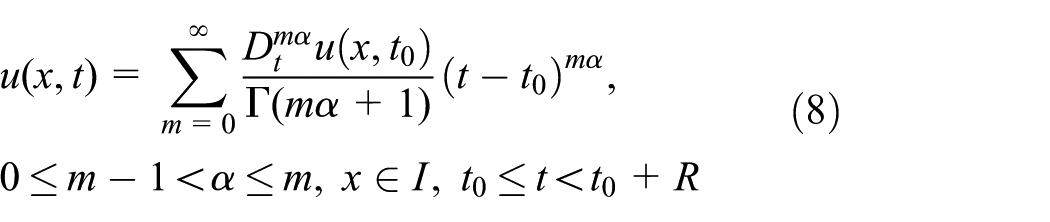
which denotes a generalized Taylor’s series expression. To particularize, if one sets

is obtained. 20
Solution of the time-fractional Fisher equation with RPSM algorithm
First, we study the time-fractional Fisher equation

by the initial condition

Therefore, we study procedure of the RPSM to ascertain series solution for our time-fractional Fisher equation dependent on given initial conditions by replacing its fractional PS expanded with its truncated residual function.
The RPSM proposes the solution for equations (9) and (10) with a fractional PS at point

Next, we let

where
Besides, equation (12) may be reported by

At first, to find the value of coefficients

and the kth residual function
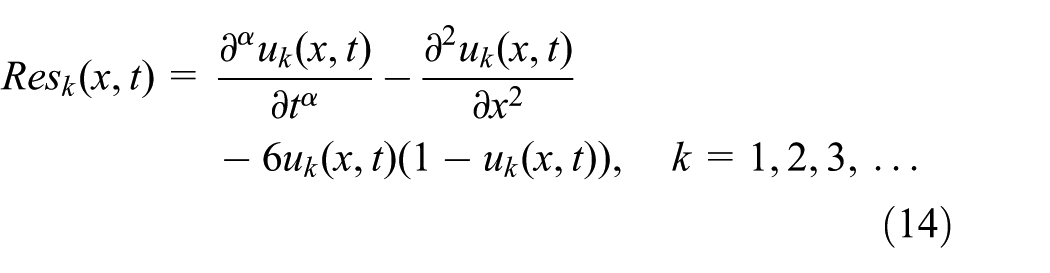
As in Abu Arqub and colleagues,15–18 it is clear that
Then,

to obtain the needed coefficients
Hence, to determine

where

for

Therefore

From equation (15), we deduce that

Therefore

Likewise, to determine the shape of the second unnamed coefficient

where

Therefore

From equation (15), we deduce that

Therefore

Similarly, to determine

where
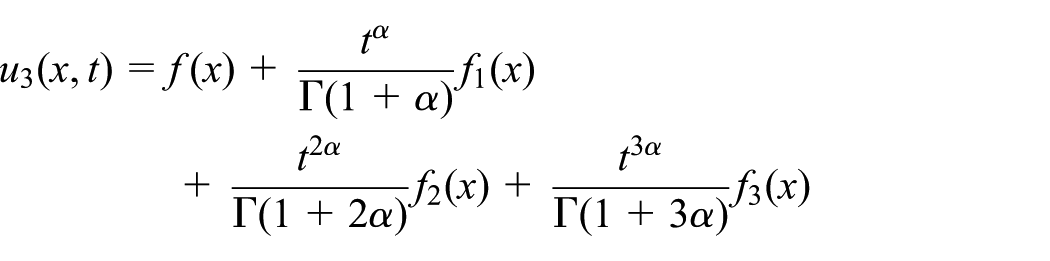
Therefore
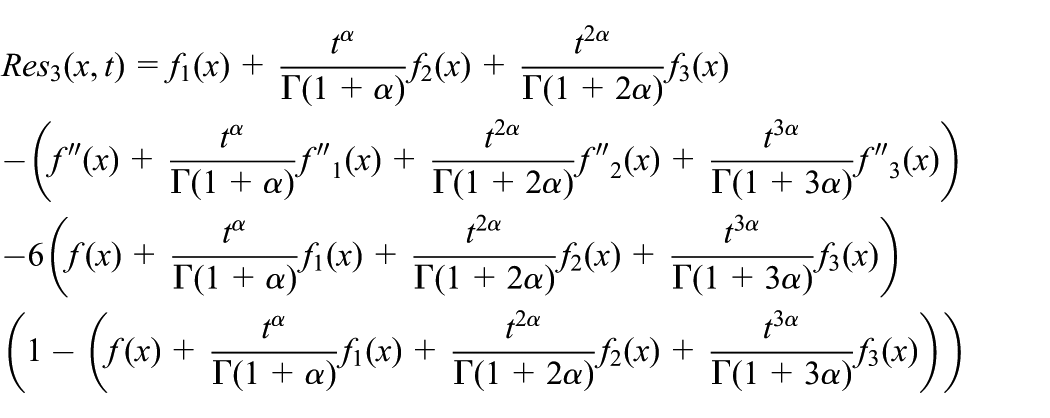
From equation (15), we deduce that

Therefore

Likewise, employing the similar operation for

Therefore

To give a deficit overview of the content of our work, in the next section, by the above recurrent connections, we can demonstrate some graphical consequences of equations (1) and (2) in Figures 1–3.
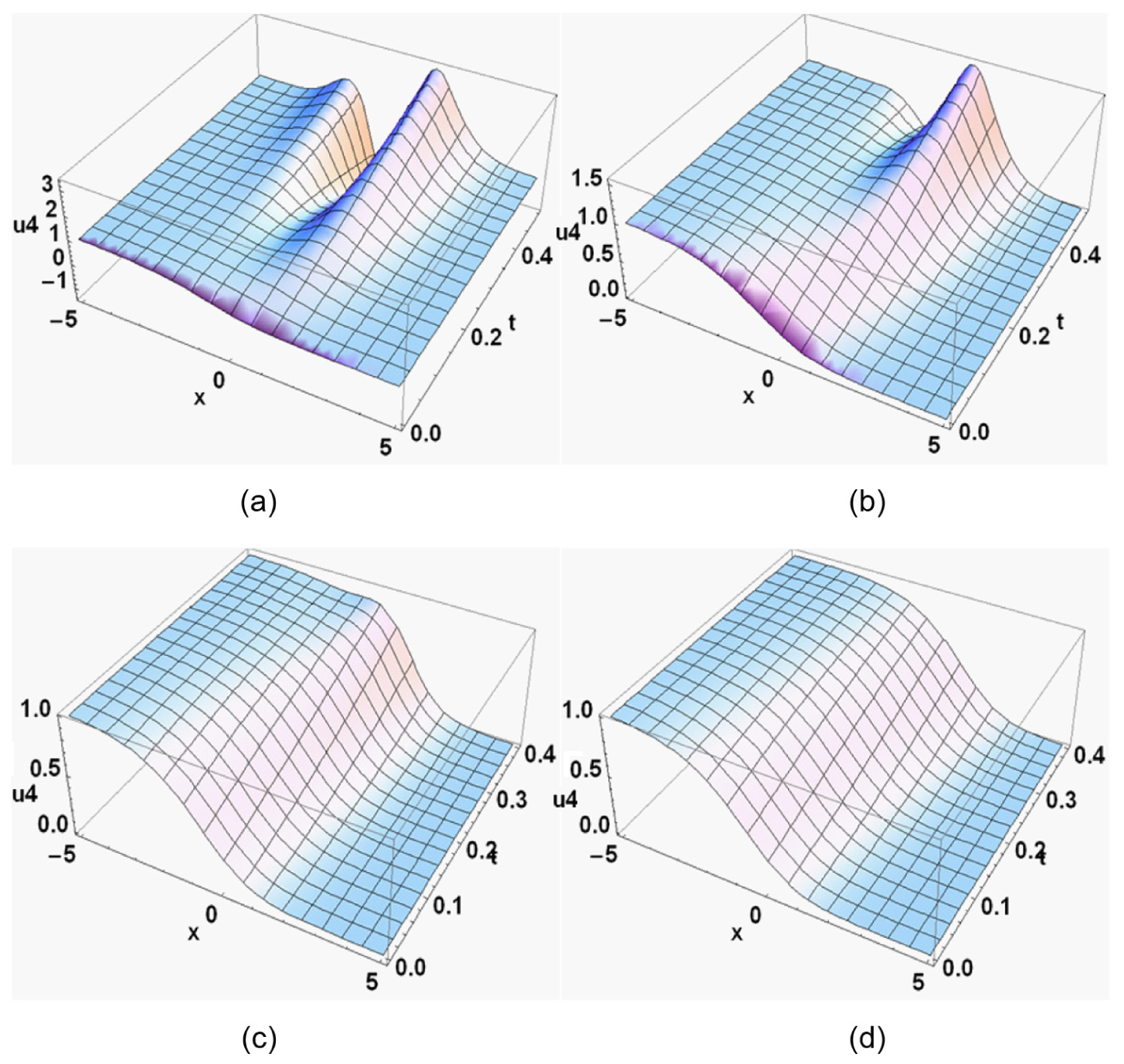
The 3D graphic for the exact solution


Graphical results of the RPSM
Following our considerations in the previous section, we can form graphical consequences of equation

with the initial condition

In Figure 2, we plot the RPS (residual power series) approximate solution
In Figure 3, we plot the RPS approximate solution
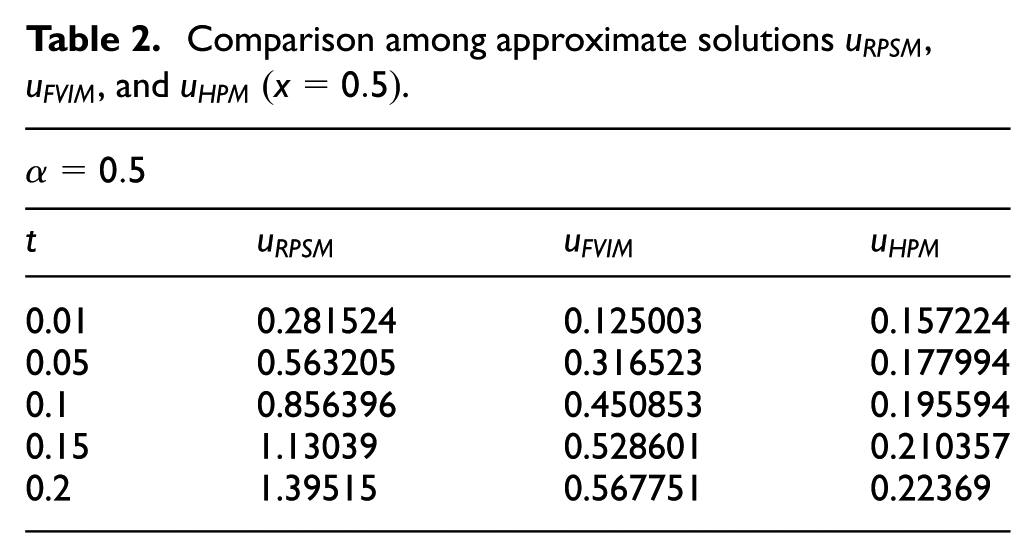
In Tables 1–3, we constitute table of numerical solutions
Comparison among approximate solutions

Comparison among approximate solutions
Comparison between approximate solution
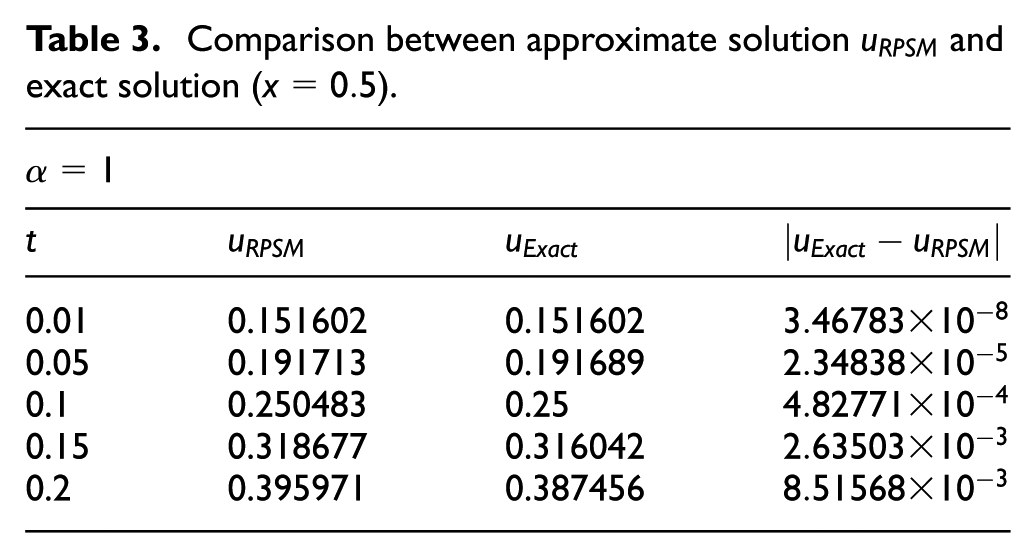
Tables 1–3 clarify the convergency of the approximate solutions to the exact solution and exact error is smaller as the value of the t decreases.
Final remarks
The fundamental objective of this article is to introduce an algorithmic form and implement a new analytical repeated algorithm derived from the RPS to find numerical solutions for nonlinear time-fractional Fisher equation. The approximate solution is given in the shape of PS. Graphical and numerical consequences are introduced to illustrate the solutions. The consequences found using the RPSM are very active and appropriate in general conditions with less calculational work and time. It has been established that the structure of this RPSM obsesses a very fast convergent series with easily calculable components using symbolic calculation software. The article stressed our notion that the introduced process can be applied as an instead to get analytic solutions of different kinds of fractional linear and nonlinear partial differential equations practiced in mathematics, physics, and engineering.
Footnotes
Academic Editor: Xiao-Jun Yang
Declaration of conflicting interests
The author(s) declared no potential conflicts of interest with respect to the research, authorship, and/or publication of this article.
Funding
The author(s) disclosed receipt of the following financial support for the research, authorship, and/or publication of this article: This work was funded by the International Scientific Partnership Program ISPP at King Saud University (ISPP# 63).