




Abstract
In this work, a powerful iterative method called residual power series method is introduced to obtain approximate solutions of nonlinear time-dependent generalized Fitzhugh–Nagumo equation with time-dependent coefficients and Sharma–Tasso–Olver equation subjected to certain initial conditions. The consequences show that this method is efficient and convenient, and can be applied to a large sort of problems. The approximate solutions are compared with the known exact solutions.
Keywords
Introduction
Partial differential equations can define a number of physical problems in different fields of science. These linear and nonlinear problems play important roles in applied science. There are many analytical approximate methods to solve problems in the literature such as the homotopy analysis method proposed by Liao,1,2 the variational iteration method proposed by He,3,4 and homotopy perturbation method.5,6 Among these, residual power series method (RPSM) is a new algorithm.
The RPSM was developed as an efficient method for determining values of coefficients of the power series solution for fuzzy differential equations. 7 The RPSM is constituted with a repeated algorithm. This method is effective and easy to obtain power series solution for strongly linear and nonlinear equations without linearization, perturbation, or discretization. Unlike the classical power series method, the RPSM does not need to match the coefficients of the corresponding terms and a repeated relation is not required. This method calculates the coefficients of the power series by a chain of algebraic equations of one or more variables. Besides, the RPSM does not require any converting while changing from the higher order to the lower order; thus, the method can be applied directly to the given problem by choosing an appropriate initial guess approximation.
It has been successfully put into practice to handle the approximate solution of the generalized Lane–Emden equation, 8 the solution of composite and non-composite fractional differential equations, 9 predicting and representing the multiplicity of solutions to boundary value problems of fractional order, 10 constructing and predicting the solitary pattern solutions for nonlinear time-fractional dispersive partial differential equations, 11 the approximate solution of the nonlinear fractional KdV–Burgers equation, 12 the approximate solutions of fractional population diffusion model, 13 and the numerical solutions of linear non-homogeneous partial differential equations of fractional order. 14 The proposed method is an alternative process for getting analytic Maclaurin series solution of problems. This method has proved to be powerful and effective, and can easily handle a wide class of linear and nonlinear problems.
The purpose of this work is to employ RPSM to obtain the numerical solution for generalized Fitzhugh–Nagumo equation (FNE) with time-dependent coefficients 15 and Sharma–Tasso–Olver equation (STOE). 16 Nonlinear time-dependent generalized FNE is given by 15

subjected to the initial condition

Using specific solitary wave ansatz and the tanh method (TanhM), new variety of soliton solutions are introduced in Triki and Wazwaz. 15 Bhrawy 17 applied the Jacobi–Gauss–Lobatto collocation method to solve the generalized FNE. In recent years, many physicists and mathematicians have paid much attention to the FNE on account of its importance in mathematical physics.18–23
The following nonlinear equation is obtained

where
The outline of the remainder of this article is as follows. In section “Numerical applications of the RPSM,” we present some properties of RPSM and its numerical applications for generalized FNE with time-dependent coefficients and STOE. Section “Graphical results” shows formed graphics and drew tables for the reliability of obtained solutions. Finally, some concluding remarks are given and graphics are formed in section “Conclusion.”
Numerical applications of the RPSM
In this section, we apply RPSM to solve the above-proposed equations.
Time-dependent generalized FNE
Consider generalized FNE with time-dependent coefficients (1.1) and (1.2).
The exact solution for equation (1.1) is 15

We apply the RPSM to find out series solution for this equation subjected to given initial conditions by replacing its power series expansion with its truncated residual function. From this equation, a repetition formula for the calculation of coefficients is supplied, while coefficients in power series expansion can be calculated repeatedly from the truncated residual function.9,30
Suppose that the solution takes the expansion form

Next, we let

where
Equation (2.2) can be written as

First, to find the value of coefficients

and the kth residual function,

As in Abu Arqub and colleagues,7–10 it is clear that

where

for

From equation (2.5), we deduce that

Therefore, the 1st residual power series (RPS) approximate solutions are

Similarly, to find out the form of the second unknown coefficient,

in

Therefore, the 2nd RPS approximate solutions are

Similarly, we write

in
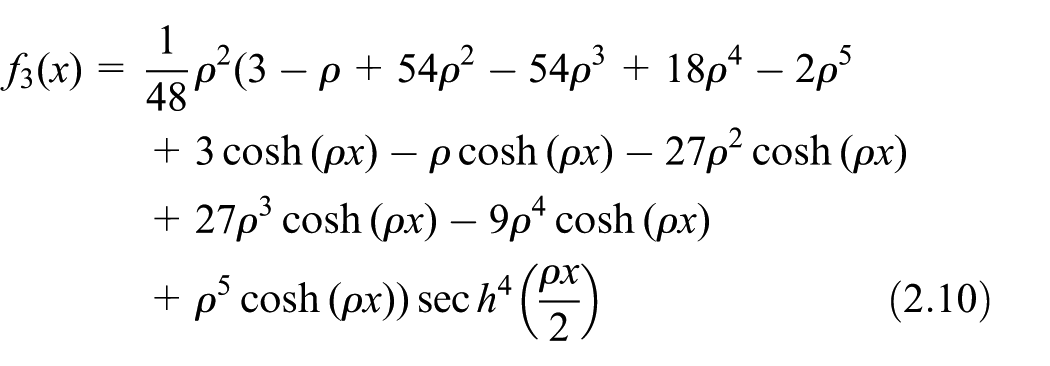
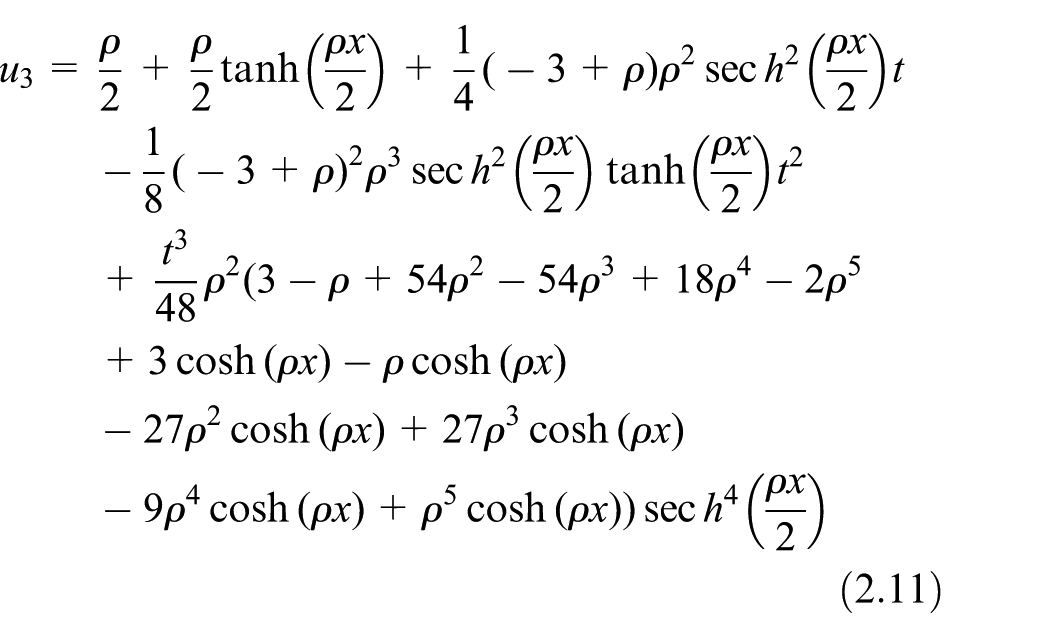
Therefore, the 3rd RPS approximate solutions are
STOE
Consider equation (1.3) with the initial condition 16

The exact solution for equation (1.3) is 16

We apply the RPSM to find out series solution for this equation. Suppose that the solution takes the expansion form

where uk is the truncated series of u

where
To find the value of coefficients

and the kth residual function,

To determine

where

for

From equation (2.15), we deduce that

The 1st RPS approximate solutions are

Similarly, to find out the form of the second unknown coefficient,

in

Therefore, the 2nd RPS approximate solutions are

Similarly, we write

in

Therefore, the 3rd RPS approximate solutions are

and


Graphical results
In this section, we formed graphics and drew tables for the reliability of above-obtained solutions.
Figures 1–4 show that the exact error is smaller as the number of k increases. It is clear that the value of

Surface graph of the RPS approximate solution and exact solution for equation (1.1) (


Surface graph of the RPS approximate solution and exact solution for equation (1.3) (

Tables 1 and 2 clarify the convergence of the approximate solutions to the exact solution.
Comparison between RPS approximate solution

Comparison between RPS approximate solution
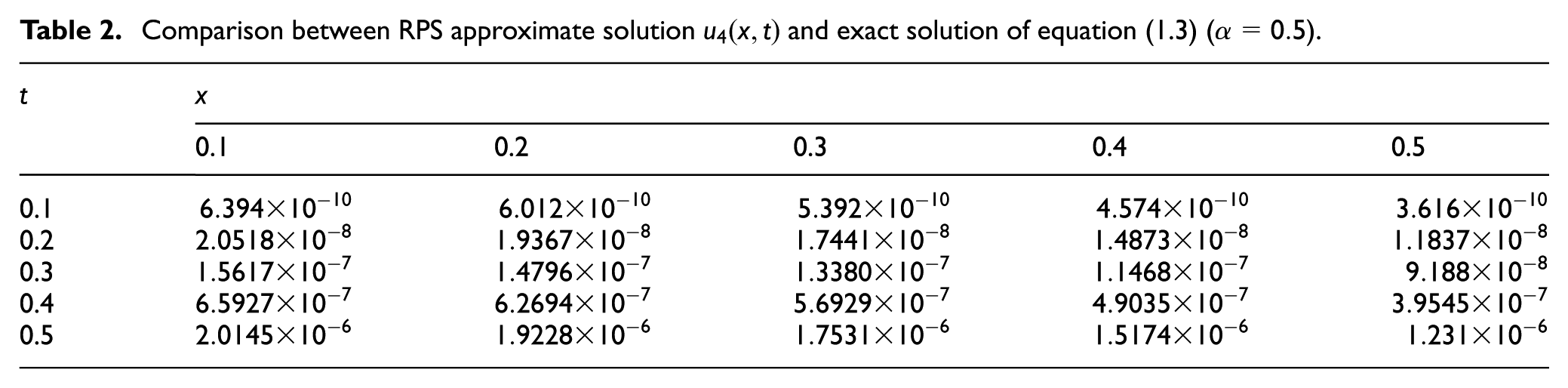
In Tables 3 and 4, comparison is made among approximate solutions with known results. These results are obtained using RPSM and TanhM. 15
Comparison between solutions

Comparison between solutions
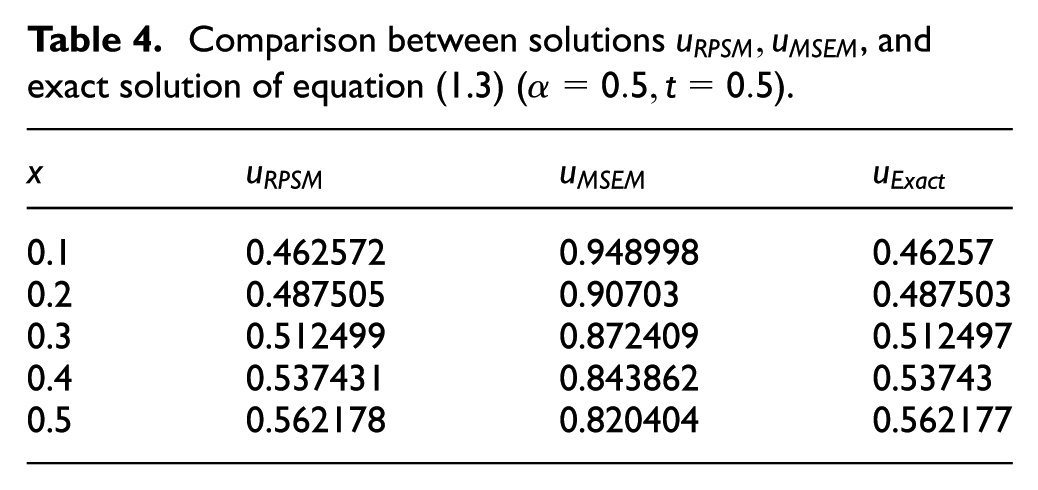
A comparison is made among approximate solutions with known results. These results are obtained using RPSM and the modified simple equation method (MSEM). 16
Conclusion
The RPSM is applied successfully for solving the generalized FNE with time-dependent coefficients and STOE for certain initial conditions. The fundamental objective of this article is to introduce an algorithmic form and implement a new analytical repeated algorithm derived from the RPS to find numerical solutions for the FNE and STOE. Graphical and numerical consequences are introduced to illustrate the solutions. Thus, it is concluded that the RPSM becomes powerful and efficient in finding numerical solutions for a wide class of nonlinear differential equations. The consequences emphasize the power of RPSM in handling a wide variety of nonlinear problems. The RPS does not require linearization, perturbation, or discretization of the variables, it is not impressed estimate of errors, and it is not confronted with necessity of large calculator memory and time. The main advantage of this method is the simplicity in calculating the coefficients of terms of the series solution using only the differential operators.
Footnotes
Acknowledgements
The authors would like to express their sincere gratitude to the referees for the valuable suggestions to improve the paper.
Academic Editor: José Tenreiro Machado
Declaration of conflicting interests
The author(s) declared no potential conflicts of interest with respect to the research, authorship, and/or publication of this article.
Funding
The author(s) disclosed receipt of the following financial support for the research, authorship, and/or publication of this article: This research project was supported by a grant from the “Research Center of the Center for Female Scientific and Medical Colleges,” Deanship of Scientific Research, King Saud University. The authors are thankful for the support by the Visiting Professor Program at King Saud University.