




Abstract
With the accelerated process of urbanization and traffic development, especially the urban rail transit system’s great improvement, Park-and-Ride provides an effective mode for trips between suburbs and downtown. In this research, online and field survey is carried out on the use of Park-and-Ride facilities. Analyses are conducted on personal attributes containing gender, age, and income; the travel characteristics such as driving time during departing from origin to parking lot, parking duration, transfer mode, transfer walking time and waiting time, and transfer times; Park-and-Ride users’ intentions concerned walking time, waiting time, and time looking for parking space; and reasons for Park-and-Ride trip mode not be chosen. On the basis of decomposition for travel procedures, impedance models for different trip modes including public transport, private car, and Park-and-Ride are built and then the multinomial logit model for choice probability of trip modes and Park-and-Ride demand model is established. After further analysis on the survey data, calibrations and tests for the impedance models above are performed. Finally, a case is shown to demonstrate application of the proposed model.
Introduction
With the accelerated process of urbanization, the resident space is gradually extended to suburbs. The distance between residence and working place is getting longer, and the number of automobile of suburbs is increasing as the improvement of living standards, and it seems that traffic problem is becoming more and more serious. It is shown in suburbs of the United Kingdom that car ownership is above 1 per person for young adults. In addition, suburban public transport coverage is relatively small, which makes inconvenient moving around by public transport. At the same time, it usually has traffic congestion, serious traffic pollution, and expensive parking in urban core area. Therefore, it is reasonable to encourage people driving their own car in suburban area and taking public transport in the center area of city.
Under the background of urban and traffic development, especially the urban rail transit system’s great improvement, Park & Ride (short for P&R below) provides an effective trip mode for travels between suburbs and downtown. Travelers are induced not to enter specific areas by own car but by convenient public transport using P&R facilities, 1 which can relieve urban congestion with no significant reducing of convenience, and would lead the average P&R passenger to increase her driving by 8–15 vehicle kilometers traveled per round trip. 2 Therefore, P&R facilities providing efficient and economic transfer conditions can play a key position role for urban transportation.
Recently, P&R systems have been constructed and widely used gradually in cities such as Beijing, Shanghai, Guangzhou, and Nanjing in China. It is planned in Beijing that 71 P&R facilities will be built completely near subway stations and 21,000 parking spaces can be supplied. 3 In Shanghai, 13 P&R facilities in use form a 3900-parking-space P&R system which has supported 10 rail stations of urban rail transit line 1, 2, 3, 7, 8, 9, 11, and Jinshan railway line. 4 In all, 48 more P&R facilities will be built completely in 2016 in Guangzhou. 5 And in Nanjing, there are 12 P&R facilities distributed around major subway stations of urban rail transit line 1, 2, 3, and 10, and the number is expected to reach 24 in 2017. 6 Most of the existing P&R facilities mentioned above have been fully utilized; however, some of them are not, such as the P&R facility near the Wen-shui-lu subway station in Shanghai, in which 370 parking spaces are provided but only 70–80 of them are used in early peak period; and the P&R facility around the Hai-zhu transfer hub in Guangzhou always has a utilization rate less than 50%. 7 According to the authors’ investigation in Nanjing, the P&R facilities are usually large in scale and well organized, with a high parking space utilization and turnover rate of more than 70%, and in some large P&R facilities such as around Ma-qun or Yuan-tong, the parking space utilization rates are sometimes above 95%, but what is noteworthy is that a significant proportion of the parking is for temporary or for working nearby, but not for transfer. It could be seen that estimating the P&R demand based on the decision process for P&R utilization is one of the main problems to be solved in P&R facilities layout planning.
In recent years, lots of researchers began to pay attention to the problems related to P&R including locations and charges of P&R facilities. Liu et al. 8 built a competitive railway/highway system with P&R service in a corridor in which commuters choose between the drive only alternative and the P&Rs located continuously along the corridor to characterize the equilibrium mode choice. Holguin-Veras et al. 9 developed analytical formulations to gain insight into the optimal location under potential demand maximization and to estimate a parabolic approximation to the catchment area for a given P&R site. Syed et al. 10 investigated traveler response to the introduction of parking user fees at heavily patronized park-and-ride facilities within the San Francisco Bay Area Rapid Transit (BART) District of California. In their research, the primary finding was that introduction of daily parking fees did not cause significant changes in access mode choice, facility location, or line-haul mode of park-and-ride users. 10 Kono et al. 11 assess travelers’ responses to the use of existing P&R services based on an economical welfare maximization approach, and they considered that P&R choice is not only influenced by parking fees but also by the fares and other attributes of alternative transportation modes.
Aimed at P&R trip mode choice behavior analysis, Xiong et al. 12 focused on the private cars visitors from Yangtze River delta and investigated the influences of the park policy and service level factors on the P&R choice behavior. According to the stated preference (SP) survey results and disaggregated theory, a Logit model about P&R behavior was built. 12 Eric and Ilona 13 conducted a stated choice experiment that included P&R, car, and public transport alternatives and established disaggregate mode choice models to analyze the travel choice behavior. Liu et al. 8 proposed a deterministic continuum equilibrium model to characterize commuters’ modal choices and P&R transfer behaviors. In the research, they proved that, at equilibrium, the variable travel cost per unit distance on the highway was not higher than that on the railway along the corridor. 8 Yun et al. 14 performed revealed preference (RP) and SP surveys of car drivers’ and public passengers’ mode choice behaviors in typical P&R transfer station in Shanghai and established two individual binary logit models for P&R under smooth traffic state and congested state. He et al. 15 did an onsite face-to-face survey in Nanjing, China. They found that the drivers with higher income and more years of driving experience would less likely use P&R facilities while higher congestion level and parking fees would increase the odds of using P&R facilities, while the gender and age of the drivers, tolls, expenditure on gasoline, driving stress, and familiarity to the roads did not have significant impacts on the use of P&R facilities. 15 Clayton et al. 16 presented the findings of a comparative empirical case study based on a field survey of city centre car parks and P&R users conducted in the city of Bath, UK; what’s more, radial distance to parking, availability of P&R sites in the direction of travel, gender, age, income, and party size were found to be important factors in a binary logistic regression model, explaining the RP of parking type. Qin et al.17,18 analyzed the decision-making behavior of P&R from a psychological point of view. Correlation analysis in their researches showed that the influencing factors of age, whether the travelers have ever used P&R, and decision time highly correlate with decision strategy choice.17,18 Islam et al. 19 investigated the mode change behavior of P&R users by a questionnaire containing RP and SP questions. They found that travel time taken by transit vehicle and transfer time at P&R stations were the primary factors affecting individuals’ decision on choosing public transport, whereas parking fare is the additional factor affecting commuters’ choice of driving. 19
For demand forecasting of P&R, Hole 20 used Stated Choice data to forecast the demand for an employee P&R service. The research showed that the modal shift away from parking on site would be small unless the new service was accompanied by measures aimed at making parking on site less attractive such as introducing parking charges. 20 Vincent and Hamilton 21 suggested demand modeling methodologies based on the characteristics of P&R usage for changes in demand at existing sites, and estimation of demand at new sites, and finally applied the methodologies to a New Zealand situation. Gong 22 set up disaggregate structural equation modeling (SEM) for peripheral P&R facilities’ demand forecast based on the analysis of the personal characteristics, activity, and modes choice of the travelers in the attractive area of peripheral P&R facilities and the zone’s road level. Holguin-Veras et al. 9 indicated that demand area of P&R followed an ellipse-like figure, the area enclosed by the limiting functions increased with the transit level of service (LOS) and trip distance, and so did the corresponding catchment areas. Qin 7 had conducted a P&R demand survey, established P&R demand distribution model, and analyzed the demand intensity within the catchment area of P&R facilities. Besides, reference for location, layout, planning, and design of P&R facilities had been provided by the author. 7
In this study, surveys of P&R users and non-P&R users are carried out based on two different questionnaires, thus the influences of personal attributes including gender, age, and income, and travel characteristics such as trip cost and travel time on the choice P&R mode are tested. Then, a behavior decision model for P&R facilities is developed. Specifically, on the basis of an online and field questionnaire survey of travelers, weights of influence factors such as fees for parking, comfort degree, walking time, and waiting time are quantified in the impedance model. It is namely that travelers’ preference on trip modes including P&R, private car, and public transport could be acquired by contrasting the impedance values.
Survey on P&R demand
Methodology
In this research, two different questionnaires for P&R users and non-P&R users are designed based on analyzing the significant factors of parking demand and the affected range of transfer facilities. The two questionnaires both contain three parts, among which the first part focuses on personal attributes, including gender, age, and monthly income, and in the second part, the travel characteristics which contains origin and destination, trip mode, parking lot, driving time during departing from origin to parking lot, parking duration, the time looking for a parking space, transfer mode, transfer walking time and waiting time, transfer times, and total travel time need to be answered. Aimed at P&R users, the intentions including reasons for choosing P&R, attention on P&R, the feelings of crowding degree in public transport, attitudes on walking time, waiting time, and the time looking for parking space are investigated in the third part. While aimed at non-P&R users, the third part is about the reasons of not choosing the P&R mode. Besides, the survey is raised online, as field survey for supplementary.
For the online survey, a number of residential areas surrounding P&R facilities in Nanjing such as Tian-run-cheng in Pukou District and Bai-shui-jia-yuan in Qixia District are selected as target areas. Questionnaires are sent out through residential property owners chatting groups. Based on the recovering of questionnaires, related travel information of both P&R users and non-P&R users can be acquired.
The field survey is taken as a data supplement to the online survey. Three P&R facilities, Anheqiao North and Tiantongyuan North in Beijing and Maqun in Nanjing, are selected to carry out distribution and recovering of questionnaires. Only P&R users are taken to be respondents.
Data analysis
A total of 242 questionnaires are recollected totally, and 220 of them are valid, including 105 for P&R users and 115 for non-P&R users. After analyzing on the questionnaires, some differences are raised between P&R users and non-P&R users according to gender, ages, earnings, and so on. Some travel characteristics of P&R users and the reasons that P&R mode not be chosen are also raised in this part.
Personal attributes
Analyzing according to gender, ages, and incomes between P&R users and non-P&R users is based on Table 1.
Descriptives of P&R users and non-P&R users.
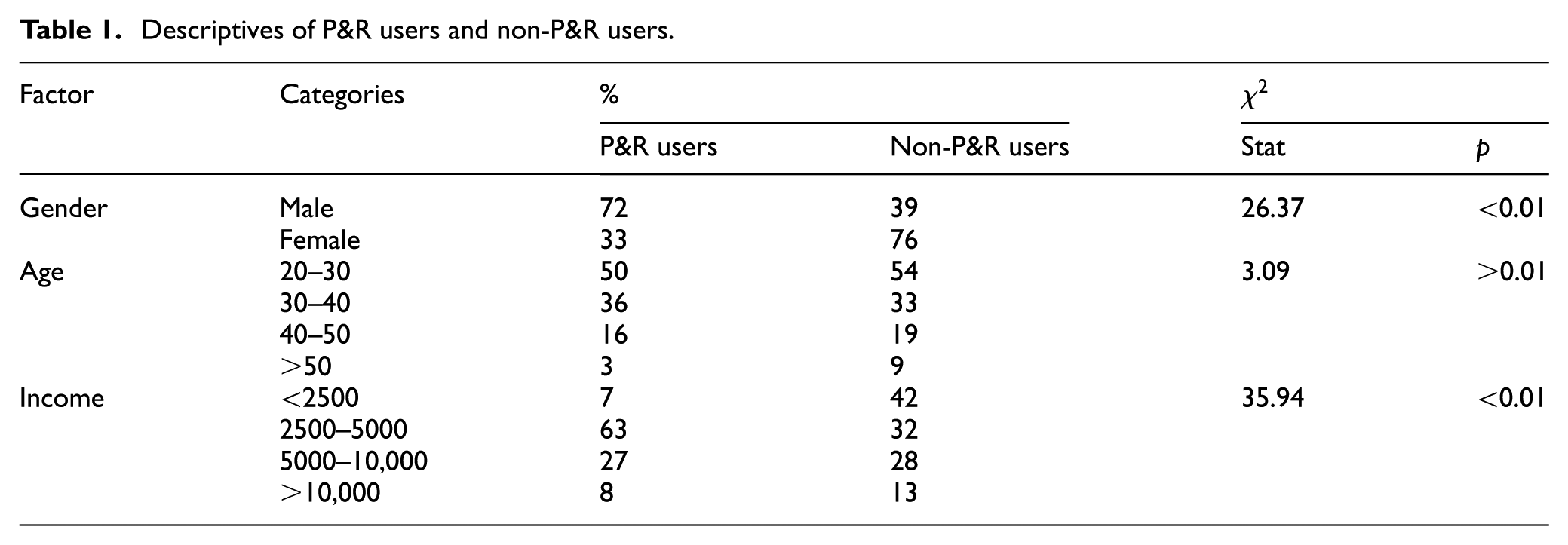
The chi-square test is taken to explore which of the above factors contribute to explaining the choice of P&R trip mode. The test result is shown in Table 1. There are big differences (p < 0.01) in gender proportion among P&R users and non-P&R users: 69% of P&R users are male, and 66% of travelers not using P&R facilities are female, that is to say, males prefer to use P&R facilities more than females. Respondents are aged between 21 and 50 years, and there is no obvious preference to use or not use P&R facilities by different age groups. With respect to income distribution, 85% of P&R users have a monthly income between 2501 and 10,000 yuan, while the non-P&R users’ monthly incomes are more likely less than 2500 or higher than 10,000. Based on the p value of income, it can be assumed that consumption habits are also important factors influencing the choice of trip mode.
Travel characteristics of P&R users
Analyzing the distributions of driving time during departing from origin to parking lot, transfer mode, transfer walking time and waiting time, transfer times, and total travel time of the P&R users are shown in Figures 1–5.

Driving time during departing from origin to parking lot.

Transfer mode.

Transfer walking time and waiting time.

Transfer times.

Total travel time.
Obviously, 66% of P&R users can arrive at parking lot in 15 min from the origins. In all, 80% users prefer urban railway as a transfer mode. Close to 80% users spend less than 10 min on transfer; 91% users transfer one or two times. Total travel time is always less than 2 h.
P&R users’ intentions analysis
The reasons for choosing P&R, attention on P&R, feelings of crowding degree in public transport, attitudes on walking time, waiting time, and the time looking for parking space for P&R users are investigated, which provides basic data for the proposed model.
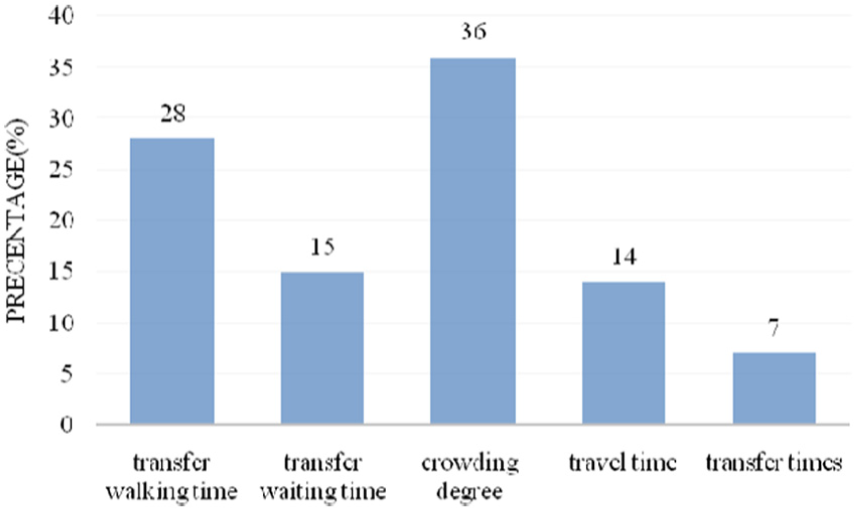
It is shown in Figure 6 that the important reasons for the choice of P&R users include saving time and saving fuel consumption. Other reasons like traffic congestion in urban area, lacking park space at destination, and high fees for destination’s parking also occupy a certain proportion. From Figure 7, it could be seen that the P&R users concern about crowding degree in public transport and transfer walking time more than other conditions on transfer mode. Comparatively, transfer time is not considered as a major factor during the survey. Additionally, the feelings of crowding degree in public transport which is set to be 1, 2, 3, 4, and 5 representing very comfort to very crowd are normally distributed with the average of 3.

Reasons for choosing P&R.
Attention on P&R.
It can be assumed from Figures 8–10 that 85% of the respondents believe that 3.8 min of walking time is short enough, 12 min of walking time is relatively long, and more than 15 min of walking time is the limit of acceptable. At the same time, 85% of the respondents believe that 4 min of waiting time is short enough, 11.6 min of waiting time is relatively long, and more than 15 min of waiting time is the limit of acceptable. Aimed at the time looking for parking space, 85% of the respondents consider that 3.6, 12, and more than 15 min are short enough, relatively long, and the limit of acceptable, respectively.

P&R user’ attitudes on walking time.

P&R user’ attitudes on waiting time.
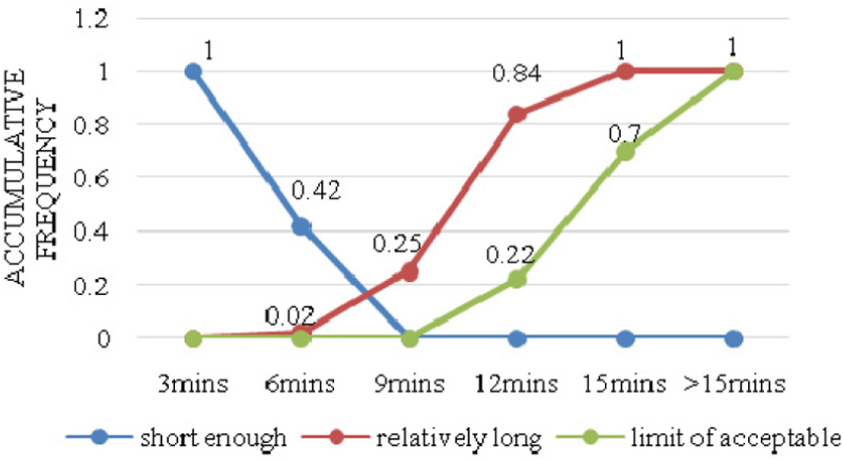
P&R user’ attitudes on time looking for parking space.
Reasons for P&R mode not be chosen
From Figure 11, the main reason for not choosing P&R is the shortage of parking space, which counts for 43% in the survey. Other important reasons include inconvenient transfer and high fees for parking.

Reasons for not choosing P&R.
Model formulation
Trip mode choice model
In this research, public transport, private car, and P&R are alternative trip modes. According to the survey result, the characteristic variables of the model are preliminarily selected. Then, personal characteristics, travel characteristics including time and cost, and comfort level are confirmed to be the factors affecting mode choice after trial operation. Table 2 shows the variables and corresponding meanings in the trip mode choice model. It is noted that traveler’s tolerance level for walking time, waiting time, and time looking for parking space are similar as shown in Figures 8–10. Therefore, the three kinds of time are set to be one variable, while the time on private car or public transport is set to be another variable. Then, the choice probability of P&R trip mode can be calculated by comparing the impedance of each trip mode.
Trip mode choice model variables and corresponding meanings.

Impedance in public transport trip mode
The impedances of public transport trip mode contain the following: SEX is the sex of traveler; INC is the income of traveler; AT is the walking time during departing from origin to reaching public transport site, the walking time during departing from public transport site to reaching destination, and the waiting time for public transport, min; VT is the travel time by public transport, min; TC is the cost for public transport, yuan; CD is the traveler’s feeling of crowding degree in public transport; and TT is transfer times. So the impedance of public transport trip mode can be expressed as below

Impedance in private car trip mode
The impedances of private car trip mode contain the following: CON is the constant term; VT is the driving time during departing from origin to reaching destination parking lot, min; AT is the time looking for parking space and the walking time during departing from public transport site to reaching destination, min; and TC is the cost for fuels, tolls, and parking, yuan. So the impedance of private car mode can be expressed as below

Impedance in P&R trip mode
The P&R trip mode can be divided into three steps: driving from origin to P&R facilities, transferring between different public transports, and traveling from public transport site to destination. The impedance in the first step contains the following:

where
In summary, the impedance model can be expressed by the following equations

where k = 1,2,3 represent modes of public transport, private car, and P&R.
The multinomial logit model
The multinomial logit model is applied to calculate the choice probabilities of trip modes based on the impedance models above

where
P&R demand model
The travel demand for each mode is calculated on the basis of distribution rate above

where
In addition, the developing factor is considered for parking facilities demand, which can be expressed as follows

where Q is the parking demand of P&R facilities,
Model calibrations and test
For model calibration, the maximum likelihood function definition and Newton–Raphson method is applied to estimate the parameters. The results are listed in Table 3.
Calibration result of the model and t-test.
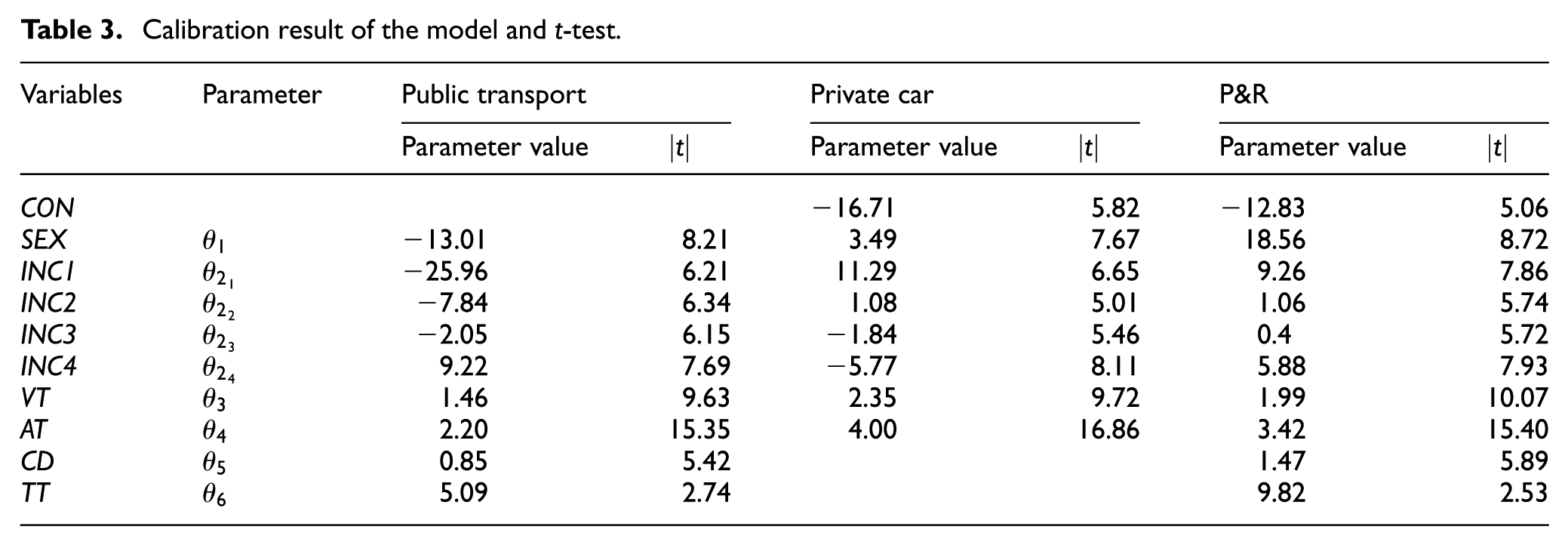
T-value, hit ratio, and McFadden determination coefficient are selected as indices in this research. T-value can judge whether a single variable significantly affects the trip mode choice result or not. Hessian matrix calculation is made to conduct t-value test. It could be observed from Table 3 that t absolute values of all parameters are greater than 1.96, which demonstrates that all variables do affect the choice of trip modes on the confidence level of 95%. Then, the hit ratios of each trip mode solved by the proposed model are 84.3%, 81.8%, and 86.5%, respectively. And generally, it could be considered a good result for hit ratios greater than 80%. Finally, the whole degree is judged by R2 covering 0–1 and the value approaching to 1 show the better goodness of fit. For the proposed model, the McFadden determination coefficient of
Case analysis
A P&R radiation area with about 2000 travel demands daily is chosen for validating the proposed models. The values of variables participated in computing are shown in Tables 4–7. In addition, the distributions of gender, age, and month income are independent of each other.
Travelers’ personal attribute distributions.

Variables values of public transport users’ travel characteristics.

Variables values of private car users’ travel characteristics.

Variables values of P&R users’ travel characteristics.

The impedances for trip modes including public transport, private car, and P&R are estimated according to formulas (1)–(4). Then, the choice probabilities for different trip modes are calculated to be 0.5935, 0.2252, and 0.1813 according to formulas (5) and (6), in which
Thus, based on the proposed models, the predicted parking demand for the P&R facility is acquired under the assumption of known travel demands, travelers’ personal attribute distributions, and variables values of travel characteristics.
Conclusion
With the accelerated process of urbanization and traffic development, especially the urban rail transit system’s great improvement, P&R provides an effective trip mode for trips between suburbs and downtown.
In this research, online and field survey is applied on the use of P&R facilities. Based on 220 valid questionnaires, analyses are conducted on personal attributes containing gender, age and income; the travel characteristics such as driving time during departing from origin to parking lot, time looking for parking space, parking duration, transfer mode, transfer walking time and waiting time, transfer times, and so on; P&R users’ intentions concerned walking time, waiting time, and time looking for parking space; and reasons for P&R trip mode not be chosen. It is found that gender and monthly incomes are important factors influencing the choice of trip mode, while there is no obvious preference to P&R facilities using or not by different age groups. Then, the top three reasons for the choice of non-P&R users are the shortage of parking space, inconvenient transfer, and high fees for parking. The important reasons for the choice of P&R users include saving time and saving fuel consumption. Aimed at the intentions of walking time, waiting time, and time looking for parking space, about 4 min are the values satisfying majority of P&R users.
On the basis of decomposition for travel procedures, impedance models for different trip modes including public transport, private car, and P&R with consideration of travel time, travel cost, and comfort level are built and then P&R demand model based on trip mode choice probabilities is established. After further analysis on the survey data, calibrations and tests for the impedance models are performed. Finally, a case is shown to demonstrate application of the proposed model.
This research provides theoretical basis for setting up P&R facilities. With the help of P&R demand model, it is possible to improve the utilization rate of parking facilities and provide the achievement of sustainable development of traffic.
Footnotes
Academic Editor: Hai Xiang Lin
Declaration of conflicting interests
The author(s) declared no potential conflicts of interest with respect to the research, authorship, and/or publication of this article.
Funding
The author(s) disclosed receipt of the following financial support for the research, authorship, and/or publication of this article: This research was supported by the National Natural Science Foundation of China (Nos 51408190 and 51608171) and the National Science Foundation for Post-doctoral of China (No. 2016M600357).