




Abstract
In view of the thermo-mechanical coupling effect that commonly exists in the loading zone of angular-contact ball bearings while the bearings are operated, several process parameters are analyzed, including coordination condition of thermal expansion–deformation load, interaction relationship of contact stress, friction heat, and temperature raised in the loading zone of bearings. Based on the dynamic method of rolling bearings and finite element analysis method, the thermo-mechanical coupling calculation model of angular-contact ball bearings is established and solved. Based on the model, the influences of coupling effect on temperature field, loading characteristics, and fatigue life of bearings are analyzed. Then, the influence of geometric parameters and working conditions of bearings on the thermo-mechanical coupling effect are discussed. The results show that there are differences in the results of temperature distribution, loading characteristics, and fatigue life while the thermo-mechanical coupling effect is considered or not in the bearings analysis; furthermore, the mentioned differences vary with the different geometric parameters and working conditions.
Keywords
Introduction
High-speed angular-contact ball bearings are commonly used in important fields such as aviation, railway, and precision equipment. Its load-carrying properties and dynamic properties directly relate to the fatigue life, temperature rise, and stability of the bearings. 1 That is why the analysis of its properties and geometric design has attracted a great concern. Prediction on the numerical calculation of rolling bearings is an indispensable analyzing method. There are four developments in the model of analyzing rolling bearings, including statics analysis, quasi-statics analysis, quasi-dynamic analysis, and dynamic analysis; 2 in addition, calculation programs such as BRAIN, BEAST, COBRA, and ADORE have been developed in succession.3–6
In addition, the scuffing on the contact surface becomes more and more common with the high speed and heavy load of bearings; the most important reason is the excessive friction heat and more temperature rise. Thus, the analysis of heat generation and temperature distribution is the other key content on the bearings analysis theory. Many scholars have carried out the research on the thermal properties of angular-contact ball bearings through the theoretical modeling and software simulation.7–9
The analysis method for a single performance, such as dynamic performance or thermal performance, of angular-contact ball bearings has been well developed. 10 However, as a result, the ill-considered coupling effect between thermal and mechanical properties of angular-contact ball bearings in those models, of both dynamic analysis and thermal analysis, are not accurate to the actual situation yet.
Based on the analysis of dynamic and thermal models of angular-contact ball bearings, it can be found that in the thermal and temperature analysis, the heat source depends on the angular-contact ball bearings’ contact and friction characteristics, which should be determined through dynamic analysis method. Meanwhile, the results of thermal and temperature analysis will change the working clearance of ball bearings due to the thermal expansion of bearing element, and affect the contact characteristics of bearings, thus the loading and dynamic characteristics.
Therefore, more and more bearings scholars focus their attention on the thermo-mechanical coupling analysis of the rolling bearings. K Yan et al. 11 established a seven-node thermo-deformation coupling model of the spindle-bearing system based on the coupling relationship between temperature rise and bearing deformation with the external load and assembly. Further the accuracy of the model was verified by comparing with the other model’s results and experimental results. W Bian et al. 12 developed a thermo-mechanical coupling model of angular-contact ball bearings through the analysis of thermal deformation, Hertz contact stiffness, and contact angle of bearings. Furthermore, the influence of temperature on contact angle and stiffness of bearings is analyzed based on this model. But the closed-loop analysis of thermo-mechanical coupling is not really formed in this research because this model mainly considers the effect of the thermal properties on the mechanical properties and thus the effect of the mechanical properties on the thermal properties is not deeply analyzed. A Zahedi et al. 13 established a thermo-mechanical coupling model of spindle, indicating that the heat source is mainly from the bearings. Based on this model, deformation and temperature rise of the spindle and the bearing housing were calculated. However, due to the bearing, dynamic analysis in this research was still based on the quasi-static analysis method, and there is a large deviation for the high-speed and light-load rolling bearings. P Zhang and XA Chen 14 developed a thermo-mechanical coupling model of motorized spindle based on the dynamic analysis method. In this model, the dynamic and thermal parameters of spindle, and stiffness of rolling bearings, were considered, and the thermo-mechanical coupling effect of motorized spindle was analyzed from system perspective. This model provided an accurate and reliable analysis method for exploring the dynamic characteristics and thermal properties of spindle system, such as stiffness of bearings and spindle, the temperature rise, and heat expansion of spindle. But this model mainly focused on the performance of the spindle, and the dynamic characteristics of bearings was not involved. Thus, this model does not satisfactorily reference value for failure analysis and life prediction of rolling bearings.
In addition, many researchers also focus on the research of heat transfer of rolling bearings. T Liu et al. 15 theoretically modeled the heat transfer on axial and radial directions for short cylindrical roller bearing and angular-contact ball bearing, thus the thermo-mechanical model is procured and experimentally verified. W Wu et al. 16 investigated the impact of physical configuration of ball bearings on the heat transfer, and thus, the temperature’s variation of high-speed ball bearings and their research, in general, reveal the significance of flow pattern. In addition, VT Than et al. 17 proposed a method to estimate the heat transfer between complicated structures with different materials and experimentally verified it.
In conclusion, in order to provide a more accurate basic data for the failure analysis and fatigue life prediction of the angular-contact ball bearings, the thermo-mechanical coupling model of angular-contact ball bearings is developed in this article. The influence of thermo-mechanical coupling effect on the dynamic and thermal properties is further analyzed.
Modeling and solution of thermo-mechanical coupling of high-speed angular-contact ball bearings
Thermo-mechanical coupling of high-speed angular-contact ball bearings
The external force and designed initial geometric parameters of angular-contact ball bearings are as shown in Figure 1. The outer ring is stationary. Loads and rotation are applied on the inner ring. Assume that the actual geometric parameters of angular-contact ball bearings are (Dai, Dao, Daw, N, αa0, fi, and fo) when external loads (Fx, Fy, Fz, My, and Mz) are applied on the bearings. The parameters Dai, Dao, Daw, and αa0 represent the actual diameter of the inner ring, outer ring, ball, and the actual initial contact angle with the thermal effect, respectively. Parameters N, fi, and fo represent the total number of rolling element, inner curvature factor, and outer curvature factor, respectively. Those actual geometric parameters could be calculated by diameter thermal expansion formula 18 according to the temperature and the designed initial geometric parameters of each element of bearings.
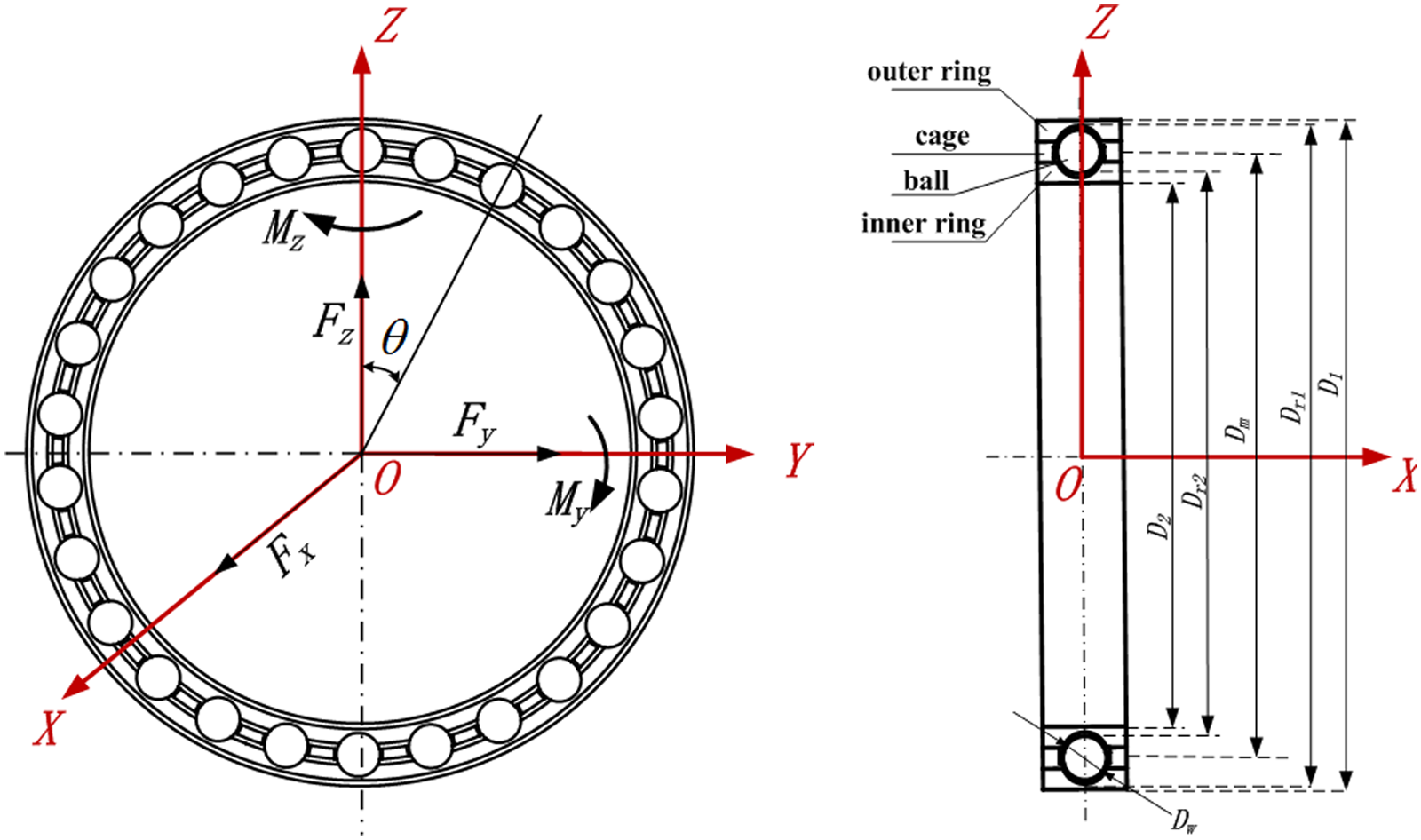
Diagram of angular-contact ball bearings with external loads.
Based on the external load and actual initial geometry parameters, the contact load, contact stress, and sliding velocity in the loading zone of bearings can be first calculated by quasi-dynamic method. 19 Then, the heat generated at a single contact between balls and raceways due to sliding in the short axis direction, heat generated by sliding due to spin motion of balls, and heat generated by lubricant drag acting on balls can be calculated by heat generation equations 10 according to the relevant dynamic parameters which can be calculated by quasi-dynamic analysis. In addition, the heat generated by sliding due to gyroscopic motion of balls and heat generated at a single contact between balls and raceways due to sliding in the long axis direction are ignored, because the gyroscopic motion of balls in the raceway and ball sliding in the long-axis direction of contact area have been reduced greatly in the geometric design. 20
Considering that the rolling element is discretely distributed in the bearings, the heat generation on the contact zone is actually affected by moving heat sources. It means that at the time dt when the ith ball moves onto the contact ellipse, the contact zone is in the continuous heating state. After a time interval T, when the ith ball leaves but the (i+1)th ball does not arrive at the contact ellipse, the contact zone is in the continuous cooling state. The acting time of moving heat sources dt is determined by the width of contact ellipse, the rotation speed of inner ring, and the revolution speed of balls. The period time of moving heat sources T is determined by the total number of balls, the rotation speed of inner ring, and the revolution speed of balls.
Based on the heat generation analysis above, the temperature field of angular-contact ball bearings is further analyzed by ANSYS. In order to simplify the computation, it is assumed that the transient temperature field of the bearings is symmetrically distributed along the axis. Then, the three-dimensional problem is simplified to a two-dimensional problem, and the model is shown in Figure 2.

Analysis model of temperature field of angular-contact ball bearings: (a) solid model and (b) FEA model.
The heat flux on the contact ellipses between ball and raceways can be calculated using equation (1). To the heat source on other contact zones, the heat flux can be calculated by Kannel method 21 which makes the heat to be evenly distributed on the belt surface consisting of contact areas

where H is the total friction heat on the surface of contact pair, A is the contact area, I is the distribution coefficient of friction heat on surface 1 of the contact pair, and subscripts 1 and 2 denominate the contact surfaces 1 and 2, respectively.
According to the thermal conductivity of contact pair material, the convective heat-transfer coefficient, and the velocity of the contact surface, the distribution coefficient of friction heat on surface 1 of the contact pair I can be calculated using equation (2) 22
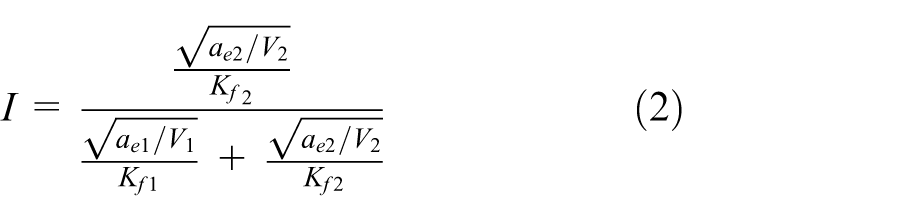
where ae is the convective heat-transfer coefficient, V is the velocity of the contact surface, and Kf is the thermal conductivity of the material.
In addition, there is the forced convection of the lubricant on the interior surface of the bearings’ compartment. And the heat-transfer coefficient in the inner raceway and the outer raceway can be determined using equation (3). 23 Assuming that the heat-transfer coefficient in the inner raceway is h1 and the heat-transfer coefficient in the outer raceway is h2, the heat-transfer coefficient in the other surface can be defined as 2h2 for the surface between the cage and the guiding ring, h1/3 for the shaft’s outer surface and the side of the inner ring, and h2/3 for the side of the outer ring. 21 The heat transfer of outer surface of bearing housing is the natural convection of air, and the coefficient h3 can be determined using equation (4)


where n is the rotational speed of the inner ring; ν is the kinematic viscosity of the lubricant; Dw, Dm, and α are the ball diameter, pitch diameter, and contact angle of bearings; Pr is the Prandtl number of lubricant; Dh is the inner diameter of bearing housing; and Gr is the Grashof number of air.
Solution of thermo-mechanical coupling model of angular-contact ball bearings
The solution procedure of thermo-mechanical coupling model of angular-contact ball bearings is shown in Figure 3. And the solving process can be briefly expressed as follows:
First, through programming in MATLAB, the quasi-dynamic equations are solved by Newton–Raphson algorithm to obtain the contact loads, stress, and relative sliding velocity between the contact pair surfaces.
Next, based on the loading and kinematic characteristics obtained in step 1, heat generation of each heat sources in the bearings is calculated by the model of heat generation.
Then, through programming in APDL on the temperature analysis module of ANSYS, finite element model of temperature field analysis is built and solved based on the thermal data supplied by step 2.
Finally, according to the results of temperature analysis, the actual parameters of elements are modified by radial thermal expansion formula. Return to step 1 with the new values of geometric parameters calculated in step 4.
Repeatedly execute steps 1–4. While the difference in the temperature data obtained by the ith iteration and (i+1)th iteration is less than the setting error, the iteration process will be stopped and the thermo-mechanical coupling analysis is concluded.

Calculation chart of thermo-mechanical coupling model of angular-contact ball bearings.
Model verification
The experiment designed by GC Chen 24 was used to verify the accuracy of the thermo-mechanical coupling model. In this experiment, an angular-contact ball bearing 276927NK1W1(H) with aviation lubrication oil BT301 was used. An axial load of 10,000 N and radial load of 1960 N were applied on the inner ring. The outer ring is stationary and the rotational speed of the inner ring ranges from 6000 to 14,000 r/min. The diameter of spray hole is 0.8 mm and the initial supply pressure of lubrication oil is 0.45 MPa. The environment temperature is 18°C.
Figure 4 shows the results of temperature rise on the outer surface of the bearings’ outer ring determined by experiment and simulation. Simulations under two conditions, considering the thermo-mechanical coupling effect or not, are carried out. It can be seen that there is better agreement between the experimental results and simulation results while considering the thermo-mechanical coupling effect. Furthermore, the relative errors of temperature rise between experimental work and simulation work while considering the thermo-mechanical coupling effect are all lower than 16%, which represents an acceptable level.

Temperature rise determined by simulation and experiment.
According to the comparison results, it can be concluded that the thermo-mechanical coupling model developed in this article is reliable, and this model can be used in further analysis work.
Results and discussions
Take a certain type of angular-contact ball bearings as an example; the results on loading characteristics and thermal characteristics of bearings calculated by thermo-mechanical coupling model and normal model will be compared, and the influences of geometric parameters and working conditions on thermo-mechanical coupling effect will be investigated. Geometric and material parameters are shown in Tables 1 and 2, respectively. The axial load and radial load are 3000 and 2000 N, respectively. The speed of the inner ring is 20,000 r/min.
Geometric parameters of angular-contact ball bearings.

Material parameters of angular-contact ball bearings.
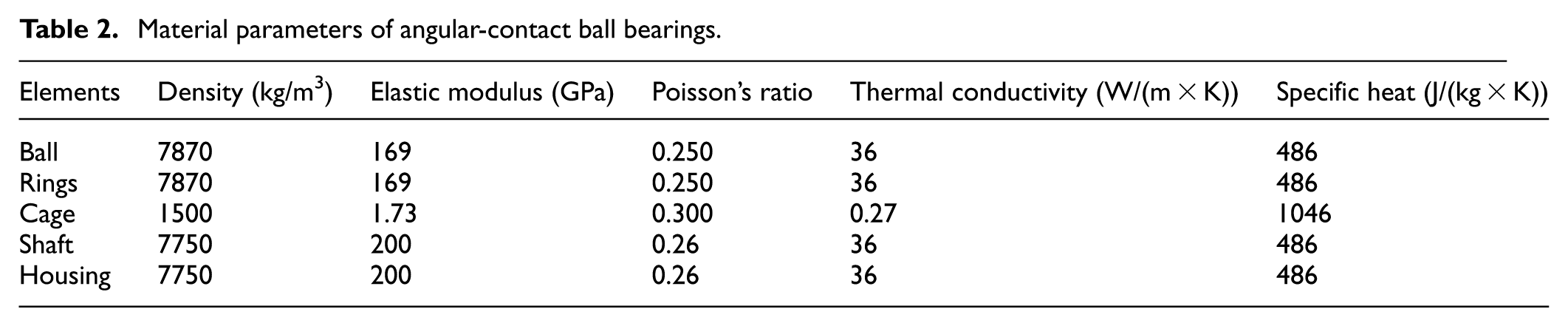
Figure 5 shows the temperature field of bearings analyzed upon two different models. Figure 5(a) shows the steady result of temperature field considering the thermo-mechanical coupling effect, and Figure 5(b) shows the steady result of temperature field without considering the thermo-mechanical coupling effect. It can be seen that thermo-mechanical coupling effect has a greater influence on the calculation of heat generation and prediction of the temperature distribution of the bearings. The main reason is that the effect of temperature rise on working clearance of bearings will, in turn, continue to affect the heat generation due to friction on the contact zone.

Temperature field of angular-contact ball bearings (a) with thermo-mechanical coupling effect and (b) without thermo-mechanical coupling effect.
Meanwhile, because working clearance of bearings plays an important role in the loading characteristics and fatigue life of bearings, 25 the difference in steady temperature field of bearings calculated by two different models will further affect the loading characteristics and fatigue life of bearings. Table 3 shows the maximum contact load, maximum contact stress, and fatigue life of bearings with and without thermo-mechanical coupling effect.
Maximum contact loads, maximum contact stress, and fatigue life of angular-contact ball bearings.

It can be seen from the data in Table 3 that the maximum contact load and stress reduce slightly and the fatigue life increases slightly when the thermo-mechanical coupling effect is considered. The reason is that range of the temperature field induced by friction heat is focused in the thermo-mechanical coupling model. Then, the thermal expansions of bearing elements lead to the change in displacement and deformation relationship between elements. In this case, the range of temperature increases the working clearance of bearings, thus when comparing with the results calculated by the normal quasi-dynamic model, the maximum contact load and stress calculated by thermo-mechanical coupling model are less. The fatigue life which is determined based on the contact stress will increase naturally when the thermo-mechanical coupling effect is considered.
Influences of geometric parameters on thermo-mechanical coupling effect
Influences of initial contact angle on thermo-mechanical coupling effect
The temperature fields of angular-contact ball bearings on different initial contact angles are shown in Figure 6. The left figures show the results considering the thermo-mechanical coupling effect, and the right figures show the results without considering the thermo-mechanical coupling effect. It can be seen that there are great changes in the temperature distribution in the bearings with the different initial contact angles. When the initial contact angle is small, the maximum temperature of bearings disappears in the contact area between the ball and the inner raceway. But with the increase in initial contact angle, the place of the maximum temperature of bearings gradually transfers to the contact area between the ball and the outer raceway.

Temperature field of angular-contact ball bearings with different initial contact angles: (a) α0 = 16° (with thermo-mechanical coupling effect), (b) α0 = 16° (without thermo-mechanical coupling effect), (c) α0 = 18° (with thermo-mechanical coupling effect), (d) α0 = 18° (without thermo-mechanical coupling effect), (e) α0 = 20° (with thermo-mechanical coupling effect), (f) α0 = 20° (without thermo-mechanical coupling effect), (g) α0 = 22°(with thermo-mechanical coupling effect), (h) α0 = 22° (without thermo-mechanical coupling effect), (i) α0 = 24°(with thermo-mechanical coupling effect), and (j) α0 = 24°(with thermo-mechanical coupling effect).
In addition, there is also difference between the results of temperature field which is calculated by the two different models. But the influence law of initial contact angle on the thermo-mechanical coupling effect cannot be concluded solely by the results of temperature distribution.
The maximum temperatures of bearings with different initial contact angles are shown in Figure 7. No matter whether thermo-mechanical coupling effect is considered, the maximum temperature of bearings always reduces with the increase in the initial contact angle of bearings. It is because that with the increase in initial contact angle of bearings, the resultant forces and contact stresses between the balls and the raceways which loaded the axial force and radial force at the same time decrease (it can be seen from Figure 8 as the maximum contact load and stress between the ball and the inner raceway on different initial contact angles of bearings). Thus, the heat generations in the bearings due to friction will decrease.

Maximum temperature in the contact area with different initial contact angles of ball bearings.
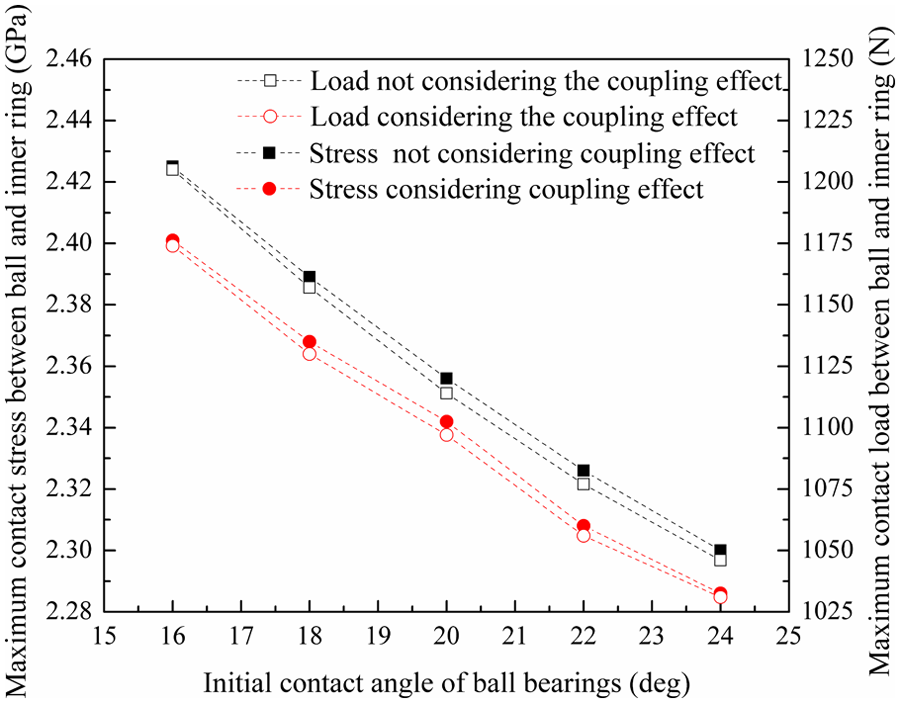
Maximum contact load and stress in the contact area with different initial contact angles of ball bearings.
Meanwhile, it can be concluded from Figure 7 that the difference in maximum temperature calculated by the two different models for bearings on the same initial contact angle calculated by the two different models gradually become small with the increase in the initial contact angle of the bearings. The main reason is that the temperature of bearings decreases with the increase in initial contact angle, and the thermo-mechanical coupling effect is reduced.
Based on the loading characteristics of bearings on different initial contact angles, the predicted fatigue life of bearings is calculated and the results are shown in Figure 9. The fatigue life calculated with thermo-mechanical coupling effect is slightly higher than the fatigue life calculated without thermo-mechanical coupling effect, but the effect of initial contact angle on the difference in fatigue life calculated by two different models is not obvious.

Ball-bearings fatigue life with different initial contact angles.
Influences of total number of ball on thermo-mechanical coupling effect
The maximum temperatures of bearings with the different total number of balls in bearings are shown in Figure 10. No matter whether thermo-mechanical coupling effect is considered or not, the maximum temperature of bearings always reduces with the increase in balls. It is because that with the increase in balls, the contact loads and contact stresses between the ball and the raceways decrease and the distribution of load and stress in the loading zone of bearings becomes uniform as well (it can be seen from Figure 11 as the maximum contact load and stress between the ball and the inner raceway on different total number of balls). Thus, the heat generations in the bearings due to friction will decrease.
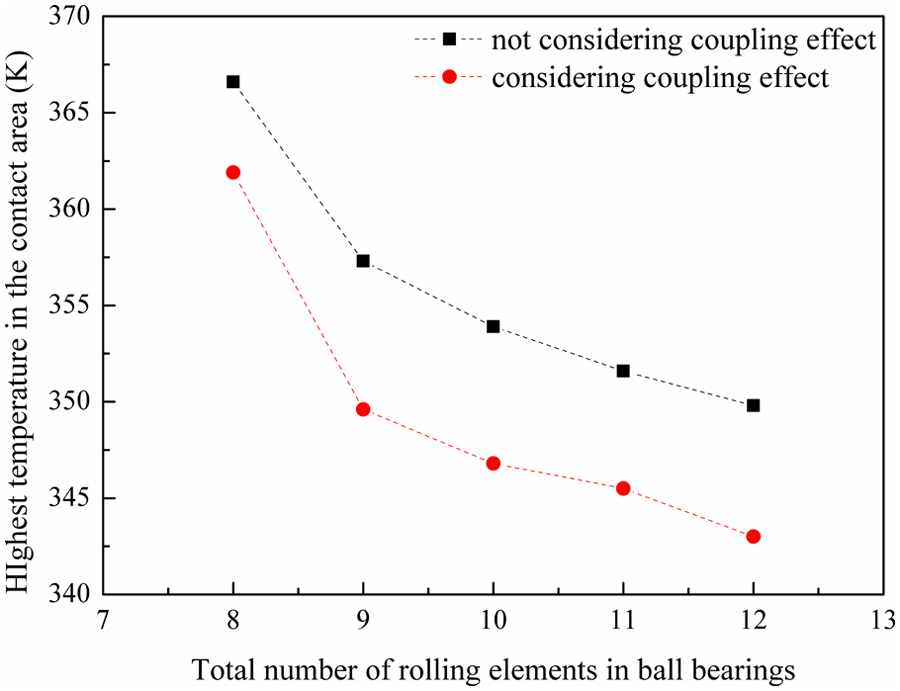
Maximum temperature in the contact area with different rolling element number in ball bearings.

Maximum contact load and stress in the contact area with different rolling element number in ball bearings.
In addition, it can be seen from Figure 10 that the difference of maximum temperature of bearings calculated by the two different models become great with the increase of balls. The main reason is that the heat source in the bearings increases with the increase of balls, and the accumulation of thermo-mechanical coupling on each heat sources makes the difference become larger gradually.
Based on the loading characteristics of bearings on the different total number of balls, the predicted fatigue life of bearings is calculated and the results are shown in Figure 12. It can be seen that the fatigue life gradually increases with the increase in balls. It is because that the contact loads and stresses between the ball and the raceways decrease when the total number of balls in the bearings increases. In addition, it can also be seen from Figure 12 that the fatigue life calculated with thermo-mechanical coupling effect is slightly higher than the fatigue life calculated without thermo-mechanical coupling effect and the difference in fatigue life calculated by two different models gradually increase with the increase in balls. The main reason is the same which caused the difference in the temperature.
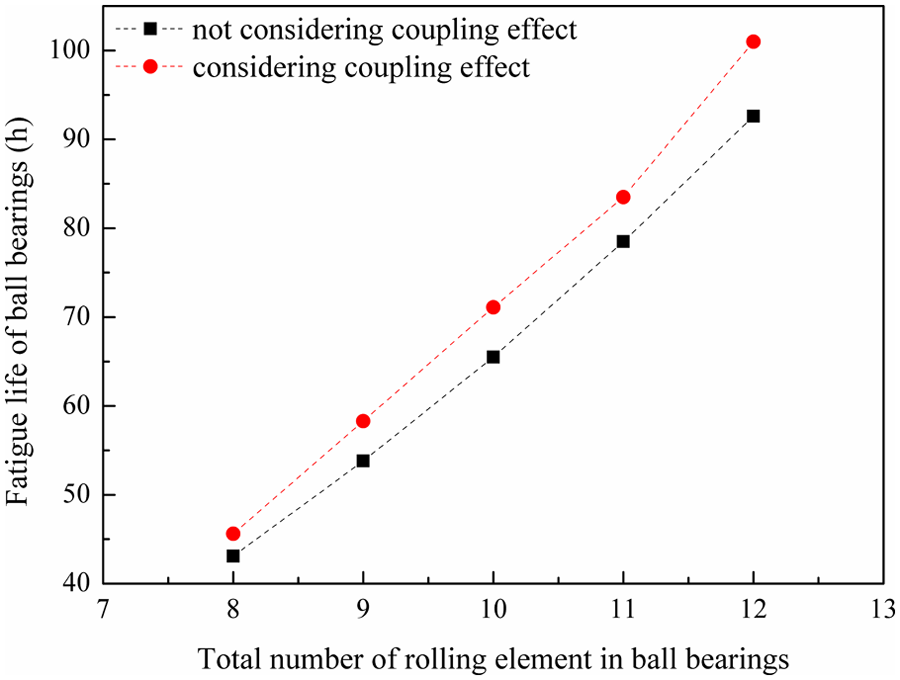
Ball-bearings fatigue life with different rolling element numbers.
Influence of working condition on thermo-mechanical coupling effect
Influence of axial load of bearings on thermo-mechanical coupling effect
The maximum temperatures of bearings with the different axial loads of bearings are shown in Figure 13. Overall, no matter whether thermo-mechanical coupling effect is considered or not, the maximum temperature of bearings calculated with thermo-mechanical coupling effect is always smaller than the maximum temperature of bearings calculated without thermo-mechanical coupling effect. And the difference in maximum temperature of bearings calculated in the two conditions become great with the increase in the axial load of bearings. The main reason is that the contact loads and stresses between the ball and the raceways increase with the increase in the axial load of bearings, and there is more heat generation due to friction in the bearings. Finally, the results calculated by the model, without considering the thermo-mechanical coupling, will deviate from the actual situation.
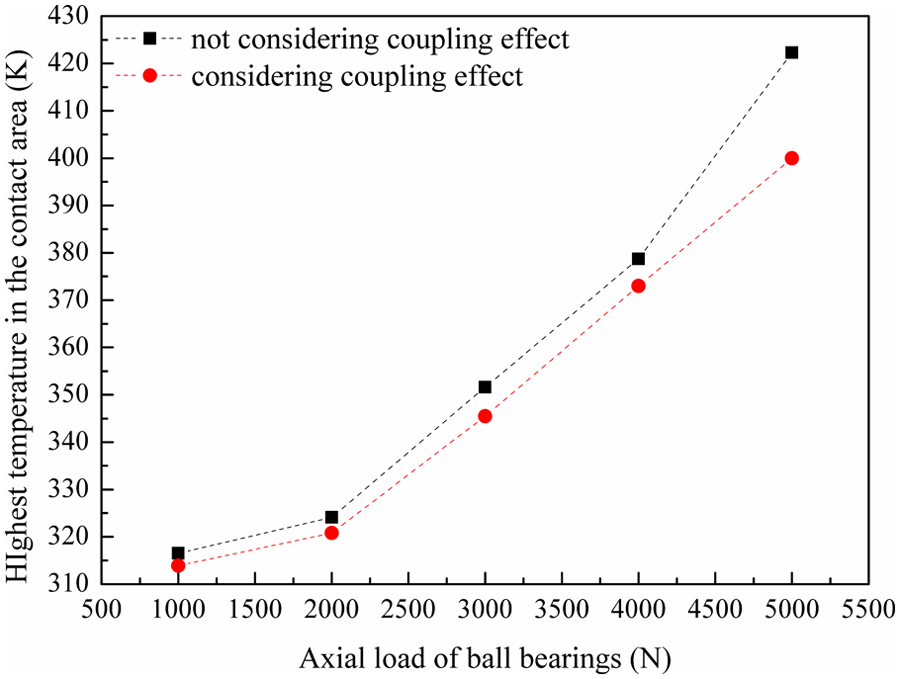
Maximum temperature in the contact area with different axial loads of ball bearings.
In addition, Figure 14 shows the maximum contact load and stress between the ball and the inner raceway on the different axial loads of bearings. While the axial load of bearings is small (1000 N in the figure), the maximum contact load and stress between the ball and the inner raceway considering the thermo-mechanical coupling effect is slightly higher than that not considering the thermo-mechanical coupling effect. But with the increase in the axial load of bearings, the maximum contact load and stress between the ball and the inner raceway considering the thermo-mechanical coupling effect gradually become smaller than that not considering the thermo-mechanical coupling effect, and the difference between the two results, with considering and not considering the thermo-mechanical coupling effect, gradually increases.
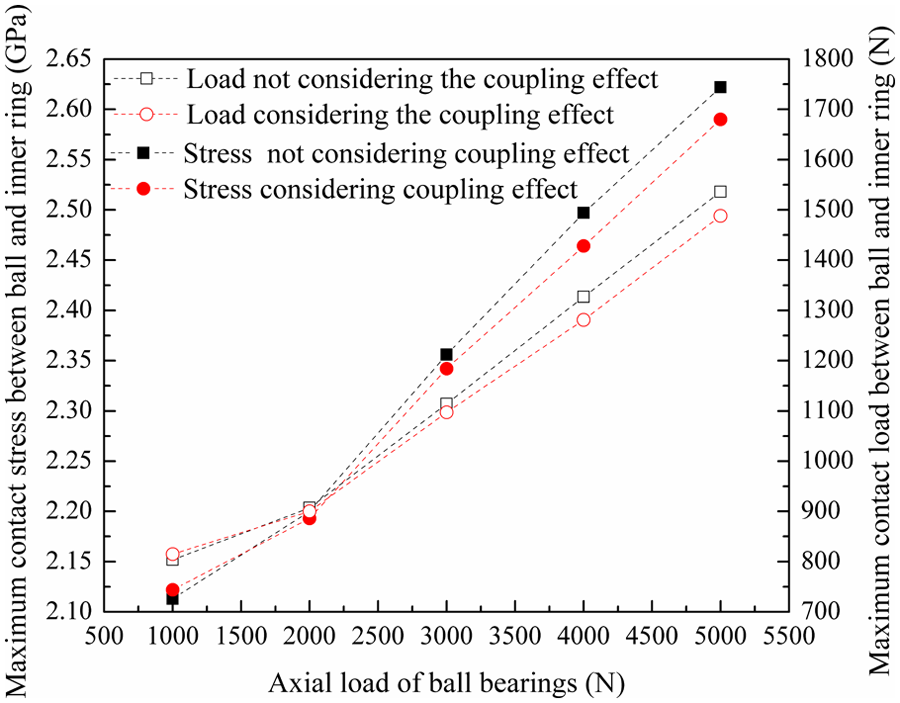
Maximum contact load and stress in the contact area with different axial loads of ball bearings.
Combining the results of thermal properties and loading properties of angular-contact ball bearings on different axial loads, it can be concluded that the thermo-mechanical coupling effect becomes more obvious with the increase in axial load of bearings, and it can be predicted that the thermo-mechanical coupling effect has a great influence on the fatigue life as well.
The fatigue life on the different axial loads of bearings which are calculated based on the loading characteristics of bearings is shown in Figure 15. It can be seen that the relationship of fatigue life calculated by two methods is similar to that of maximum contact load and stress between the ball and the inner raceway shown in Figure 14. That is, the fatigue life considering the thermo-mechanical coupling effect is slightly smaller than that not considering the thermo-mechanical coupling effect while the axial load of bearings is small. But on the condition of the heavy axial load of bearings, the fatigue life considering the thermo-mechanical coupling effect is higher than that not considering the thermo-mechanical coupling effect, and the difference between the two results, with considering and not considering the thermo-mechanical coupling effect, gradually increases with the increase in the axial load of bearings.

Ball-bearings fatigue life with different axial loads.
Influence of radial load of bearings on thermo-mechanical coupling effect
The maximum temperatures of bearings with the different radial loads of bearings are shown in Figure 16. With the increase in the radial load of bearings, the maximum temperature of bearings gradually rises up, and the difference in calculated results, with considering and not considering thermo-mechanical coupling effect, gradually increases. The main reason is that more friction heat is generated in the contact areas because the contact loads and stresses between the ball and the raceways increase with the increase in the radial load of bearings. While the temperature of bearings rises up with the increase in the radial load of bearings, the coupling relationship of thermal properties and mechanical properties will become stronger, and finally, the calculated result considering the thermo-mechanical coupling effect will gradually differ from the calculated result without considering the thermo-mechanical coupling effect.

Maximum temperature in the contact area with different radial loads of ball bearings.
Figure 17 shows the maximum contact load and stress between the ball and the inner raceway on the different radial loads of bearings. No matter how the range of radial load, the maximum contact load, and stress between the ball and the inner raceway considering the thermo-mechanical coupling effect is smaller than that not considering the thermo-mechanical coupling effect, and the difference between the two results, with considering and not considering the thermo-mechanical coupling effect, gradually decreases due to the weak thermo-mechanical coupling effect caused by low temperature.

Maximum contact load and stress in the contact area with different radial loads of ball bearings.
The fatigue life on the different radial loads of bearings which is calculated based on the loading characteristics of bearings is shown in Figure 18. The relationship of fatigue life calculated by two methods is similar to that of maximum contact load and stress between the ball and the inner raceway shown in Figure 17. The reason is that the contact stress between the ball and the raceways is the most important factor in the calculation model of fatigue life of bearings.
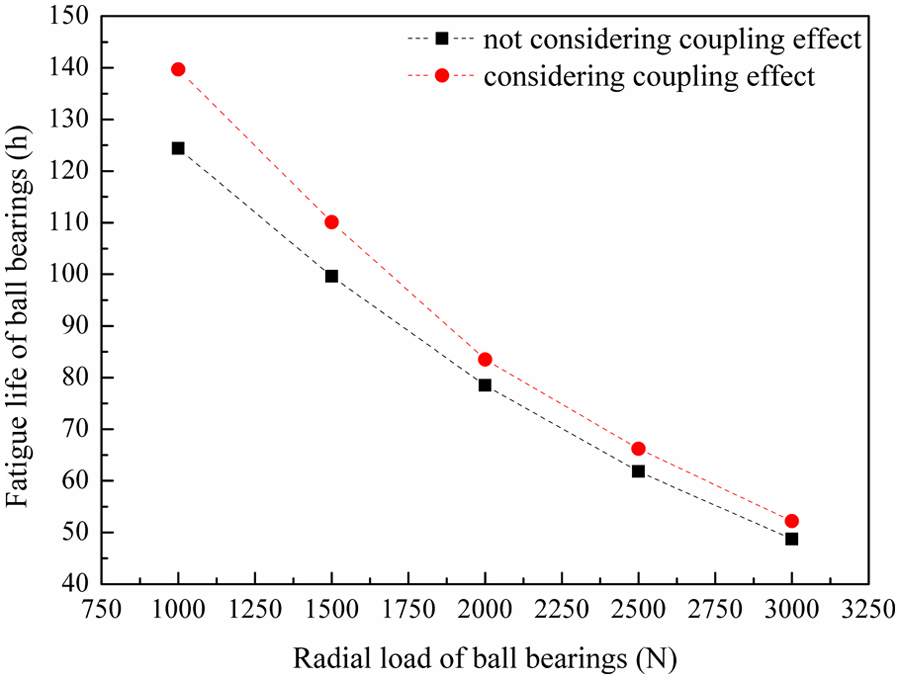
Ball-bearings fatigue life with different radial loads.
Influence of rotational speed of inner ring on thermo-mechanical coupling effect
The maximum temperatures of bearings with different rotational speeds of the inner ring are shown in Figure 19. Overall, no matter whether thermo-mechanical coupling effect is considered or not, the maximum temperature of bearings calculated with thermo-mechanical coupling effect is always smaller than the maximum temperature of bearings calculated without thermo-mechanical coupling effect. Thus, it can be concluded that the temperature rise always results in the increase in working clearance of bearings, no matter how the range of the rotational speed of the inner ring is.

Maximum temperature in the contact area with different rotational speeds of inner ring.
In addition, it can be seen from Figure 19 that the difference in maximum temperature of bearings calculated by the two different models increases with the increase in the rotational speed of the bearings. The main reason is that the contact load and contact stress between the ball and the outer raceway increase with the increase in the rotational speed of bearings (it can be seen from Figure 20 as the maximum contact load and stress between the ball and the outer raceway on the different rotational speeds of bearings). And then, the bearings’ temperature increases due to more friction heat on the contact areas of bearings, and the thermo-mechanical coupling effect becomes more and more obvious (no less on the temperature, the difference between the results of loading characteristics shown in Figure 19 is caused by the same reason).

Maximum contact load and stress in the contact area with different rotational speeds of inner ring.
The fatigue life of the different rotational speeds of the inner ring which is calculated based on the loading characteristics of bearings is shown in Figure 21. It can be seen that no matter how the range of the rotational speed of the inner ring is, the fatigue life considering the thermo-mechanical coupling effect is higher than that not considering the thermo-mechanical coupling effect, and the difference between the two results, with considering and not considering the thermo-mechanical coupling effect, gradually increases with the increase in the rotational speed of the inner ring.
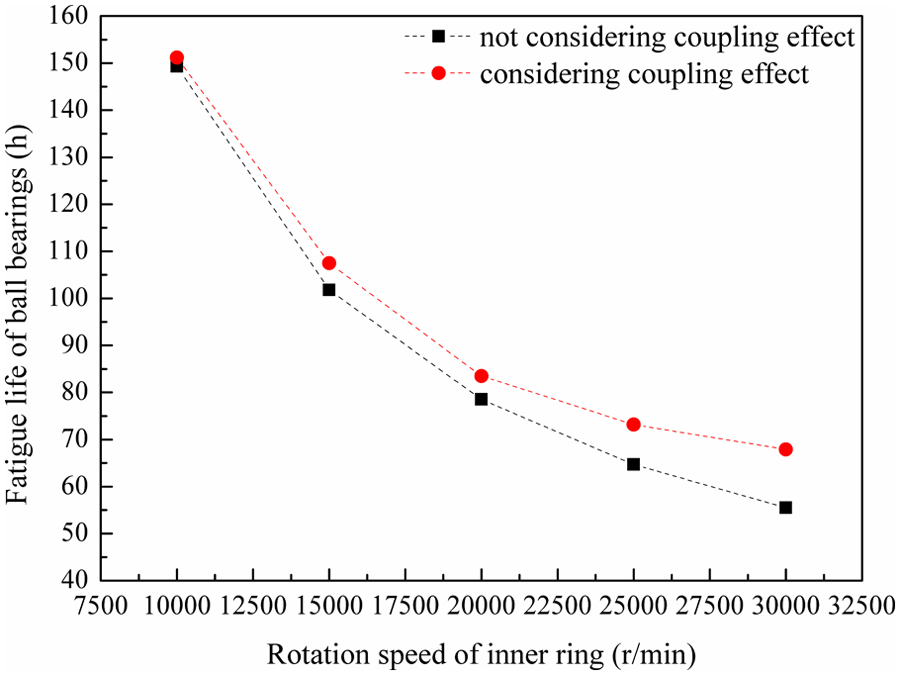
Ball-bearings fatigue life with different rotational speeds of inner ring.
Conclusion
Due to the strong coupling between the thermal and the mechanical characteristics of angular-contact ball bearings, the coordination condition of thermal expansion–deformation load and interaction relationship of contact stress, friction heat, and temperature rise in the loading zone of bearings were analyzed in this article. Based on the dynamic method of rolling bearings and finite element analysis method, the thermo-mechanical coupling calculation model of angular-contact ball bearings was established and solved. And the influences of coupling effect on temperature field, loading characteristics, and fatigue life of bearings were analyzed. Finally, the influences of geometric parameters and working conditions of bearings on the thermo-mechanical coupling effect were discussed. The following conclusions are produced:
The thermo-mechanical coupling calculation model of angular-contact ball bearings was established in this article; it can provide the more precise analysis method and predict tool for analyzing the thermal properties and dynamic characteristics of angular-contact ball bearings on the actual working conditions.
Comparison was made with the results of the model without considering the thermo-mechanical coupling effect, and there are obvious differences in the temperature distribution, loading characteristics, and fatigue life of angular-contact ball bearings when the thermo-mechanical coupling effect is considered.
The errors of the results without considering the thermo-mechanical coupling effect were obtained, and the actual situation will be enlarged with the increase in the initial contact angle, the total number of balls, the axial load and the radial load of the bearings, and the rotational speed of the inner ring.
Footnotes
Appendix 1
Academic Editor: Praveen Agarwal
Declaration of conflicting interests
The author(s) declared no potential conflicts of interest with respect to the research, authorship, and/or publication of this article.
Funding
The author(s) disclosed receipt of the following financial support for the research, authorship, and/or publication of this article: The work has received support from the National Natural Science Foundation of China (no. 51375108), the Natural Science Research Project of Education Department of GuiZhou Province of China (Qian Jiao He KY Zi [2014]294), the Science and Technology Foundation of GuiZhou Province of China (Qian Ke He LH Zi [2015]7039), and the Science Personnel Training Project of Zunyi (Zun Shi Ke He Ren Cai [2016]9).