



Abstract
The high temperature rise of grease lubricated angular contact ball bearing under high speed operation will affect the working accuracy of the bearing, and even lead to the loss of accuracy. In this paper, a friction heat generation model for high-speed grease lubricated angular contact ball bearing was established. Based on the quasi-static analysis model, the thermal expansion of the bearing components is brought into the quasi-static equilibrium equation, and the modified quasi-static analysis model of high-speed grease lubricated ACBB is obtained. Under grease lubrication conditions, a local bearing heat-generation model was employed to assess power losses in different contact zones, in which bearing contact parameters, external loads, and rotation speeds conditions were fully considered. Moreover, the temperature distribution of grease lubricated high-speed bearing was analyzed by the multi node thermal network method. Through the analysis model of bearing dynamic and thermal characteristics considering the influence of thermal expansion established, bearing contact parameters have significant differences. The calculated values of outer ring temperature of grease lubricated angular contact ball bearing is in good agreement with the experimental values. The model can predict the temperature values of grease lubricated angular contact ball bearing under axial load at high speed.
Keywords
Introduction
High-speed grease-lubricated rolling bearings mainly refers to the bearings with
Numbers of researches were focused on the thermal characteristics of rolling bearings, including heat generation research and temperature field analysis. The heat generation research was based on experimental fitting, mechanical analysis, and other means to introduce the calculation method of heat generation; The temperature field analysis aimed at obtaining the temperature on the bearing and studying changes by finite element analysis and thermal node method.
Palmgren 3 fitted the empirical formula of the overall friction torque of the rolling bearing. The formula was proposed based on experimental experience and the overall heat generation was calculated. Harris 4 analyzed the bearing from the mechanics theory and obtained the calculation method of frictional heat generation for various parts inside the bearing. Rumbarger et al. 5 took the high-speed gas turbine main shaft roller bearing as the object and calculated the local friction heat generation in the bearing. Kim et al. 6 analyzed the numerical calculation method of the friction torque and temperature of the angular contact ball bearings in the spindle system. Harris and Kotzalas 7 calculated the frictional heating power of the ball and rolling contact surface, the frictional heat generation attributed to the viscosity of the lubricating oil, the frictional heat between the cage and the ring, and the frictional heat between the roller end and the inner ring side. Jiang et al. 8 calculated the heat generation of bearings based on the Palmgren formula considering spin friction torque. Guanci et al. 9 calculated the heat generation of bearings based on the calculation principle of the local heat generation method by applying the heat generation calculation program. Mohan et al. 10 calculated the frictional shear stress in the ball-raceway contact area based on the elastohydrodynamic lubrication micro-contact theory. On this basis, the differential sliding friction heat generation and total heat generation inside the ball bearing were calculated.
The angular contact ball bearing (ACBB) is lubricated with oil or grease, and its power loss is basically caused by the friction between the internal components of the bearing and the lubricant. But for grease lubrication, the lubrication caused by thickener is different from oil lubrication, so the viscosity of grease should be fully considered in power loss calculation. In recent years, Ma et al. 11 based on the local heat source analysis method, established a mathematical model to accurately calculate the heating rate of grease lubricated spherical roller bearings. Brecher et al. 12 proposed a simple calculation model to estimate the cage friction loss of high speed and low lubrication spindle bearings. Gonçalves et al. 13 Studied the effect of thickener content on friction torque of thrust ball bearing. Niel et al. 14 Developed a simplified method to obtain the ring temperature of angular contact ball bearings only with the least external geometric data and global power loss. Tong and Hong 15 Studied the effect of angular misalignment of angular contact ball bearing on running torque. Zhang et al. 16 Proposed a friction torque model for ball bearings with geometric imperfections. Popescu et al. 17 Established the calculation model of power loss of angular contact ball bearing by four methods, and compared the calculation results of 7205b with the experimental results.
However, the power loss of grease lubricated bearings in the speed range of 12,000–36,000 rpm has not been accurately evaluated.
Pouly et al. 18 built a thermal network model of oil-air lubricated thrust ball bearings and predicted the power loss and temperature distribution of the bearings, but the model is not suitable for high-speed angular contact ball bearings. Neurouth et al. 19 used the thermal network method to establish a simplified thermal network model of grease-lubricated thrust ball bearings, and numerically calculated their power losses. Yanshuang et al. 20 selected a number of nodes,established a node thermal balance equation, and performed bearing temperature calculations. Zheng and Xu 21 established a heat transfer equation to calculate the temperature distribution of double-row rolling bearings when they reached thermal equilibrium under normal operating conditions. Huang dongyang et al. 22 established a balance equation for the complete shafting structure consisting of bearings, main shaft, sleeve, bearing housing and end cover, and solved the nodal temperature.
Bossmanns and Tu 23 established a high-speed electric spindle thermal model and solved the nodal temperature. Flouros 24 conducted experiments on aero-engine high-speed heavy-load ball bearings and summarized the calculation formulas for heat generation and outer ring temperature. Takabi and Khonsari 25 established the thermal node model of the ball bearing, verified the node temperature by experiment. Result shows that the temperature value calculated by the node model is very accurate. Than and Huanget 26 established a node model for high-speed spindle bearings, and also conducted experimental comparison. The error between the temperature value on the spindle calculated by the node model and the experimental value is <5%. Huang et al. 27 analyzed the thermal characteristics of the ball screw feed system, used the overall calculation method to calculate the heat generated by the bearing, and made a finite element analysis of the system temperature. Cheng qingyuan et.al 28 carried out steady-state thermal analysis using thermal network method and finite element method, and compared the calculation results of the two methods. Consistent with the problems described above, these studies have not focused on the grease lubricated rolling bearings under high-speed conditions.
The heat generation calculation and heat transfer model of angular contact ball bearing under high speed condition, especially grease lubricated bearing, need to be further discussed, and the influence of thermal expansion on bearing temperature is not sufficient. Most studies have focused on the thermal properties of angular contact ball bearings with grease and oil lubrications under different speed, loadings, and pre-tightening conditions. And the heat characteristics of heat generation and heat exchange phenomenon between rolling body and raceway were also studied. However, for the grease lubricated angular contact ball bearing, the researches by considering the thermal expansion of the grease lubricated bearing at high speed and using the local heat generation method and the heat network transfer method to calculate the temperature distribution of the rolling contact surface were rarely reported. Here in this paper, the application of local micro heat generation model in the analysis of thermal characteristics of grease lubricated angular contact ball bearing was extended. Finally, the deviation between the theoretical value and the experimental value was analyzed through the test comparison, which provides a reference for the thermal characteristic analysis and optimization design of grease lubricated high-speed angular contact ball bearing.
Quasi static model of bearing considering thermal expansion
In the process of high-speed rotation of bearing, the temperature rise of bearing leads to the thermal expansion of internal parts, which changes the structural parameters of bearing and the contact state between bearing parts, and affects the change of the bearing friction torque, and ultimately affects the thermal characteristic analysis of bearing. Therefore, it is necessary to analyze the force and deformation to study the thermal characteristics of the bearing.
Thermal expansion of angular contact ball bearings
The formula given by Harris 7 is used to calculate the thermal expansion of the bearing.

Where
According to formula (1), the linear thermal expansion of bearing components was deduced. Radial thermal expansion of inner and outer raceways:

Where

Where
Axial thermal expansion of inner and outer raceways:

Where
Dynamic analysis of bearing considering thermal expansion
As an important part of rotor system, angular contact ball taking both axial load and radial load. It is widely used in high-speed machine tool spindle system or other high-speed rotors. In this paper, according to the actual experiment state of the bearing, only axial loading is considered. The geometric relationship of ACBB under axial load are shown in Figure 1, and the contact relationship between ball and inner/outer raceway in ACBB axial load are shown in Figure 2. 29

Geometric relationship of angular contact ball bearing.

Contact relationship between ball and raceway of ACBB.
When the grease lubricated angular contact ball bearing was subjected to an axial load, the influence of thermal expansion was considered in the force analysis. To determine the internal load distribution in a high speed angular contact ball bearing, a five-degree mechanical model is established. As shown in Figure 3, the distances between inner/outer raceway groves and ball center is increased, the inner and outer raceway groove curvature centers and ball center are no longer collinear, the contact angles of ball-inner raceway and ball-outer raceway are not equal anymore. According to the geometric relationship in Figure 3, the equation (5) is listed:

Where

Position of ball center and raceway curvature center considering thermal expansion.
When the high speed angular contacted ball bearing taking axial load, the force on the ball is shown in Figure 4. The force balance equations in the horizontal and vertical directions are listed as follows:

Where,

Force diagram of ball considering thermal expansion (axial load).
Then the balance equation of the whole bearing can be written as:

The bearing force equilibrium equations (5)–(7) including thermal expansion conditions are established simultaneously, and the Newton Raphson method is used to solve the equations.
Kinematics analysis of angular contact ball bearings
Angular contact ball bearings have a simple structure, but their movements are complicated. For the motion of ball, not only rotation happens around the axis of the bearing and itself, but also spin motion exists in the contact area between the ball and the inner and outer rings of the bearing.
The relationship between the speed of each part when the ball is in contact with the bearing outer ring raceway, and the distribution of the normal force between the ball and the bearing outer ring raceway on the contact ellipse are shown in Figure 5. The elliptical surface is determined by the projected long semi-axis and the projected short semi-axis, respectively.
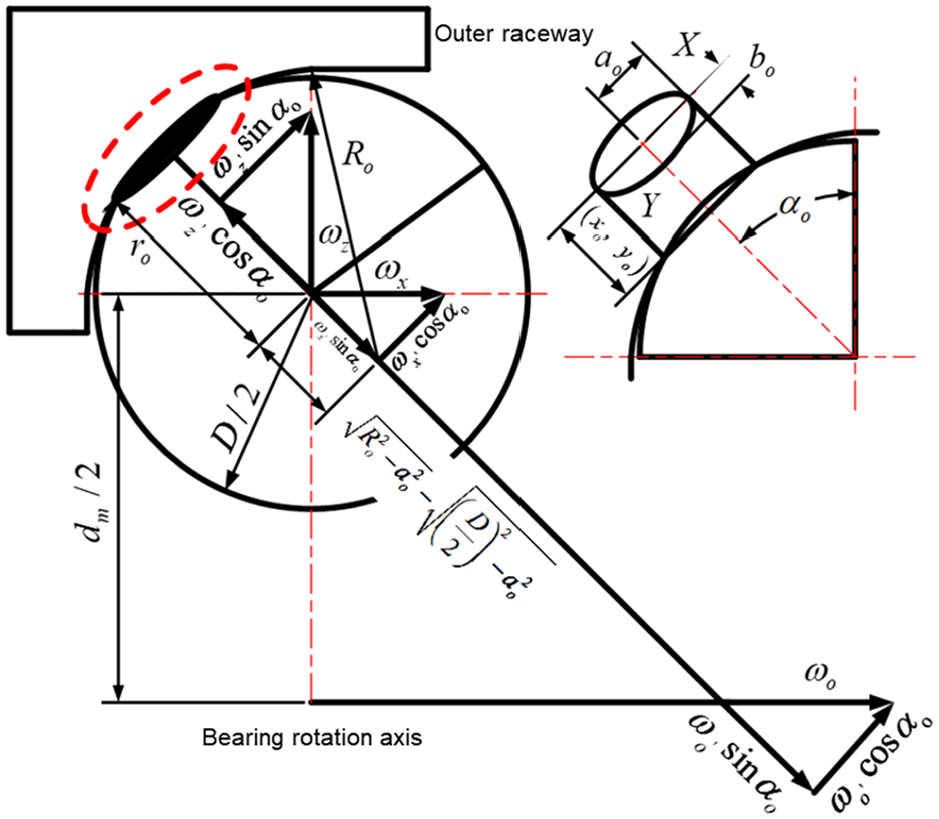
Outer ring raceway contact speed and bearing load distribution.
The spin angular velocity

The spin angular velocity

Here,
In high-speed angular contact ball bearings, according to the outer channel control theory, there is pure rolling between the ball and the outer ring, and the spin speed

For bearings with a fixed outer ring and a rotating inner ring, the ratio of the ball rotation angular velocity

The ratio of the ball revolving angular velocity

Here,
Heat generation model of local heat source approach
The local heat source analysis approach is to determine the specific power loss of each heat source according to the force and relative motion relationship of the internal contact surface of the bearing, and the total power consumption of the bearing is the sum of the power losses of each local heat source. The specific power loss of different heat sources inside the angular contact ball bearings were determined by the following equations. 30
Compared with oil lubrication or oil air lubrication, the rheological characteristics of grease have been taken into account by the heat generation model of grease lubricated rolling bearing established in this paper. And the friction coefficient of grease lubrication was applied in the calculation of friction torque. The mathematical model for accurate calculation of heat generation rate of grease lubricated angular contact ball bearing was established.
(1) Friction power consumption caused by the differential sliding of a single ball and raceway.
Contact friction heat between ball and raceway was by integrating the product of lubricant shear stress in ball-raceway contact and ball sliding speed on the contact ellipse.

Here,
The shear stress of grease is calculated according to Herschel–Bulkley equation.

(2) Friction power generated by gyro rotation of a single ball

Here,
(3) The spin friction power consumption of a single ball
The bearings follow the outer channel control theory when running at high speed, that is, when the balls are in contact with the inner and outer rings, the balls only roll and spin in the inner ring, and the outer ring does pure rolling. On the basis of above, the spin friction torque

Here,
The frictional heat generation

(4) Friction power consumption due to sliding between cage and ferrule guide surface


Here,
(5) Friction power consumption caused by sliding of single ball and cage

Here,
Therefore, the total friction power consumption obtained by the local method model is

Here,
Heat transfer model of high speed grease lubricated angular contact ball bearing
The basic heat transfer modes include heat conduction, heat convection, and heat radiation. When the high-speed spindle runs at a high speed under a certain load, the surface temperature of the spindle does not exceed 200°C (generally 40–80°C). The influence of heat radiation is ignored, and only the influence of heat conduction and heat convection is considered.
Thermal network model
In the analysis of the steady-state temperature field, for any thermal node, the heat flow into the node should be equal to the heat flow out of the node (Kirchhoff’s law),32,33 and the system heat balance equation system including each temperature node is established. Because convection heat transfer is often non-linear. Generally, the heat balance equation is a nonlinear system of equations, and finally the steady-state temperature field of the system is obtained by solving the system.
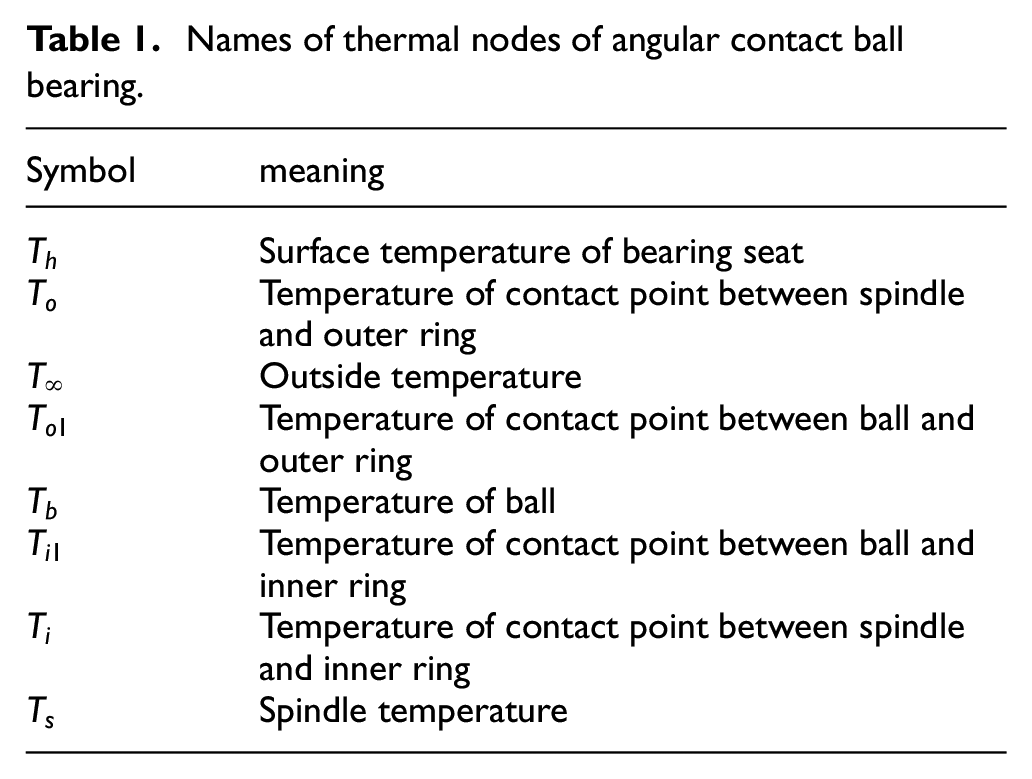
The key nodes in the bearing assembly was shown in Figure 6(a), and the meaning of each thermal node was shown in Table 1. For grease lubricated angular contact ball bearings, the heat transfer process includes: the heat convection between the spindle end face and the outside, the heat conduction between the spindle and the bearing inner ring, the heat conduction between the inner ring and the grease, the heat conduction between the grease and the ball, the heat conduction between the grease and the outer ring, the heat conduction between the bearing outer ring and the bearing housing, and the heat convection between the bearing seat and the outside.

Thermal node distribution (a) and thermal network (b) of grease lubricated angular contact ball bearing.
Names of thermal nodes of angular contact ball bearing.
The thermal network of grease-lubricated angular contact ball bearings was shown in Figure 6(b). This thermal network model is a transfer system which includes five unknown temperature nodes: inner ring, inner raceway, ball, outer raceway, and outer ring.
Angular contact ball bearing thermal balance equations
According to the conservation of energy, the heat flowing into and out of each node is equal. According to the bearing node and thermal network, five thermal balance equations are shown in Figure 6.
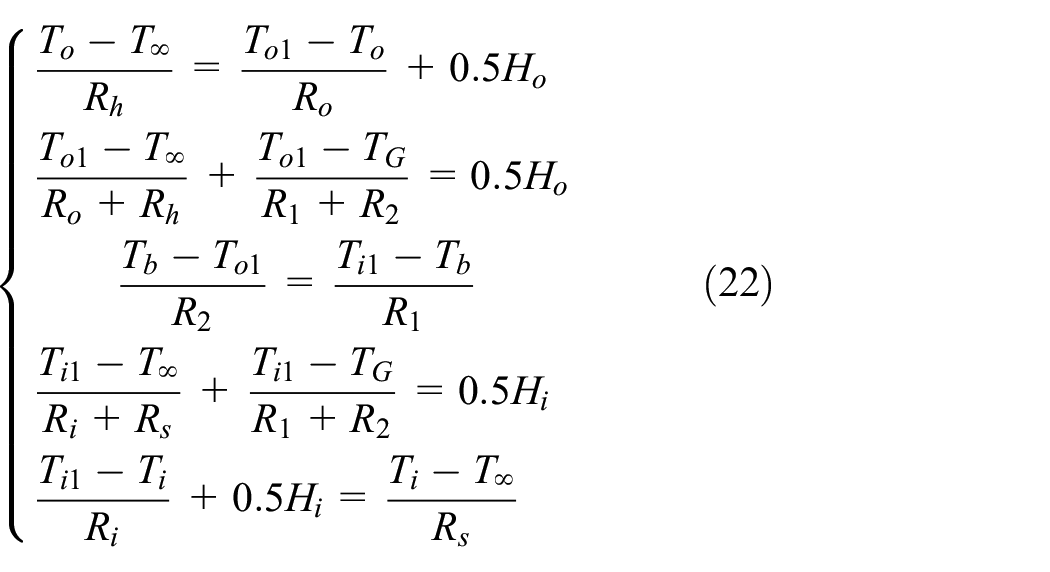
where,
Equations for thermal resistance calculation.

The distribution of bearing temperature field can be obtained by solving the heat balance equations under considering the mechanical model of thermal expansion, calculation of grease lubrication heat generation, and heat transfer model. For high-speed grease lubricated ball bearings, the complete process of thermal analysis is shown in Figure 7.

The computation process of thermal analysis.
Experiment device and process
The test device for measuring the temperature of the outer ring of the bearing is shown in Figure 8. Here, 1 is the main shaft, 2 is the sealing ring, 3 is the temperature sensor, 4 is the bearing seat, 5 is the test bearing, 6 is the axial loading body, and 7 is the bearing fixing device. The bearing 5 is installed on the main shaft 1. The speed of the main shaft 1 is provided by the servo motor. The inner ring of the bearing is synchronized with the speed of the main shaft 1. The axial loading device 6 is loaded on the outer ring of the bearing 5. The loading method is hydraulic loading. The temperature sensor 3 is inserted into measuring hole of bearing housing. The experiment speed range was 6000–21,000 rpm, the axial load was 500 N, and the temperature sensor for measuring the temperature of the bearing outer ring was PT100.
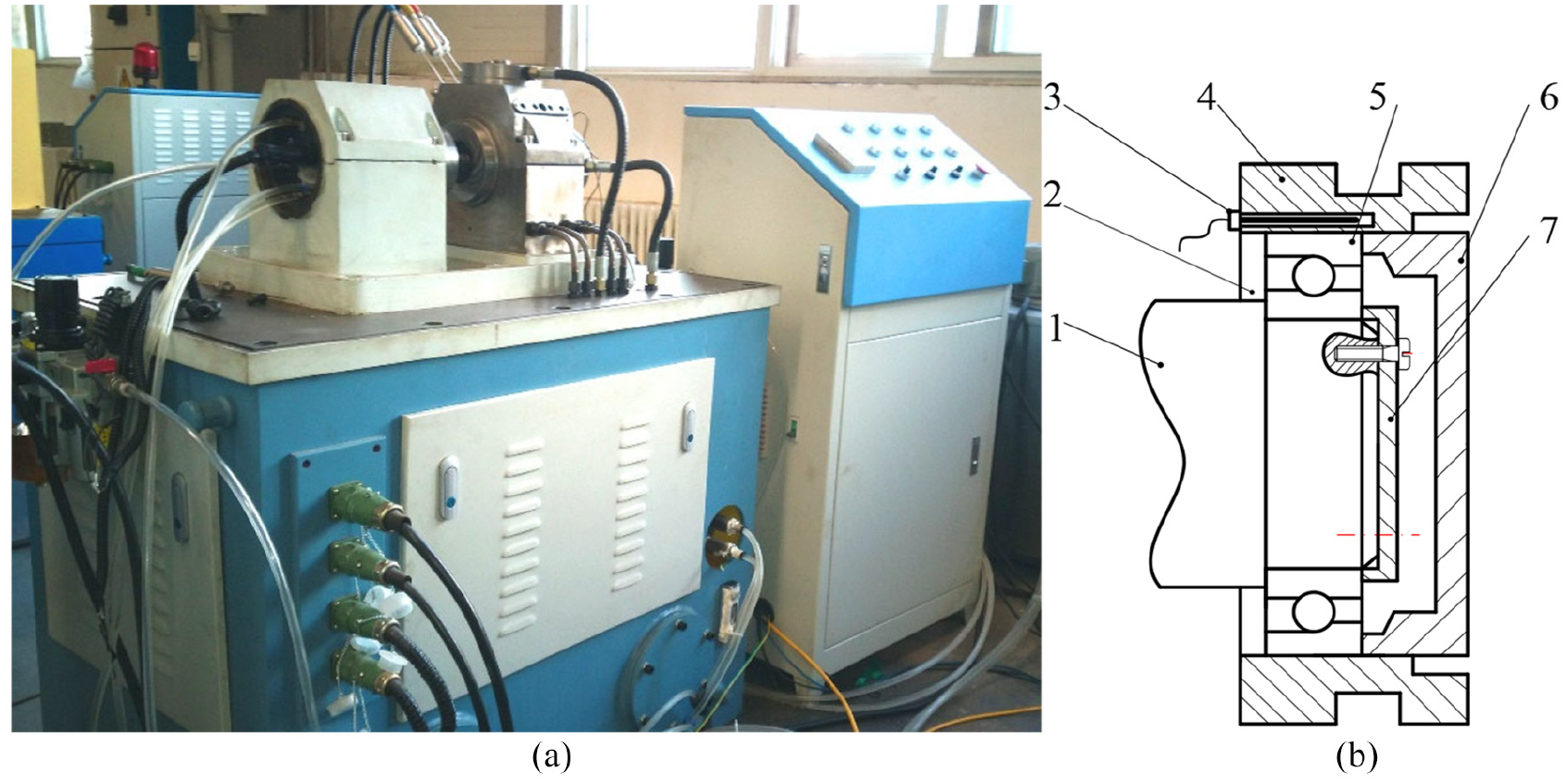
Test device for temperature rise of outer ring of bearing: (a) the experimental rig, (b) the location of the components of the experimental rig.
The test object was grease lubricated angular contact ball bearing. The bearing model was 7005C The basic structural parameters of the bearing are shown in Table 3.
Basic structural parameters of 7005C bearing.

Results and discussion
Influence of thermal expansion on bearing parameters
When the grease lubricated angular contact ball bearing rotated at high speed, the thermal expansion caused by temperature rise had a great influence on the contact angle and contact load of the bearing. The change of the contact angle and contact load had an important influence on the motion relationship and friction lubrication of the internal components of the bearing.
Contact angle
The effect of the change of the high speed of the inner ring (6000–36,000 rpm) on the contact angle between the ball and the inner and outer ring raceways under an axial load of 200–600 N is shown in Figure 9.

Influence of rotational speed and axial load on contact angle.
As depicted in Figure 9, with the increase of rotating speed, the internal contact angle of bearing (red line) increases from 18.6° to 19.9° without considering bearing thermal expansion, and (green line) from 21.9° to 39.2° with considering bearing thermal expansion; the external contact angle of bearing (gray line) decreases from 18.3° to 13.3° without considering bearing thermal expansion, and (blue line) from 21.6° to 19.1° with considering bearing thermal expansion. These are discussed under a load of 500 N. At the same time, it can be found that the internal and external contact angles increase with the consideration of thermal expansion. The inner ring contact angle is more affected by the thermal expansion of the bearing when the speed is higher than
Contact load
The change of the contact load between the ball and the ring raceway with the inner ring speed and the applied axial load are shown in Figure 10.

Influence of rotational speed and axial load on contact load.
As depicted in Figure 10, with the increase of the rotating speed, the variation law of the contact load inside, and outside the bearing is similar to that of the contact angle.
Influence of thermal expansion on motion parameters
The change of various movement speeds with the inner ring speed under an axial load range of 200–600 N was shown in Figure 11.

Influence of rotational speed and axial load on the velocity of the ball.
Influence of thermal expansion on bearing temperature rise
Heat generation of bearing components
The total heat generation of grease lubricated angular contact ball bearing calculated by local method under 21,000 rpm and axial load of 200–600 N were compared in Figure 12(a). The total heat generation of grease lubricated angular contact ball bearing calculated by local method at 500 N and 6000–21,000 rpm were compared in Figure 12(b). The effect of thermal expansion on heat generation were also compared.

Heat generation values at a speed of 21000rpm (a) and a preload of 500 N (b).
The effect of thermal expansion on heat generation increased with the increase of axial load. At low speed, the heat generated by considering thermal expansion is close to that without considering thermal expansion; with the increase of speed, the total heat generated by considering thermal expansion increases obviously, because the spin angular velocity increases obviously when considering thermal expansion, and the spin friction heat increases with the increase of speed, resulting in the total heat generation increases obviously.
Thermal expansion of bearing components
The thermal expansion of each component of grease lubricated angular contact ball bearing are shown in Figure 13.

Thermal expansion values of bearing components.
During the high-speed operation of the bearing, the temperature of the inner ring is higher than that of the outer ring, which lead to the larger thermal expansion of the inner ring raceway compared with that of the outer ring raceway. So the relative radial thermal expansion between the inner ring raceway and the outer ring raceway decreases, which is negative. With the increasing temperature difference between the inner ring raceway and the outer ring raceway, the relative radial thermal expansion between the inner ring raceway and the outer ring raceway decreases. Similarly, the relative axial thermal expansion of the inner and outer raceways is growing smaller, which is also a negative value, because the temperature of the spindle is greater than that of the bearing housing.
Experimental comparison
Temperatures of bearing components with/without considering thermal expansion are shown in Figure 14. The temperature of the inner ring is the highest, while that of the outer ring is the lowest. This is because the heat generation of the inner ring is higher than that of the outer ring, causing the temperature of the inner ring to be higher than the temperature of the outer ring. The temperature of the ball is intermediate between the value of two ring parts. Such phenomenon indicates that although the ball generates the most heat, the ball of the grease lubricated bearing is wrapped by the grease, and the temperature of the ball is lower than that of the inner ring due to cooling of the grease.

The temperature values of bearing components.
The experimental conditions are as follows: the axial load was 500 N, the rotating speed rised from 6000 to 21,000 rpm, and the outer ring temperature of angular contact ball bearing was measured. The influence of thermal expansion was taken into account in the calculation of bearing outer ring temperature, which is compared with the measured outer ring temperature, as shown in Figure 15. The results show that the calculated value considering the effect of thermal expansion is closer to the experimental value. The theoretical and experimental values calculated with and without thermal expansion are compared, and their differences are shown in Figure 16.
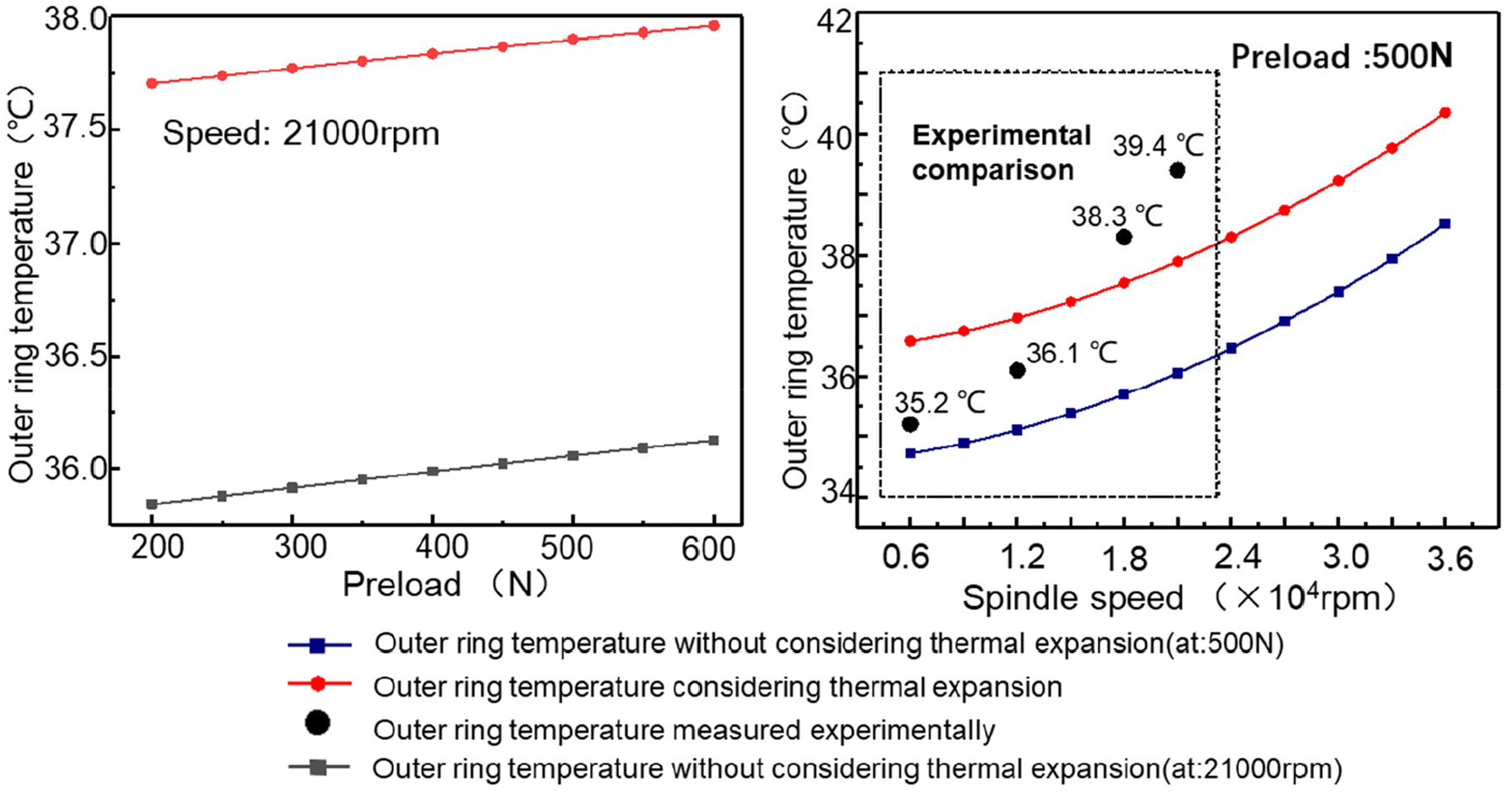
Deviation between calculation values and experiment values of outer ring temperature.

Fitting line diagram of bearing outer ring temperature difference with and without thermal expansion.
Conclusions
The dynamic characteristic analysis model considering internal friction, heat generation, and thermal expansion of high-speed grease lubricated bearing is established. The steady-state grease lubricated heat transfer model is established by using the thermal network method. The temperature rise of each node and the thermal expansion of bearing parts under different working speeds and loads are calculated, and then the dynamic characteristics of the bearing are analyzed. Fitted by aforementioned model, the temperature of outer ring is in good agreement with the experimental values, which proves the reliability of the model in analyzing and calculating the temperature of grease lubricated angular contact ball bearing.
It is found that thermal expansion has a significant effect on the bearing mechanical and kinematic parameters, which determines the heat generation calculation and heat transfer results of the bearing, and then affects the temperature field distribution of the bearing. Therefore, under the condition of high speed, the thermal expansion of the bearing can not be ignored.
Footnotes
Acknowledgements
The authors would like to thank all anonymous reviewers for their constructive suggestions.
Handling editor: James Baldwin
Declaration of conflicting interests
The author(s) declared no potential conflicts of interest with respect to the research, authorship, and/or publication of this article.
Funding
The author(s) disclosed receipt of the following financial support for the research, authorship, and/or publication of this article: This research was financially supported by the National Key Research and Development Program of China (2018YFB2000202). The supports are gratefully acknowledged.
