




Abstract
Phase change material applied in lightweight buildings makes it possible to improve thermal comfort and reduce energy consumption, and compensate the disadvantage of low thermal inertia. The field tests for the composite envelope lightweight building integrated with composite phase change material layer were carried out. The performance is compared with the buildings with ordinary structure under summer, winter, and transition climate. According to the climatic conditions of Chengdu city, the phase change material has the effect of heat attenuation and temperature delay by improving the indoor stability of the lightweight building. The lightweight building integrated with phase change material layer could significantly reduce the surface temperature of inside wall and the indoor air temperature during the hot season and transition season. A simulation model for heating and cooling load of the lightweight building was set up to assess the energy saving for phase change material application. The annual load of model building with phase change material composite exterior wall is 23.85% less than that of ordinary model building.
Keywords
Introduction
In modern buildings, lightweight envelope structure has been more and more widely used. Lightweight retaining structure is popular used in the stadium, the station yard, prefabricated building, site construction, and other occasions. The lightweight retaining structure is mostly based on expanded polystyrene (EPS), polyurethane (PU) foam, extruded polystyrene (XPS), EPS foam mortar, and porous inorganic insulation material. The use of lightweight retaining structure can greatly reduce the bearing weight of structure. On the other hand, it can improve the insulation effect of the building retaining structures. But its poor thermal storage capacity led to indoor temperature fluctuations increased and comfort reduced. And the need for strict control of indoor temperature fluctuations is demanded.1–4
To solve these problems, some important findings were presented in previous studies, including theoretical analysis and experimental studies. Feustel and Stetiu 5 selected thermal building simulation program based on finite difference approximation of the numerical value to evaluate the performance about the latent heat storage capacity of phase change material (PCM) wall in architectural environment. Double PCM wallboard is used to improve the heat storage capacity of the building. It is aimed to make the room temperature maintain a comfortable temperature close to the upper limitation without mechanical cooling conditions. Kondo from Denki University 6 used 95% (18) alkyl alkane and 5% (16) alkyl alkane for PCMs, preparation of phase change wallboard system will be a PCM cross-linked polyethylene balls into the gypsum board, and study the heat storage capacity. Sari 7 from the University of Gazios Manpasa in Turkey tested the stability of fatty acid. Kuznik and Virgone 8 simulated experiment in Artificial Climate Laboratory and measured the difference in thermal environment of the PCM room and ordinary experimental room in the summer, the winter, and transitional seasons. Bontemps and Ahmadb 9 measured thermal performance of PCM in passive solar house and made a numerical simulation based on the measured data.
According to the previous research, it is found that in the outdoor climate conditions, there are few reports about the study on the thermal performance in the long time contrast test of composite PCM based on the indoor thermal environment of the lightweight retaining structure buildings. In this article, a new type of thermal insulation and lightweight structure for the purpose of improving the thermal performance is realized by the combination of the insulation material and the PCM into a multi-layer structure. With the heat storage/release capacity of phase transition process, it can improve the thermal performance of lightweight envelope, and has a good thermal insulation and thermal storage effect for the new thermal insulation lightweight enclosure. This article aims to set up the two cubicles in the same size with and without the PCM layer intend to analysis the thermal performance of lightweight retaining structure buildings to improve the indoor thermal environment by field test and numerical simulation under the condition of typical climate and different season.
Experimental system and method
In this experiment, two lightweight building cubicles were set up (cubicle1 and cubicle2) in Chengdu, China. The size is 800 mm (L) × 1000 mm (W) × 1300 mm (high). The outer retaining structure includes five layers: 20-mm-thick PCM layer, 1-mm-thick stainless steel plate, 40-mm-thick lightweight polystyrene foam plate, 1-mm-thick stainless steel, and 8-mm gypsum board. The structure is shown in Figure 1. The cubicle2 is integrated with PCM inside, fixed with the array tube PCM and gypsum board in the same size with the box inner surface, and fixed them in the inner surface of the box. PCM is located between the gypsum board and the inner surface in order to form composite retaining structure. PCM used in the experiment is one kind of new material which is easy to composite with the wall. PCM encapsulated in the tube is nontoxic and nonflammable. The phase change temperature range is 18°C–26°C. The physical parameters of the material are shown in Table 1.

The field test and cross-sectional schematic view of walls: (a) cubicle1, (b) cubicle2, (c) PCM with plaster board, and (d) the experimental system.
The physical parameters of the material.

PCM: phase change material.
As shown in Figure 1, the experimental rig and test procedure were described as following:
Test rig: The test rig includes meteorological observation station JTR13C (temperature measurement range: −30°C to 70°C, temperature measurement precision: ±0.5°C); solar radiometer CMP10 (Maximum solar irradiance: 4000 W/m2), and T-type thermocouples (temperature accuracy: ±0.5°C). All instruments were calibrated before the test. The data were collected automatically by building thermal temperature and heat flow automatic test instrument TRG-II, and connected with computer by RS232 interface in order to realize the data recording and output in the real time.
Test points allocation: The test points were allocated as the thermocouple on the same position in both sides (five sides include indoor surface, outdoor surface, and the top) of the boxes and the center of the rooms. Thermocouples are used to measure the indoor (A, B, D, and E) and outdoor (C) air temperatures. All points were 22, and each cubicle was 11.
Test procedure: The two cubicles in this experiment are located in a completely unobstructed place on the roof of the College of Architecture and Environment of Sichuan University. The cubicles were arranged in the same direction, and the gate was closed in order to maintain the same test conditions. All the test time intervals were set to 15 min. A total of 4-month test data were collected with inside and outside air temperature of the room and surface temperature of internal and external wall, etc.
Experimental results and discussion
Because of the long test time period and plenty of the experimental data, this article only selected the representative data for analyzing. Respectively, 10-day data were selected from the test data recorded in the end of August, early December, and early April which were different time period with different climate features to analyze. The selected time periods were 25th August to 3rd September, 5th to 14th December, and 30th March to 8th April. They represent summer and early winter season, the transitional climate in Chengdu. These days were typical because of the sunny day, cloudy, and rainy days during the period.
The temperature change characteristics of indoor air temperature
As shown in Figure 2, the indoor air temperature change curve contrasted with different experimental room in the summer. It is obvious that the outdoor air temperature fluctuates between 22.1°C and 34.5°C because of the hot weather in the 5 days before the test and 2 days after the test. There are three rainy days in the middle period so that the fluctuation of outdoor air temperature is between 18.3°C and 22.8°C. It is found that when the outdoor temperature is relatively high during daytime (8:00–18:00), the air temperature inside the ordinary cubicle (cubicle1) increased rapidly with the rising temperature due to its small heat storage capacity and lower thermal inertia index. However, the cubicle integrated with PCM (cubicle2) has a larger thermal inertia index so that it is better to prevent the temperature transferring to inside space. It would take effect with good heat attenuation and delay temperature rise. The delay time of cubicle2 and cubicle1 are 3.25 h and 1.5 h, respectively. The average delay time were 2.5 h and 1.5 h, respectively. The maximum indoor air temperature of the cubicle2 was 8.5°C lower than cubicle1. And the average temperature is also lower with 1.5°C. In the night (18:00–8:00), as PCM release the heat energy stored during daytime, the cubicle2 temperature was significantly higher than the cubicle1 which the maximum indoor air temperature of cubicle2 was 7.3°C higher than cubicle1. The PCM used in the article has a phase change temperature range of 18°C–26°C. During test, due to sunny weather, the outdoor temperature is too high, and PCM is not fully released heat during the day. During the continuous rainy days, the temperature is generally low (outdoor air temperature fluctuations between 18.3°C and 22.8°C). PCM can release full heat which is not released during the previous sunny days. It would maintain the indoor air temperature of the composite PCM cubicle relatively smooth and comfortable.
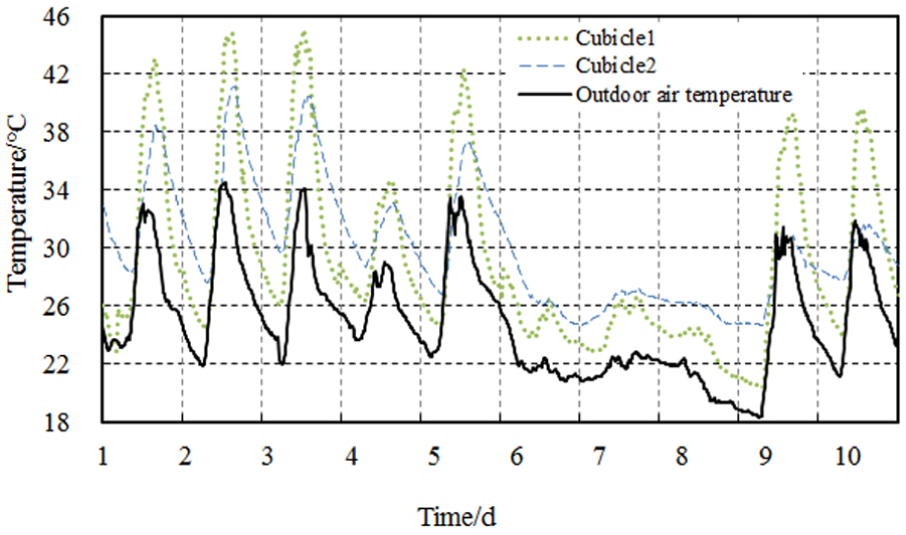
Variation of indoor air temperature in two cubicles (8.25–9.3).
The indoor air temperature curve of the experimental room in the early winter is shown in Figure 3. It is found that when the outdoor temperature is relatively low which fluctuates between 2.4°C and 15.4°C. The indoor temperature of the ordinary room (cubicle1) will fluctuate from 1.9°C to 20.5°C. For the cubicle2, the temperature fluctuation range is from 4.6°C to 18.5°C. In the night, because the composite room (cubicle2) is able to release the heat stored during the day, the indoor temperature is relatively stable and similar with the outdoor temperature, thereby saving the heating energy consumption. Such as in the 2 am, the average air temperature of cubicle2 is 1.4°C higher than cubicle1, and the maximum of the difference is up to 4°C.

Variation of indoor air temperature in two cubicles (12.5–12.14).
The indoor air temperature change curve contrasted with different experimental room in the transitional season is shown in Figure 4. It is found that when the outdoor weather is relatively cool, the outdoor air temperature is in the range of 7.8°C–29.8°C, the fluctuation of the air temperature inside the ordinary box (cubicle1) is 9.6°C–41.4°C. The indoor air temperature of composite room (cubicle2) fluctuated in the range of 11.0°C–29.5°C. It could indicate that heat storage capacity of PCM can maintain the indoor air temperature fluctuated in a relatively small range. During daytime (8:00–18:00), the maximum indoor air temperature of the cubicle2 is 12.3°C lower than the cubicle1. During night (18:00–8:00), it is 6.3°C higher than the cubicle1. Since during the transition season, the temperature difference between day and night is large. PCM could release the fully heat energy in night with the better thermal performance of charge and discharge heat characteristic. Such as the first day of the test, the sudden rise in the outdoor temperature during the day led to the rapid increase in the general room temperature and indoor air temperature. However, at the same time, the temperature of the composite room (cubicle2) is flat with outdoor air temperature. In the night, the temperature of the cubicle1 decreased rapidly with the outside decreased temperature. However, the cubicle2 kept the stable temperature range due to the release of heat stored from the daytime by PCM. And the heat released sufficiently which provided favorable conditions for the heat storage with PCM in the second daytime. In rainy days, as PCM can release the heat stored in the sunny days, the indoor air temperature in the cubicle2 could maintain relatively stable and comfortable.

Variation of indoor air temperature in two cubicles (3.30–4.8).
According to the above test results, in the hot season, the cubicle integrated with PCM has obviously effect on heat storage capacity, heat attenuation, and temperature delay. When the outdoor temperature is low, the cubicle integrated with PCM can effectively store the heat absorbed during the day, and release them in the night which maintain the indoor air temperature be relatively stable or reduced. The effect of PCM in winter is not good compared with that in summer and transitional season which is mainly due to the lower solar irradiance during the daytime in Chengdu. The heat storage of the PCM cannot be absorbed well.
The temperature change characteristics of inside and outside wall surface
As shown in Figure 5, it is the temperature change curve of the south wall inside and outside of the experimental cubicles in the summer. During 25th August–3rd September, it was found that the temperature of two room south wall were high, and the temperature difference of these two kinds of cubicles nearly kept around 0.3°C. The maximum temperature is 54.9°C. The south wall surface temperature of the cubicle2 fluctuated between 24.4°C and 40.5°C, while the south wall surface temperature of the cubicle1 fluctuated between 20.2°C and 44.9°C which fluctuated larger than the cubicle2. And the maximum temperature difference of south wall of these two experimental cubicles was up to 9.8°C. The latent heat storage capacity of PCM reduces the indoor actual heat.

Variation of inside and outside south wall surface temperature in two cubicles (8.25–9.3).
As shown in Figure 6, it is the inside and outside south wall surface temperature change contrast curve between the cubicle2 and cubicle1 during winter season. It can be found when the outdoor temperature is relatively low, the composite room and ordinary room inside and outside south wall surface temperature fluctuated from 1.4°C to 44.2°C. And, during the night, the PCM could release the solar radiation heat absorbed in the day, then reduce the extent of wall temperature. The south wall surface maximum temperature of the cubicle2 is 4.5°C higher than cubicle1.

Variation of inside and outside south wall surface temperature in two cubicles (12.5–12.14).
As shown in Figure 7, it is the temperature change curve of the south wall inside and outside of the experimental cubicles in the transition season. During the testing period, it can be found that the south wall surface temperatures of two cubicles were both in high, and the highest temperature was up to 51°C. The outside surface temperatures of two cubicles were same, and the average temperature difference was 0.5°C. The temperature difference between the outside south wall surface and the inside surface of the cubicle1 was 25.5°C. For cubicle1, it is 16.7°C.

Variation of inside and outside south wall surface temperature in two cubicles (3.30–4.8).
According to the above analyses, it can be found that the cubicle integrated with PCM layer could significantly reduce the surface temperature of inside wall during the hot season and transition season. At low outdoor temperatures, during the night, the cubicle integrated with PCM layer could effectively release the solar radiation heat absorbed in the day, and reduce the degree of the reduction of inside wall surface temperature.
Simulation of indoor thermal environment
Simulation model
In this simulation, the phase transition model is simplified as a one-dimensional (1D) conduction finite difference (CondFD) solution algorithm which uses an implicit finite difference scheme.
Rigorous validations and verification studies for general heat transfer calculations and the CondFD solution algorithm in EnergyPlus have been performed by many researchers and the EnergyPlus developer team.10–13 Version 8.1 of EnergyPlus with the CondFD algorithm solved by a fully implicit finite difference scheme is used in this study. Equation (1) shows the calculation method for the fully implicit scheme

where T is the node temperature, I is the node being modeled, i+1 is the adjacent node to interior of construction, i − 1 is the adjacent node to exterior of construction, j+1 is the new time step, j is the previous time step, Δt is the calculation time step, Δx is the finite difference layer thickness, Cp is the specific heat of material, kw is the thermal conductivity for interface between i node and i+1 node, kE is the thermal conductivity for interface between i node and i − 1 node, and ρ is the density of material.
Then, equation (1) is accompanied by equation (2) that relates enthalpy and temperature

where HTF is an enthalpy–temperature function that uses input data. The enthalpy–temperature function is used to develop an equivalent specific heat at each time step (equation (3))

In the CondFD algorithm, all elements are divided or discretized automatically using equation (4), which depends on a space discretization constant (C), the thermal diffusivity of the material (α), and the time step the default space discretization value of 3 is used in this study

Validation of the simulation model
The test data of the indoor air temperature with the two experimental cubicles, from 2nd to 3rd September, was selected as typical test days to validate the simulation model. As shown in Figure 8, the tested value of indoor air temperature was contrasted with simulated value with cubicle1 and cubicle2. The difference between test and simulation results is less than 5%. It is good agreement between test and simulation results. It could validate that the simulation model can be used to simulate indoor thermal environment of lightweight buildings integrated with PCM under Chengdu climate conditions.
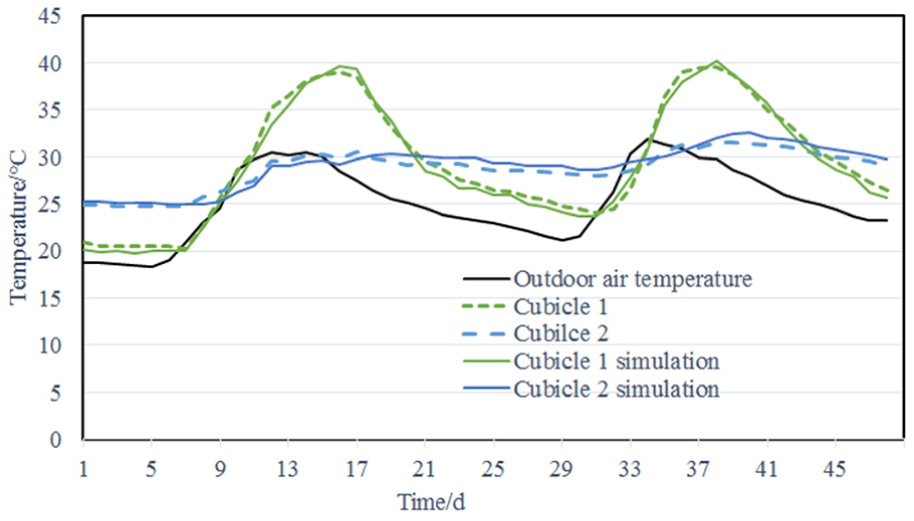
Comparison between test value and simulated value for indoor air temperature.
Simulation results and discussion of annual heating and cooling load
The “Ideal Loads Air System” of EnergyPlus was assumed for the HVAC system. It supplies the necessary heating or cooling air at the specified conditions to meet the zone heating or cooling load without defining air loops, water loops, and so on. In the simulation, the indoor air temperature of heating condition is set at 18°C, and that of heating condition is set at 26°C. The outdoor ambient temperature is set as the typical annual temperature.
For the lightweight building in Chengdu, PCM composite exterior wall can significantly reduce the building load as shown in Figure 9. The maximum is in April, it could reduce the cooling load up to 1.44 × 10⁵ kJ. The cooling load of cubicle2 is similar with cubicle1 in hot summer. Although the energy saving effect of PCM is not good during hot summers, the loads in a lightweight building integrated with PCM are more stable with no peak compared with ordinary lightweight buildings. The annual load of model building with ordinary exterior wall structure is 7.35 × 10⁶ kJ, while the model building with PCM composite exterior wall is 5.60 × 10⁶ kJ, which is 23.85% less than that of ordinary model building.

The heating and cooling load of cubicle1 and cubicle2.
Conclusion
For the climatic conditions of Chengdu city in China, the thermal performance of lightweight buildings integrated with PCM is assessed by experiments and simulations, and compared with the ordinary contracture building. The study summarizes the following:
The test results showed that the PCM has the effect of heat attenuation and temperature delay by improving the indoor stability of the lightweight building, especially during summer and transition season. The maximum reduction of indoor temperature is 8.5°C, and the average reduction of the temperature is 1.5°C. The maximum delay time of temperature is 3.25 h. When the outdoor temperature is low, lightweight building structure with PCMs could release the heat absorbed in the day very well in order to improve the indoor temperature. The maximum temperature could increase 4°C.
The lightweight building integrated with PCM layer could significantly reduce the surface temperature of inside wall during the hot season and transition season. The maximum temperature difference about the two experimental cubicles is up to 9.8°C. At low outdoor temperatures, during the night, the cubicle integrated with PCM layer could effectively release the solar radiation heat absorbed in the day, and reduce the extent of the wall inside surface temperature reduction. The maximum temperature difference of the two experimental south wall inside surfaces is up to 4.5°C.
For the lightweight building in Chengdu, PCM composite exterior wall can significantly reduce the building load. Although the energy saving effect of PCM is not good during hot summers, the loads in a lightweight building integrated with PCM are more stable with no peak compared with ordinary lightweight buildings. The annual load of model building with PCM composite exterior wall is 23.85% less than that of ordinary model building.
The new lightweight envelope structure with thermal insulation has high thermal performance, heat insulation and heat storage effect, and makes full use of the heat storage/release capacity of the PCM. Other advantages are flexible, easy maintain, small covered area, long life span. In addition, it can be applied to many types of temporary buildings. This study provides some meaningful guides for application of PCM in lightweight building.
Footnotes
Academic Editor: Shuli Liu
Declaration of conflicting interests
The author(s) declared no potential conflicts of interest with respect to the research, authorship, and/or publication of this article.
Funding
The author(s) disclosed receipt of the following financial support for the research, authorship, and/or publication of this article: This project was funded by the National Natural Science Foundation of China (no. 51508352), the Science &Technology Department Foundation of Sichuan Province, China (no. 2014GZ0052), and the Science & Technology Department Foundation of Chengdu City, China (no. 2015-HM01-00244-SF).