




Abstract
Hybrid ground-source heat pump system has been widely used for mitigating the heat accumulation problem of conventional ground-source heat pump systems. This article proposes a wet-bulb temperature-based control method for a hybrid ground-source heat pump system which comprises a ground-source heat pump and a conventional water-cooled chiller using a cooling tower. With this method, the operation priority between the ground-source heat pump and the water-cooled chiller is determined according to the outdoor wet-bulb temperature. A TRNSYS platform of the system is developed, and simulations are carried out to investigate the system performance under the proposed control method. Meanwhile, simulations with two other control methods (reference methods), that is, the ground-source heat pump–prioritized method and water-cooled chiller–prioritized method, are also conducted. The study results show that the proposed control method has obvious advantage in controlling the heat balance of the ground-source heat exchangers, and in the meantime, no more energy is consumed when compared with the two reference control methods.
Keywords
Introduction
Energy and environmental issues are gaining much concern around the world. Buildings account for 30% of the total energy consumption in China. 1 Thus, improving the energy efficiency of buildings is of significance for mitigating the energy and environmental issues. The heating, ventilation, and air conditioning (HVAC) system for providing a comfortable indoor environment for the occupants plays an important role in building energy consumption. For commercial buildings in China, more than 40% of the energy is consumed by HVAC system. 2 Large efforts have been paid for improving the energy efficiency of the HVAC system in the last decades. The ground-source heat pump (GSHP) system is widely used in HVAC system for its high efficiency and environmental friendliness.3,4 It utilizes the ground as the heat sink (in summer) and source (in winter). In summer, the system cools the buildings and transfers the heat from the buildings into the ground for storage using circulating medium such as water. In winter, the stored energy is further used for heating the buildings. Its high efficiency is mainly attributed to the favorable and stable ground soil temperature in the whole year. The ground soil temperature below 10–15 m depth is not obviously affected by the over-ground thermal disturbances (i.e. the intensified solar radiation, elevated air temperature etc.), and it is almost constant at a value close to the annual average air temperature. 5
In recent years, more attention has been paid to the GSHP system due to its energy accumulation problem which is caused by the imbalance between the heat storage and heat release to and from the ground, respectively. The energy accumulation problem will lead to the degradation of the system efficiency and even the failure of the system. Taking the buildings in hot-summer and cold-winter region for example, the accumulated building cooling load is much larger than the accumulated building heating load. Considering the heat storage and release characteristics of the ground soil, the heat accumulation problem of the GSHP system must be carefully considered for the buildings in this climate region.6,7 To mitigate the heat accumulation problem of GSHP system, a hybrid ground-source heat pump (HGSHP) system, which comprises a ground-source system and a supplemental heat dissipation system, has been proposed.8–10 At present, one of the most commonly used and economical supplemental heat dissipation devices is cooling tower. 11 In the hybrid system, the cooling tower can meet part of the heat rejection demand of the system. Thus, the heat storage by the ground soil can be reduced. The heat accumulation problem can be mitigated and even avoided.
As mentioned above, to mitigate the heat accumulation problem, the HGSHP system which combines a GSHP with a supplemental heat dissipation device has been widely adopted. Alternatively, another HGSHP system which combines a conventional water-cooled chiller (WCC) with a GSHP can also be adopted to mitigate the heat accumulation problem. This HGSHP system can be used to well balance the heat storage and release of the ground-source heat exchanger, and in the meantime improve the system performance on a long-term basis. In this system, both the WCC and the GSHP are used for providing cooling for the buildings. Note that the cooling tower is usually used as the heat dissipation device for the WCC. With the building cooling load partially undertaken by the WCC, the heat imbalance of the ground heat exchanger (GHE) can be mitigated and even eliminated by optimizing the operation schedule of the system. To distinguish with the HGSHP system which combines a GSHP with a supplemental heat dissipation device, the investigated HGSHP system which combines a GSHP and a WCC is termed as the hybrid cooling (HC) system.
A HGSHP system requires suitable control strategies to maximize the usage of the geothermal energy while keeping the heat balance of the ground soil. There are already many studies on searching for the optimal control strategies to improve the system performance of the HGSHP system. Xu 12 proposed three strategies which are load-based control, energy model–based control, and adaptive temperature set-point control. Both the advantages and disadvantages of these three control strategies were presented and discussed in detail. However, in that study, the GHE operated continuously during the cooling periods, that is, the GHE was always subject to heat injection, which is not beneficial to the recovering of the GHE. 13 Considering the intermittent operation of the GHE, Yavuzturk and Spitler 14 and Man et al. 15 adopt a time schedule control strategy, that is, to operate the cooling tower and the GHE alternately during a fixed period in a day to dissipate the accumulated heat in the ground soil. The obvious disadvantage of the time schedule control is that it may be at cross purposes when the outdoor wet-bulb temperature is higher than the soil temperature around the GHE. Similarly, Gang and Wang 16 and Gang et al. 17 proposed a model predictive control method to switch between the GHE and cooling tower. In their study, the artificial neural network (ANN) is used to simulate the GHE and predict its exiting water temperature. The switch between the cooling tower and GHE is determined by comparing their exiting water temperatures. The result shows that the control method can improve the system performance significantly. However, the ANN-based method requires large amount of operation data for model training and is difficult for engineering application.
As mentioned above, there are already many research works aiming at the optimal control for the HGSHP system which combines a GSHP with a supplemental heat dissipation device, for example, cooling tower. However, these existing control strategies are not applicable for the HGSHP system which combines a GSHP with a conventional WCC. The performance of the WCC can be affected by many factors such as the cooling load, compressor efficiency, and climate conditions. Thus, for HC system, some additional aspects (e.g. the performance of the WCC) should be considered when optimizing the operation schedule of the system.
A simple and reliable control method, that is, a wet-bulb temperature-based control method, is proposed for optimizing the operation of the HC system. In fact, the HC system has two cooling systems which are the GSHP system and the conventional water-cooled system. These two cooling systems can operate either independently or together. The operation of the WCC is determined according to the outdoor wet-bulb temperature.
This study investigates the performance of the HGSHP system which combines a GSHP and a conventional WCC (i.e. HC system) with the proposed optimal control method (i.e. the wet-bulb temperature-based method). The system performances of the two reference control methods, that is, the GSHP-prioritized method and the WCC-prioritized method, are also investigated. The results are used to evaluate the performance of the proposed control method.
This article is arranged as follows. Section “System design and configuration” gives a detailed description of the investigated system including the building and the HC system; section “System control methods” describes the proposed control method and the other two reference control methods; section “Description of the test facility” describes the test facility, that is, the construction of the simulation platform in TRNSYS; section “Simulation and result analysis” presents the simulation results and analysis. It mainly includes the optimal design for the proposed method and the performance comparison among these three control methods. Section “Conclusion” is the conclusion. The study results and conclusions may provide some meaningful guidelines for the application of the HC system in practice.
System design and configuration
Building description
The investigated building is a medium-size railway station located in Yancheng, which is subject to both hot-summer and cold-winter region and cold region in China, 18 as shown in Figure 1. The annual hourly load profile in a typical meteorological year simulated with the building energy simulation software DeST 19 is presented in Figure 2. The peak cooling and heating loads are determined as 1365 and 853 kW with referring to Bureau, 20 respectively. The yearly accumulative cooling and heating loads are 1,447,058 and 1,164,942 kWh, respectively. Note that the cooling load is much larger than the heating load in terms of both the peak value and the accumulative value. The building is equipped with a central air conditioning system which is sized based on the obtained building load. The cooling season is from 15 May to 15 October and the heating season is from 1 December to 28 February of the next year according to related criterions.21,22

Climate region of building in China.

Annual hourly heating and cooling loads.
System configuration
The central air conditioning system is a HGSHP system as shown in Figure 3. The investigated system consists of a GSHP and a conventional WCC (i.e. HC system). In winter, the GSHP is used for building heating. In summer, either the GSHP or the WCC is used for building cooling.

Schematic diagram of the HC system.
The technique data of the HC system are given in Table 1. A heat pump unit with a nominal heating capacity of 896 kW and cooling capacity of 823 kW is selected based on the peak heating load. In total, 187 vertical GHEs are used to meet the heating demand. The diameter and depth of the GHE are 200 mm and 100 m, respectively. Within the GHE, the vertical buried U-pipe has an external diameter of 32 mm and an internal diameter of 26 mm. Because the cooling demand is much larger than the heating demand, the heat pump unit alone which is sized based on the peak heating load cannot meet the cooling demand completely. Additionally, a WCC with a nominal cooling capacity of 670 kW is chosen to meet the remaining cooling demand. All the water pumps, cooling towers, and so on are sized according to the capacities of the heat pump unit and the WCC.
Technique data of the HC system.

HC: hybrid cooling; GSHP: ground-source heat pump; WCC: water-cooled chiller; COP: coefficient of performance.
System control methods
To optimize the system performance of the investigated HC system, a wet-bulb temperature-based control method is proposed. Meanwhile, a GSHP-prioritized method and a WCC-prioritized method are also used to evaluate the system performance for reference. Note that the operation schedules of these three methods are the same in heating season, and only the GSHP is used for building heating.
Wet-bulb temperature-based control method (the proposed control method)
As the outdoor air wet-bulb temperature has a significant effect on the efficiency of the cooling tower in cooling season, the priority between the GSHP and the WCC is determined based on the outdoor air wet-bulb temperature. A fixed threshold for the wet-bulb temperature is set. If the outdoor wet-bulb temperature is lower than the threshold, the WCC with cooling tower operates with the priority. At this situation, if the cooling demand exceeds the maximum cooling capacity of the water-cooled chiller, the heat pump unit with GHE will be in operation to meet the remaining cooling demand. Otherwise, if the outdoor wet-bulb temperature is higher than the threshold, the heat pump unit with GHE operates with the priority. At this situation, if the cooling demand exceeds the maximum cooling capacity of the heat pump unit, the WCC with cooling tower will be in operation to meet the remaining cooling demand.
GSHP-prioritized control method
In cooling season, the heat pump unit is put in operation with priority. If the cooling demand exceeds the maximum cooling capacity of the heat pump unit with GHE, the WCC unit with cooling tower will be put in operation to meet the remaining cooling demand.
WCC-prioritized control method
In cooling season, the WCC with cooling tower is put in operation with priority. If the cooling demand exceeds the maximum cooling capacity of the water-cooled chiller unit with cooling tower, the heat pump unit with GHE will be put in operation.
Description of the test facility
In this study, a simulation platform for this investigated system is developed by TRNSYS, 23 which is widely used for building energy simulation. The simulation platform, as shown in Figure 4, serves as a virtual test rig to investigate the system performance. It mainly consists of GHE, heat pump, WCC, cooling tower, controller, and so on. The top part of the simulation platform is the GSHP system and the bottom part is the WCC system. The control system with proposed control method decides which system will work first. The models of heat pump, WCC, and cooling tower are taken from the literature.24–26 The models of GHE, water pump, air handling unit (AHU), distributor, and mixer are provided by TRNSYS. The details about the main models are introduced as follows.

Schematic diagram of simulation platform of the HGSHP system.
Heat pump/WCC
In this study, a water-to-water heat pump model24,25 is used to represent the heat pump unit. In this model, a first-order inertia is introduced to simply describe the dynamic characteristic of the heat pump unit. The mathematical description of this model is shown as equations (1)–(4)



where T and T′ are the water temperature at inlet and outlet of the thermal storage, respectively, °C; C is the thermal capacitance, J/°C, and only the thermal capacitances of the water volume in the evaporator and condenser are concerned. m is mass flow rate, kg/s; the subscripts ev, cd, ch, cl, in, out, and w indicate the evaporator, the condenser, the chilled water, the cooling water, the inlet, the outlet and the water, respectively.
GHE
A duct ground heat storage (DST) model (type 557a) 27 in TRNSYS is used to simulate the GHE. This model was developed by Lund University in Sweden. It assumes that boreholes in underground regenerator are evenly distributed. The ground temperature (Tsoil) is comprised of three parts including global temperature (Tglobal), local temperature (Tlocal), and dynamic temperature (Tsteadyflux) described in equation (5). The global and local temperatures are solved using the finite difference method and the steady-flux temperature is obtained analytically. More details about the DST model can be found in the work by Helström 28 and Li 29

Cooling tower
A counter-flow cooling tower is used in this study. The schematic of the heat and mass transfer in the counter-flow cooling tower is shown in Figure 5. This model is developed based on the literature. 30 The main mathematical description of the cooling tower model is shown as equations (6)–(13)






In the above equations, a0, a1, a2, and a3 are 93,625, 1786.1, 11.35, and 0.98855 J/kg, respectively. 31 The outlet water and outlet air condition can be calculated according to the inlet water and the inlet air condition by the method of number of transfer units (NTU) which is usually used to measure the heat transfer capacity of heat exchangers.
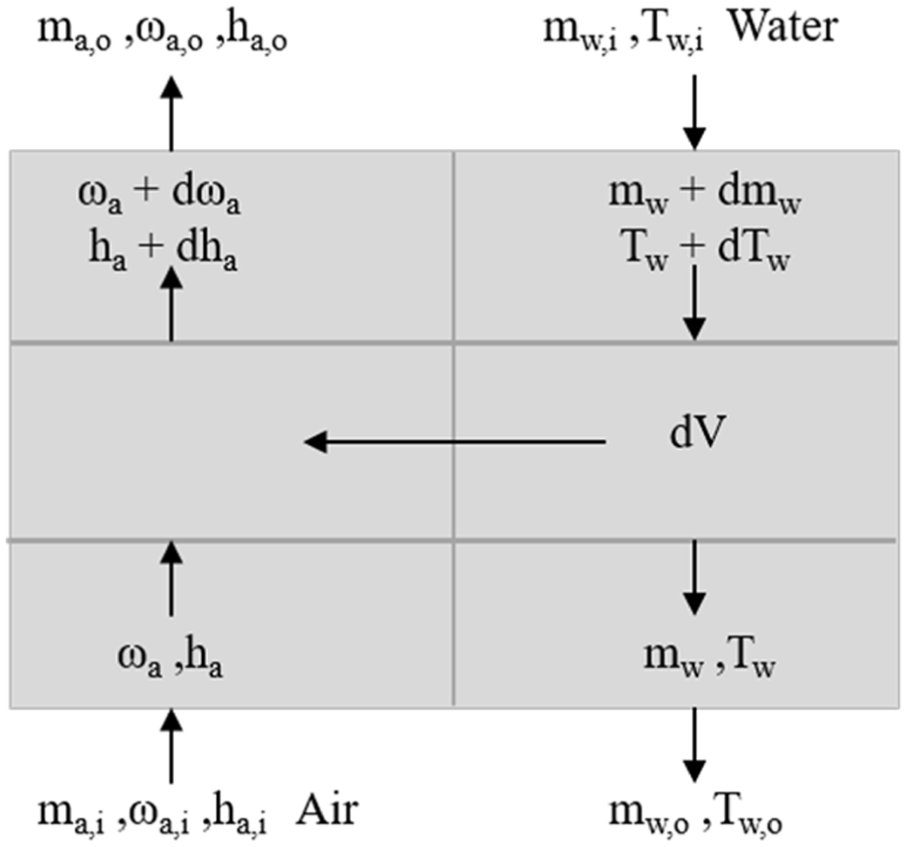
Schematic diagram of the cooling tower.
Water pump
A variable-speed water pump is used in this study. The mathematical model of the variable-speed pump in TRNSYS (i.e. type 743) is an empirical model which can be described using equation (14). 32 With the given frequency, the power consumption of the water pump can be calculated as shown in equation (14)

where f is the frequency and P is the pump power. The undetermined coefficients b0, b1, b2, and b3 can be identified from the field data. In this study, b0, b1, b2, and b3 are 0, 0.0016, −0.0037, and 0.9671, respectively.
Simulation and result analysis
Boundary conditions
The building is a subway station. The HGSHP system with the WCC (i.e. HC system) operates from 5:00 am to 12:00 pm each day in the heating and cooling seasons. The HC system starts to operate from summer to avoid a too low outlet water temperature from the GHE in winter. In heating season, the outlet water temperature of the heat pump unit is set to be constant of 45°C. In cooling season, the outlet chilled water temperature of the heat pump/WCC is set to be constant of 7°C. The initial average soil temperature is 16.5°C. The building load and outdoor weather data are read by the TRNSYS simulation platform in the form of user-defined profiles. For each case, the system is simulated for 21 years with the time step of 1 h. The results of the second year and the last 20 years are chosen as 1-year and 20-year analysis, while the first year is pre-working.
Optimization of the wet-bulb temperature-based control method
In the proposed wet-bulb temperature-based control method, the priority between the GSHP and the WCC is determined by comparing the outdoor wet-bulb temperature with a fixed threshold. Thus, the performance of this system using the proposed control may be significantly affected by the chosen threshold for the outdoor wet-bulb temperature. In this study, the system performance is measured in terms of the variation of the average soil temperature until the end of the 20th year and the total energy consumption for 20 years. It is necessary to find the optimal threshold to optimize the system performance during the whole life span (the life span of 20 years is assumed). Simulations using the proposed control method are conducted for different chosen thresholds. The results are show in Table 2.
Results of different thresholds for the outdoor wet-bulb temperature.

the optimal threshold for the outdoor wet-bulb temperature.
The results show that the average soil temperature at the end of the 20th year increases obviously with the decrease in the threshold of the outdoor wet-bulb temperature. It is mainly because that lower threshold of the outdoor wet-bulb temperature leads to the reduced operation of the WCC while resulting in more use of the GSHP unit. This consequently leads more heat injected to the GHE. In addition, it can also be found that the average soil temperature at the end of the 20th year keeps almost the same when the threshold is 23.2°C. It means that the heat accumulation problem is completely eliminated. With regard to the total energy consumption for 20 years, it obviously decreases as the threshold of the outdoor wet-bulb temperature increases. A little bit decrease in the total energy consumption can be found as the threshold increases from 23.2°C to 28°C. When the threshold increases from 23.2°C to 28°C, very limited energy reduction (less than 1%) can be obtained. However, this may lead to more than 5°C decrease in the average soil temperature. It may degrade the energy efficiency of the GSHP unit during heating season and increases the possibility for the unit to fail to run on the extremely cold weather. Therefore, the optimal threshold for the outdoor wet-bulb temperature is set as 23.2°C.
System performance evaluation and analysis
To evaluate the system performance under the proposed control method, two reference control methods are used as benchmark. These three methods are compared mainly in terms of three aspects, that is, energy consumption, efficiency of heat pump/WCC, and the heat balance of the GHE. Only the 1-year and 20-year system performance is presented. It is worth to note that the optimal threshold for the proposed control is 23.2°C.
1-year analysis
Table 3 shows the operation time of the GSHP and WCC using these three control methods in the cooling season. The operation time of the wet-bulb temperature-based control method is something similar to the WCC-prioritized method. By the wet-bulb temperature-based control method, the WCC runs for about 2762 h in cooling season, while the GSHP runs for 951 h. In contrast, the GSHP runs much more time than the WCC in GSHP-prioritized control method. The results show that large difference exists among these three control methods in terms of the operation time.
Operation time of the GSHP and the water-cooled chiller in cooling season.
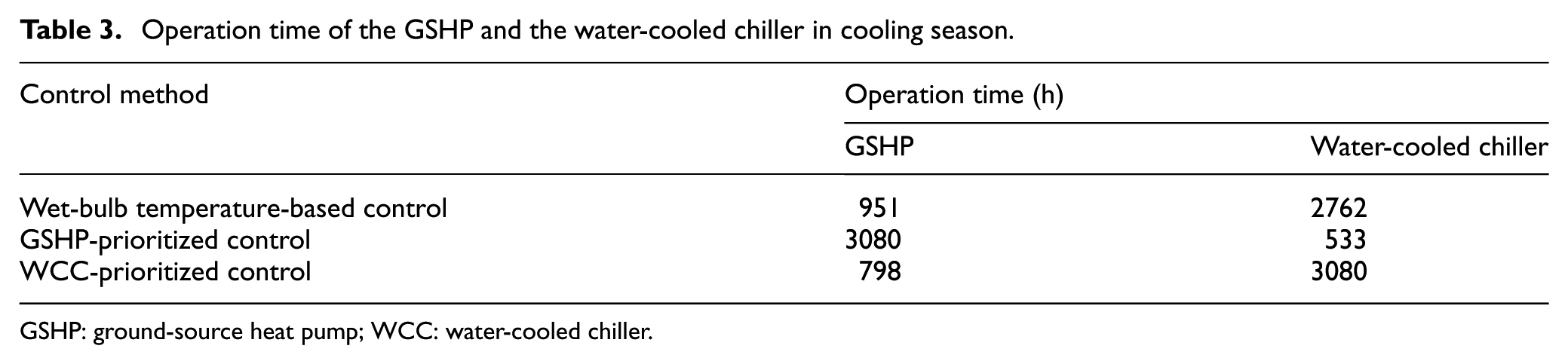
GSHP: ground-source heat pump; WCC: water-cooled chiller.
The average soil temperature and the inlet and outlet water temperatures of the GHE using these three control methods are shown in Figure 6. For GSHP-prioritized control method, the outlet water temperature of the GHE in cooling season is higher than 35°C for a long time and even exceeds 40°C sometimes. At the end of the year, the mean soil temperature increases by about 2.3°C when compared with the initial soil temperature. For WCC-prioritized method, at the end of the year, the mean soil temperature decreases by 0.6°C. The outlet water temperature from the GHEs is below 35°C. When compared with above two reference methods, the wet-bulb temperature-based control method not only can keep the outlet water temperature from the GHEs at a reasonable level but also can well balance the heat absorption and release of the GHEs. At the end of the year, the average soil temperature almost returns to the initial value again with a very small difference less than 0.1°C.

The average soil temperature and the inlet and outlet water temperatures of the GHEs in 1 year: (a) GSHP-prioritized control method, (b) WCC-prioritized control method, and (c) wet-bulb temperature-based control method.
The coefficients of performance (COPs) of the GSHP and the WCC using these three control methods are shown in Figure 7. The COPs of the GSHP in the heating season are almost the same for these control methods. In the cooling season, the COPs of the GSHP and WCC can be maintained at a relatively higher level using the wet-bulb temperature-based control method when compared with the other two control methods.
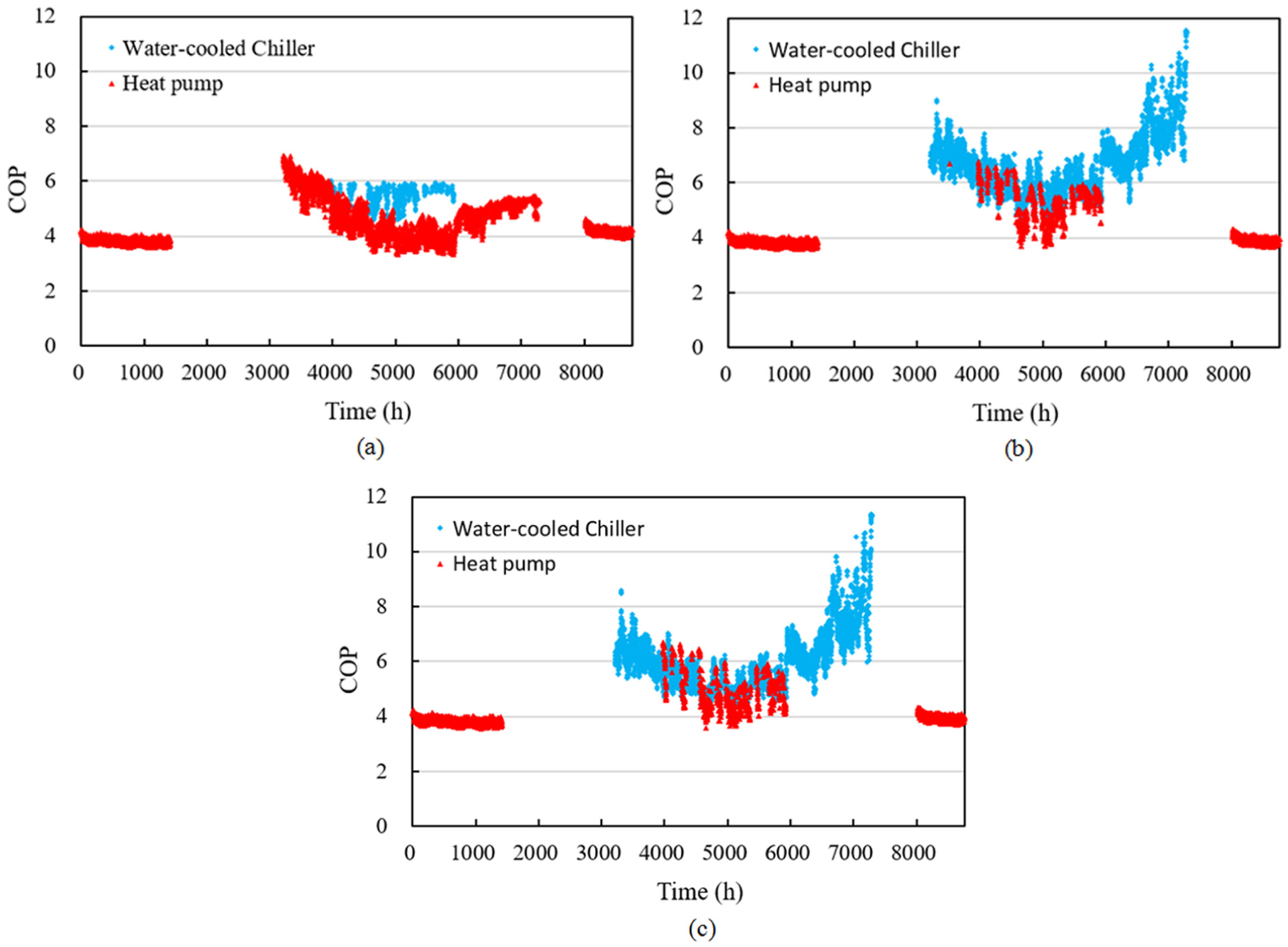
COPs of the GSHP and the water-cooled chiller: (a) GSHP-prioritized control method, (b) WCC-prioritized control method, and (c) wet-bulb temperature-based control method.
The system energy performances of these three methods are also compared as listed in Table 4. The total system energy consumption using the wet-bulb temperature-based control method is 5.6% and 3.2% lower than the GSHP-prioritized method and the WCC-prioritized method, respectively.
Annual energy consumption of these control methods in 1 year.

GSHP: ground-source heat pump; WCC: water-cooled chiller; AHU: air handling unit.
Based on the above analysis of the system performance in 1 year, it can be found that the heat balance of the GHEs can be well controlled using the proposed wet-bulb temperature-based control method, while energy consumption is also minimum when compared with GSHP-prioritized control method and WCC-prioritized control method.
20-year analysis
The variations of the average ground soil temperature of the GHEs in 20 years using these three methods are shown in Figure 8. It is clearly shown that the heat balance of the GHEs can be well controlled with the proposed wet-bulb temperature-based control method. Almost no variation can be observed on the average soil temperature at the end of the 20th year when compared with the initial average soil temperature (i.e. 16.5°C). In contrast, when the GSHP-prioritized control method or the WCC-prioritized control method is used, the heat balance of the GHEs cannot be well controlled on long-term basis. For the GSHP-prioritized control method, the average soil temperature increases significantly with the system operation and even exceeds 35°C in the last several years. For the WCC-prioritized control method, the average soil temperature has an opposite variation trend. The average soil temperature reduces to 6°C at the end of the 20th year. Such high or low soil temperature can significantly degrade the energy efficiency of the GSHP and even affect the safety of this GSHP system.

Average ground soil temperature in 20 years.
Conclusion
This article proposes an optimal and reliable control method for a HGSHP system which includes a GSHP unit and a WCC. Both the GSHP and the WCC are used for building cooling. With the proposed control method, the operation priority between the GSHP and the WCC in cooling season is determined by comparing the outdoor wet-bulb temperature with an optimal fixed threshold. The optimal wet-bulb temperature of a medium-size railway station located between hot-summer and cold-winter and cold region in China is about 23.2°C. If the outdoor wet-bulb temperature is lower than the threshold, the WCC operates first. At this situation, when the cooling demand exceeds the maximum cooling capacity of the water-cooled chiller, the GSHP with GHE is put into operation for meeting the cooling demand. Otherwise, when the outdoor wet-bulb temperature is higher than the threshold, the GSHP operates first. At this situation, if the cooling demand exceeds the maximum cooling capacity of the GSHP, the WCC is put into operation.
A simulation platform for the HGSHP system is developed in TRNSYS to evaluate the performance of the proposed control method in terms of energy consumption and heat balance of the GHE. In the meantime, two conventional control methods, that is, the GSHP-prioritized method and WCC-prioritized method, are also used for performance comparison and evaluation. The results show that the heat balance of the GHEs can be well controlled using the proposed wet-bulb temperature method, while the energy consumption is minimum when compared with that using the two conventional control methods. After 20 years’ operation, the average soil temperature with the proposed control method almost has no variation when compared with the initial soil temperature (i.e. 16.5°C). However, the average soil temperature increases to 42°C and reduces to 6°C with the GSHP-prioritized method and WCC-prioritized method, respectively. The total system energy consumption using the wet-bulb temperature-based control method is 5.6% lower than that using the GSHP-prioritized method and 3.2% lower than that using the WCC-prioritized method, respectively. The results of this study may provide some meaningful guidelines for the practical system operation of the HGSHP system which combines a GSHP and a WCC for mitigating the heat accumulation problem of the GHE.
Footnotes
Appendix 1
Academic Editor: Shuli Liu
Declaration of conflicting interests
The author(s) declared no potential conflicts of interest with respect to the research, authorship, and/or publication of this article.
Funding
The author(s) disclosed receipt of the following financial support for the research, authorship, and/or publication of this article: This work was financially supported by a grant (No. 51678263) from the National Natural Science Foundation of China.