




Abstract
The characteristics of urban rail transit emergencies include fast diffusion, wide-ranging influence and difficult handling. They require the coordination of multiple organizations. Previous studies have shown that the inter-organization collaboration efficiency is low. This article takes the subject of urban rail transit emergencies and studies the factors that influence inter-organization collaboration obstacles in emergency rescues, trying to reveal the formation path of inter-organization emergency collaboration obstacles. The 25 factors that influence inter-organization collaboration obstacles, which are determined using interviews and a survey, are grouped into five major elements (emergency organization obstacles, emergency information obstacles, emergency resource obstacles, emergency plan obstacles and emergency command obstacles). A hypothesis model of the relationship among these factors is established based on emergency management theory and organization collaboration theory, and then empirical research is conducted using a structural equation model combined with large-scale questionnaires. Then the dynamic causal model of inter-organization collaboration obstacles is established through system dynamics to explore the formation mechanism of such obstacles. The results indicate that the five elements interact with each other, and that eliminating these obstacles, especially those in the emergency organization obstacles and emergency plan obstacles groups, is essential for improving the efficiency of emergency command and inter-organization collaboration.
Keywords
Introduction
In recent years, urban rail transit has developed rapidly as the effective way to fundamentally improve city traffic conditions. Urban rail transit has the features of a particular space, compact structure, a dense electric system, rapid operation and so on. With the development of urbanization in China, the factors that trigger urban rail transit emergencies have dramatically increased, becoming more and more complicated. Rail transit companies, fire departments, hospitals, police, passenger transport, armed police, media and non-government departments should coordinate and cooperate to deal with rail transit emergencies, which are characterized by fast diffusion, wide-ranging influence and great difficulty in handling. However, the plethora of organizations participating in relief operations makes sharing information and coordinating relief difficult. 1 Moreover, a lack of coordination leads to duplication of effort, wasted resources and slow relief efforts. 2 The 2010 Haiti earthquake response revealed that a variety of impediments to information flow considerably hindered coordination. 3
Information sharing, cooperative communication and joint knowledge creation are all identified as collaboration mechanisms. 4 Thus, proper information collection, sharing and processing mechanisms would lead to effective coordination and efficient operation outcomes. 5 Besides, the enhancement of coordination and cooperation among different departments could achieve inter-organization collaboration, making fast rescue in an emergency possible and reducing losses. Inter-agency coordination in rescue operations is closely associated with information sharing, resource allocation and decision-making. However, rescue practice and relevant studies have shown that the inter-organization collaboration is inefficient in dealing with emergencies. It is necessary to realize inter-organization collaboration according to the rapidly changing range and severity of emergencies. Past research paid more attention to the mechanism of emergency collaboration than how to achieve collaboration and neglected the mechanisms by which emergency collaboration obstacles are formed. If the causes and formation mechanism of inter-organization collaboration obstacles are identified through academic research or practice, obstacles can be overcome or eliminated to establish better collaboration mechanisms and improve collaboration efficiency.
Thus, we derived our research objectives to analyze urban rail transit emergency barriers based on an inter-organization collaboration perspective. To further achieve our research objectives, this study applies the resource-based view (RBV), 6 information-processing view (IPV) 7 and systems theory to help our understanding of how organizations can overcome emergency collaboration obstacles. The RBV argues that “organizations may achieve competitive advantage from bundling of resources to create capabilities.” 8 The IPV advocates that “the greater the task uncertainty, the greater the amount of information that must be processed among decision makers during task execution in order to achieve a given level of performance.” 9 Systems theory emphasizes the interconnected nature of organizational activities. 10
To answer our research objectives, we have adopted an approach that combines interpretivism and positivism. This article is organized as follows. Section “Literature review and construct development” presents a critical review of related research focusing on various factors in emergency collaboration efficiency and develops the construct of five factors influencing inter-organizational coordination, deals with the determination of the factors that influence inter-organizational collaboration obstacles, designs a questionnaire, identifies necessary measures and tests the data. Section “Theoretical foundation and hypothesis development” focuses on hypothesis formulation. Section “Hypothesis testing and results” deals with measures, reliability and validity analysis and hypothesis testing. Section “Discussion” discusses the results. Section “Limitations and future research” discusses the theoretical and practical significance, the limitations of our study and future research directions.
Literature review and construct development
Impacts on inter-organizational collaboration efficiency
Due to the customary emergency management pattern, the rigid ways of emergency disposal and the phenomenon of information islanding, coupled with different organizations not being positively inclined to take responsibility, “one to one” communication and collaboration among the numerous organizations in the emergency disposal process are very rare, especially where inter-organization collaboration is concerned, so instructions from a higher level of leadership are required in many cases. Therefore, scholars engaged in disaster organization behavior have put forward many factors that influence the efficiency of emergency collaboration. For the government, its organizational structure, functional structure, ownership structure and so on are the order parameters (the dominant variables) affecting collaboration among the parts within the government, and the government’s interests, organizational culture, organizational objectives and so on also contribute to it in some degree. SE Robinson 11 analyzed two cases of emergency response to Hurricane Katrina and found that different emergency standards and criteria, different public emergency phases and organization relationships formed in advance had an effect on inter-organization collaboration efficiency. EL Quarantelli 12 believed that the different goals of emergency organization, new tasks and emergency event conditions affect emergency collaboration efficiency. In addition, some scholars also put forward factors affecting the efficiency of emergency coordination, such as cultural differences among organizations, the closeness of relationships among organizations and sharing of emergency knowledge, how effective and scientific the emergency command is, the normal learning frequency among multiple agents, the frequency of emergency knowledge exchange.13–17
Positive factors related to inter-organizational collaboration efficiency
Some scholars analyzed factors that have a positive impact on inter-organizational collaboration efficiency. For example, Kozuch and Sienkiewicz-Malyjurek 18 reported that coordination, communication and trust are the driving factors contributing to effective inter-organizational collaboration. Patel et al. 19 put forward a collaboration model involving support, teamwork, interaction and so on.
Much literature has focused on collaboration in the emergency rescue process. For instance, M McGuire and C Silvia 20 considered that a consistent understanding of the seriousness of the emergency, a strong capability to deal with emergencies, a simplified emergency organization structure and an efficient emergency executive capability had effects on the emergency organization collaborative efficiency. N Kapucu 21 analyzed several tornado emergency cases in Florida, United States and found that reasonable emergency plans, effective information channels on the emergency in hand and the adoption of effective technology contributed to improve the emergency collaboration efficiency.
Moreover, the efficiency of collaboration has received attention. KL Comfort 22 proposed some factors affecting the emergency collaboration efficiency, such as effective delivery of emergency information, evolution of the emergency, consistency of emergency goals, differences in organizational culture and degree of sharing emergency risks and pointed out that acquiring core information contributed to improve the effectiveness of the response action and promote coordination among emergency organizations. 23 TE Drabek 24 believed that the factors influencing multi-subject emergency collaboration efficiency include effective emergency plans, multi-subject emergency decision-making approaches, efficient decision-making, an effective emergency command center and an effective emergency exercise mode among multiple agents.
Negative factors related to inter-organizational collaboration efficiency
In addition, some scholars analyzed the factors that have a negative impact on inter-organizational collaboration efficiency, especially the problems, difficulties or potential barriers in collaborative working, which must be overcome to achieve inter-organizational collaboration. Such barriers, indentified from the literature, that is, non-supportive organizations, inadequate partnering arrangements, weak management, have been found at the individual, team and organization levels.25,19
Meanwhile, in disaster rescue, T Liu, 26 in a summary of the emergency response to the 7.23 Yongwen major railway accident, pointed out that poor coordination specification was the leading cause of the disorder and loss of control at the scene, which was shown in such aspects as the unclear tasks of each of the rescue personnel, the lack of smooth and effective communication, limited coordination of action, uneven progress of the rescue and the lack of an interactive mechanism to summarize and analyze information. McEntire 27 analyzed the tornado emergency in Fort Worth, Texas, United States and concluded that incomplete and inaccurate emergency information, the lack of emergency supplies, the lack of communication among emergency personnel, conflicts between the organization authorities and language barriers and other factors hindered the collaboration of the emergency organization. H Liu et al. 28 surveyed the earthquake emergency response and found that there were difficulties with coordinating the interaction, that is, a lack of information communication and sharing, a weak resource integration and allocation capability, disorderly participation of social forces.
In summary, the abovementioned scholars put forward many factors affecting multi-organization emergency coordination efficiency from their respective research backgrounds. However, they did not analyze which factors play the key roles and the relationship among those factors, which makes it difficult to clarify and improve the key points of emergency collaborative efficiency in emergency practice.
Determination of inter-organizational collaboration obstacle factors
Definitions of inter-organizational collaboration obstacles
Based on the definitions in the literature, this article defines inter-organization collaboration obstacles as the factors that hinder the formation of inter-organization collaboration and also means the barriers in the coordination process among organizations. In the emergency rescue practice, the obstacles always come from the organizational level, such as the irrational arrangement of resources, the lack of effective systems. Thus, the concrete content of inter-organization collaboration obstacles should be collected and analyzed based on the practice data.
Inter-organizational collaboration obstacle factors
There are no suitable measures of inter-organizational emergency collaboration obstacles in urban rail transit. Our procedures for developing instruments for these constructs followed Churchill’s (1979) 29 scale development methodology, including a comprehensive literature review, followed by pretesting with academics in the field of risk or disaster management. To guarantee the rationality and effectiveness of the survey, an initial scale was formulated, combined with previous research on and the characteristics of urban rail transit, and modified through expert interviews and pre-investigation, which means we made minor modifications to the wording of items based on feedback from the pretests in order to improve the scale performance.
Therefore, this article designs a Likert scale including 32 indexes of inter-organization collaboration obstacle factors. In order to ensure the validity of the indexes, prior research is conducted within Changsha Metro Group Co Ltd, Shenzhen Metro Group Co Ltd, Xi’an Metro Group Co Ltd, and relevant emergency scientific institutions, and 85 valid questionnaires were recovered. Twenty-six indexes are retained after the data processing and are shown in Table 1. All the factors are adopted in a 5-point Likert scale, where 1 means “almost no effect” and 5 means “remarkable effect.”
Scale of inter-organization collaboration obstacle factors in urban rail transit emergency rescue.

Reliability and validity test
It is necessary to analyze the reliability of the questionnaires before conducting statistical analysis. Reliability means the degree of consistency of the measurement or the possibility of getting the same result when measuring the same object repeatedly in the same case, reflecting the consistency or stability of a measuring tool. As the most common reliability coefficient, values of Cronbach’s alpha over 0.80 mean great reliability. The reliability analysis result is shown in Table 2. The Cronbach’s alpha of the questionnaire is 0.937 (over 0.8) and so illustrates the high internal consistency and reliability of the questionnaire.
Reliability statistics.

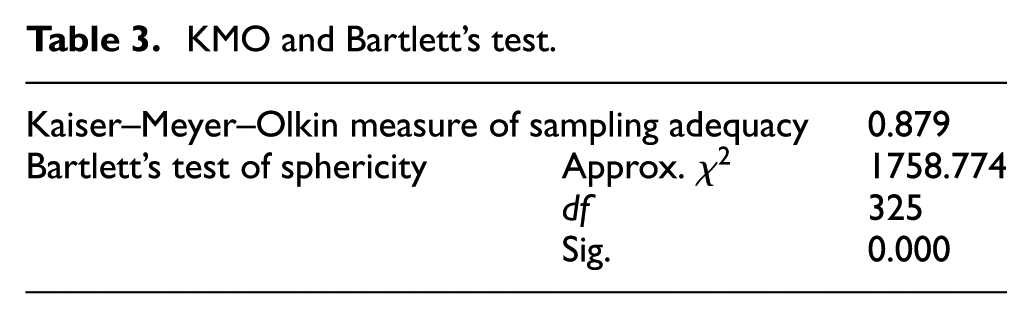
Exploratory factor analysis examines whether a common factor of the biggest variance ratio can be extracted through all the items which, theoretically, belong to the same dimension, in order to conceptualize the connotation of this dimension. Before the factor analysis, it is necessary to test whether the samples are appropriate for factor analysis. The Kaiser–Meyer–Olkin (KMO) measure and Bartlett’s test of sphericity can be used to determine the suitability of the samples. 30 Generally, if the KMO measure is over 0.7, it is appropriate for factor analysis. Moreover, Bartlett’s test is required to reach the significance level. The KMO and Bartlett’s test (Table 3) show that the KMO measure is 0.879, and the significance level of Bartlett’s test is less than 0.001. Therefore, the samples of emergency collaboration are suitable for factor analysis.
KMO and Bartlett’s test.
Factor analysis
The principal component analysis (PCA) method and the varimax rotation algorithm can be used to capture the common factors. The number of extracted factors is determined by whether the eigenvalues are over 1; the standard for deleting an item is that the factor loading is less than 0.5, and the cumulative variance can explain over 50%. The eigenvalue, contribution rate and rotated component matrix of the common factors were obtained by factor analysis using SPSS software. Five common factors are extracted; the cumulative variance can explain 65.340%, the table of factor loading is shown in Table 4, and factor loadings less than 0.5 have been deleted (factor VAR6: lacking smooth communication among organizations), and the larger ones retained.
Translational component matrix.

Twenty-five influencing factors of inter-organization collaboration obstacles in urban rail transit emergency rescues are selected and they are grouped into five elements (emergency organization obstacles, emergency information obstacles, emergency resource obstacles, emergency plan obstacles and emergency command obstacles), as shown in Table 5.
Influence elements and factors of inter-organization collaboration obstacle in urban rail transit emergency rescue.

Theoretical foundation and hypothesis development
Conceptual model
From the RBV and IPV perspective, combined with the results of factors analysis of inter-organizational collaboration obstacles, the mechanisms that influence the obstacles can be understood as the relationships among these factors, including emergency organizations, emergency information, emergency resources, emergency plan and emergency command, as shown in Figure 1. In the following subsections, we explain the relationships in our proposed framework and introduce our hypotheses.

Hypothesized relationships.
Research hypotheses
If the rights, obligations, and responsibilities of the organizations involved in emergency rescues are unclear, or there is culture difference, goal difference, conflict of authority and insufficiently close relationship among these organizations, information collection, delivery and sharing will be insufficient or inefficient. Sometimes, for reasons of information security, high-profit expectations or internal interests, and the risks and goals of organizations, emergency information may not be delivered to the relevant organizations. 33 This is called the “islanding effect.” Thus, we postulate the following hypothesis:
Hypothesis 1: emergency organization obstacles have a positive effect on emergency information obstacles.
An emergency organization determines the occupation, allocation and utilization of emergency resources. 34 The allocation of emergency resources may be affected by the tightness and culture differences of organizations. This article proposes the following hypothesis.
Hypothesis 2: emergency organization obstacles have a positive effect on emergency resource obstacles.
Emergency information is the basis of emergency decisions and the guarantee of emergency collaboration.35–37 A lack of information, ineffective delivery or low degree of information sharing will lead to the lack of a decision-making basis. Emergency command is based on acquiring enough information. Many scholars report that emergency information is very important to emergency decisions. Consequently, we posit the following.
Hypothesis 3: emergency information obstacles have a positive effect on emergency command obstacles.
The emergency plan describes in advance the detailed process of emergency rescue, so emergency management is available whenever an emergency happens. 38 The emergency plan includes the scope of duties, working process, information delivery, resource preparation and so on. The emergency plan is made by organizations and if these organizations are rarely in contact in peacetime, the emergency plan made may be incomplete or not be sufficiently practiced. Conversely, an incomplete or irrational emergency plan will lead to conflicts of authority or confusion among organizations, poor transmission of emergency information or difficulties in emergency resource scheduling. Therefore, we suggest the following hypothesis:
Hypothesis 4: emergency plan obstacles interact with emergency organization obstacles.
Hypothesis 5: emergency plan obstacles have a positive effect on emergency information obstacles.
Hypothesis 6: emergency plan obstacles have a positive effect on emergency resource obstacles.
Emergency information is closely related to emergency resources. A lack of emergency resources may lead to incomplete information. Consequently, we propose the following hypothesis:
Hypothesis 7: emergency resource obstacles have a positive effect on emergency information obstacles.
Emergency resources are the foundation of emergency rescues. A lack of emergency resources may lead to difficulties and uncertainty in the emergency command. Hence, we suggest the following:
Hypothesis 8: emergency resource obstacles have a positive effect on emergency command obstacles.
Hypothesis testing and results
Methodology
To measure the five dimensions of inter-organizational collaboration obstacles for urban rail transit emergencies, a second questionnaire survey was conducted, and all scales were designed using the 5-point Likert-type scale, with ratings from 1 as “almost no effect” to 5 as “remarkable effect.” Thus, the respondents could fill out the survey according to their experience and theoretical knowledge. The items were screened to form the formal questionnaire, using a 25-item inter-organizational collaboration scale for urban rail transit emergencies, as shown in Table 5.
A three-stage analysis, comprising reliability and validity analysis, structural equation modeling and causal analysis, was conducted. First, after data collection, the Cronbach’s alpha value was generated for each construct. If the Cronbach’s alpha value was greater than 0.7, the construct was accepted. 39 Since all the constructs achieved the target value, the reliability analysis was completed and we moved on to the next analysis. The validity test was conducted using PCA. The common method of varimax rotation with Kaiser normalization was used to clarify the factors. 40 The exact number of factors was then to be extracted using SPSS software. The items would load on the extracted factors, which load on they intend to measure, could be reserved determined by comparing their loading on the factors.
Second, the next step involved confirmatory factor analysis (CFA) in evaluating the construct validity, and path analysis in assessing the relationship among factors. The CFA and hypothesis testing could be conducted through structural equation modeling using AMOS software to examine the relationships among emergency collaboration obstacles. Some goodness-of-fit indices were used to evaluate the tenability of models, such as goodness-of-fit index (GFI), comparative fit index (CFI), root mean square error of approximation (RMSEA). 41
Finally, the last step involved causal analysis based on the system dynamics. The dynamic causality could be established using Vensim software to explore the formation of inter-organizational collaboration obstacles according to the static relationships among the five emergency collaboration obstacles.
Data collection
The target respondents came from urban rail transit companies, fire departments, police, hospitals, media, government departments, traffic departments, universities, social organizations. Of the 260 questionnaires, 223 questionnaires were returned completed, with 195 valid responses and a return rate of 83.6%. Preliminary data reveal that 89% of the respondents have a Bachelor degree or above, 23.1% of them work in an urban rail transit company, 19.5% come from universities, scientific institutions, and the others come from a fire department, police, hospital, media, government department, traffic department, or social organizations. The valid samples are representative and reliable enough to reflect the total characteristics.
Measure assessment
The reliability test of the 195 valid questionnaires was taken through SPSS version 19.0 software, resulting in the Cronbach’s alpha value (Table 6); the results of the KMO and Bartlett’s test are shown in Table 7.
Reliability test of scale.

KMO and Bartlett’s Test.

KMO: Kaiser–Meyer–Olkin.
According to the test, the total reliability value is 0.944 (over 0.8), which means that the questionnaires are reliable. Factor analysis is available because the value of the whole KMO scale is 0.921 (over 0.9). The Sig value is 0.000, which means that the data fit a normal distribution and the scale is valid.
Structural equation modeling
First-order and second-order CFA is conducted via the real surveyed specimens (n = 195). The results of the examination of the relationships among the five factors and the significance of path coefficients are shown in Figure 2, the fitting indexes are shown in Table 8. According to the judgment standard of the model fit, GFI = 0.926 > 0.9, CFI = 0.929 > 0.9, IFI = 0.931 > 0.9, and RMSEA = 0.059 < 0.8 are within the acceptable range. Therefore, the theoretical models and hypotheses 1–8 have been supported.

Results of relationship test of inter-organization collaboration obstacles.
Result of confirmatory factor analysis.

GFI: goodness of fit index; CFI: comparative fit index; IFI: incremental fit index; RMSEA: root mean square of approximation.
Dynamic modeling for inter-organizational collaboration obstacles
The analysis of structural equation modeling indicates the relationships among emergency organization obstacles, information obstacles, resource obstacles, plan obstacles and command obstacles. However, the complex relationships among the five types of obstacle cannot explain the formation mechanism of inter-organization collaboration obstacles. Thus, depending upon the empirical and statistical research of the above relationships, the dynamic model of the influence mechanism for inter-organization collaboration obstacles is established through system dynamics, as shown in Figure 3, which explains how inter-organization collaboration obstacles form. The five important factors, including emergency organization obstacles, information obstacles, plan obstacles, resource obstacles and command obstacles, affect the formation of inter-organization collaboration obstacles.

Dynamic mechanism of inter-organization collaboration obstacles.
Combined with the results of structural equation modeling, the five types of obstacle are influenced by a number of organizational factors. As shown in Figure 3, emergency organization obstacles are influenced by insufficiently close relationships and different goals, and the different goals may lead to different standards or criteria which influence emergency plan obstacles. Besides organizational factors, many situational factors may also influence these obstacles. For example, emergency resource obstacles are influenced by scheduling difficulties, due to a lack of emergency supplies, funds, technologies and staff.
At the more detailed level, distant relationships lead to emergency organization obstacles that increase the inter-organization collaboration obstacles. Then, inter-organization collaboration obstacles facilitate distant organizational relationships. Furthermore, the distant relationships also affect the knowledge sharing and information interaction, which influence emergency information obstacles and so increase the formation of inter-organization collaboration obstacles. Besides, the different goals of emergency organizations may lead to different standards and criteria for the emergency plan, causing emergency plan obstacles, which will lead to inter-organization collaboration obstacles. In addition, scheduling difficulties may also contribute to emergency resource obstacles that facilitate inter-organization collaboration obstacles, and the difficulties and limitations of coordination may be increased by scheduling difficulties, so leading to emergency command obstacles that determine the level of inter-organization collaboration obstacles.
Discussion
Statistical analysis was carried out using SPSS and AMOS, the reliability and validity of the questionnaires were tested, factor analysis and path analysis were conducted for each variable, the components of emergency collaboration obstacles were discussed, interactions among the five emergency collaboration obstacle factors are explored and all of the hypotheses are proved. Causal analysis was conducted using Vensim, and feedback loops were established to verify the empirical research results and explain the dynamic mechanism of inter-organization collaboration obstacles.
Dimensions of emergency collaboration obstacles and the most important item of each dimension
The results indicate that inter-organizational collaboration obstacles include five dimensions, that is, emergency organization obstacles (EOO), emergency resource obstacles (ERO), emergency plan obstacles (EPO), emergency information obstacles (EIO) and emergency command obstacles (ECO), and 25 elements. For EOO, the closeness of the relationship among organizations has the most significant impact on inter-organizational collaboration obstacles. It is thus necessary to strengthen communication among organizations in peacetime.
For EIO, the low level of emergency knowledge sharing has the most significant impact. Sharing information among organizations improves the learning of organizations; thus, the collaboration effect is improved. Emergency rescue efficiency can be improved if knowledge of the disposal of casualties, resource allocation, disposal of fire and other rescue knowledge are shared. Emergency command institutions acquire relevant decision knowledge through the sharing of knowledge among organizations; then decisions can be made rapidly and efficiently, enabling the impact and loss to be reduced.
For ERO, a lack of emergency funds has the most significant impact. Sufficient funds may aid the preparation of enough emergency supplies, organizing emergency plan exercises and so on.
For EPO, insufficient practicing of the emergency plan has the most significant impact. Strengthening emergency plan exercises contributes to improving the scientific nature and rationality of the plan.
For ECO, relying on a temporary command institution has the most impact. Because the command institution is built only in response to the emergency, the designated command institution cannot react and command consistently. Inter-organization collaboration can be improved by strengthening the operation of the command institution as well as communication among organizations.
Interactions among five factors and formation mechanism of inter-organizational collaboration
According to Figure 2, EOO and EPO, as the foundation dimensions, interact with each other and both of them have a positive impact on ERO and EIO. As the top dimension, ECO is directly affected by both EIO and ERO, while it is affected indirectly by EOO through EIO and also affected indirectly by EPO through ERO. That is to say, the five factors of inter-organization collaboration obstacles are closely related. Therefore, eliminating these obstacles, especially those in the EOO and EPO groups, is essential for improving the efficiency of emergency command and inter-organization collaboration.
According to Figure 3, inter-organizational collaboration obstacles in the emergency rescue process are formed through the dynamic interactions among the five emergency obstacles. Specific factors will give rise to emergency obstacles; for instance, distant relationships could lead directly or indirectly to EOO or EIO and to increased inter-organizational collaboration obstacles. Meanwhile, inter-organizational collaboration obstacles will be affected by many aspects, such as scheduling difficulties, different goals. Thus, the relationships among the factors detailed and the five emergency obstacles indicate the dynamic formation process of inter-organizational collaboration obstacles.
Inter-organizational collaboration obstacles overcoming and improvement
According to the empirical analysis of inter-organizational collaboration obstacles, our study presents the relationship model and dynamical model of inter-organizational emergency collaboration obstacles and on the basis of these models, recommend that the importance of emergency organization, information, plan and resource. Moreover, we have attempted to answer our research objectives and put forward some ideas to improve and overcome the five obstacles. The main suggestion as follows: first, setting the shared vision to form the consistent organizational goals and decrease the cultural difference; second, establish the information sharing platform, such as the emergency command center, where the relevant departments could gather to enhance the cross-functional communication and deal with the emergency; third, cultivate and train the professional emergency collaboration team to form the emergency linkage network, who could quickly mobilized the emergency resource.
Limitations and future research
Like other studies, the present study has its own limitations. First, our study respondents were located only in China. This study needs to be further validated. Second, we have not identified the differences among emergency rescue organizations. There are cultural differences and other uncertainties among emergency organizations and institutions. Third, our approach provides strong insights into the formation mechanism of inter-organizational collaboration obstacles for urban rail transit, but how to overcome and deal with the barriers according to the mechanism are not put forward and examined. Future research could extend the results, proposing reasonable measures and suggestions.
Based on our research limitations, we have identified the following future research directions. On one hand, future research could examine other factors that might influence inter-organizational collaboration. Furthermore, case research could be explored to validate the research results. On the other hand, future studies could also extend our model to other industries and include more theoretical lenses. In particular, we suggest extensions of the knowledge-based view, which may provide further insight into the antecedents of coordination obstacles. Finally, it is recommended to further investigate and quantify the degree of influence of the collaboration obstacles.
Footnotes
Academic Editor: Hai Xiang Lin
Declaration of conflicting interests
The author(s) declared no potential conflicts of interest with respect to the research, authorship, and/or publication of this article.
Funding
The author(s) disclosed receipt of the following financial support for the research, authorship, and/or publication of this article: This work was supported by MOE (Ministry of Education in China) Project of Humanities and Social Science under grant no. 13YJC630232 and the Talent Training Program of Yunnan Province under grant no. KKSY201606041.