



Abstract
With the rapid development of urban rail transit in China recently, improving its quick emergency response capability is becoming an important issue. Based on the perspective of inter-organizational collaboration, this article examines the formation mechanism of quick emergency response capability of urban rail transit and proposes the concept model hypothesis, in order to highlight the inter-organizational emergency collaboration relationships and the quick emergency response capability. According to site surveys and analysis of the elements of inter-organizational collaboration in emergency rescue and the meaning of quick emergency response capability, the scale of emergency collaboration and emergency response capability is designed, and the hypothetical concept model is tested by structural equation model. The results indicate that the emergency collaboration can be realized mainly through emergency organizations, resources, plans, and information. These elements interact with each other; the quick emergency response capability includes fast reaction and emergency disposal capability, emergency decision and execution capability, and coordination and joint action capability. These capabilities restrict each other. Moreover, emergency collaboration has significant but different influence on different dimensions of quick emergency response capability. Therefore, allocating and controlling emergency elements are pivotal to realizing inter-organizational emergency collaboration and generating the quick emergency response capability of urban rail transit.
Keywords
Introduction
In recent years, frequent underground emergencies worldwide have led to many casualties and property loss, as well as unfavorable political influence on public security and stability, leading to social anxiety. Disaster or emergency management has attracted contributions from researchers all across the globe. 1 Moreover, it must be acknowledged that emergency management plays a vital role in minimizing loss if immediate after an accident. In this article, we discuss emergency response, regarded as the process of gathering resources and acting immediately after the incident happens. 2 The process is from the occurrence of a threat or an incident to responses and actions, and the goal of emergency response is to help rescue injured personnel, protect vulnerable people, and control and lessen the impact of an accident as much as possible. 3
We can infer that most disaster relief organizations are trying to move relief goods and rescue people more quickly and effectively, 4 thus emergency response must be agile, resilient, and active. Similarly, we come across words such as agility, flexibility, and so on in the literature of humanitarian relief and supply chain.5–7 As the frequency of natural disasters and underground emergencies have vastly increased in recent years, the pressing need for emergency response remains an issue despite increasing contributions in the field.
Emergency response is essential to achieving effective emergency management. One of the most important components of emergency management is to evaluate the emergency response capacity of an emergency department. 8 Emergency response capability (ERC) is a comprehensive capability to deal with natural disasters, sudden public health incidents, sudden public safety incidents, military conflicts, and so on. 8 If some emergencies occur, adequate resources would be allocated to relief, a huge number of measures would be taken in time through the emergency response capacity. Besides, proper information collection, sharing, cooperative communication, and processing mechanisms would lead to effective coordination and efficient operational outcomes. 9 Information sharing and coordination during inter-agency response also improve effectiveness of response. 10 Emergency response requires collaboration between numerous people and groups. 11 ERC would strengthen as a result of coordination or collaboration across responding organizations. 12 However, detailed investigations into the effect of emergency collaboration (EC) on ERC are lacking.
Consequently, we derived our research objectives to develop ERC based on inter-organization collaboration perspective. To further achieve our research objectives, this study applies the resource-based view (RBV), 13 information-processing view IPV, 14 and coordination theory to help our understanding of how organizations can create the quick ERC. The RBV argues that “organizations may achieve competitive advantage that bundling of resources to create capabilities.” 5 IPV advocates that “the greater the task uncertainty, the greater the amount of information that must be processed among decision makers during task execution in order to achieve a given level of performance.” 15
To answer our research objectives, this study aims to investigate the associations between ERC and EC of urban rail transit in China through a positivism approach, such as structural equation model (SEM). This article is therefore organized as follows. Section “Theoretical foundation and hypothesis development” focuses on concept model building and hypothesis formulation, including a review of related research, defining emergency response and EC. Section “Research methods” deals with questionnaire design and data collection. Section “Test of hypotheses and results” deals with sample assessment, hypothesis testing and shows the analysis results. Section “Discussion and limitations” discusses the empirical results, limitations, and further research directions.
Theoretical foundation and hypothesis development
Theoretical framing
The complex and dynamic nature of emergency response can be influenced by the large number of different factors in the changing environment. The RBV asserts that organizational capacities are defined as a higher-order construct which relies on the bundling of resources. 16 The bundling of resources is necessary to capabilities formation, 17 if resources are combined and utilized together, they could create capabilities. Resources can be categorized as physical capital, human capital, 13 and extended as financial capital and technological capital. 18 When resources are processed or utilized in bundles, the integration of resources could drive performance and develop capability. 19
The IPV suggests that in the wake of disaster or emergency, uncertainty is high, quick, and accurate information is necessary. 15 When the environment is rapidly changing, units are interdependent, prompt information delivery is critical. 20 Efficient exchange of information could reduce uncertainty in the changing environment. 21 In IPV, organizations should adopt coordination to enhance the information processing. 14 Besides, organizations link through the channels of communication among units to facilitate effective coordination. 22
In the humanitarian relief and emergency management, information flows and adequate resources provide such a platform for coordination/collaboration among peer emergency organizations. 23 Moreover, there are many other factors affecting coordination in emergency, our study focuses on the formation of EC leads to a better emergency response and creates ERC. Thus, we posit that emergency organization, resource, plan, and information directly affect EC to build the emergency response capacity. Emergency organizations, emergency resources, emergency plans, and emergency information interact with each other, realizing EC and generating quick ERC, as shown in Figure 1. On the basis of evidence of extant literature and theory, this framework model describes the elements of inter-organizational EC and the relationships between inter-organizational EC and quick ERC. In the following subsections, we explain the components of our proposed framework and introduce our hypotheses.
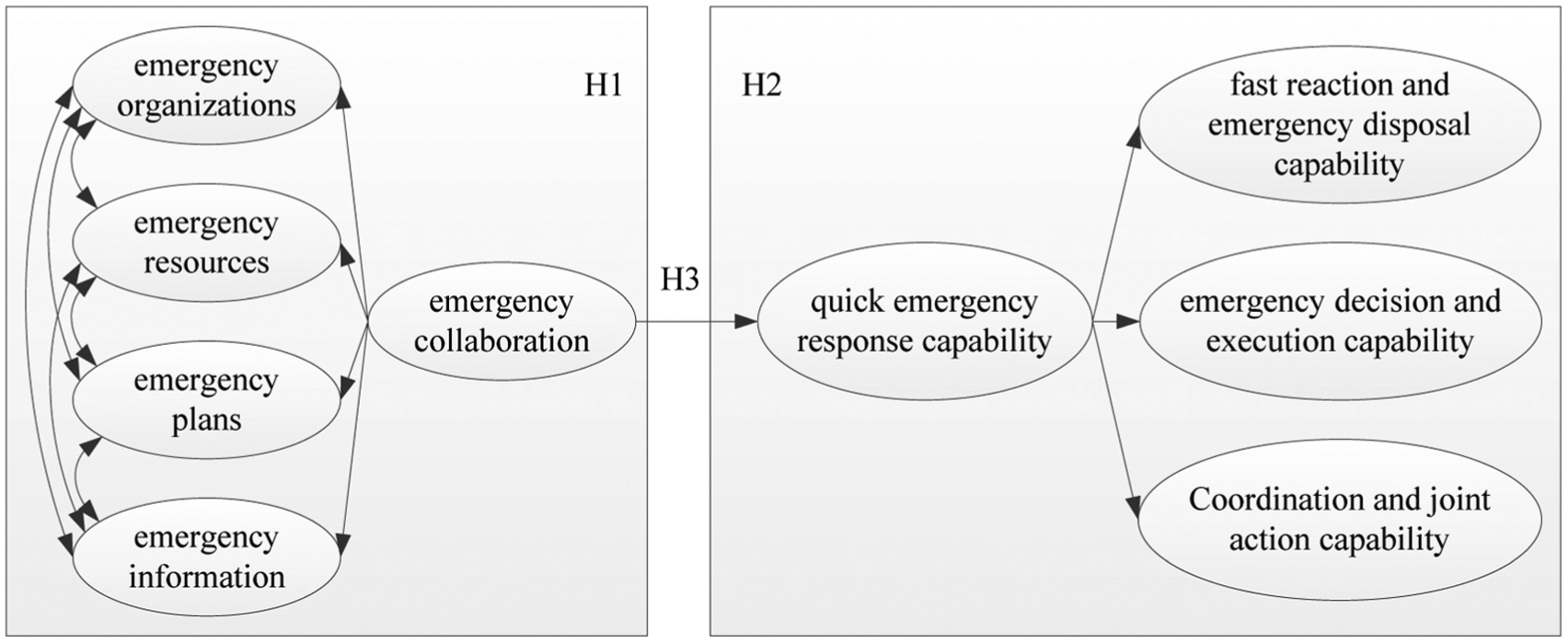
The proposed framework for emergency response.
EC
Collaboration has been and remains a significant obstacle to effective emergency management.24,25 In recent years, some scholars have done contributions about the factors influencing or relating to EC, as shown in Table 1. McEntire 26 in a case study examined how organizations collaborate in an attempt to perform multiple response and recovery functions, suggested a number of reasons to show why emergency operations proceed smoothly, including political support, preparedness measures, networking, technology, cooperative relationships, and so on. In addition, access to core information enhances the efficiency of response actions and increases coordination throughout the network of responding organizations. 28 Likewise, Robinson et al. 32 explored the factors which influence the development of stable emergency response collaborative partnerships and emphasized the importance of communication and interaction in the development of disaster response networks. Kapucu 29 found that pre-season planning, open communication between emergency managers and elected officials, and the use of technology all had a significant impact on community responses.
The extant literature of factors related to emergency collaboration.

Extensive research has been done on the influential factors of inter-organizational EC. By analyzing the case of Fort Worth tornado on 28 March 2000 in the United States, researchers suggested certain factors inhibited emergency coordination, that is, information challenges, a lack of communication between the field and emergency operations center, equipment failures, language barriers, and a command and control mentality. 26 Waugh 27 argued that emergency organizations typically had their own decision-making styles and differences in organizational cultures had tremendous impact on how emergency organizations interact with other organizations outside and with individuals. The efficiency of EC is related to the type and amount of information available; the degree of planning and preparedness prior to the event; the specific time, location, and magnitude of the incident; and the existing organizational resources or constraints. 28 In analysis of four hurricanes cases between 13 August and 25 September 2004, in Florida, USA, researchers found that emergency communication procedures available and utilized, a plan to alert all agencies of a threat, and the use of information technology to improve communication and coordination among agencies were effective coordination strategies. 29 Additionally, McGuire and Silvia 30 studied the efficiency of EC from three aspects: problem severity, organizational and managerial capacity, and internal structure. Likewise, Wang et al. 31 found out information in three aspects, named task importance, resources shared by response goals, and key relations for each task, contributed to effective collaboration during the process of emergency response.
Based on the research achievements and by merging and classifying the influential factors of inter-organizational EC, this article presents the inter-organizational EC elements of urban trail transit. These elements include emergency organizations, emergency resources, emergency plans, and emergency information.
Emergency organizations
Emergency organizations are considered the core of emergency management systems. These constitute the main body for building daily emergency management systems and supervising rules and regulations, as well as commanding executive agencies. Internationally, emergency organizations are considered the omnibearing, multi-agent, multi-level, and comprehensive organizational networks for disaster response, which include government, police, fire services, medical services, media departments, and private organizations, rather than a single organization or several organizations that participate in building emergency management systems in emergency response without coordination. Emergency organizations are the most active elements of the quick ERC of urban rail transit, closely related to emergency resources, emergency plans, and emergency information.
Emergency resources
Emergency resources refer to the various essential resources for effectively undertaking emergency activities and guaranteeing an emergency rescue system to run normally in an emergency response process for urban rail transit. Also, emergency resources are the foundations upon which to develop the quick ERC of urban rail transit, including human resources, goods and equipment, funds, technologies, emergency facilities, historical data, laws and regulations, and so on. Rational reserves and deployment of emergency resources are fundamental for quick ERC.
Emergency plans
Emergency plans aim to prevent and cope with potential incidents or disasters. This means that the several schemes prepared in advance or arrangement for guaranteeing emergency rescue in a quick, orderly, and effective manner, to minimize accidental losses, are the most crucial elements of the ERC of urban rail transit. Emergency plans which are formulated based on different kinds of emergencies could not only ensure emergency action as planned and realized quickly and with high efficiency but also provide guidance for daily training and drills for emergency rescuers as well as maintain emergency resources in a good state. The activities include formulating, exercising, evaluating, and revising emergency plans.
Emergency information
Emergency information refers to the processed data such as figures, images, texts, and so on in the emergency response process for urban rail transit. This is the important foundation of emergency decisions and emergency rescue. Moreover, the quick ERC of urban rail transit depends largely on the timeliness of mastering emergency information. Emergency information is closely related to the emergency management information system (EMIS). EMIS is an emergency information exchange platform for urban rail transit, which employs multiple means and methods, from multiple perspectives, to gather and transfer data and messages. Effective exchange of emergency information could improve the coordination of emergency organizations to realize the high efficiency of organizational management, and to make emergency organizations work in cooperation with the external environment to raise the strain capacity for handling emergencies. Consequently, we propose the following hypothesis:
Hypothesis 1. EC is composed of four elements, that is, emergency organizations, emergency resources, emergency plans, and emergency information.
ERC
Emergency response has attracted much research attention in recent decades. Researchers have generated a vast literature covering a broad range of objectives, perspectives, and levels of analysis. Emergency response research began in the wake of the Three Mile Island Nuclear incident in Pennsylvania, USA, in 1979. 33 This incident brought about sweeping regulatory changes in emergency response practice as well as elevated research activities in this area. 34 Since then, researchers have studied emergency response related to other natural disasters such as hurricanes, earthquakes, and wildfires.35,36 Emergency response demands fast and effective action, often in life-threatening situation. 11 Additionally, it includes alarm systems, accident notification, accident reporting, command decisions, resource allocation, coordination, rescue emergency shelter, expert support and evacuation, and so on. Procedure planning is an important issue in the emergency process; an emergency plan serves both as a legal document and as a manual that describes those procedures. An emergency plan contains information about the kind and location of available safety equipment (such as emergency exits and fire barriers) and the detailed procedures to follow in a number of eventualities. 37 Researchers argue that an effective emergency rescue plan (ERP) enables cooperation and coordination among the human agents involved. 38 Bruyelle et al. 39 emphasize the importance of the origin of the message in the process of emergency decision-making and suggest communication is important for informing the authorities of the situation and expediting the organization of the rescue during the process of emergency response. Furthermore, resources are essential for emergency rescue. The emergency response team (ERT) is also considered the most effective approach for dealing with emergencies in industries, and for minimizing the risk of casualties and losses. Several groups and team members with different levels of experience, roles, and responsibilities work together in the ERT. 40
The United Nations Development Programme (UNDP) defines capacity as the ability of individuals and organizations or organizational units to perform functions effectively, efficiently, and sustainably. 41 The capacity assessment model proposed by the UNDP shows obvious advantages compared with other capacity models, which means a structured and analytical process whereby the various dimensions of capacity are measured and evaluated within the broader environmental or systems context, as well as specific entities and individuals within the system. According to Hu et al., 42 the framework for emergency response capacity consists of three levels: systems, organizational, and individual. The systems level contains policy, regulations, process, and so on, and the organization level consists of strategy, culture, resources (human, financial, information), and so on. Some researchers43–46 have also been involved in exploring the essential problem of ERC evaluation. There are two modes of ERC evaluation: first, dealing with the emergency incidents in a timely fashion; second, reducing the total costs of emergency rescue and restoration.
Quick ERC derives from the fundamental elements necessary for emergency rescue and is based on integrating, allocating, and applying these elements. The function of quick ERC relies on reacting to emergencies as quickly as possible, disposing emergencies to prevent conditions from worsening, making scientific decisions immediately, and executing effectively. Moreover, it involves coordinating individuals and organizations participating in emergency rescue to work toward the same goal efficiently. Although the emergency proposal of urban rail transit emergencies captures special engineering background, quick and effective decisions, execution and control, and omnibearing coordination are essential for generating quick ERC. Hence, we suggest the following hypothesis:
Hypothesis 2. Quick ERC is composed of three dimensions, that is, fast reaction and emergency disposal capability, emergency decision and execution capability, and coordination and joint action capability.
Impacts of inter-organizational EC on quick ERC
The formation of quick ERC of urban rail transit depends on the implementation of EC from inter-organizations, resources and information, and inter-organizational EC. This could support and promote quick ERC. These approaches, that is, breaking organizational boundary, preparing and quickly implementing emergency plans, effectively allocating resources, and gathering and transferring information, could drive the formation of quick ERC and raise the efficiency and level of emergency management. Thus, we posit the following hypothesis:
Hypothesis 3a. Emergency response collaboration has positive effect on quick ERC (Model I).
Hypothesis 3b. EC has positive effect on fast reaction and emergency disposal capability, emergency decision and execution capability, and coordination and joint action capability (Model II).
Research methods
Measures
If possible, established scales from the extant literature can be utilized in this study. 47 However, we could not identify suitable measures of EC and ERC of urban rail transit. Instrument development procedures for these constructs followed Churchill’s 48 scale development methodology including a comprehensive literature review, followed by pre-testing with academics in the field of risk or disaster management. To guarantee the science and effectiveness of the survey, the initial scale was formulated combined with previous research on and the characteristics of urban rail transit, and modified through the expert interviews and pre-investigation, which means we made minor modifications to the wording of items based on the feedback from pre-tests in order to improve scale performance. To measure the four dimensions of EC and three dimensions of quick emergency response capacity, all scales were designed using the 5-level Likert-type scale, with rating from 1 as strongly disagree to 5 as strongly agree. Thus, the respondents could fill out the survey according to their experience and theoretical knowledge. The items were screened to form the formal questionnaire, using a 17-item EC scale and an 11-item ERC scale.
Procedure
As mentioned, prior to data collection, the content validity of the scale was established by grounding it according to existing literature and expert view and conducting pre-tests. Then, we will conduct three-stage instrument development process, namely, reliable analysis, exploratory factor analysis (EFA), and confirmatory factor analysis (CFA) for assessing the construct reliability and validity of the instrument 49 and conducting the empirical research.
Based on the existing literature, the initial scale was developed and pre-tested combined with expert interviews to determine the formal questionnaire of EC and fast ERC. Then, the questionnaires were sent out and collected through e-mail and online survey. After the data collection, Cronbach’s alpha value was generated for each construct. If Cronbach’s alpha value was greater than 0.7, the construct was accepted. 50 Moreover, the constructs with an acceptable Cronbach’s alpha value of at least 0.6 were further evaluated for the possible improvement. The item inter-correlation matrix was adopted in determining the items whether the best candidates for deletion. If the items that negatively correlated to other items, they were first discarded. The items with correlation value below 0.1 also were discarded. After the elimination of some items, the reliability analysis was performed again. If the construct still failed to achieve the minimum alpha value of 0.6, it would be deleted. Since all constructs get the target value, the reliability analysis completed and moved on the next analysis.
Second, EFA was conducted through principal component analysis (PCA). The common method of varimax rotation with Kaiser normalization was used to clarify the factors. 51 The exact number of factors would be extracted through EFA using SPSS software. The items would load on factors, determined through comparing their loading on the factors. The items, which load on they intend to measure, could be kept from consideration.
Finally, the last step involved CFA in evaluating construct validity, and path analysis in assessing the relationship among factors. The CFA and hypothesis testing could be conducted through SEM using AMOS software to examine the relationship between EC and fast ERC. Some goodness-of-fit indices (GFIs) were used to evaluate the tenability of models, such as GFI, comparative fit index (CFI), root mean square error of approximation (RMSEA), and so on. 52
Data collection
The unit of analysis employed in this study was at the level of the emergency response institution of urban rail transit. The target sample was composed of the professionals who have experience of engaging in urban rail transit emergency response for more than 3 years. We deem these professionals to be the most knowledgeable about emergency response and our related subjects of interest: emergency resources, plan, information, organization, and the capability of quick emergency response.
The hypotheses were tested with data collected from e-mail and online survey. The Internet-based survey in China was utilized for data collection. As mentioned above, a 5-point Likert scale with end points of “strongly disagree” and “strongly agree” was used to measure items. Of the 240 questionnaires, 204 questionnaires were returned completed, with 159 valid responses and a return rate of 77.9%. Preliminary data reveal that 85.6% have a Bachelor degree or above, 13.8% are senior managers, 46.8% are middle managers, 39.6% are operating personnel, and the average working life is 5.5 years. Therefore, although the total samples are reduced, the valid samples are representative and reliable enough to reflect the whole characteristics. Respondent profile is presented in Table 2.
Respondent profile.

Non-response bias
Non-response bias is the difference between the answers of respondents and non-respondents. 53 In this study, non-response bias was assessed comparing the responses of e-mail and online samples of returned surveys to provide support of non-response bias.53,54 The final sample was split into two, depending on the kinds that they are inquired. The group of online survey consisted of 96 responses, while the group of mail survey consisted of 63 responses. The t tests performed on the responses of these two groups yielded no statistically significant differences (at 99% confidence interval). The result suggests that non-response does not appear to be a problem.
Test of hypotheses and results
Reliability test
Reliability means the consistency degree of the measurement, or the possibility of the same result when measuring the same object in the same case, reflecting the consistency or stability of a measuring tool.55–57 Generally, Cronbach’s alpha can be seen as the reliability coefficient, which over 0.80 means great significance. 58 The reliability analysis result is shown in Table 3. Cronbach’s alpha of the questionnaire is 0.865, and Cronbach’s alpha values of EC and quick ERC are 0.839 and 0.823, respectively. Therefore, all the values are over 0.80 and illustrate the high internal consistency and reliability of the questionnaire.
Reliability statistics.

Validity test
Factors analysis of the EC questionnaire
EFA examines whether a common factor of the biggest variance ratio can be extracted through all the items which, theoretically, belong to the same dimension, in order to conceptualize the connotation of this dimension. Before the factor analysis, it is necessary to test whether the sample is appropriate for factor analysis. The Kaiser–Meyer–Olkin (KMO) measure and Bartlett’s sphericity test can be used to determine the suitability of the sample. Generally, if KMO measure is over 0.7, it is appropriate for factor analysis. Moreover, Bartlett’s test is required to reach the significance level. The method of PCA and varimax rotation algorithm can be used to capture the common factor. The number of the extracting factor is determined through whether the eigenvalues are over 1; the standard of deleting the item is whether the factor loading is less than 0.4; and the cumulative variance of extracted factor can explain over 50%.
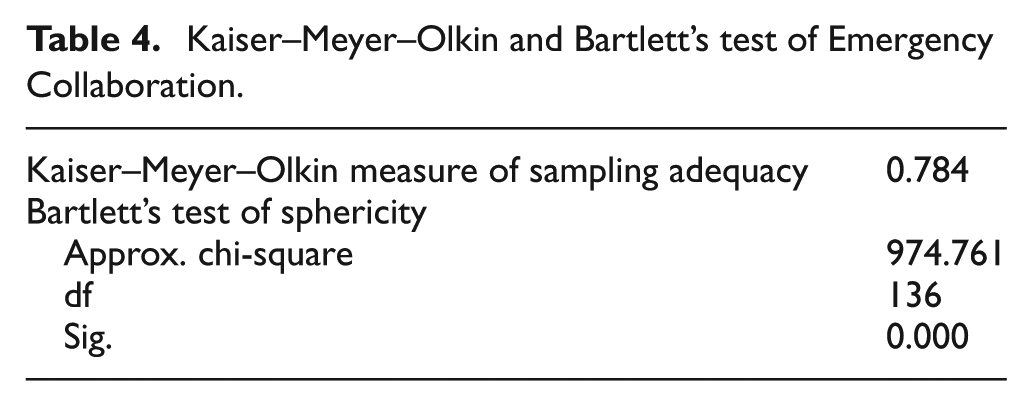
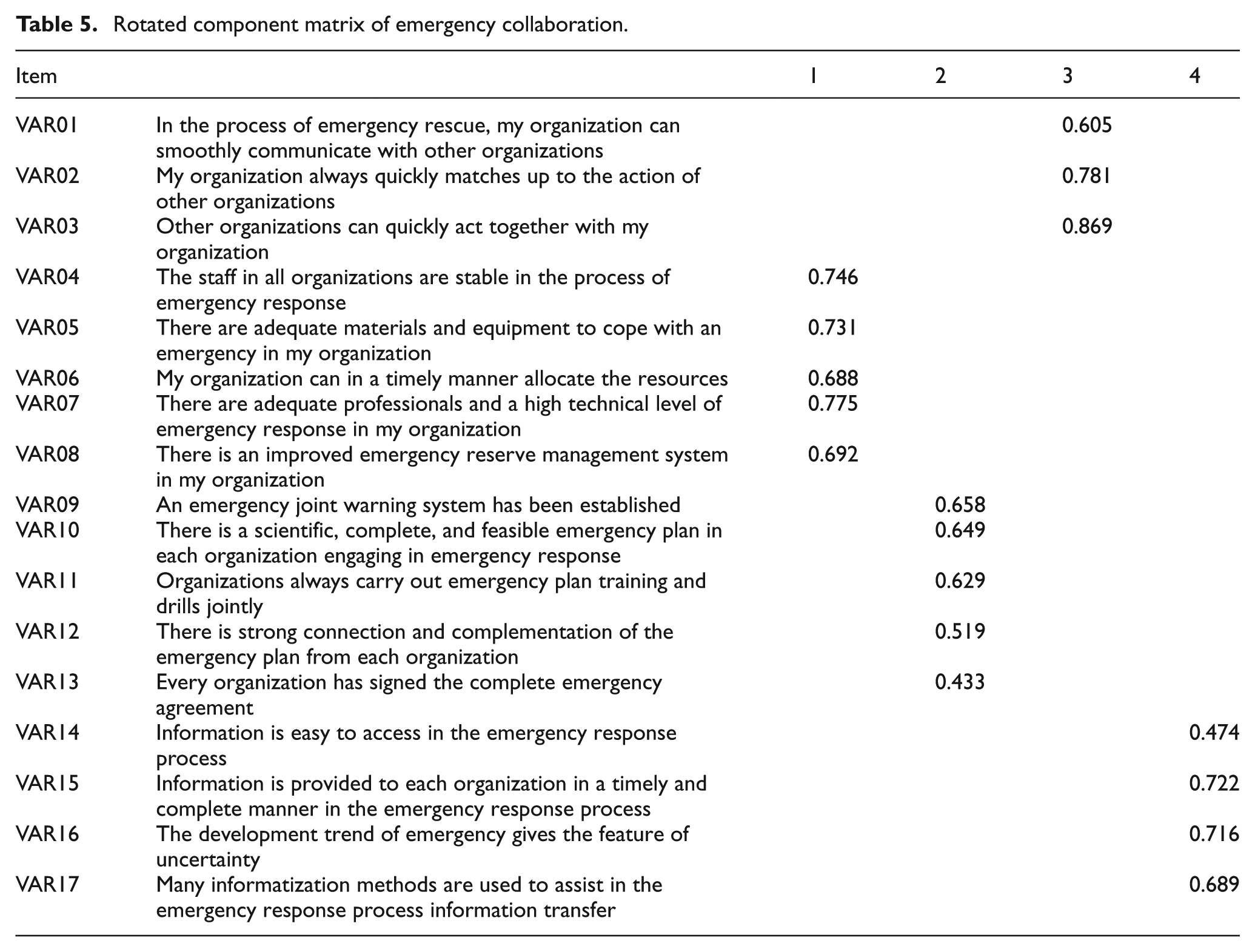
The KMO and Bartlett’s test (Table 4) show that the KMO measure is 0.784, and the significance level of Bartlett’s test is less than 0.001. Therefore, the sample of EC is suitable for EFA. Four common factors are extracted; the cumulative variance can explain 58.91%, the table of factor loading is shown in Table 5, and factor loading less than 0.4 has been deleted, and the bigger one is reserved.
Kaiser–Meyer–Olkin and Bartlett's test of Emergency Collaboration.
Rotated component matrix of emergency collaboration.
The first-order and second-order CFA are conducted via the real surveyed specimen (n = 159). As shown in Figure 2, the higher construct existed, which is deemed as EC, and every fitting index of CFA as shown in Table 6. According to the judgment standard of the model fit,36,59 the acceptable scope are GFI > 0.9, adjusted goodness-of-fit index (AGFI) > 0.9, and RMSEA < 0.1. The results in Table 4 are close to the requirement; therefore, hypothesis 1 is verified.

The first-order and second-order confirmatory factor analysis of the emergency collaboration questionnaire.
Results of confirmatory factor analysis for emergency collaboration.

CFI: comparative fit index; AGFI: adjusted goodness-of-fit index; GFI: goodness-of-fit index; IFI: incremental fit index; TLI: Tucker–Lewis index; RMSEA: root mean square error of approximation.
Factor analysis of quick emergency response capacity
The KMO and Bartlett’s test (Table 7) show that the KMO measure is 0.806, and the significance level of Bartlett’s test is less than 0.001. Therefore, the sample of ERC is suitable for factor analysis. Three common factors are extracted; the cumulative variance can explain 62.97%, the table of factor loading is shown in Table 8, and the factor loading less than 0.4 has been deleted, and the bigger one is reserved.
Kaiser–Meyer–Olkin and Bartlett's test of Emergency Response Capability.

Rotated component matrix of emergency response capability.

The first-order and second-order CFA are conducted through the real surveyed specimen (n = 159). As shown in Figure 3, the higher construct existed, which is deemed as quick ERC, and every fitting index of CFA as shown in Table 9. According to the above judgment standard of the model fit, the results in Table 4 are close to the requirement; therefore, hypothesis 2 is verified.
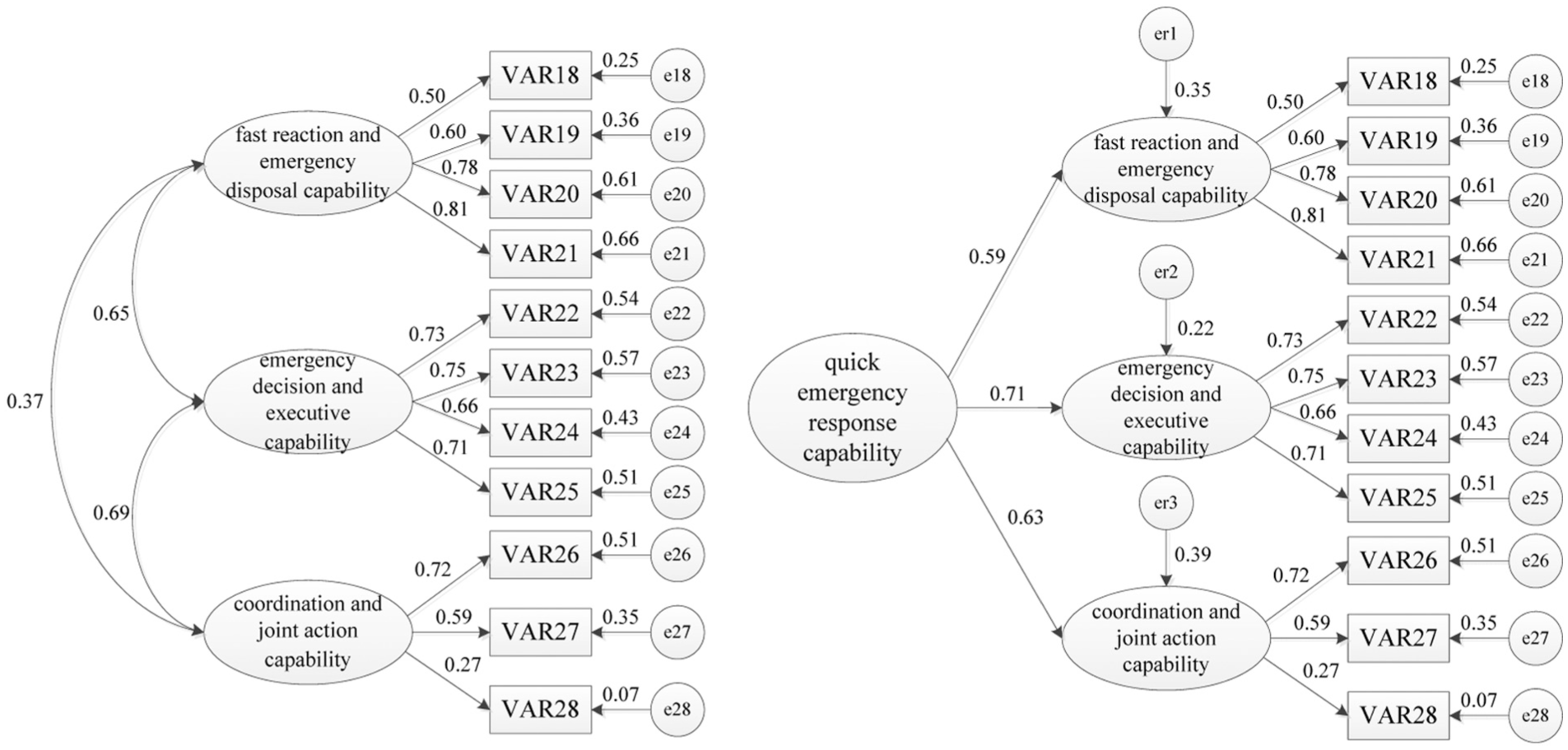
The first-order and second-order confirmatory factor analysis of emergency response capability questionnaire.
Results of confirmatory factor analysis for emergency response capability.

CFI: comparative fit index; AGFI: adjusted goodness-of-fit index; GFI: goodness-of-fit index; IFI: incremental fit index; TLI: Tucker–Lewis index; RMSEA: root mean square error of approximation.
SEM
Hypothesis 3 illustrates the relationship between EC and quick ERC. Taking the EC as exogenous latent variable, and the quick ERC or the capacity composition as endogenous latent variables, the SEM is established and calculated using AMOS version 22. The results are shown in Figures 4 and 5. The fitting indexes are shown in Table 10. Model I was developed first, with the latent dependent variable of EC and the latent dependent variable of quick ERC. According to the fitting effect, χ2/df is 2.371 < 5, RMSEA is 0.093 < 0.1, other indexes largely in line with the judgment standard. Therefore, the assumption is accepted and hypothesis 3a verified, which reveals that EC has a positive effect on ERC. In the next stage, Model II was developed by testing the path from EC to the three dimensions of ERC, respectively, were fast reaction and emergency disposal capability (FREDC), emergency decision and executive capability (EDEC), and coordination and joint action capability (CJAC). The second model resulted that χ2/df is 2.528 < 5, RMSEA is 0.098 < 0.1, other indexes largely in line with the judgment standard. Therefore, the assumption is accepted and hypothesis 3b verified, which reveals that EC has a positive effect on fast reaction and emergency disposal capability, emergency decision and execution capability, and coordination and joint action capability.
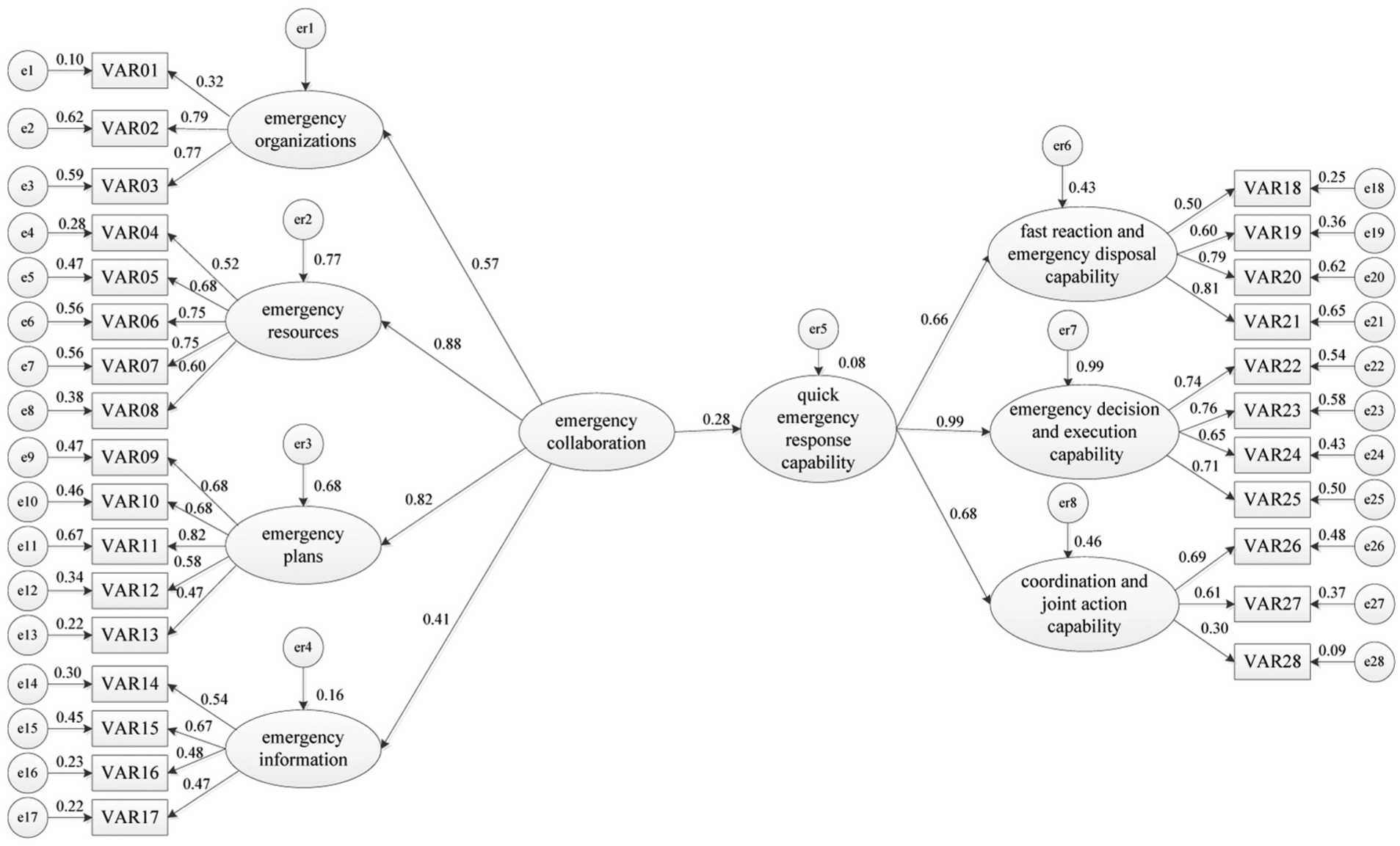
The result of relationship validation between emergency collaboration and emergency response capability.
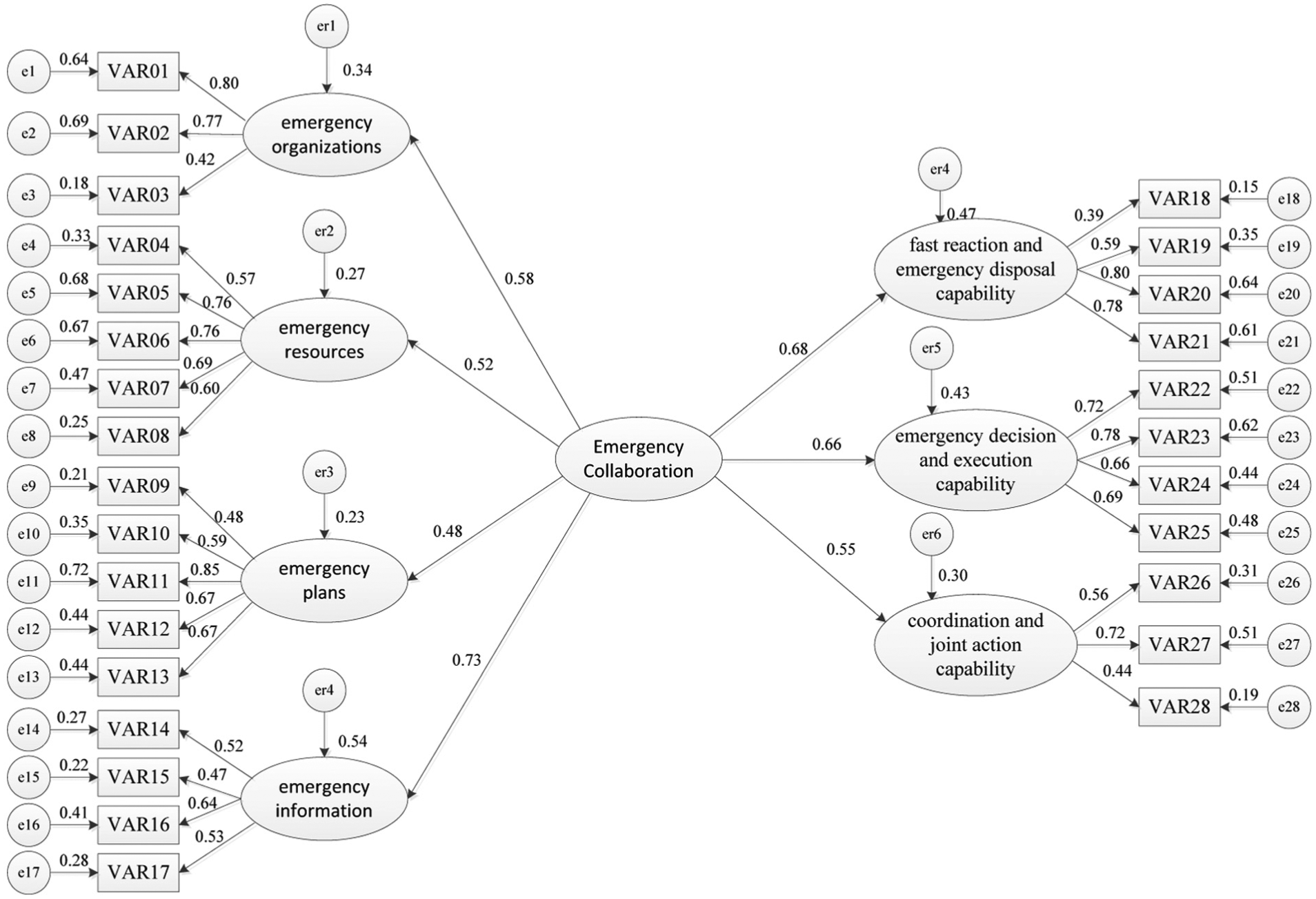
The result of relationship validation between emergency collaboration and fast reaction and emergency disposal capability, emergency decision and execution capability, and coordination and joint action capability.
Results of structural equation model.

ERC: emergency response capability; EC: emergency collaboration; CFI: comparative fit index; AGFI: adjusted goodness-of-fit index; GFI: goodness-of-fit index; IFI: incremental fit index; TLI: Tucker–Lewis index; RMSEA: root mean square error of approximation.
Discussion and limitations
Discussion of results
Statistical analysis was carried out using SPSS version 22 and AMOS version 22; the reliability and validity of the questionnaires of emergency response collaboration and quick ERC were tested; factor analysis and path analysis were conducted for each variable; components of EC and quick ERC were discussed; interactions between EC and quick ERC were explored, and all of the hypotheses proved.
Dimensions of EC and quick ERC
Results indicate that EC includes four elements, that is, emergency organizations, emergency resources, emergency plans, and emergency information. Cooperating in emergency rescue, resources integration, implementing emergency plans, and information communication are necessary to realize inter-organizational EC. These four elements interact with each other. Talent, capital, materials, equipment, and other resources can promote organizational operation. Emergency plans arrange the issues of organizational operation, resource utilization, information transfer, and so on. Correspondingly, information delivered smoothly is pivotal to organizational operation and emergency plans implementation. Moreover, quick ERC includes fast reaction and emergency disposal capability, decision and execution capability, coordination and joint action capability. Quick ERC does not belong to any organization, but is shaped by activities and coordination in and inter-organization, that is, inter-organizational coordination ERC. Furthermore, the fast reaction and emergency disposal capability, emergency decision and execution capability, and coordination and joint action capability are indispensable and restricted by each other.
Relationship between EC and quick ERC
As we can see from Figure 4, EC has some influence on quick ERC (β = 0.28). Realizing inter-organization EC is conducive to improving ERC. The formation of quick ERC needs support from organizations, and resources, as well as implementing emergency plans and transmitting information smoothly. Further analysis, shown in Figure 5, indicates that EC has different impacts on different dimensions of emergency capability, that is, fast reaction and emergency disposal capability (β = 0.68), emergency decision and execution capability (β = 0.66), and coordination and joint action capability (β = 0.55). That is to say, the realizing of inter-organizational collaboration facilitates fast reaction and emergency disposal capability, emergency decision and execution capability, and coordination and joint action capability. Since different dimensions of quick ERC are closely related to each element of EC, allocating and controlling the elements, that is, emergency organization, emergency resources, emergency plans, and emergency information, reasonably and effectively, are key to realizing EC and generating quick ERC.
Other effects between EC and quick ERC
On the basis of the results of this study, EC can promote and foster the quick ERC in urban rail transit organizations. However, the effect of quick ERC on EC has not been validated in this study; moreover, whether there are any mediating and moderating variables can work on the relationships between EC and quick ERC. For example, emergency information can be a moderator which influences the efficiency of emergency response, or the different culture or atmosphere of different organization can enable or hinder the formation of EC. Hence, the relationships among many latent variables can be conducted and focused to facilitate the quick ERC.
Theoretical and managerial implications of results
Our research has important theoretical and managerial implications. Based on RBV and IPV perspective, information sharing and communication may be seen as complementary and intangible resources. 17 Arguably, the tangible resources, that is, supplies, human resources, and plans, play important role in conjunction with the intangible resource of information sharing and communication. When combining or bundling those resources, they may lead to EC and/or ERC.17,18 Our study provides empirical evidence that EC acts as an antecedent to quick emergency response capacity, and the content of EC also has prompting effect. This is one of the first studies utilizing survey data to test such hypothesized relationships in the urban rail transit context. ERC may be enhanced because better cooperation among organizations and resources allocating and information sharing can develop to promote emergency units responding more rapidly and effectively to disruptions. 60
In addition, this study offers some useful implications for emergency managers. Our findings demonstrate that investments in EC may generate ERC depending on key factors, such as adequate resources, good plans, open information channels, and so on. Thus, EC means avoiding operating in isolation. Using information, physical and other resources may get access to the beginning of the response. Our empirical results show that more willing the agencies are to share information, allocate resource, decision-making jointly, the better the response. Agencies should share information and develop partnerships to build trust long before an emergency occurs. 15
Limitations and future research
The authors acknowledge that a sample size with larger coverage would be more appropriate for estimation using SEM analysis. Meanwhile, the sample size of this study was statistically adequate for developing a satisfactory SEM, because it is larger than the minimum requirement of 100 proposed by Hair et al. 61 However, the sample of this study mainly focuses on the field of urban rail transit. Therefore, future research is recommended to conduct large-scale surveys covering professionals not only in urban rail transit, China, but also in other industries or western countries such as United Kingdom and the United states. The results of this study provide preliminary evidence and act as a platform for further studies that investigate the associations between EC and ERC across different industries and countries.
The respondents were all professionals who worked in urban rail transit administrations or firms and had direct experience with the emergency disposal or rescue, which should ensure the credibility of the data obtained in this study. Although the current quantitative study provides generalizable results of the relationships between EC and quick ERC, to enable an in-depth understanding of the relationships between these variables, qualitative research methods, such as case studies and focus groups, are recommended for use in subsequent research. Results from future qualitative data analysis may also act as cross-validation such as in the triangulation method. 62
SEM has become the methodology of choice for researcher investigating complex relationships between latent constructs. 63 Covariance-based structural equation model (CB-SEM), the most commonly used approach to SEM, is one of the confirmatory approaches that hold of the common factor to minimize the discrepancy between observed and estimated data through using software AMOS, LISREL, MPLUS, and so on. Our study also utilized CB-SEM method to test the relationship between EC and ERC. However, there is another SEM approach, namely variance-based SEM (partial least squares–structural equation model (PLS-SEM)), is one of the exploratory approaches that aimed to maximize the total variation of endogenous construct in a causal model. In comparison with CB-SEM, PLS-SEM requires less samples than CB-SEM, 64 is suitable for small sample and low response rates research. In contrast, we can try to adopt PLS-SEM method to conduct the emergency management research.
Footnotes
Acknowledgements
The affiliation for Zheng Junwei at the time this research was carried out is as above, however, he has now moved to Kunming University of Science and Technology, Kunming, China.
Academic Editor: Geert Wets
Declaration of conflicting interests
The author(s) declared no potential conflicts of interest with respect to the research, authorship, and/or publication of this article.
Funding
The author(s) disclosed receipt of the following financial support for the research, authorship, and/or publication of this article: This work was supported by Ministry of Education in China (MOE) Project of Humanities and Social Sciences under Grant no. 13YJC630232 and Project of China Hunan Provincial science and technology Department under Grant no. 2014SK3214.