




Abstract
The basic idea of active contour model upon the image segmentation problem is evolved into a closed curve about the functional minimization problems. Active contour model based on edge information takes advantage of gradient information, and it has some shortcomings such as cannot separate weak boundary, fuzzy boundary, and discontinuous boundary object. Chan–Vese active contour model without edges can overcome the shortcomings of model based on gradient, but it cannot separate gray inhomogeneous target and evolves slowly, moreover, segmentation efficiency is low. The aim of this article is to overcome the shortage of the geodesic active contour model such as lower convergence rate and more easily trapped in local minimum .The article puts forward a new active contour model control system where the edge information is combined with regional one effectively, and it makes good use of the gradient information and the area information. A large amount of simulation results show that the proposed algorithm’s convergence speed is much faster than geodesic active contour model, and it can segment serious noisy image. It inherited the edge and the region information as well, so the new model performs well in resisting noise and has high segmentation efficiency.
Introduction
Image segmentation is one of the most fundamental problems among the image processing and computer vision fields. In the nature world, there are a large number of nonlinear systems1–10 and discrete systems,11–16 while a large amount of methods were used to solve these problems in the system such as adaptive control,2,9–11,13,17 network control,3–7,12,18 and fuzzy control.7,11,19 Due to the good performance, Kass et al. 20 proposed active contour model (ACM), and it was widely applied for segmentation fields. Lots of segmentation models have been proposed, and most of them can be simply classified into two categories: edge models20–23 and region ones.24–40
The edge of the ACM depends on image gradient information which makes the evolution curve remain on the object boundaries; geodesic active contour (GAC) model 22 can be one of the most representatives and they have many problems. For example, for a given initial contour, it could converge to the local minimum point of energy functional. ACM based on region has many advantages over ACM based on the edge. First, regional model does not use image gradient information. Chan–Vese (CV) model 26 and the region scalable fitting (RSF) model27,28 are on behalf of them. CV model can be used to segment two distinct homogeneous regions successfully. But it is not suitable for intensity in-homogeneity because of its inherent characteristics. Although gray in-homogeneity can often exist in the real world, in order to deal with the shortage of CV model, solve the problem of gray heterogeneous image segmentation. Recently, C Li 27 raised a local area scalar fitting model (RSF) in view of the uneven distribution of gray-scale image segmentation problem. However, it is within the great amount of calculation in higher space.
In this article, we propose a new image segmentation discrete dynamic system by making good use of ACM and distance regularized level set evolution (DRLSE) method. By introducing a functional term, a new energy function is defined. A variational level set method without re-initialization is proposed. The article is organized as follows: the CV 26 model and the GAC 22 model are simply reviewed in section “Model description”; in section “Description of the new model”, our image segmentation network control system is proposed; in section “Experimental result and analysis,” a large amount of experiments about synthetic and real images have been made to validate the proposed algorithm; and in section “Conclusion,” some conclusive remarks are included.
Model description
CV model
CV 26 model is defined as follows

where
GAC model
The energy function of GAC 22 model can be defined as follows

Here,

where
Description of the new model
Inspired by the concept of distance regularization about the paper,27–29 it can not only avoid re-initialization of the level set but can also modify level set function. Here, based on GAC 22 model and DRLSE27–29 method, the new model used the advantages of the regional model and the edge model and presented the same DRLSE 27 method. The energy function of the proposed model is defined as follows

where


where

where

where


Therefore, the whole function by the level set expression can be represented by the following formula

Here, I is an original image;


To minimize the energy function

Similarly, the whole

where

where

The design and realization of the major algorithm is as follows:
Step 1. Initiate
Step 2. Computing
Step 3. Computing the convolution of
Step 4. Computing g by formula (5);
Step 5. Making the level set function satisfied with the Neumann boundary condition;
Step 6. Computing
Step 7. Calculating
Step 8. Computing
Step 9. Calculating curvature
Step 10. Computing the level set penalized term
Step 11. Calculating the terms
Step 12. Updating the level set function
Step 13. Repeat steps 1–12 until the desired result is obtained.
Experimental result and analysis
Experiment 1
For the same gray image segmentation, the proposed model is more efficient than the GAC model.
The initial contour lies inside the target; let
The parameters of the GAC model are
2. The initial contour lies outside of the target; let

Results of the GAC model with DRLSE and the proposed model for the same image: (a) initial contour, (b) GAC result for 16 times iteration, (c) GAC result for 64 times iteration, (d) initial contour, (e) the proposed result for 16 times iteration, and (f) the proposed result for 36 times iteration.
The parameter setting of the GAC model is

Segmentation of the GAC model and the proposed model for the cell image: (a) initial contour, (b) GAC result for 64 times iteration, (c) GAC result for 100 times iteration, (d) initial contour, (e) the proposed result for 36 times iteration, and (f) the proposed result for 64 times iteration.
Experiment 2
The proposed model behaves well in restraining noise.
The parameters of the Chan-Vese Improved (CVI)31,32 model are
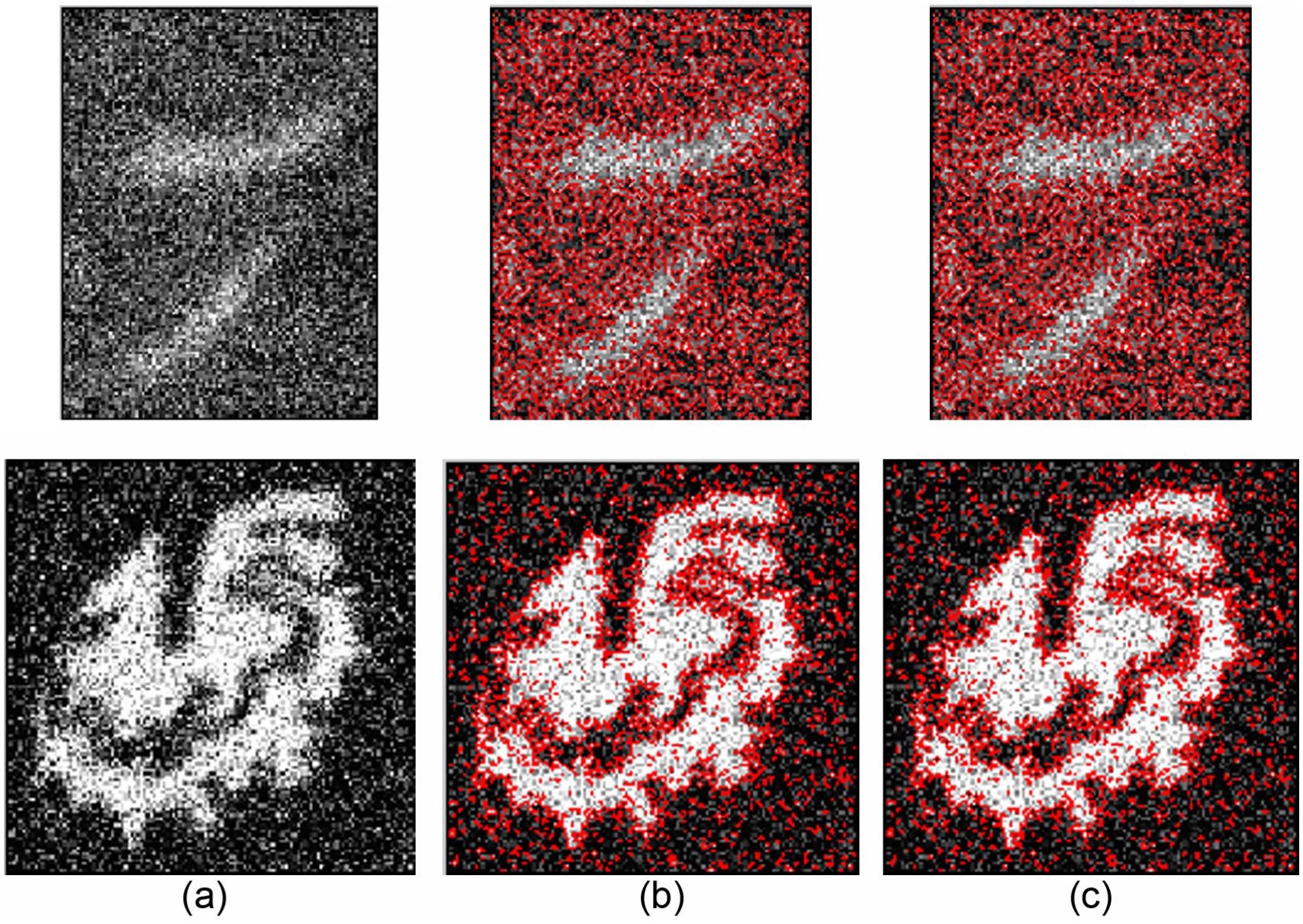
Results of the CVI model for two strong noise images: (a) original noisy image, (b) segmentation result after 10 iterations, and (c) segmentation result after 50 iterations.

Segmentation result of the GAC model and the proposed model for three stronger noisy images: (a) initial contour, (b) GAC model after 1600 iterations, (c) proposed model after 196 iterations, (d) initial contour, (e) GAC model after 100 iterations, (f) the proposed model after 16 iterations, (g) initial contour, (h) GAC model after 400 iterations, and (i) the proposed model after 16 iterations.
As shown in Figure 4, the first column is the original noisy image and the initial contour, and the corresponding size of (a), (d), and (h) is 101 × 99, 128 × 128, and 94 × 123, respectively. Here, the second column demonstrates the segmentation result by GAC model, and it can be easily concluded that the GAC model cannot separate the noisy image despite long time iteration, whereas the last column shows the segmentation result by the proposed model, it shows the less iteration condition, and it can segment the first column noisy image effectively. And the corresponding parameters of GAC model are
Experiment 3
The proposed method has the characteristic like the active contour based on edge.
The parameters of the GAC model are
As shown in Figure 5, the first column is the original image and the initial contour, and the corresponding size of these three images are 152 × 118, 108 × 74, 256 × 256, respectively; the second column shows the result of the GAC model, and the third column is the result of the proposed method. It can be easily found that GAC converges very slowly, whereas the proposed method only requires iterating 16 steps and can obtain the desired segmentation result. It also demonstrates that the proposed method has the characteristic as the ACM based on the edge information.

Segmentation results of the GAC model and the proposed model for the same three images: (a) initial contour, (b) GAC model after 16 iterations, (c) the proposed model after 16 iterations, (d) initial contour, (e) GAC model after 16 iterations, (f) the proposed model after 16 iterations, (g) initial contour, (h) GAC model after 16 iterations, and (i) the proposed model after 16 iterations.
Experiment 4
The proposed model has the same characteristics as the ACM based on region, and can even segment open curve with in-homogeneous image. The corresponding parameters are

Results of the proposed model for different images: (a) iteration 100 times, (b) iteration 36 times, (c) iteration 4 times, (d) iteration 16 times, (e) iteration 4 times, and (f) iteration 16 times.
Experiment 5
Further comparison of result for GAC model and the proposed model was made. The parameters of GAC model are set as

Results of GAC and proposed model for two images: (a) initial contour, (a1) GAC iteration 36 times, (a2) GAC iteration 1600 times, (a3) proposed method iteration 36 times; (b) initial contour, (b1) GAC iteration 36 times, (b2) GAC iteration 400 times, and (b3) proposed method iteration 36 times.
Comparison results are demonstrated in Table 1; for the same image, while at the same iteration times, it can be found that the proposed model takes less time.
Segmentation experiment parameter table of the GAC model with DRLSE and proposed model.

GAC: geodesic active contour; DRLSE: distance regularized level set evolution.
Conclusion
ACM network control system was proposed by combining regional and edge information, and a lot of experiments have been done to demonstrate that the new model is superior to GAC 22 model and CVI 31 model. On the one hand, it can not only separate the image by GAC model but can also segment image by active contour based on the regional information; on the other hand, it behaves with the better anti-noise performance. Furthermore, it can also segment the open boundary curve effectively. Moreover, for the same image, it can segment the target correctly with less time. Therefore, compared with the original GAC model and the simple ACM based only on the regional information, the proposed algorithm model behaves more efficiently.
Footnotes
Academic Editor: Chenguang Yang
Declaration of conflicting interests
The author(s) declared no potential conflicts of interest with respect to the research, authorship, and/or publication of this article.
Funding
The author(s) disclosed receipt of the following financial support for the research, authorship, and/or publication of this article: This work was partially sponsored by the National Nature Science Foundation (60874103, 61473139, and 61622303), the project for Distinguished Professor of Liaoning Province, Liaoning Provincial Education Department Program (L2011042), and Excellent Talents for University of Science and Technology Liaoning (2016RC03).