



Abstract
One of the crucial challenges in the area of image segmentation is intensity inhomogeneity. For most of the region-based models, it is not easy to completely segment images having severe intensity inhomogeneity and complex structure, as they rely on intensity distributions. In this work, we proposed a firsthand hybrid model by blending kernel and Euclidean distance metrics. Experimental results on some real and synthetic images suggest that our proposed model is better than models of Chan and Vese, Wu and He, and Salah et al.
Keywords
Introduction
In the field of computer vision and image processing, image segmentation is an important and complicated goal. The main objective of image segmentation is to change the appearance of a given image into something new that is more accessible for analysis. To figure out image segmentation problems, researchers have proposed a number of segmentation models. They also worked to improve the efficiency of the existing models.
Snake model or active contour model proposed by Kass et al. 1 found a reliable image segmentation model which depends on functional minimization. In this technique, an initial contour starts around the desired object; then, it moves towards the target object and finally stops at its boundary. The main demerit of this technique is its sensibility of initial position of the contour. Many techniques have been developed for the enhancement of the Snake model, one of them which is most popular and significant is the level set method proposed by Osher and Sethian. 2 The existing active contour models may be categorized into edge-based models: Caselles et al.,3,4 Kass et al., 1 Li et al., 5 Xu et al., 6 Malladi et al., 7 and region-based models: Wu and He, 8 Chan and Vese, 9 Salah et al., 10 Paragios and Deriche, 11 Tsai et al., 12 Hanbury, 13 Horowitz, 14 Gao and Bui, 15 and Mumford and Shah 16 . Each of these approaches have their merits and demerits.
In the edge-based models, image gradient is used for stopping the movement of the evolving contour on boundary of the targeted object. Also, a balloon force term is used in these techniques, which shrinks and expands the contour. Though, the performance of edge-based models is well in those images having good intensities contrast in various regions, but still it has congenital limitations. For example, the efficiency of these models is not well in those images having too many edges. Also, the selection of suitable balloon force term is sometimes difficult.
Region-based models are based on grouping similar characteristics pixels into homogeneous regions. Region-based models are superior than edge-based models, for example, in these techniques image gradient does not use, rather than it uses statistical information and gives better segmentation results. Their performance is also good in those images having weak boundaries. Though, region-based approach is simple and useful, still it has congenital limitations, for example, computationally and memory point of view these models are expensive.
Chan and Vese 9 restricted Mumford and Shah’s 16 model and proposed two phase segmentation model. Their model is one of the popular region-based models which easily segment highly noisy images and those images whose boundary cannot be defined by image gradient. Wu and He 8 proposed convex variational segmentation model which works well in low-intensity inhomogeneity but may fail in severe intensity inhomogeneous images. Salah et al. 10 used the notion of kernel-induced non-Euclidean distance, which works well in noisy images but may fail to segment severe intensity inhomogeneity and multi-intensity regions’ images.
In the current work, we proposed a hybrid model, i.e., Kernel-Based Chan Vese (KBCV) model by combining the notion of Euclidean and kernel-induced non-Euclidean distances utilized in the models of Chan and Vese 9 and Salah et al. 10 The proposed KBCV model to some level vanquishes limitations of the models of Wu and He, 8 Chan and Vese, 9 and Salah et al. 10 This paper is arranged as follows:
In the next section, we briefly reviewed the models of Chan et al., Wu and He, and Salah et al., then the proposed KBCV model is presented. Also, the proposed KBCV model is tested on some synthetic and real images. Finally, conclusion of the current work is presented.
Previous work
In this section, we discuss some popular models designed for segmenting images having intensity inhomogeneity and multi-intensity regions.
Active contour without edges model
Chan and Vese
9
proposed an active contour approach for two phase segmentation which is a particular case of Mumford and Shah’s
16
model. The basic idea of Chan et al. model is to decompose a given image

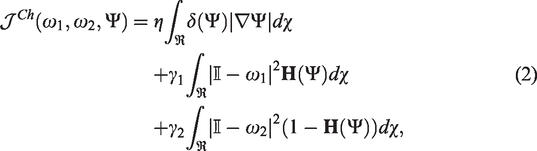

As

Hence, regularized version of equation (2) is

Keeping

In the same manner, keeping ω1 and ω2 constant, then minimization of equation (3) with respect to

Chan et al.’s model gives good segmentation results in noisy images and intensity homogeneous images. However, it gives poor segmentation results in sever inhomogeneous images and multi-intensity regions images, as it is nonconvex.
Effective level set image segmentation with a kernel induced data term
Usually, image data in various image sections may not easily linearly separable. For such kind of data, most of the linearly separable models give poor segmentation results. To solve this issue, Salah et al. 10 utilized the notion of kernel function and non-Euclidean distance and proposed a new image segmentation model. Kernel function 17 and kernel trick 18 play very important role in data classification problems.
Let the given image be

Here,

The energy function

Salah et al.’s model works well in segmenting noisy and low-intensity inhomogeneous images. However, like Chan and Vese’s 9 model it has the same problem in segmenting inhomogeneous and multi-intensity regions images.
Convex variational level set method for image segmentation
Wu and He
8
proposed a convex variational level set model which relies on the coefficient of variation. The energy function of Wu and He’s model is as follows


Minimizing equation (6) by gradient descent method, we get the following equation:
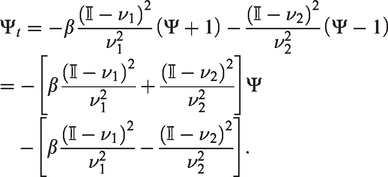
Wu and He’s model is efficient only in low-intensity inhomogeneity and does not segment images having severe intensity inhomogeneity and multi-intensity regions.
Motivation to hybrid data term
Chan and Vese 9 used Euclidean distance in their model, which is designed for two phase image segmentation and this model may work well in noisy images. However, it is difficult for Chan et al. model to segment multi-intensity regions and severe inhomogeneous images. Also, this model has high computational cost. Salah et al. 10 utilized the notion of kernel and non-Euclidean metric in their model. Their model is efficient in segmenting noisy, intensity homogeneous, and low-intensity inhomogeneous images; nevertheless, this model is inefficient in segmenting sever intensity inhomogeneous images and images having multi-intensity regions. Computational cost of this model is also maximum. In the same manner, Wu and He’s 8 model has the same limitations.
In this work, we put forward a new hybrid model, namely, KBCV model by combining the notion of Euclidean and non-Euclidean metrics used in the models of Chan and Vese 9 and Salah et al. 10
The proposed KBCV model overcomes the limitations of discussed models in previous work's section. Besides this, the proposed KBCV model also works well by adding speckle noise in the given image but not in multi-intensity images. The efficiency of the proposed can be observed from Figures 1 to 3 and Table 1.
Quantitative comparison of the proposed KBCV model outcomes with the models of Chan and Vese, Salah et al., and Wu and He.
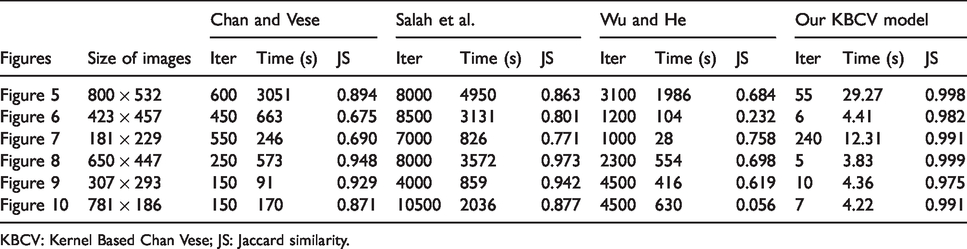
KBCV: Kernel Based Chan Vese; JS: Jaccard similarity.
Proposed model
Model of Salah et al. 10 utilized kernel function and non-Euclidean distances. The efficiency of kernel function is very important in the classification of nonlinearly separable data.19–22 It implicitly projects the image data into a higher dimensional space through some transformation where it can be separated by a linear hyper plane. The hyper plane which is linear in the higher dimensional feature space when projecting back to the original data space is nonlinear Schölkopf. 18
Motivated by the discussed models, in this section, we proposed a hybrid model based on Euclidean and kernel metrics, i.e., in the fitting terms of Chan and Vese’s
9
model, we used kernel metric as below


The parameter
Suppose 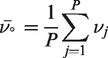
Let 
Therefore, the bandwidth parameter σ can be estimated by the distance variance as

The distance variance of the data points shows a measure of how the data points are closed to the data cluster.
Keeping 
Now keeping 
Approximating the time derivative in equation (8) by using forward difference scheme, we get the following equation


Smoothing term
Generally, models of Chan and Vese
9
and others use length term in their models for smoothing and re-initialization of the evolving contour. Due to length term, numerical approximate method becomes time consuming; therefore, we use Gaussian smoothing filter rather than length term, which is defined as follows

Gaussian smoothing filter minimizes noise and unwanted features present in the given image. For effective segmentation results, we take the values of
Though, comparing with other models, the proposed KBCV model gives good quantitative results. For quantitative comparison, we use Jaccard similarity (JS), which is discussed in the next section.
Jaccard similarity
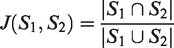
JS index or simply JS is a measure of similarity between two data sets. It compares the elements of two sets to show which elements are same and which are distinct. Its range is from 0 to 1, the closer its value to 1, the more similar the two data sets and vice versa. The JS between two data sets S1 and S2 (say) is defined as follows
Experimental results
In this section, we examine the proposed KBCV model on medical images. Also, the experimental results of the proposed KBCV model are compared with the outcomes of Chan and Veses, 9 Salah et al.’s, 10 and Wu and He’s 8 models in some real and synthetic images. All the experimental outcomes are obtained on Window 8.1, core i3 operating system with 4-GB RAM, 1.7-GHz processer and MATLAB R2013a software.
Performance of the proposed KBCV model in medical and noisy images
In Figures 1 and 2 the proposed KBCV model is examined on various medical images, while in Figure 3, it is tested in some synthetic and noisy images. In these figures, first and second rows show initial and final contour, respectively. In Figure 4, the proposed model is tested on images having different objects and are corrupted by speckle noise, where it produced satisfactory results. The proposed model segments each of these images in a few iterations.

Experimental results of the proposed model, for each image first row shows initial contour while second row shows final contour. (a)-(d) Original skin lesion images with initial contours and (e)-(h) original skin lesion images with final contours.
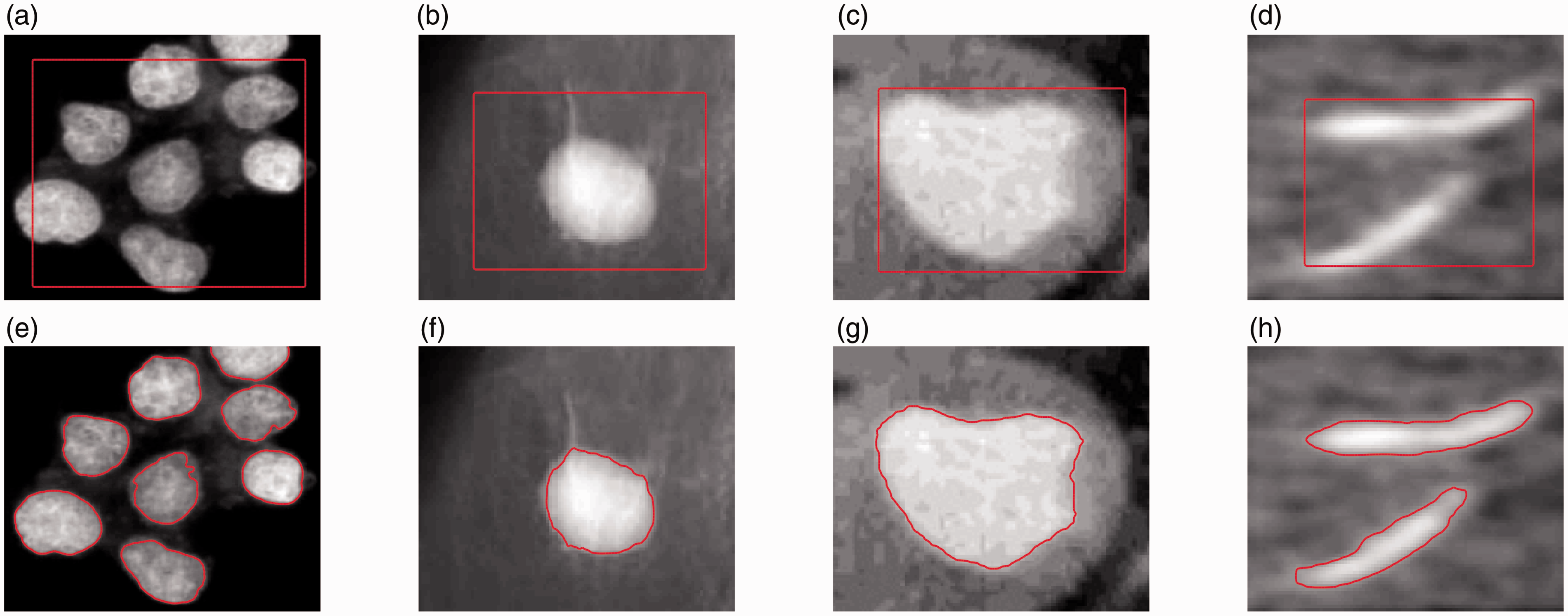
Performance of proposed model in medical images. (a)-(d) Original images with initial contours and (e)-(h) original images with final contours.

Performance of proposed model in noisy images. (a)-(d) Original noisy images with initial contours and (e)-(h) original images with final contours.

Performance of proposed model on images having multiple objects and effected by speckle noise. (a)-(c) Original noisy images with initial contours and (d)-(f) original images with final contours.

From left to right first, second, third and fourth column represents CV model result, Salah et al. model result, Wu et al. model result, and proposed Kernel Based Chan Vese model result. For each model, from top to bottom first and second row shows initial contour and final contour, respectively: (a) Original jet image with initial contour; (b) Original jet image with initial contour; (c) Original jet image with initial contour; (d) Original jet image with initial contour; (e) Chan and Vese’s model result; (f) Salah et al.’s model result; (g) Wu and He’s model result; and (h) proposed model result.

From left to right first, second, third and fourth column represents Chan et al. model result, Salah et al. model result, Wu et al. model result, and proposed Kernel Based Chan Vese model result, respectively: (a) Original image with initial contour; (b) Original image with initial contour; (c) Original image with initial contour; (d) Original image with initial contour; (e) Chan and Vese’s model result; (f) Salah et al.’s model result; (g) Wu and He’s model result; and (h) proposed model result.

From left to right first, second, third and fourth column represents Chan et al. model result, Salah et al. model result, Wu et al. model result, and proposed Kernel Based Chan Vese model result, respectively: (a) Original x-ray image with initial contour; (b) Original x-ray image with initial contour; (c) Original x-ray image with initial contour; (d) Original x-ray image with initial contour; (e) Chan and Vese’s model result; (f) Salah et al.’s model result; (g) Wu and He’s model result; and (h) proposed model result.

From left to right first, second, third and fourth column represents Chan et al. model result, Salah et al. model result, Wu et al. model result, and proposed Kernel Based Chan Vese model result, respectively: (a) Original bird and moon image with initial contour; (b) Original bird and moon image with initial contour; (c) Original bird and moon image with initial contour; (d) Original bird and moon image with initial contour; (e) Chan and Vese’s model result; (f) Salah et al.’s model result; (g) Wu and He’s model result; and (h) proposed model result.

From left to right first, second, third and fourth column represents Chan et al. model result, Salah et al. model result, Wu et al. model result, and proposed Kernel Based Chan Vese model result, respectively: (a) Original image with initial contour; (b) Original image with initial contour; (c) Original image with initial contour; (d) Original image with initial contour; (e) Chan and Vese’s model result; (f) Salah et al.’s model result; (g) Wu and He’s model result; and (h) proposed model result.

From left to right first, second, third and fourth column represents Chan et al. model result, Salah et al. model result, Wu et al. model result, and proposed Kernel Based Chan Vese model result, respectively.
Qualitative and quantitative comparison
Figures 5 to 10 show comparison among the segmented outcomes of Chan and Vese’s, 9 Salah et al.’s, 10 Wu and He’s, 8 and the proposed KBCV models. Each of these figures shows that the efficiency of the proposed model is much better than each model.
Quantitative comparison (i.e., no. of iterations, CPU time in seconds and JS) can be observed from Table 1.
Conclusion
In this work, we proposed a hybrid image segmentation model based on Euclidean and non-Euclidean distance metrics. Experimental outcomes of the proposed KBCV model shows better robustness and efficiency. Also, comparison with Chan and Vese’s, Salah et al.’s, and Wu and He’s models show the superiority of the proposed model, both, in term of qualitatively and quantitatively. We shall extend our work towards texture images.
Footnotes
Declaration of conflicting interests
The author(s) declared no potential conflicts of interest with respect to the research, authorship, and/or publication of this article.
Funding
The author(s) received no financial support for the research, authorship, and/or publication of this article.
