



Abstract
Elastodynamic response of three-dimensional icosahedral quasi-crystals under mechanical loadings is presented in this article. Two kinds of cases are considered here, in which the plane problem and anti-plane problem are included. The phonon and phason elastic fundamental fields along with their coupling effect in crack analysis are explicitly presented in terms of the theoretical and numerical analyses. Using the finite difference method, some numerical results of stresses, displacements, and normalized dynamic stress intensity factor are obtained. By comparing the results of quasi-crystals, this article reveals the influence of phonon and phason elastic fundamental fields, which occupy an important position in dynamic deformation behavior of quasi-crystals. Of course, phonon–phason coupling effect also should not be neglected.
Introduction
Quasi-crystals (QCs) are viewed as a new structure of solids, which is different from crystals, and possess noncrystallographic rotational symmetry and quasi-periodic long-range orientational symmetry.
1
According to the quasi-periodicity, similar to crystals, QCs have a phonon degree of freedom; meanwhile, QCs have a special type of elastic degree of freedom, which is named as phason degrees of freedom, and this fact has been investigated widely extensively and profoundly. On the issue of the generalized static elasticity theory, almost all of the scholars agree on its form, but they are unable to agree on the elasto-/hydrodynamic deformation of QCs. There are different theoretical viewpoints.2,3 Namely, almost all of the scholars have the same viewpoint for the phonon modes, which represent wave propagation. However, as the study of this topic has progressed, different viewpoints have been postulated regarding the role of phason modes in the dynamic deformation process. We can basically summarize the relevant viewpoints as follows: Similar to the phonon field
More recently, the phonon–phason elasticity of QCs also attracted a lot of attention. For example, Li et al.22,23 provided fundamental solutions for thermo-elasticity based on half infinite plane cracks embedded in one-dimensional hexagonal QCs. Colli and Mariano 24 and Radi and Mariano 25 have described linear elasticity of QCs and obtained some meaningful results for dislocations in QCs. Wang and Pan 26 obtained some analytical solutions for some defect problems in one-dimensional hexagonal and 2D octagonal QCs. Of course, dislocation and plate theory of QCs have been developed by some researchers, for example, Caillard et al., 27 Yang et al., 28 Sladek et al., 29 Li and Liu, 30 Liu et al., 31 and Li and Fan. 32
There exist about 200 QCs observed to date, in which about 100 are icosahedral QCs, so these QCs present major importance in the material. So far, people research dynamic initial growth and fast propagation of the crack for conventional structural materials, the results of approximate analysis and numerical analysis and experimental measurement are obtained based on the finite size specimen.33,34 In order to accomplish our subject, this work may put forward some new insights into the deformation behavior of the kind novel quasi-crystalline materials by extending the practice to the investigation. In this similar research topic, Zhu and Fan 13 and Wang et al. 14 have used the cracked decagonal Al-Ni-Co QC to simulate dynamic behavior of QCs, and Tupholme 35 obtained a solution of a crack moving in one-dimensional hexagonal QCs under anti-plane shear loadings. Hakan and Aklncl 36 use the matrix transformations and Fourier transform for dynamic plane elasticity problems of 2D QCs and provide some significant results.
It is hoped that the dynamics problem of QCs could be better convinced if they have considered the dynamic fracture behavior of the finite specimen of icosahedral QCs. So, we extend their method to the dynamic behavior of QCs based on the finite difference method (FDM). Two kinds of cases are considered in this article: one is a plane problem and the other is an anti-plane problem. On the basis of the finite specimen, the results for both kinds of cases of the stresses and displacements and stress intensity factors are calculated using the FDM.
Basic equations and simplified model
If a quasi-crystalline medium is subjected to given loadings, there will yield two displacement fields. One is

In linear elasticity of QCs, the stress tensors related to the strain tensors can be expressed by 5

where

and

where


The dimensionless stress intensity factor can be introduced as follows 37

For the elastodynamics, we adopt the viewpoint raised by Lubensky et al. 3

in which
A cracked specimen of icosahedral QCs of plane problem based on FDM
Referring to Figure 1, we consider a specimen of icosahedral QCs with a Griffith crack of 2D plane problem. Suppose the Griffith crack penetrates through the specimen of icosahedral QCs along the z-axis direction, that is, the quasi-periodic direction. If the deformation of the specimen of icosahedral QCs is induced by a uniform tensile stress at upper and lower surfaces, it is obvious that all variables of elastic field are independent of z, that is,

The specimen for icosahedral QCs with a Griffith crack.
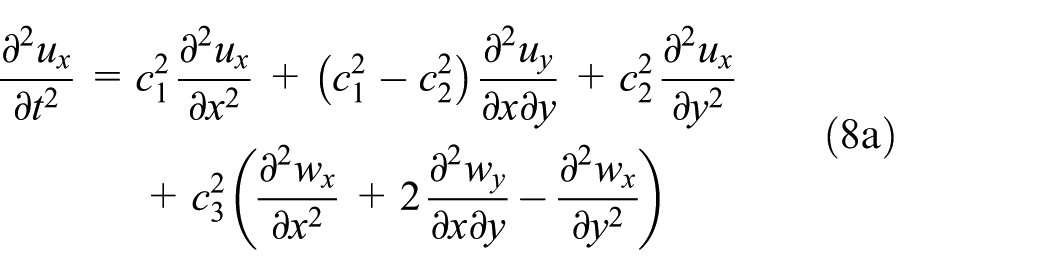
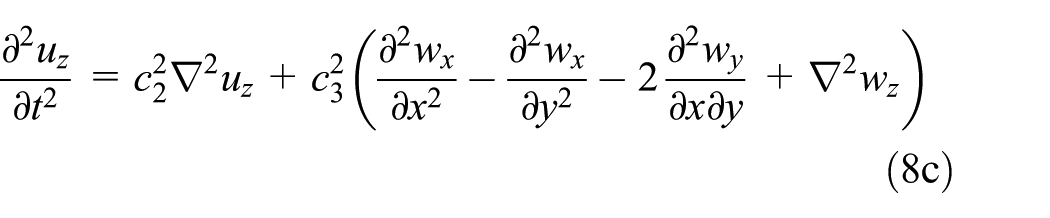
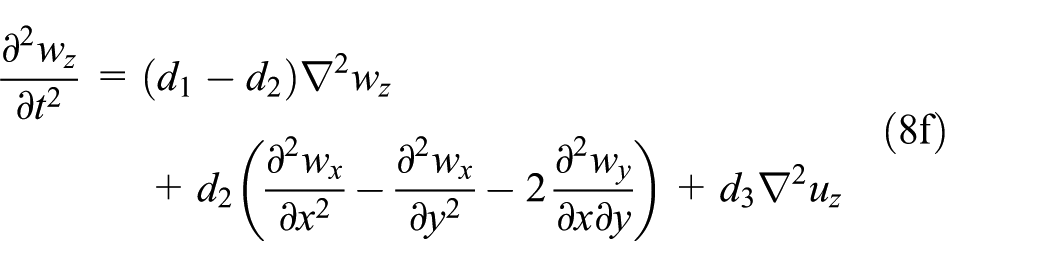
From these equations (3)–(7), let us take displacement variables of equilibrium as the unknown variables of the governing differential equations for 2D problem, then the equation can be easily expressed by



where





where
Similar to Zhu and Fan 13 and Wang et al., 14 we suppose the initial displacements and velocities of the phonon field and phason field are equal to zeroes, that is

We now pay attention in investigating the effect of the phonon and phason fields in the icosahedral Al-Pd-Mn QCs. The related parameters are used, in which the density
First, the response of the cracked specimen can be declared by FDM for several different dynamic loadings. The related parameters

(a) Triangle pulse, (b) rectangular pulse, and (c) zigzag pulse.
It is obvious that when the periodicity

The schematic diagram of the response of (a) a triangle pulse, (b) a rectangular pulse, (c) and a zigzag pulse.
Second, we will discuss the dynamic stress intensity factor in the dynamic loadings for the following cases: (a) Poisson coefficients are different, while the density of material and the elastic constants of phason field remain unchanged; (b) the elastic constant of the phason field
The related mechanical properties of icosahedral quasi-crystals.

The results declared by Figure 4(a) can be summarized as follows: the change in wave is caused by the change in

Normalized dynamic stress intensity factors for (a) different Poisson coefficients and (b) different
The fast crack propagation also belongs to nonlinear problem in the deformation of icosahedral QCs, in which the movement rule of crack is unknown in advance. The researchers always make some simplifying assumptions to the movement rule of crack when they give the analysis for the propagation of crack in the field of fracture mechanics research. We suppose that the crack extends along the x-axial direction and is related to the y-axial direction with symmetry. The parameters of the specimen are given by

(a) Dynamic stress intensity factor () and crack propagation speed ( ) for
) for
(a) Dynamic stress intensity factor () and crack propagation speed () for
(a) Dynamic stress intensity factor () and crack propagation speed () for
From these figures, we can summarize as follows: (1) When stress threshold
A specimen with a crack of anti-plane problem of icosahedral QCs based on FDM
In this section, we consider the anti-plane longitudinal shear problems of icosahedral QCs, in which the nonzero stress components are

The differential equations of equilibrium for anti-plane problem can be expressed by

Substituting equation (11) into equation (12), one can obtain

If

Consider a three-dimensional QC with a crack. It can be shown in Figure 8.

A schematic diagram of a mode III crack penetrates along the z-axial direction.
Without loss of generality, we only consider the upper right quarter of the cracked specimen based on the symmetry. Due to the lack of the elastic constants of the phason field, we first assume the stress of phason field
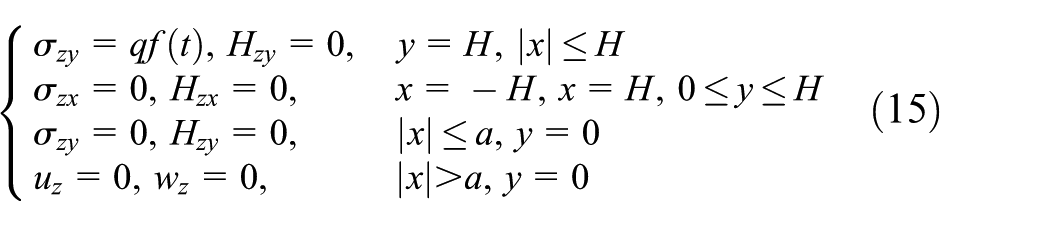
The initial displacements and velocity of the phonon field and phason field must be taken into account. We suppose that they equal to zeroes, that is

In the following, we take a = 0.2 to simulate the length of the crack and take H = 1 to simulate the length of the specimen. Meanwhile, the stress loading is deemed to be 10 MPa. The related elastic constants are shown in Table 2.
The related parameters used in the numerical results.

Figure 9 declares that the normalized dynamic stress intensity factor (NDSIF) is equal to zero before the longitudinal wave induced by the dynamic loading propagates to the surface of the crack. The time is exactly equal to that of the wave that propagates to the surface of the crack.

Variation of normalized dynamic stress intensity factor with time.
It is obvious that the difference between the displacement of a point at the crack tip of the phonon and phason field is tremendous (Figure 10). The influence of the altered loadings for icosahedral QCs with a crack will be studied as shown in Figure 11. Three kinds of cases are considered. The first one is the loading stress equal to 2 MPa. The other two kinds of cases require that the loading stress is equal to 2 or 10 MPa, respectively.

The displacement of a point at the crack tip of (a) phonon field and (b) phason field.
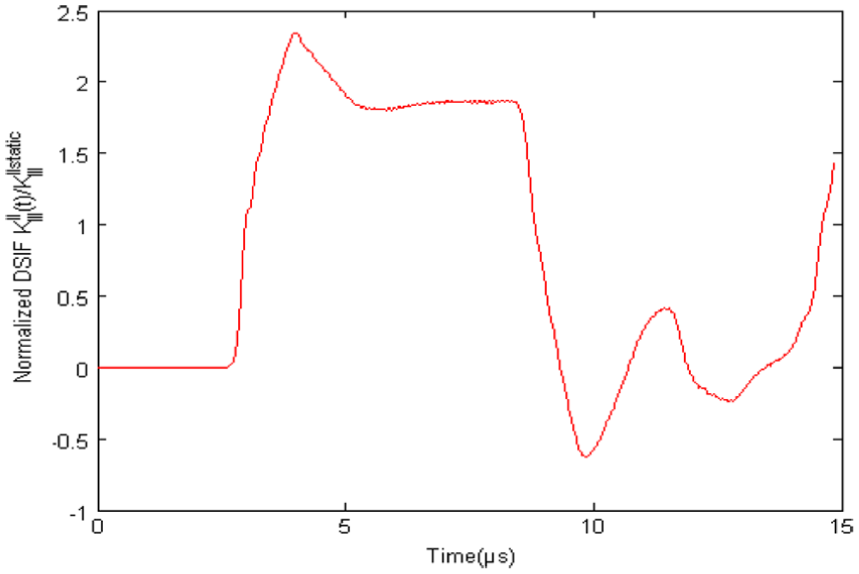
Variation of normalized dynamic stress intensity factor with time.
The NDSIF does not alter along with the change in the loading stress, so the stress at the crack tip increases when the loading stress increases. A total of three displacements are depicted in Figures 12 and 13, and we can see when the load stress increases, the displacements fluctuate drastically.
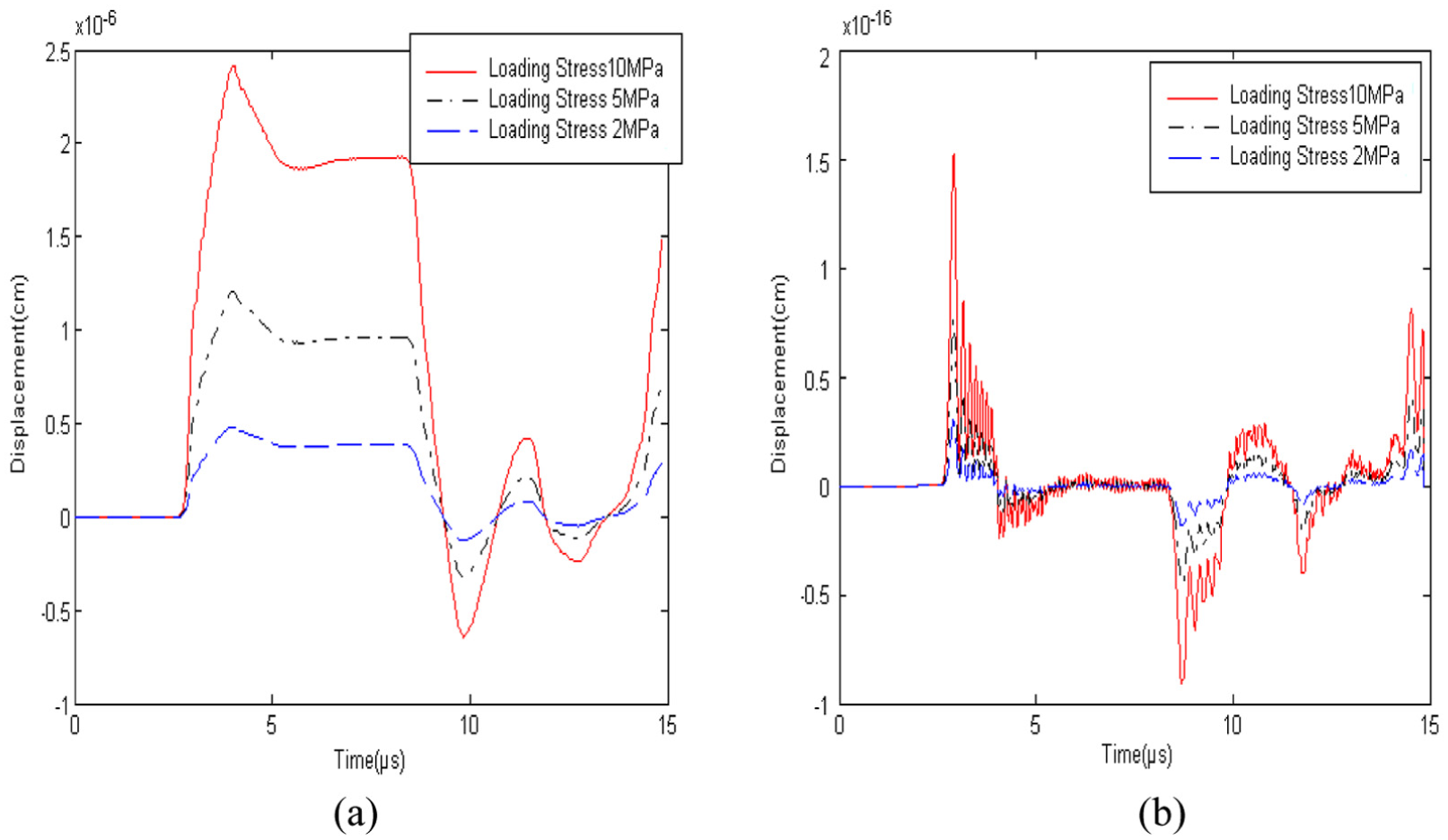
The displacement of a point at the crack tip of (a) phonon field and (b) phason field.

The displacement of a point at the crack tip of (a) phonon field and (b) phason field.
In anti-plane problem of icosahedral QCs, we apply the stress criterion as the fracture criterion which is similar to the plane problem. Suppose that the stress value of a point near the crack tip is to control the size of the fracture parameters. On the basis of stress criterion, this article made a rapidly expanding analysis of crack. In this problem, three kinds of cases will be considered

Variation of normalized dynamic stress intensity factor with time for (a)
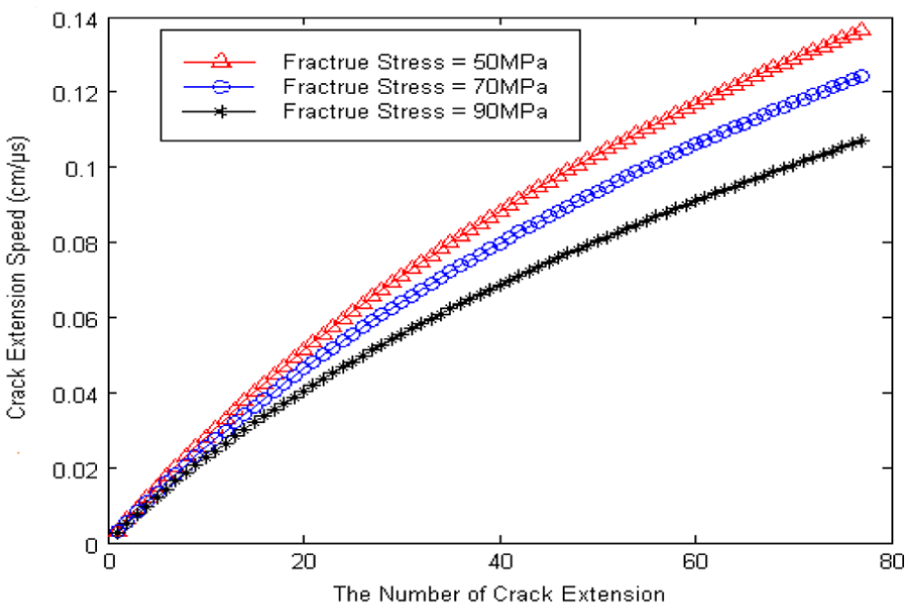
Different speeds of extension versus different fracture stresses.
It is evident that when the initial fracture stresses are equal to 50, 70, and 90 MPa, the times of crack extending to the boundary of the material are 5.6, 6.2, and 7.2 µs, respectively. The dynamic stress intensity factors have a uniform trend based on the different initial fracture stresses. When the fracture stress becomes larger, it is inferred that the icosahedral QCs (Al-Mn-Pd) are prone to fracture. The speed of crack propagation increases as the fracture stress reduces, and the fracture resistance of materials becomes stronger. It can be inferred that the higher speed of the crack tip can be achieved in the expansion, and the dynamic fracture process brings into correspondence with ordinary materials. It shows that even though there exist the phason field and phonon–phason coupling effects in QCs, a lot of similarities exist between the fracture process of QCs and ordinary materials. This phenomenon does not conflicts the basic principle of the fracture dynamics.
Conclusion and discussion
The dynamic problem of icosahedral QCs is a mathematically daunting problem. For the statics problem of QCs, systematical and direct methods of mathematical physics and complex variable functions are developed to solve the equations under appropriate boundary value and initial value conditions, and many exact analytical solutions are constructed. But it is more difficult for the dynamic case. Based on previous theory for dynamic problem of QCs, this article mainly presents for elastodynamic response of three-dimensional icosahedral QCs using FDM. Two kinds of cases are considered: one is the plane problem of dynamic initial growth and fast propagation of the crack for QCs, and the results of approximate analysis and numerical analysis are obtained based on the finite size specimen and the other is the anti-plane problem of QCs. The phonon and phason elastic fundamental fields along with their coupling effect in crack analysis are explicitly presented in terms of numerical analyses. Using the FDM, some numerical results of stresses, displacements, and NDSIF are obtained. By comparing the results of QCs, this article reveals that the influence of phason field and phonon–phason coupling should not be neglected, which occupy an important position in dynamic deformation behavior of QCs.
Footnotes
Academic Editor: Filippo Berto
Declaration of conflicting interests
The author(s) declared no potential conflicts of interest with respect to the research, authorship, and/or publication of this article.
Funding
The author(s) disclosed receipt of the following financial support for the research, authorship, and/or publication of this article: This work is supported by the National Natural Science Foundation of China (no. 11402158) and the Qualified Personnel Foundation of Taiyuan University of Technology (grant no. tyut-rc201358a).