




Abstract
Traditionally, machine equipment manufacturers match new metalworking suppliers through yellow pages and websites, which is inefficient and not timely for supplier information transfer. In this article, a cloud-based supplier matching system is proposed to offer machine equipment manufacturers an efficient way to match suitable metalworking suppliers. A cloud architecture to enhance utilization of servers and simplified device management is designed. Two cloud services are designed in this system, including order-bidding service and order-cooperation service. A comparison result shows that the system can provide a flexible matching system for both metalworking suppliers and machine equipment manufacturers.
Keywords
Introduction
As machine equipment manufacturers increasingly focus on their competencies, they become more dependent on suppliers which have professional technique such as metalworking suppliers. 1 Selecting and evaluating core supplier is a key for machine equipment manufacturers to maintain a competitive advantage and cost reduction. 2 Traditionally, there are a few ways which machine equipment manufacturer may use to find a new metalworking supplier, including yellow pages, the recommendation of other suppliers, or websites. The common problem of above ways is machine equipment manufacturer cannot obtain immediately supplier’s information, such as types of machining processes, maximum accuracy of machine tool, and materials that can be used. They must contact with suppliers through telephone or email to acquire machining information. However, it is not easy for machine equipment manufacturer to find suppliers which match their requirement in a short term, they have to spend lots time to seek suitable suppliers. Therefore, there is a lack of system which provides metalworking suppliers to update their information and to assist machine equipment manufacturer to match suitable suppliers.
Currently, the suppliers are facing two difficult issues. One is that customers require strict delivery time. Another is that it is hard for suppliers and manufacturers to satisfy heavy demand in a limited time. It means that suppliers have to overcome difficulties such as capacity constraint and manufacturing cycle. 3 However, it is difficult to predict when machine equipment manufacturer receives large orders. To solve demand uncertainty problem, suppliers can cooperate with each other. This not only can complete the mission on time but also increase mutual cooperation among the suppliers.
Moreover, metalworking suppliers always play passive roles when machine equipment manufacturer developed a new metalworking supplier to cooperate. Most of the metalworking suppliers always maintain relationship with existing machine equipment manufacturers; they have few opportunities for developing new clients due to a lack of efficient platform. In this article, we proposed two cloud services, including order-bidding service and order-cooperation service, to provide metalworking suppliers a flexible way for raising the competitiveness.
In this study, a cloud-based supplier matching system (CSMS) for machine equipment manufacturers and metalworking suppliers is designed to resolve the above problems which were listed as follows:
Traditionally, machine equipment manufacturers find a new appropriate metalworking supplier inefficient because of lack of integrated information resource.
With the trend of customization, metalworking suppliers must have the strategic application to handle emergency and heavy order.
Metalworking suppliers lack a flexible pipeline to develop new clients.
Literature review
Currently, most of the cloud architecture primarily used virtualization technology such as Hyper-V or VMware virtualization tools. The virtualization simplifies operations in offering high availability for applications and flexibility of application deployment and migration.4–6
X Wang et al. 7 presented a novel cloud data center auditing system and build the log analysis model to extract security events from collected log with agreeable false positives. A distributed agent framework was developed to collect log data from the cloud infrastructure. They also evaluated their system both in real world and simulation, and the experimental results showed that their system performed well.
EK Lee et al. 8 proposed the supplier selection and management system (SSMS) to suggest a methodology leading to effective supplier management processes using information obtained from the supplier selection processes.
Some researches about integrating resources and improving the efficiency of order-taking in manufacturing were proposed before. S Saniuk et al. 9 implemented the virtual production networks (VPNs) which help small and medium enterprises operating in a metallurgical sector to rapidly plan a VPN to jointly execute production orders. This platform achieves sharing of unused resources and order tasks of enterprises and significantly promotes the capacity of productions. In addition, JC Hou et al. 10 developed a Web-based multi-possibility supplier selection system to assist manufacturers to make decisions for selecting supplier effectively with business theories and analytic hierarchy process (AHP). A case study of this article shows that the system really could help the manufacturer to match a suitable supplier in a complicated situation.
Methodology
Cloud architecture
For building cloud servers and services for CSMS, two factors are considered. One is the utilization. Without proper operating, the server cannot reach its full performance. The idling of the servers would cause the concealed waste. Another issue is the device management. For the number of servers increased, more efforts will be needed for managing the servers.
Considering the two issues, a fundamental architecture, including the hardware and the software, based on the cloud computing system which has high utilization of servers and simplified device management is designed. The architecture of the cloud server center is shown in Figure 1. For hardware, we placed five rack servers on the cloud center and connected them into a computer cluster. The switches of key, video, and mouse (KVM) to manage devices are also utilized for offering a convenient, economical, centralized management for IT devices. Taking the advantages of centralized management, it would reduce much operation time on each different server. Windows Server 2012 is adapted as our server operation system.
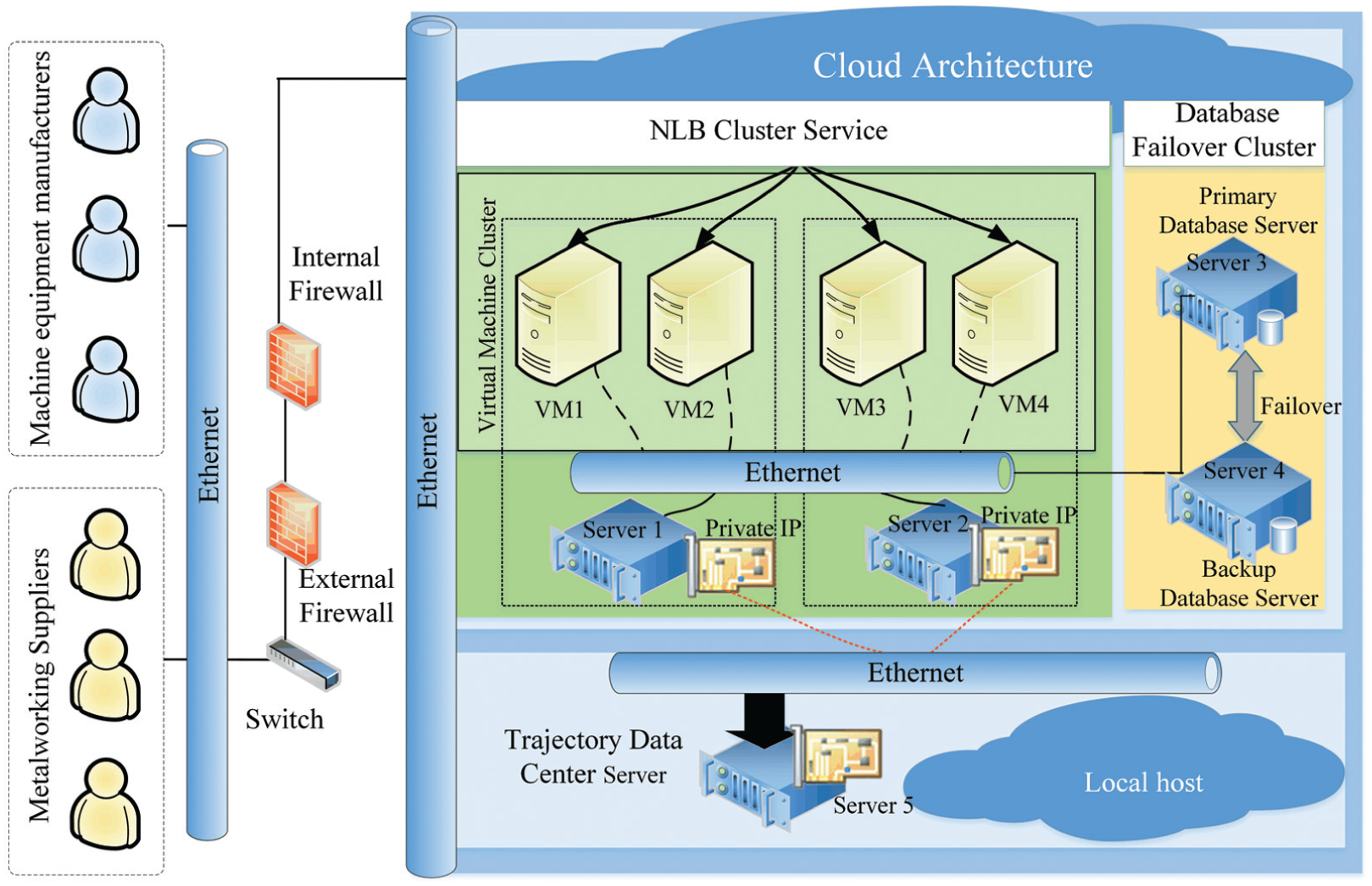
CSMS cloud architecture.
In the cloud center, we divided the servers of the computer cluster into four groups. The characters of the groups are Web Services, Trajectory Data Center Server, Database Center, and Backup Center, respectively. Figure 1 illustrates the whole proposed cloud architecture and the purposes of four groups are shown below:
Web Service (Server 1 and Server 2): Utilizing the Hyper-V 3.0, a virtualization software of Microsoft Server 2012, to build virtual machines on each server in this group, Server 1 and Server 2, and adding them to the cluster. This group would offer the Network Load Balancing (NLB) service which could automatically distribute traffic to the surviving hosts for scale performance. We take Server 1 as the major node in the group. It is the management center of all Web Service servers and would provide several services, including Active Directory service, Network Address Translation (NAT) service, and Distributed File System (DFS) service.
Database Center (Server 3): As the primary of the database, Database Center manages all data of CSMS which includes metalworking supplier information and trade detail, and joins to the failover cluster group.
Backup Center (Server 4): The server also joins to the failover cluster group and automatically backups Database Center to this service using Active Geo-replication. When Database Center fails and cannot provide service, Backup Center will immediately provide database redundancy.
Trajectory Data Center (Server 5): This server can collect and store trajectory data of users, including search history and transaction record using a distributed agent framework. The purpose is to find which supplier is needed by machine equipment manufacturer. This server is only for cloud service provider, so we build it in the local host.
There are two layers of server security. For the first layer, we use a hardware firewall to provide the first line of defense when there is an external connection to the server. The second layer uses a software firewall to protect the Web Service.
Order-bidding service
In the case of customized machines, the workpieces of each machine are designed to match specific requirements. Therefore, the cost of manufacturing is more expensive because of increasing difficulty and less quantity of production. In order to offer more suppliers for machine equipment manufacturers to select and to give metalworking suppliers an opportunity to develop new clients, we proposed the order-bidding service with a competitive bidding way. The operation flow is described as follows. The service concept is shown in Figure 2:
For machine equipment manufacturers, the order-bidding service allows them to create new orders on the CSMS and to set deadlines.
The information of orders includes types of machining processes, minimum accuracy, volume, materials, and design detail.
For metalworking suppliers, they can search the orders and bid on them.
When the deadline expired, the order-bidding service would list the suppliers and bidding prices of each to provide more selections for machine equipment manufacturers.
After an order is confirmed, the transaction process will continue.
If an order is a failure, the service will take the order off automatically.

Order-bidding service concept.
Order-cooperation service
To target the goal of “Zero-Inventory,” the trend of production has been changing recently. To lower the stock, most of the machine equipment manufacturers start producing workpiece only when they already get the solid order. 11 However, when supplier suddenly obtained a heavy order from machine equipment manufacturer with a close deadline, it will be hard for a supplier to handle. An order-cooperation service is designed to solve this problem. Whenever a metalworking supplier faces a heavy order, it can share the order to other suppliers through this service to reduce the operation time. There are two modules on order-cooperation service: common type and cooperation type. The common type is for machine equipment manufacturers. Unlike order-bidding service, machine equipment manufacturer can deal with metalworking supplier right after receiving quotation without competitive bidding. The cooperation type is only for metalworking suppliers. A supplier can create its heavy order with urgent deadline into this service, so other suppliers can decide how many orders they can cope with and share together. Through the cooperation type, not only orders can be finished efficiently but also the mutual cooperation among the suppliers will be increased. This service concept is shown in Figure 3.

Order-cooperation service concept.
Workpiece tracking service
To achieve higher efficiency about information transfer, we proposed the workpiece tracking service which is used to replace the traditional contact way by telephone or email. After a successful transaction, the supplier will offer machine equipment manufacturer a schedule of production. The supplier can update the schedule with the current statement of the production so machine equipment manufacturer is able to control the progress according to the same schedule. Furthermore, the service will remind suppliers and machine equipment manufacturers 3 days before the target completion date to avoid delay problem. A comparison before and after using CSMS is provided in Table 1.
Comparison before and after using CSMS.
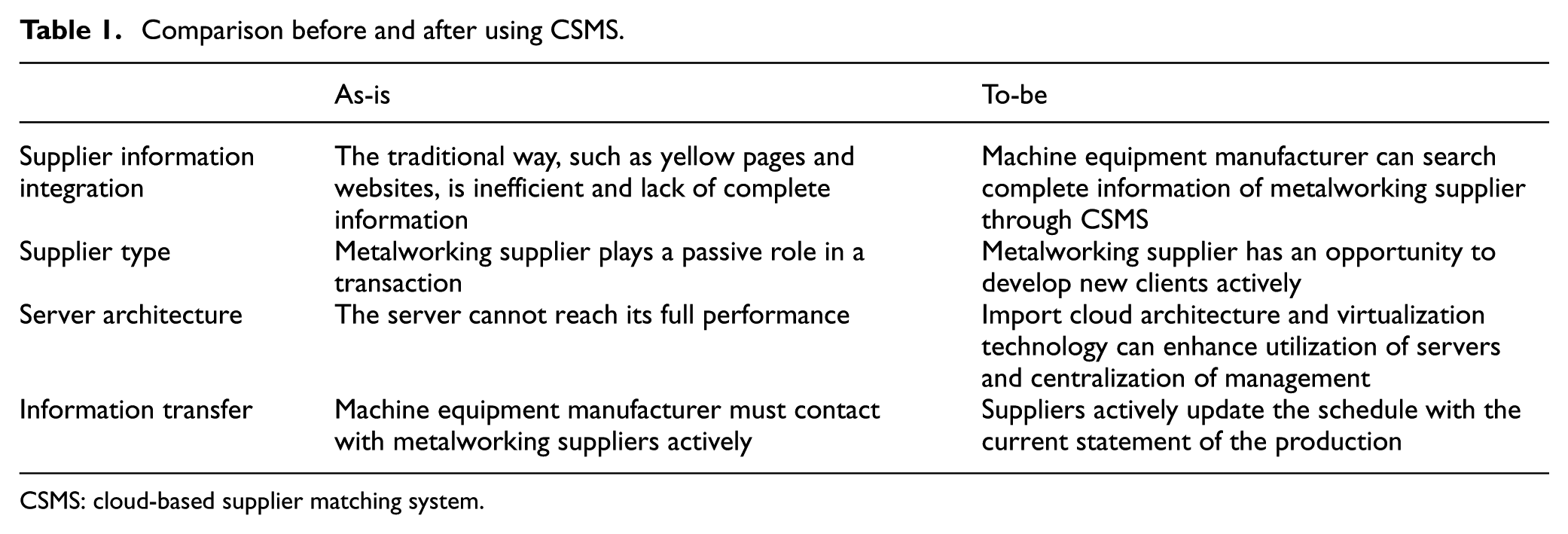
CSMS: cloud-based supplier matching system.
Conclusion
In this research, we proposed a CSMS, which offers a flexible matching service for both metalworking suppliers and machine equipment manufacturers. We also proposed a fundamental cloud architecture which has the high utilization of servers and simplified device management. We design two transaction services, order-bidding service and order-cooperation service, to allow machine equipment manufacturers have more selections of suitable suppliers and to create metalworking suppliers more opportunities to develop new clients. Also, we provided a workpiece tracking service for machine equipment manufacturers to track production progress of workpiece through the system. In the future work, we are aiming at the following goals:
Developing the matching mechanism with an AHP approach to recommend the best choice to machine equipment manufacturer for the decision.12–14
Analyzing trajectory data from trajectory data center to validate the matching mechanism and improve the services.
In order to enhance security and confidentiality for users, we will adopt advanced encryption standard (AES) encryption algorithms to protect the commercial information of transaction process.15,16
Footnotes
Academic Editor: Stephen D Prior
Declaration of conflicting interests
The author(s) declared no potential conflicts of interest with respect to the research, authorship, and/or publication of this article.
Funding
The author(s) received no financial support for the research, authorship, and/or publication of this article.