




Abstract
The mechanical properties of the steering column have a significant influence on the comfort and stability of a vehicle. In order for the mechanical properties to be improved, the rotary swaging process of the steering column is studied in this article. The process parameters, including axial feed rate, hammerhead speed, and hammerhead radial reduction, are systematically analyzed and optimized based on a multi-objective optimization design. The response surface methodology and the genetic algorithm are employed for optimal process parameters to be obtained. The maximum damage value, the maximum forming load, and the equivalent strain difference obtained with the optimal process parameters are, respectively, decreased by 30.09%, 7.44%, and 57.29% compared to the initial results. The comparative results present that the quality of the steering column is improved. The torque experiments and fatigue experiments are conducted with the optimal steering column. The maximum torque is measured to be 260 NM, and the service life is measured to be 2 weeks (40 NM, 2500 times), which are, respectively, increased by 8.3% and 8.69% compared to the initial results. The above results display that the mechanical properties of the steering column are optimized to verify the feasibility of the multi-objective optimization method.
Keywords
Introduction
The steering column, used for conversion and transfer of energy, constitutes an important component connecting the steering wheel to the steering system. In recent years, the studies on the steering column are of great significance due to the importance of the steering column in the safety performance of a vehicle. The steering column is currently machined by rotary swaging, and the forging quality is proven to be better than the corresponding steering columns, machined by traditional processes.1–3 Yet, forging quality defects such as loosening, cracks, and spine grains will appear inevitably during rotary swaging. In order for the mechanical properties of the steering column to be improved, it is quite significant for the rotary swaging process of the steering column to be optimized for forging quality improvement. Lim et al. 4 studied the steering column for the driving performance and vibration characteristics to be discussed. Wang et al. 5 conducted the torsion failure testing to analyze the location of the strain concentration on the splines of the steering column. Wang et al. 6 analyzed the influence of bearing stiffness on modal frequencies in automotive steering system. Research results were used for the design of the steering column to be either optimized or improved and the resonance phenomenon and noise generation to be avoided. From the above studies, a focus on the performances of the steering column in working conditions is made.
Similarly, much research on the rotary swaging process is also conducted. Kuhfuss et al. 7 conducted an experimental research on the micro components manufactured by rotary swaging, and the changes in microstructure after rotary swaging such as the distortion of structures and residual stress were presented. Yin et al. 8 analyzed the rotary swaging process for the thin-walled tube in a three-dimensional (3D) finite element analysis (FEA) model. Moumi et al. 9 applied finite element (FE) simulation on the study of the material flow characteristics during infeed rotary swaging. Rong et al. 10 studied the critical values of the diameter reduction for the appearance of the as-cast microstructure, dynamic recrystallization of grains, and twins in the swaged magnesium with the processing maps with FEA in combination. Abdulstaar et al. 11 investigated the microstructure evolution and the mechanical properties alteration of pure aluminum during severe plastic deformation caused by rotary swaging. Jang et al. 12 executed an FE simulation and experimental verification in order to obtain the desired quality of a shell body nose by rotary swaging. Reliability analysis for the process-induced cracks occurrence was performed by the fault tree analysis. The results presented that a swaged shell nose part with a higher reliability could be successfully produced by rotary swaging. Piwek et al. 13 presented the production-orientated capabilities of light-weight design to manufacture those components by rotary swaging. As observed from the above studies, none of them optimize rotary swaging parameters systematically in order for a better forging quality to be obtained.
There are many indicators for forging quality measurements.14–18 One indicator is the damage value. Metal products operated under intense mechanical and high strain rates must have high mechanical performance characteristics. The damage of the forging subjected to large plastic strains is mainly governed by void nucleation, growth, and coalescence. Therefore, the measurement of damage value under large finite deformation is very important for the forging quality to be improved. Forming load is an additional indicator for forging quality measurement. Reduction in the forming load and enhancement of the metal liquidity in the cavity will obtain the forging with a smooth streamline and fine organization. The forging deformation uniformity constitutes the deformation uniform degree of various internal parts of the forging, subsequently being an additional important indicator for forging quality measurement. The better the forging deformation uniformity is, the lower the internal strain is. Consequently, the quality of the forging will be improved.
According to the above studies, in order for the mechanical properties of the steering column to be improved in this article, a multi-objective optimization design is conducted by the response surface methodology (RSM) and the genetic algorithm (GA) for optimal process parameters of the steering column to be obtained. Finally, the numerical simulations and experiments with the optimal process parameters are investigated for verifying the feasibility of the multi-objective optimization method.
Optimum problem description
The schematic view of head of the rotary swaging machine is shown in Figure 1. 19 Rotary swaging process is a precise metal forming process without chipping, and two or more dies, for the blank tubes to be machined, are usually used. The dies are rotated around the outer diameter of the blank tube. Simultaneously, radial compressive forces are applied on the blank tube in order for the blank tube to be formed along the axis in accordance with the line of the dies. During rotary swaging, the rotational speed of the blank is significantly lower than the rotational speed of the dies. Due to differences in rotational speeds, each hammering of the dies can strike in various positions of the blank tube’s outer surface. Therefore, it can be ensured that the force that the blank tube bears is more uniform, and the organization of the blank tube is more consistent. 20

Head of rotary swaging machine.
In this article, the schematic view of the rotary swaging of the steering column is shown in Figure 2. During rotary swaging, the ambient temperature of the blank is approximately 38°C. Four dies are needed in total. Generally, the three main process parameters are selected as follows: axial feed rate V is 1500 mm/min, hammerhead speed N is 300 r/min, and hammerhead radial reduction H is 1.5 mm.
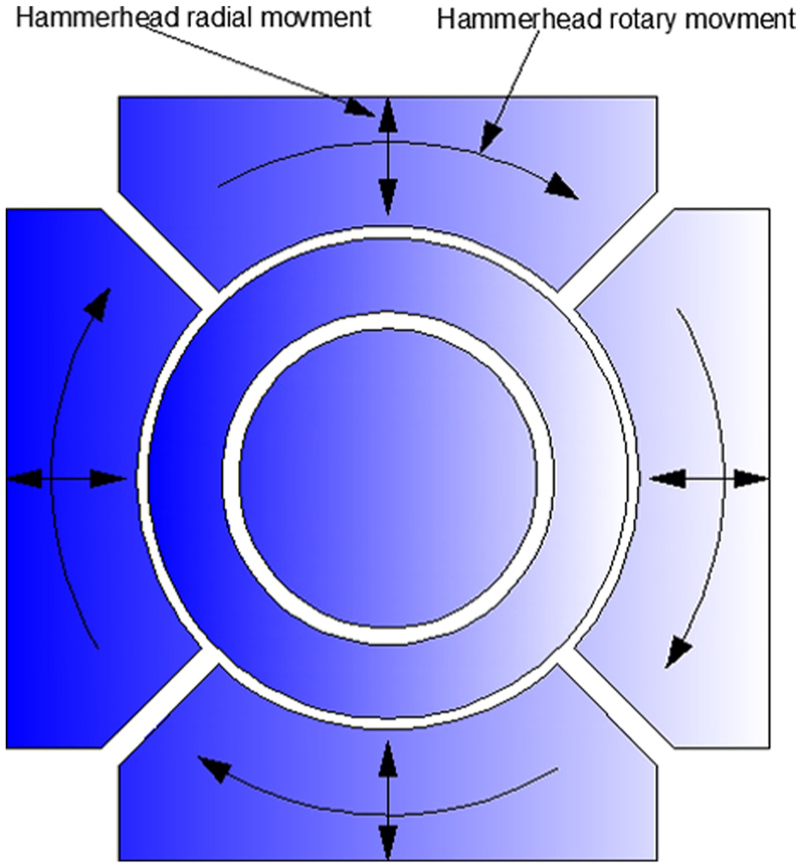
Rotary swaging of steering column.
In order for the mechanical properties of the steering column to be improved, it is significantly important for rotary swaging of the steering column forging quality to be improved. It has been analyzed that forging quality is related to forging damage, forging forming load, and forging deformation uniformity. In order for the establishment of the optimal model of the steering column mechanical properties to be facilitated, factors affecting the forging quality are needed to be quantified. In this article, the maximum damage value D and the maximum forming load F are used as the quantized indicators for damage and forming load, respectively. Certain studies present that the lesser the difference between the equivalent strain and the average equivalent strain in arbitrary units, the more uniform the deformation distribution of the mock-up tends to be eventually.21–23 Consequently, the equivalent strain difference E is used as the quantized indicator for deformation uniformity.
During rotary swaging, the quantized indicators D, F, and E of the steering column quality will vary by different combinations of the process parameters V, N, and H. Therefore, in this article, D, F, and E are selected as the forging quality optimization objectives, and the process parameters V, N, and H are selected as optimization variables. The following functional relationship can be established as follows

For the relationship analysis between the quality of the steering column and the process parameters systematically, D, F, and E are integrated into an indicator I, and the functional relationship is established as follows

Apparently, the lower the values of I, the better the quality of the steering column will be. Therefore, the main objective is I being minimal. In this article, the boundary conditions of the design variables are considered, and the optimization problem of the mechanical properties of the steering column is stated as follows
Minimize I

where XiDOWN and XiUP (i = 1, 2, 3) are, respectively, the lower and upper limits of the design variables.
Optimum design and calculation
Orthogonal experimental design
There are three factors affecting the experimental indicators to be considered in this article, namely, axial feed rate V, hammerhead speed N, and hammerhead radial reduction H. Each factor selects five levels. Therefore, the L25 (55) orthogonal table is selected. Orthogonal experimental factors and levels are shown in Table 1.
Orthogonal experimental factors and levels.

Numerical simulation
Numerical simulation model of the rotary swaging blank tube is a hollow tube with an outer diameter of ϕ25 mm, an inner diameter of ϕ 20 mm and 268 mm in length. The material of the hollow tube is a No. 10 steel having good ductility, high toughness, excellent weldability, easy formation in cold and hot process, good machinability after normalizing and cold formation, no temper brittleness, and poor hardenability as characteristics. The material of both hammerheads and fixtures is Cr12MoV having good hardenability, high hardness, excellent wear resistance, and low deformation by heat treatment as characteristics. The hollow tube uses 25,311 four-node tetrahedron elements for meshing with 6801 nodes. The hammerhead uses 28,487 four-node tetrahedron elements for meshing with 6384 nodes. The fixture uses 252 eight-node hexahedron elements for meshing with 415 nodes. The FE model of the hammerhead is shown in Figure 3, and the FE model of rotary swaging is shown in Figure 4. Through numerical simulations of 25 sets of experiments, the maximum damage value D, maximum forming load F, and equivalent strain difference E are obtained. The values of V, N, H, D, F, and E are all normalized shown in Table 2.

Finite element model of the hammerhead.

Finite element model of the rotary swaging.
Calculation results.

Response surface model
Response surface method constitutes a data fitting method based on mathematical statistics and minimum quadratic.
24
The substance of the response surface method is for a polynomial approximation with articulate forms to be constructed and the implicit performance function to be expressed. In the design space of variables, all functions can be represented as the approximation function

where φl is the basis function related to the argument, al is the undetermined coefficient, and L is the item number of φl.
In the design space, m (m ≥ L) design sample points xi (i = 1, 2,…, m) are selected to solve the approximation function

where matrix

In this article, the above calculation results are fitted using the quadratic regression model. The regression fitting equations between D, F, and E and V, H, and N are as follows
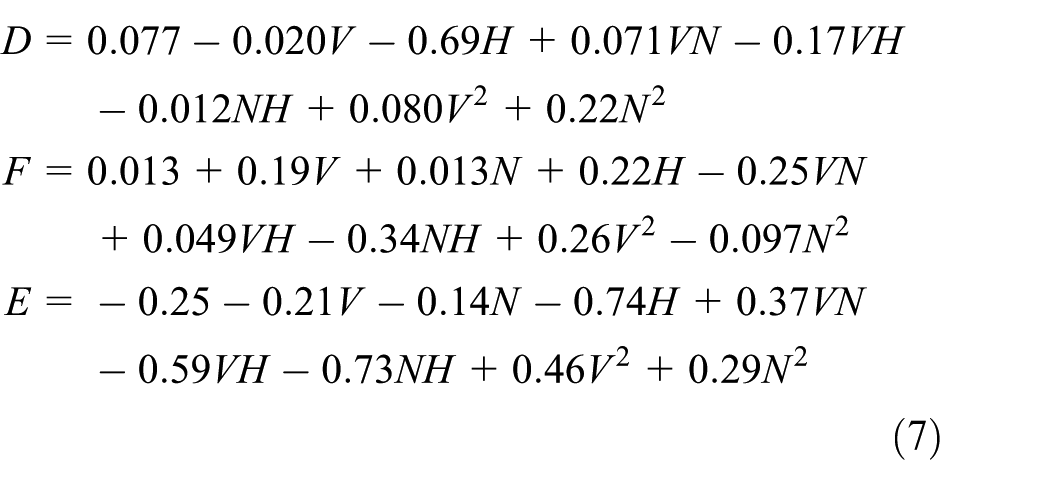
According to statistical analysis results, the coefficients of R-squared for the regression models of D, F, and E are equal to 98.39%, 97.47%, and 97.63%, respectively, which demonstrates that the RSM model has good compatibility to the calculation data. Table 3 is the analysis of variance (ANOVA) table for the regression models of D, F, and E and the respective model terms. V, N, and H, the interaction effect of V with N, the interaction effect of V with H, the interaction effect of N with H, the second-order term of V, and the second-order term of H have a significant effect on the value of D and E. H and the second-order term of V have a significant effect on the value of F.
ANOVA for the regression models and respective model terms.

ANOVA: analysis of variance.
In Figures 5–7, the response surfaces for D, F, and E in relation to the design parameters of V, N, and H are shown. As observed from these figures, D, F, and E increase first and consequently decrease as V increases; D and E both increase first and consequently decrease as N increases; and F decreases as N increases. D, F, and E increase as H increases.
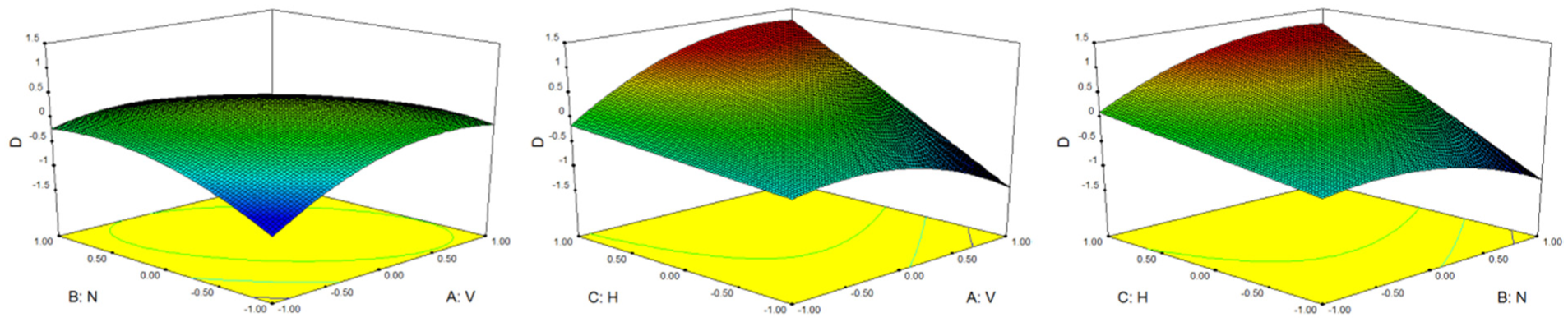
Response surface of D with combined effect of V, N, and H.

Response surface of F with combined effect of V, N, and H.

Response surface of E with combined effect of V, N, and H.
Pearson’s correlation coefficients between optimization objectives D, F, and E are calculated. The correlation coefficient between D and F is 0.969, projecting a significant positive correlation between D and F with the same alteration trend. The correlation coefficient between D and E is 0.975, projecting a significant positive correlation between D and E with the same alteration trend. The correlation coefficient between F and E is 0.969, projecting a significant positive correlation between F and E with the same alteration trend. The above analysis displays that the significant relationship between responses exists and three optimization objectives have the same alteration trend for no conflict among D, F, and E to be demonstrated. Therefore, the multi-objective optimization problem can be converted into a single objective optimization problem by the linear weighted sum method. In this article, the single objective function can be represented as follows

where a1, a2, and a3 are weighting coefficients.
During optimization, the shape and deform uniformity of the forging are considered equally important, and the relative scale is selected to be 3 in the engineering practice value. Therefore, the weighting coefficients are, respectively, selected to be 1, 1, and 1 25 in this article. However, if the relative scales are directly set as the weighting coefficients, the phenomenon “tarsus eats decimal” can appear, and the influence of the higher value will be expanded for the human factors. Therefore, weighting coefficients utilize the product of the reciprocal of the optimal value under every single objective and relative scale. Based on the above analysis, the single objective function can eventually be represented as follows

where D*, F*, and E* are the minimum values of each single goal.
Optimization calculation
GA constitutes a global optimization search algorithm combining the rule of survival of the fittest with a random information exchange mechanism of chromosomes within the group, based on natural selection and genetic theory during a biological evolution process. 26 The GA just utilizes the fitness of individuals to optimize groups, and therefore, the GA has a strong robustness compared with traditional optimization designs. Simultaneously, this algorithm utilizes the design variables’ code for a multi-point search to be conducted in the design space, and therefore, the search efficiency results are very high.
In this article, the value ranges of the rotary swaging parameters of the steering column are as follows:
Chuck axial feed rate:
Hammerhead speed:
Hammerhead radial reduction:
Based on MATLAB modeling, the regression models of D, F, and E are as the fitness functions and nonlinearly optimized by GA for the minimum values of each single goal to be obtained. Following iterative optimization, the values of D, F, and E remain at −0.7269, −0.7808, and −1.6704, respectively, as shown in Figure 8. Consequently, the minimum values of each single goal are as follows: D* = −0.7269, F* =−0.7808, and E* = −1.6704.

Single objective optimization result by genetic algorithm.
The values of D*, F*, and E* and formula (7) are substituted into formula (9) to obtain the regression model of I as follows

The regression model of I is as the fitness function and nonlinearly optimized by GA for the minimum value of I to be obtained. After 51 iterations, the value of I remains at −3.2687, as shown in Figure 9. Therefore, the minimum value of I is −3.2687, which is the optimal value of the multi-objective optimization problem in this article. In this case, the corresponding optimal rotary swaging parameters are as follows: axial feed rate V is 1600 mm/min, hammerhead speed N is 299.9 r/min, and hammerhead radial reduction H is 1.2004 mm.

Multi-objective optimization results by genetic algorithm.
Numerical simulations are conducted with initial and optimal process parameters. The contours of the material damage D, forming load F, and equivalent strain difference E are shown in Figure 10. The simulation results are shown in Table 4. The values of D, F, and E obtained with optimal process parameters are, respectively, decreased by 30.09%, 7.44%, and 57.29% compared to the initial results. It is presented that the forging quality of the steering column is improved.

The contours of the material damage, forming load, and equivalent strain difference: (a) the initial process parameters and (b) the optimal process parameters.
The simulation results.

Experimental procedure
The steering column is machined by the Felss rotary swaging machine with the optimal process parameters. The end-product and section view of the steering column are shown in Figure 11. The internal surface of the end-product has good surface finish, and the linear metal internal is smooth.

End-product and section view of the steering column.
The torque experiments and the fatigue experiments are conducted by the torque tester shown in Figure 12. When the torsion experiment is conducted, the optimal steering column and the initial steering column are subjected to pre-torque of 35 NM by the special tooling for simulating the steering wheel. Following, the steering column is fixed to the torque tester and lined in order for a more accurate observation of the breaking point and the yield deformation state subsequent to the static torsional damage on the steering column. In this experiment, the twisting speed of 30°/min is set up in the computer, and the torque is applied in a certain direction. The torque and the corresponding twist angle will be automatically collected and recorded by the computer until the test curve projected mutation and drops. At this moment, the torque is the maximum static torque.

Torque tester.
When the torsion fatigue experiment is executed, the symmetrical cycle method is adopted. The alternating torques designated to be ±40 NM are applied on the optimal steering column and the initial steering column. A 2500-cycle experimental period is set up in the computer. The periodically reciprocating torque experiment will be conducted until the steering column projects yield deformation. At this moment, the cycles are recorded displaying the service life of the steering column.
The above experimental results are shown in Table 5. The maximum static torque of the optimal steering column is increased by 8.3% compared to the initial maximum static torque, and the service life of the optimal steering column is increased by 8.69%. It is concluded that the mechanical properties of the optimal steering column have significantly been improved.
Mechanical performance experimental results.

Conclusion
The ANOVA concludes that V, N, and H, the interaction effect of V with N, the interaction effect of V with H, the interaction effect of N with H, the second-order term of V, and the second-order term of H have a significant effect on the value of D and E; H and the second-order term of V have a significant effect on the value of F. Through respective surface analysis, it is known that D, F, and E increase first and subsequently decrease as V increases; D and E increase first and subsequently decrease as N decreases; and F decreases as N increases. D, F, and E increase as H increases.
The rotary swaging process parameters of the steering column are optimized based on a multi-objective optimization method in this article. The optimal value of the multi-objective optimization problem is −3.2687, and the corresponding optimal process parameters are as follows: axial feed rate V is 1600 mm/min, hammerhead speed N is 299.9 r/min, and hammerhead radial reduction H is 1.2004 mm.
Numerical simulation is conducted with the initial and optimal process parameters. The maximum damage value, the maximum forming load, and the equivalent strain difference obtained with the optimal process parameters are, respectively, decreased by 30.09%, 7.44%, and 57.29% compared to the initial results. The comparative results present that the forging quality of the steering column has significantly been improved.
The torque experiments and fatigue experiments are conducted with optimal steering column. The maximum torque is measured to be 260 NM, and the service life is measured to be 2 weeks (40 NM, 2500 times), which are, respectively, increased by 8.3% and 8.69% compared to the initial results. Apparently, the mechanical properties of the steering column are optimized. The feasibility of the multi-objective optimization design method, used for mechanical properties optimization of the steering column, is demonstrated.
Footnotes
Academic Editor: Michal Kuciej
Declaration of conflicting interests
The author(s) declared no potential conflicts of interest with respect to the research, authorship, and/or publication of this article.
Funding
The author(s) disclosed receipt of the following financial support for the research, authorship, and/or publication of this article: This project was financially supported by the Foundation for Sci & Tech Commission Research Project of Chongqing (CSTC2014YYKFB0187).