




Abstract
In this article, R1234ze(E), R152a, and three mixtures M1, M2, and M3 composed of R152a and R1234ze(E) (in the ratio of 60:40, 50:50, and 40:60, by mass, respectively) as drop-in replacements of R134a in vapor compression system were theoretically analyzed. The performance of the vapor compression system was compared in terms of compressor discharge temperature, volumetric cooling capacity, cooling capacity, compressor power consumption, and coefficient of performance. The results showed that R152a had better coefficient of performance as well as nearly equal volumetric cooling capacity and cooling capacity compared to R134a; however, flammable R152a running with high compressor discharge temperature was restricted. Cooling capacity of R1234ze(E) was far lower than that of R134a. M2 was selected as the best alternative for R134a. Volumetric cooling capacity of M2 and R134a was similar so that M2 can be used in R134a vapor compressor system without modifying compressor. Coefficient of performance of M2 was higher than that of R134a by about 3% with 7% lower cooling capacity and 10% lower compressor power consumption. Compressor discharge temperature of M2 was higher than that of R134a by about 2°C–5°C. It was concluded that M2 can primely be an energy conservation and environmental protection alternative to R134a in vapor compression system.
Introduction
During 1900s, chlorofluorocarbons (CFCs) and hydro chlorofluorocarbons (HCFCs) with high ozone depletion potential (ODP) and global warming potential (GWP) were extensively used in domestic refrigeration and mobile air conditioning systems. CFCs and HCFCs should be banned according to the Montreal Protocol. 1 R134a considered as a promising alternative refrigerant to CFCs and HCFCs is now widely used in domestic refrigerator and mobile air conditioner. Its ODP value is zero, but GWP value is high with 1300. R134a is main compound of green house gas emission according to the Kyoto Protocol. 2 Fluorinated gases with GWP value higher than 150 should be banned in new model automobiles air conditioner from 1 January 2011 and all new automobiles air conditioner since 1 January 2017 according to the rules of F-gas. 3 In 2014, the European Union revised F-gas 4 contained that hydrofluorocarbons (HFCs) with GWP value higher than 150 should be banned in domestic refrigerators and refrigeration machines since 1 January 2015 along with commercial cooling storage containers and freezers since 1 January 2022. As global warming is intensifying, R134a will be eliminated according to the rules of F-gas, so the replacement of R134a has been a hot area of research for several years.
M Rasti et al. 5 using R436a (mixture of 46% iso-butane and 54% propane) and R600a as replacement of R134a in domestic refrigerator showed the results that the energy consumption of R436a and R600a in comparison to R134a at the optimum charges were reduced about 14% and 7%, respectively. MM Joybari et al. 6 using the exergy analysis to find the optimum charge of R600a as a replacement of R134a obtained that the optimum of charge required for R600a was 50 g, 66% lower than R134a. BO Bolaji 7 presenting an experimental study of R152a and R32 to replace R134a in domestic refrigerator showed that the design temperature and pull-down time were reached earlier using R152a and R134a than using R32. The average coefficient of performance (COP) of R152a was about 4.6% higher than that of R134a while the average COP of R32 was about 8.4% lower than that of R134a. M El-Morsi 8 presenting a theoretical analysis of a vapor compression refrigeration system using pure HC (hydrocarbon) refrigerants as replacement of R134a showed that R600 had the higher COP and liquefied petroleum gas (LPG) had the lower COP than that of R134a by 4% and 10%, respectively. M Mohanraj and colleagues9,10 presenting a theoretical and experimental analysis of R430a (mixture of 76% R152a and 24% R600a) as replacement of R134a in domestic refrigerators showed that volumetric cooling capacities of R134a and R430a were similar; the COP of R430a was higher than that of R134a by 3.25%–3.6%. The above low-GWP refrigerants researched can adopt in R134a refrigerating plant and perform well; however, they have a common character that presents high flammability which impose restrictions on wide use in refrigeration areas.
R1234yf and R1234ze(E)11–13 appeared as the alternatives to R134a. 14 R1234yf and R1234ze(E) have the properties of low flammability, non-toxic, and low GWP values that are 4 and 6, respectively. R1234yf has been presented as a R134a drop-in substitute in mobile air conditioning applications, 15 and R1234ze(E) can be used in heat pumps 16 and chillers. 17 HFOs/HFCs mixtures can be used as promising replacement of R134a due to lower GWP and better COP. A Mota-Babiloni et al.18,19 presenting an experimental analysis of a non-flammable R450a (mixture of 52% R1234ze(E) and 48% R134a) as R134a drop-in replacement showed the results that the average cooling capacity and COP of R450a compared with R134a is 6% lower and 1% higher, respectively.
Many researchers have investigated the alternative refrigerants to R134a; however, the HFOs/HFCs mixtures such as R1234ze(E)/R152a has not been seen in available references. This article aims to explore the feasibility of R1234ze(E)/R152a mixtures as potential alternative to R134a. Moreover, pure R1234ze(E) and R152a are also cited as alternatives in comparison with R134a to make this research more persuasive. This research has great significance under the situation of energy conservation and environmental protection in refrigeration industry.
Characteristics of R152a, R1234ze(E), R1234ze(E)/R152a mixtures, and R134a
Environmental impact
In the late 1980s, environmental acceptability was an important index of the alternative refrigerants. In order to protect the atmospheric ozone layer and reduce the greenhouse effect, the R134a alternative refrigerants not only require zero ODP value but also lower GWP value. The new refrigerant mixtures M1, M2, and M3 composed of R152a and R1234ze(E) (in the ratio of 60:40, 50:50, and 40:60, by mass, respectively) proposed in this article were considered as replacements of R134a. The GWP value of R1234ze(E) and R152a is 6 and 138, respectively, and the GWP value of R1234ze(E)/R152a mixtures can be estimated as follows

where GWPMIX is the GWP value of refrigerant mixtures; GWPA and GWPB are the GWP value of refrigerant A and refrigerant B, respectively; and wA and wB are the mass fraction of refrigerant mixtures, respectively.
Environmental impact of refrigerants is compared in Table 1. It is obtained that the ODP value of R152a R1234ze(E), R1234ze(E)/R152a mixtures, and R134a are both zero; however, the GWP value of R152a, R1234ze(E), and R1234ze(E)/R152a mixtures are far lower than R134a, which have great advantage to stop global warming.
Environmental impact.

ODP: ozone depletion potential; GWP: global warming potential.
Temperature glide characteristic of R1234ze(E)/R152a mixtures
The normal boiling point of R1234ze(E) and R152a are quite closed, which is conducive to form as azeotropic or near azeotropic mixtures. R1234ze(E)/R152a mixtures’ temperature glide with R152a content changes at standard atmospheric pressure are shown in Figure 1. It was obtained that the supreme temperature glide of R1234ze(E)/R152a mixtures was about 0.6°C, and with the R152a content larger than 0.6, temperature glide of R1234ze(E)/R152a mixtures was approximately 0°C. R1234ze(E)/R152a mixtures can be regarded as near azeotropic mixture at a range of R152a content between 0 and 1.
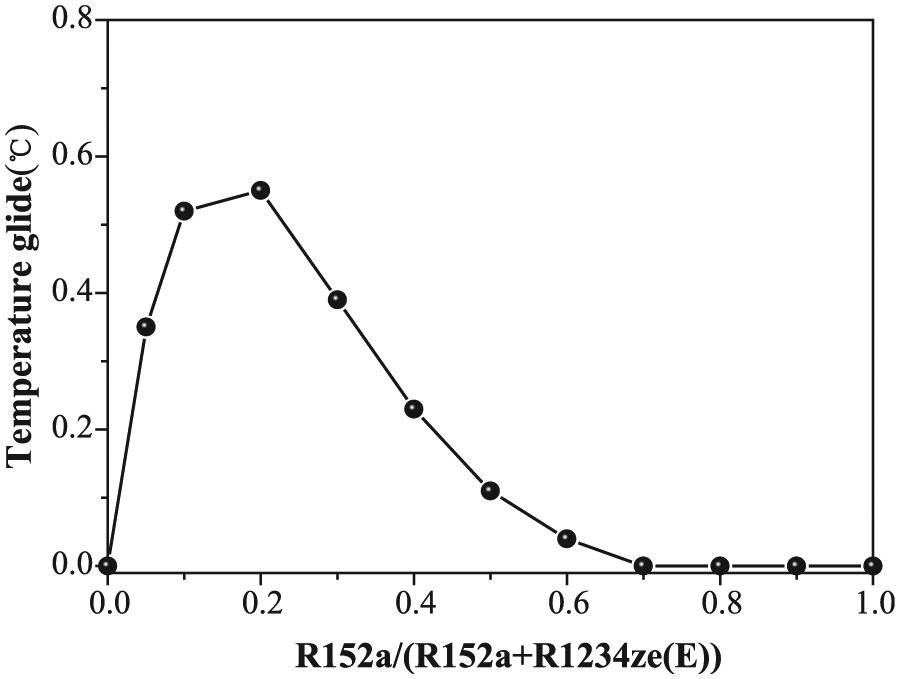
Temperature glide with R152a content changes at standard atmospheric pressure.
Thermodynamic properties of R1234ze(E)/R152a mixtures and R134a
The thermodynamic properties including saturated vapor pressure, latent heat, liquid and vapor density, liquid and vapor viscosity, and liquid and vapor thermal conductivity of R152a, R1234ze(E), M1, M2, M3, and R134a for wide range of temperatures (between −20°C and 80°C) are depicted in Figure 2. All the thermodynamic properties were obtained from REFPROP 9.1 20 using the Lemmon and Jacobsen mixing rule. 21 Figure 2(a) depicts the variation of saturated vapor pressure of R152a, R1234ze(E), M1, M2, M3, and R134a versus temperature. From the viewpoint of thermodynamics, the saturated vapor pressure of alternative refrigerants should be similar to that of R134a to achieve consistent thermodynamic characteristics and lower than that of R134a to reduce change of original system and costs. It was obtained that R152a, M1, M2, and M3 with approximately the same saturated vapor pressure line were lower than that of R134a by about 9%–11.5% and R1234ze(E) was lower than that of R134a by about 23%–26%, at a range of temperatures between −20 and 80°C. Hence, compressor can operate at relatively lower pressure. Latent heat of six researched refrigerants versus temperature is shown in Figure 2(b). It was obtained that latent heat of R152a, M1, M2, and M3 were higher than that of R134a by about 53%–86%, 27%–48%, 21%–39%, and 14%–31%, respectively, while latent heat of R1234ze(E) was slightly lower that of R134a. As the R1234ze(E) mass fraction increases, latent heat of R1234ze(E)/R152a mixtures decreases. Higher latent heat indicates an increase in refrigeration capacity of the system, which reduces the compressor running time. The liquid and vapor densities of six researched refrigerants are shown in Figure 2(c) and (d). The liquid density of R152a, M1, M2, M3, and R1234ze(E) were found to be lower than that of R134a by about 19%–26%, 12%–19%, 11%–17%, 8%–14%, and 2%–4%, respectively, which result in reduction of the refrigerant charge requirement. The vapor density of R152a, M1, M2, M3, and R1234ze(E) were found to be all lower than that of R134a. The reduction of vapor density increase gas velocity and shear force between vapor and liquid, which enhance heat transfer and increase pressure drop in evaporator and condenser. The liquid and vapor viscosity of six researched refrigerants are compared in Figure 2(e) and (f). It was obtained that liquid and vapor viscosity of R152a, M1, M2, and M3 were found to be all lower than that of R134a, which result in low friction and pressure drop in evaporator and condenser. While the liquid and vapor viscosity of R1234ze(E) was higher than that of R134a over the wide range of temperature. The liquid and vapor thermal conductivity of six researched refrigerants are compared in Figure 2(g) and (h). It was obtained that liquid and vapor thermal conductivity of R152a, M1, and M2 were higher than that of R134a, which result in better evaporator and condenser efficiency. Hence, better performance of vapor compressor system can be expected with R152a, M1, and M2. Liquid and vapor thermal conductivity of M3 was nearly equal to that of R134a, while liquid and vapor thermal conductivity of R1234ze(E) was lower than that of R134a, over the wide range of temperature.

Thermodynamic properties with temperature variation: (a) saturated vapor pressure, (b)latent heat, (c and d) vapor and liquid density, (e and f) vapor and liquid viscosity, and (g and h)vapor and liquid thermal conductivity.
Thermodynamic analysis
Schematic diagram of vapor compression system is shown in Figure 3(a), which essentially consists of an evaporator, an air condenser, a capillary tube, and a hermetic reciprocating compressor. These equipments are connected by pipelines to circulate the refrigerant with suitable thermodynamic properties. Its corresponding pressure–enthalpy (p–h) diagram with liquid subcooling and vapor superheating is shown in Figure 3(b). Compression, condensation, expansion, and evaporation are represented in Processes 1–2, 2–3, 3–4, and 4–1, respectively, in the diagram. Liquid subcooling and vapor superheating are represented in processes 1′–1 and 3′–3, respectively. Thermodynamic state of the refrigerant at compressor inlet (evaporator outlet), compressor outlet (condenser inlet), condenser outlet (capillary tube inlet), and capillary tube outlet (evaporator inlet) are represented in points 1, 2, 3, and 4, respectively. In order to calculate the thermodynamic cycle of the vapor compression system, some assumptions are made as follows:
There were no pressure drops in evaporator, condenser, and connection pipelines tubes, that is, pressure only changes in capillary tube and compressor.
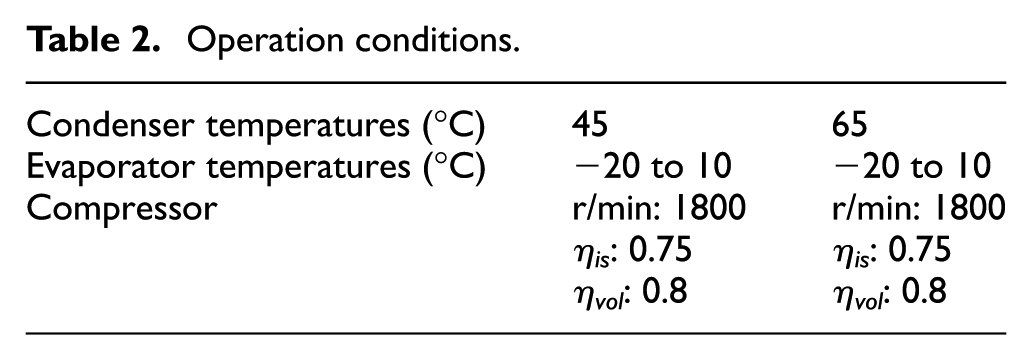
The compressor isentropic efficiency (ηis) is 0.75 and volumetric efficiency (ηvol) is 0.8.
Compressor had a constant stroke volume (Vdis) 8.16 cm3/rev and a constant speed (r/min) 1800 r/min.
There were no heat losses or heat gains to or from the system.
The superheating and subcooling temperatures were 5K at all operation conditions. The superheating and subcooling degree occurred in the evaporator and condenser, respectively.

(a) Vapor compression system and (b) pressure–enthalpy diagram.
In order to accept alternative refrigerant as a drop in replacement in vapor compression system, Some important performance characteristics such as volumetric cooling capacity, cooling capacity, compressor power consumption, COP, compressor discharge temperature, and pressure ratio have to be considered.
The volumetric cooling capacity can be calculated as

where h1 and v1 are the specific enthalpy and specific volume of the refrigerant at the compressor inlet, h4 is the specific enthalpy of the refrigerant at the evaporator inlet, and ηvol is volumetric efficiency.
The pressure ratio is defined as the ratio of the condenser pressure (pcon) to the evaporator pressure (peva), it can be calculated as

The condenser and evaporator pressures are obtained corresponding to the condenser and evaporator temperatures, respectively.
The COP is defined as the ratio of the cooling capacity to the compressor power consumption. It can be expressed as

where Qc is the cooling capacity and Wcomp is compressor power consumption.
The cooling capacity can be expressed as

The compressor power consumption can be expressed as

The actual specific enthalpy of the superheated vapor refrigerant at the compressor outlet (h2) can be expressed as follows

where ηis is the isentropic compressor efficiency and h2s is the superheated vapor enthalpy at the compressor outlet for an isentropic compression process.
The refrigerant mass flow rate (mr) can be estimated as follows

where RPM is the compressor speed, Vdis is compressor displacement, and ρ1 is the density of the refrigerant at the compressor inlet. The compressor discharge temperature T2 is an important parameter due to its effect on the stability of the lubricants and compressor components. Compressor discharge temperature can be obtained using both the condenser pressure and the actual specific enthalpy at the compressor outlet.
The thermodynamic cycle performance parameters and thermodynamic properties of the refrigerants at all operation conditions were obtained from REFPROP 9.1, 20 which have been a high accurate software for predicting the performance of vapor compression system.
Operation conditions
In order to obtain the results in the theoretical assessment of vapor compression system using six researched refrigerants, two different condenser temperatures were set as 45°C and 65°C versus a wide range of evaporator temperatures (range between −20°C and 10°C). The operation conditions are shown in Table 2.
Operation conditions.
Results and discussion
Variation of mass flow rate
The mass flow rate of six refrigerants versus evaporator temperature is shown in Figure 4. It was obtained that the mass flow rate of R1234ze(E), M3, M2, M1, and R152a were lower than that of R134a by about 19%, 24%, 27%, 30%, and 41%, respectively, at a temperature range between −20°C to 10°C due to lower vapor density. Hence, lower compressor power can be expected with R1234ze(E), M3, M2, M1, and R152a. The mass flow rate of six refrigerants was the same with the increase in condenser temperatures. Hence, in this work, the mass flow rate of six refrigerants versus condenser temperature was neglected.
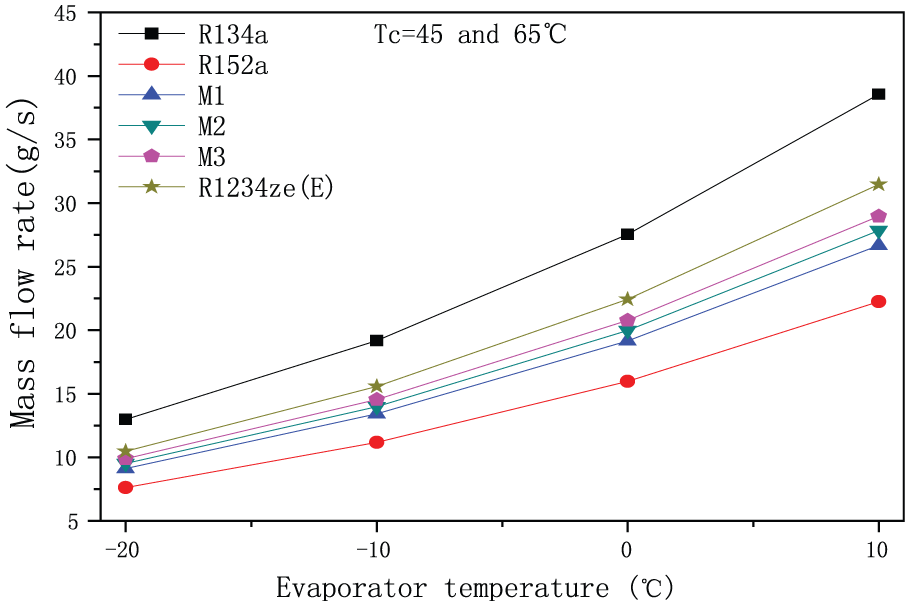
Variation of mass flow rate with evaporator temperature.
Variation of pressure ratio
The pressure ratio of six refrigerants versus evaporator temperature is shown in Figure 5. It was obtained that the pressure ratio of R1234ze(E) was higher than that of R134a by about 1.5%–3.5% and 2.5%–4.5%, respectively; however, R152a, M1, M2, and M3 with nearly equal pressure ratio were lower than that of R134a by about 1% and 2%, respectively, at condenser temperatures 45°C and 65°C. The pressure ratio is a main factor influencing volumetric efficiency of the compressor. Hence, better volumetric efficiency can be expected with R152a, M1, M2, and M3. Pressure ratio displays a negative correlation with the evaporator temperature as well as a positive correlation with the condenser temperature.
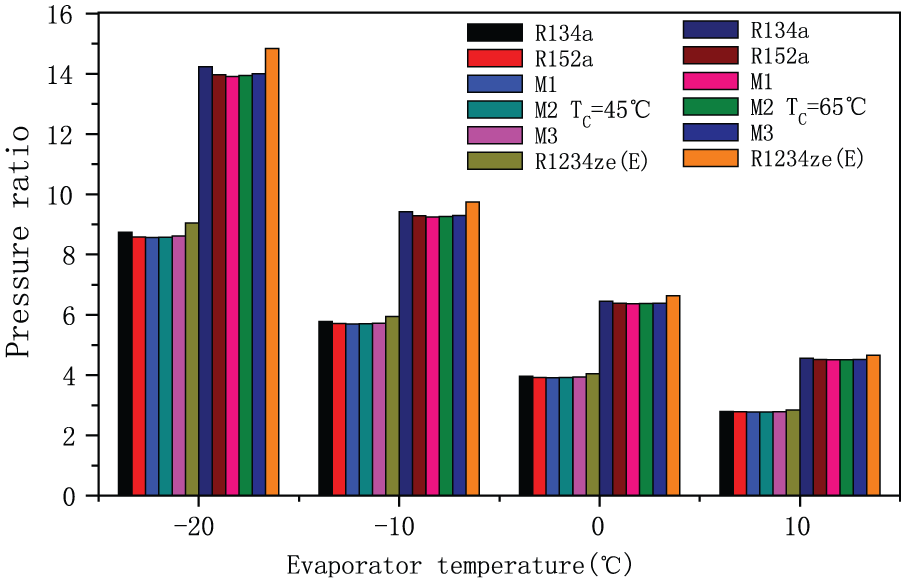
Variation of pressure ratio with evaporator temperature.
Variation of volumetric cooling capacity
The volumetric cooling capacity of six refrigerants versus evaporator temperature is shown in Figure 6. It was obtained that the average volumetric cooling capacity of M1, M2, M3, and R1234ze(E) were lower than that of R134a by about 5%, 7%, 10%, and 27%, respectively, at condenser temperature 45°C and 65°C, while for R152a was very close to that of R134a at condenser temperature 45°C and 65°C. Volumetric cooling capacity is a main factor for alternative refrigerants, which has influence on the size of compressor. Volumetric cooling capacity of alternative refrigerants should be controlled in the range of −8% to 8% compared to that of original refrigerant. R152a, M1, and M2 can be used as drop-in replacement of R134a without modification of the compressor; however, R1234ze(E) and M3 are not suitable because of lower volumetric cooling capacity, which influence the performance of the compressor when take as drop-in replacement of R134a. Volumetric cooling capacity displays a positive correlation with the evaporator temperature as well as a negative correlation with the condenser temperature.
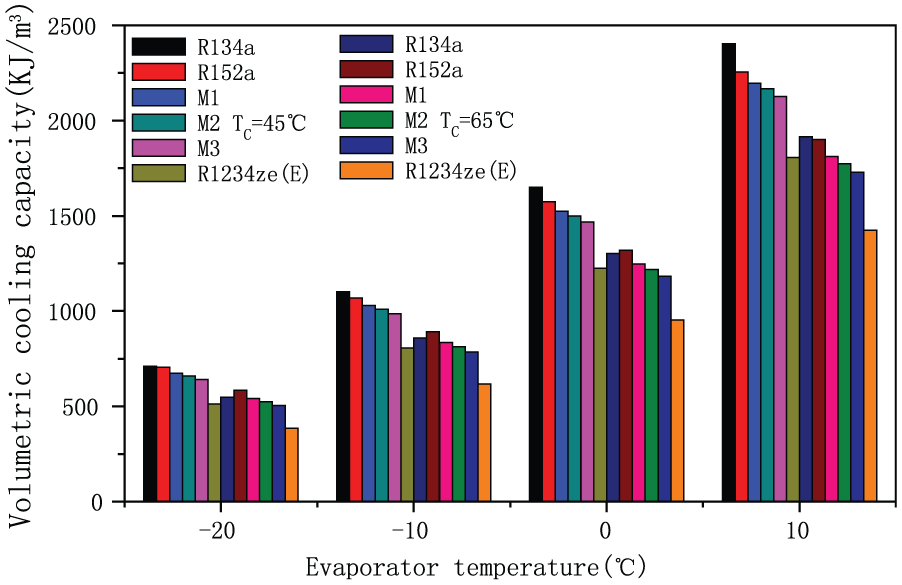
Variation of volumetric cooling capacity with evaporator temperature.
Variation of compressor power consumption and cooling capacity
The compressor power consumption of six refrigerants versus evaporator is shown in Figure 7. It was obtained that the average compressor power consumption of R152a, M1, M2, M3, and R1234ze(E) was lower than that of R134a by about 6%, 9%, 10%, 12%, and 26%, respectively, at condenser temperatures 45°C and 65°C. Compressor power consumption of the vapor compression system increases with evaporator temperature due to an increase in mass flow rate as well as increases with the condenser temperature because of an increase in enthalpy difference between compressor inlet and outlet. The cooling capacity of six refrigerants versus evaporator temperature is shown in Figure 8. It was obtained that average cooling capacity of M1, M2, M3, and R1234ze(E) was lower than that of R134a by about 5%, 7%, 10%, and 27% at condenser temperatures 45°C and 65°C, respectively; however, cooling capacity of R152a was nearly equal to that of R134a. Cooling capacity displays a positive correlation with the evaporator temperature as well as a negative correlation with the condenser temperature.

Variation of compressor power consumption with evaporator temperature.
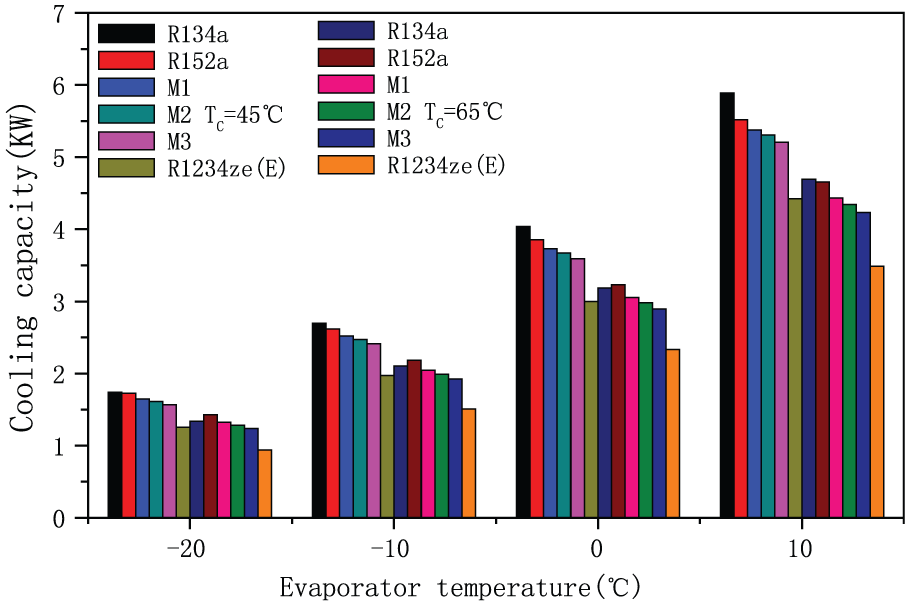
Variation of cooling capacity with evaporator temperature.
Variation of COP
The COP of six refrigerants versus evaporator is shown in Figure 9. It was obtained that the average COP of R152a, M1, M2, and M3 was higher than that of R134a by about 4%, 2.5%, 2%, and 1.5%, respectively, at condenser temperature 45°C, and higher than that of R134a about 9%, 6%, 5%, and 4%, respectively, at condenser temperature 65°C. This is mainly because of relatively lower compressor power consumption. While COP of R1234ze(E) was nearly equal to that of R134a, it was observed that COP of R1234ze(E)/R152a mixtures were higher than that of R134a because the R1234ze(E) with lowest COP in the mixtures was almost the same with that of R134a. COP difference between R152a and R134a, M1 and R134a, M2 and R134a along with M3 and R134a increase with the condenser temperature increase; hence, better COP can be expected at higher condenser temperature with R152a, M1, M2, and M3. COP displays a positive correlation with the evaporator temperature as well as a negative correlation with the condenser temperature.

Variation of coefficient of performance versus evaporator temperature.
Variation of compressor discharge temperature
The compressor discharge temperature of six refrigerants versus evaporator is shown in Figure 10. It was obtained that compressor discharge temperature of R152a, M1, M2, and M3 was higher than that of R134a by 8°C–18°C, 3.5°C–7.5°C, 2°C–4.5°C, and 0.5°C–1.5°C, at condenser temperature 45°C, respectively, and higher than that of R134a by 12°C–22°C, 5°C–9°C, 3°C–5°C, and 0.8°C–1.8°C, respectively, at condenser temperatures 65°C; however, compressor discharge temperature of R1234ze(E) was lower than that of R134a by about 5.5°C–11°C and 8°C–13.5°C, respectively, at condenser temperatures 45°C and 65°C. The compressor discharge temperature of R152a, M1, M2 and M3 were higher than that of R134a for a range of condenser and evaporator temperatures because of their higher specific heat ratio. Higher compressor discharge temperature affects motor coil and the properties of lubricants, which have influence on the life of compressor. It is confirmed that compressor will be significantly influenced using R152a as a drop-in replacement of R134a. This is because compressor discharge temperature of R152a is far higher than that of R134a. However, the compressor discharge temperature of M1, M2, and M3 was significantly reduced compared to R152a because they mixed low volatile component R1234ze(E). For R1234ze(E)/R152a mixtures, M2 and M3 are the better substitute for R134a because of relatively close compressor discharge temperature.

Variation of compressor discharge temperature versus evaporator temperature.
Analysis of best substitute for R134a
R152a performs better COP as well as nearly equal volumetric cooling capacity and cooling capacity compared to R134a, which make it the best replacement of R134a; however, R152a with the flammability limits listed as 5.1%–17.1% 22 running high compressor discharge temperature causes high insecurity in vapor compression system. Hence, R152a is not recommended as a drop-in replacement of R134a. R1234ze(E) performs similar COP with R134a; however, cooling capacity are far lower than that of R134a, which will cause the question of insufficient refrigeration capacity. Hence, R1234ze(E) cannot be a substitute for R134a. R1234ze(E)/R152a mixtures can make their respective advantages complementary to each other. For security analysis, R1234ze(E) is classified as low-flammable refrigerant (A2L); 23 however, R1234ze(E) becomes non-flammable if the air humidity is equal to or less than 10% corrected for 296.15 K. 24 Although R1234ze(E) has low flammability, it can be used to reduce the flammability potential of other fluids. 25 R1234ze(E) is constantly used to add to flammable refrigerants such as HFCs, epoxy ethane, and HCs (including propane, ethane, and octane) to reduce the flammability of mixtures. Hence, less flammability can be expected for R1234ze(E)/R152a mixtures compared to R152a, which can increase security in vapor compression system. For R1234ze(E)/R152a mixtures, M2 is selected as the best replacement of R134a due to similar volumetric cooling capacity, cooling capacity, compressor discharge temperature, and better COP compared to R134a. M1 performs better cooling capacity and COP compared to M2, while M1 runs with relatively higher compressor discharge temperature and contains more flammable content R152a. M3 runs lower compressor discharge temperature and contains lower flammable content R152a compared to M2; however, volumetric cooling capacity of M3 is lower than that of R134a by about 10%. Hence, it is necessary to modify the size of compressor when taking as a drop-in replacement of R134a.
Lubricant of R152a/R1234ze(E) mixtures
R152a generally has a higher solubility in a range of synthetic lubricants and shows less tendency to phase separate; however, R152a cannot be miscible with mineral oil. 26 R1234ze(E) can be nearly miscible with common lubricant. 25 Hence, R152a/R1234ze(E) mixtures can be miscible with synthetic lubricants. It is not necessary to change the oil when R152a/R1234ze(E) mixtures take drop-in replacement of R134a if the original system compressor use synthetic lubricants.
Experimental comparison based on literature
BO Bolaji 7 presenting an experimental study of R152a to replace R134a in domestic refrigerator showed that the performance of R134a closely follows that of R152a. A Mota-Babiloni et al. 27 performing an experimental using R1234ze(E) as drop-in replacements for R134a showed that the cooling capacity and COP of R1234ze(E) are 30% and 6% lower than that of R134a. A Mota-Babiloni et al. 19 presenting an experimental analysis of R450a (mixture of 52% R1234ze(E) and 48% R134a) as R134a drop-in replacement showed the results that the average cooling capacity and COP of R450a compared with R134a are 6% lower and 1% higher, respectively. In this article, the cooling capacity of M2 is lower than that of R134a by about 7%. COP of M2 is higher than that of R134a by about 3%. The performance of R450a similar to that of M2 can be attributed to the similar performance of R134a and R152a. The theoretical performance of M2 in comparison with the experimental performance of R450a can make this article persuasive.
Conclusion
In this article, the thermodynamic analysis for R1234ze(E), R152a, and R1234ze(E)/R152a mixtures as drop-in replacements of R134a in vapor compression system was performed and the conclusions were as follows:
R152a had better COP as well as nearly equal volumetric cooling capacity and cooling capacity compared to R134a which was restricted by high compressor discharge temperature and flammability.
R1234ze(E) had similar COP with R134a; however, cooling capacity was far lower than that of R134a.
As for R1234ze(E)/R152a mixtures, M2 was selected as the best drop-in replacement of R134a. M2 had a low GWP value 72, which is environmentally friendly using in vapor compression system. Volumetric cooling capacity of M2 was similar to that of R134a. Hence, M2 can be used as a drop-in replacement of R134a without modification of compressor. The COP of M2 was found to be higher than that of R134a by 2% and 5% at condenser temperatures 45°C and 65°C, respectively. Cooling capacity of M2 was found to be lower than that of R134a by about 7%. Compressor power consumption of M2 was found to be lower than that of R134a by about 10%. Compressor discharge temperature of M2 was slightly higher than that of R134a, which may slightly affect the compressor life. The flammability of M2 was reduced due to the presence of R1234ze(E) in the mixture. M2 can be used as a drop-in replacement of R134a without modifications if original system compressor uses synthetic lubricant.
Footnotes
Appendix 1
Academic Editor: Lin-Shu Wang
Declaration of conflicting interests
The author(s) declared no potential conflicts of interest with respect to the research, authorship, and/or publication of this article.
Funding
The author(s) disclosed receipt of the following financial support for the research, authorship, and/or publication of this article: This study was supported by National Natural Science Foundation of China (51176124).