




Abstract
Aiming at the characteristic that the vibration signals of hydraulic pump usually have strong nonlinearity and low signal-to-noise ratio, this article presents a novel hydraulic pump degradation feature extraction method based on improved local characteristic-scale decomposition and multi-fractal spectrum. First of all, the original vibration signal is decomposed into the independent intrinsic scale components by local characteristic-scale decomposition, and the main intrinsic scale components which contain the sensitive degradation information are selected by mutual information. And then, the multi-fractal parameters of the main intrinsic scale components are calculated. The presenting capability of four fractal spectrum parameters on hydraulic pump degradation state is analyzed, and as a result, the multi-fractal spectrum width
Keywords
Introduction
Performance degradation recognition is the basis of hydraulic pump fault prediction. 1 Performance degradation recognition contains two important aspects. 2 One aspect is to extract the appropriate features from the raw vibration signals which can reflect comprehensive performance degradation. The other aspect is to build an effective intelligent model that can be used to recognize the degradation states. Proper feature extraction method is the key step of the performance degradation recognition and it affects the precision of final recognition. Many investigations have been successfully applied in the performance degradation recognition of hydraulic pump.3,4
In this article, we present an innovative feature extraction method for hydraulic pump based on local characteristic-scale decomposition (LCD) and multi-fractal spectrum. 5 As a new adaptive processing method for nonlinear signals stationary, LCD can decompose complex nonlinear signals into several independent intrinsic scale components (ISCs). 6 Compared with the traditional method empirical mode decomposition (EMD), LCD has advantages in iterations and end effect restraining. Because the signal is fitted by the cubic spline curve only one time in the process of decomposition, the iteration number of LCD is often less than EMD. LCD is able to adaptively divide the original signals and inhibit the problems of endpoint and mode mixing. Therefore, LCD is used to preprocess the vibration signals of hydraulic pump in this article.
Recently, fractal theory has become a popular method in nonlinear science, and it has been widely applied in various fields, 7 such as image processing, 8 turbulent flows, 9 bioengineering, 10 and geophysics. 11 In the above research, the single fractal method is used to describe the fractal characteristics of the vibration signals, which reflects the inherent complexity of the nonlinear vibration signal on the overall. However, because of the characteristic that the vibration signals of hydraulic pump usually have strong nonlinearity and low signal-to-noise ratio, it is difficult to reflect the inherent nonlinear dynamic characteristics of the vibration signals using the single fractal method. Multi-fractal is developed from the single fractal. It uses a spectral function to describe the different fractal characteristics. There are already many references12–16 which introduce multi-fractal theory to image processing, target detection, and many other fields. Yu 12 used multi-fractal spectrum to characterize the distribution of singularity intensity. Chen and colleagues13,14 analyzed the multi-fractal and multi-fractal correlation of random binomial measures, and the phase transformation of scale area in multi-fractal correlation was also studied. Li and Xu 15 and Serra 16 proposed a vibration signal processing method based on multi-fractal detrended fluctuation analysis (MF-DFA) to investigate the multi-fractal behaviors of the nonlinear vibration signal.
Here, we introduce a new method for the hydraulic pump performance degradation recognition based on LCD and multi-fractal spectrum. First of all, the vibration signals of hydraulic pump are decomposed into a set of ISCs by LCD, and the ISCs which contain the main degradation feature information are selected using the mutual information. Second, four multi-fractal spectrum parameters are analyzed, and as a result, the multi-fractal spectrum width is finally selected as the degradation feature parameter. Finally, the binary tree support vector machine (BT-SVM) is used to identify the degradation status. The results show that the proposed method can recognize the degradation status of hydraulic pump effectively.
The remainder of this article is organized as follows. In section “Decomposition of the vibration signals by LCD,” the LCD theory is briefly introduced. Next, the mutual information theory is used to improve the method of LCD. In section “Multi-fractal spectrum,” we present the multi-fractal spectrum theory and analyze the four parameters of the multi-fractal spectrum in detail. In section “The strategy of performance degradation assessment,” the performance degradation recognition method based on BT-SVM is proposed. In section “Experimental validation,” the hydraulic pump fault test is first introduced, and then, the vibration signals acquired from the experiment that are used to evaluate the feature extraction methods are discussed. Finally, our conclusions are presented in section “Conclusion.”
Decomposition of the vibration signals by LCD
LCD algorithm
Due to the influence of the compressibility of fluid and the intrinsic substantially mechanical vibration, the vibration signals of hydraulic pump have the characteristics of strongly nonlinear and non-Gaussian, and the degradation information is contained in different scales. So the vibration signals are necessary to be decomposed into multi-scale before feature extraction. Due to LCD is used to process the unsteady signals effectiveness, it is widely used in nonlinear signal processing currently. 17 Essentially, LCD is a novel stationary and linearization process for the original signals. Under different instantaneous frequency fluctuations, the original signals are decomposed into limited and independent ISCs which represent the characteristic constituents in different scales.
Assume that X(k), k = 1,2, …N is the N-dimensional original signal, and it is a finite time series with compact support. The original signal X(k) can be decomposed by LCD as the following steps: 17
Define the baseline extraction operator

where
As the value of baseline extraction operator
Separating m1(t) from the residual h1(t)

If h1(t) satisfies the condition of ISCs, output ISC1 = h1(t) as the first ISC. Else, set x(t) = h1(t) as the original data and repeat the process from step 1.
Separating the first ISC from the original signal x(t)

The residual signal r1(t) is treated as new data and repeat the process from steps 1 to 3 to obtain other ISCs until the residual signal rn(t) is monotonous or a constant function. The signal x(t) is decomposed into ISC1, ISC2, … ISC n and a trending component rn(t) as follows

Following the steps above, arbitrary time series is decomposed into several ISCs and a trending component. Degradation feature information hidden in nonlinear and non-stationary signals of hydraulic pump is specifically detailed in various ISCs. Owing to the defects of decomposition rules, the false ISCs are produced in the process of LCD. In order to eliminate the influence of the false ISCs, the mutual information is applied to select the main ISCs.
Selection of ISCs
Being a novel method for measuring the correlation degree between two time series, the mutual information is an interdisciplinary subject. 18 The mutual information is used to measure the uncertainty of random variables, the more complexity the system, the greater the entropy value is. For the two correlated random variables x, y, the function expression of mutual information is defined as follows

where
The kernel of the mutual information is to detect the correlation of the ISCs with the original signals which judges authenticity of ISCs. Based on the definition of the mutual information, the mutual information value between false ISCs and original signal is far less than the value between real ISCs and original signal. The ISCs with their mutual information values greater than the average

where
Multi-fractal spectrum
In fractal geometry, the multi-fractal spectrum includes the calculation of a statistical distribution of the probability of a fractal dimension to describe the internal fractal structure of the data. In applications, we use the numerical calculation method to calculate the multi-fractal spectrum parameters. The specific procedures of this method are as follows: 19
Divide the vibration signal into equal long small pieces by the sliding window length

Select the order q values by computing the distribution function of the q

where
The distribution function is subordinated to the scale relation as follows

The promotion of the order model can be calculated by equation (10)

The singular exponent

According to equation (11), we can obtain the four important multi-fractal spectrum parameters
The strategy of performance degradation assessment
The method of BT-SVM
Support vector machine (SVM) has been used in many areas for solving both binary classification and pattern recognition problems. BT-SVM has the characteristics of short calculating time and high classification accuracy. For k-class samples, we just set up k−1 classifiers. The structure of BT-SVM is shown in Figure 1.

The BT-SVM.
The key to construct the SVM model is to choose suitable kernel function. The Gaussian radial basis function is presented as the kernel function in this article, which can evaluate the distance between the feature vectors accurately. The classification performance is determined by the kernel parameter
The strategy of performance degradation assessment
The calculation process of performance degradation assessment (PDA) is shown in Figure 2. First, the training data are decomposed into ISCs using LCD method, and the false ISCs are filtered based on the mutual information. Second, the multi-fractal spectrum parameters as the degradation feature are computed. Finally, the BT-SVM model is trained by the degradation feature and its effectiveness is validated by the test samples.
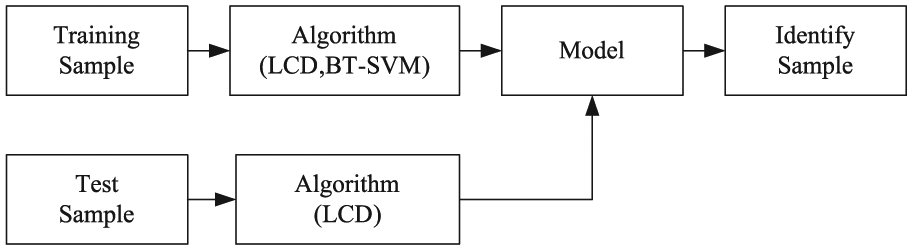
The degradation state identification strategy of hydraulic pump.
Experimental validation
Experimental rig
In order to validate the effectiveness and feasibility of the theory that we proposed in this article, the method based on LCD and multi-fractal spectrum is applied in the performance degradation recognition of hydraulic pump. The hydraulic pump tested is SY-10MCY14-1EL, which has seven pistons. The driving dynamo is Y132M-4, which has the settled speed of 1480 r/min and the period of 0.041 s. Installation of the vibration sensors is shown in Figure 3. The sampling frequency is 12,000 Hz. The vibration signals are saved in the computer by the DH-5920 dynamic signal testing and analyzing system. In this article, five different degrees of loose slipper fault of hydraulic pump is used to simulate the performance degradation process of hydraulic pump. The five performance degradation states (normal condition, slight fault, mild fault, moderate fault, and severe fault) are described by the different distances of the loose slippers 0.15, 0.24, 0.38, and 0.57 mm, which are shown in Figure 4.
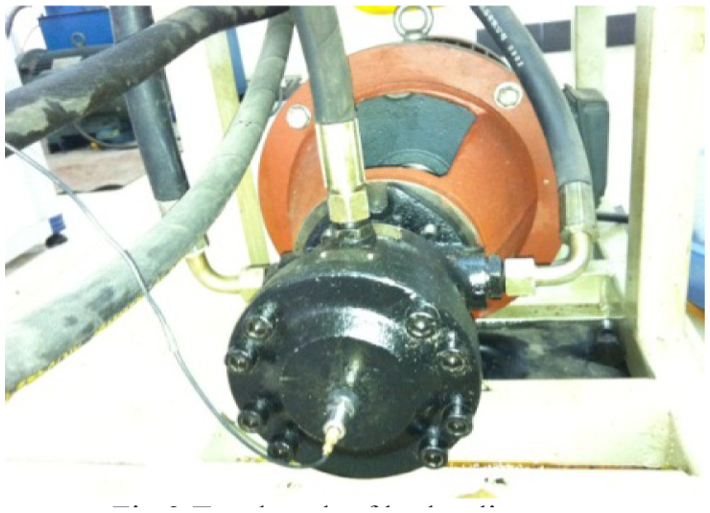
Test bench of hydraulic pump.

Experimental pistons.
With the consideration of data provided by the manufacturers, the loose slipper is one of the typical faults of hydraulic pump. Five degradation states vibration signals including normal condition, slight fault, mild fault, moderate fault, and severe fault are shown in Figure 5. When the fault occurs, its feature information is relatively weak, and the vibration signals contain much disturbance information. As a result, the vibration signals of hydraulic pump with different degradation conditions have obvious differences in time domain structure. When the hydraulic pump is in normal working condition, the distribution of vibration signal is random, and the uncertainty is the highest. With the deepening of the degree of degradation, the periodicity of the signal is obviously enhanced, and the vibration amplitude is gradually increasing.

Curve in time domain for hydraulic pump in different status: (a) normal condition, (b) slight fault, (c) mild fault, (d) moderate fault, and (e) severe fault.
Results and analysis
According to equations (1)–(4), the vibration signal is decomposed by LCD. A total of 15 ISCs and one residual function are obtained. Figure 6 shows the first 10 ISCs. In Figure 6, we can clearly see that the different scales of the hydraulic pump degradation characteristics are shown in the ISCs. From the ISC1 to ISC5, we can see clearly that the periodic impulse characteristics are gradually reduced with the original signal decomposition. Moreover, there is no obvious mode mixing phenomenon in the ISCs. This phenomenon further reveals the good performance of LCD decomposition.

ISCs by LCD of the vibration signals.
Based on equation (5), the average values of the mutual information values of the ISCs are shown in Table 1. It shows that the correlation coefficients between the first five-order ISCs and the original signal are much larger than the other high-order ISCs. According to the presented selection rule, ISC1–ISC5 are selected as the main ISCs.
Mutual correlation coefficients between the ISCs and the signals.
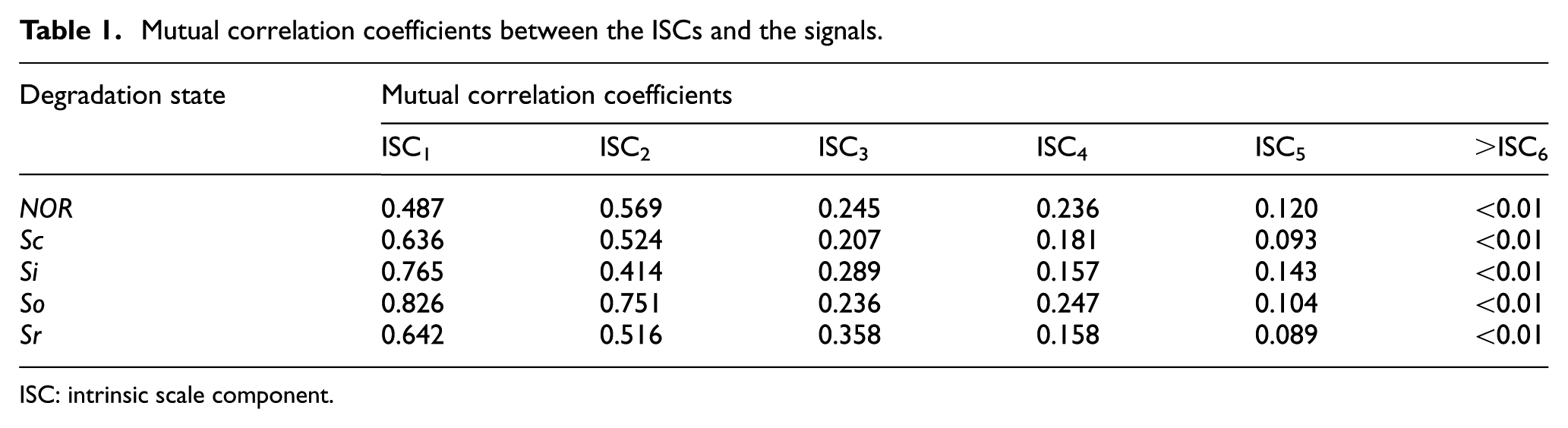
ISC: intrinsic scale component.
Analysis of multi-fractal spectrum parameters
The multi-fractal spectrum parameters of the five kinds of vibration signals are calculated, respectively, which are listed in Table 2. The value of
The multi-fractal spectrum parameters of different degradation states.

In order to analyze the sensitivity of different fractal spectrum parameters to the degradation state of hydraulic pump, the distribution of the different fractal spectrum parameters in different degradation states are, respectively, shown in Figures 7–10. With Figures 7–10, for the five different degradation states, it is clear that

The distribution of the vibration signal
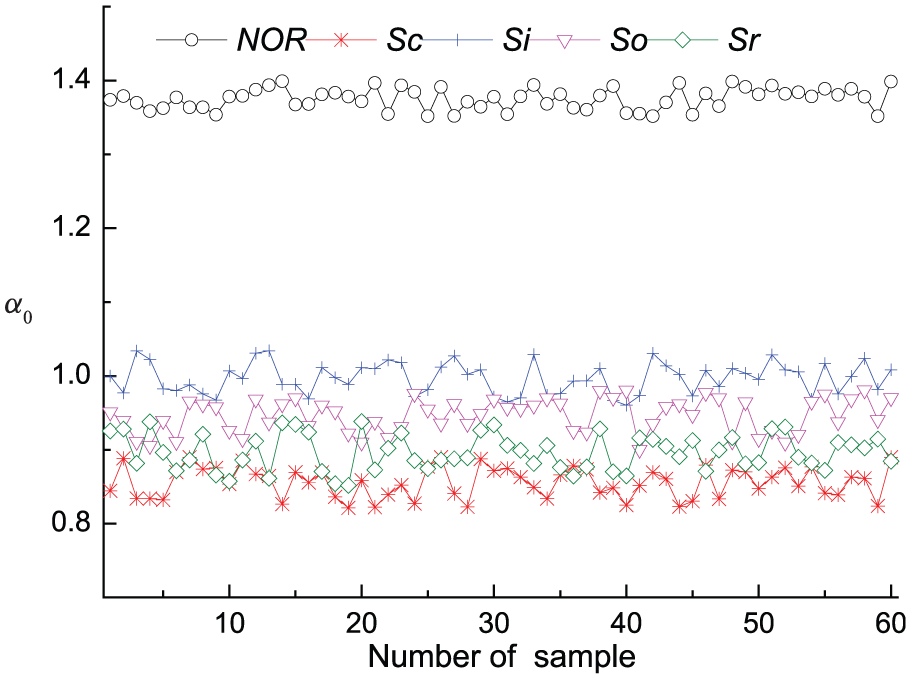
The distribution of the vibration signal
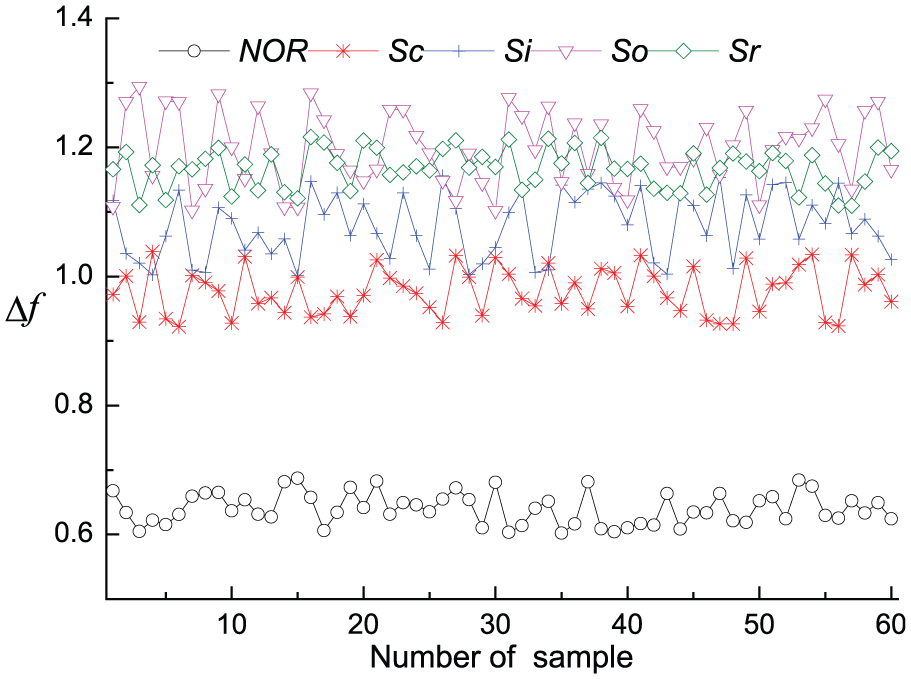
The distribution of the vibration signal
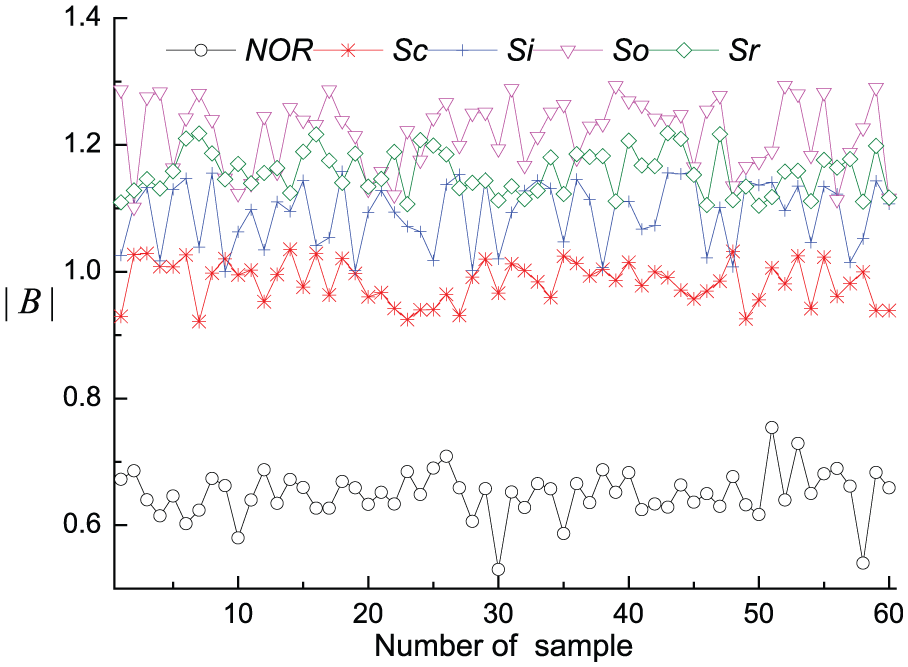
The distribution of the vibration signal
Performance degradation recognition
In order to verify the effectiveness of the proposed method, 1500 group samples of vibration signals are tested in the experiment. Data for each degradation state have 300 samples, which are randomly selected to construct a training set with 100 samples and a testing set with 200 samples. Each sample contains 2048 data points. For the 1500 samples, the multi-fractal spectrum parameter
The recognition results.

Conclusion
Aiming at the characteristic that the vibration signals of hydraulic pump usually have strong nonlinearity and low signal-to-noise ratio, a novel degradation feature extraction method based on LCD and multi-fractal theory was proposed in this article. The experimental results indicated that the proposed method is effective in identifying hydraulic pump performance degradation state. And the detailed conclusions are drawn as follows:
The LCD modified by mutual information is applied in the decomposition of vibration signals. Noises and disturbances are effectively reduced, and the main ISCs are obtained.
The multi-fractal parameters of the main ISCs are calculated. The presenting capability of four fractal spectrum parameters on hydraulic pump degradation state is analyzed, and as a result, the multi-fractal spectrum width
Experimental results of hydraulic pump show that the features extracted by the proposed method are effective to reveal degradation information and it is meaningful for hydraulic pump performance degradation recognition.
Footnotes
Acknowledgements
We appreciate the Guiyang hydraulic pump manufacturers for their support to our experiment. At the same time, we are grateful to the Mechanical Engineering College, China, for providing the experimental situation. At the end, we would like to express sincere appreciation to the anonymous reviewers.
Academic Editor: Davood Younesian
Declaration of conflicting interests
The author(s) declared no potential conflicts of interest with respect to the research, authorship, and/or publication of this article.
Funding
The author(s) disclosed receipt of the following financial support for the research, authorship, and/or publication of this article: This project is supported by the National Natural Science Foundation of China (grant no. 51275524).