




Abstract
The coupled system of smooth and discontinuous absorber and beam bridge under moving loads is constructed in order to detect the effectiveness of smooth and discontinuous absorber. It is worth pointing out that the coupled system contains an irrational restoring force which is a barrier for conventional nonlinear techniques. Hence, the harmonic balance method and Fourier expansion are used to obtain the approximate solutions of the system. The first and the second kind of generalized complete elliptic integrals are introduced. Furthermore, using power flow approach, the performance of smooth and discontinuous absorber in vibration reduction is estimated through the input energy, the dissipated energy, and the damping efficiency. It is interesting that only depending on the value of the smoothness parameter, the efficiency parameter of vibration reduction is optimized. Therefore, smooth and discontinuous absorber can adapt itself to effectively reducing the amplitude of the vibration of the beam bridge, which provides an insight to the understanding of the applications of smooth and discontinuous oscillator in engineering and power flow characteristics in nonlinear system.
Keywords
Introduction
The vibration absorbers play an important role in vibration control in mechanical systems1–3 and comprise a spring–damper attachment mounted on the main structure. When the main structure is forced to vibrate, the device can absorb energy to reduce its vibration amplitude. Based on the characteristics of the vibration absorber, it may be classified into two kinds: linear absorber and nonlinear one. As is well known, the effectiveness of the linear absorber is limited to the narrow frequency range. The linear absorber cannot meet the actual requirement with the development of engineering. Hence, the development of the nonlinear absorber is promoted. Riganti and Zavattaro 4 considered the problem of a qualitative distinction between chaotic and hyperchaotic responses in a nonlinear vibration absorber with 2 degrees of freedom. A theoretical study was presented to design nonlinear vibration absorbers and improve their stability and effective frequency bandwidths in Frank Pai and Schulz. 5 Starosvetsky and Gendelman 6 demonstrated that a nonlinear energy absorber can successfully absorb energy from both excited modes of the linear subsystem. The performance of nonlinear dampers was detected and two conservation laws were obtained in Samani and Pellicano. 7 The problem of mitigating the vibration by nonlinear dynamical absorbers was addressed. 8 They found that it was effective in a wide range of forcing amplitudes. Furthermore, the behavior of a new type of nonlinear dynamic vibration absorber was studied in Febbo and Machado. 9 Recently, the effectiveness of the nonlinear absorber for eliminating bifurcations and suppressing the amplitude of primary resonance response was showed in Ji. 10 These results mentioned above demonstrate that the nonlinear absorbers have overcome some drawbacks of the linear absorber. But the use of nonlinear dynamic vibration absorbers (DVAs) for replacing the classical linear devices was not generally convenient in Samani and Pellicano. 11 Of course, the results were related to the specific problem of moving loads and had no evidence to claim that such results could be generalized to other mechanical systems.
The investigations on vibration and control of beam bridges using the vibration absorbers have been of great significance in engineering. There are a few works on the study of vibrations of beams subjected to either stationary or moving loads.12–19 The structural analysis of a Timoshenko beam system with tuned mass dampers (TMDs) under moving-load excitation was presented in Chen and Chen, 15 and the effectiveness of a TMD for vibrational control was emphasized. An optimal TMD system was utilized to suppress the undesirable beam vibration in Younesian et al., 16 and the dynamic performance of the bridge before and after the installation of the TMD system was compared to show the effectiveness of the designed TMD system. The optimal design of a linear vibration absorber was considered for vibration reduction in simply supported beams subjected to constant moving loads in Issa Jimmy. 17 The dynamic performance of a combined bridge–vehicle system with an TMD system was analyzed in Moghaddas et al. 18 An optimal design of TMD system was proposed to suppress the effect of non-symmetrical and side-way motion of vehicles traveling on bridges. 19 Furthermore, in practice, it is worth pointing out that frequency often shifts from one mode to another in the beam bridge subjected to moving loads. All kinds of moving loads can lead to the different external excitation frequency. It involves a versatile dynamic damper which can lead itself to linear dynamic dampers or nonlinear ones to meet the demands of vibration reduction. Although the use of nonlinear absorbers overcame the drawback of narrow frequency range, the natural frequencies are fixed, which cannot adapt itself to meeting the demands of vibration reduction in order to increase load capacity and extend the service life of beam bridge. Hence, the results encourage the research on a versatile dynamic damper which leads itself to linear dynamic damper or nonlinear one in order to meet vibration control demands.
Smooth and discontinuous (SD) oscillator was put forward by Cao et al.20,21 The research results showed that the restoring force was irrational nonlinear form in the system. It was found that SD oscillator admitted codimension-two bifurcation at the trivial equilibrium in certain cases and the bifurcation diagram was drawn. 22 Tian et al. 23 investigated Hopf bifurcations of SD oscillator by introducing a series of new kinds of elliptic integrals of the first and second one. Cao and Xiong studied the complex resonant behaviors by constructing a series of generating functions and canonical transformations to obtain the normal form of the system, which offered a better understanding of the transition of resonance mechanism and further revealed the transfer mechanism of vibration energy in a nonlinear dynamical system. 24 Hence, SD oscillator has rich and complex dynamic behaviors, and the nature frequency can change with the smooth parameter, which indicates that it is valuable to construct SD absorber to assess its efficiency of vibration absorption.
The motivation of this article is originated from the interests in constructing SD absorber based on SD oscillator and detecting the efficiency of vibration reduction for the application of SD absorber. Hence, we propose the coupled system of SD absorber and beam bridge in this article. In order to detect the effectiveness of SD absorber, the coupled system of SD absorber and the beam bridge under moving loads is detected. It is noting that by introducing a series of new kinds of elliptic integrals of the first and second kind and using the harmonic balance method, we can obtain the algebraic equation whose solutions are topologically equivalent to the ones of the coupled system.
This article is organized as follows. In the next section, the coupled system of SD absorber and the beam bridge subjected to moving loads are constructed, in which the axial force is considered. Furthermore, an infinite series of moving loads with constant velocity repeat at the given time intervals. In section “Solution procedure and dynamical analysis,” the algebraic equations are obtained by introducing a series of new kinds of elliptic integrals of the first and second kind and using the harmonic balance method, whose solutions are topologically equivalent to the ones of the original coupled system. In section “Efficiency of SD absorber,” the associated vibratory power flows are calculated from the inner product of the force and the corresponding velocity response. The portion of the input energy dissipated by the viscous damper and the kinetic energy of SD absorber is computed, which shows the effect of SD absorber. In the last section, the efficiency parameter of vibration reduction is defined. The influence of different parameters on the efficiency parameter is investigated and of particular concern is the smoothness parameter contributed to the characteristics of the efficiency parameter.
Mathematical model for the bridge–SD absorber coupling system
SD oscillator is an example of a conservative nonlinear oscillatory system whose natural frequency can be changed depending on the value of the smoothness parameter.20–24 In a complicated real system, frequency often shifts from one mode to another. It involves a versatile dynamic damper which can lead itself to linear dynamic dampers or nonlinear one to meet reduction demands. Hence, based on SD oscillator, SD absorber is constructed as shown in Figure 1. SD absorber consists of the mass

SD absorber.
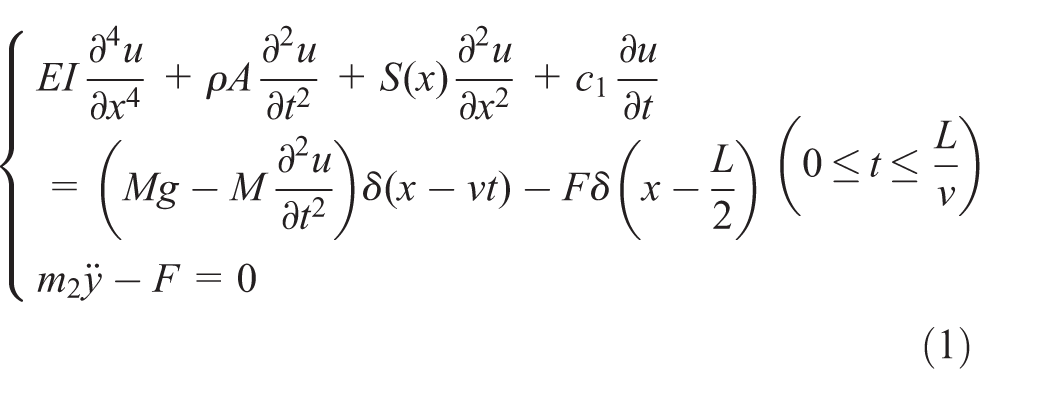
In order to detect the effectiveness of SD absorber, we assume that the beam bridge is subjected to an infinite series of moving loads with a constant speed v. The system model of the coupled bridge–SD absorber is shown in Figure 2. If the beam bridge is perturbed by a viscous damping
where
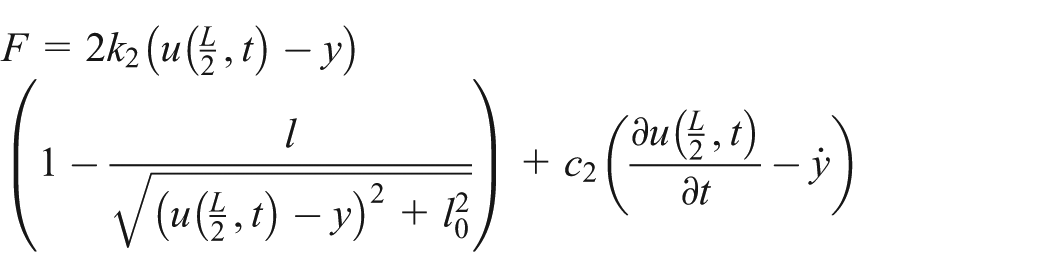
and EI,

Bridge–SD absorber model.
Although more effective vibration reduction in beam bridge will be given using a heavy SD absorber, the static deflection of beam bridge increases as well. Hence, the mass of the absorber cannot be too large. Here, the mass of SD absorber is less than 1% of the total mass of the beam bridge.
We will focus our attention on efficiency of vibration reduction for SD absorber. The first mode of the beam is the dominant mode in our application and a single mode model will be adopted. Hence, u can be written in the following form

where
Substituting equation (2) into equation (1) and integrating the first equation of equation (1) over

Traditionally, dynamic effects on the beam bridge under the action of a single moving load are taken into account. Here, a beam bridge is subjected to an infinite series of moving loads with constant velocity which repeat at time

Let

Equation (4) yields
Clearly, from equation (4), the limit case of SD absorber, that is,
Solution procedure and dynamical analysis
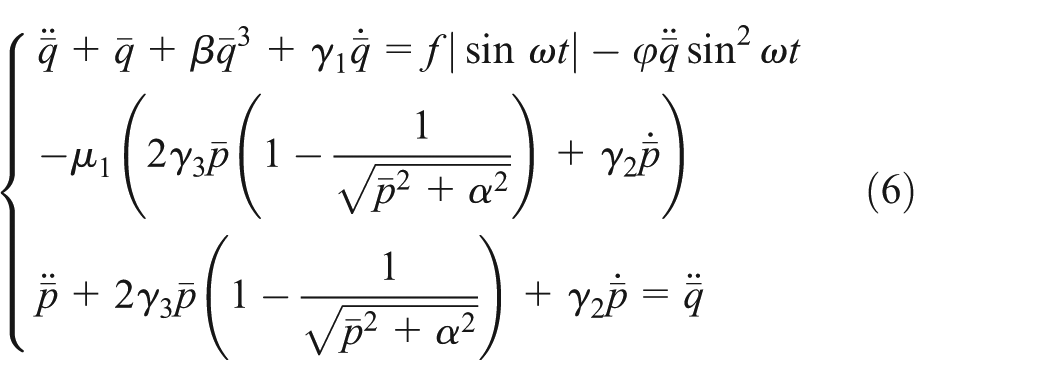
Power flow theory has been one of the major methods for studying vibration.29–33 Vibratory power flow can be introduced to examine the efficiency of SD absorber, which contains the force, the speed, and their phase relationship and can describe power flow transmissions more accurately in dynamical system. It is necessary to study the performance of SD absorber in vibration reduction using power flow approach. Hence, we focus our attention on the solution of equation (6) in this section. By introducing a series of new kinds of elliptic integrals of the first and second kind and using the harmonic balance method, 26 we obtain the algebraic equation whose solutions are topologically equivalent to the ones of the original equation (6).
Obviously, the external excitation

Let

and the nonlinear restoring force

where

Of course, when equations (7) and (9) are used each time, the leading order terms are used.
Clearly


To calculate

and

where
Therefore
In the special case of

we have

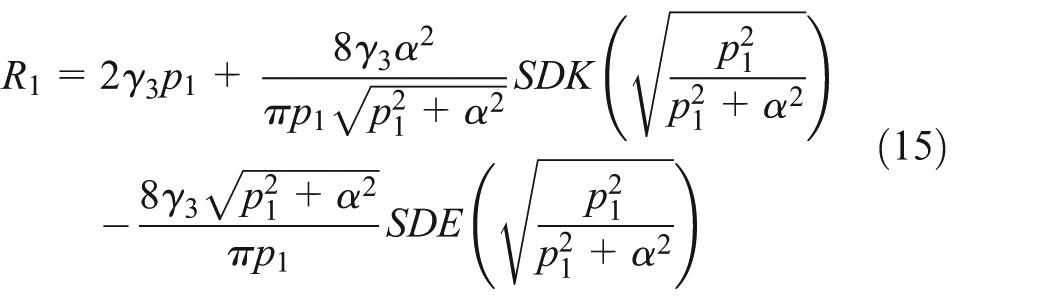
Hence, we have successfully introduced generalized complete elliptic integrals of the first and second kind in investigating the Fourier expansions of the irrational nonlinear restoring force for both smooth, that is,
The general idea of the harmonic balance method is to represent each time history by its frequency content to obtain a series of algebraic equations by balancing the same frequency components. Hence, substituting equations (7)–(9) into equation (6) and comparing the coefficients of the same harmonics (i.e.

which leads to the static response

The numerical method is used to obtain the solutions of equations (6) and (19), that is, the original equation and the algebraic equation, in order to demonstrate the validity of the harmonic balance method. Three different speeds are examined, and other parameters are
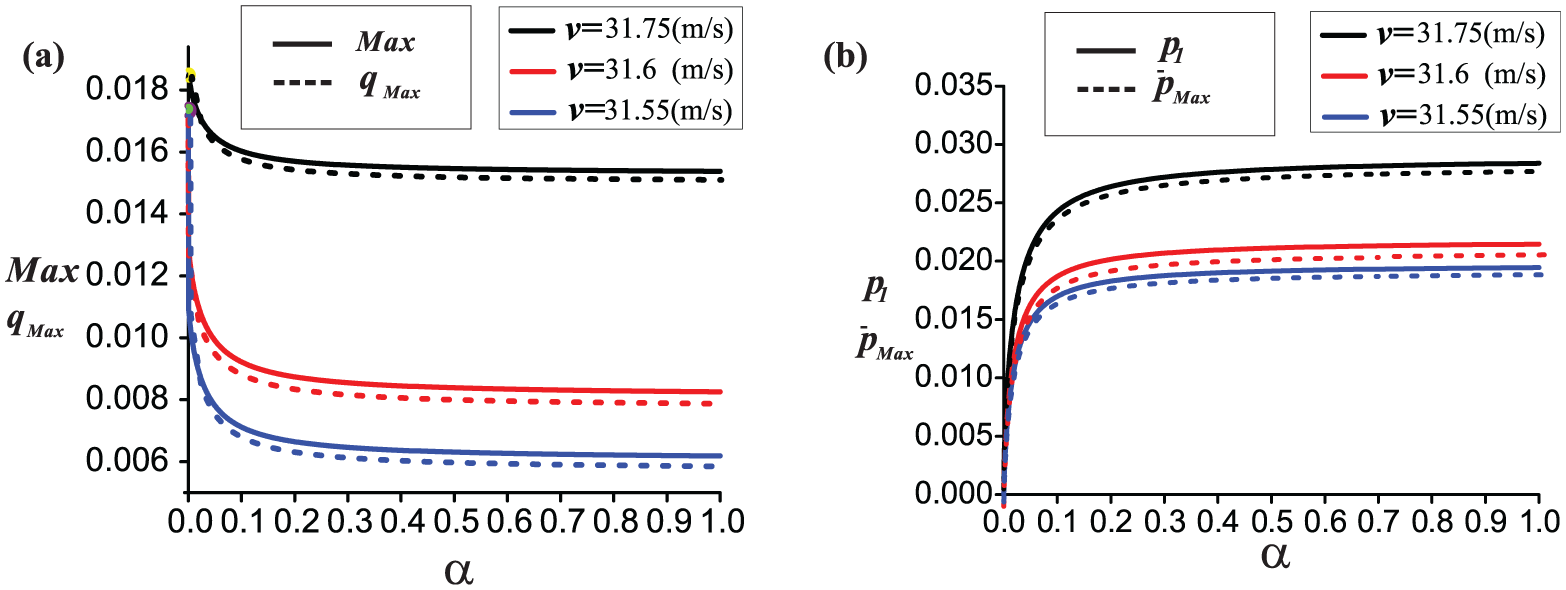
Influence of v on the maximum of the amplitude: (a) Max,
The effect of v on the vibration of the coupled bridge–SD dynamical system and the validity of the harmonic balance method are examined as follows:
The values of Max and
As
Once the nonlinear dynamic displacements can be obtained using the harmonic balance method, the associated vibratory power flow will be calculated from the inner product of the force and the corresponding velocity response in this section. Furthermore, the portion of the input energy dissipated by the viscous damper and the kinetic energy of SD absorber is computed, which shows the effect of SD absorber.
Input power flow
Let

From

Substituting the first equation of the transformation (8) into equation (21), the first derivation of

where
The instantaneous input power flow density

Hence, the time-averaged input power flow

From equation (24),
Absorption power flow
The instantaneous and time-averaged absorption power flow absorbed by SD absorber can be derived. That is, the instantaneous absorption power flow

and

Substituting the second equation of the transformation (8) and (25) into equation (26) yields

where
Especially, when

Obviously,
Efficiency of SD absorber
The aim of the power flow control is to increase absorption power flow and reduce the input power flow as much as possible. We introduced

Hence, when
Effects of the mass of moving load and the smoothness parameter
To examine the effect of the equivalent mass of the moving load M on
The values of
The parameter
As the parameter

Influence of M and
Effects of the mass ratio and the smoothness parameter
The effects of the mass ratio

Influence of
Performance of the frequency-variable absorber
Previous research has clearly shown that a better understanding of the parameter
The efficiency parameter of vibration reduction, that is,
Figure 6 illustrates the effect of

Influence of
In order to reveal the effects of
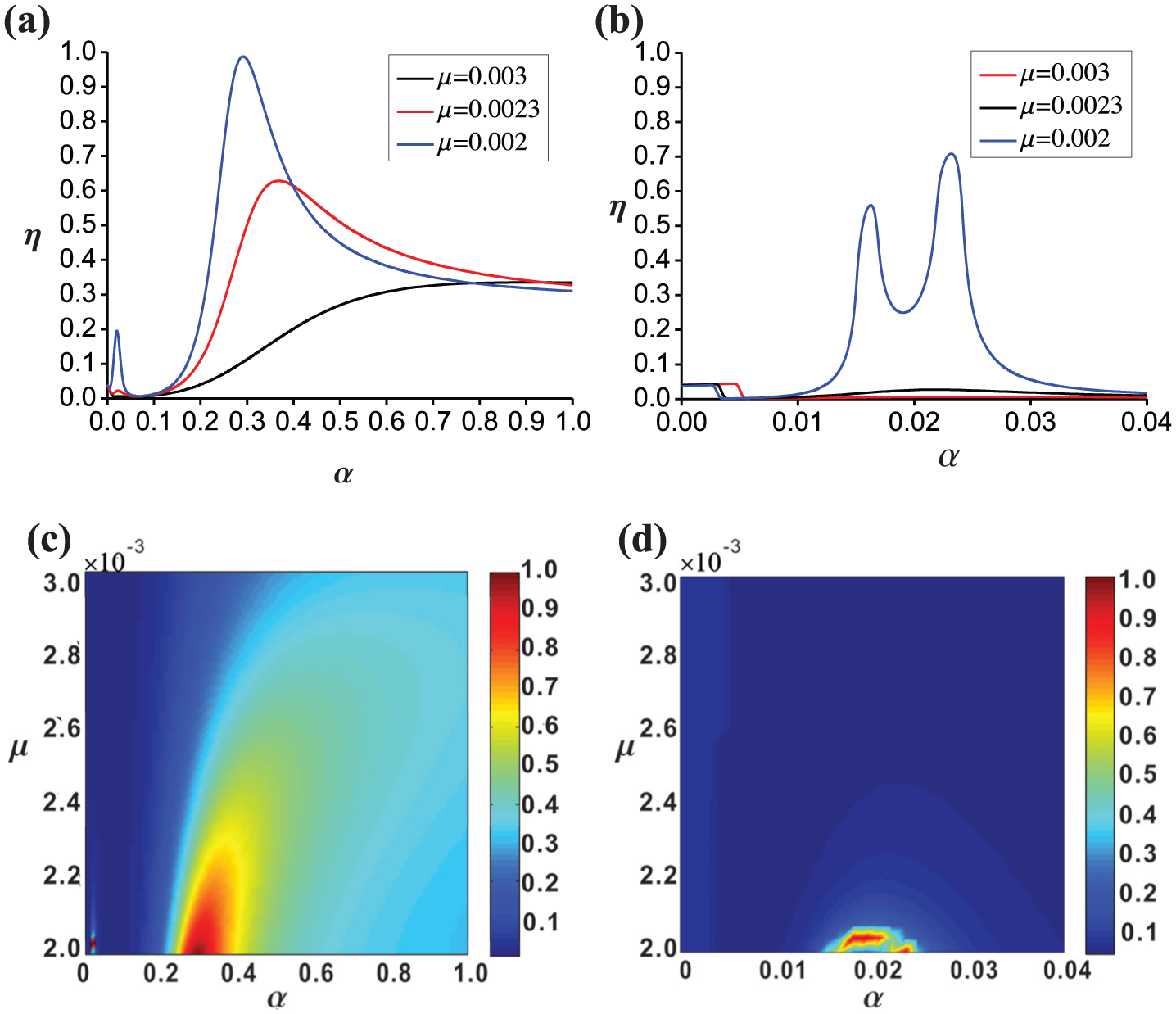
Influence of
Figure 8 shows that the relationship between

Influence of
To sum up, the natural frequency of SD absorber can be changed depending on the value of the smoothness parameter. Hence, SD absorber can be the linear absorber (TMD) or the nonlinear one, which can adapt itself to meeting vibration reduction demands. Rather, from Figures 4, 6, and 8, we know that the results seem random. In fact, these illusions originate from the definition of
Conclusion
SD absorber was proposed to suppress the vibrations of the beam bridge under successive moving loads which repeat at time
It is worth pointing out that frequency often shifts from one mode to another in a complicated real beam bridge, which involves a versatile dynamic damper which can lead itself to linear dynamic dampers or nonlinear one to meet reduction demands. SD absorber is just the linear absorber or the nonlinear absorber and its natural frequency changes depending on the value of the smoothness parameter
Footnotes
Academic Editor: Mario L Ferrari
Declaration of conflicting interests
The author(s) declared no potential conflicts of interest with respect to the research, authorship, and/or publication of this article.
Funding
The author(s) disclosed receipt of the following financial support for the research, authorship, and/or publication of this article: This work was supported by the Natural Science Foundation of China (nos 11372196, 11472180, and 11302136), Natural Science Foundation for Breeding Outstanding Young Researcher in Hebei Province of China (no. A2015210097), Natural Science Youth Foundation in Hebei Province of China (no. A2015421006), the New Century Talent Foundation of Ministry of Education (NCET-13-0913), and the Training Program for Leading Talent in University Innovative Research Team in Hebei Province (no. LJRC006).