




Abstract
Previous studies have shown that constraining parking policy can alleviate air pollution and traffic congestion by reducing vehicle ownership and usage. The feasibility and efficiency of the parking policy are crucial to urban traffic planning and management. With the aim of exploring the elements related to parking demand and improving the policy efficiency, this study analyzed several factors relevant to vehicle ownership and usage which may affect the feasibility of policy. In all, 40,000 samples obtained from Beijing residents’ trip interview survey were used. A combined method with empirical study and network dynamic analysis is used to give a clear relationship between parking supply and private usage. The results, after conducting a quantitative analysis, show that vehicle ownership is related to family income, family size, geographic location, and parking fee, while trip purpose and parking fee in destination influence the frequency of car usage. It is noteworthy that the proportion of free parking in working trips is up to 96%, and single driving occupies a proportion as high as 90%. The research suggests that planners should be cautious of parking facility supply strategy and pay great attention to parking fees of working trip.
Introduction
With the rapid development of economy and the enhancement of people’s payment ability, more and more Chinese families are willing to own a car and use it. By 2014, China ranked first in the sales of new cars in the world. 1 These vehicles in the cities need to have places to park. However, the construction of parking facilities has lagged behind the motorization and fails to satisfy the increasing demands. Meanwhile, law enforcement is not timely, leading to the status quo that many cars are parked at will, occupying sidewalks, bike lanes, public spaces, and so on. Decision-makers have thus fallen into a dilemma: on one hand, the parking issues will probably deteriorate if the supply of parking spaces does not increase. On the other hand, meeting current parking demand by merely increasing parking facilities will require immense financial and land resources, risk in the benefit in the long run. How to formulate a parking policy to solve the problem has become a key issue. Therefore, it is urgent to formulate a parking policy aiming at effectively resolving the present plight.
It seems that many researchers have reached consensus on the effects of parking policy. First of all, car usage brings about many negative effects, such as air pollution, greenhouse gas emission, energy consumption, and traffic congestion.2–5 Second, car usage can be restricted and adjusted through parking policy, so as to improve the environment and ease congestion.6–11 Donald Shoup 6 researched the parking fare problem for employee and pointed out that the number of solo drivers to work fell by 17% after cashing out. The research of Transit Cooperative Research Program (TCRP)7,8 revealed that parking prices and fees, parking management, as well as supply also impose influence on car usage. Simićević et al. 9 also revealed that parking prices could impose influence on car usage and the time limitation determined the type of parking used (on-street or off-street). Some scholars explored the issue of parking space supply as well. Litman 12 put forward that enormous parking requirements reduce housing affordability and lead to various economic and environmental costs. Donald Shoup raised doubts for the minimum parking requirements policy. He held that minimum parking requirements increase the cost of urban development, degrade urban design, burden enterprise, promote automobile dependency, and encourage city sprawl. 13 Liu et al. 14 confirmed that when parking supply is insufficient, morning commuters would choose their departure times with the consideration of securing parking space. Moreover, some scholars believed that vehicle ownership demand can be partially replaced. Rowe et al. 15 revealed in the research a strong relationship between transit service and parking demand. Olaru et al. 16 pointed out that in many cities park and ride is gaining popularity for its ability to integrate car driving with public transport. Martin et al. 17 drew a conclusion that the average vehicles per household of the sample dropped from 0.47 to 0.24 from the research on car-sharing.
Nonetheless, these studies focus more on the implementation effect of parking policy than on the feasibility of the policy itself. It is likely that the policy that works well in low-density cities in North America or Europe can be less applicable to high-density cities, such as Beijing, which have serious contradiction between supply and demand. Therefore, to examine the impact of parking policy on traffic demand regulation, it is necessary to analyze to what extent people rely on cars; whether car ownership and car usage can be replaced; what factors influence car ownership and car usage; what is the relationship between parking, car ownership, and car usage; and so on.
This study aims to analyze the relationship between parking supply and private car trip. The methodology includes two parts: empirical study and network dynamic–based method. The empirical study will show the relationship between car ownership and private car usage related to parking supply, family income, family size, car ownership, parking fee, and so on. Furthermore, a quantitative analysis is performed using the network dynamic model. The results are hoped to give a better understanding of the relationship between parking supply and car trip. The remaining part of the article is organized as follows. Section “Survey and data” will introduce the survey and data sample in the study. Section “Empirical study” will show the empirical results including the car ownership and car usage. Section “A network dynamic analysis” will give a network dynamic analysis based on the empirical results. The last section will give the conclusions and future work.
Survey and data
The data used in this study were obtained from the residents’ trip survey in Beijing, in which 40,000 families were interviewed from September 2014 to December 2014. The questionnaire involved family attributes, vehicle ownership, travel behavior, and other issues related to parking, including parking lot category, parking fee, and so on. Statistical analysis and correlation analysis were conducted. Beijing city covers an area of 16,000 km2 with a population of 21.52 million people. In the city, altogether there are 5.61 million motor vehicles, among which 4.20 million are private cars. In 16 administrative districts in Beijing, 6 districts are urban centers, including Dongcheng, Xicheng, Chaoyang, Haidian, Fengtai, and Shijingshan districts. Their locations are shown in Figure 1. These six districts, located in the city center, cover an area of 1378 km2 with a population of 12.76 million people.

Administrative divisions of Beijing.
The sampling rate was 2 per 1000 of the total population of the city. The samples are randomly distributed in each survey area. Using the method of random sampling, the data of totally 40,000 households were selected.
The questionnaire covered family attributes, vehicle ownership, travel behaviors, and other factors. Family attributes included family size, family income, geography, the number of vehicles, and so on. If a family-owned vehicles, the information of overnight parking location and parking fee were inquired. Travel behavior included information such as trip purpose, trip mode, and trip destination. If the trip was completed by car, the charging method of parking fee, parking fee, number of passengers in the car, and some other information were asked.
Although face-to-face interview was adopted, the accuracy of information could not be guaranteed. Not all respondents had all the information completed. In the process of data analysis, errors and invalid data were deleted. Only the effective data were analyzed. The sample size was enough to support the analysis even after the removal of invalid data.
Empirical study
Analysis of car ownership
According to the conclusion of Todd Litman’s 12 study, car ownership is related to demographic, geographic, and management factors. Adejumo and Kobelo 18 drew the conclusion that studies researching on vehicle-type ownership show great interest for reasons such as economic, social, and cultural. Brownstone and Fang 19 held the viewpoints that vehicle ownership is under the influence of residential density and the household characteristics might determine what vehicles to choose and how much to drive them. Anowar 20 argued that vehicle ownership decisions are strongly tied with residential location and residential tenure. Based on what have been discussed, we utilize family income, family size, geographic factor, management factor, and others in this study to analyze car ownership.
The number of vehicles owned by families of the same income level in Beijing is less than that in the Litman’s research case (as shown in Figure 2). For example, in the research of Litman, the number of cars owned by families with the income of 40k–50k USD is about two, and in Beijing it is about one. However, it can be seen from the figure that the higher the income, the larger the number of cars owned by families. The figure is consistent. In the research of Litman, 12 the number of cars per household basically shows a relationship of linear increase, while the case of Beijing shows that above the income level of 200,000–250,000 CNY, the growth rate becomes smooth, which may be related to car ownership restricted policy in Beijing.
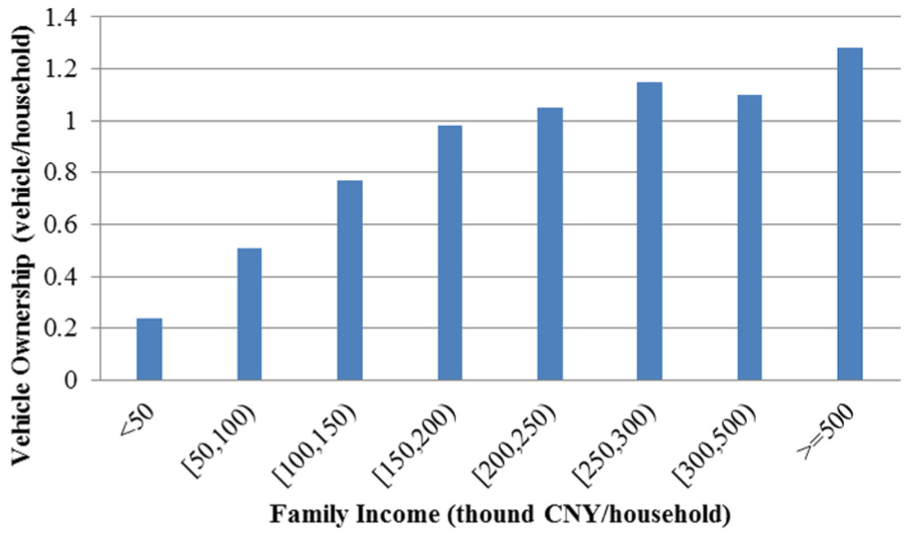
The relationship between car ownership and family income.
Figure 3 shows the change in residents’ income structure obtained from two surveys. Obviously, with the rapid economic development of Beijing and increase in residents’ income, the proportion of high-income families is increasing. The increase in the proportion of groups with income of 50,000–100,000 CNY and 100,000–150,000 CNY will bring about great demand of car purchasing.
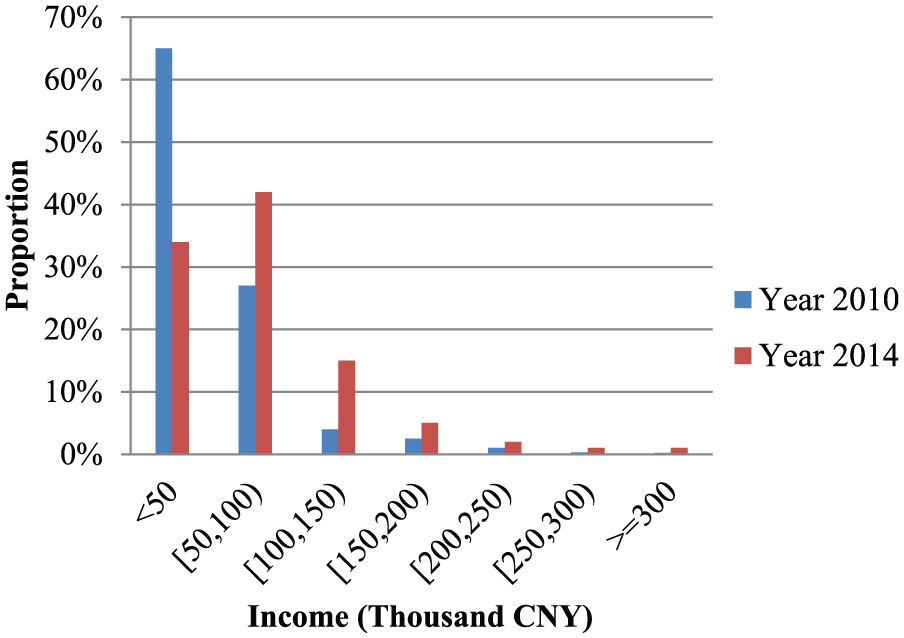
Contrast analysis in family income between 2010 and 2014.
As shown in Figure 4, the larger the number of family population, the larger the number of family car ownership. However, the number of car ownership per capita does not change significantly with the increase in family population. The number of cars owned by families with three members in Beijing is greater than other family groups.

The relationship between family-owned vehicles and family size.
Analysis of car usage
As shown in Figure 5, the trips by private car account for 22% of working trips. However, working trip accounts for 44% of the total trip which ranks the top of trip purposes. Therefore, trips by private car for working account for 10% of all trips. In all trips by private car, working trips account for 65%, which contributes greatly to the congestion of the city. Moreover, Figure 5 also reveals the high percentage of free parking in work trip, which lead to further deteriorate the traffic conditions. In Beijing, the ratio of free parking reaches as high as 94%. The trips by private car to work contribute most to free parking with the ratio of 96%, even higher than the 95% in the United States. 6 Consequently, charging working trips would safely put traffic under control.

Relationship between car usage and parking fee.
Figure 6 demonstrates the high proportion of solo driver in all types of trip purpose except for shuttle people and escort others. Being the most important trip purpose, the work trip, however, shares the highest proportion ratio of solo driver as 90%, which is close to 93% of American. 6 If the proportion of solo driver could be reduced, traffic congestion will be relieved, especially for the people who go for work.

The relationship between passenger number and trip propose.
A network dynamic analysis
Parking policies can effectively regulate car ownership and usage according to previous studies. Specifically, in order to adjust and control travel demands, parking policies should be carefully introduced in accordance with the dynamic logical relationship between parking supply and private car trip as they are complicatedly related. On one hand, to what extent travelers rely on private cars should be analyzed, as well as the rationality and feasibility of replacement of private car ownership and usage. On the other hand, the factors that influence the possessing and utilization of personal automobiles should be identified if this trip mode weighs too heavy to be replaced. Generally speaking, a mathematical model ought to be proposed capturing the internal connection between parking supply and private car ownership and usage.
This article adopts network dynamic model (NDM) to study how the parking demands are correlated with car ownership and usage. NDM focuses on the mechanism of interaction between one part and the other parts of the system, especially on the complex multiple relationship between them. Network dynamic uses logic dynamic relationship graphs to express non-linear dynamic relationship. Feedback loops, which serve as elements of logical dynamic relationship diagrams, are closed paths of a series of causes and effects, and the quantity of feedback loops represents the complexity of the system. The causality of two system variables can be positive, negative, irrelevant, or complex. The positive correlation refers to the circumstance that the increase in a variable will result in an increase in another relevant variable, while negative correlation corresponds to the contrary. The complex relationship indicates that the correlation of two elements varies between positive and negative from time to time. The positive and negative correlations are symbolized, respectively, by arrows with “+” and “−” in the causal graph. If a closed loop starts and ends with a certain variable, and the transmitting of a relationship in it ultimately induces the increase in the variable, this kind of loop is entitled as a positive feedback loop, otherwise it manifests as a negative feedback loop.
This article first analyzes the logic dynamic relationships of parking supply and private car trip (Figure 7). Then an NDM is introduced based on which to capture the relationship of parking supply and car travel. Afterward, a relational model incorporating all the characteristic elements is constructed according to the dynamic relationships within the NDM and the statistics from empirical studies. As a result, the relationship of parking supply and private car trip is obtained.

Schematic diagram of logic dynamic relationship in private car trip and parking supply.
NDM
It is obvious that there is rigid demand for private cars in the present trip structure. According to Todd Litman’s 12 research, private car ownership and usage is related to demographic, geographic, and management factors. Actually, the numerical value of rigid demand for private car trip can be ascertained on the basis of the traffic trip characteristics of Beijing City. That indicates the remainder of private car trip can be regulated in that they are influenced by family income, family size, geographic features, parking managements, and so on. The element structure of private car trip is shown in Table 1. The household income of an urban family determines its purchasing ability for private cars, affordability of parking fares, and the number of parking stalls. Family size is a deterministic factor in terms of the number of private cars and the demand intensity of them. Meanwhile, the residential location has a great influence on the usage frequency of private cars and the arrangement of parking lots. Resultantly, all those factors will affect urban families on their usage of private cars as well as the number and the supplying patterns of urban parking services.
Element structure of private car trip.

In a mathematical derivation where the family income is denoted as F, the family size as P, the number of household private cars as C, the objectives of urban management as CM, the spatial location of the city as J, and the amount of supplied parking stalls as TS, the parking fares are regarded as a dominant governing factor for the modification as it can regulate the proportion of private car trip. And the relationships of parking supply and private car trip are analyzed with these notations.
As for demand for private cars of urban families, the number of private cars is positively correlated to household income (denoted as F), which means the increase in income can stimulate desire for private cars. In addition, demand for private cars is also positively correlated to family size. It will accordingly increase as the family size expands. To summarize, the function is formulated as follows

where i is the index of a certain family,
The demand intensity of private car trip can be obtained according to the desired amount of cars and residential location of urban families. The distance from living place to downtown indicates usual trip distance to some extent, exemplified by commute trips and entertainment trips, and so on. As private car can play a greater role in long-distance trips, the demand for private car trip multiplies with the increase in travel distance. Therefore, the intensity of private car trip (signified as S) is derived as follows

where
Parking management exerts direct effects on travel demand, especially when city governors enforce laws or regulations to modify parking fares and the number of parking stalls aiming at resolving problems such as excess travel demand and parking at will. As for a certain family, people tend to select the most suitable parking site considering their economic capability and the parking services provided by the residential communities. Thus, when it comes to the influential weights to parking demand, private car ownership ranks first as a direct influencing factor, parking management comes next, and the parking service comes last. The urban parking management can be mathematically expressed as follows

where
Parking charge is an effective management strategy with the objectives of further curbing private car ownership and overusing of private cars as travel tools. Parking charge can not only support subsequent development of parking facilities but also regulate trip issues caused by private cars. So parking charge (denoted as TMF) is closely related to family income and urban parking management. The mathematic form is expressed as

where

Model estimation
Based on the proportion of private car trip from network dynamic analysis and the network dynamic characteristics of urban parking and private car usage, the correlation between the proportion of private car trip and parking free parking is obtained by analyzing the survey data in Beijing city. Specifically speaking, as Figure 8 shows, the proportion of private car trip is 0.16 as the free parking rate corresponds to 0.94. Nevertheless, if free parking rate is modified to 0.80, the occupation of private car trip shrinks to 0.11, as is illustrated in Figure 8.
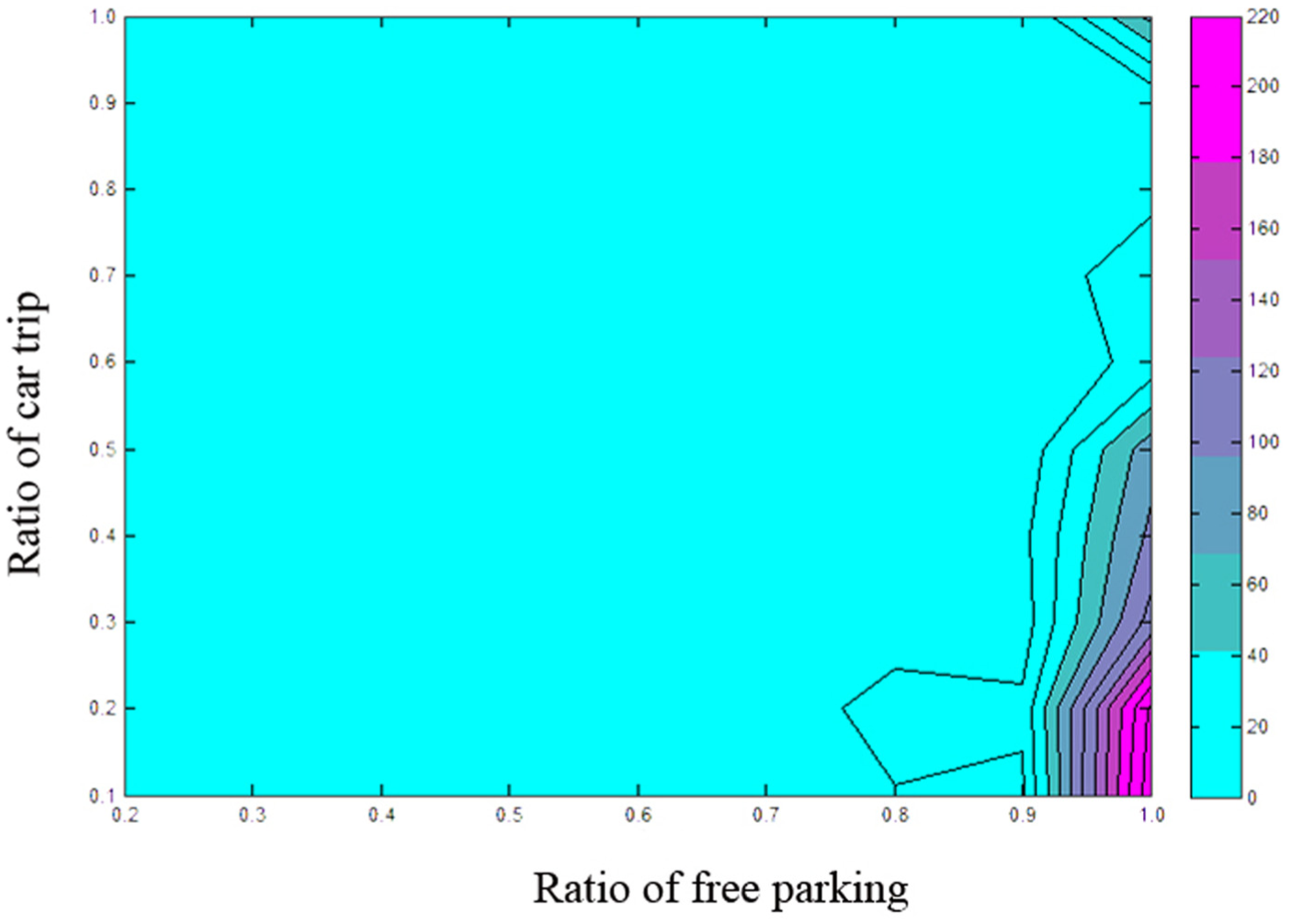
The relationship between car trip rate and the ratio of free parking from empirical results.
Hence, it follows that the decrease in free parking rate results in the decrease in the proportion of private car trip to some extent. However, the influence on families with high-frequency car usage is relatively less than that on families with moderate-frequency or low-frequency car usage, which indicates that families that do not use their private cars at a high frequency may further lower their private car usage when parking fares increase or free parking rate decreases. After a calculation is conducted on the basis of data and model, the correlation of proportion of private car trip and free parking rate is shown in Figure 9


The relationship between car trip rate and the ratio of free parking from network dynamic model.
As shown in formulation (6), the relationship between the proportion of private car trip and free parking rate assumes a damping feature. On condition that free parking rate is less than 0.7, the influence on the proportion of private car trip is declining as the free parking rate decreases; whereas when free parking rate is more than 0.7, the modification of free parking rate leads to significant variation in the proportion of private car trip. This result is causal as it is induced by both the encouragement of free parking and the improvements of services in other trip modes such as public transport. The services provided by other types of trip modes will directly reduce the rigid demand for private cars, which will consequently result in substantial reduction in the proportion of private car trip.
Conclusion
Three main conclusions are achieved from this article. First, vehicle ownership is related to family income, family size, geographic location, and parking fee. Second, trip purpose and parking fee exert significant effects on the car usage. Third, the influenced factors of car trip and parking supply are interconnected and shape the influential network between car trip and parking supply.
The car ownership is positively correlated to family income, and so to family size. In another case where the location is far from city center and the bus service level is low, the car ownership level appears high as well. Although it has not been proved that overnight parking fee is directly related to car ownership, it can be foreseen that increasing the proportion of charging for parking may exert impact on car ownership, due to the fact that the ratio of free parking of low-income groups is high. Along with the changes in external factors, the demand of car ownership will change, as well as the parking facility. As long as parking facilities are constructed, it would be difficult to alter their function, especially the underground parking lots. Therefore, urban planners should be cautious not to blindly construct parking lots without referring to the demand under free parking level.
According to the situation in Beijing, working trips account for the largest proportion of trips by car. Among working trips, the proportion of solo driver reaches as high as 90%, indicating a very low efficiency. The higher proportion of free parking always brings about more car usage. If working trips can be charged, trips by car will be under control. As a result, charging parking in working places should be paid enough attention.
Footnotes
Academic Editor: Yongjun Shen
Declaration of conflicting interests
The author(s) declared no potential conflicts of interest with respect to the research, authorship, and/or publication of this article.
Funding
The author(s) disclosed receipt of the following financial support for the research, authorship, and/or publication of this article: This research was supported in part by the National Nature Science Foundation of China under grant 71301010.