




Abstract
A theoretical model of a micro piezoelectric energy harvester is proposed based on the nonlocal elasticity theory, which is operated in the flexural mode for scavenging ambient vibration energy. A nonlocal scale is defined as the product of internal characteristic length and a constant related to the material. The dependences of performance of the harvester upon the nonlocal scale and the scale ratio of the nonlocal scale to the external characteristic parameter are investigated in detail. Numerical results show that output power of the harvester decreases, and resonance frequency reduces gradually at first then increases rapidly when nonlocal scale increases. The results of nonlocal elasticity theory are compared with that of classic beam theory. All the results are helpful for material and structure design of the micro piezoelectric energy harvester.
Keywords
Introduction
Harvesting energy from mechanical vibrations by piezoelectric structure has received a considerable amount of interest as a means of wireless power supply for the mechanical systems to be self-sensing and self-support. Moreover, small vibration on the order of nanometers poses challenges for the improving precision of ultra-precision machine tools and metrology equipment.1–3 Therefore, harvesting redundant energy from ambient environment not only can scavenge mechanical energy into electricity for wireless devices but also is conducive to the stability of the structure and reduces the small vibration from the machine. The flexibility associated with piezoelectric materials makes it very attractive for power harvesting, such as high energy densities, no electromagnetic inference, and integration potential. 4 Hence, the piezoelectric device is a premium choice for the design of self-powered wireless sensors embedded in mechanical systems, which is called piezoelectric vibration energy harvester. 5
With the further development of microelectronic devices and modern micro-sensing technology toward micro and nano-scale dimensions, the need for efficient piezoelectric energy harvesting micro devices is becoming more and more critical. 6 Size effect of the small length scales such as lattice spacing between individual atoms and grain size is needed to be considered when the structural scale reaches to micron or nano level. In addition, the mechanical properties of materials will result in an exception because of the heterogeneity of the internal microstructure of materials and show the obvious size effect. 7 Thus, size effects in the electromechanical conversion of piezoelectric power harvesters should be taken into account. 8
Since controlled experiments in micro and nano-scale are both difficult and expensive, the development of appropriate mathematical models for nanostructures is an important issue concerning approximate analysis of nanostructures. 9 Although solution through molecular dynamics (MD) simulation is a possibility for such problems, its large computational cost prohibits its use for a general analysis. Moreover, the conventional continuum models cannot handle this issue since without taking scale effects into account. Hence, the best alternatives are those methods which can both provide the simplicity of continuum models and incorporate the scale effect into such chosen continuum models. Strain gradient theory can calculate the scale effect by considering the high-order effects. 8 But the high-order material constants are difficult to measure and cannot be expressed directly in relation to the scale. Eringen’s nonlocal elasticity theory is one of the mathematical models to account for scale effect in the nanostructures by introducing an intrinsic length scale.10–12 The internal length scale is introduced into the constitutive equations as a material parameter by the nonlocal elasticity theory. In recent years, the studies of nanostructures using the nonlocal elasticity theory have been an area of active research, which also includes the piezoelectric structures.
In this article, the theoretical model of the micro piezoelectric energy harvester is first proposed based on the nonlocal elasticity theory. The piezoelectric vibration energy harvesters have the most efficiency of the energy collection when resonance occurs under the ambient vibration. 13 The size effects on performance of the micro piezoelectric energy harvester and the resonance frequency are focused on investigation.
Introduction to theory of nonlocal elasticity
In Eringen’s nonlocal elasticity theory,10–12 the stress at a point


where physical quantity with


where
A model of the micro piezoelectric bimorph harvester
A model of the piezoelectric bimorph (PB) harvester is shown in Figure 1: one end of the micro beam is cantilevered by a vibrator, which vibrates along the vertical direction harmonically with a known amplitude A at a given frequency ω, and the free end is attached by a mass m0. Two piezoelectric layers with same thickness h are poled along the thickness direction. L and b denote length and width of the PB, respectively. The bimorph is connected with a load circuit, whose impedance can be simplified by ZL.
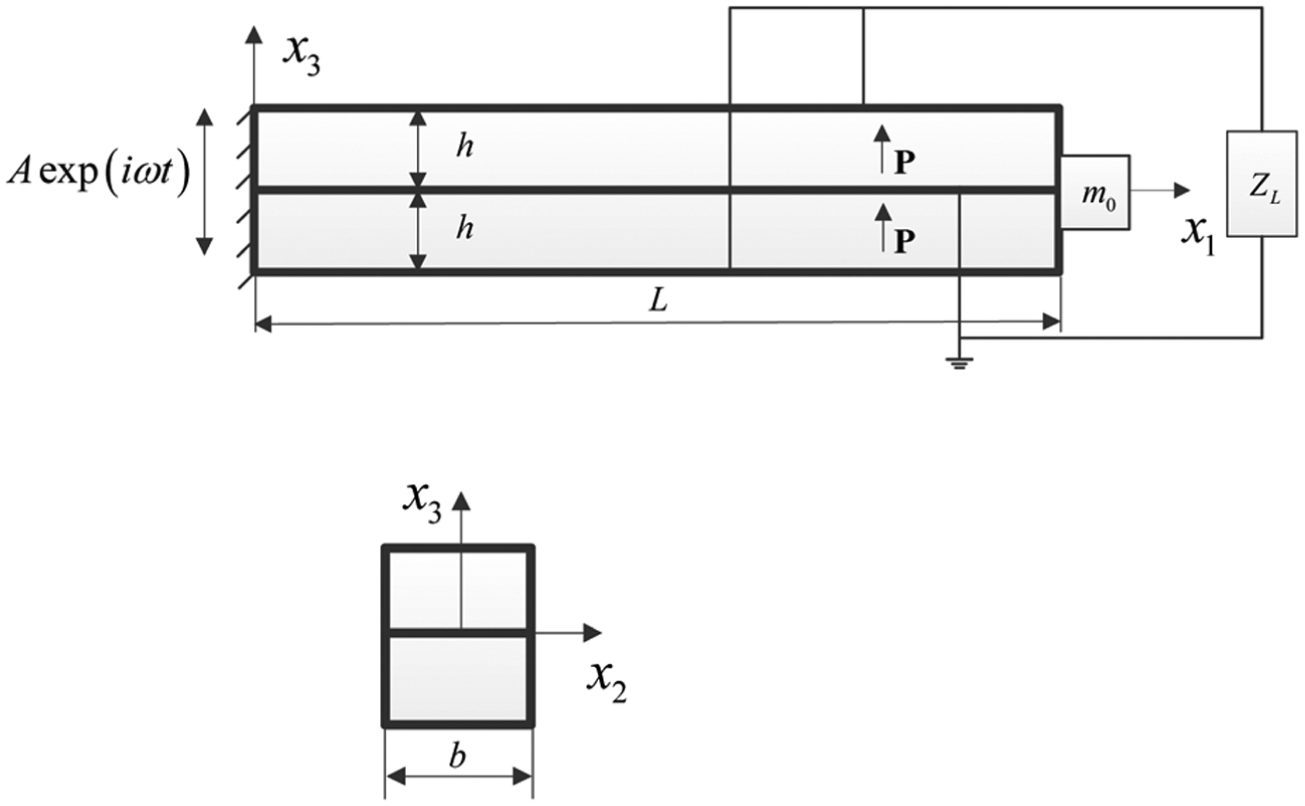
A micro cantilevered piezoelectric bimorph power harvester.
Based on the linear piezoelectric theory, 19 the electric field in the ceramic layers corresponding to the electrode configurations, shown in Figure 1, is of the following components

where φ is the electric potential of each piezoelectric layer, and the convention that a comma followed by an index denotes partial differentiation with respect to the coordinate associated with index is used. We now consider the flexural motion of the bimorph in the x3 direction, assuming that the bimorph is slim, that is, the length L is much larger than the thickness 2h and the width b. According to the Bernoulli–Euler beam assumption, 20 the axial strain S1 of the flexural motion of such a thin bimorph can be expressed as

where u3 is the displacement of the PB in the x3 direction.
Despite the existence of shearing force, the shear strain is ignored in Euler beam. The constitutive relation for the piezoelectric layers can be written as 19

where s11, ε33, and d31 denote the axial elastic compliance measured with fixed electric field, the transverse dielectric constant measured with fixed stress, and the transverse-axial piezoelectric coefficient. From equation (7), we solve for the axial stress T1 and the transverse electric displacement D3 and obtain

where
Following the above assumptions, the piezoelectric constitutive of nonlocal elasticity theory can be expressed as

Performance of the micro PB harvester
In this section, we apply precise electric field method 19 to get the electric field first, then obtain general solution of the displacement by solving the equation of motion, and finally combine the boundary conditions with circuit equation to solve the output power density of the harvester.
Electric field
From the charge equation of electrostatics D3,3 = 0, differential equation of the electric displacement in equation (9) can be written as

The electric field can be obtained by integrating on equation (10) with respect to x3. Then from equation (5), the electrical potential can be written as

where e1 and e2 are integration constant independent of x3. Let

General solution of the displacement
The equation of motion for the slim beam can be expressed in terms of the bending moment as

with M as the bending moment of the cross section, and m = 2hbρ represents the mass per unit length of the PB, where ρ is the density of the piezoelectric layer. By analyzing the cross section of the bimorph, the bending moment and shear force can be calculated as

From equations (9), (12), (13), and (14), we have

where generalized bending stiffness

Substituting equation (15) into equation (13), the equation of motion can be expressed by u3 as follows

For harmonic motions, we use the complex notation

where i is an imaginary unit. The equation of motion (16) can be simplified as

where

where Bj (j = 1, 2, 3, 4) are undetermined constants, and

At the cantilevered end of the beam, the boundary conditions are


At the right end, we have no bending moment but a shear force balancing the inertia force of the attached mass, that is


The undetermined constants Bj (j = 1, 2, 3, 4) can be determined from the boundary conditions of the cantilevered beam, under the premise of finding the expression of voltage V which can be got from electrical condition.
Output power density
At first, we solve the expression of electrical displacement from equation (9) to obtain the expression of voltage V. For the upper piezoelectric layer, the electrical displacement, which is independent of x3, can be obtained from equations (9) and (12) as

where the expression of the general solution of displacement (19) has been used. The general solution of equation (25) consists of the general solution of homogeneous linear equation and special solution. Hence, the general solution of electric displacement can be written as

where

From electric boundary conditions that D3 = 0 for the electric displacement at x1 = 0 and x1 = L, we have


From equation (26), the electric charge on the top electrode at x3 = h is given by

The current flowing out of the electrode is

As indicated in Figure 1, double current flows to the circuit load because two piezoelectric layers are in parallel. Thus, the current and voltage satisfy Ohm’s law

From equations (29) to (31), we have

where

where an asterisk represents complex conjugate and volume of the harvester
Numerical results
To illustrate the size effect on the performance of scavenge energy from ambient vibration of the harvester, the piezoelectric material PMN-33% PT is chosen for numerical calculation. Its density

For the piezoelectric materials, damping is always introduced by replacing the elastic compliance s11 with a complex form
We calculate in Figure 2 the relationship between the output power density and the driving frequency for different nonlocal scale e0a, where L = 10 µm. It can be seen that output power density reaches maximum when resonance occurs. For further illustration, Figure 3 illustrates the maximum of output power density and resonance frequency versus the nonlocal scale e0a. As can be seen, the maximum output power density of the piezoelectric power harvester decreases dramatically when the nonlocal scale e0a increases, but its corresponding resonance frequency reduces gradually at first and then increases rapidly. The computational results of output power density and resonance frequency of nonlocal elasticity theory both have the same order as those of strain gradient theory. 8

Power density versus the driving frequency for different nonlocal scale e0a where L = 10 µm.
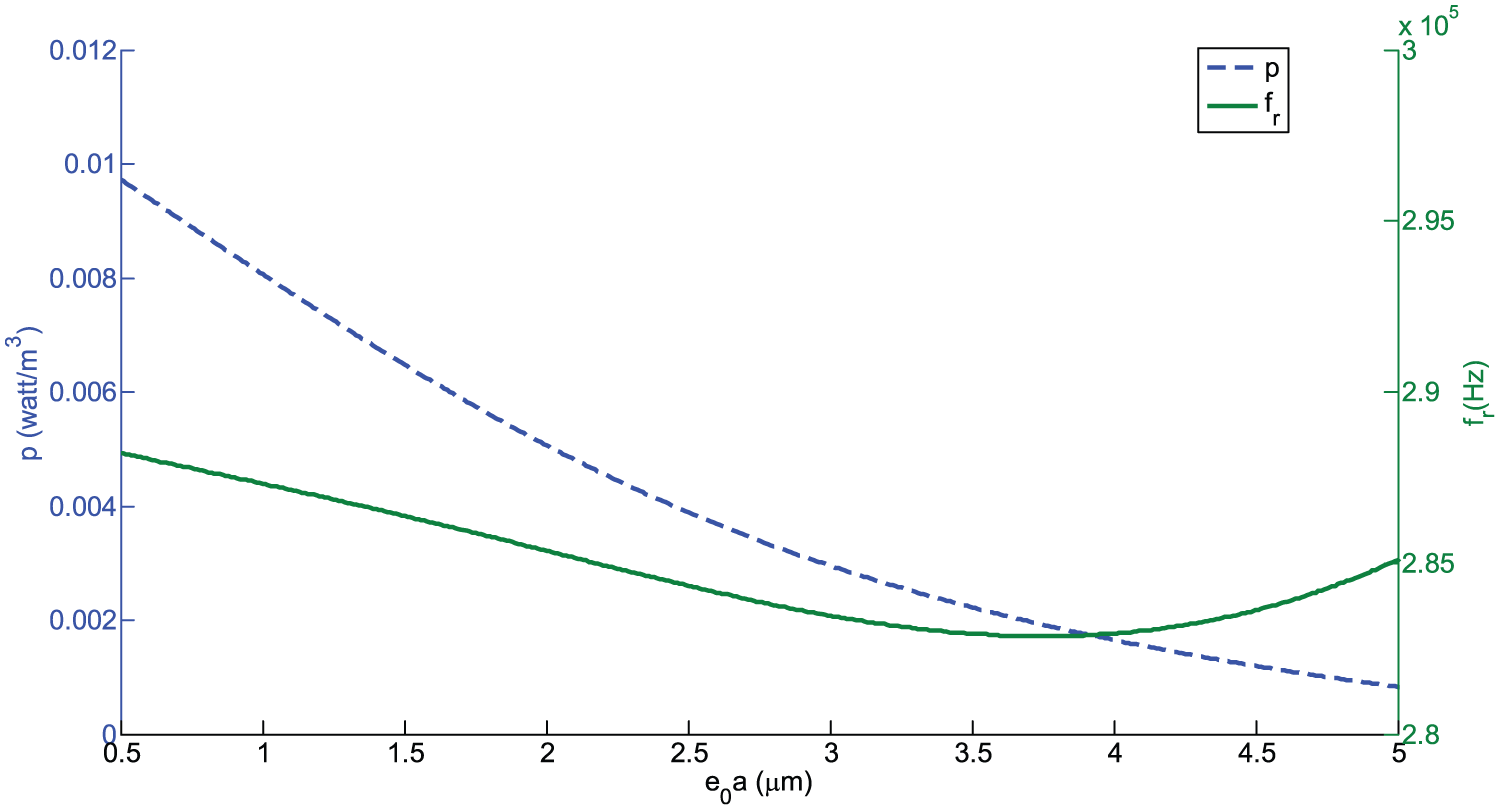
The maximum power density and its corresponding resonance frequency fr versus nonlocal scale e0a where L = 10 µm.
We plot the output power density versus length of the PB for different nonlocal scale ratio e0a/L = 0.05, 0.25, and 0.45 in Figure 4(a), respectively, and for different nonlocal scale e0a = 1.5, 3.0, and 4.5 µm in Figure 5(a), respectively. It can be seen that output power densities calculated by classical beam theory and nonlocal electricity theory both increases with increasing length. Moreover, the curves of nonlocal electricity theory diverge farther away from that of classical beam theory with increasing e0a or e0a/L. It means that the smaller the structure size or the larger the nonlocal scale e0a, the more obvious the size effect. Furthermore, comparing Figures 4(b) and 5(b), we can note that the curves of output power density ratio pN/pC of nonlocal elasticity theory to classic beam theory versus the length are almost horizontal lines when e0a/L are fixed; but when e0a are fixed, the curves become steeper. It is because that e0a/L decreases with increasing length when e0a is fixed, the output power density of nonlocal elasticity theory is close to that of classic beam theory more rapidly. It can be inferred from Figure 5(b) that these curves of pN/pC will be close to one when e0a/L is close to zero.

(a) Power density and (b) the ratio pN/pC of nonlocal power density to classical power density versus length for different scale ratio e0a/L.

(a) Power density and (b) the ratio
Resonance frequency is another important factor of the vibration energy harvester since at the frequency the harvester can scavenge the most energy from environment. Figures 6(a) and 7(a) demonstrate that resonance frequency decreases with increasing length when e0a/L or e0a is fixed. Figures 6(b) and 7(b) illustrate that the resonance frequency ratio frN/frC of nonlocal elasticity theory to classic beam theory versus the length of the PB when e0a/L or e0a is fixed, respectively. We can note from Figure 6(b) that classic beam theory overestimates the resonance frequency of the PB when e0a/L is equal to 0.05 or 0.25. However, if e0a/L is fixed 0.45, classic beam theory overestimates the resonance frequency when the length L is less than 20 µm and then underestimates the resonance frequency when the length is larger than 20 µm. Furthermore, Figure 7(b) shows that the ratio frN/frC is close to 1 with increasing length when e0a is fixed. However, the classic beam theory may underestimate the resonance frequency when nonlocal scale e0a and the length are with the same order, such as e0a = 4.5 µm and L < 6 µm. These conclusions are consistent with that of Figure 3.
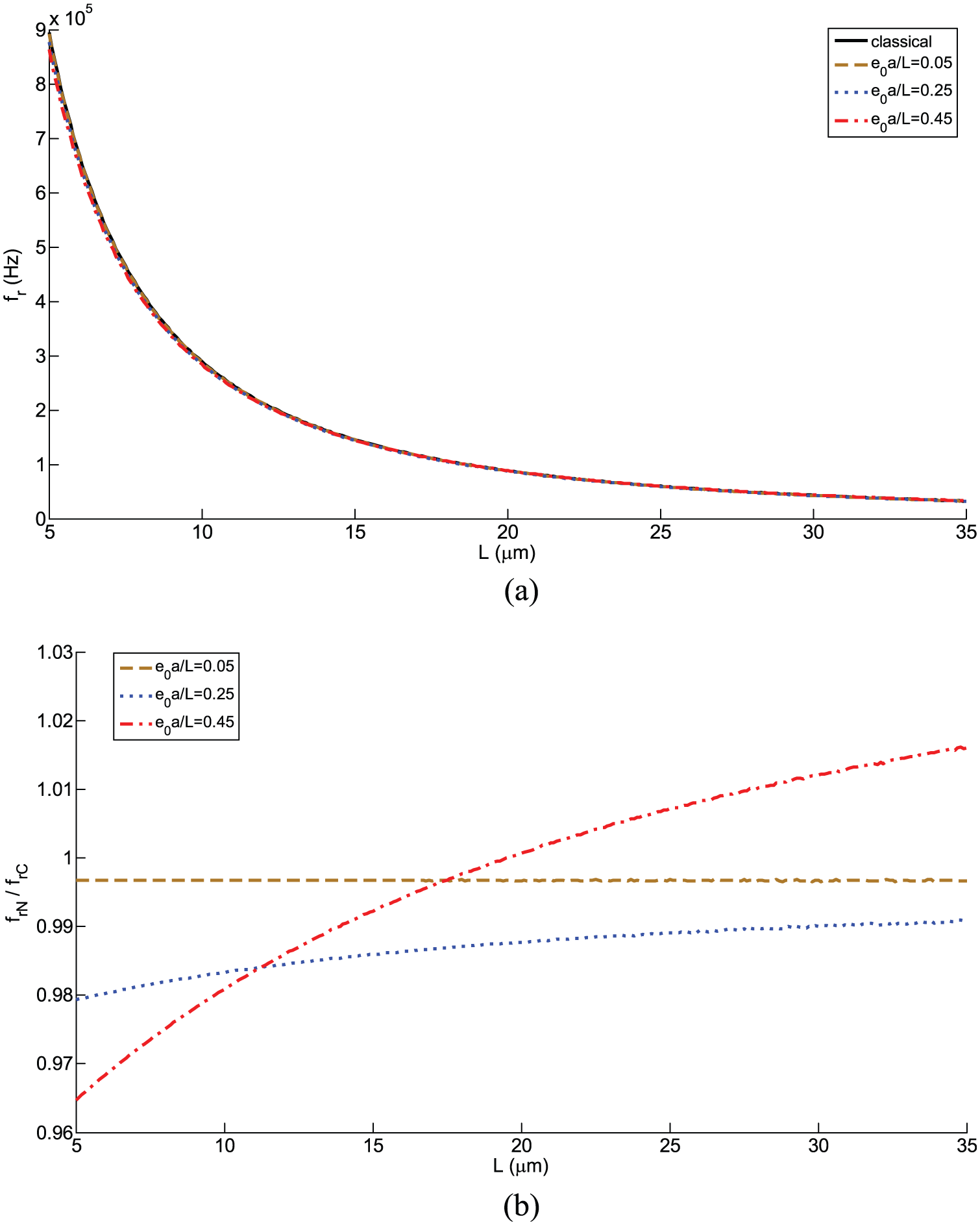
(a) Resonance frequency and (b) the ratio frN/frC of nonlocal resonance frequency to classical resonance frequency versus length for different scale ratio e0a/L.

(a) Resonance frequency and (b) the ratio frN/frC of nonlocal resonance frequency to classical resonance frequency versus length for different nonlocal scale e0a.
Conclusion
The performance of a vibration energy harvester with PB operated in the flexural mode is analyzed based on the nonlocal elasticity theory. The dependence of the performance of the harvester upon the nonlocal scale and scale ratio is investigated. When nonlocal scale increases, output power of the harvester decreases and resonance frequency reduces gradually at first and then increases rapidly. Classic beam theory overestimates the output power without considering size effect. When the scale ratio is fixed, the output power ratio of nonlocal elasticity theory to classic beam theory is independent of the length. Furthermore, the output power ratio of nonlocal elasticity theory to classic beam theory increases to 1 when the scale ratio decreases to 0. Classic beam theory may overestimate or underestimate the resonance frequency when the scale ratio is close to 1.
Footnotes
Academic Editor: Mark J Jackson
Declaration of conflicting interests
The author(s) declared no potential conflicts of interest with respect to the research, authorship, and/or publication of this article.
Funding
The author(s) disclosed receipt of the following financial support for the research, authorship, and/or publication of this article: This work was supported by the National Natural Science Foundation of China (11272126, 51435006, and 51421062), Specialized Research Fund for the Doctoral Program of Higher Education of China (20110142120050), and Fundamental Research Funds for the Central Universities of the Ministry of Education of China (2015TS121).